1612: Robert Crichton, Lord Sanquhar and mediocre swordsman

On this date in 1612, the Scottish noble Robert Crichton, Lord Crichton of Sanquhar, swung for revenge served very cold.

Sanquhar (alternatively, Sanquire) was a Scottish noble imported to the English court in the train of King James. Keeping up his swordsmanship in a practice bout with the fencing-master John Turner, Sanquhar had his eye put out by his opponent’s foil.

While this injury was the source of the tragedy that ensued for both men, it is said — perhaps it’s just literary license — that it was the illustrious French king Henri IV who turned the situation deadly with a passing remark when Sanquhar subsequently visited Henri’s duel-mad realm to the effect that it was a wonder that the author of such a horrible wound still lived. Already down one organ for his trouble, Sanquhar was stung to discover emasculation stacked on his woes; even though it was several years after* the duel, Sanquhar began plotting to vindicate eye and honor alike.

If this is so, it is not altogether clear to us that hiring a dependent to shoot the offending duellist unawares in a tavern quite comports with an offended dignity, but that’s chivalry for you. (Actually, the fact that Turner was not himself a gentleman made it socially problematic for Sanquhar to engage him in a proper affair of honor, per the queer codex of early modern masculinity.)

His Lordship had leaned on at least three underlings while engineering his belated revenge, and one of these wisely turned crown’s evidence against the rest of the quartet and hung the lot of his confederates. The headline case was of course the prosecution of the Baron Sanquhar handled personally by the king’s Solicitor-General, one Francis Bacon.

At trial on June 27 — 47 days after the murder; two days before the execution — Sanquhar mounted a better defense for his honor than for his neck.

After this loss of my eye and with the great hazard of the loss of life, I must confess that I ever kept a grudge of my soul against Turner, but had no purpose to take so high a revenge; yet in the course of my revenge I considered not my wrongs upon terms of Christianity — for then I should have sought for other satisfaction — but, being trained up in the courts of princes and in arms, I stood upon the terms of honour, and thence befell this act of dishonour, whereby I have offended — first, God; second, my prince; third, my native country; fourth, this country; fifth, the party murdered; sixth, his wife; seventh, posterity; eighth, Carlisle, now to be executed;** and lastly, ninth, my own soul, and I am now to die for my offence.

But, my lords, besides my own offence, which in its nature needs no aggravation, divers scandalous reports are given out which blemish my reputation, which is more dear to me than my life: first, that I made show of reconciliation with Turner, the which, I protest, is utterly untrue, for what I have formerly said I do again assure your good lordships, that ever after my hurt received I kept a grudge in my soul against him, and never made the least pretence of reconciliation with him. Yet this, my lords, I will say, that if he would have confessed and sworn he did it not of purpose, and withal would have foresworn arms, I would have pardoned him; for, my lords, I considered that it must be done either of set purpose or ignorantly. If the first, I had no occasion to pardon him; if the last, that is no excuse in a master, and therefore for revenge of such a wrong I thought him unworthy to bear arms.

Shorter Lord Sanquhar: I confess.

Needing not so much to contest the case at the bar as to narrate its intended moral, Bacon speculated that Sanquhar must have come by his egregious “affections of dwelling in malice, rather out of Italy … than out of any part of this island, England, or Scotland.” While this murder was not a duel, it sprang from a palpably similar place — and duels, just then taking on their recognizable ritual form, were furiously opposed by the state. Sanquhar had resided in Italy, but more than that, the term was code for the fencing experts who brought from the continent codes duello and mannerly rapiers and the prospect of destructive private vendettas. This was more than premeditated homicide; it was an arrogation of the king’s own prerogatives of justice and order.

“What the law abhorred was not cold-blooded premeditated duelling as such, but the attitudes manifested by that practice,” writes Jeremy Horder.† “The calculating duellist is an ‘isolent’ person acting with ‘arrogancy and rebellion’ in casting off the yoke of obedience, as if he had the power to set his own laws above those of the common law.”

Angling for a promotion to Attorney General (he would get it in 1613), Bacon also made a point to lavish praise on his Scotch-born sovereign for another lesson the trial was meant to underscore to his English subjects: “his majesty hath shewed himself God’s true lieutenant, and that he is no respecter of persons; but the English, Scottish, nobleman, fencer, are to him alike in respect of justice.”

Nobleman and subalterns alike died on different gallows this date: Lord Crichton of Sanquhar hanged before Westminster Hall, while his two assassin-henchmen dangled on gallows at Fleet Street.

* Sources propose various dates from 1604 to 1607 for the eye-foiling; Bacon in arraigning Sanquhar remarks that “it is now five years” since that happened.

** The man who actually shot John Turner.

† “The Duel and the English Law of Homicide,” Oxford Journal of Legal Studies, Autumn 1992.

On this day..

1628: John Lambe murdered

Here Dr Lambe, the conjurer lyes,
Against his will untimely dies
The Divell did show himselfe a Glutton
In taking this Lambe before he was mutton
The Divell in Hell will rost him there
Whome the Prentises basted here.
In Hell they wondred when he came
To see among the Goats a Lambe.

Libel (one of many) on John Lambe’s murder

Friday the 13th of June in 1628 bore foul luck for John Lambe, an aged astrologer, magician, and folk healer so hated of Londoners that a mob fell on him as he returned from theater this evening and butchered him in the street.

While we hope to justify Lambe’s presence in these pages under our going interest in lynchings, his curious homicide transgresses the boundaries of Executed Today as surely as did Lambe transgress those of Stuart London.

North of 80 at the time of his death — although still vigorous enough at that age to defend himself with a sword — Lambe came to misfortunate public notoriety in the 1620s. These were crisis years when the crown sowed the dragon’s teeth that would in later years devour Charles I. Lambe’s slaughter was a little taste of worse to come.

Sources from the period view Lambe as both a shameless fraud and a vile wizard, with no consistency between the propositions save for their vitriol. Lambe seems like he got the worst of both perceptions at once: he faced a 1619 complaint to the Royal College of Physicians that he was a “mountebank and impostor.” [sic] Three years after that, he was in the dock for witchcraft

What Lambe did do was beat two charges in as many years that could easily have hanged him: the aforementioned witchcraft case in 1622, and a rape charge in 1624. Evidence in either case was underwhelming, but the charges themselves were incendiary; Lambe’s knack for slithering out of the hangman’s grasp must have suggested for the man on the street a channel to sinister higher powers.

Commoners bestirred themselves about this time against the realm’s own higher powers — the politically ham-fisted new king Charles and his grapples with Parliament to secure sufficient tax revenue for his inept war with France and Spain.

In all this mess, the Duke of Buckingham — royal favorite and possible lover of Charles’s father — was the number two man in the kingdom, and the number one object of hate.

In the mid-1620s, Lambe became conjoined in the public eye with Buckingham — as Buckingham’s demon-summoning henchman, say. Was it the Duke’s pull that spared his familiar the noose? Was it Lambe’s necromancy that captured the king in the thrall of his detested aide?

Did it even matter?

From the distance of centuries the particulars of the supposed affiliation between the two seems difficult to establish,* but it sufficed for Lambe’s death (and Buckingham’s too) that they were analogues for one another, that their respective villainies could be multiplied one atop the other.

Despite all that tinder lying around, we don’t know the exact spark for Lambe’s murder on June 13, 1628. A few months before, Buckingham had fled a humiliating military defeat in France; Parliament and King were at loggerheads that June, forcing the reluctant Charles to accede to a Petition of Right on June 7 that remains to this day a bedrock document of Britons’ liberties.

On the 13th, Lambe was recognized by “the boyes of the towne, and other unruly people” attending a play at the Fortune Playhouse.

As he left it, some began to follow him. Maybe it was just one insult too tartly answered that multiplied these hooligans, or maybe there was a ready rabble that immediately took to his heels. The frightened Lambe picked his way to the city walls menaced all the way by his lynch mob, hired a few soldiers as an ad hoc bodyguard, and by the dark of night tried desperately to find some sort of shelter from the crowd growing in both number and hostility. Under the mob’s threat, a tavern put him out, and a barrister likewise; his guards fled their posts; and someone at last laid his hands on John Lambe. By the time the frenzy had passed, Lambe’s “skull was broken, one of his eyes hung out of his head, and all parties of his body bruised and wounded so much, that no part was left to receive a wound.” Many contemporaries must have understood it as the just punishment that courts could not manage to exact.


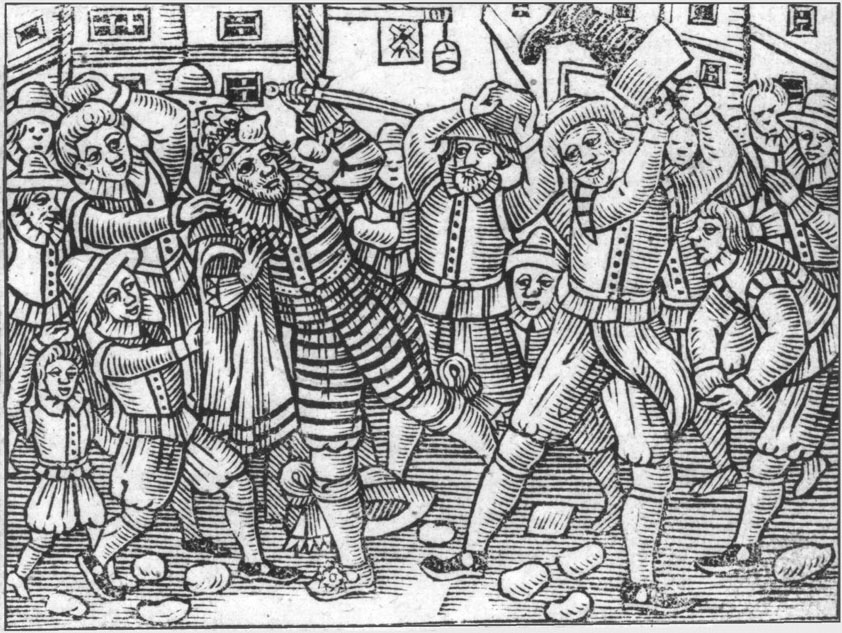
Woodcut of the assault on Lambe outside the Windmill Tavern, from the title page of A Briefe Description of the Notorious Life of Iohn Lambe (1628)

The libels now rejoiced openly in Lambe’s summary justice — nobody was ever prosecuted for his murder — and anticipated another one to follow it.

“Who rules the Kingdome? The King. Who rules the King? The Duke. Who rules the Duke? The Devill,” one menacing placard announced. “And that the libellers there professe, Lett the Duke look to it; for they intend shortly to use him worse then they did his Doctor, and if thinges be not shortly reformed, they will work a reformation themselves.”

Their thirst for “reformation” was not long delayed.

Ten weeks after Lambe’s murder, a disaffected army officer named John Felton at last enacted the swelling popular sentiment and assassinated Buckingham.

“The Shepheards struck, The sheepe are fledd,” one unsympathetic doggerel taunted, recalling the dead wizard whose supernatural exertions could no longer protect his wicked patron. “For want of Lambe the Wolfe is dead.”

The History of Witchcraft podcast has an excellent episode on Dr. Lambe here.

* So says Alastair Bellany, whose “The Murder of John Lambe: Crowd Violence, Court Scandal and Popular Politics in Early Seventeenth-Century England” in Past and Present, vol. 200, no. 1 is a principal source for this post. (It’s here, but behind academic paywalls.)

On this day..

1690: Old Mobb, witty highwayman

On this date in 1690, according to the Newgate Calendar,* the venerable gentleman rogue Thomas Sympson — better known as Old Mobb — was hanged for robbery.

Old Mobb — at least, the stylish and erudite version of the man given us in the Calendar — preyed the roads of late 17th century England for many a year, perhaps all the way back to the ill-fated reign of Charles I.

His rollicking adventures could have formed the fair corpus of a durable legend; in some alternate world Ainsworth chose Old Mobb as for Rookwood and it is he and not Dick Turpin who has the television serial and the pub nameplates.

A nobleman Sir Bartholomew Shower, whose name might also be the safeword at a leather masquerade, was apprehended by Old Mobb one day nearly penniless as to his person; taking exception at being shorted by such a wealthy grandee, Mobb forced him to write up a bill for 150 quid to draw on the goldsmith of nearby Exeter, leaving Shower trussed up under an obliging hedge “as security for the payment” while he went into town to cash the cheque.

The annals have next a widow, bound for Bath no less in tribute to the classics, and had a jolly battle of the sexes with her over her condition which of course Old Mobb won, since he had the gun. His target, you see,

wept very plentifully, in order to move him to pity; she told him she was a poor widow, who had lately lost her husband, and therefore she hoped he would have some compassion on her. “And is your losing your husband then,” says he, “an argument that I must lose my booty? I know your sex too well, madam, to suffer myself to be prevailed on by a woman’s tears. Those crocodile drops are always at your command; and no doubt but that dear cuckold of yours, whom you have lately buried, has frequently been persuaded out of his reason by their interposition in your domestic debates. Weeping is so customary to you, that everybody would be disappointed if a woman was to bury her husband and not weep for him; but you would be more disappointed if nobody was to take notice of your crying; for according to the old proverb, the end of a husband is a widow’s tears; and the end of those tears is another husband.”

The poor gentlewoman upon this ran out into an extravagant detail of her deceased husband’s virtues, solemnly protesting that she would never be married again to the best man that wore a head, for she should not expect a blessing to attend her afterwards; with a thousand other things of the same kind. Old Mobb at last interrupted her, and told her he would repeat a pleasant story in verse which he had learned by heart, so, first looking round him to see that the coast was clear on every side, he began as follows: —-

A widow prude had often swore
No bracelet should approach her more;
Had often proved that second marriage
Was ten times worse than maid’s miscarriage,
And always told them of their sin,
When widows would be wives agen:
Women who’d thus themselves abuse,
Should die, she thought, like honest Jews
Let her alone to throw the stones;
If ’twere but law, she’d make no bones.

Thus long she led a life demure;
But not with character secure:
For people said (what won’t folks say?)
That she with Edward went astray:
(This Edward was her servant-man)
The rumour through the parish ran,
She heard, she wept, she called up Ned,
Wiped her eyes dry, sighed, sobbed, and said:

‘Alas! what sland’rous times are these!
What shall we come to by degrees!
This wicked world! I quite abhor it!
The Lord give me a better for it!
On me this scandal do they fix?
On me? who, God knows, hate such tricks!
Have mercy, Heaven, upon mankind,
And grant us all a better mind!
My husband — Ah that dearest man!
Forget his love I never can;
He took such care of my good name,
And put all sland’rous tongues to shame. —
But, ah! he’s dead –‘ Here grief amain,
Came bubbling up, and stopped the strain.

Ned was no fool; he saw his cue,
And how to use good fortune knew:
Old Opportunity at hand,
He seized the lock, and bid him stand;
Urged of what use a husband was
To vindicate a woman’s cause,
Exclaimed against the sland’rous age;
And swore he could his soul engage
That madam was so free from fault
She ne’er so much as sinned in thought;
Vowing he’d lose each drop of blood
To make that just assertion good.

This logic, which well pleased the dame,
At the same time eludes her shame:
A husband, for a husband’s sake,
Was what she’d ne’er consent to take.
Yet, as the age was so censorious,
And Ned’s proposals were so glorious,
She thought ’twas best to take upon her,
A second guardian of her honour.

“This,” says Old Mobb, “is an exact picture of woman-kind, and as such I committed it to memory; you are very much obliged to me for the recital, which has taken me up more time than I usually spend in taking a purse; let us now pass from the dead to the living, for it is these that I live by. I am in a pretty good humour, and so will not deal rudely by you. Be so kind, therefore, as to search yourself, and use me as honestly as you are able; you know I can examine afterwards, if I am not satisfied with what you give me.” The gentlewoman found he was resolute, and so thought it the best way to keep him in temper, which she did by pulling out forty guineas in a silk purse, and presented them to him. It is fifty to one but Old Mobb got more by repeating the verses above than the poor poet that wrote them ever made of his copy. Such is the fate of the sons of Apollo. [dear reader, why not take this opportunity to click on an ad? -ed.]

We certainly have in these puffed-up knaves torn down for our amusement a little window into the romance of the road where by means of Stand And Deliver one attains the liberty to put put hypocrites in their place whilst usurping the abundance that is the latter’s usual wages.

Old Mobb robs a famous astrologer whose constellations fail to predict the engagement; to a doctor who upbraids him, he retorts, “I only take [my victims’] money away from them; but you frequently take away their lives: and what makes it the worse you do it safely, under a pretence of restoring them to health.”

As pieces de resistance, Old Mobb gets the better of two of Restoration England’s most infamous grandees.

The Duchess of Portsmouth, the widely hated French Catholic mistress to Charles II,** Old Mobb improbably manages to trap in her stagecoach giving him leave to excoriate her in words similar to those that real 17th century Britons must have muttered many times while in their cups. “I know you to be the greatest whore in the kingdom; and that you are maintained at the public charge. I know that all the courtiers depend on your smiles, and that even the K— himself is your slave,” Mobb says, rubbishing her sex and her nationality all at once. “That haughty French spirit will do you no good here. I am an English freebooter; and insist upon it as my native privilege to seize all foreign commodities. Your money indeed is English, and the prodigious sums that have been lavished on you will be a lasting proof of English folly; nevertheless, all you have is confiscated to me by being bestowed on such a worthless b—h. I am king here, madam, and I have a whore to keep on the public contributions as well as King Charles.”

The ruthless hanging judge Lord Jeffreys Old Mobb likewise pays in his own coin when Jeffreys threatens our marauder with potential damnation, speaking as it were through Jeffreys to the obsequious blackguards who afflict the public life of every time and place.

When justice has overtaken us both, I shall stand at least as good a chance as your Lordship; who have already written your name in indelible characters of blood, by putting to death so many hundred innocent men, for only standing up in defence of our common liberties, that you might secure the favour of your Prince. It is enough for you to preach morality upon the Bench, where nobody dares to contradict you; but your lessons can have no effect upon me at this time; for I know you too well not to see that they are only calculated to preserve money.

* The Newgate Calendar positively avers a hanging of Friday, May 30, 1690, but there are some complicating data points. There’s his purported campaign with William “the Golden Farmer” Davis, who was supposed to have left a parting note for Old Mobb upon Davis’s December 1690 execution. (However, 1690 was the year when May 30 was on a Friday, not 1691.)

The invaluable Old Bailey Online has none of this, though the date range is a period of spotty recordkeeping. It does give us a nondescript and lamely apologetic “Old Mobb” hanged on the 18th of September 1691; although this guy had done some highway robbery, he doesn’t otherwise bear an obvious resemblance to the Newgate Calendar’s colorful character. He might be the same guy, or they might just share a cant alias. “Mob” — short for mobilevulgus, the “fickle crowd” — was just establishing itself in English at this point with a usage a bit more flexible than it has for us today; our criminals’ point of contact might be simply that each lasted unusually long in the profession, and therefore each received a nickname meaning something like “Old Man”. Jonathan Swift complained bitterly of this truncated neologism in 1710, writing that “I have done my utmost for some years past to stop the progress of Mobb and Banter, but have been plainly borne down by numbers, and betrayed by those who promised to assist me.” (Sorry, buddy … English is a living language.)

At any rate, I don’t know whether Old Mobb is one guy or two, nor am I fully confident of the best date of execution. These are the least of our difficulties when it comes to veracity, considering that the man’s attributed exploits likely comprise 100% shameless fabrication. It’s just that kind of post.

** Careful how you speak of her: she’s an ancestor (via the late Princess Diana) of the current royal princes.

On this day..

1789: Not Mary Wade, 11-year-old thief

Thanks to Aaron Molyneux for the guestpost. It’s just an excerpt of a much more detailed treatment Molyneux first made of this case on PrisonVoices.org. I’ve made a handful of minor edits to compress this excerpt, and added or moved some links. -ed.

On Wednesday the 14th of January 1789 Mary Wade stood in court at the age of just 11 years old and received the verdict that her life was to be cut short. For the robbery of one cotton frock, a linen tippet and a linen cap she was found guilty and sentenced to hang. Judged to have committed an adult’s crime, she would face an adult’s punishment.

Although in modern Britain theft may seem a quite unremarkable crime, in Mary Wade’s age robbery was dealt with by extreme punishment. The court suggested that Mary’s theft was equal to “holding a pistol to the breast of a grown person”. Whether or not Mary Wade was aware of the hard-lined punishments given to those who stole remains unknown but having committed a very similar crime at the age of eight, only to get away with it because of her young age, she did know it was a crime and therefore it would seem that there was an air of desperation about Mary’s actions.

Sentenced to die by hanging Mary was taken away from her mother and marched out of the Old Bailey. For a girl of Mary’s age this situation must’ve been a frightening ordeal. Being sent to Newgate prison was not for the faint hearted. It was a vile place deemed so unhealthy that Physicians often refused to go in. By the time Mary entered, Newgate was London’s main jail and Mary joined many others waiting to be hanged before huge crowds outside the prison doors. Arriving in irons Mary would have been faced with open sewage, disease and lack of water. It would be a shock to the system for anybody never mind an eleven year old girl. If those entering had enough money they would enter the Master’s side or the press yard where they would have beds, heat and have their irons removed. But those who could not afford would be thrown into the Common Felons side. These would go without bedding or proper clothing and be forced to slum in the overcrowded, rat-infested cells. Mary almost certainly would have been with the fellow women convicts in the Common Felons side.

More than likely alone, vulnerable and scared Mary would spent a total of ninety three days waiting to be marched out in front of the baying crowds which gathered outside the prison walls to watch convicts hang for their crimes. Ninety three days in which she would wait for her death.

Then, on the 16th of March 1789, in celebration of King George III‘s recovery from madness, Mary Wade’s death sentence was respited along with all other condemned women. Instead of hanging, she would be transported to New South Wales on the convict ship Lady Juliana.

Read on at Prison Voices for more on Mary Wade’s offense, and for her story as a transported convict — where she became the ancestor of a huge number of latter-day Australians.

On this day..

1690: Jack Bird, pugilist

On this date in 1690, the somewhat comic thieving career of Jack Bird came to an end at Tyburn.

Bird ran away from an apprenticeship to serve as a foot-guard under the Duke of Monmouth in the Low Countries, and “here,” says the Newgate Calendar, “he was reduced to such necessities as are common to men who engage themselves to kill one another for a groat or fivepence a day.”

Jack fled his enlistment and commenced a life of larceny.

His first experience wasn’t so good.

After stealing a bit of silk from an Amsterdam merchant, he was put to twelve months’ hard labor, and upon fainting away at the initial brutal work was punished by being chained to the floor of a flooding cistern for an hour where he was “obliged to pump for his life … [for] if the water had prevailed he must inevitably have been drowned, without relief or pity.”

Released back to Old Blighty, Bird’s want of fortune or employment prospects — and possibly England’s want of the flooding cistern punishment — led him to the road, where he robbed with mixed results.

On the one hand, the Newgate Calendar credits him with one of the more humiliating failures in the annals of crime, when he held up a former seaman who had lost both his hands. As Bird was obliged to frisk his fingerless mark to obtain his valuables, he brought himself close enough that the victim, a “boisterous old tar,” “suddenly clapped his arms about his neck, and spurring his own horse pulled our adventurer from his; then falling directly upon him, and being a very strong man, he kept him under, and mauled him with his stirrups.” Bird ended up in Maidstone jail, where he was lucky to have a hanging sentence commuted.

On the other hand, he’s credited with a folklorish encounter with “the mad Earl of P–“.* Ordered to deliver his purse, the Earl counteroffered: “I will box you fairly for all the money I have, against nothing.” Jack thought this a merry lark and accepted straight away. The Earl’s chaplain insisted on doing the honors in his master’s stead and Bird — clearly toughened up from his younger self — duly pummeled the divine. Honor-bound to a fault, the Earl paid up.

Our pugilist’s downfall was the gentler sex. Somewhat gentler, anyway. One night when out with a bawd, Jack and his date chanced across a passerby between Dutchy Lane and the Great Savoy Gate in the Strand whom they fell upon and robbed. The opportunistic footpads fled into the dark, but the woman was caught. Jack went to visit her at Newgate and maybe buy off her victim/prosecutor, but instead found himself arrested on suspicion of being her absconded male accomplice.

In a last act of gallantry, the 42-year-old outlaw made a guilty plea and successfully took all the blame on himself.

* From a sift through Wikipedia’s list of English Earldoms, I think this must refer to the notoriously violent Earl of Pembroke, who himself only avoided being hanged for murder by dint of availing the privilege of the Peerage. Whether the alleged boxing round has any basis in fact …

On this day..

1462: John de Vere, Earl of Oxford

On this date in 1462, the 12th Earl of Oxford, John de Vere, was beheaded in the Tower of London during the Wars of the Roses.

The heir to one of the realm’s most ancient noble titles — one of the early Earls of Oxford was on hand for the Magna Carta — John de Vere was a Lancastrian during those treacherous years. He’d even been knighted as a young man with the (then-four-year-old, but already king) Henry Vi.

Despite due loyalty to his sovereign, however, he largely stayed out of the running contest for the throne. This neat trick served him well when the Lancastrian cause went pear-shaped.

Given his apolitical record, it’s a surprise to find Lord Oxford and his son Aubrey suddenly arrested in early February 1463, for treasonable correspondence with the deposed Lancastrian queen Margaret of Anjou. The precise nature of the “conspiracy” remains fuzzy,* as does the theretofore cautious Lord Oxford’s reason for involving himself in such a dangerous enterprise. (Aubrey might have been the moving spirit.) The verdict, however, was very sharp, for father and son alike, leaving the earldom to pass to Aubrey’s younger brother John de Vere.**

This man’s family is, of course, well known in literary fields. The 17th Earl of Oxford, Edward de Vere, was an Elizabethan writer who’s been frequently hypothesized as the actual creator of the Shakespeare canon — the so-called Oxfordian theory of authorship. If so, perhaps he took a little special relish in writing into 3 Henry VI (Act 3, Scene 3) his predecessor’s brief against the Yorkists.

WARWICK
Can Oxford, that did ever fence the right,
Now buckler falsehood with a pedigree?
For shame! leave Henry, and call Edward king.

OXFORD
Call him my king by whose injurious doom
My elder brother, the Lord Aubrey Vere,
Was done to death? and more than so, my father,
Even in the downfall of his mellow’d years,
When nature brought him to the door of death?
No, Warwick, no; while life upholds this arm,
This arm upholds the house of Lancaster.

* This biography of the 13th earl rummages the sparse available evidence, but concludes that apart from a few basic facts the available accounts “agree on little else, and it is not easy to establish a coherent account of the episode, what form the conspiracy took, how it was betrayed, and above all, by what was it motivated.” Just those minor details.

** Several other conspirators besides the de Veres were also put to death in the affair. Minor consolation: the sentencing judge, John Tiptoft, was in 1470 executed himself.

On this day..

1855: Emmanuel Barthelemy, duelist

The winner of England’s last fatal duel was hanged at Newgate on this date in 1855 … but not for the duel.

Both participants in that duel, Emmanuel Bart(h)elemy and Frederic Cournet, were French emigres* who had commanded Parisian barricades during the 1848 revolution.

On its surface the duel was one of those trivial affairs of honor: Barthelemy heard that Cournet (otherwise unknown to him) had repeated some defamatory rumors about Barthelemy already abroad in France, and challenged Cournet on that basis; Cournet at first dissociated himself from any such smears, but upon better consideration thought he considered Barthelemy’s notice a little on the ultimatum side and took exception to that.

The consequent set-to was delayed some time by negotiations over every element of its ceremony. When at last it was arranged, it unfolded thus:**

it should commence with pistols, the combatants, being 40 paces apart, advancing 10 paces before firing if they chose, and having two shots each, miss-fires not counting; that the choice of position, the choice of pistols, and the signal for firing should be determined by tossing up; that if the pistols proved ineffectual swords should be resorted to to terminate the affair.

Cournet won the toss and got to choose his position and take the first shot. Barthelemy had to stand stock-still as Cournet

advanced his 10 paces and fired, but though on 14 similar occasions he had never failed to hit his opponent this time he missed. Barthelemy then told him that he had his life in his hands, but would surrender his right to fire if Cournet would agree to terminate the duel with swords. [Barthelemy had wanted swords to be the dueling weapon in the first place -ed.] Cournet declined to do so, saying that he would stand his adversary’s fire and take his second shot. Barthelemy then levelled his pistol, but … it snapped. He put a fresh cap on and it snapped a second time,† and it was then agreed that he should use Cournet’s pistol, which was loaded and handed to him. Before discharging it, however, he again offered ineffectually to terminate the contest with swords. He then fired, and with fatal precision.

Barthelemy himself and all four of the seconds involved (both Barthelemy’s and Cournet’s) were arraigned in this case, but the jury returned only a manslaughter verdict. Barthelemy served a few months; he would have to exercise fatal precision once again to find a different route to the scaffold.

In his non-duelling life, Barthelemy was a mechanical engineer, and it was in this capacity that a soda-water manufacturer named George Moore employed him to repair his machinery at 73 Warren Street, just off Fitzroy Square.

Late the night of Friday, December 8, Barthelemy showed up with a veiled woman at the place and asked for Moore. Minutes later, the servant-girl saw all three emerge struggling violently together from their private meeting. As she raced to the door to scream for help she saw the Frenchman raise a pistol and fire …

“Murder!”

Her screams started attracting the neighbors as Barthelemy burst past her, but an iron gate in front of the house obstructed him. Before more people could assemble he fled back into the house and locked it shut behind him.

Moore’s neighbor, a former East India Company man named Charles Collard, thought quickly to his own grief. Collard raced around the back side of the house where a garden opened onto another street, and arrived just in time to catch Barthelemy vaulting over the garden wall. Collard pounced on him, and in the ensuing melee Barthelemy shot him, too.

This was all too late for Barthelemy, for the delay had brought an onrushing of neighbors and passersby who quickly subdued the gunman. Somehow — nobody quite knew how — his companion was nowhere to be found. She had vanished from the house leaving only her veil, and as she had surely not escaped by the front gate it was thought that she must have found some way to slip out the back casually amid the commotion and made a nonchalant escape. She was never seen again.

Moore was found quite dead in his home: he’d been shot through the head, and the marks on his body indicated that the fatal wound had been preceded by some whacks with a cane. Collard lingered on many hours in agony — long enough for his captured murderer to be brought before him and Collard to deliver a signed j’accuse identifying Barthelemy as the villain.

Barthelemy must have had a way with jurors because even in convicting him for murder on this occasion, the panel still recommended mercy. There seems to have been some thought that the mysterious dispute in the house might have been a spontaneous affair qualifying as manslaughter, while the murder of Collard might have passed (since Collard grabbed Barthelemy) as self-defense. The crown unsurprisingly did not share this exceptionally generous view of a man who had already been in the dock for homicide in the past and declined to extend mercy.

Barthelemy disdained the religious entreaties of his captors, scandalizing the right-thinking with bon mots like “it is no use to pray to God, as God will not break the rope.” Indeed, He did not.

* It was perhaps fitting that Frenchmen, a people with an abiding enthusiasm for the duel, who transacted this milestone encounter. En garde!

** Per the London Times of Oct. 28, 1852, summarizing evidence presented in court.

† Upon post-duel examination it emerged that Barthelemy’s pistol had failed to discharge because of a bit of linen rag stuck in the breach. This eyebrow-raising fact gave rise to the suspicion of foul play, though on whose part and to what end is less distinct. Both guys ended up with a shot at one another with the exact same pistol. Cournet just missed his.

On this day..

1284: Alice Bowe and her friends

(Thanks to Meaghan Good of the Charley Project for the guest post. -ed.)

At some unspecified day in November 1284, in Edward I’s England, Alice Bowe or Alice at the Bowe (not the garden designer of the same name) was burned at the stake for murder, and seven of the men who took part in her same crime were hanged.

Alice and sixteen others had lynched a guy who’d attacked their friend.

Alfred Marks’s 1908 book Tyburn Tree: Its History and Annals, available for free here, tells the story:

In the year 1284, the 13th of Edward I., Laurence Ducket, goldsmith, having grievously wounded one Ralph Crepin in Westcheape, fled into Bow church, to the which, in the night time, entered certain evil persons, friends unto the said Ralph, and slew the said Laurence, lying in the steeple, and then hanged him up, placing him so by the window as if he had hanged himself, and so was it found by inquisition: for the which fact Laurence Ducket, being drawn by the feet, was buried in a ditch without the City: but shortly after, by relation of a boy, who lay with the said Laurence at the time of his death, and had hid himself there for fear, the truth of the matter was disclosed.

Wherefore a certain woman, Alice atte Bowe, the mistress of Crepin, a clerk, the chief causer of the said mischief, and with her sixteen men, were imprisoned, and later, Alice was burnt, and seven were drawn and hanged, to wit, Reginald de Lanfar, Robert Pinnot, Paul de Stybbenheth, Thomas Corouner, John de Tholosane, Thomas Russel, and Robert Scott. Ralph Crepin, Jordan Godchep, Gilbert le Clerk and Geoffrey le Clerk were attainted of the felony and remained prisoners in the Tower.

The church was placed under an interdict by the archbishop: the doors and windows stopped up with thorns. But the body of Laurence was taken from the place where it lay, and given burial by the clergy in the churchyard. After a while, the bishop of Rochester, by command of the archbishop, removed the interdict.

On this day..

1690: An infanticide, a coiner, and a highwayman

Hanging day — and burning day, and drawing-and-quartering day — at Tyburn this date in 1690 saw a dozen souls condemned to shuffle off this mortal coil.

Nine of these were reprieved, mostly various shoplifters and thieves. (One, Constance Wainwright, was just 16 years old: she stole a silver teapot and a petticoat.)

Mercy Harvey — named only M– H– in her Old Bailey indictment — was a domestic servant and “a very Ignorant Silly Girle” who bore a son out of wedlock. A young woman in such a predicament in 1690 London could be liable to lose her position, and in a city swelling up daily with new arrivals there could be very far to fall indeed.

The Ordinary of Newgate devotes the most space in his account to her, suggesting that she was the most amenable of the condemned to his ministry. Mercy Harvey described to him a timeless predicament.

I discoursed with her, and ask’d, Whether she had any Promise of Marriage with him who begat it? She answered no. Or whether he did promise any Maintenance for herself? She replyed no: but by often soliciting her she yielded to his Desires. She said that when she proved with Child, she dispaired how to provide for it, and so Satan tempted her to expose the Child to Death.

The young woman confessed her crime on hanging-day, but in a state of near collapse, and she was “very sick, and unfit for Discourse.”

What added torture Harvey must have experienced with the rough hemp rope around her neck as the Ordinary with “unwearied industry” dilated to volley “all manner of Godly Exhortations” at her two male counterparts.

Thomas Castle and Thomas Rowland both refused to play their part, clinging by their obdurance to a last remnant of dignity or to fleeting extra moments of life.

Castle had suffered the added indignity of being dragged to the fatal tree on a sledge. Condemned a traitor under England’s bloody code for coining 50 counterfeit shillings (coin-clipping materials were found stashed up his chimney in an iron box), Castle was fortunate enough to have the disemboweling-and-quartering part of his sentence remitted.

The last character of the bunch was one of those stock characters of a passing age, the highwayman. Thomas Rowland had skipped out two decades prior on an apprenticeship in the exciting field of bricklaying and taken to the roads, where according to a colorful Newgate Calendar record he “always robbed in women’s apparel, which disguise was the means of his reigning so long in his villainy.” (But he made his getaways, we are assured, riding astride his mounts — not sidesaddle.)

We don’t know if Rowland caught any flak in Newgate for this abrogation of masculinity, but Rowland “was so abominably wicked that the very morning on which he died, lying in the Press Yard, for he wanted for no money whilst under confinement, a common woman coming to visit him, he had the unparalleled audaciousness to act carnally with her, and gloried in the sin as he was going to execution.”

On this day..

1729: Jephthah Big, ineffective extortionist

On this date in 1729, Jephthah Big was hanged at Tyburn — “so ill at the place of execution, that he could not attend the devotions proper for men in his calamitous situation,” according to the Newgate calendar.

This member of the all-name team got his from an Israelite warrior-judge noted for the human sacrifice of his daughter. The sin of Jephthah Big was much the smaller.

When Big’s brother got hired as a London gentleman’s coachman, Jephthah decided to make a quick hundred guineas of his own off the guy by sending him “such a letter as would make the gentleman tremble.”

The difficulty in this scenario is always in actually taking possession of the boodle without exposing oneself to capture.

Jephthah’s big plan was to ask for the money to be delivered to the Black Boy ale-house in Goodman’s Fields, but while his confederate Peter Salter was holding down a bench there day after day waiting for the windfall, Salter chanced to read a newspaper advert taken out by the target himself offering a reward for busting the shakedown. When a porter turned up asking for their extortionist alias, Salter sagely opted not to answer to it and instead left the tavern … but the porter had his own suspicions, and when he saw Salter by chance again a few days later, he had him arrested.

Salter got out of the scrape by turning crown’s evidence against Jephthah Big, who was hanged as the instigator of the whole mess.

On this day..