1799: Isaac Yeshurun Sasportas, anti-slavery insurrectionist

On this date in 1799, Portuguese Jew Isaac Yeshurun Sasportas was publicly hanged in Kingston for attempting to incite a slave revolt in the British colony of Jamaica.

Here in a revolutionary age, probably no insurrection could terrify Europe’s ancien regimes like the Haitian Revolution.

History’s most successful slave revolt, the rising that seized Saint-Domingue from the French conceivably threatened — if it should spread — the entire material foundation of Europe’s colonial exploitation, and the racist intellectual superstructure that justified it.

This nightmare of crowned heads was also the dream of the epoch’s visionaries, and the subject of a struggle whose victims included Isaac Yeshurun Sasportas among many, many others.

Domingue if I do

An insurrection of Caribbean slaves against European exploiters had obvious appeal to their brethren groaning at the bottom of the Atlantic economy. In “Saint Domingue in Virginia: Ideology, Local Meanings, and Resistance to Slavery, 1790-1800” (Journal of Southern History, Aug. 1997) James Sidbury explores the (to whites) nerve-wracking arrival in that U.S. state of both news and refugees from revolutionary Saint-Domingue.

In 1793 Willis Wilson complained to Governor Lee of the “defenceless situation” of the town of Portsmouth, whose militia lacked arms and whose streets contained “many hundreds [of] French Negroes” including, Wilson had been “inform’d,” many who “belong[ed] tothe insurrection of Hispaniola.” … a commander at the state arsenal of Point of Fork — located on the James River west of Richmond and southesat of Charlottesville — reported dangerous “conversations amount the “people of colour” … “particularly since the Arrival of the French from C[ap] F[rancois],” Saint Domingue.

While these currents carried along Gabriel Prosser and a young Denmark Vesey, they also swept up men who were not slaves at all.

Isaac Sasportas, the nephew of a prominent Charleston trader (said trader’s 200-year-old home still stands there), was himself a wealthy Caribbean shipper who in the 1790s seems to have taken a nearly professional interest in revolution. After trying and failing to re-ignite a rebellion in Dutch Curacao, he started zeroing in on Haiti’s next-door neighbor, the brutal British sugar colony of Jamaica. Distinguished as it was by a running history of slave revolts, it was a natural target for the fin de siecle‘s savvy revolution-exporter.

Sasportas landed there in 1799 under cover of his gadabout-merchant act to reconnoiter British defenses and make contact with the island’s maroons.

Diplomatic L’Ouverture

The Haitian Revolution’s progress through the 1790s and into the first years of the 19th century was itself a complicated political process entailing the realest of realpolitik. Here was a colony surrounded by rival empires’ outposts, whose home country was itself engulfed in revolution. This could, and did, cut a lot of different ways.

Legendary national liberator Toussaint L’Ouverture agreed to work with the French revolutionary government in April 1793 to repel the inroads of Brits, who smelled an opportunity to swipe the lucrative colony. Alliance with the French (L’Ouverture’s black regiments served under French colors) came in exchange for the French recognizing emancipation. Win-win.

But the script had flipped by the last years of the decade.

Toussaint L’Ouverture reveals to British officer Thomas Maitland papers from the French representative d’Hedouville.

In 1798, the British were evacuating their Saint-Domingue enclaves … and L’Ouverture, now the Bonaparte figure of a somewhat autonomous polity, had to maneuver it regionally vis-a-vis its neighbors.

Fomenting slave rebellions willy-nilly was not on his agenda. Indeed, “one could even describe Louverture, in the diplomatic field, as an active impediment to the spread of emancipation.”*

So far was the former slave L’Ouverture from anti-slavery firebrand that in 1798-99 he made arrangements with the slave powers Britain and the United States, helping them oppose the French. And when the French envoy went to work on the grab-Jamaica scheme with Sasportas as an agent — Paris now being the one to smell an opportunity to steal a rival’s colony — L’Ouverture found it expedient to play along whilst quietly tipping the British to the whole plot. In effect, L’Ouverture shopped Sasportas.

Louverture could have used his newfound power to advocate independence and emancipation across the Caribbean; he decided otherwise.

Napoleon Bonaparte and other French leaders hoped that Louverture would turn Saint-Domingue into the centerpiece of a revolutionary French empire in the Americas. With an army of twenty thousand veteran black soldiers, Louverture could have threatened France’s enemies in North America, most notably British Jamaica and the United States. But Louverture declined the offer, choosing instead to sign secret treaies of nonaggression and commerce with these two countries in 1799 …

That same year, the French agent Roume drafted an ambitious plan to use part of Louverture’s army to invade British Jamaica. After the landing, Roume redicted, Jamaica’s slaves would revolt and join local maroons and Dominguian liberators on a victorious march to Kingston. Dominguian troops would become heralds of freedom, France would acquire a lucrative colony at little cost, and the expedition would deal a mortal blow to British commerce. Louverture acquiesced in public, but in private he notified British and U.S. authorities of Roume’s bellicose plans. England subsequently captured France’s secret agent in Jamaica, a French Jew named Isaac Sasportas, and the entire venture foundered. Having apparently concluded that an expedition would divert key troops and resources that were needed to secure his power base in Saint-Domingue, Louverture chose to sacrifice the Jamaiacans’ freedom on the altar of his own ambitions. Jamaican slaves would remain in bondage until 1834.

– From Haiti: The Tumultuous History — From Pearl of the Caribbean to Broken Nation

Haiti the Game

Whether one rates it as dextrous statecraft or unconscionble betrayal, L’Ouverture’s maneuvering to maintain a scope of action for himself and his fledgling nation would continue until 1802. It featured brutal continuation of Haiti’s cash crop plantation economy — now worked by cultivateurs supporting black elites, instead of slaves supporting French elites — rough suppression of labor protests, high-minded assertion of racial equality, and unsentimental diplomatic skullduggery shifting arrangents among France, Britain, and the U.S. He even bought slaves to regenerate the half-island’s labor force, decimated by years of warfare.

In the end, this Bonaparte of Haiti was undone by the Bonaparte of France** in 1802, with the full support of the British. During a lull in those nations’ hostilities, they found frank agreement that “Toussaint’s black empire” was to neither’s liking — and “We both want to destroy Jacobinism, especially that of the blacks”.† L’Ouverture played the diplomatic game very adroitly, but he had no card to match a mutual agreement of white privilege among his opposite numbers.

Toussaint L’Ouverture died of pneumonia in a French dungeon … but his countrymen rallied against the French incursion and completed the Haitian Revolution. Its independence day is January 1, 1804.‡

* Philippe R. Girard, “Black Talleyrand: Toussaint Louverture’s Diplomacy, 1798-1802,” The William and Mary Quarterly, Jan. 2009

** Napoleon’s wife Josephine was herself of Caribbean aristocratic stock: she grew up on her family’s sugar plantation in Martinique.

† Prime Minister Henry Addington, as quoted in The Slaves Who Defeated Napoleon: Toussaint Louverture and the Haitian War of Independence, 1801-1804. Thomas Jefferson, fretting “another Algiers in the seas of America,” also kinda-sorta went along with the idea, although Jefferson was at least equally concerned about a potential French resurgence keyed by its unruly Caribbean base; for America, this politicking set up the Louisiana Purchase, and that transaction was considerably facilitated by the French failure to re-establish control in Haiti after arresting L’Ouverture.

‡ In one last warped expression of colonialism — and a dreadful preview of the ruinous debt peonage more familiar to our present day — Haiti had to pay “reparations” to France for the loss to the French empire of itself, Haiti. It made these payments until 1947. France has no plans to repair the reparations.

On this day..

1793: 213 or so Lyonnaise

Upon learning of the recent Republican capture of Toulon from the British and anti-revolutionary allies — a military achievement authored by a 24-year-old artillerist by the name of Napoleon Bonaparte — Joseph Fouche dispatched the following missive from the city where he his iron-fisted occupation was earning the epithet “Executioner of Lyon(s)”

Despite showing himself a ferocious Jacobin during the Terror, the Machiavellian Fouche helped author Robespierre‘s downfall and later became ennobled as the Duke of Otranto under Bonaparte. Needled by the Corsican about having voted for Louis XVI’s execution, Otranto aptly riposted, “Yes, sire; and that is the first service I had the honour of rendering your majesty!”

Joseph Fouche to Collot d’Herbois
22nd December 1793

And we likewise, my friend, have contributed to the surrender of Toulon, by spreading terror amongst the traitors who had entered the town, and by exposing to their view the dead bodies of thousands of their accomplices.

The war will be at an end if we know how to profit by this memorable victory; let us show ourselves terrible, that we may not fear becoming weak or cruel; let us annihilate in our anger, and at one single blow, every conspirator, every traitor, that we may not feel the pain, the long torture of punishing them as Kings would do.

Let us follow the example of nature in the exercise of justice. Let us be avenged as a nation, let us strike as quick as lightning, and let even the ashes of our enemies disappear from the land of liberty.

Let the perfidious and ferocious English be assailed from every quarter; let the whole republic turn into a volcano, and pour forth the devouring lava upon them: may the infamous island that produced those monsters, who no longer belong to the human species, be hurled for ever in the waves.

Farewell, my friend: tears of joy gush from my eyes, and overflow my heart. The courier is setting off. I shall write to you by the post.

FOUCHE

P.S. We have but one means of celebrating our victory. We shall this evening send 213 rebels to the place of execution: our loaded cannons are ready to salute them.

(Translation primarily as rendered in the London Times, July 18, 1815)

Whether this horrifying last bit of revolutionary braggadocio was in fact effected does not seem to be quite clear. This book claims that Fouche had 192 executed that day for the amusement of a party of Jacobins and prostitutes, which has the suspicious whiff of propaganda about it.

Hubert Cole, in Fouche: The Unprincipled Patriot reckons it “only” 67, with Fouche routinely inflating his atrocity figures a la military body counts for the benefit of ardent revolutionaries in Paris.

The use of cannon loaded with anti-personnel grapeshot — condemned tied together in pairs and then indiscriminately blasted; troops on hand to finish off survivors with bayonets — was an innovation in death-dealing technology that the National Convention did not appreciate, and Fouche was obliged to return to the more decorous methods of regular firing squads and that newfangled beheading machine.

* Not to be confused with Nazi torturer Klaus Barbie, the Butcher of Lyon. We hope the good people of Lyon will not require too many more synonymous sobriquets.

On this day..

1802: Jacques Maurepas and his entire family

On this date in 1802, a Haitian general, his family, and his men, were butchered by French forces fighting to retain control of Saint-Domingue.

Haing recently mastered the French Revolution, Napoleon Bonaparte — ever one for keeping it in the family — late in 1801 dispatched his brother-in-law* and brother-in-arms Leclerc to suppress the Haitian Revolution.

Over the course of 1802, Leclerc made headway towards accomplishing just that, as much with carrots as with sticks.

Maurepas was one of the Haitian commanders tasked by Toussaint L’Ouverture with defending Saint-Domingue, in his case, Port-de-Paix. Faced with a French landing, Maurepas burned the town to the ground and withdrew for an effective guerrilla resistance in the mountains.

But he eventually came to terms with the French, as did other Haitian officers, L’Ouverture included — reintegrating forces back with the French on the understanding that all that liberte, egalite, fraternite stuff would at least extend as far as not reintroducing slavery.

The French had other plans for their lucrative once-and-future colony, and when the Haitians caught wind of them, trouble resumed — now under the leadership (since the French had sagely deported L’Ouverture) of Jean-Jacques Dessalines.**

Leclerc had the, er, “fortune” of succumbing to yellow fever shortly after Dessalines’ promising revolt got underway; he was succeeded by the brutal Rochambeau, who threw away the carrots and relied on naked violence to control the island. (Again, not uncharacteristic of Napoleonic conquests.)

Maurepas had not actually gone over to Dessalines, but the fact that he was a black Haitian general was reason enough for his white French superior officer to arrest him preventively. Immediately upon assuming command, Rochambeau made an example of Maurepas.

The sea off the Cape was chosen to be the theatre of an execution, unparalleled in what is called civilized life. For fear that Maurepas, who had gained distinction under Toussaint L’Ouverture, after having embraced the side of France, should join the insurgents, Leclerc had written to him to come by sea, with his family and his troop, to take the command of the Cape, which he destined for him as a reward for his services. No sooner had he arrived than he and his soldiers were seized and disarmed. Rochambeau ordered preparations to be made for a barbarous punishment in order to put the negro general to death, with his troop, consisting of 400 blacks. It was also put in deliberation whether death should be inflicted on his children, in order to prevent them from rising up to avenge their father.

After having been bound to the mast of a vessel, Maurepas was frightfully insulted. His wife, his children, and his soldiers were brought to be drowned under his eyes. The executioners were astounded when they beheld a father fix his dying eyes by turns on his children, his wife, and his companions in arms, undergoing a violent death; while they, on their part, turned their eyes away from a father, a husband, a general, whose countenance was disfigured by the tortures he was enduring. After being made to contemplate each other’s sufferings, they were all tossed into the ocean. They died without complaining in a manner worthy the champions of liberty. With a reversal of the order of nature, the father died last; he also suffered most.

Thus died Maurepas, whose character was a compound of frankness and severity. Thrice had he repulsed the French at the gorge of Trois-Rivières; he had at once the glory and the misfortune to go over to the French with victorious arms. The elevation of his soul equalled his valor. He preserved a tender feeling for the master whose slave he had been; he caused funeral honors to be paid to that master, and when his grave had been negligently prepared, he threw off his upper garment in order to perform the pious office properly. Among men of his own blood he was a powerful chief. A spirit of order and justice prevailed in his life. His riches, which were considerable, were given up to pillage. It would almost seem as if so much excellence were subjected to so much ignominy, expressly to show that while black men are capable of any virtue, white men are capable of any crime. Certainly, my narrative is replete with instances which, beyond a question, prove that moral as well as mental excellence is independent of the varieties of color.

This brutal punishment, preceded by vile perfidy, filled the camps of the insurgents with horror. That horror was augmented when Rochambeau, at the Cape, put to death five hundred prisoners. On the place of execution, and under the eyes of the victims, they dug a large hole for their grave, so that the poor wretches may be said to have been present at their own funeral.

Far from cowing the rebels into submission, this savagery fired more ferocious resistance from men, women, and children who now perceived that their race subjected them to wholesale and arbitrary cruelty that no display of loyalty could overcome.

A terrible retribution was determined upon. Dessalines erected 500 gibbets, and hanged half a regiment of French that he had captured by a bold countermarch. A war of extermination followed, and in December, 1803, aided by an English squadron, the French were compelled to evacuate the island.

January 1, 1804 is Haiti’s Independence Day.

* By way of marriage to Napoleon’s sister Pauline. Pauline enjoyed the Saint-Domingue adventure more than did her spouse; she sported with lovers and balked at returning to France. “Here,” she noted, “I reign like Josephine; I hold first place.”

This character is the subject of a recent biography.

** After expelling the French and becoming the first ruler of independent Haiti, Dessalines took a page from Napoleon’s own playbook and crowned himself Emperor.

On this day..

1800: Mario Cavaradossi, Tosca’s lover

It’s at dawn on this date in 1800 that the republican Mario Cavaradossi is shot at Castel Sant’Angelo in the climax of the Puccini opera Tosca.

This opera was adapted from the play La Tosca, by Victorien Sardou. That author does this site the considerable favor of exactly dating the action; a character at the end of Act 1, Scene 1 announces, “this evening, 17 June, a celebration at the Palazzo Farnese in honor of this victory.” The remaining story unfolds over that night and into the next morning.

En route to Marengo: Jacques-Louis David‘s heroic picture of Napoleon crossing the Alps comes from this campaign.

“This victory” worth the proposed palazzo party is the Austrian defeat of Napoleon at the Battle of Marengo during Bonaparte’s 1800 invasion of Italy.

But there’s a minor problem. Said seesaw battle went not to Austria but (decisively) to Napoleon, after a late French rally.

The action of Tosca takes place in a Rome which has received an initial, incorrect notice of Austrian victory. This is of particular import in the Eternal City because it’s under the temporary receivership of the Hapsburg Queen Maria Carolina, a virulent foe of the French Republic as befits a sister of Marie Antoinette.

(France-supported Italian revolutionaries had already deposed Maria Carolina once; the Corsican’s reappearance on her peninsula gave her good cause to fear that it would happen again.*)

At any rate, “Queen Caroline” and her husband Ferdinand were not above spilling blood to hold down the republican elements in Rome. Harold Acton pegged their harvest at “8,000 political prisoners … 105 were condemned to death, six of whom were reprieved.”

Our date’s fictional principal would reckon among those.

We meet him as a painter with subversively liberal inclinations, in love with the titular heroine as she with him — but opposed by police chief Scarpia: his profession is to pursue revolutionaries; his passion, to pursue Tosca.

Scarpia captures, and tortures, Cavaradossi for aiding an escaped official of the recently destroyed Roman Republic, and forces Tosca to yield herself to him in exchange for her lover’s life.** This is Tosca’s aria lamenting her position:

One thing: because Scarpia doesn’t want to be implicated in the release of a dangerous radical, he insists on a mock-execution in which the prisoner will appear to be shot and feign death, the better to spirit Cavaradossi away and on to happily-ever-after.†

And because Scarpia is a villain, he arranges for his rival’s “mock” execution to be not so mock after all … to the suicidal horror of Tosca.

Aaaaaand curtain.

There are scads more Tosca excerpts on YouTube. Here’s an Italian-English libretto, and here a handy summary.

* It would, in fact, happen again.

** Okay, to agree to yield herself to him. Tosca stabs Scarpia to death when he rises to collect her promised virtue.

† “In the manner of Count Palmieri,” Scarpia instructs his subaltern. If this is a reference to a real case, we are not aware of it; there was a royalist Marquis Palmieri executed in Naples in 1807 by Napoleon’s brother, Joseph.

On this day..

1797: Gracchus Babeuf, for the Conspiracy of Equals

If the “revolutionary extremist” exists at all as an identifiable type, he exists in purest incarnation in Gracchus Babeuf. No revolutionary better fits the description “narrowminded to the point of genius”; few have defined their heaven more clearly or crusaded so fanatically, ascetically, so religiously to bring it to earth.

Gracchus Babeuf: The First Revolutionary Communist

On this date in 1797, Francois-Noel Babeuf lost his head for the Conspiracy of Equals — the last Jacobin upheaval of the French Revolution, or the first Communist upheaval of post-Revolution modernity.

Francois-Noel — he styled himself “Gracchus” after the populist Roman tribunes — was a young man of Desmoulins‘ generation but from a considerably more hardscrabble background. Like the starry-eyed Dantonist scribbler, Babeuf discovered himself a brilliant journalist and pamphleteer with the onset of the Revolution; he did several prison stints during various revolutionary phases of the early 1790s for his too-radical-for-school opinions.

He did another in 1795 under the French Directory for his firebreathing rag Le Tribun du Peuple, which was particularly unfashionable stuff during the post-Robespierre Thermidorian regime.

Nothing daunted, Babeuf emerged from prison the leading apostle of the Parisian proletariat which had by then been decisively separated from power.

The order of the day was class consolidation with the spoils of the aristocracy apportioned among a new oligarchy of wealth. As France rushed headlong towards Bonaparte and Bourbon restoration, Babeuf was the man left to rally “the party which desires the reign of pure equality.”

The French Revolution was nothing but a precursor of another revolution, one that will be bigger, more solemn, and which will be the last.

The people marched over the bodies of kings and priests who were in league against it: it will do the same to the new tyrants, the new political Tartuffes seated in the place of the old.

Manifesto of the Equals, 1796

One can see why later revolutionaries — Marx included; Babeuf makes a cameo in the Communist Manifesto — would adopt this sort of thing as a harbinger of the next century’s revolutions.

And if the Directory had known who Nicholas II would be, it would have had no intention of going the way of his family.

Instead, it shut him down in February, 1796: Napoleon Bonaparte personally carried out the operation, just days before he wed Josephine.


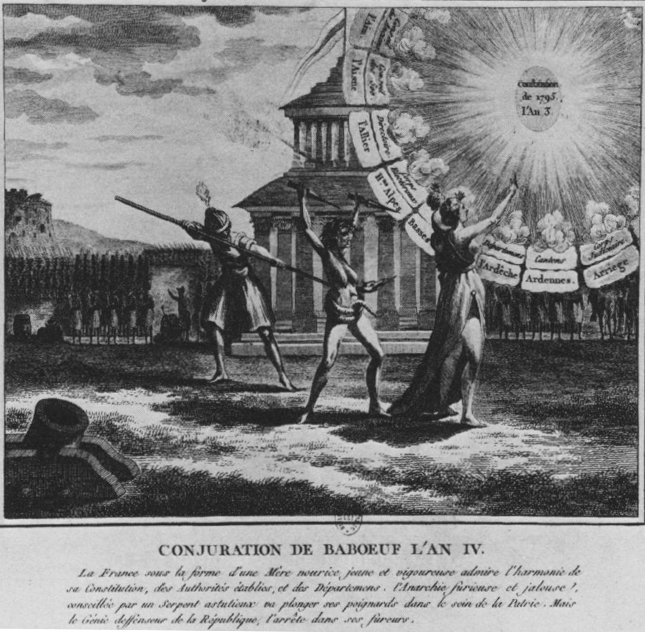
The Babeuf Conspiracy. Anonymous French print.

Babeuf’s party comes down to us as a “conspiracy,” under which word the state would charge him and which his follower Philippe Buonarroti would later rebrand the “Conspiracy of Equals”. It was not so much a grassy-knoll type of conspiracy as it was an underground organization.

When its adherents placarded Paris with the seditious “Analysis of the Doctrine of Babeuf” as the city endured a potentially dangerous economic crisis in April 1796, the government was put to a test of its strength.

It passed.

Having infiltrated Babeuf’s network, it arrested the principals on the eve of the Conspiracy’s intended insurrection. They were hailed out of Paris (a safeguard against sympathetic risings) to the commune of Vendome and there put on trial.* Babeuf and his associate Augustin Alexandre Darthe were condemned to death on May 26th and guillotined the very next day.

The last gasp of the French Revolution dropped with their heads into the basket.

Revolutionary Babeuvism, however, had scarcely just begun.

I don’t know what will become of the republicans, their families, and even the babies still at their mothers’ breasts, in the midst of the royalist fury that the counter-revolution will bring. O my friends! How heart-rending these thoughts are in my final moments! … To die for the fatherland, to leave a family, children, a beloved wife, all would be bearable if at the end of this I didn’t see liberty lost and all that belongs to sincere republicans wrapped in a horrible proscription.

-Babeuf’s last letter to his family

* The trial of Babeuf was itself a jurisprudential milestone: it was the first French trial to be transcribed verbatim.

What might look today like a nifty little advance for efficient judicature was bitterly controversial in 1797. The French Revolution had overturned an ancien regime practice of professional magistrates accepting legal testimony by written deposition and deciding matters behind closed doors. The liberte, egalite, fraternite way would instead demand that testimony be given live in the courtroom where citizen jurors could weigh its credibility.

Babeuf’s lawyer, Pierre-Francois Real, protested against the court stenographers, arguing that “The law insists that the system of written depositions not be restored in any way. That system will undoubtedly return if any means are used to save testimony given orally.”

There’s a fascinating disquisition on the curious and contradictory development of this issue and the way it “violates … common assumptions about the advance of textuality in the West” during the French Revolution in Laura Mason, “The ‘Bosom of Proof’: Criminal Justice and the Renewal of Oral Culture during the French Revolution” The Journal of Modern History, March 2004.

On this day..

1799: The defenders of Jaffa, at Napoleon’s command

On this date in 1799, Napoleon Bonaparte gave, and saw executed, the dreadful order to slaughter thousands of Muslim prisoners from the Siege of Jaffa.

Having just conquered the city from the Ottomans, the Corsican faced the inconvenience of having a large number of POWs with no way to provision them. What to do?

His private secretary Louis Antoine Fauvelet de Bourrienne later remembered the scene.

The Arnauts and Albanians, of whom these refugees were almost entirely composed, cried from the windows that they were willing to surrender upon an assurance that they would be exempted from the massacre to which the town was doomed; if not, they threatened to fire on the ‘aides de camp’, and to defend themselves to the last extremity. The two officers thought that they ought to accede to the proposition, notwithstanding the decree of death which had been pronounced against the whole garrison, in consequence of the town being taken by storm. They brought them to our camp in two divisions, one consisting of about 2500 men, the other of about 1600.

I was walking with General Bonaparte, in front of his tent, when he beheld this mass of men approaching, and before he even saw his ‘aides de camp’ he said to me, in a tone of profound sorrow, “What do they wish me to do with these men? Have I food for them?–ships to convey them to Egypt or France? Why, in the devil’s name, have they served me thus?” After their arrival, and the explanations which the General-in-Chief demanded and listened to with anger, Eugene* and Croisier [the officers who accepted the Jaffa garrison’s surrender] received the most severe reprimand for their conduct. But the deed was done. Four thousand men were there. It was necessary to decide upon their fate. The two aides de camp observed that they had found themselves alone in the midst of numerous enemies, and that he had directed them to restrain the carnage. “Yes, doubtless,” replied the General-in-Chief, with great warmth, “as to women, children, and old men–all the peaceable inhabitants; but not with respect to armed soldiers. It was your duty to die rather than bring these unfortunate creatures to me. What do you want me to do with them?”

The third day arrived without its being possible, anxiously as it was desired, to come to any conclusion favourable to the preservation of these unfortunate men. The murmurs in the camp grew louder the evil went on increasing–remedy appeared impossible–the danger was real and imminent. The order for shooting the prisoners was given and executed on the 10th of March.

This atrocious scene, when I think of it, still makes me shudder, as it did on the day I beheld it; and I would wish it were possible for me to forget it, rather than be compelled to describe it. All the horrors imagination can conceive, relative to that day of blood, would fall short of the reality.**

… the situation of the army, the scarcity of food, our small numerical strength, in the midst of a country where every individual was an enemy, would have induced me to vote in the affirmative of the proposition which was carried into effect, if I had a vote to give. It was necessary to be on the spot in order to understand the horrible necessity which existed.

War, unfortunately, presents too many occasions on which a law, immutable in all ages, and common to all nations, requires that private interests should be sacrificed to a great general interest, and that even humanity should be forgotten. It is for posterity to judge whether this terrible situation was that in which Bonaparte was placed.† For my own part, I have a perfect conviction that he could not do otherwise than yield to the dire necessity of the case. It was the advice of the council, whose opinion was unanimous in favour of the execution, that governed him, Indeed I ought in truth to say, that he yielded only in the last extremity, and was one of those, perhaps, who beheld the massacre with the deepest pain.

As tends to happen, this sort of thing made future garrisons much less interested in surrender.

Walter Scott, in his biography of the Corsican, judged that the “bloody deed must always remain a deep stain on the character of Napoleon.”

[W]e do not view it as the indulgence of an innate love of cruelty; for nothing in Bonaparte’s history shows the existence of that vice, and there are many things which intimate his disposition to have been naturally humane. But he was ambitious, aimed at immense and gigantic undertakings, and easily learned to overlook the waste of human life, which the execution of his projjects necessarily invvolved … That sort of necessity, therefore, which men fancy to themselves when they are unwilling to forego a favourite object for the sake of obeying a moral precept — that necessity which might be more properly termed a temptation difficult to be resisted — that necessity which has been called the tyrant’s plea, was the cause of the massacre at Jaffa, and must remain its sole apology.

And, Scott adds, “it might almost seem that Heaven set its vindictive brand upon this deed of butchery.”

This city the French wanted so desperately as to “forget humanity” was beset with plague; Antoine-Jean Gros would depict Napoleon on canvas humanely visiting the stricken right around the time he ordered a couple thousand prisoners shot dead.


Bonaparte Visiting the Pesthouse in Jaffa, by Antoine-Jean Gros (1804).

Bourrienne recorded that

[a]fter the siege of Jaffe the plague began to exhibit itself with a little more virulence. We lost between seven and eight hundred, men by the contagion during the campaign of Syria.

* “Eugene” is Napoleon’s adopted son-in-law Eugene de Beauharnais, one of the commanders whose expedient clemency inconvenienced the marshal. Beauharnais’s father was executed himself, during the French Revolution.

** Bourrienne goes light on the atrocity details, and makes it sound like it’s all shootings; Muslim sources record bayonet work.

† [sic!] By “terrible situation … in which Bonaparte was placed,” he of course means the terrible situation in which Bonaparte placed himself by launching his Egyptian campaign.

On this day..

1799: Dun Mikiel Xerri, Maltese patriot

(Thanks to Jonathan Shipley of A Writer’s Desk for the guest post. -ed.)

That Napoleon Bonaparte, he simply can’t leave well enough alone.

He already conquered Malta. Most of the Maltese were even okay with it. But then he started disassembling the Maltese nobility and restricting the church. This displeased Dun Mikiel Xerri, and it was on this date in 1799 that Xerri was shot dead for spearheading a Maltese revolt against the French.

Born on September 29, 1737 in Zebbug, Malta, Xerri studied as a young man at various universities throughout Europe. Learned, he becme a Roman Catholic priest and dabbled in both philosophy and mathematics, living warmly under the rule of The Knights of St. John. Then, Napoleon came.

It was 1798 and Napoleon’s fleet was traveling to Egypt on expedition. Napoleon asked for safe harbor on Malta to resupply his ships. The Maltese refused him water and so Napoleon ordered a division of troops up to Valletta, the Maltese capital city. Ferdinand von Hompesch au Bolheim, the 71st Grand Master of the Order of St. John, thought again on his stance on the water issue but Napoleon was already beginning to be entrenched in Maltese life, looting the Order’s assets and administering control. Not wanting to fight fellow Christians (the French), Hompesch did little to quell the influx of French soldiers. In fact, he quickly signed a treaty handing over sovereignty of the Island of Malta to the French Republic.

This initially pleased some Maltese, tired of Knight rule, but the honeymoon didn’t last long.

Xerri, and many others, believed a revolt was the only way to regain people’s rights due to the fact that the rights of Maltese nobility were figuratively stripped, and the treasures of the Maltese church literally so.

Outraged Maltese rose against the French garrison headquartered in Notabile. Outraged Maltese formed a National Assembly. Outraged Maltese raised open rebellion on the islands.

The French retreated to the fortified cities around the harbor where their ships were anchored. The Maltese, in arms, implored the Kingdom of the Two Sicilies (run by King Ferdinand I) and Great Britain (then under the rule of King George III).

It was to no avail. During the blockades, hundreds of people, Maltese and French alike, died from starvation and deprivation. Desperate, within the fortress, Xerri the patriot and others decided to attack French forces in Valletta and Cottonera. The plot, however, was discovered by the French and before it could be executed, 49 people were arrested for the plotted insurrection, Xerri among them.

The archbishop of Malta, Vincenzo Labini, met with Xerri and Xerri’s companions the morning of January 17, 1799. Prayers were offered, quiet words of salvation exchanged. Xerri was taken from Fort Saint Elmo to the Palace Square. French troops awaited him. Xerri, moments from death, gave a silver watch to the official on duty. He asked to be shot through the heart. “May God have pity on us!” he shouted with the others. “Long live Malta!” He was then shot dead, taken away, and buried near the Church of Saint Publius in Floriana.

Malta did not gain its independence until September 21, 1964.

On this day..

1815: Joachim Murat, Napoleonic Marshal

On this date in 1815, French Marshal-cum-Neapolitan King Joachim Murat was shot in Pizzo, Italy, for a failed attempt to regain his throne.

The charismatic cavalryman cuts a snazzy figure in the Napoleonic era, from its very infancy: it was Murat who secured for the 26-year-old Bonaparte the cannon used to deliver the “whiff of grapeshot” whose odor set Napoleon on the path to becoming Emperor.

Murat knew a good thing when he had it, and thereafter zipped around with the peripatetic conqueror, finding time between dashing mounted charges to marry Napoleon’s sister Caroline.

Murat’s honors multiplied with his commander’s victories: “First Horseman of Europe” (whatever that means); Grand Duke of Berg and Cleves; at last, in 1808, he was appointed King of Naples and Sicily, beneficiary via Caroline of the Corsican’s policy of installing family members to helm his satellite kingdoms.

Still, that elevation didn’t mean Murat would just retire to his Mediterranean villa and his mistresses: he was on call when Bonaparte went to invade Russia.

Leo Tolstoy, undoubtedly a hostile witness in his epic War and Peace, renders Murat as something of an oblivious dunderhead:

Though it was quite incomprehensible why he should be King of Naples, he was called so, and was himself convinced that he was so, and therefore assumed a more solemn and important air than formerly. He was so sure that he really was the King of Naples that when, on the eve of his departure from that city, while walking through the streets with his wife, some Italians called out to him: “Viva il re!” he turned to his wife with a pensive smile and said: “Poor fellows, they don’t know that I am leaving them tomorrow!”

But though he firmly believed himself to be King of Naples and pitied the grief felt by the subjects he was abandoning, latterly, after he had been ordered to return to military service — and especially since his last interview with Napoleon in Danzig, when his august brother-in-law had told him: “I made you King that you should reign in my way, but not in yours!” — he had cheerfully taken up his familiar business, and — like a well-fed but not overfat horse that feels himself in harness and grows skittish between the shafts — he dressed up in clothes as variegated and expensive as possible, and gaily and contentedly galloped along the roads of Poland, without himself knowing why or whither.

Like his fellow-Marshal Michel Ney, Murat nevertheless had the realpolitik chops to get on after their thrust to Moscow had so calamitously reversed — in Murat’s case, by cutting a deal with the Austrian Empire to retain his kingship.

But also like Ney, he couldn’t resist joining Napoleon’s ill-fated 1815 reunion tour. Murat could have survived the consequent loss of his throne, but made a quixotic bid to invade with only a handful of men the former possession whose people he quite wrongly imagined would rally to his cause.

Not the realization of the day-dreams of the most dreaming youth, not the visible acting of the strangest visions which the dramatist and romance-writer have conceived, could strike us with more wonder than the simple narration of that which befel the son of the baker of Cahors in his passage from the ranks of the French army to the throne and sceptre of Naples; and, alas! one step farther, an unquiet and a mournful one, to that small court in the castle of Pizzo, where the hero of a hundred fights, — the Achilles of the chivalrous French, — gazed for a second, with uncovered eye and serene brow on the party drawn out to send the death-volley home to his heart.

Well, this depiction of Murat’s end is plainly of more sympathetic character than Tolstoy would have done.

… the disgraceful tribunal, after consultation, declared, “That Joachim Murat, having by the fate of arms returned to the private station whence he sprung, had rashly landed in the Neapolitan dominions with twenty-eight followers, no longer relying upon war, but upon tumults and rioting; that he had excited the people to rebellion; that he had offended the rightful King; that he had attempted to throw the kingdom of Naples and the whole of Italy into confusion; and that therefore, as a public enemy, he was condemned to die, by authority of the law of the Decennium, which was still in vigour.” This very law, by a strange caprice of fortune, was one which Joachim himself had passed seven years before. He had, however, humanely suspended its operations many times, at particular seasons of his rule; and yet this very law, so passed, and so suspended by him, was made the instrument of his death.

The prisoner listened to his sentence with coolness and contempt. He was then led into a little court of the castle, where he found a party of soldiers drawn up in two files. Upon these preparations he looked calmly, and refused to permit his eyes to be covered. Then advancing in front of the party, and, placing himself in an attitude to meet the bullets, he called out to the soldiers, “Spare my face — aim at the heart.” No sooner had he uttered these words than the party fired, and he, who had been so lately King of the Two Sicilies, fell dead, holding fast with his hands the portraits of his family …

* More evidence that blood is thicker than water, since Napoleon and Murat were not chummy. According to Memoirs of Napoleon, His Court and Family, by the wife of another Napoleonic general,

The Emperor did not cherish for Murat the sincere friendship which he entertained for the other officers of the army of Italy. He used frequently to make him the subject of derision; and many of us have heard him laugh at the King of Naples, whom he used to call a Franconi King.

On this day..

1796: Francois de Charette, Vendee rebel

On this date in 1796, Republican France subdued the troublesome Vendee with the execution of its last great rebel.

Royalist officer Charette (English Wikipedia link | French) had assumed leadership of the anti-Republican revolt that broke out in the Vendee in 1796 — albeit with some turf rivalry with other anti-Republican figures in the area.

After a capable stretch of guerrilla campaigning, Charette had no sooner laid down his arms than the desperately counterrevolutionary English pushed for an ill-considered resumption of hostilities.

This time, the rebels took it in the culottes.

Charette, having upheld the monarchist cause long past his fellows — and much past any hope of success — became the figure the Republic had to eliminate to pacify the region. As English historian Archibald Alison has it, Charette paid a grim price for refusing to just be bought off.

Anxious to get quit of so formidable an enemy on any terms, the Directory offered [Charette] a safe retreat into England with his family and such of his followers as he might select, and a million of francs for his own maintenance. Charette replied, “I am ready to die with arms in my hands; but not to fly, and abandon my companions in misfortune. All the vessels of the Republic would not be sufficient to transport my brave soldiers into England. Far from fearing your menaces, I will myself come to seek you in your own camp.” …

This indomitable chief, however, could not long withstand the immense bodies which were now directed against him. His band was gradually reduced from seven hundred to fifty, and at last, ten followers. With this handful of heroes he long kept at bay the Republican forces; but at length, pursued on every side, and tracked out like a wild beast by bloodhounds, he was seized after a furious combat, and brought, bleeding and mutilated, but unsubdued, to the Republican headquarters. … Maltreated by the brutal soldiery, dragged along, yet dripping with blood from his wounds, before the populace of the town, weakened by loss of blood, he had need of all his strength of mind to sustain his courage; but, even in this extremity, his firmness never deserted him.

He was shot in Nantes after a perfunctory trial, refusing a blindfold and giving the orders to his own firing squad.


The execution of Charette. Mid-19th century illustration.


Execution of General Charette, in Nantes, March 1796, by Julien Le Blant.

Napoleon, who had done well to duck a possibly career-killing assignment to the Vendee the year before and was in consequence at this very moment the Revolution’s emergent man on horseback,* paid tribute from his suitable distance to Charette’s brilliance.

Charette was a great character; the true hero of that interesting period of our Revolution, which, if it presents great misfortunes, has at least not injured our glory. He left on me the impression of real grandeur of mind; the traces of no common energy and audacity, the sparks of genius, are apparent in his actions.

* Having made his name by efficiently putting down a royalist putsch in Paris a few months before, Napoleon had wed Josephine just three weeks before Charette’s execution.

On this day..

1804: Louis-Antoine-Henri de Bourbon-Condé, duc d’Enghien

It was worse than a crime, it was a blunder on this date in 1804.

Napoleon shocked, just shocked, his admirers and more especially his foes by having a royal relative ventilated at Vincennes for the trifling offense of plotting against his life.

The particular allegations against him may have been formulated with greater haste than precision, but the duc d’Enghien actually had been taking English coin to overthrow Republican France for the past decade, and nonchalantly avowed as much at his drumhead tribunal.


The Duke awaiting execution in the predawn gloom in the moat of the Chateau de Vincennes. The pathos of the accompanying dog is mandatory for this scene, as in this Harold Piffard illustration. This spot is now marked with a monument.

After surviving one too many assassination attempts, Napoleon was in the market for someone to make an example of, and the Bourbon scion, hanging about the French frontiers conniving with the English, certainly qualified.

The dispatch of his military commission, which rammed through a conviction the night of the 20th and arranged the fusillade immediately thereafter, raised self-righteous hackles among rival monarchs who had little enough compunction of their own about politically expeditious regicide.

Conventional disdain for the shooting (as with this (pdf) from the Fourth Estate), reached far and wide, and appears in Tolstoy’s War and Peace as a subject for (spurious) gossip in the Russian salons.

The group about Mortemart immediately began discussing the murder of the Duc d’Enghien. The vicomte said that the Duc d’Enghien had perished by his own magnanimity, and that there were particular reasons for Bonaparte’s hatred of him.

The vicomte told his tale very neatly. It was an anecdote, then current, to the effect that the Duc d’Enghien had gone secretly to Paris to visit Mademoiselle George; that at her house he came upon Bonaparte, who also enjoyed the famous actress’ favors, and that in his presence Napoleon happened to fall into one of the fainting fits to which he was subject, and was thus at the duc’s mercy. The latter spared him, and this magnanimity Bonaparte subsequently repaid by death.

Pierre Bezukhov, the novel’s spirit-questing Russian noble then in the thrall of the Little Corporal, has the rashness to defend d’Enghien’s execution.

“The execution of the Duc d’Enghien,” declared Monsieur Pierre, “was a political necessity, and it seems to me that Napoleon showed greatness of soul by not fearing to take on himself the whole responsibility of that deed.”

Though that defense went over like a lead balloon with the partygoers (and with Tolstoy), others have ventured to stand in the breach for the Corsican, who assuredly attracts far more opprobrium as a commoner shooting a royal traitor than he would have had their bloodlines been reversed. Bonaparte enthusiasts, like those of the Napoleon podcast, are particularly susceptible to such impolitic sentiment.

[audio:http://napoleon.thepodcastnetwork.com/audio/tpn_napoleon_20060920_011.mp3]

But Louis-Antoine-Henri normally gets better sympathy than that, as he did with the like of Chateaubriand, who resigned his Napoleonic commission in outrage.

And his death — far more notable than anything he did in life — is supposed to have occasioned the quip, “C’est pire qu’un crime, c’est une faute”: “it is worse than a crime, it is a blunder.” (Or, “it is worse than a crime, it is a mistake.”) Often attributed to Talleyrand, it was more likely uttered by his machiavellian mirror image, Joseph Fouche.

(See here for more on the phrase’s lineage. Talleyrand was so strongly in support of d’Enghien’s death that he is sometimes accused of steamrolling Napoleon on the subject. The wily minister destroyed some evidence and effected a timely volte-face when Bonaparte fell.)

The First Consul — he would crown himself Emperor later in 1804 — never had use for any such soft-pedaling, and unapologetically avowed the Duke’s execution literally to the end of his life.

Dying in exile on St. Helena years later, it is said, Napoleon read a calumny upon the d’Enghien shooting in the English press and promptly hauled out his already-completed will to insert in his own hand his lasting justification for the affair.

I caused the Duc d’Enghien to be arrested and tried, because that step was essential to the safety, interest, and honour of the French people, when the Count d’Artois* was maintaining, by his own confession, sixty assassins at Paris. Under similar circumstances, I should act in the same way.

* The Comte d’Artois was, at the time of Napoleon’s writing, the heir presumptive to the restored Bourbon monarchy — and he did indeed succeed in 1824 as Charles X. In 1804, the future king was in exile in Britain funding hits on Bonaparte and kindred counterrevolutionary stuff. For adherents of the much-disputed theory that Napoleon was poisoned in his island captivity, d’Artois figures as a possible instigator of the murder.

On this day..