This position provided access to the Fuhrer for Fromm — and for his chief of staff, Col. Claus von Stauffenberg. And it gave his office the authority to issue the “Valkyrie” orders for quelling civil unrest that Stauffenberg’s circle would use to attempt to seize Berlin.
Fromm realized that his underling was involved in a plot against the Nazi dictator, but neither joined it nor smashed it.
This play-it-safe approach turned out not to be safe at all. When Stauffenberg’s attempt to assassinate Hitler failed, Fromm hastily attempted to cover his tracks by summarily executing Stauffenberg and co-conspirators.
Not all that subtle, really. “You’ve been in a damned hurry to get your witnesses below ground,” Joseph Goebbels sneered.
Heinrich Himmler quickly had Fromm arrested. “Fate does not spare the man whose convictions are not matched by his readiness to give them effect,” wrote July 20th conspirator Hans Speidel. (As cited by Shirer.)
Although in Friedrich Fromm’s case, that wasn’t entirely true.
In recognition of the general’s calculated but not-unhelpful show of loyalty on the decisive date (enacted when Fromm realized the plotters had made a dog’s breakfast of everything) Hitler generously permitted the general to be “honorably” shot … rather than strangled from a meathook.
* Some sources give March 12, rather than March 19. I have been unable to establish primary documentation, but the sites for March 19 are far more numerous. (Years-later update: I probably got this wrong. I’d be better inclined to believe March 12.)
On this date in 1942, eleven members* of a Berlin-based anti-Nazi resistance circle were executed at Plotzensee Prison — five by hanging, six by guillotine.
These members of the group organized around leftist Luftwaffe communications officer Harro Schulze-Boysen and intellectual Arvid Harnack were one of three Soviet intelligence nodes all of whom were confusingly designated Die Rote Kapelle.
That designation, assigned by Nazi intelligence rather than the networks themselves, has basically stuck and colored their postwar reputation with the anti-Communist politics of the Cold War.
Red affiliations that blackened Die Rote Kapelle’s memory west of the Berlin wall were more readily embraced by the Warsaw Pact. This East German stamp also honors John Sieg, a member of the circle who committed suicide upon his arrest.
And not only in retrospect: according to Gerald Reitlinger, the capture of known lefties misbehaving became the occasion of a McCarthyesque freakout full of internal political score-settling among the Nazis.
The affair of Burgess and Maclean will give some idea what capital can be made when someone with a leftish record enters and betrays a position of trust. The emotions roused are out of all proportion to the things that have been betrayed. [German military intelligence chief Wilhelm] Canaris declared that the conspiracy had cost the lives of 200,000 German soldiers.
While the cells in France/Belgium and Switzerland also covered by the “Red Orchestra” designation look like straight NKVD espionage operations, the Berliners were apparently more of a loose network of civilian dissidents who got pulled into (amateurish) spying as a part of their variety of quixotic protests from the very citadel of the Third Reich. When not nicking sensitive documents from Schulze-Boysen’s day job and haplessly attempting to ship them to the Russians, they made futile White Rose-like gestures of conscience, like anti-Nazi placarding under the cover of darkness, and more calculated stuff, like collecting war crimes evidence in the hopes of indicting their perpetrators after the war.
Well, what is one supposed to do as an anti-Nazi in Berlin in 1941?
And what if one is in a position to answer that question with, “provide effectual aid to the enormous army poised to destroy Hitler”?
Nelson’s book is new, but her argument is not unique.
Other books also titled Red Orchestra (Perrault, Tarrant | review of both) more strongly emphasize the commie-taskmaster dimension in what by any standard is thrilling real-life fare.
The German Resistance Memorial Center has salutes to the Red Orchestra’s members, networks and activities.
* Arvid Harnack’s American wife Mildred, initially condemned only to a prison term for her part in the Orchestra, had her sentence upgraded and followed her comrades’ fate on February 16, 1942.
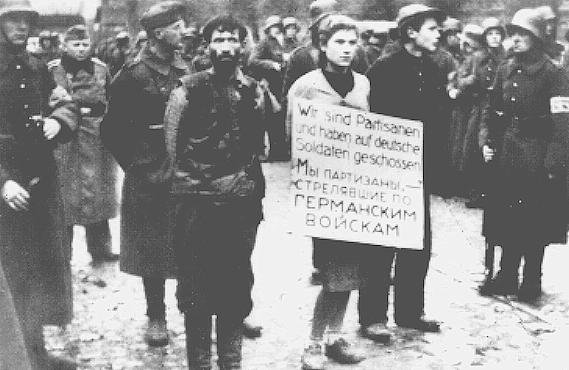
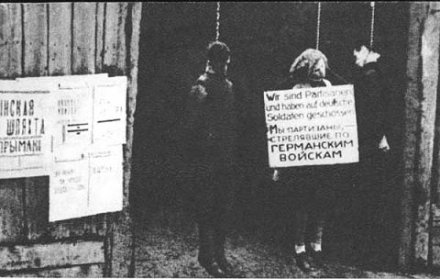
On this date in 1941, the German occupiers of Minsk conducted an infamous public hanging of partisans — perhaps the first such salutary public execution of resistance members of the war.
Jewish* 17-year-old Maria (Masha) Bruskina was the central figure of the grim tableau, and wore the placard announcing “We are partisans and have shot at German soldiers.” Evidently, she also attracted the most attention** from the onlookers to whom the scene was addressed.
Before noon, I saw the armed German and Lithuanian soldiers appear on the street. From over the bridge they escorted three people with their arms tied behind their backs. In the middle there was a girl with a sign-board on her chest. They were led up to the yeast factory gate. I noticed how calmly these people walked. The girl did not look around … The first one led to the gallows was the girl.
She was hanged with bewhiskered World War I vet Kiril Trus and the 16-year-old Volodia Shcherbatsevich. The men were members of a partisan cell organizing anti-fascist resistance; Masha Bruskina was a nurse who had been caught aiding the partisans by providing civilian clothes and papers for wounded Red Army soldiers under her care to smuggle them back to the resistance.
The scene of their deaths was captured in a series of powerful photographs taken by one of the Lithuanian Wehrmacht collaborators.
* Phototextualities: Intersections of Photography and Narrative claims that Bruskina lightened her hair and changed her name to prevent her Jewishness affecting her resistance work; even though she was a Minsk native, her initial identification didn’t happen until 1968. The men who suffered with her were named almost immediately after the war.
** Despite the eye-catching place of the girl, she was officially unidentified for decades even after the name Masha Bruskina surfaced. In “A Historical Injustice: The Case of Masha Bruskina,” (Holocaust Genocide Studies 1997, 11:3) Nechama Tec and Daniel Weiss argued that Soviet authorities, and later Belarusian ones, found her Jewishness problematic and resisted identifying her because of it — while an ethnically Russian female partisan like Zoya Kosmodemyanskaya could be more conveniently accepted as a heroine. Maybe, but bureaucratic inertia and simple precedence (since Zoya Kosmodemyanskaya was known immediately while Masha Bruskina was not) are also plausible contributing factors.
A plaque unveiled at the Minsk yeast factory in 2009 finally called her Maria Bruskina.
On this date in 1942, the Germans visited upon the Czechoslovakian village of Lidice one of the most notorious butcheries of World War II: the physical destruction of the town, and the execution of most of the adult population, in revenge for the assassination of Reichsprotektor Reinhard Heydrich.
Heydrich had power of life and death in Nazi-occupied Bohemia and Moravia, and did not scruple to use it.
“The Hangman of Prague” was no mere functionary, but a Nazi grand wizard from way back, who’d had a hand in the Third Reich’s most terrifying greatest hits — the Night of the Long Knives, Kristallnacht. Just four months before this date, Heydrich had chaired the Wannsee Conference.* (Watch Kenneth Branagh as Heydrich ride herd over a gaggle of bureaucrats to get the Final Solution up and running in Conspiracy.) Hitler called him his “man with the iron heart.”
So he was a natural target for the Czechoslovakian army-in-exile and their British handlers, made more so by his lordly disdain for common-sense security safeguards.
Zipping along a predictable route in an open car, he was a sitting duck for a hit squad, who gave the Nazi bastard a mortal shrapnel wound from a grenade that had him lingering painfully at death’s door for several days before he finally died of blood poisoning.
The 1964 Czechoslovakian film Atentat (“Assassination”) chronicles the plot to kill Heydrich and its aftermath.
For this effrontery, Czechoslovakians would pay a dreadful price.
But the Reich also exacted collective reprisals to make plain that the entire “protectorate” could be considered hostage against such plots in the future.
Special transports of Jews marked “Attentat auf Heydrich” were shipped to the camps, and 152 were executed on the day Heydrich succumbed. But then, the Nazis were brutalizing Jews anyway. Something more headline-grabbing would be needed.
After gaudy funerals for the slain Reichsprotektor, the Reich settled upon the small town of Lidice north of Prague — trumping up a few connections to resistance to “justify” collective punishment.
On this date, German troops stormed it, summarily executed all the men and boys** old enough to bear arms and a fair number of women, deported the others, and then physically destroyed and buried the town.
Lidice was intended as a demonstration — boldly published to the world as proof against a repeat,† it became the byword of Nazi cruelty towards subject nations. Though not by quantitative standards the greatest crime of the occupation, not even the greatest crime in reprisal for Heydrich, its three syllables distill all the evil of Hitler’s conquest for Czechoslovakia.
Lidice did live, and does yet, as an emblem par excellence those terrible years.
Less alive: Heydrich’s right-hand man Karl Hermann Frank, who was hanged in Prague after the war for engineering this monstrous crime. Those survivors of Lidice able to make the trip enjoyed priority seating.
* Heydrich’s aide at the Wannsee Conference, and taker of cleaned-up minutes, was Mr. Banality of Evil himself, Adolf Eichmann.
** Only three men of Lidice survived the destruction: two who were in England at that time, and one who was imprisoned in Prague for killing his son. The sentence for this crime, it turned out, was life.
† An effective proof — the calculated wholesale slaughter apparently did cool both the conquered populace and the enemies of Germany on enthusiasm for further assassinations.
On this date in 1948, Polish resistance hero Witold Pilecki was shot by Poland’s Communist government for a variety of subversions.
Witold Pilecki as an officer (top), imprisoned in Auschwitz (middle), and at his fatal trial (bottom).
A former cavalry officer turned Home Army figure,* Pilecki authored one of the Great War’s most daring (and oddly obscure) covert escapades. In 1940, he volunteered to infiltrate Auschwitz — whose operations were then largely opaque to the Polish resistance — and allowed himself to be rounded up by the Gestapo.
Pilecki spent 31 months in the notorious concentration camp, organizing an inmate resistance network and shipping intelligence about the camp’s operations to the Polish resistance and (through them) the western Allies.
Though his pleas for a raid to liberate Auschwitz were in vain, Pilecki’s report catalogued the today-familiar horrors of the camp.
One bit, as it turned out, was a bit of foreshadowing.
The fourth and most heavy kind of punishment was an execution by shooting: death effected quickly, how much more humane and desired by those undergoing torture. “Execution” is not the right term; the right one would be “shooting dead,” or just “killing.” … The butcher Palitsch** — a handsome boy, who did not used to beat anybody in the camp, as it was not his style, was the main author of macabre scenes in the courtyard. Those doomed stood naked in a row against the Black Wall, and he put a small calibre rifle under the skull in the back of their heads, and put an end to their lives.†
Pilecki escaped Auschwitz in 1943, rejoined the Home Army, and had the good fortune to wind up in Italy at war’s end.
Instead of retiring to write his memoirs, he slipped back into Poland to spy on the postwar Communist government … but the man who had lived through Nazi internment couldn’t pull the same trick on the reds, who were in the process of rooting out anti-Communist resistance elements.
Polish Prime Minister (and fellow Auschwitz survivor) Jozef Cyrankiewicz provided testimony against Pilecki in his show trial (Polish link) on espionage and arms charges.
Pilecki was executed May 25, 1948, at Warsaw’s Mokotow Prison just as he had seen so many killed at the Black Wall — with a single shot to the back of the head.
Pilecki was posthumously rehabilitated by the post-Cold War Polish government, and honored with the country’s highest decoration
* Pilecki co-founded an early resistance organization, the Secret Polish Army (Tajna Armia Polska, or TAP), subsequently absorbed by the Home Army.
** Gerhard Palitsch — or Palitzsch — was a notorious SS roll-call man thought to have personally executed some 20,000 people in the manner described by Pilecki.
An illustration of Gerhard Palitsch executing prisoners at the Black Wall, by Polish inmate Jan Komski
Disliked by camp commandant Rudolph Hoess, Palitsch’s proclivity for taking inmate mistresses eventually got him busted for race defilement, whereupon he himself landed in the camp’s confinement, obliged to “[beg] inmates who used to tremble before him for bread.” (People In Auschwitz)
He was not for the ovens or the Nuremberg trials, however, and instead found himself mustered to the eastern front, eventually dying in action against the Red Army in Hungary. This page (in Polish) assembles various inmate recollections of Gerhard Palitsch.
† As the translation in the cited source is a tad uneven, I’ve taken the liberty of cleaning it up a bit.
On this date in 1945, a Hamburg coal worker was executed for an excessively realistic take on the war effort.
Although — or because — Germany’s administrative infrastructure was falling apart under the Allied onslaught late in World War II, its judiciary had no compunction about doling out death sentences.
While the overall number of cases dealt with by most special courts was much lower than in previous years, due to the gradual collapse of the court system, in these last months of the war some judges passed proportionally more death sentences than ever before. Legal officials continued to justify their brutal sentencing by claiming that this would prevent another ‘stab in the back’.
Poor Max Schlichting, a coal worker with an unfortunate communist past, was sentenced to death for Wehrkraftzersetzung — “subversion” or “undermining the war effort,” the same thing they got Remarque’s sister on.
Specifically: he remarked to a soldier, in the aftermath of the American landing at Normandy, that Germany was going to lose the war. An undercover Gestapo spy overheard him.
We have the rare privilege this date* to salute 1,000 years since the martyrdom of St. Bruno of Querfurt.
St. Bruno — also Brun or Boniface — had his head chopped off, and 18 companions were allegedly simultaneously hung or hacked to pieces, by a chieftain who did not appreciate the bishop’s efforts to Christianize the Baltics. The wherefores, and even the wheres (different sources locate it in Prussia, Rus’, or Lithuania) of this missionary’s end are permanently obscure to us.
But this relatively forgotten saint has something to tell us about the fluid area of contact between the Latin and Greek Christian spheres in the decades before their schism.
Lithuanian Institute of History scholar Darius Baronas argues** that although Bruno’s missions were conducted independently under papal authorization, he received support from the courts of both the Polish king Boleslaw the Brave and the Grand Prince of Kievan Rus’ Vladimir the Great.†
Both rulers hoped to extend their influence among the still-pagan lands of Europe, a secular incarnation of the rivalry between eastern and western rites.
So why is he so little-known to posterity? Baronas observes that St. Bruno
is a supreme example of a missionary saint and his activities ranged almost from the Baltic to the Black Sea. Yet despite his activities, let alone his glorious death, he did not receive much praise from his contemporaries and still less from later generations. His subsequent cult was rather circumscribed and was largely forgotten.
Precisely because of his ambiguous place between these two competing powers, and because his mission did not conform precisely with either’s policies of statecraft, neither Boleslaw nor Vladimir promoted a cult of Bruno: each realm was uncertain which side Bruno was on, and which side would profit most from his inroads among the pagans.
* February 14, 1009 is also cited as a date for St. Bruno’s martyrdom — for instance, by the Catholic Encyclopedia; the source of this may be the chronicle of Thietmar of Merseburg. In the absence of a determinative reason to prefer that earlier date, and allowing that 1,000-year-old executions are prone to shaky dating, I’m placing it on March 9 based on the Annals of Quedlinburg.
This text, reading “St. Bruno, an archbishop and monk, who was called Boniface, was beheaded by Pagans during the 11th year of this conversion at the Rus and Lithuanian border, and along with 18 of his followers, entered heaven on March 9th,” also happens to be the earliest surviving written reference to Lithuania.
** Darius Baronas, ‘The year 1009: St. Bruno of Querfurt between Poland and Rus”, Journal of Medieval History (2008), 34:1:1-22
† Vladimir the Great is himself a saint, too — in the Catholic tradition as well as the Orthodox.
On February 22, 1943, Sophie Magdalena Scholl, former student of philosophy and biology at the University of Munich in Germany, was executed by guillotine for her role in the White Rose nonviolent Nazi resistance group.
Scholl was born just 21 years earlier and spent a carefree childhood in Ludwigsburg and later, in Ulm.
Although she initially joined Bund Deutscher Mädel at age 12 (as required), she quickly grew disenchanted with the group and began to identify strongly with the dissenting political views of some of her teachers, family, and friends.
While serving the required six months in the National Labor Service prior to enrolling in university, Scholl began exploring the philosophy and practice of passive resistance, which she was almost immediately able to put into practice at the University of Munich the following spring, where she quickly fell in with the compatriots of her older brother, Hans Scholl.
Initially a forum to entertain the abstract questions of budding young intellectuals, the group (which dubbed itself the White Rose) quickly moved towards taking a more active role in resistance to the Nazi regime.
How should an individual act under a dictatorship? What obligations, or indeed, power, did a group of half a dozen students have in the face of such stifling repression? As Sophie and her brother watched as their father was jailed for a critical remark made about Hitler to an employee, other group members shared stories of atrocities witnessed during war service (of the six members, all but Sophie were male).
It was agreed that some sort of action was necessary. But what?
The group began distributing a series of leaflets urging other Germans to join them in resistance against the Nazi regime. The earlier leaflets were mailed anonymously to addresses all over Germany (copied out of the phone book), but later, the group began targeting the student population. In Fellow Fighters in the Resistance, they wrote: “The name of Germany is dishonoured for all time if German youth does not finally rise, take revenge, smash its tormentors. Students! The German people look to us.”
Passive was their philosophy, but their language was most certainly not.
In February 1943, the group targeted the last of the series of six leaflets for distribution in the main building of the university. Scholl and her brother volunteered to distribute the leaflets one morning, and nearly were able to disappear into the throng of students once classes let out, before being spotted by a janitor and quickly arrested.
After hours of interrogation, Scholl had almost established her innocence, until investigators searched the siblings’ apartment and found proof of her guilt. At this point, she switched tactics and proudly stood by her actions, stating that she was obligated to act in accordance with her conscience and would freely do the same thing again, and this in the face of increasingly hostile and derogatory questioning by her interrogator.
Scholl, her brother Hans, and White Rose member Christoph Probst were subsequently brought to trial in the People’s Court in a crowd of hand-picked Nazi supporters and in front of the notorious Nazi judge Roland Freisler. Found guilty, each was allowed to give a brief statement. Scholl proclaimed, “Where we stand today, you will stand soon.”
Hans and Sophie Scholl and Probst were executed just hours after their trial. Sophie Scholl’s last words were: “Such a fine, sunny day, and I have to go, but what does my death matter, if through us thousands of people are awakened and stirred to action?”
Indeed, the pamphlet that led to Scholl’s death did have that very effect. Smuggled out of Germany later that year, the Allied Forces seized on it and dropped thousands of propaganda copies German cities later that year, retitled as “Manifesto of the Students of Munich”.
In the post World War II era, the Geschwister Scholl (Scholl siblings) have since attained an almost mythical stature in German culture and history, with numerous monuments and schools dedicated in their honor (as well as the famous University plaza the siblings crossed the day of their arrest). In a nationwide 2003 poll, Sophie and her brother Hans were voted the fourth most important Germans of all times, above Bach, Goethe and Einstein.
A celebrated movie about Sophie Scholl was released to critical acclaim in 2005, and the White Rose continues to be the subject of numerous books and articles, from the philosophical to the startlingly practical and pertinent questions of the present day, of just what an ordinary and relatively powerless individual can and should do under extraordinarily trying circumstances.
The demonstrative public hanging this day in 1944 of Poles in the remains of the Warsaw Ghetto* was little more than an everyday atrocity in Nazi-occupied Poland — although, ten days after the gauleiter responsible for previous mass executions had himself been assassinated by the Polish Home Army, it presumably had an extra bit of meaning for the city’s denizens.
Nazi terror reached new heights for the non-Jewish population of Warsaw in the winter of 1943-4. People were seized at random in the streets and executed on the spot; between October and February some 270 to 300 men and women were publicly hanged or shot each week — the kind of atrocities the French commemorate in Tulle and Oradour were, in Warsaw, a part of daily life. ‘On my way to Leszno Church today,’ Julian Kulski, a young soldier of the Home Army, recorded on 11 February 1944, ‘I saw a crowd of people standing in front of the Wall. They were gazing at something above the Wall, on the Ghetto side of it. As I got closer, I could see for myself — hanged from the upper-storey balconies of what had been an apartment house were the bodies of twenty-two of our Freedom Fighters.’ Kulski, at any rate, took them for Freedom Fighters.
This blurry photo dated to the same day and location was taken from a moving tram.
This mass execution may also be one alluded to by Jewish resistance fighter Yizhak “Antek” Zuckerman,** who survived the war in Warsaw with false papers identifying him as a Pole. His A Surplus of Memory: Chronicle of the Warsaw Ghetto Uprising remembers such an execution occurring while they lived on Leszno Street after the ghetto’s destruction — and that it greatly upset his wife, Zivia Lubetkin, because Zuckerman was so late arriving home that day.
One day the Germans hanged fifty Poles on street lamps, something they often did. This time it was on Leszno Street, in retaliation for harassing Germans. In such a case, they would take fifty Poles from their “stock” in Pawiak, publish their names, add the crime for which they were being murdered, and hang them in the city on electric poles. In this case, they also strung people up on the outside walls of the ghetto, where there was still a wall, even though there was no longer a ghetto.
* Warsaw’s Jewish ghetto had been liquidated the previous spring; at this point, it was rubble behind the still-standing wall.
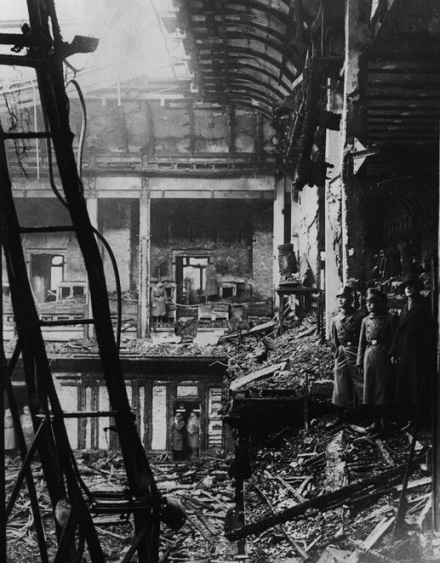
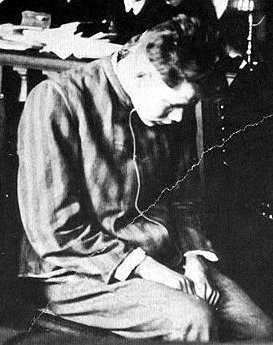
On this date in 1934, Dutch bricklayer Marinus van der Lubbe was beheaded by guillotine in Leipzig for setting the Reichstag Fire.
A watershed event* in the formation of the Nazi dictatorship, the Reichstag fire days before a parliamentary election enabled Hitler to stampede voters, suspend civil liberties, suppress left-wing parties on grounds of a suspected Communist plot, and seize “emergency” powers he would never relinquish.
Heil Hitler.
This clip from an American miniseries on Hitler with the characters chattering in unaccented English portrays the fascists’ opportunistic use of the attack on a national symbol … something not exactly unknown to later generations.
Van der Lubbe, who was arrested on the scene, suffered the predictable fate. Four other Communists charged as accomplices were acquitted, in a trial with the gratifying spectacle of Hermann Goering personally testifying, and being undressed on cross-examination by one of the reds. One is reminded here that Hitler did not yet have everything in the state apparatus at his beck and call … although he did have a great deal already, inasmuch as the arson law under which van der Lubbe died was passed after the Reichstag fire and made retroactive.
If the big-picture outcome of the Reichstag fire is pretty clear-cut, its real origin and the corresponding rightness of the judicial verdicts have remained murky ever since. The fact that the scene of the crime became Nazi ground zero for the next decade sort of obscures the evidence.
Van der Lubbe confessed, so his participation is generally taken as a given.
Whether he was really able to start the blaze acting alone, as he insisted, and the Nazis “only” exploited this fortuitous calamity; whether he was part of a larger leftist plot, as his prosecutors claimed; or whether, as Shirer and many others since have viewed him, he was a patsy in a false flag operation set up by the Nazis with an eye towards creating a politically advantageous national emergency — these possibilities remain very much up for debate.
For what it’s worth, postwar West German courts reversed and un-reversed the sentence before officially rehabilitating van der Lubbe last year on the non-specifically indisputable grounds that the legal machinery brought to bear on the Reichstag fire “enabled breaches of basic conceptions of justice.”
I do not see that one can blame the majority of Germans who, in 1933, believed that the Reichstag fire was the work of the Communists. What one can blame them for, and what shows their terrible collective weakness of character … is that this settled the matter. With sheepish submissiveness, the German people accepted that, as a result of the fire, each one of them lost what little personal freedom and dignity was guaranteed by the constitution, as though it followed as a necessary consequence. If the Communists had burned down the Reichstag, it was perfectly in order that the government took “decisive measures”!
Next morning I discussed these matters with a few other Referendars. All of them were very interested in the question of who had committed the crime, and more than one of them hinted that they had doubts about the official version; but none of them saw anything out of the ordinary in the fact that, from now on, one’s telephone would be tapped, one’s letters opened, and one’s desk might be broken into. “I consider it a personal insult,” I said, “that I should be prevented from reading whichever newspaper I wish, because allegedly a Communist set light to the Reichstag. Don’t you?” One of them cheerfully and harmlessly said, “No. Why should I? Did you read Forwards and The Red Flag up to now?”

 The cunning career army officer had been serving as the head of the Replacement Army.





 Scholl was born just 21 years earlier and spent a carefree childhood in Ludwigsburg and later, in Ulm.
 Van der Lubbe, who was arrested on the scene, suffered the predictable fate. Four other Communists charged as accomplices were acquitted, in a trial with the gratifying spectacle of Hermann Goering personally testifying, and being undressed on cross-examination by one of the reds. One is reminded here that Hitler did not yet have everything in the state apparatus at his beck and call … although he did have a great deal already, inasmuch as the arson law under which van der Lubbe died was passed after the Reichstag fire and made retroactive.
