2013: A day in the death penalty around the Persian Gulf

A year ago today, three Persian Gulf states made the news for their April 1 executions.

Iraq

Iraq four people on April 1, 2013 for terrorism-related offenses, including Munaf Abdul Rahim al-Rawi.

This onetime al-Qaeda figure once styled the “governor” of Baghdad was arrested in 2010 and actually cooperated with his captors, enabling U.S. and Iraqi officials to assassinate two other al-Qaeda leadersAbu Abdullah al-Rashid al-Baghdadi and the long-hunted Abu Ayyub al-Masri.


Munaf Abdul Rahim al-Rawi, in a 2010 interrogation

Such cooperation didn’t come with any assurance for safety of his own. After the operations his intelligence made possible, al-Rawi went on trial for his life. “One of the investigators said a death sentence is waiting for me,” he told a reporter nonchalantly. “I told him, ‘It is normal.'”

The hangings were Iraq’s 19th, 20th, 21st, and 22nd of the year.

Saudi Arabia

On April 1, 2013, Saudi Arabia beheaded Abdul Rahman Al Qah’tani in Riyadh. He “shot dead Saleh Moutared following a dispute.”

His was the 29th execution of the year.

Kuwait

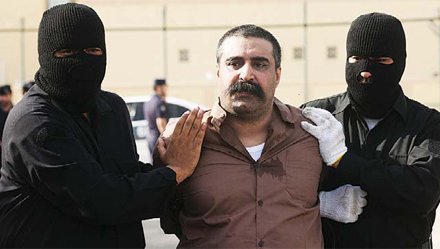
Three men were hanged at the central jail in Sulaibiya, Kuwait, on April 1, 2013, the first executions in the gulf monarchy since May 2007.

  • Pakistani Parvez Ghulam, convicted of strangling a Kuwaiti couple in 2006.
  • Saudi Faisal Dhawi Al-Otaibi, who stabbed a friend to death.
  • A stateless Arab Bedouin, Dhaher (or Thaher) al-Oteibi, who killed his wife and children and claimed to be the long-awaited twelfth imam. One imagines there was conceivably some mental instability there.

Kuwait employed the gallows with some regularity, with 72 hangings from the death penalty’s introduction in 1964 up until 2007. At that point, it ceased carrying out executions without any public explanation, though it has never ceased handing down death sentences.

This date’s resumption of hangings did not play at subtlety: media invitations resulted in a harvest of gallows photography. (See below.)

“We have begun executing death sentences as criminality and brutality have increased in our community, and the court issues sentences for serious crimes on a daily basis,” Kuwaiti prosecutor Mohammad Al-Duaij said in announcing the hangings. “These executions should eliminate the increasing number of crimes and be a deterrent.”

He added, ominously, that the other 48 people then on Kuwaiti death row had had their cases submitted to the emir for approval.

On this day..

1941: The massacre at Skede in Liepaja

The World War II occupation of the Latvian town of Liepaja (Libau, to the Germans) produced mass executions throughout 1941.

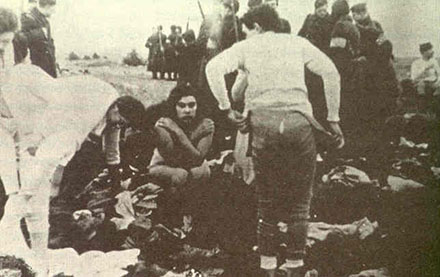
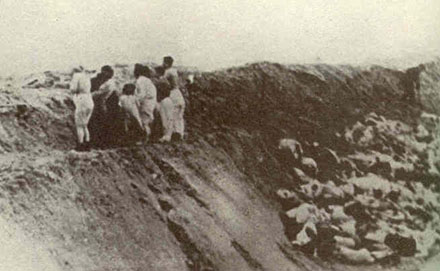
This date in 1941 commenced one of the largest such actions: over 2,700 Jews as well as 23 Communists forced over the course of two-plus days to strip on the freezing Skede dunes overlooking the Baltic and there shot by German and Latvian teams into a vast pit. It’s one of the most recognizable Holocaust atrocities because it was extensively photographed.*

As one can see from the pictures, the victims here were mostly women.


Some of the women in this photographs can be identified by name (pdf). Left to right: (1) Sorella Epstein; (2) presumably Rosa Epstein, her mother; (3) unknown; (4) Mia Epstein; (5) unknown. Alternate identification makes Mia Epstein (5) instead of (4), and (2) Pauline Goldman.

Almost all of Liepaja’s Jews perished during the war.

* Germany’s Bundesarchiv (search on Libau 1941) confirms the precise December 15 dating for these images; it also has some other photographs of atrocities in Liepaja/Libau on other occasions.

On this day..

1909: Les Chauffeurs de la Drome

At daybreak this date in 1909, three French rural bandits dubbed “Les Chauffeurs de la Drôme” were publicly guillotined in Valence to the hurrahs of a great crowd.

Most of the (plentiful) information online about these charmers is in French; in their day about 1905 to 1908 they enjoyed quite a lot of notoriety in southern France for their bloody crime spree, comprising at least 11 murders amid numerous home invasion burglaries. They were a throwback gang whose niche the 20th century would eradicate as surely as they themselves. In the time before ubiquitous mass communication and high-speed transport, a sufficiently bold band of robbers could have their way with a rural residence miles from any possible aid: this was one of the great terrors of Europe, and early crime broadsheets from centuries previous dwell often on the terrors of an isolated farmer or miller made prey in his own home by a band of cutthroats.*

The root of the word chauffeur is the French verb “to heat” — think stoking an engine, for the word’s familiar meaning of professional driver — and the specialty of the Chauffeurs de la Drome was torturing their hostages by scorching their feet with hot irons until the sufferers yielded up the hidey-holes of whatever treasure they had on premises. Their trial was a fin-de-siecle circus, and their executions likewise to a discomfiting degree. Though nothing specifically scandalous occurred as the chauffeurs were snuffed out on a public street, there are a number of pictures of this event, some of them made into postcards and circulated.

This was a trend not very much appreciated by the French government, but of course such images make arresting historical artifacts.

We’re here featuring select images of Octave David. When David walked the few steps through a sea of early-rising spectators to the portable guillotine erected on the streetcar tracks directly in front of the prison gates, his companion Pierre Berruyer had already been beheaded. (The chauffeurs were nos. 126 through 128 in the prolific Anatole Deibler’s career.)

He would have glimpsed Berruyer’s headless trunk already rolled into the large box that would soon receive his body as well. (The box had accommodations for four.) And while the execution team washed down the blade between uses, the grotesque bloody puddles and remains of fresh gore were a constant source of complaint. All three executions were completed in a six-minute span; it’s safe to assume that the smell and the feel of Pierre Berruyer’s violent death surrounded David as he walked to the used chopper. As the events here transpired, the third robber Urbain Liottard still awaited his own turn just inside the prison walls — in a few moments, Liottard would see two steaming neckless corpses stacked up in the rude bin gaping to receive him.


Looking alarmingly Christlike, the half-naked form of the condemned murderer emerges from the prison’s maw amid a throng of indistinct, black-clad voyeurs.


David reaches the guillotine; the assistant executioners are about to tip him onto the board that will carry him into place. The identification on these photos is from Bois de Justice, an invaluable site on the history of the guillotine; I’m unsure from my own observation whether to equate the figure in these pictures with the one in the first, above.


One of the beheadings (I’m not certain that it’s David’s) has been completed; the body and head are being transferred to their receptacles. Again, Bois de Justice has details on this scene.


Following one of the beheadings, the visibly stained blade is raised for cleaning before the third criminal is brought out.

* For some examples, see Joel Harrington’s The Faithful Executioner, a book we’ve previously profiled.

On this day..

2003: He Xiuling, Ma Qingxui, Li Juhua and Dai Donggui

On this date in 2003, four women all condemned for drug offenses were among a group executed by shooting at Wuhan, in central China. This mass execution (conducted in secret but preceded by a humiliating public trial) was scheduled around the June 26 International Day against Drug Abuse and Illicit Trafficking. China has a very long history of looking askance at drug-dealing, and it usually uses the prelude to June 26 for some pointed, well-publicized executions.

In 2003, photographer Yan Yuhong spent 12 hours with this quartet of women on the eve and morning of their executions at Detention Center No. 1. Only years later did the photographs get out: a moving glimpse of ordinary people under the pall of death and the guards and prisoners around them, they made worldwide news in 2011. Apparently their distribution in 2003 was quashed on authorities’ concerns that they were a bit too moving for the big anti-drug message.

Select images follow; the entire series can be perused here or here, and in poignant timeline form here.

He Xiuling

He Xiuling is the most immediately recognizable among them, a pudgy 25-year-old who looks inordinately mirthful in many pictures, but sobs openly just before she is led away to be shot. Follow-up reporting paints the picture of a simple country girl lured by a boyfriend into being a drug mule. She was evidently led to believe, up until the last, that her sentence would be commuted: “I’ll still only be 40 when I’m free!”

Had she been spared, she would be 35 now.


She thought the white top made her look “too fat”, and a guard kindly provided a black one.


Several pictures how He Xiuling smiling and laughing. Here, she enjoys breakfast on the morning of the 25th. She has about four hours to live.


Weeping moments before her execution.

Ma Qingxui

The oldest of the women and seemingly the only one of the quartet who could be characterized as something more than a small-time mule, 49-year-old Ma Qingxui from Baokang county of Hubei province was on her fourth conviction for smuggling more than 8 lbs. of narcotics.


Dressed all in red, Ma Qingxui donates her clothes to another inmate.


Ma Qingxiu being escorted out of the detention center for the execution grounds at 7:21 a.m.

Li Juhua and Dai Donggui

The prisoners least seen in the series and those of whom the least has been reported in the west.


An ordinary (non-condemned) prisoner paints Li Juhua’s toenails on the morning of the latter’s execution.


She dictates her last will and testament to a fellow-prisoners.


On the evening of June 24th, Dai Donggui carefully folds the execution clothes a guard has purchased for her.


A last supper. Reportedly, McDonald’s food is routinely served at the facility for this occasion.

On this day..

1920: Triple lynching in Duluth, Minnesota

On this date in 1920, a white mob perhaps 10,000 strong swarmed into the Duluth, Minn. jail and extracted three young African-American circus workers accused of gang-raping a white woman. Elias Clayton, Elmer Jackson and Isaac McGhie stood an immediate drumhead trial, then were lynched in the heart of Duluth as they vainly protested their innocence.

The self-congratulatory posed photograph of mob members with the bodies was made into a horrifying postcard, a frequent practice in lynch law America.


“What this looks like is the kind of photo you would see at a hunting lodge, where the guys had been out shooting bear, and they came back and they said, ‘We got three.’ You can see people on tip-toe. They’ve crowded into this shot. These are not people who are ashamed to be seen here. This is, ‘I want to be in this picture.'”

Michael Fedo, author of The Lynchings in Duluth

Nineteen-year-old Irene Tusker and her boyfriend James Sullivan had attended the one-day circus the evening before. What transpired that night remains unknown to this day: Irene eventually took the streetcar home without incident. Hours later, James Sullivan’s father claimed that the couple had been held at gunpoint by black carnies as Irene was gang-raped.

By the evening of the 15th, a vengeful mob had surrounded the police station/local lockup. Officers were ordered not to use deadly force against the townsfolk, so the battle to push into the premises was waged with brickbats against firehoses, and eventually with ineffectual pleas to let the law take its course.*

The incident drew nationwide reaction — usually condemnation (with a couple of exceptions). Occurring as it did in one of the continental states’ northernmost towns, it also underscored lynching as a nationwide problem rather than “merely” a southern one.

“Duluth has disgraced herself and has, by reason of her geographical position, disgraced the north,” the Cleveland Plain Dealer editorialized (June 17, 1920) — just one of innumerable newspaper editorials in the days following the Duluth outrage. “A city that has no more backbone than to submit to the rule of riot cannot be held blameless. But it will be surprising if Duluth and the state of Minnesota do not take steps to punish the murderers. The method of procedure was so deliberate and so brazenly open that identification and conviction of the ringleaders should be an easy matter.”

Brace for a surprise: according to the Minnesota Historical Society’s excellent site on the Duluth lynchings, only three whites served prison time (a shade over one year apiece) for rioting. Nobody was ever convicted for murdering Clayton, Jackson, or McGhie.

One black man, Max Mason, caught a long prison sentence for the supposed rape. He was paroled after five years on condition that he leave Minnesota for good.

“I was just short of nineteen the night that the bodies of McGhie, Jackson, and Clayton swung from a light pole in Duluth. I read the stories in the newspapers and put them down feeling sick, scared, and angry all at the same time. This was Minnesota, not Mississippi, but every Negro in the John Robinson Show had been suspect in the eyes of the police and guilty in the eyes of the mob … I found myself thinking of black people as a very vulnerable us — and white people as an unpredictable, violent them.”

-Minnesota-raised Roy Wilkins, the eventual director of the NAACP, in his autobiography (via)

The great-grandson of one of the lynch mob’s members wrote this book about the hangings’ legacy

The lynching was practically written out of the official state history most white children consumed at school in the middle part of the 20th century,** though the nine-year-old Lithuanian Jewish boy Abram Zimmerman who lived nearby the execution site later told his son all about it. Young Robert Allen Zimmerman tapped his father’s lynching stories under his subsequent nom de troubadour of Bob Dylan, and the Duluth atrocity is alluded to in Dylan’s “Desolation Row”.†

Latter-day Duluth has, to its credit, tried to manage something a little bit more overt.

In 2003, a monument commemorating Duluth’s moment of infamy was dedicated opposite the place where the young men were strung up and photographed. Minnesota Public Radio produced a series on the lynching during the construction of this monument which is still available online.


All images (cc) ArtStuffMatters. The photographer has a thoughtful recent blog post on the [dearth of] public lynch memorials in the United States.

* The law in Minnesota had no death penalty on the books, and still has none today.

** To be fair to the state, its immediate response did include passing anti-lynching legislation in 1921.

† “They’re selling postcards of the hanging/They’re painting the passports brown/The beauty parlor is filled with sailors/The circus is in town.”

On this day..

1942: Stjepan Filipovic, “death to fascism, freedom to the people!”

On this date in 1942, this happened:

The young man striking the dramatic pose is Stjepan Filipovic, an anti-fascist partisan hanged in the city of Valjevo by the Serbian State Guard, a collaborationist force working with the Axis occupation of Yugoslavia.

Filipovic is shouting “Death to fascism, freedom to the people!” — a pre-existing Communist slogan that Filipovic’s martyrdom would help to popularize. Smrt fašizmu, sloboda narodu! … or you can just abbreviate it SFSN!

In the city where Filipovic died, which is in present-day Serbia, there’s a monumental statue in his honor replicating that Y-shaped pose — an artistically classic look just like our favorite Goya painting, poised between death and victory.


(cc) image from Maduixa.

Filipovic was a Communist so we’re guessing that he would not have had a lot of truck with the ethnic particularism that’s latterly consumed the Balkans. Times being what they are, however, the national hero to Tito’s Yugoslavia has become a post-Communist nationalist football.

That Valjevo monument — it’s in Serbia, remember — calls him Stevan Filipovic, which is the Serbian variant of his given name. But as Serbia is the heir to Yugoslavia, he at least remains there a legitimate subject for a public memorial. Filipovic himself was Croatian, but his legacy in that present-day state is a bit more problematic: in his native town outside Dubrovnik, a statue that once commemorated Filipovic was torn down in 1991 by Croat nationalists; its vacant plinth still stands sadly in Opuzen. (Opuzen’s film festival, however, awards its honorees a statuette replicating the destroyed monument.)

On this day..

1946: Bela Imredy, Hungarian fascist prime minister

On this date in 1946, Bela Imredy, the fascist former prime minister of Hungary, was shot in Budapest.

Imredy was a Catholic financier who steered Hungarian economic policy in a succession of state posts during the chaotic 1930s.

When one of those governments fell in 1938, regent Miklos Horthy appointed Imredy prime minister. He was forced out of office the next year on revelations that he had Jewish ancestry.

This did nothing to moderate Imredy’s anti-Semitic views; he returned at the head of a new fascist party and nearly became Prime Minister under the German occupation in 1944.

Horthy demurred, and another future gallows-bird got the job instead. Imredy took the Minister of Economic Coordination as his last political gig.

A “People’s Tribunal” condemned Imredy after the war for war crimes and Nazi collaboration.

On this day..

1892: Four anarchists in Jerez

On this date in 1892, four anarchists named Burique, Lamela, Lebrijano and Zarzuela were publicly garroted on a large stage in front of the prison at the Andalusian city of Jerez (or Xeres).

Spain, like many other European states, grappled with anarchists in the late years of the 19th century.

Revolutionary peasants made the rich agricultural lands of Andalusia among the anarchist strongholds: the shadowy La Mano Negra, the “Black Hand”, had been smashed up with a number of executions in the early 1880s. This was not the end of agitation, however: its successor movement, Los Desheredades, “the Disinherited,” continued to grow.

On the night of January 9, 1892, a band of several hundred agricultural workers boldly raided Jerez in an attempt to free some anarchist prisoners. They were driven off after a night’s fearful fighting — a prototype “anarchist outrage” for headlines the world over. It was, for Federico Urales, “an act of dreams. Sticks and sickles to beat the well-fed lords of Jerez, from the men who starved to keep to keep their lands.” (Source, in Spanish)


From the Melbourne, Australia Argus, Jan. 11, 1892

“We know what the workers are: wicked people! With them, one has the bread in one hand, and the garrote in the other.” -from Vicente Blasco Ibanez’s La Bodega, in which the Jerez mutiny is a central theme. It’s available in the public domain in the original Spanish

Dozens of “outragers” were captured in hot pursuit that next morning. The investigation quickly honed in on the four ringleaders, who were put to death this date. One allegedly left a written statement conveniently renouncing anarchy. Another spoke from the platform, and “declared that he died in the cause of the working classes, and he appealed to the crowd not to respond by expressing sympathy.”*

But many others would suffer lengthy, non-capital sentences on evidence perhaps more expedient than rigorous. The poet Fermin Salvochea spent most of his fifties in prison on a spurious accusation of having conspired in the Jerez attack.

And these executions scarcely quelled Spain’s unrest. Angry cadres demonstrated (or rioted) against the executions throughout Iberia, provoking the familiar cycle of more police raids, more outrages, more martyrs … for years to come, and culminating in the indiscriminate arrests and mass torture of Barcelona anarchists in that city’s Montjuic Castle in in 1896-97

* From the Feb. 11, 1892 New York Times, which proceeds to describe the distinctive execution method thus:

[The garrote] is a brass collar, which is contracted by means of a screw in the back. As the screw is turned the collar shuts upon the neck of the condemned, and at the same time the sharpened steel point of the screw enters the spinal marrow where it joins with the brain, causing instantaneous death.

On this day..

1909: Remy Danvers

On this date in 1909, French double-murderer Remy Danvers was guillotined in Carpentras.


From Le Matin, January 27, 1909.

Danvers, already a career criminal, signed on as a farmhand at age 22 in 1907 — a period when capital punishment in France was in abeyance owing to the presidency of a death penalty opponent who systematically blocked executions.

On February 1, 1908, he shot that farmer dead to steal some money he learned was available in the house … and for good measure shot his wife too, as she begged him on her knees for her life. He got caught trying to dump the burlap-sacked corpses in the Rhone. (Here’s a French-language summary, from the original Le Figaro report.)

Because of the de facto death penalty moratorium, Danvers didn’t sweat his death sentence too much. However, the outrages of the Pollet gang finally restored the guillotine to the French criminal justice scene earlier in January of 1909. Danvers turned out to be the very next victim in its path.

Shortly before the sentence was carried out, the public prosecutor appeared in Danvers’ cell to advise the doomed man of his appeal’s rejection, and the consequent imminent removal of his head. Fortified by rum, a visibly upset Danvers managed to get through it, but execution-starved French folk crowded a scene that authorities attempted to restrict. Someone snapped this photo:

The unruly public, the New York Times opined, “undoubtedly will hasten Parliamentary action toward making future executions private.”

That date was still some years away, but a France increasingly discomfited by its history of public executions did institute laws forbidding attendees from filming or photographing executions. (Those laws didn’t work, but there they were just the same.)

There’s more about Remy Danvers in this guillotine.cultureforum.net thread (French).

On this day..

1946: Franz Strasser

On this date in 1946, former Nazi Kreisleiter Franz Strasser was hanged at Landsberg Prison for war crimes.

Strasser was condemned for shooting five downed American airmen in Czechoslovakia in December 1944, an American tribunal dismissing the defense: “There is not a scintilla of evidence to support STRASSER’s contention that he shot the prisoners to prevent their escape.” (A pdf scan of the entire verdict is here.)

On this day..