1959: Harvey Glatman, signature killer

On this date in 1959, serial sex killer Harvey Glatman was gassed in San Quentin.

The dweeby, jug-eared TV repairman manifested an early kinky streak when his parents discovered the rope burns he’d given himself practicing autoerotic asphyxiation.

In time, he would do it without that important prefix.

Paroled from Sing Sing for teenage molestation convictions, Glatman moved west — to Denver, and then to Los Angeles, spending several years in monklike isolation from the opposite sex.

“Then,” writes Carlton Smith in a book about the BTK killer, “one sweltering afternoon in July 1957, the dam broke.”*

Glatman began trolling the City of Angels’ famous seedy underbelly for young women to model for “detective magazines” shoots — an understood euphemism for snapping illicit bondage pics. This excellent cover not only enabled him to have his victims willingly put themselves at his mercy in private, it enabled him to take their pictures as trophies.

They were images of Glatman’s detailed methodology of murder, which showed a sequence of terror by re-creating the entire psychological arc of the crime. He first photographed each victim with a look of innocence on her face as if she were truly enjoying a modeling session. The next series represented a sadist’s view of a sexually terrorized victim with the impending horror of a slow and painful death etched across her face. The final frame depicted the victim’s position that Glatman himself had arranged after he strangled her.

-Robert Keppel, Signature Killers


Photos Glatman took of two of his victims, models Judy Ann Dull (top) and Ruth Mercado (bottom). Images via Murderpedia’s collection, at least one of which is very distinctly NSFW. Murderpedia also has, as per usual, a detailed writeup of the Glatman case.

Glatman killed two women this way and a third via a lonely-hearts club meeting,** while losing a few targets along the way who were put off by his aspect or wily enough to demand a male escort for the photography sessions.

He was only stopped in 1958 when a police officer chanced to encounter him while attempting the more daring enterprise of roadside kidnapping. The perp was only 30 years old at the time, a frightening mixture of predatory calculation and homicidal lust: if not for this fortuitous early detection, it’s not too hard to imagine 1957-58 Glatman standing at the outset of a serial rape-murder spree of Bundyesque dimensions.

Unlike that later conniving, spotlight-hogging monster, Glatman post-arrest retreated quickly back to reclusion. He made only a token effort to deny his crimes; as soon as detectives tricked him (by pretending they had it already) into coming clean about a hidden toolbox full of incriminating evidence, the confessions started gushing out of him — another dam burst. He was begging detectives for death well before trial and willingly pled guilty to speed his own steps to San Quentin’s gas chamber. It took less than a year, time Glatman mostly spent in self-imposed isolation from the society of the inmates and guards around him in prison.

“It’s better this way,” he once said near the end, of his imminent date with those noxious fumes. “I knew this is the way it would be.”

Glatman’s LAPD interrogator, legendary detective Pierce Brooks, would later serve as a consultant for the made-for-TV Dragnet 1966 movie. In that film, the serial kidnapper, bondage-photographer, and murderer of young models, “Don Negler”, is conned by police into revealing the location of his incriminating toolbox — just like Glatman was.

The full film is available on YouTube; the interrogation sequence begins about 1:23:56. It clinches with the nebbishy “Negler’s” pathetic self-explanation.

Negler: The reason I killed those girls is they asked me to. (pause) They did; all of ’em.

Joe Friday: They asked you to.

Negler: Sure. They said they’d rather be dead than be with me.

* Glatman is also a suspect in a never-solved Colorado murder from 1954. So maybe that dam had a few leaks.

** The personal-ad gambit led the press to start nicknaming Glatman the “Lonely-Hearts Killer,” which appellation was of course already spoken for.

On this day..

1895: The Vegetarian perpetrators of the Kucheng Massacre

On the morning of September 17, 1895, in the presence of the British and American consuls, seven perpetrators of a Chinese massacre of western Christian missionaries were beheaded at Foochow.

Anticipating the better-known Boxer Rebellion by four years, the Kucheng Massacre (there are many other transliterations of “Kucheng”) was likewise a response to the Celestial Empire’s frustrating second-class status as against European interlopers.

Christian missionaries had been a point of friction in China for decades. Though their rights to proselytize had been guaranteed in a hated treaty dictated to China by force of arms, they often met resentment or worse on the ground.

“You bring incense in one hand, a spear in the other;” one evangelist reported being told: that is, however honorable the immediate intentions of many individual missionaries, their presence looked like a stalking horse for less reputable western interventions like the opium trade. (That’s how it looked to many Chinese. Professional western diplomats themselves found the impolitic preachers a hindrance to their statecraft, according to Ian Welch’s 2006 paper “Missionaries, Murder and Diplomacy in Late 19th Century China: A Case Study” (pdf).*)

On August 1, 1895, these frustrations unleashed a river of blood at the village of Huashan in Gutian County, where a Buddhist secret society — known as “Vegetarians” in the western press for their characteristic dietary vow — fell upon a group of vacationing British Anglican missionaries still abed at dawn and ruthlessly slaughtered eleven of them. (There are some 1890s books paying tribute to the fallen available online: Robert and Louisa Stewart: In Life and in Death, and The sister martyrs of Ku Cheng : Memoir and Letters of Eleanor and Elizabeth Saunders (“Nellie” and “Topsie”) of Melbourne.)

“The attack came,” said a physician from a nearby town who was summoned to the bloody scene, “like a thunderbolt from a clear sky, not one of the victims having received the slightest intimation of the intended assault.”

Word of the carnage struck western powers with similar force.

Incensed newspaper-readers literally demanded** gunboat diplomacy, and literally got it, especially when Chinese authorities drug their feet on the condign punishment the missionaries’ countrymen were clamoring for.

All this put British diplomacy on a sticky wicket, which Welch (pdf) deals with in detail. To satisfy the domestic audience, the government had to be seen to be taking a hard line on avenging the outrages; at the same time, London was wise to the Chinese state’s shakiness and wary that a “barbarous holocaust” perpetrated against the Vegetarians would trigger a mass backlash and bring the whole thing down.

An obdurate Chinese viceroy impeded the quick resolution everyone was after by making inflammatory public proclamations against Christians, and releasing without explanation six of the thirteen men who had initially been condemned to death in the month of August. The seven who were executed on this date were therefore only the vanguard of 26 humans ultimately put to death for their involvement in the atrocity.

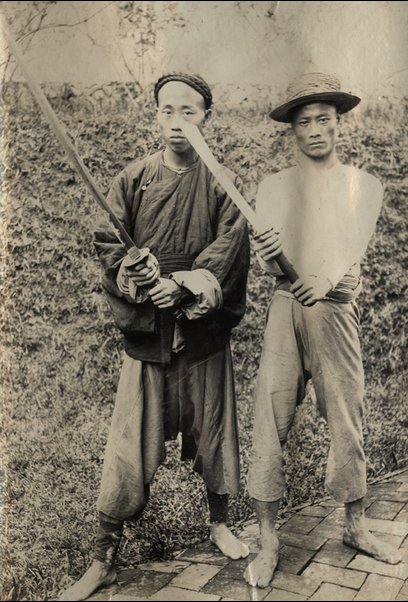
Some of the execution photographs that follow are Mature Content. They’re obtained via Visual Cultures in East Asia; some also available at USC Digital Library.


Raids and investigations to bring the Vegetarian movement to heel continued for several months thereafter, and the whole affair ultimately was quelled without doing any of the wider damage that might have been feared — not even to missionaries who continued pouring into China.

And that, effectively, kicked the can down the road on the anti-foreigner sentiments afoot in the land … sentiments that would find much costlier expression a few years later when another secret society kicked off the Boxer Rebellion.

* I’ve relied heavily on Welch for this post. He’s also collected a massive trove (over 1,200 pages) of primary documents from this incident available in a series of pdfs (some quite large) from the Australian National University website:

** This was not universally so. The wife of missionary Stephen Livingston Baldwin, who knew some of the victims of the attack, urged a “charitable” response and sensitivity that “the Chinese feel that all the world is against them, and they are not far from right.” (New York Times, Aug. 10, 1895) In letters responding to intemperate coverage elsewhere, she acidly compared (pdf) western editorialists’ high dudgeon to their look-forward-not-back dismissal of recent stateside anti-Chinese violence.

It was ten years yesterday since more Chinese were killed, and burned alive and left to die wounded, in one hour, at Rock Springs, Wyoming (the very same Territory in which the recent massacre occurred) than have been Americans and English in China in the thirty-four years I have personally known that land, being a resident there twenty years and closely connected with it ever since. Ten years yesterday since that awful Rock Springs massacre, and up to date no one arrested, much less punished! The anti-Chinese papers of the town and neighbourhood gloating over the awful details and assuring all that there would be “no Congressional investigation,” and no waste of “enterprising newspaper eloquence” over the woes of the Chinese, “though their blood flow like rivers, as they had no votes and no friends.” In less than four weeks after the Ku-Cheng massacre, arrest, investigation and execution have all taken place for the Ku-Cheng massacre. Would that our colored, red and yellow brethren, so helpless in our so-called civilized and Christian land, had some power behind them to bestir Ministers Plenipotentiary, wave flags, and run gunboats to the front, to bully, if necessary, our pusillanimous Government into some sort of civilization — I will not say Christian justice!

On this day..

1944: Six Milice collaborators in France

On this date in 1944, just days after the Liberation of Paris secured the restoration of the French Republic, six collaborators were publicly shot in the foothills of the French Alps. They were the condemned of the first court-martial to sit in liberated France.

A London Times correspondent estimated that 4,000 or more of their countrymen braved cruel wind and rain to cheer the traitors’ deaths meted to these young members of the Vichy government’s hated milice.

They were among ten members of that militia captured at a training grounds in Grenoble, and the shooting of these six was preceded by a loudspeaker announcement decrying the tribunal which tried them for having the softness merely to imprison the other four.

“The Liberation Committee considers that the sentences which failed to inflict the death penalty on all the militiamen not to be in conformity with the wishes of the French people and accordingly promises, in conformity with those wishes, to see that the composition of the court-martial is revised in order to avoid a repetition of such weakness.” The people answered with a cheer.

London Times, Sep. 4 1944

The executions, carried out on a grounds the Gestapo had once used to executed Resistance members, were also photographed, and the striking images published in the Oct. 2 issue of Life magazine. Once available online from Life at this now-dead link, the gallery is reproduced at this Chinese page; Warning: Disturbing Content.

Photographer John Osborne, later a noted editor and habitue of Richard Nixon’s enemies list, would not have been a candidate for the Resistance’s court.

“I am susceptible as most,” he wrote in Life‘s original dispatch. “When I first saw the 10 men and boys in the courtroom dock at this trial, I wanted to cry. They looked so young, wretched, unshaven … It was very easy to sentimentalize over these men, all of whom were underlings. It was easy to agree with the [collaborators’] chief defender, Pierre Guy, that France would be harming only herself if she killed them now.”

On this day..

1969: Joseph Blösche, Der SS-Mann

On this date in 1969, Joseph Blösche was executed in Leipzig, German Democratic Republic, for his part in the Holocaust.


Blösche (far right) chills out at the Warsaw Ghetto with, among others, Jurgen Stroop (fourth from right, in profile).

Blösche (English Wikipedia entry | German) was an SS Rottenführer and a Nazi Party member whose particular contribution to deporting Jews from the Warsaw Ghetto to Treblinka was fitting in some opportunistic rape, typically followed with summary murder. The ghetto’s wards called him “Frankenstein”.

Blösche was eventually captured by the Red Army, which you’d think might augur ill for his survival prospects. However, with the aid of a horrible accident he suffered in a postwar labor camp that helpfully disfigured his face, Blösche managed to fade quietly into East German society, wed, and raise a family.

He would need that facial anonymity, because the un-disfigured version is there full-frontal gazing over his submachine gun in one of the war’s most iconic and chilling images — snapped for the benefit of the Stroop report documenting the ghetto’s liquidation.


An SS trooper, eventually identified as Joseph Blösche, looms over a frightened Jewish boy in the Warsaw Ghetto. (The child might be one of Artur Dab Siemiatek, Levi Zelinwarger, Israel Rondel, or Tsvi Nussbaum)

This photo was published in the U.S. in Life magazine on November 28, 1960. The terrible image haunted Holocaust survivor Peter Fischl into writing his poem “The Little Polish Boy”.

Blösche’s luck ran out when his name came up in a West German war crimes trial in 1961; East Germany’s follow-up eventually zeroed in on the man, and he was convicted in April 1969 for directly killing up to 2,000 people, and participating in deportations that killed 300,000 more. He was executed in Leipzig with a single shot to the neck.

Joseph Blösche is the subject of the German documentary Der SS-Mann (there’s also a book of the same title).

On this day..

1946: Public Execution in Debica

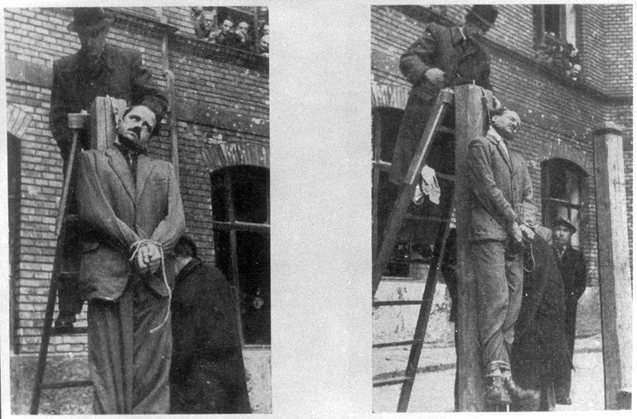
On this date in 1946, market day in the southeastern Polish town of Debica, three captured fighters* from the anti-communist Freedom and Independence (WiN) movement were publicly hanged.

This salutary, and surprise, hanging was a nasty public message during the dirty post-war war to consolidate communist authority in Poland.

The message, however, was not exactly meant for a world wider than Poland itself, so the fact that it was captured in a grainy photograph snapped by WiN agent Józef Stec and subsequently smuggled out to the West was not at all to the liking of Polish authorities.

According to a WiN eyewitness report also presumed to have been filed by Stec,

First the MO [local militia], the UB, and the military occupied the execution square holding their machine guns ready to fire. Then, a car came with uniformed individuals who placed the noose on the hook. After a short time the same car brought three condemned men in white shirts. Their hands and legs were tied with barbed wire. A Jewish prosecutor read the sentence and passed the condemned into the hands of the executioner. Before the execution, one of the condemned yelled: “Long live the Home Army. Long live General Anders and General Bor-Komorowski. Down with the commies. Brothers persevere or you’ll die like us. I swear before God that I have never been a bandit [as communist authorities designated them]. I am dying for the Motherland. Lord forgive them [the executioners] because they know not what they are doing.

* The victims were Józef Grebosz, Józef Kozlowski, and Franciszek Noster, according to the 2003 monograph After the Holocaust: Polish-Jewish conflict in the wake of World War II, by Marek Jan Chodakiewicz. This monograph is also the source for Stec’s quoted report on the hanging.

On this day..

1918: Aloïs Walput, grenadier

On this date in 1918, 21-year-old Aloïs Walput of the 2nd Belgian Grenadiers was shot at the Belgian North Sea town of Oostduinkerke, during the First World War.


Image from here.

He had killed his corporal two weeks before, and was one of “only” 13 Belgian soldiers executed during the Great War, either for military offenses such as desertion, or regular criminal ones such as Walput’s homicide.

On this day..

1946: Laszlo Baky and Laszlo Endre, Hungarian Holocaust authors

On this date in 1946, fascist Hungarian politicians Laszlo Baky and Laszlo Endre were executed by hanging in Budapest for their role in the decimation of Hungarian Jewry.

These two charmers were major figures in Hungary’s horrible final months of World War II.

Post-Stalingrad, the Hungarians had realized they were yoked to the losing side and started looking for an exit strategy; instead, early in 1944, they got a German occupation.

This occupation lifted the virulent anti-semites Baky and Endre into national power, because along with keeping Hungary in the Axis coalition, the Nazis also forcibly overcame its junior partner’s former reticence about Jewish genocide.

Adolf Eichmann arrived into Nazified Hungary and used our day’s two principals (along with another executed collaborator, Andor Jaross, they’re known as the “deportation trio”) as his instruments. Within months, hundreds of thousands of Hungarian Jews were being shipped to the gas chambers. This period is one of the waypoints of pernicious Nazi race theory, when the collapsing German regime spent military resources urgently needed at the front to organize the mass slaughter of Jews.*

And they had to work fast, because by that next winter the Red Army was seizing Budapest. These enthusiastic fascist operators did not fare well by the postwar government.

Most photos from Kuruc.info (the garishly branded ones) and the Yad Vashem database (the not garishly branded).


Laszlo Endre under arrest.


Both men, just prior to their execution.

* To do justice to the breadth of the human capacity, this is also the time and place where we find Raoul Wallenberg minting lifesaving Swedish passports by the thousands.

On this day..

1915: 22 Singapore mutineers

On this date in 1915, “the sentences of the court-martial on a batch of 45 mutineers of the 5th Light Infantry were promulgated in public” — as the Straits Times reported — “and, in the case of 22 who were condemned to death, the sentences were executed on the spot.”

A crowd of fifteen thousand watched the spirited Indian sepoys shot dead for revolting the previous month.

This demoralized 800-strong garrison of Punjabi Muslims — who had, it need hardly be added, a noble history of insurrection to think upon — was already deployed far from home to look after the imperial interests of the London gentry while British lads mustered for bayonet charges in No Man’s Lands.

The last straw for these sepoys was a rumor that they were to be shipped to the European theater and made to turn their weapons against the Turkish sultan, their Muslim coreligionist.*

On February 15, 1915, helpfully covered by the celebratory fireworks of the Chinese New Year, about half the garrison left its barracks, attacked its British officers, and started killing any European they came across. (Many British familes took refuge in jail cells.)

Around 40 died in a few days before a mixed British-French-Russian-Japanese force arrived to crush the revolt. It was just one among a number of insurrectionary outbreaks during the war to rattle Britain’s possessions in Asia and elsewhere.

Punishments meted out this day were not the end of it at all; the court of inquiry sat until May, sentencing several dozen to death and many others to prison terms or penal transportation.

And if the mutiny never really threatened British control of Singapore, the ethnic and religious fissures it exposed in the imperial order have obvious resonances (pdf) for our present day.

And not only in the event, but in the aftermath. Prof. C.M. Turnbull noted (pdf)

In order to distinguish mutineers from peaceable citizens, all Indian residents were required to register and obtain passes. This aroused considerable anger, which was exacerbated by the cavalier attitude of some registration officers, who acted as if all Indians were to blame.

* The Ottomans had also issued a call to jihad with the onset of war, hoping to drive just this sort of wedge among Britain’s colonies.

On this day..

1905: Two murderers beheaded in French Indochina

On this date in 1905, this happened in French Indochina:

“Annamites” — a term that will not get you a warm welcome in Southeast Asia today — were residents of the French protectorate of Annam. It, along with Tonkin to its north and Cochinchina to its south, comprise present-day Vietnam: “Annamite” was also sometimes generalized as a colonialist synonym for all Vietnamese. (Here’s a 1947 Life magazine article by William Bullitt that does just that in its warning about the burgeoning war wherein “Annamites — half starved and weakened by malaria, gentle by nature but courageous” had started “kill[ing] every Frenchman they can.”)

Postcard pictures on this post via BeheadedArt.com, which delivers what it promises. (Clicker beware.)

On this day..

1944: French collaborator in Rennes

This U.S. Army photo from a few months after D-Day is filed simply thus:

“Photo taken at the instant bullets from a French firing squad hit a Frenchman who collaborated with the Germans. This execution took place in Rennes, France.” Himes, November 21, 1944.


Click to see a larger image of this stunning photo — or, take in this huge copy.

On this day..