1930: Thomas Shipp and Abram Smith, strange fruit

On this date in 1930, two black youths were lynched in Marion, Indiana for murdering a white man and raping his girlfriend.

(The rape allegation — although it, and not the homicide, seems to have been the thing that triggered the lynching — was subsequently withdrawn, and there were even rumors that the white girlfriend was a lover and confederate of one of the lynched men. It’s just one strand in the very human tapestry around the “last classic lynching north of the Mason-Dixon line” explored by Cynthia Carr in Our Town: A Heartland Lynching, a Haunted Town, and the Hidden History of White America.)

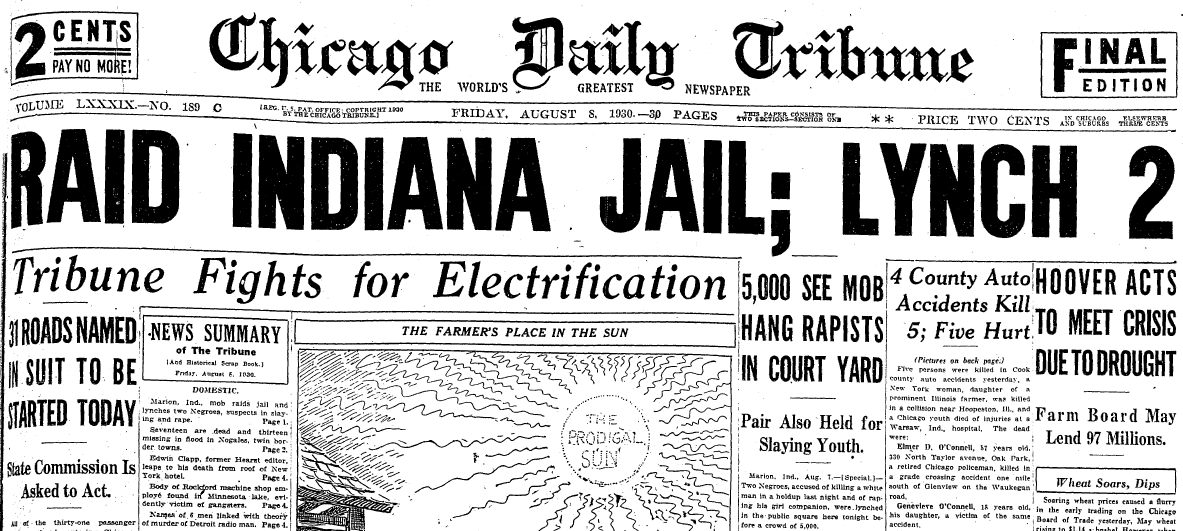
Thomas Shipp and Abram (or Abraham) Smith had been taken just the day before. The Chicago Daily Tribune (Aug. 8, 1930), for whom this event was banner news, reported that

Shipp, who is said to have confessed killing the white man, Claude Deeter, 23, of Fairmount, Ind., was hanged from an elm tree in the courthouse yard. Smith, whom the girl identified as her assailant, was thrown from a third floor window of the jail with a noose around his neck and strangled.

Reports of the crimes and confessions, published in Marion newspapers this afternoon, stirred this quiet community of 23,000 to intense excitement. There was no hint of the impending violence, however, until 8:30 p.m., when a motorcade of Deeter’s fellow townsmen arrived from Fairmount.

The Fairmount delegation, numbering about 100, gathered in the public square, openly displaying their guns and shouting for a lynching … The sheriff led his deputies to the front door, argued a moment with the leaders of the mob and then ordered the tear bombs thrown. Blinded, the lynchers fell back for a few minutes, but returned and began the sledge hammer siege which forced the jail doors within ten minutes. No shots were fired on either side.

Following the lynching the mob gathered in the square for an hour, some proposing to drive the 2,000 members of the Negro colony from the city and burn their dwellings. Peace officers from Indianapolis, Kokomo, Fort Wayne, and other towns were arriving however, and gradually the mob broke up.

The corpses hung in the square for hours, attracting throngs of gawkers — including a photographer able to snap this picture:


Teacher/poet Abel Meeropol ran across this photo of the Shipp-Smith lynching a few years later in a magazine, and it so “haunted” him — his word — that he penned the anti-lynching poem “Strange Fruit”. You know it from Billie Holiday‘s arresting vocal rendition.

Southern trees bear strange fruit
Blood on the leaves
Blood at the root
Black bodies swinging in the southern breeze
Strange fruit hanging from the poplar trees

Pastoral scene of the gallant south
The bulging eyes and the twisted mouth
The scent of magnolia sweet and fresh
Then the sudden smell of burning flesh

Here is a fruit for the crows to pluck
for the rain to gather
for the wind to suck
for the sun to rot
for the tree to drop
Here is a strange and bitter crop

Abel Meeropol was no passing sentimentalist himself, but a prolific left-wing activist. During the McCarthy years, he adopted the children of the Rosenbergs when the latter were electrocuted as Soviet spies. As faithfully as those two orphaned boys have carried the torch for their lost birth parents, they also still carry an adoptive surname: Michael Meeropol and Robert Meeropol.


A third person was almost lynched in the same Marion, Ind., incident, but 16-year-old James Cameron (sometimes called “Herbert” or “Robert” in the 1930 news reports) managed to convince the mob that he wasn’t involved. Just how he managed this feat and what he’d really been up to is another strand of Carr’s tapestry: many of the Marion blacks as well as whites she interviewed overtly mistrusted Cameron.

At any rate, the crowd let him off with a beating, and Cameron served time as an accessory to the crime.

After release, he became an anti-lynching activist in Indiana and, later, Wisconsin — where he founded a (since-shuttered) Black Holocaust Museum. He started several NAACP chapters.

Cameron was pardoned by Indiana Gov. Evan Bayh in 1993, and authored a memoir titled A Time of Terror: A Survivor’s Story.

In the more immediate aftermath, it was far from a given that this date’s effusion of summary justice wouldn’t cascade into a generalized racial pogrom.

As the Tribune article notes, the lynch mob mulled attacking the black community, ultimately dissuaded by the gradual arrival of lawmen. By the next day, the Indiana national guard had occupied Marion. The Tribune on Aug. 10 reported the town “peaceful to all outward appearances but acutely aware of an undercurrent of racial antagonism that it feared might flame into open warfare at any moment.”

Lest this seem a bit over-the-top, recall that all this went down just a few years since a lynch mob in Tulsa had metastasized into one of America’s most notorious race riots. The prospect of wholesale bloodletting was very real.

When the local attorney general and grand jury waved away the small matter of punishing mob leaders, several of whom were publicly known by name, Indianapolis attorney general (and Marion native) James M. Ogden drove up to town and personally filed indictments, to the fury of white residents.

“It was astonishing to see and feel the mob atmosphere that still prevailed nearly seven months after the murder,” wrote a correspondent for The Nation. Ogden’s deputies were “looked upon as enemies of the community, not only by the mob, but also by most of the court officials.” After all-white juries acquitted the first two people tried, the state dropped its remaining indictments.


The maelstrom of race and politics and history that emerged from that first fatal transaction — a brutal but banal Lover’s Lane heist — grew so far beyond the original cast of criminal and victim that they practically became secondary to the story.

On August 8, 1930, a wire story datelined Fairmount, Ind., ran in the Indianapolis Star (but not the Marion papers):

Deep regret that the negro slayers of their son Claude, were lynched in Marion last night by a mob, was expressed today by Mr. and Mrs. William Deeter, members of the Apostolic faith, a sect similar to the Quakers.

“God should have been the judge,” said the elderly Deeter. “They had no right to do it,” his wife assented.

Both are opposed to capital punishment and did not want to see the negroes put to death for their crime.

On this day..

1916: Three in the Mexican Revolution

On an uncertain date — approximated only to “about the time of the Columbus affair,” which was Pancho Villa‘s famous (and otherwise unrelated) raid on Columbus, N.M. March 8-9, 1916 — a triple execution took place in Juarez, Mexico.

The who, why, and wherefore appear to be completely lost. Only the image remains:

These images were captured by C. Tucker Barrett, a lawyer and amateur photographer serving with the U.S. Army’s 16th Infantry Regiment then stationed right across the border from Juarez, in El Paso, Texas. (This regiment would be detailed for a punitive expedition into Mexico, which Barrett also photographed.)

The Mexican Revolution may be ancient history, but Juarez and extrajudicial executions are still very much in the news.

On this day..

1943: Leonard Siffleet, beach beheading

On this date in 1943, Australian World War II commando Leonard Siffleet was beheaded on Aitape Beach in Papua New Guinea, along with two Ambonese, H. Pattiwal and M. Reharing

A photograph of the Japanese soldier Yasuno Chikao an instant before he strikes off Siffleet’s head was taken from the body of a Japanese casualty later in the war. Published in Life magazine, it became one of the war’s most iconic photos.

On this day..

1936: The Sacred Heart, by Spanish leftists

On this date in 1936, anticlerical leftists in the Spanish Civil War allegedly subjected a monumental statue of Christ to a ritual “execution”.


“This picture, taken by a Paramount News-reel representative and received by air from Madrid yesterday, illustrates an outrage which has no parallel in the photographs published by “The Daily Mail” of the Spanish Reds’ war on religion. It shows a Communist firing squad aiming at the colossal Monument of the Sacred Heart on the Cerro de los Angeles, a hill a few miles south of Madrid which is regarded as the exact centre of Spain.” (Source)

This outstandingly incendiary image made for great recruiting for the Francoist enemies of the “firing squad” and gave credence to a “crusade” lexicology that insured the devout would break overwhelmingly against the Republic. (Nearly 7,000 men and women in religious orders whose deaths during the war are charged to the Republican account also helped.)

Maybe that was inevitable, anyway.

George Orwell, the English leftist who volunteered for the Spanish Republicans, noted in his Homage to Catalonia that

the people in this part of Spain must be genuinely without religious feeling — religious feeling, I mean, in the orthodox sense. It is curious that all the time I was in Spain I never once saw a person cross himself; yet you would think such a movement would become instinctive, revolution or no revolution. Obviously the Spanish Church will come back (as the saying goes, night and the Jesuits always return), but there is no doubt that at the outbreak of the revolution it collapsed and was smashed up to an extent that would be unthinkable even for the moribund C. of E. in like circumstances. To the Spanish people, at any rate in Catalonia and Aragon, the Church was a racket pure and simple. And possibly Christian belief was replaced to some extent by Anarchism, whose influence is widely spread and which undoubtedly has a religious tinge.

Be that as it may, Republican types suspected photographic fakery.

Just like its inspiration is reported to have done, this statue survived its “execution” in fine shapewas resurrected by public subscription, and can still be seen at Cerro de los Angeles outside Madrid.


The “executed” statue today. (cc) image from bigchus.

On this day..

1968: Nguyen Van Lem

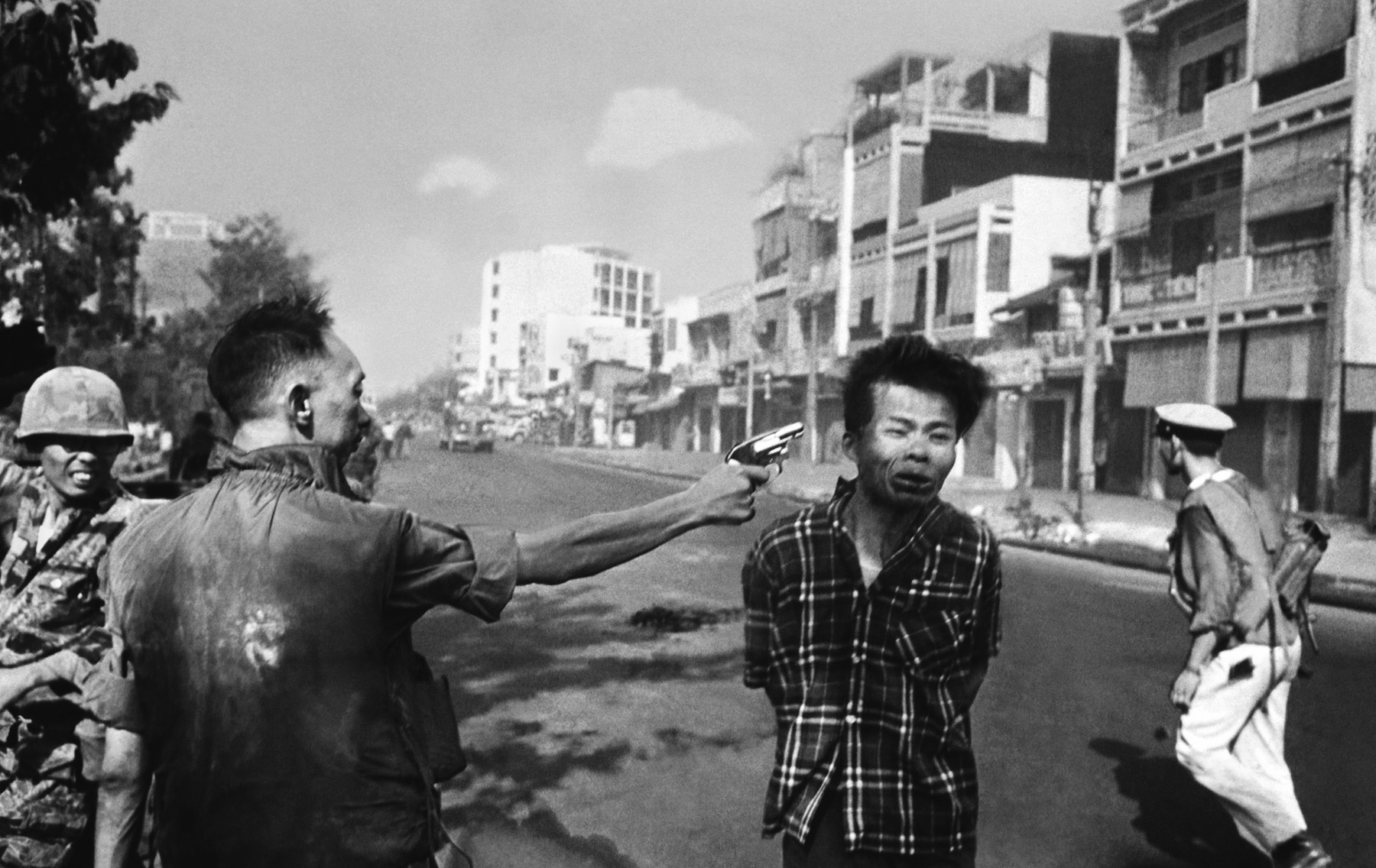
Around noon of February 1, 1968, in the opening days of the communist Tet Offensive, South Vietnamese General Nguyen Ngoc Loan summarily executed a Viet Cong prisoner on the streets of Saigon — and photographer Eddie Adams captured perhaps the war’s most unforgettable image.

An American cameraman also captured it in on celluloid. Caution: This clip shows … well, a man being shot in the head at point-blank range.

Though the image brought Adams the Pulitzer Prize, he would express discomfort with it later in life, and eulogized General Loan in Time magazine when he died in the U.S. in 1998.

The general killed the Viet Cong; I killed the general with my camera … photographs do lie, even without manipulation.

For Adams, the lie was the omission of context — that the plainclothes Lem had allegedly just been caught having murdered not only South Vietnamese police but their civilian family members; that Loan was a good officer and not a cold-blooded killer.

Adams’ editor has said that many such summary executions were taking place during the Battle of Saigon — a broader context to the image no matter its specific fairness to the executioner.

But of course, the shot gained its deeper resonance from the growing disgust with the Vietnam War … and from its concise tableau of a century’s brutality. Here is a frozen image of Orwell’s boot stamping on a human face, forever.

Like any great work of art, Adams’ serendipitous photograph took on a life of its own … and a tapestry of meanings richer than its creator could ever have intended.

On this day..

1874: William Udderzook, because a picture is worth a thousand words

On this date in 1874, William Udderzook was hanged in West Chester, Pennsylvania for an insurance scam gone horribly macabre — accidentally making judicial history in the process.

Udderzook and his brother-in-law Winfield Scott Goss had contrived to pick up some easy scratch by insuring Goss’s life and having him “burned to death” in a laboratory fire; Udderzook procured a medical cadaver for the purpose, and duly identified its charred remains the late lamented Goss, who was in fact laying low in Newark under an assumed name.

An amateurish stunt by today’s standards, but forensic science was still in its infancy. During the Civil War just a decade before, the majority of the dead had been buried unidentified. Personal recognition was still the best way available in most cases to tell who was who.

Udderzook and Goss’s wife therefore collected on their say-so, but insurance adjusters smelled fraud. It was through their pressure that the “Goss-Udderzook tragedy” unfolded, and became an object lesson and test case in the science of establishing identity.

Goss was the first hoisted on his own petard, for his faked death meant that Udderzook could not afford to have investigators find him alive. So Udderzook murdered Goss, this time for real — real gruesome, that is. When the body was discovered, it had been dismembered, disemboweled, and repeatedly stabbed.

When Udderzook faced trial, Goss’s identity with “Wilson” (his assumed name) was the central question, and it was established using photography. (The same way they identified the body, actually, per a contemporary New York Times account here. (pdf))

Udderzook fought the photographic identification all the way to the Pennsylvania Supreme Court — which turned aside the appeal with a landmark ruling whose embrace of the photographic science would unlock its forensic potential:

That a portrait or a miniature painting from life and proved to resemble the person may be used to identify him cannot be doubted, though, like all other evidences of identity, it is open to disproof or doubt, and must be determined by the jury. There seems to be no reason why a photograph, proved to be taken from life and to resemble the person photographed, should not fill the same measure of evidence. It is true that the photographs we see are not the original likenesses; their lines are not traced by the hand of the artist nor can the artist be called to testify that he faithfully limned [sic] the portrait. They are but paper copies taken from the original plate, called the negative, made sensitive by chemicals, and printed by the sunlight through the camera. It is the result of art, guided by certain principles of science. . . .

It is evident that the competency of the evidence in such a case depends on the reliability of the photograph of a work of art, and this, in the case before us, in which no proof was made by experts of this reliability, must depend upon the judicial cognizance we make of photographs as an established means of producing a correct likeness. The Daguerrean process was first given to the world in 1839. It was soon followed by photography, of which we have nearly a generation’s experience. . . . We know that its principles are derived from science; that the images on the plate, made by the rays of light through the camera, are dependent on the same general laws which produce the images of outward forms upon the retina through the lenses of the eye. The process has become one in general use, so common that we cannot refuse to take judicial cognisance of it as a proper means of producing correct likeness.

On this day..

1967: Ernesto “Che” Guevara

As of 1:10 p.m. Bolivia time this date in 1967, Ernesto “Che” Guevara was no longer a man: he was only a god.

The Argentinian-born doctor turned Cuban revolutionary icon and the man who wrote the book on guerrilla warfare had put abroad to foment insurgency. His efforts in the Congo foundered; his bid to replicate the Cuban revolution in Bolivia was doing likewise when he was captured.

After holding him overnight, the government sent a coded order to execute him in the field. Che had done the same thing with his own hands to several who betrayed the Sierra Maestra guerrillas.

Soldier Mario Teran drew the short straw for a footnote to destiny; when he hesitated, Che chastised him with the legendary parting words “that someone invented or reported”:

“Shoot, coward, you’re only going to kill a man.”

Maybe so, but the man looked Christ-like when they put his body on display for the press. As certain as they made his death, still Che lives.

CIA asset (and George Bush Sr. confidante) Felix Rodriguez took his watch as a trophy. The rest of Che Guevara belongs to the world.*

This site could hardly attempt a definitive rendering of such a towering and controversial figure, a task fit for two, three, many biographies.

Lengthy video documentaries are here and here. Many of Che’s own words are collected here. Declassified U.S. National Security Archive documents relating to his capture and death are here.

And highly recommended is SovMusic.ru’s huge library of Che Guevara mp3 files — like this Francesco Guccini song:

[audio:Che_Guevara_Francesco_Guccini.mp3]

“We cannot be sure of having something to live for unless we are willing to die for it.”

-Che Guevara

* Especially, of course, its marketers.

On this day..

1979: Eleven by a Firing Squad in Iran

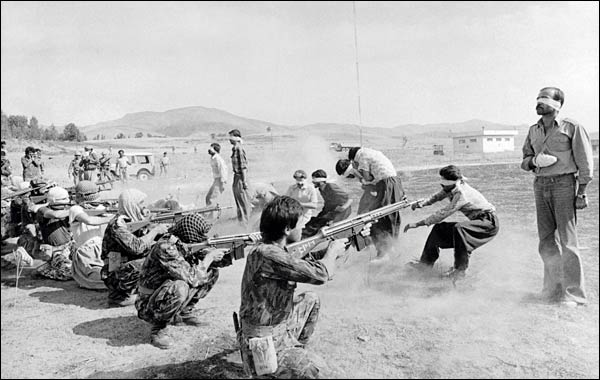
On this date in 1979, the only anonymous photograph to win a Pulitzer Prize captured nine Kurdish rebels and two of the Shah’s policemen executed by firing squad in revolutionary Iran.

This shot, one of a series taken of the event with the permission of the judge who condemned the men to immediate death in a half-hour trial at the Sanandaj airfield, ran the next day in the Iranian paper Ettela’at, whose editor prudently kept the photographer’s identity secret. Within two days, the stunning photo had rocketed around the world.

It won the Pulitzer Prize for Spot News Photography the following spring, still credited anonymously.

Two years ago, the Wall Street Journal revealed — with the photographer’s permission — the identity of the man who shot this indelible image: Jahangir Razmi, who had gone on to a career as one of Iran’s top photographic journalists. He came to New York to collect the prize 27 years late.

The article breaking the story is still available on the Journal‘s website, and on the personal site of reporter Joshua Prager. An NPR story discussing the search for Razmi’s identity is here.

On this day..

1905: Fou Tchou-Li, by a thousand cuts

On this date in 1905, Fou Tchou-Li suffered the last execution by lingchi in Beijing, for the murder of a Mongolian prince.

Lingchi, or slow slicing, involved the public dismemberment of the victim. As such, it became iconic to westerners as an image of exotic Chinese cruelty — albeit iconic in a mythicized form, the accounts conflicting, undependable, Orientalist. (Many different ones are collected at the Wikipedia page.)

Lingchi is especially notable — apart from fathering the phrase “death by a thousand cuts” in the English lexicology — for its overlap with the era of photography.

Fou Tchou-Li’s death was captured on film, and the images famously captivated Georges Bataille for the expression of seeming ecstasy on the face of the dying (or dead) man.

Bataille was said to meditate daily upon the image below in particular — “I never stopped being obsessed by this image of pain, at the same time ecstatic and intolerable.”

Agony and ecstasy? A sequence of images, strong stuff in spite of their low quality, describing Fou Tchou-Li’s execution can be viewed here. Notice, however, that it’s not the one pictured here — the scholar who maintains this page claims the man’s identity became confused by western interlocutors. The different, unnamed man who as “Fou Tchou-Li” riveted Bataille is pictured here.

In Regarding the Pain of Others, Susan Sontag explained the mystical nexus of pleasure and pain Fou Tchou-Li’s torture suggested to the French theorist, aptly comparing it to graphic but pre-photographic exaltations of torture in the western artistic tradition, such as Saint Sebastian:

To contemplate this image, according to Bataille, is both a mortification of the feelings and a liberation of tabooed erotic knowledge — a complex response that many people must find hard to credit. … Bataille is not saying that he takes pleasure in the sight of this excruciation. But he is saying that he can imagine extreme suffering as a kind of transfiguration. It is a view of suffering, of the pain of others, that is rooted in religious thinking, which links pain to sacrifice, sacrifice to exaltation — a view that could not be more alien to a modern sensibility.

It’s no idle point to say that all this reads quite a lot into a single frame that may not be all that representative of the moment, though that wouldn’t necessarily diminish Bataille’s gist. More, these are western interpretations of — projections upon — an image marked as fundamentally outside in a tableau irresistibly blending the colonizer and the colonized.

The execution was ordered in the last days of the Qing Dynasty, which had long been substantially beholden to European states, especially the British; the prisoner was apparently administered opium to numb the pain, the very product Britain had gone to war to force China to accept.

Taiwanese video artist Chen Chieh-jen interpreted the photography that so captivated Bataille, and its colonial context, in Lingchi: Echoes of a Historical Photograph (review).

Two weeks after this date, China abolished the punishment for good.

On this day..

1952: Rudolf Slansky and 10 “conspirators”

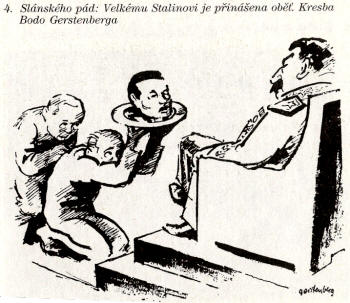
On this date in 1952, eleven high-ranking Czechoslovakian politicians were hanged at Prague’s Pankrac Prison two weeks after a show trial purging unreliable elements from the Communist party.

One of the most infamous show trials in Czechoslovakia saw 14 high-ranking Communists — eleven of them Jews — railroaded for a “Trotskyite-Titoist-Zionist activities in the service of American imperialism”. Three received life sentences. The other eleven went to the gallows.

While the roots of the persecution, especially the undertones of anti-Semitism, sink into the id of the Stalinist Eastern bloc, the most evident proximate cause was the USSR’s assertion of control over its satellite states at a time when Josip Tito was successfully charting a course of independent communism. Purges in Poland, Bulgaria and Hungary had taken place in the years before.

The Soviet agents rounding up suspects for Stalin did not trifle with small game. Rudolf Slansky was General Secretary of the Communist Party and therefore the second-most powerful man in the country; by the time he was tried, after a year in prison under torture, he was publicly denouncing himself.

Otto Sling, whose name became synonymous with forbidden heterodoxy, did likewise — “I was a treacherous enemy within the Communist Party … I am justly an object of contempt and deserve the maximum and the hardest punishment.”

And Vladimir Clementis, the Slovak Minister of Foreign Affairs, was erased from a photo taken with the Czechoslovakian President, a circumstance Milan Kundera reflected upon in The Book of Laughter and Forgetting:

In February 1948, the Communist leader Klement Gottwald stepped out on the balcony of a Baroque palace to harangue hundreds of thousands of citizens massed in Old Town Square … Gottwald was flanked by his comrades, with Clementis standing close to him.

The propaganda section made hundreds of thousands of copies of the photograph taken on the balcony where Gottwald, in a fur hat and surrounded by his comrades, spoke to the people. On that balcony the history of Communist Bohemia began. Every child knew that photograph, from seeing it on posters and in schoolbooks and museums.

Four years later, Clementis was charged with treason and hanged. The propaganda section immediately made him vanish from history and, of course, from all photographs. Ever since, Gottwald has been alone on the balcony. Where Clementis stood, there is only the bare palace wall.

The hanged were rehabilitated in 1963.

Artur London, who received a life sentence and was released after rehabilitation, wrote about his experiences in The Confession, subsequently a 1970 Costa-Gavras film. The wife and son of Deputy Minister of Foreign Trade (and Auschwitz survivor) Rudolf Margolius have also both written memoirs covering the trial.

The younger Margolius in particular, who has staunchly defended his father as an essentially apolitical man and not a Communist apparatchik, has been in the thick of present-day disputes in Czechoslovakia’s successor states over whom is due sympathy and recognition for bygone political crimes.

On this day..