1698: Guido Franceschini, The Ring and the Book inspiration

Robert Browning‘s long narrative poem The Ring and the Book concerns the murder trial of the nobleman Guido Franceschini — a real-life case that saw the defendant in question executed in Rome on this date in 1698 for murdering his wife Pompilia as a suspected adultress. (And her parents just because.)

The 21,000-line work was Browning’s greatest success in life, though many particulars of Browning’s spin on events have been challenged by the 2001 study Roman Murder Mystery.

We’ll be content this day to take Browning’s audience’s-eye view of the jealous husband’s scaffold comeuppance on execution-day.

To mount the scaffold-steps, Guido was last
Here also, as atriciousest in crime.
We hardly noticed how the peasants died,
They dangled somehow soon to right and left,
And we remained all ears and eyes, could give
Ourselves to Guido undividedly,
As he harangued the multitude beneath.
He begged forgiveness on the part of God,
And fair construction of his act from men,
Whose suffrage he entreated for his soul,
Suggesting that we should forthwith repeat
A Pater and an Ave with the hymn
Salve Regina Coeli, for his sake.
Which said, he turned to the confessor, crossed
And reconciled himself, with decency,
Oft glancing at Saint Mary’s opposite,
Where they possess, and showed in shrine to-day,
The blessed Umbilicus of our Lord,
(A relic ’tis believed no other church
In Rome can boast of) — then rose up, as brisk
Knelt down again, bent head, adapted neck,
And, with the name of Jesus on his lips,
Received the fatal blow.

The headsman showed
The head to the populace. Must I avouch
We strangers own to disappointment here?
Report pronounced him fully six feet high,
Youngish, considering his fifty years,
And, if not handsome, dignified at least.
Indeed, it was no face to please a wife!

The “old yellow book” of original case notes that Browning found at a Florentine market and subsequently served as his reference source is available here. The poem itself is, of course, in the public domain; read it in its entirety here, or get hours of free audio reading here.

On this day..

1931: The Longhua Martyrs and the Five Martyrs of the League of Left-Wing Writers

On this date in 1931, the Chinese nationalists executed 23 Communists at Longhua, including five members of the League of Left-Wing Writers.

Early in what would prove to be the very long Chinese Civil War, the Koumintang government in 1930 mounted a suppression* of Communist outposts. That included military campaigns attempting to encircle communist-held regions, as well as an internal crackdown. It’s the latter that concerns us here.

A Communist-founded League of Left-Wing Writers operating in Shanghai was formally banned by the Koumintang in September 1930. Threatened with arrest, the writers struggled to stay underground but at a January 17 meeting in the British concession area,** British police arrested Li Weisen, Hu Yepin, Rou Shi, Yin Fu, and Feng Keng. They were handed over to the Chinese authorities.


The Five Martyrs: From left: Hu Yepin, Rou Shi, Feng Keng, Yin Fu, Li Weisen (Li Qiushi)

They became the Five Martyrs of the League when they were shot this date in 1931 along with 18 other Communist prisoners, one of them a pregnant woman.

Among the five martyrs, Rou Shi† was particularly close to the great writer Lu Xun, who was heartbroken when he received word of his young protege’s untimely end — “one of China’s best youths,” in his estimation. In hiding himself, Lu Xun composed a “Lament for Rou Shi”:

To long and sleepless nights I’ve grown
accustomed in the spring;
Fled with a wife and babe in arms,
my temples are graying.
‘Mid dream there comes an image faint —
a loving mother’s tear;
On city walls the overlords’
e’er-changing banners rear.
I can but stand by looking on
as friends become new ghosts,
In anger face bayonet thickets
and search for verse ripostes.
The poem intoned, my gaze turns low —
one cannot write such down.
Moonlight shimmers with watery sheen
upon my jet-black gown.

(as translated by The Lyrical Lu Xun: A Study of His Classical-Style Verse)

The discerning present-day visitor to Longhua can pay respects at the Longhua Revolutionary Martyrs Cemetery.

* The suppression claimed, among others, the life of Mao Zedong’s first wife.

** The extraterritorial British concession in Shanghai was a legacy of the opium wars.

† There’s an English translation of Rou Shi’s short story “A Slave Mother” here.

On this day..

Feast Day of Saint Agnes

January 21 is the feast date and traditional martyrdom date (in the year 304) of Agnes of Rome, a 13-year-old put to death in the Diocletian persecutions who has the distinction of being among the seven women mentioned by name in the Catholic Canon of the Mass.

Agnes means “chaste” in Greek,* and this was precisely the problem.

As prosperous as she was pulchritudinous, she was pious even moreso and spurned the many suitors for her hand and bed. Eventually one or the other of them peevishly reported her as a Christian.

Upon arrest, the abstinent youth was allegedly subjected to an official program of sexual assault, including displaying her naked in public and forcing her into a brothel. It’s said that divine intervention prevented her violation in these ordeals. (The flowing locks in the Ribera portrait of her at right are part of that myth, supposed to have sprouted long enough to save her from her public shaming.)

Considering that her defining characteristic is her virginity, Agnes has quite the lurid legend — and that does not exclude her very martyrdom. Per the erotically-charged poetic account of the 4th-5th century Christian poet Prudentius,** Agnes rejoiced sensually in the executioner sent to to render her to her heavenly bridal-bed:

I rejoice that there comes a man like this,
A savage, cruel, and wild warrior,
Rather than a languid, soft,
Womanish youth fragrant with perfume,
Come to destroy my life with the death of my honor.

This lover, this one at last, I confess, pleases me.
I shall rush to his eager steps
And not demur from his hot ardor.
I shall welcome the entire length of
His blade into my bosom, drawing the sword-blow
To the depths of my breast.

Original Latin here from Prudentius’s Liber Peristephanon (Crowns of Martyrdom)†

Agnes, whose purported relics are interred in the Roman church Sant’Agnese in Agone, is the patron saint of an entire pantheon of feminine sexual incipience: chastity, virgins, young women, and betrothed couples.‡

Little surprise, then, that the legend arose in Christendom that a maid could invoke the vision of her future husband by performing certain suggestive rituals — like lying supine and naked on her bed — on the eve of St. Agnes (that is, the night of January 20).

It’s upon this occasion that Keats pins his narrative poem The Eve of St. Agnes§ (full text here or here), in which a young woman performing these rites is in her dreamlike state deflowered by the desired suitor her family forbids — and then the two slip away by night “o’er the southern moors.”

Beyond a mortal man impassion’d far
At these voluptuous accents, he arose,
Ethereal, flush’d, and like a throbbing star
Seen mid the sapphire heaven’s deep repose;
Into her dream he melted, as the rose
Blendeth its odour with the violet,–
Solution sweet: meantime the frost-wind blows
Like Love’s alarum pattering the sharp sleet
Against the window-panes; St. Agnes’ moon hath set.


The Eve of St. Agnes, by John Everett Millais (1863) shows Keats’s Madeleine about to disrobe before taking to bed on that occasion. The Keats poem was very popular with Millais’s pre-Raphaelite crowd.

* It’s also similar to the Latin word for lamb, agnus; consequently, the lamb is Agnes’s usual iconographic symbol.

** Prudentius, best-known for his seminal allegorical verse Psychomachia, composed a number of hymnal poems. Some are still in use today — such as “Of the Father’s Love Begotten”.

† Translation has a few tweaks of my own but is primarily that of Colbert I. Nepaulsingh in “The Afrenta de Corpes and the Martyrological Tradition,” Hispanic Review, Spring, 1983.

‡ She’s also the patron saint of rape victims.

§ Tennyson later wrote a short poem of his own touching the same theme, “St. Agnes’ Eve”.

On this day..

1355: Ines de Castro, posthumous queen

On this date in 1355, the 29-year-old lover of the Portuguese crown prince was put to summary death by the reigning king’s minions.

Ines de Castro (English Wikipedia entry | Portuguese) would be posthumously acknowledged as queen on the say-so of her ex, whom everyone obeyed because he was called Peter (Pedro) the Cruel.

But in the years before Ines’s death you could just call him loverboy.

As a young man, Peter got plugged into a typical dynastic marriage with Constance of Panafiel, a descendant of kings of Castille and Aragon.*

In Constance’s entourage came the enchanting Ines, the daughter, albeit illegitimate, of a Galician nobleman.

Peter was entirely smitten by entirely the wrong woman. Vainly did the Portuguese sovereign Afonso IV strive to conform his indiscreet son to the demands of conjugal propriety. At last, the put-upon Constance died after bearing Peter his heir in 1345 and left the field to her rival.

Afonso steadfastly refused to let his lovestruck son marry Ines, and even tried banishing her to Castile, but the two carried on their forbidden passion secretly like they were in poetry, which would soon be the case.


One of 20-plus operas and ballets about Ines de Castro. She also turns up in the Portuguese national epic The Lusíadas, the French play La Reine Morte, and Ezra Pound’s Cantos (“Ignez da Castro murdered, and a wall / Here stripped, here made to stand”) … among many other literary appearances.

But beyond any qualms of prudery, Peter’s obsession made dad sweat the politics.

Peter refused to marry anyone else, and got tight with Ines’s brothers. These guys were Castilian exiles with their own axes to grind. Was the whole fortune of his house and his realm to fall under the sway of this unpredictable faction just because Peter couldn’t keep it in his codpiece? The affair had already made a dog’s breakfast of the alliance Peter was supposed to contract with his scorned wife’s family; now that Peter was having kids** with his mistress, there was the potential for a contested succession, and the brothers were goading Peter to pretend to the throne of their native Castile.

Afonso figured that this was about where his son’s right to romantic love ended. Peter had proven many times that only the most drastic of steps could separate him from Ines.

On the 7th of January 1355, Afonso and his own advisors met in secret and declared Ines’s death. Then three of the king’s emissaries, Pêro Coelho, Álvaro Gonçalves and Diogo Lopes Pacheco, rode out to find the irksome mistress at Coimbra, and chopped off her head right in front of her children.†


Assassínio de Dona Inês de Castro (date unknown), by Columbano Bordalo Pinheiro.

It was only with difficulty that a sufficient reconciliation between father and son was effected to manage a stable transition once Afonso kicked off in 1357. Finally in charge, Peter set about earning that “the Cruel” sobriquet by hunting down the retainers who had slain his wife and having them all put to terrible deaths in their turn, like their hearts ripped out of their chests. Just like had happened to Peter, see.

Peter also announced that he had been secretly married to Ines, posthumously legitimizing her. Legend, probably apocryphal, has it that he even exhumed her body and set her up on the throne in regal finery like the cadaver synod, so that his courtiers could pay their respects to the putrefying flesh of “the queen who was crowned after death”. But she wasn’t coming back for real: in the still-extant Portuguese idiom, “Agora é tarde; Inês é morta” — “It’s too late, Ines is dead.”


Couronnement d’Inés de Castro en 1361 (c. 1849), by Pierre-Charles Comte.

In death at this hour, Ines de Castro reigns in a gorgeous carved tomb in the Alcobaca Monastery … right next to her lover, King Peter I.

* The Peter-Constance marriage was itself an alliance of marital castaways. Constance had been the child bride of Castilian King Alfonso XI, but was put aside by Alfonso so that he could realign his bedroom politics by instead marrying Peter’s own elder sister. But Alfonso neglected her, too — causing a love triangle that would in time end with an execution.

When Peter’s humiliated sister fled the Castilian court, the Portuguese royal family allied with Constance’s family against Alfonso, by marrying the spurned Constance to the spurned-in-law Peter.

** High noble titles were bestowed on the three children of Peter and Ines who survived into adulthood. Two of them, John and Denis, unsuccessfully attempted to claim the throne during the chaotic interregnum of Portugal’s 1383-1385 Crisis.

† Ines’s execution/murder is associated with Quinta das Lagrimas, the Estate of Tears, even though that’s not where it actually occurred. A fountain there is said to have sprung from the tears she said as she was slain, and its red stones stained by her blood.

On this day..

1868: Giuseppe Monti and Gaetano Tognetti, by the Papal guillotine

On this date in 1868, Italian revolutionaries Giuseppe Monti and Gaetano Tognetti were guillotined in Rome.

Theirs was a passion of the Risorgimento, the 19th century drive to unify as a single nation the peninsula’s quiltwork of minor kingdoms, duchies, and city-states.

Following the Third Italian War of Independence, this had largely been accomplished … with the notable exception of the Papal States surrounding Rome. You can hardly have Italy without the Eternal City.

So national liberator Giuseppe Garibaldi gathered a force under the slogan Roma o morte and prepared to march … while Pope Pius IX began receiving reinforcements from the sympathetic French emperor Napoleon III.

Inside Rome, Monti and Tognetti prepared a little morte of their own. Intending to mount a fifth-column uprising to coincide with the arrival of Garibaldi’s army, the two detonated a couple barrels of gunpowder under the Serristori barracks, killing 23 French zouaves and four Roman civilians. (All links in this paragraph are Italian.)

Unfortunately for the bombers, no general rising ensued, and the Papal and French armies subsequently repulsed Garibaldi at the Battle of Mentana on Nov. 3, 1867 — extending the papal enclave’s lease on life only slightly, but just enough to deal with Monti and Tognetti.

Their fate at the hands of the civil and religious authorities (one and the same, at this time), is dramatized in the 1977 Italian film In Nome Del Pap Re. (This Google books freebie purports to relate their final days.)

The triumph, such as it was, was short-lived for the Papal States: these were the very last executions by guillotine in Rome; the Papal States polity as a whole had time for only two more executions in its history before the Italian nationalist army completed the risorgimento by capturing Rome in 1870.

The two are memorialized in a celebratory ode by Giosue Carducci.

PER GIUSEPPE MONTI E GAETANO TOGNETTI
MARTIRI DEL DIRITTO ITALIANO

I
Torpido fra la nebbia ed increscioso
Esce su Roma il giorno:
Fiochi i suon de la vita, un pauroso
Silenzio è d’ogn’intorno.

Novembre sta del Vatican su gli orti
Come di piombo un velo:
Senza canti gli augei da’ tronchi morti
Fuggon pe ‘l morto cielo.

Fioccano d’un cader lento le fronde
Gialle, cineree, bianche;
E sotto il fioccar tristo che le asconde
Paion di vita stanche

Fin quelle, che d’etadi e genti sparte
Mirar tanta ruina
In calma gioventù, forme de l’arte
Argolica e latina.

Il gran prete quel dì svegliossi allegro,
Guardò pe’ vaticani
Vetri dorati il cielo umido e negro,
E si fregò le mani.

Natura par che di deforme orrore
Tremi innanzi a la morte:
Ei sente de le piume anco il tepore
E dice – Ecco, io son forte.

Antecessor mio santo, anni parecchi
Corser da la tua gesta:
A te, Piero, bastarono gli orecchi;
Io taglierò la testa.

A questa volta son con noi le squadre,
Né Gesù ci scompiglia:
Egli è in collegio al Sacro Cuore, e il padre
Curci lo tiene in briglia.

Un forte vecchio io son; l’ardor de i belli
Anni in cuor mi ritrovo:
La scure che aprì ‘l cielo al Locatelli
Arrotatela a novo.

Sottil, lucida, acuta, in alto splenda
Ella come un’idea:
Bello il patibol sia: l’oro si spenda
Che mandò Il Menabrea.

I francesi, posato il Maometto
Del Voltèr da l’un canto,
Diano una man, per compiere il gibetto,
Al tribunal mio santo.

Si esponga il sacramento a San Niccola
Con le indulgenze usate,
Ed in faccia a l’Italia mia figliuola
Due teste insanguinate. –

II
E pur tu sei canuto: e pur la vita
Ti rifugge dal corpo inerte al cuor,
E dal cuore al cervel, come smarrita
Nube per l’alpi solvesi in vapor.

Deh, perdona a la vita! A l’un vent’anni
Schiudon, superbi araldi, l’avvenir;
E in sen, del carcer tuo pur tra gli affanni.
La speme gli fiorisce et il desir.

Crescean tre fanciulletti a l’altro intorno,
Come novelli del castagno al piè;
Or giaccion tristi, e nel morente giorno
La madre lor pensa tremando a te.

Oh, allor che del Giordano a i freschi rivi
Traea le turbe una gentil virtù
E ascese a le città liete d’ulivi
Giovin messia del popolo Gesù,

Non tremavan le madri; e Naim in festa
Vide la morte a un suo cenno fuggir
E la piangente vedovella onesta
Tra il figlio e Cristo i baci suoi partir.

Sorridean da i cilestri occhi profondi
I pargoletti al bel profeta umìl;
Ei lacrimando entro i lor ricci biondi
La mano ravvolgea pura e sottil.

Ma tu co ‘l pugno di peccati onusto
Calchi a terra quei capi, empio signor,
E sotto al sangue del paterno busto
De le tenere vite affoghi il fior.

Tu su gli occhi de i miseri parenti
(E son tremuli vegli al par di te)
Scavi le fosse a i figli ancor viventi,
Chierico sanguinoso e imbelle re.

Deh, prete, non sia ver che dal tuo nero
Antro niun salvo a l’aure pure uscì;
Polifemo cristian, deh non sia vero
Che tu nudri la morte in trenta dì.

Stringili al petto, grida – Io del ciel messo
Sono a portar la pace, a benedir –
E sentirai dal giovanile amplesso
Nuovo sangue a le tue vene fluir…

In sua mente crudel (volgonsi inani
Le lacrime ed i prieghi) egli si sta:
Come un fallo gittò gli affetti umani
Ei solitario ne l’antica età.

III
Meglio così! Sangue dei morti, affretta
I rivi tuoi vermigli
E i fati; al ciel vapora, e di vendetta
Inebria i nostri figli.

Essi, nati a l’amore, a cui l’aurora
De l’avvenir sorride
Ne le limpide fronti, odiino ancora,
Come chi molto vide.

Mirate, udite, o avversi continenti.
O monti al ciel ribelli,
Isole e voi ne l’oceàn fiorenti
Di boschi e di vascelli;

E tu che inciampi, faticosa ancella,
Europa, in su la via;
E tu che segui pe’ i gran mar la stella
Che al Penn si discovria;

E voi che sotto i furiosi raggi
Serpenti e re nutrite,
Africa ed Asia, immani, e voi selvaggi,
Voi, pelli colorite;

E tu, sole divino: ecco l’onesto
Veglio, rosso le mani
Di sangue e ‘l viso di salute: è questo
L’angel de gli Sciuani.

Ei, prima che il fatale esecutore
Lo spazzo abbia lavato,
Esce raggiante a delibar l’orrore
Del popolo indignato.

Ei, di demenza orribile percosso,
Com’ebbro il capo scuote,
E vorria pur vedere un po’ di rosso
Ne l’òr de le sue ruote.

Veglio! son pompe di ferocie vane
In che il tuo cor si esala,
E in van t’afforza a troncar teste umane
Quei che salvò i La Gala.

Due tu spegnesti; e a la chiamata pronti
Son mille, ancor più mille.
I nostri padiglion splendon su i monti,
Ne’ piani e per le ville,

Dovunque s’apre un’alta vita umana
A la luce a l’amore:
Noi siam la sacra legion tebana,
Veglio, che mai non muore.

Sparsa è la via di tombe, ma com’ara
Ogni tomba si mostra:
La memoria de i morti arde e rischiara
La grande opera nostra.

Savi, guerrier, poeti ed operai,
Tutti ci diam la mano:
Duro lavor ne gli anni, e lieve omai
Minammo il Vaticano.

Splende la face, e il sangue pio l’avviva;
Splende siccome un sole:
Sospiri il vento, e su l’antica riva
Cadrà l’orrenda mole.

E tra i ruderi in fior la tiberina
Vergin di nere chiome
Al peregrin dirà: Son la ruina
D’un’onta senza nome.

On this day..

1347: Not the Six Burghers of Calais

On this date in 1347, the city of Calais yielded to an English siege.


The siege of Calais, from Jean de Wavrin‘s Chroniques d’Angleterre. (More images)

Edward III had proceeded to invest Calais directly after the previous year’s staggering win at Crecy. The crippled French leadership could not relieve the city, and after fruitlessly probing for an opening, the relief army marched away at the start of August 1347.

By this time reduced to eating vermin and ordure, the starved city had little choice but to capitulate. According to Froissart’s account, the king declared that “the Calesians have done him so much mischief, and have, by their obstinate defence, cost him so many lives and so much money, that he is mightily enraged.” He wasn’t only sore about the city’s holding out over the preceding year: Calais was notorious as a refuge for English Channel pirates who had long bedeviled the commerce of Edward’s realm.

As a condition for sparing the rest of the town, Edward demanded that six of its leading citizens present themselves to him, “with bare heads and feet, with ropes round their necks, and the keys of the town and castle in their hands.” Edward seems truly to have meant (much against the conscience of his own nobles) to put these men to death “for that the Calesians had done him so much damage, it was proper they should suffer for it.”

This information caused the greatest lamentations and despair [in Calais]; so that the hardest heart would have had compassion on them; even the lord de Vienne wept bitterly.

After a short time, the most wealthy citizen of the town, by name Eustace de St. Pierre, rose up and said: “Gentlemen, both high and low, it would be a very great pity to suffer so many people to die through famine, if any means could be found to prevent it; and it would be highly meritorious in the eyes of our Saviour, if such misery could be averted. I have such faith and trust in finding grace before God, if I die to save my townsmen, that I name myself as first of the six.” When Eustace had done speaking, they all rose up and almost worshipped him: many cast themselves at his feet with tears and groans Another citizen, very rich and respected, rose up and said, he would be the second to his companion, Eustace; his name was John Daire. After him, James Wisant, who was very rich in merchandise and lands, offered himself, as companion to his two cousins; as did Peter Wisant, his brother. Two others then named themselves, which completed the number demanded by the king of England.

Wealthy elites sacrificing themselves for the greater good? The past really is a different country.

These six duly presented themselves, nearly naked and haltered and braced to bear the brunt of Edward’s vengeance. The English king had the executioner summoned … and then, Edward’s (very pregnant) queen Philippa dramatically fell to her knees

and with tears said, “Ah, gentle sir, since I have crossed the sea with great danger to see you, I have never asked you one favour: now, I most humbly ask as a gift, for the sake of the Son of the blessed Mary, and for your love to me, that you will be merciful to these six men.”

The king looked at her for some time in silence, and then said; “Ah, lady, I wish you had been anywhere else than here: you have entreated in such a manner that I cannot refuse you; I therefore give them to you, to do as you please with them.” The queen conducted the six citizens to her apartments, and had the halters taken from round their necks, after which she new clothed them, and served them with a plentiful dinner: she then presented each with six nobles, and had them escorted out of the camp in safety.

Edward still had the last laugh when it came to Calesian carnage.

This nigh-unconquerable foothold on the French coast would persist in English hands for two centuries: the first century spanned the Hundred Years’ War, which England was licensed to protract by dint of (and France would not settle because of) the menacing northern base England won this day. “Each will have to take up his shield,” ran a French verse cited in Barbara Tuchman’s A Distant Mirror: The Calamitous 14th Century, “For we’ll have no peace till they give back Calais.”


The Six Burghers persisted even longer than that.

George Bernard Shaw wrote a one-act play standing the story on its head, in which a henpecked Edward exasperatedly yields to his nagging wife’s merciful caprice, to the open derision of the burghers themselves.

A bit more exalted of spirited is Rodin‘s sculpture group Les Bourgeois de Calais — rendering six emaciated, suffering, and courageous figures.

I have, as it were, threaded them one behind the other, because in the indecision of the last inner combat which ensues, between their devotion to their cause and their fear of dying, each of them is isolated in front of his conscience. They are still questioning themselves to know if they have the strength to accomplish the supreme sacrifice–their soul pushes them onward, but their feet refuse to walk.

They drag themselves along painfully, as much because of the feebleness to which famine has reduced them as because of the terrifying nature of the sacrifice … And certainly, if I have succeeded in showing how much the body, weakened by the most cruel sufferings, still holds on to life, how much power it still has over the spirit that is consumed with bravery, I can congratulate myself on not having remained beneath the noble theme I dealt with.

Rodin

The discriminating connoisseur of Middle English may also enjoy Laurence Minot‘s poetic celebration of the siege of Calais. (Helpful explanatory annotations.)

Part of the Themed Set: Scary Escapes.

On this day..

1844: Gabriel de la Concepcion Valdes, “Placido”

On this date in 1844, Cuban poet Gabriel de la Concepcion Valdes was executed in Matanzas for conspiring to overthrow Spanish authority on the island.

His mother (who gave him up to an orphanage) was a Spanish dancer. His father (who adopted him back) was a “quadroon” barber. Valdes, aka Placido (Spanish link, which is true of most available online resources about him) grew up as a free mixed-race youth in a slave society.

This situated him in the privileged (relative to plantation slaves) but precarious position of the petty bourgeoisie, menaced not only by the prospect of economic reversal but by the vicissitudes of Spanish policy towards his caste — whose growth many colonial officials fretted warily.

Though Placido made his bread apprenticing as a print-maker and later making turquoise combs, he made his fame by dint of literary gift that was celebrated throughout Cuba and abroad. His “La siempreviva” won a literary competition when he was just 25, and led to an invitation to visit Spain (Placido declined it); the Cuban-born, naturalized Mexican poet Jose Maria Heredia visited Cuba in 1836 and made a point to look up Placido; and according to the out-of-print Cuba’s Romantic Poet: The Story of Placido by Frederick Stimson, the young Cuban was wildly popular with North American slavery abolitionists as well.

Placido is less well-remembered beyond his home island today, but arguably rates as Cuba’s most distinguished Romantic poet.

In the 1830s especially, when civil war in Spain put the reigning monarch on the liberal side, Placido was able to exploit the opening to write openly of Cuban political aspirations.

His La Sombra de Padilla, dedicated to Spain’s “wise and exalted Queen”, imagines one of Spain’s martyred comuneros charging him to venture his life for liberty against absolutism.

Better to fall prey to La Parca [the Grim Reaper]
Than to a despotic Monarca

But notwithstanding the war in Iberia, the exalted Queen still put Cuba under special (read: repressive) law. Placido’s prominence, having advocated for much more freedom than Cuba was slated to enjoy, subjected him to automatic Spanish suspicion as more authoritarian governance arrived in the 1840s.

The poet was arrested in the Conspiración de La Escalera (Conspiracy of the Ladder, so named for the structure its accused were tortured upon). This purported plot to raise a slave revolt may or may not (pdf) have really existed, but the crackdown it authorized sure did. Indeed, despite the “slave revolt” bogeyman, it was overwhelmingly free blacks whom the Spanish suppressed in this affair.

Gariel de la Concepcion Valdes, known as “Placido”, was shot with ten others, “miserable instruments of the most depraved machinations of immoral men, men who deserve the curse of the living and the opprobrium of generations to come,” just a week after his conviction.

The appointed lot has come upon me, mother,
The mournful ending of my years of strife,
This changing world I leave, and to another
In blood and terror goes my spirit’s life.

But thou, grief-smitten, cease thy mortal weeping
And let thy soul her wonted peace regain;
I fall for right, and thoughts of thee are sweeping
Across my lyre to wake its dying strains.

A strain of joy and gladness, free, unfailing
All glorious and holy, pure, divine,
And innocent, unconscious as the wailing
I uttered on my birth; and I resign

Even now, my life, even now descending slowly,
Faith’s mantle folds me to my slumbers holy.
Mother, farewell! God keep thee — and forever!

-Valdes, “Farewell to My Mother”

There are volumes of Placido’s poetry (in the original Spanish) freely available via public-domain Google books offerings here and here, with a short thumbnail biography here. For the nonfiction biographical exploration of Placido’s life, and detailed critical analysis of his poetry, this Vanderbilt master’s thesis (pdf) is highly recommended.

On this day..

1671: Zrinski and Frankopan, Croatian conspirators

He who dies honorably lives forever.

-Fran Frankopan

On this date in 1671, Croatian noble Fran Krsto Frankopan and his brother-in-law Petar Zrinski were beheaded by the Austrian empire at Wiener-Neustadt Prison.

The Zrinski-Frankopan Conspiracy — or Magnate Conspiracy — was the product of great powers chess in central Europe … and specifically, of the frustration of these lords in the frontier zone between the Austrian and the Ottoman Empires at being a sacrificial pawn.

Instead, they’d take control of their own destiny and be a self-sacrificial pawn.

Croatia and Hungary had been on the perimeter of Hapsburg authority for generations, and seen the rising Ottomans push well into Europe.

In the latest of innumerable wars, the Austrians had trounced the Ottomans, potentially (so the Croats and Hungarians thought) opening the door for reconquest of lost territory. Croatia in particular had been nibbled away by Ottoman incursions into a “remnant of a remnant.” Emperor Leopold I thought otherwise: he had Great Games to play in western Europe as well and didn’t find this an auspicious moment to go all in in the east.

Rather than following up his victory by trying to run the Turks out of their half of divided Hungary, or out of Transylvania, Leopold just cut an expedient peace on status quo ante terms quite a bit more favorable to Istanbul than the latter’s military position could demand.

The aggrieved nobles started looking around for foreign support to help Hungary break away.

This scheme never came to anything all that palpable, perhaps because the operation’s leading spirit Nikola Zrinski got himself killed by a wild boar on a hunt, and definitely because no other great powers wanted to get involved in the mess.

Zrinski (or Zrinyi) was also a noteworthy Croatian-Hungarian poet, as were the remaining conspirators.

The boar-slain’s younger brother Petar, his wife Katarina, and Katarina’s half-brother Fran Frankopan, also better litterateurs than conspirators, inherited the scheme’s leadership, and its penalty.


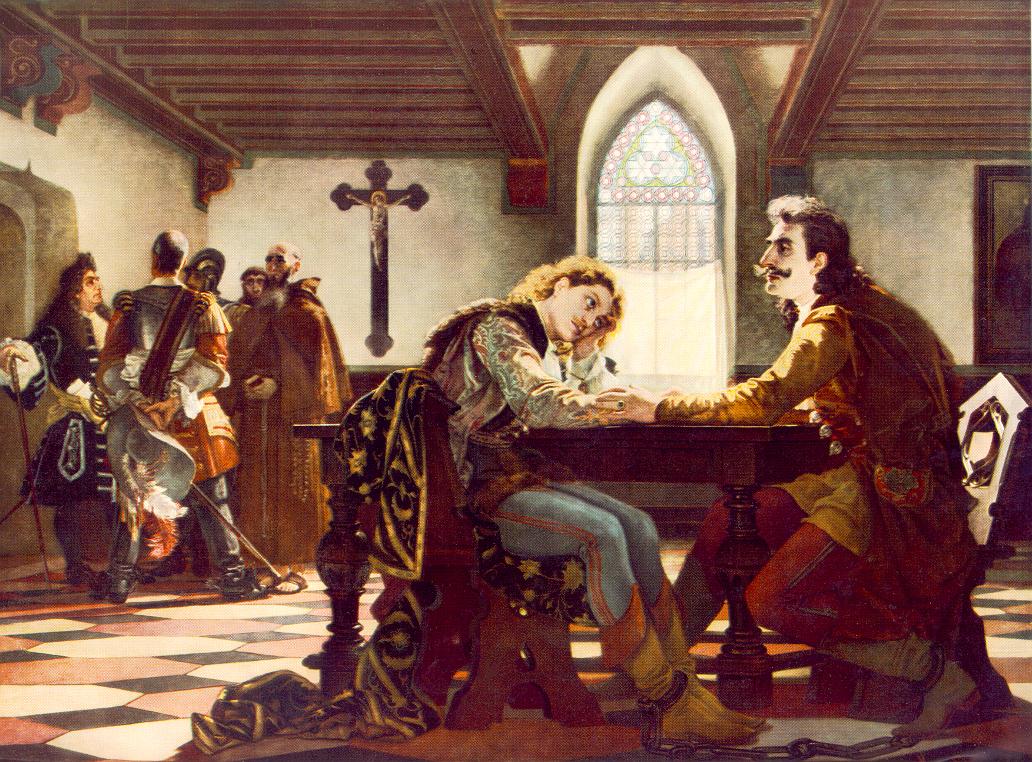
Zrinski and Frankopan in the Wiener-Neustadt Prison, by Viktor Madarasz (1864)

Royal vengeance against the plot shattered two mighty noble houses: the Zrinskis were all but destroyed by the seizure of their estates. The Frankopans — an ancient and far-flung family whose Italian Frangipani branch was even then about to yield a pope — were done as major players.

After these executions, anti-Hapsburg sentiment metastasized in Hungary into outright rebellion.

But in what was left of Croatia, the loss of the two largest landholders spelled the end of effective resistance until the era of 19th century romantic nationalism — when our day’s unfortunates were recovered as honored national heroes.

Zrinski and Frankopan are pictured on modern Croatia’s five-kuna bill, and were both reburied in Zagreb Cathedral after World War I finally claimed the Austrian Empire. (They also got memorial plaques in Wiener-Neustadt) Their mutual relation Katarina Zrinski, who avoided execution but was shut up in a convent, was a writer as well, and has ascended to the stars of founding patriotess, seemingly the go-to namesake for most any Croatian women’s civic organization. (Dudes honor the House of Zrinski by slapping the name onto sports clubs.)

On this day..

1905: Chief Zacharias Kukuri

On this date in 1905, in the midst of Germany’s genocidal destruction of the Herero people in its Southwest Africa colony (present-day Namibia), the Otjosazu chief Sacharias Kamaituara Kukuri was hanged in Windhoek.

More than half the Herero population perished following an abortive attempt to resist German colonization during this unfortunately little-remembered period, perhaps the very first of the 20th century’s ample store of genocides.

Our man’s execution occurred at the moment of a policy pivot: after the horrific extermination policy initially practiced by General Lothar von Trotha, Germany’s Herero policy was “moderating”. Von Trotha’s extermination order had been officially reversed by Berlin; by November of 1905, the murderous general would be recalled to Germany. Instead, they’d be collecting the Herero into concentration camps.

It was into the Windhoek camp that Kukuri arrived as the wounded prisoner of a German ambush.


The concentration camp under the walls of Windhoek’s Alte Feste (Old Fort). Today, the fort is a museum … and the camp, forgotten, is the grounds of a high school. (Source)

Of course, it goes without saying that, even if state policy no longer aimed officially at racial annihilation, the system of concentration camps continued the de facto genocide: the systematic destruction of Herero life in order to incorporate the population as a subject proletariat (enlightened self-interest — the colony’s “economic future would be completely destroyed by the extermination of the indispensable labor power” — is what finally trumped von Trotha). At the same time, camps structured a punitive neglect of Herero living conditions, a years-long “period of suffering” in which Herero died of overwork, malnutrition, disease and neglect as surety against any future resistance. Courts-martial of fighting-age men alleged to have had some hand in resisting by arms the German onslaught completed the salutary lesson.

Missionary sources provide us with eyewitness accounts of conditions in the camps. Missionaries stationed in the Herero Konzentrationslager reported to their superiors in Germany on the extensive and unchecked rape, beatings and execution of surrendered Herero by German soldiers. Missionary Kuhlmann spoke of the delight of settler women witnessing the drawn-out public hangings of captured Herero in Windhoek. At one such hanging, a drooling Herero fighting for his life was berated” ‘You swine, wipe your muzzle’. (pdf source)

Kukuri fell into this last category.

His fate is especially poignant for us (and, convenient to date) thanks to the memoirs of Friedrich Meier, one of the many German Christian missionaries who had poured into Namibia ever since it became a German colony. As Meier’s account of swapping Biblical allusions with Kukuri in the shadow of the latter’s gallows underscores, these missionaries had achieved some inroads.

I did not see the slightest trace of fear on him, instead it was as if he were going to a wedding. ‘Muhonge’, he said at one stage, ‘oami otja Elias mohamakuao na je otjinga me keende kejuru metemba,’ i.e. ‘Muhonge, like Elias, I too travel to heaven in a waggon.’

Having arrived at the execution site, I noticed how he kept looking at the gallows, at which preparations were still taking place. I feared for his tranquility and asked him to stop looking at it. ‘Muhonge,’ he said to me, ‘I hear everything, why should I not look at it? For is it not “my wood” [my cross]?’

When we finally stood underneath the gallows, we prayed together that beautiful song: ‘So then take my hand and lead me.’

German:

English:

Possibly he noticed that I was worried about him. Anyway when I was finished he said, ‘It would appear that you still fear that I am afraid, but have I not told you: “When a father calls his child, does that child then fear to go to him?” Give my wife, who is in Okahandja, my greetings and tell her that I have died in the faith of the lord Jesus, so too tell my children if you should ever see them.’ I asked him again to be infatuated with the lord Jesus. ‘Lord Jesus, you help me,’ with this, after he had given me his hand, he climbed up the ladder. Soon the noose was laid around his neck. And then — never will I forget that moment — the unheard-of happened, as he fell the noose slipped and the wretch fell to the ground. He lost consciousness for a moment, so too, the observers were dumbstruck. Today I still see how his eyes sought me out. Soon, however, two soldiers were there, they lifted him up, and then a little to the side, on orders of the major who led the proceedings, he was shot.

Kukuri’s grave can still be seen at the Gammans cemetery (German link) in Windhoek.

His memory as an emblem of Herero dignity under persecution also remains in present-day Namibia.

Anette Hoffmann (in “The Merits and Predicaments of Opacity: Poetic Strategies of Evasion and Resistance” for the fall 2007 Research in African Literatures) relates a later “praise poem” for 1959 Herero martyrs, whose allusion to the hanged chief (as “Hauzeo”) emphasizes his agency, rather than his victimhood.

For he as the son of the chief Kukuri and must die since Samuel Maherero had escaped to Botswana. They said that if they kill him, then that could serve as a symbol that they had exterminated the sovereignity of the Herero … he was taken to a tree near the White’s cemetery in Otjomuise, which is still here today. I can show you his grave. He is still there until now, near the railway line to Aris … when he was taken to the tree, the tree of Hauzeu, as you hear about it, it was said: now you will be hanged to die. Heavily wounded as he was, he had a rope around his neck and was hanged. However, his weight broke the rope. Then the Germans said he was innocent and had to be released. But he himself insisted to be hanged again … [he said] “I have come to see the children of Tjamuaha’s house, those left in the camps of enslavement: to see them with my own eyes … this is why I have come: take me up the tree.” They did and he died. He lies at Hauzeu’s tree. He had given himself to be hanged.

On this day..

1815: Anthony Lingard, the last gibbeted in Derbyshire

On this date* in 1815, Anthony Lingard was hanged for murder and robbery at Derby.

Lingard strangled the widow who operated the Wardlow Miers tollbooth in order to rob her poor possessions and lavish those ill-gotten proceeds upon the girl he had impregnated — “with a view to induce her to father the child upon some other person.” That’s the world without contraception for you.

Lingard’s girl thought this bribe fishy and gave him back the widow’s incriminatingly distinctive shoes after hearing reports that footwear had been taken from the murder scene. Then, she testified against him at the Derby Assizes (Lingard had also confessed the crime). Tried on Saturday the 25th, convicted “after a few minutes,” and strung up in front of the county gaol at noontime Tuesday, Lingard “met his fate with a firmness which would deserve the praise of fortitude if it was not the result of insensibility. He appeared but little agitated or dejected by his dreadful situation.”

Rather than the increasingly standard post-execution coda of anatomization, Lingard’s body was given over to a use of more ancient vintage: gibbeting.

Hung up in chains on the aptly named Gibbot Field in Wardlow near the spot of the murder, Lingard’s bleaching bones provided a grisly object lesson to passersby of the consequences of crime. Or, maybe not: though the novelty at first made a crowd-pleasing spectacle, it soon faded into the scenery.

A few years later, a 16-year-old girl poisoned off a rival in the very shadow of the gibbet, winding up executed for her trouble. A younger fellow named William Lingard eventually drew a death sentence for highway robbery committed near his own older brother’s clanking remains — a sentence commuted to convict transportation.

If what was left of Anthony Lingard failed to overawe his criminal counterparts, it did at least leave an impression on poet William Newton, who penned this sad meditation on the local landmark, found in full here. (It must have helped his perspective that Newton was into his sixties when the young pup hanged.)

“The supposed Soliloquy of a Father, under the Gibbet of his Son; upon one of the Peak Mountains”
TIME — Midnight. SCENE — A Storm.

 Art thou, my Son, suspended here on high? —
Ah! what a sight to meet a Father’s eye!
To see what most I prized, what most I loved.
What most I cherish’d, — and once most approved,
Hung in mid air to feast the nauseous worm.
And waving horrid in the midnight storm!

 Let me be calm; — down, down, my swelling soul;
Ye winds, be still, — ye thunders, cease to roll!
No! ye fierce winds, in all your fury rage;
Ye thunders, roll; ye elements, engage;
O’er me be all your mutual terrors spread.
And tear the thin hairs from my frenzied head:
Bring all your wrathful stores from either pole.
And strike your arrows through my burning soul :
I feel not, — fear not, — care not, — shrink not, — when
I know, — believe, — and feel, — ye are not men!
Storms but fulfil the high decrees of God,
But man usurps his sceptre and his rod.
Tears from his hand the ensigns of his power.
To be the petty tyrant of an hour.

 My Son! My Son! how dreadful was thy crime!
Thy name stands branded to remotest time;
Gives all thy kindred to the eye of scorn,
Both those who are, and those that may be born;
Scatters through ages on thy hapless race
In every stage of life, and death, — disgrace:
In youth’s gay prime, in manhood’s perfect bloom.
Ah! more, — it ends not, dies not, on the tomb!
O woman! woman! choicest blessing given.
If pure; — the highest gift of highest heaven!
If lax, corrupt, deceitful, — worse than hell!
Worse than the worst of demons dare to tell!
It was thy lot, ill-fated Son! to find
Thy doom pour’d on thee by the faithless kind;
Fraudful, and false, their treacherous snares they spread.
And whelm’d destruction on thy thoughtless head.

 To die, to perish from the face of earth.
Oblivion closing on thy name and birth.
Hid under ground from each invidious eye,
From every curious, every rancorous spy,
Was what thy crime deserved: — not more;
The rest seems cruelty. — When heretofore
Our barbarous sires the aweful Gibbet rear’d.
The Gibbet only, not the laws were fear’d:
The untutored ruffian, of an untaught clime,
Fear’d more the punishment than dreaded crime.
We boast refinement, say our laws are mild.
Dealt equally to all, the man, the child: —
But ye, who, argue thus, come here and see,
Feel with a Father’s feelings; — feel with me!
See that poor shrivell’d form the tempest brave.
See the red lightning strike, the waters lave.
The thunders volleying on that fenceless breast! —
Who can see this, and wish him not at rest?

At rest, — vague word! — the immaterial mind
Perhaps even now is floating on the wind: —
Ah! no, — not mind, — not spirit, — but the shell;
The mind ere this has drank of Mercy’s well:
‘Tis not for that I feel, for that I sigh.
But sweltering, putrid, rank mortality.
O! blind to truth, to all experience blind.
Who think such spectacles improve mankind:
Bid untamed youth on such sights feast his eyes,
Harden you may, but never humanise.
Ye who have life, or death, at your command.
If crime demand it, let the offender die.
But let no more the Gibbet brave the sky:
No more let vengeance on the dead be hurl’d.
But hide the victim from a gazing world.

Anthony Lingard was the last person ever gibbeted in Derbyshire. England abolished gibbeting and hanging in chains full stop in the 1830s.

* The date March 8 is widely attributed on other sites, but the primary documentation for March 28 is unambiguous. I want to suspect a seminal typo somewhere that’s been copied a thousand other times over.

On this day..