Mikhail Yaroslavich (English Wikipedia page | the much more detailed Russian) in 1304 succeeded Alexander Nevsky’s younger brother as Grand Prince of Vladimir, a position granted by Mongolyarlyk that symbolized primacy over all other Russian knyazes. But Mikhail was challenged for leadership by his cousin, the Grand Prince of Moscow.
This fellow, Yuri(y) by name, would fight Mikhail off and on for the latter’s 14 years in power. Their personal rivalry was also the political rivalry of their respective cities, Moscow and Tver — vying for that yarlyk and, in effect, for the eventual leadership of the still-gestating Russian state.
Since it was gestating at the pleasure of the Khanate at this time, the dispute was resolved by Yuri’s getting in with the new khan, Uzbeg.* To get that yarlyk, and he got it in 1317, Yuriy even went so far as to marry one of Uzbeg’s daughters.
We mention this not because it’s a piquant period detail of kingly politics and intercultural exchange, but because the next time Mikhail and Yuriy met in battle, Mikhail won a rout … and ended up with the Mongol princess in his custody.
And then, she died in his custody.
This was a most grave development for Mikhail, almost as much as for the wife herself.
The Mongol commander whom Mikhail released — because Yuriy also got a Mongol army out of the yarlyk deal — reported the tragedy with the most incriminating coloration. While we’re in no position to assert definitively that Mikhail didn’t murder the woman, it plainly does not fit the cui bono test.
The furious Uzbeg summoned Mikhail to the Horde, a summons that, times being what they were, did not admit refusal.
When he arrived, Mikhail found himself already stitched up by the accusations of his enemies, and he was beaten and stabbed to death at the khan’s order.
Mikhail mostly reads as a garden-variety unprincipled local ruler, and he had his own conflicts with ecclesiastical leaders when they took the wrong sides in the Moscow-Tver power struggle. In spite of that, our man was posthumously expropriated by the Orthodox church as a saint.** In fact, he’s the patron saint of the city (which he’s holding, in the icon pictured above) … kind of because of what happened next.
Mikhail’s son Dmitry “the Terrible Eyes” had a terrible revenge for his father’s enemy, and murdered Yuri a few years later, temporarily gaining the yarlyk for himself. The Muscovites almost immediately recaptured the upper hand, however, and in an ensuing Tverite rising the Mongols intervened directly and sacked the city.
Tver would never again regain anything like peer status vis-a-vis Moscow, which in the following years grew larger, stronger, and wealthier under Ivan I; the Mongol yarlyk thereafter became essentially the hereditary possession of his family line. The Orthodox metropolitan outright moved to Moscow under Ivan’s reign … leaving Tver with memories of what might have been, and this monumental equestrian statue of the guy who couldn’t quite make it happen.
Although the “Tartar yoke” would eventually be thrown off, that was hardly the end for political domination in Russian history.
Experiencing a like phenomenon in altogether different circumstances, the 19th century Decembrist poet Alexander Bestuzhev, aka Marlinsky reclaims the long-ago Mikhail for an updated usage.†
His 1824 poem “Mikhail Tverskoy” (Russian link) casts the knyaz as a martyr for the Russian nation. After all, by Marlinsky’s time, the poet could take comfort that those terrible Mongols were
struck by their vassals,
[And] became their slaves‡
* Also Ozbeg or Uzbek. The longest-tenured khan in the Mongol empire’s history, Uzbeg adopted Islam and might be the namesake of the Uzbek ethnic group.
** According to this tome on the Russian church, Mikhail wasn’t really venerated as a saint until centuries after his death: only when that occurred were hagiographical details of his pious life, principled refusal to worship pagan Mongol gods, and supposed contemporary popular cult backfilled into the story.
† A maneuver quite like his friend Kondraty Ryleyev, who pulled the same trick with Severyn Nalyvaiko.
‡ Full original translation of this poem by friend of the blog Sonechka.
“Mikhail Tverskoy”
by Bestuzhev-Marlinskiy
In a dungeon, glum and hollow,
Amidst nocturnal gloom,
A darkish lampad flickers,
And shines its flimsy light
Upon two men within a shady corner:
One, in his youthful years’ prime,
The other, fettered in chains,
Adorned already with gray hair.
Why has this elder been immured
Within your walls, Abode of fear?
Is he condemned to end existence hither,
Or were the gallows meant for him?
No sighs escape his mouth,
And in his fervent eyes —
The glimmer of serenity divine.
Towards the skies his gaze is often cast,
Or with a tender sorrow, he beholds
His son, imbued with grief,
And speaks in consolation:
“Enough, my dear friend,
Of tears sousing your eyes;
The time has come for us to part,
And buy the tranquil calm of native land
with Mikhail’s head.
Be always honorable, truthful.
And, if you wish
To pay your father homage,
Relinquish all the enemies of his without vengeance …”
The people clatter at the square
In the metropolis of brutal khans,
These Russia’s fierce and evil tyrants;
They gawk with savage joy
At the cadaver, beset by wounds.
Above him, smitten by despair,
The young prince weeps,
And rips his clothes and hair,
Reproaching the Tartars and Uzbeks,
And summoning the deity of vengeance …
This mighty god has heeded prayers,
And aided Russians in revolt;
Obliterating the oppressors,
Whose city turned into the ravens’ dwelling;
Whose fields of wheat were desiccated,
Whose hand that held the arms grew weak,
Who, struck by their own vassals,
Became their slaves.
On an unknown date in (perhaps) the 860s, Norse raider Ragnar Lodbrok (or Ragnar Lothbrok) was allegedly put to death in the Indiana Jones-esque manner of being cast into a pit of snakes.
Ragnar is a half-legendary character who plundered France and Britain in the mid-ninth century, the heyday of Viking marauders; he’s also the lead character of the cable TV series Vikings.
He’s known from Scandinavian sagas, like the Ragnarssona Þattr, which describes Ragnar’s final battle after shipwrecking in Northumbria.
At that time, there was a king called Ælla ruling over Northumbria in England. And when he learns that raiders have come to his kingdom, he musters a mighty force and marches against Ragnar with an overwhelming host, and hard and terrible battle ensues. King Ragnar was clad in the silken jacket Aslaug had given him at their parting. But as the defending army was so big that nothing could withstand them, so almost all his men were killed, but he himself charged four times through the ranks of King Aella, and iron just glanced off his silk shirt. Finally he was taken captive and put in a snake-pit, but the snakes wouldn’t come near him. King Aella had seen during the day, as they fought, that iron didn’t bite him, and now the snakes won’t harm him. So he had him stripped of the clothes that he’d been wearing on the day, and at once snakes were hanging off him on all sides, and he left his life there with much courage.
Here’s Ernest Borgnine as Ragnar in the 1958 film The Vikings, dying in a pit full of wild dogs, not snakes. Well, it’s the same animal kingdom.
“How the little pigs would grunt if they knew how the old boar suffers!” he’s supposed to have exclaimed, keeping to the nature theme.
Although Vikings didn’t really seem to need a casus belli to pillage England, the little pigs would in fact do some serious grunting when they found out about the boar: Ragnar’s sons punitive sorties against England martyred the Christian king St. Edmund.
Update: When this post was first written in 2011, information about this distant Viking captain was not all that plentiful. Ragnar’s starring turn in a TV serial since that time has somewhat broadened his cultural footprint.
On this date in 1937, Elena Aleksandrovna Vasilieva arrived to Moscow’s Lefortovo Prison to visit her husband, “peasant poet” Pavel Vasiliev.
“He’s been transferred to another place,” she was told.
He had been: six feet under, that very day.
Vasiliev hailed from a Cossack family in Kazakhstan, and he would fight his short life’s literary battles with a pugnacity reflecting his youthful work as a sailor and gold miner in Siberia. He was renowned for his boozing and carousing.
While the Futurists waxed eloquent over the wonders of the new machine age, the peasant writers and poets were moved by a strong revulsion for industrialization … [and glorified the village and longed to return to the simple life of rural Russia. At the same time the futility of their dream was evident even to them, and their writings are often of a tragic bent.
And bents tended towards tragedy in the 1930s.
A little too outspoken for his own good, Vasiliev openly defended Nikolay Bukharin (arrested in February 1937) as “the conscience of peasant Russia,” and characterized the politically expedient denunciations made by fellow scribblers as “pornographic scrawls on the margins of Russian literature.”
It’s a remark that would age a lot better than the man who uttered it.
The admiration of many contemporaries — Pasternak considered Vasiliev brilliant (see this Russian biography; most of the information about Vasiliev online is in Russian) — could hardly aid a man coming under official fire for “kulak bohemian ideology.” Vasiliev did prison stints (Russian again) in the early 1930s for counter-revolutionary writing, and then for “malicious hooliganism” after whaling on a former friend who had denounced him in print.
I accept the title of a rumbler,
If the brattle of gusli is thunder.**
Pavel scorned the warning, leaving his widowed Elena to husband his many unpublished verses until they could finally be published (and the poet rehabilitated) in the 1950s, after Stalin died.
* The most famous poet of this school was Sergei Yesenin, whose death at the end of a hangman’s rope at age 30 is unfortunately not eligible for this site … since Yesenin put up the rope himself. Live fast, die young, and leave a beautiful corpse.
On this date in 1655, Catholic forces under the Duke of Savoy carried out a notorious massacre of Waldensians* in the Piedmont.
This interesting, excommunicate sect had persisted for centuries in those hard-to-reach places in Alpine foothills, intermittently ignored and hunted. After Martin Luther, many Protestants inclined to see them as a proto-Reformation movement, or even a counter-papal apostolic succession reaching back to ancient Christianity.
At any rate, they sure weren’t Catholic.
And our friend the Duke decided — perhaps piqued by the murder of a missionary Catholic priest, or for whatever other reason — to mount one of those heresy-extirpating sorties and make them Catholic in 1655.
On April 17, the Marquis of Pianezza appeared with an overwhelming force of mixed Piedmontese, French, and Irish** troops. They conducted a few skirmishes, then made nice with the Waldensian civic leaders and induced them to quartering their troops temporarily further to some expedient pretext.
Alas! alas! these poor people were undone. They had received under their roof the executioners of themselves and their families. The first two days, the 22d and 23d of April, passed in peace, the soldiers sitting at the same table, sleeping under the same roof, and conversing freely with their destined victims …
At last the blow fell like a thunderbolt. At four of the clock on the morning of the 24th April the signal was given from the Castle of La Torre. But who shall describe the scenes that followed? On the instant a thousand assassins began the work of death …
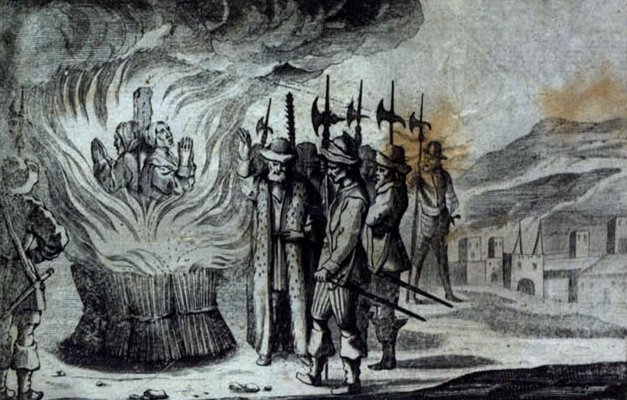
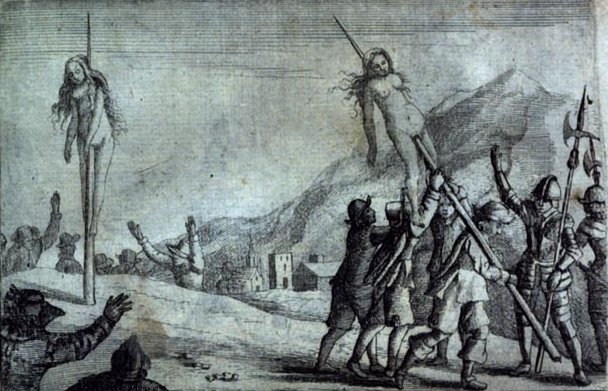
Little children were torn from the arms of their mothers, and dashed against the rocks; or, more horrible still, they were held betwixt two soldiers, who, unmoved by their piteous cries and the sight of their quivering limbs, tore them up into two halves. Their bodies were then thrown on the highways and the fields. Sick persons and old people, men and women, were burned alive in their own houses; some were hacked in pieces; some were bound up in the form of a ball, and precipitated over the rocks or rolled down the mountains … Some were slowly dismembered, and fire applied to the wounds to staunch the bleeding and prolong their sufferings; some were flayed alive; some roasted alive; others were disembowelled; some were horribly and shamefully mutilated, and of others the flesh and brains were boiled and actually eaten by these cannibals.
Without doubting the capacity of man’s inhumanity to man, the cannibalism charge reminds that we’re dealing with propaganda alongside historiography. And what great propaganda — like, babies-torn-from-incubators great.
Thumbnails (click for a larger, disturbing view) of selected images of this date’s atrocities from Samuel Morland’s The History of the Evangelical Churches of the Valleys of Piedmont
And there’s little doubt as to the overall savagery of the affair, which could well have become the opening salvo in a full-scale sectarian cleansing campaign. (A later addendum to Foxe’s Book of Martyrsnarrates the ensuing Piedmontese armed struggle, petering out before any definitive resolution in the field.)
Outrage at this hecatomb spread in Protestant Europe — which would also refer to the day’s doings as the “Bloody Easter,” since it corresponded with the eve of that celebration as reckoned by the Julian Calendar (source).
It was felt especially in Protectorate England, which intervened diplomatically.
A “day of solemn fasting and humiliation” was promulgated in Albion, along with collections for the relief of the survivors. Oliver Cromwell personally put £2,000 into the kitty.
More importantly, he dispatched diplomat Samuel Morland† to force the House of Savoy to lay off the persecution; in fact, he threatened to disrupt high statecraft between England and France unless the French twisted arms on behalf of the Waldensians.
Written correspondence for Morland’s diplomatic tour addressed to Louis XIV of France and various other continental potentates, as well as a fiery bit of oratory that Morland delivered to Savoy, all seem to have originated from the pen of Republican scribbler John Milton — the future author of Paradise Lost.‡
Milton, for whom the whole thing was more than just a day job, was further moved to put his umbrage at the slaughter into sonnet form:
Avenge O Lord thy slaughter’d Saints, whose bones
Lie scatter’d on the Alpine mountains cold,
Ev’n them who kept thy truth so pure of old
When all our Fathers worship’t Stocks and Stones,
Forget not: in thy book record their groanes
Who were thy Sheep and in their antient Fold
Slayn by the bloody Piemontese that roll’d
Mother with Infant down the Rocks. Their moans
The Vales redoubl’d to the Hills, and they
To Heav’n. Their martyr’d blood and ashes sow
O’re all th’ Italian fields where still doth sway
The triple Tyrant: that from these may grow
A hunder’d-fold, who having learnt thy way
Early may fly the Babylonian wo.
* The Waldensians in question here are interchangeably known as the Vaudois for their geographic region, actually above the Piedmont and abutting the Swiss region also known as Vaud. (These pages have visited the latter.)
On this date in history, Anne Line was hanged for harboring Catholic priests in Elizabethan England.
There’s not too much question of her “guilt.”
I am sentenced to die for harbouring a Catholic priest, and so far I am from repenting for having so done, that I wish, with all my soul, that where I have entertained one, I could have entertained a thousand.
-Anne Line at the scaffold
She’d been disinherited from her Calvinist family for converting to Catholicism, and scratched out a living teaching and embroidering and keeping safe houses for forbidden Catholic clergy.
That house was raided in early February of 1601, and while the priest escaped, Anne Line did not.
Just one day after conviction, she hanged at Tyburn along with two priests, Roger Filcock and Mark Barkworth.
One of the possible interpretations (.doc) of Shakespeare’s recondite allegorical poem “The Phoenix and the Turtle” is that it’s about Anne (the phoenix) and her husband Roger Line (the turtledove; he predeceased her).
Death is now the phoenix’ nest;
And the turtle’s loyal breast
To eternity doth rest,
Leaving no posterity:–
‘Twas not their infirmity,
It was married chastity.
Truth may seem, but cannot be:
Beauty brag, but ’tis not she;
Truth and beauty buried be.
To this urn let those repair
That are either true or fair;
For these dead birds sigh a prayer.
Update: Embargoed as of this post’s publication, Joe Arridy’s growing ranks of supporters had submitted to Colorado Gov. Bill Ritter an application for a posthumous pardon. On January 7, 2011, Gov. Ritter granted that pardon — a fitting conclusion to a cinematically heart-rending story.
“Granting a posthumous pardon is an extraordinary remedy. But the tragic conviction of Mr. Arridy and his subsequent execution on Jan. 6, 1939, merit such relief based on the great likelihood that Mr. Arridy was, in fact, innocent of the crime for which he was executed, and his severe mental disability at the time of his trial and execution. Pardoning Mr. Arridy cannot undo this tragic event in Colorado history. It is in the interests of justice and simple decency, however, to restore his good name.”
-Gov. Bill Ritter
On this date in 1939, Joe Arridy “walked to his death with the faith of a child” (Los Angeles times, Jan. 7, 1939) up “Woodpecker Hill” — where the victims of Canon City, Colorado’s gas chamber (since retired) were buried.
Shortly before execution, Joe Arridy gives away the toy train he received from warden Roy Best to a fellow prisoner.
A young Syrian-American with the mental age of a six-year-old riding the rails during the Depression, Arridy was picked up for a teenage girl’s rape-murder in a literal lynch-mob environment: he was nearly pulled from his cell for summary punishment.
Instead, the good citizens let justice run its course to the same conclusion.
The damnable thing — well, the other damnable thing — is that we have about as much reason to believe Joe Arridy committed the crime as we do you or I.
He was linked to the murder by nothing but an evolving series of unreliable confessions fed by the sheriff to his suggestible prisoner (and, later, a single “matched” hair with a suspicious chain of custody; matching hair without DNA is still an unreliable forensic technique today). The real murderer was even in custody, and was executed for the same crime while Joe Arridy’s appeals ran their futile course.
“Believe me when I say that if he is gassed, it will take a long time for the state of Colorado to live down the disgrace,” Arridy’s appellate lawyer pleaded to a deaf court.
This post is an edited version of Perske’s affidavit to the governor’s office in support of the pardon.
On March 28, 1992, Sociologist Richard Voorhees sent me a poem from an out-of-print book that described a warden weeping as he watched a man in a death row cell playing with a toy train before being walked to a gas chamber (“The Clinic” (.doc) by Margeurite Young in Moderate Fables, 1944).
“The man you kill tonight is six years old,
He has no idea why he dies,”
Yet he must die in the room the state has walled
Transparent to its glassy eyes.
I sent a copy of the poem to Watt Espy, Director of the Capital Punishment Archives, in Headland, AL. Espy researched and responded with information that tied the poem to the life and trials of Joe Arridy who at age 23 was executed on January 6, 1939.
During the next two years after receiving the poem, I traveled up and down the Eastern Slope of the Rocky Mountains from Cheyenne to Pueblo, and to Grand Junction on the Western Slope. News stories were discovered from the reading of old microfilm rolls in The Pueblo Chieftain, The Denver Post, The Rocky Mountain News (Denver), The Daily Sentinel (Grand Junction) and Wyoming Tribune (Cheyenne). Archivists and historians were interviewed at The Regional History Division of Western Colorado (Grand Junction), Wyoming State Archives (Cheyenne), District Archives of the Pueblo Public Library, Local History Center of the Cañon City Public Library, and the Colorado State Archives (Denver).
Joe Arridy’s Earliest Years
Joe Arridy was born to non-English speaking Syrian immigrants in Pueblo, Colorado on April 29, 1915. He attended the first grade in Bessemer Elementary School. At the beginning of his second year, the principal called on the Arridy family and told them that their son could not learn and asked them to keep him at home. The parents reported that for the next four years, Joe stayed around the house. He was a passive but happy child. According to his parents he was the happiest when he was alone playing all by himself. His favorite pastime was making mud pies.
Intelligence Testing and Institutionalization
At age 10, Joe was committed to the Colorado State Home and Training School for Mental Defectives, in Grand Junction. He was administered the Binet-Simon Test. The results showed that he was unable to repeat four digits (4-3-7-9). When shown the color red, he said it was black and that green was blue. He usually spoke in incompete two or three word sentences. As the questions became harder to answer, he remained silent. The examiner listed him as “an imbecile with an IQ of 46.” Later his institutional records showed no critical incident reports. For the most part he was a shy and quiet loner.
Nine months later, Joe’s father missed his son. He asked for his son to be returned home. The request was granted. Upon his return, he tended to take lonely walks all over town. These walks continued for three years.
At age 14, the walks came to an end when a probation officer caught a gang of boys performing sexual acts on him. The officer wrote an angry letter to the court, labeling Joe as “one of the worst mental defective cases that I have ever seen.” The court ordered his immediate return to the institution in Grand Junction.
During the next seven years at the institution, his records show that he was incapable of working on the farm crews or sitting in classrooms. Therefore, he was given a “day activity,” working side by side with a kindly kitchen worker, “Mrs. Bowers.” The worker reported that Joe was only capable of “Tasks of not too long duration, can wash dishes, do mopping of floors, can do small chores and errands. He depends on others for leadership and suggestions.”
Railroad Boxcar Riding
At age 22, he and a few other inmates watched men riding on top of railroad boxcars that passed the institution. So together they wandered off the institution grounds and also jumped on boxcars. They took the 24-hour ride through the mountains to Pueblo. Later they took the trip back. Joe was last seen in Grand Junction on the evening of August 13, 1936. He was believed to have jumped onto a boxcar either that night or on the next morning.
After that, Arridy disappeared from sight until he walked up to the kitchen car of a railroad work gang on August 20, in the East Railroad Yards of Cheyenne, Wyoming, dirty and hungry.
Rape and Murder in Pueblo
On Saturday evening, August 15, 1936, slightly before or after midnight, Dorothy Drain, 15, and Barbara Drain, 12, were bludgeoned about their heads while sleeping together in the same bed, at 1536 Stone Avenue in Pueblo. Dorothy was raped and beaten to death. Barbara was near death, but survived. Later, she identified Frank Aguilar as the attacker at his trial. She was not present at Joe Arridy’s trial. She did not even identify Joe Arridy as a co-attacker.
Sheriff Gets a Confession from Arridy Even Though the Real Killer is Already in Custody
On August 26, 1936, Joe Arridy was arrested by two railroad detectives and turned over to Sheriff George Carroll. Carroll, like all law officers in all of the towns up and down Colorado’s Eastern Slope, was actively picking up suspects and interrogating them regarding the attacks on the Drain girls in Pueblo.
After an hour and a half of questioning, Carroll called a reporter and told him that he had just received a complete confession for the Pueblo crime from Arridy. He recited to at least one reporter a long series of wordy, complete sentences that Arridy purportedly uttered. According to Carroll, Arridy was the lone killer and he committed the crime with a club.
At first, when Pueblo Police Chief J. Arthur Grady received news of the confession, he was shocked. The real killer, Frank Aguilar, a former WPA worker who had been supervised by the Drain girls’ father, had already been arrested for the crime.
Aguilar had been arrested during the funeral of Dorothy Drain. The Pueblo police had even recovered the weapon used in the crime. It was the head of a hatchet with nicks that matched the wounds on the girls. The Pueblo police kept all this evidence in silence because Aguilar vehemently denied committing the crime.
Following that, Sheriff Carroll changed his story. After conducting another interrogation, he then reported to the press that a hatchet—not a club—was used in the crime. He also claimed that Arridy did not do the crime alone. According to Carroll, Arridy said he did it “with Frank.”
Sheriff Carroll was a famous but loquacious individual who was known to talk long and loud about being in the posse that finally caught up with and finished off the notorious Barker gang.
Now with his regular announcements to the press he remained at his long-worded best. Carroll had been so totally verbal in his interrogations of Arridy, nothing was written down on paper. Nor was any confession signed. Consequently the confessions and changes in them were dictated daily to reporters.
Later, in the trial of Arridy, Sheriff Carroll became the star of the case. He spoke in his heroic, over-wordy style. According to the press, he did not speak from a single note. He simply testified from memory.
Frank Aguilar is Quickly Convicted
Aguilar’s trial came quickly, starting on December 15, exactly four months after the crime. It ended seven days later. His executed came quickly, too: on August 15, 1937, just two days short of the anniversary of Dorothy Drain’s murder.
Aguilar Identified as Lone Murderer in an Identical Crime in the Same Neighborhood
After the death sentence, Aguilar was brought face to face with Mrs. R. O. McMurtree, 58, who identified Aguilar as the lone attacker in a similar crime that happened two weeks earlier and just three blocks away from the Drain crime. She and her aunt, Sally Crumply, 72, were sleeping in the same bed when Aguilar attacked. He beat them on the heads as he had done in the Drain home. Like Dorothy Drain, Sally Crumply was bludgeoned to death.
Sheriff Carroll Assumes Leadership in all Aspects of the Arridy Investigation
After announcing Arridy’s first confessions to reporters and Chief Grady, two Pueblo detectives sped through the night to Cheyenne. The next morning, they joined in an added interrogation with Carroll leading it. Then they drove back to Pueblo.
Later that day, Carroll drove Arridy to Pueblo. He was present at the Pueblo Police Station when Arridy and Augilar may have been brought together. He took leadership when Arridy was taken to the Drain home and the crime was reenacted. He was present at the prison in Cañon City when Aguilar gave a signed confession that marginally included Arridy’s initials in a lower left column. That confession was printed in its entirety in the Pueblo Chieftain but was withdrawn and was never heard in a court.
Sheriff Carroll Became Chief Presenter of Evidence Against Arridy
During the prosecutor’s evidentiary presentations, Sheriff Carroll took the stand five different times. The transcript shows how Carroll was allowed to launch forth as a riveting story teller. He testified that Arridy was in complete control of his thoughts, and speaking in clear sentences that described the colors on the walls in the bedroom and the colors of nightgowns that the girls wore, and even the colors of the dresses the girls would be wearing when they went to the Sunday church services.
The Joe Arridy that Carroll described was a far cry from the Arridy who often spoke in unfinished sentences and did not know who Franklin Delano Roosevelt was. Nor did he know what a hatchet was or that his own father was present in the courtroom.
The Defense Loses in a Sanity Hearing, and Eschews an Evidentiary Defense
The defense argued at a pre-trial sanity hearing that Arridy was “Not Guilty by Reason of Insanity”. The question before the court: “Does Joe Arridy have the capacity to tell good from evil and right from wrong?” If not, he should be found to be insane and not guilty. Three psychiatrists testified that Arridy did not know right from wrong, but they hedged by saying that he was not insane. According to them, one needed to be normal first before ever being insane, and they claimed that Arridy had never been normal.
The jury deadlocked at six to six, but an hour later, voted that Arridy would have to go on trial for murder.
As strange as it may seem today, the defense attorney had conducted no investigation in the case. At the beginning of the trial he announced that he would not present an evidentiary defense and would only cross-examine witnesses for the prosecution.
He then requested that the judge set aside the earlier sanity trial verdict and that he be given permission to argue a sanity case one more time. He furthermore requested permission to make his opening argument only after the prosecution had completed with its evidentiary case. The judge agreed to all of these conditions.
The same three psychiatrists (joined by a fourth) gave the same testimony once again.
But Sheriff Carroll voiced his views unchallenged. After touting his 30 years of experience and claiming that he interrogated Arridy for “six or seven hours,” the prosecutor asked him, “Based on your experience [is] Joe Arridy capable of distinquishing right and wrong?” Carroll responded, “I think there is no doubt, whatever, but what he is”.
A verdict of “guilty” was rendered on April 17, 1937, and Arridy was sentenced to death.
On August 13, 1937, Frank Aguilar was executed, and on the same day, Sheriff Carroll and two railroad detectives received a $1000 reward for making the arrest of Joe Arridy in Cheyenne.
For a year and a half, a pro bono “Citizen Lawyer” Gail Ireland fought valiantly to save the life of Joe Arridy. During that period, Ireland managed to win at least six stays.
On January 6, 1939 at 6:15 p.m., the Colorado Supreme Court voted 4-3 to deny the last petition. Governor Teller Ammons called the warden at 6:30 p.m. and ordered that the execution be carried out.
The chaplain administered the Roman Catholic Church’s “Last Rites for a Child.” It called for the Chaplain to recite each phrase of “The Lord’s Prayer,” one at a time with Arridy repeating it, all the way to the “Amen.”
Joe Arridy’s rusty motorcycle plate served as his grave marker for 71 years, until it was replaced with a headstone reading Here Lies an Innocent Man
This volume by Perske addresses the criminal justice system’s (mis)handling of the developmentally disabled. He’s written a number of other books, fiction and nonfiction, humanizing this.
Robert Perske also graciously agreed to address a few additional questions that we had for him.
ET: How did you come to this case?
RP: It’s almost a magical thing to me. Back in 1991, I got a poem from a valued colleague of mine who is a professor, a sociologist. He was digging through some old books in Greenwich Village, and he found a poem about a warden weeping before the pellets were dropped and all of that, and how the warden cried, and how he complained about how this man playing with a toy train would die.
And I got ahold of it and went down to my buddy Watt Espy [of the Espy file -ed.], and he found it. He really dug for me, what a guy, and he found it and I headed for Pueblo and dug and dug and dug from 1991 to 1995.
What motivated me was that after coming out of World War II, I went to school and became a chaplain at an institution for mentally disabled people in Kansas. I worked my ass off to be a good pastor to them, and so when I found this much, I really started digging.
Did they lead him into the confession?
Oh, yes. He was arrested in the railyard by Sheriff George Carroll. And Carroll was a swashbuckler. He was a hero, and he was a mouthy sonofagun, and he pretty well set up the case.
As soon as he got the so-called confession, he [Carroll] didn’t call the police chief first — he called the press. He said he had the guy who did it.
But they already had the guy in Pueblo, Frank Aguilar.
Was there outright misconduct by the investigators here? Did they realize, or should they have, that they might be railroading someone?
Here’s the deal. People with so-called mental retardation were seen as nobodies in those days. They didn’t have community services, so they all went like Joe, to the institution.
In the year I was born, 1927, Oliver Wendell Holmes issued his ruling that all such people could be sterilized.
Carroll knew he had somebody like that in Joe. There was a lynch mob starting to form in Pueblo, because this head of the WPA was a good solid citizen, and when his daughters were hit, and one killed and raped, there was a lot of hiding of people.
I’ve known a lot of Joes. And he’s lovable, and he’s trusting, and he’s naive, and he’s concrete-thinking, so half of the things he says, he doesn’t really understand. But on the other hand, very dependable, and very lovable. Nobody in Pueblo saw that, but [Warden Roy] Best picked it up, and then the inmates in prison picked it up too.
In their hearts of hearts, yeah, they knew. But they figured he wasn’t worth anything. He was retarded, mentally defective was the word they used. They knew they had the real killer, but they go back and get Joe to amend the confession and now he was there “with Frank”.
If you’ve got a serious mental limitation and you’re facing a capital charge in the criminal justice system today, what’s going to happen to you?
In the year 2002, Atkins v. Virginia, they banned the death penalty in those cases. And they played around with the IQ number, but in some states they’re going farther than that because you have all kinds of other disabilities. I’d say by and large, except for Texas, people are looking at these people — not more kindly, but not looking at them as people who should be executed.
If we would have had that for Joe, he would not have been executed.
Can you give us a lay definition of developmental disability?
The most prominent one I’ve seen when I worked in the institution, and yet today when I work the streets and agencies and group homes and that sort of thing, is the inability to abstract from concrete things. For example, I’ve had guys say to me, I’d say, “why did you waive the right?” and they say, “you’ve got to waive it the right, you can’t waive it the wrong.”
Barry Fairchild, down in Arkansas — Barry thought that the reading of the rights was some kind of opening prayer.
These people survive on the basis of having abstract thinkers as their friends and protectors, so consequently guys like Richard LaPointe had cops as their friends, because they leaned on authority figures. And of course the police department are committed to secure the safety of the neighborhood, but then if there’s a terrible murder and somebody starts to blame them, they’re going to cooperate with that.
I’ve got one where, on a tape recorder, they’re saying, “if you tell us, we’ll all go home”. So that’s concrete thinking that my guys usually have.
Richard Lapointe is still in prison, not on death row. He has hydrocephalus, it’s called Dandy-Walker syndrome, so he’s a guy with all kinds of disabilities. He’s not athletic at all and gets dizzy when he stands up or stops suddenly, and yet they got him to confess to a highly athletic murder of a woman with multiple violent stab wounds and moving the body.
On this date in 1870, Japanese samurai Kumoi Tatuo was beheaded for attempting to topple the Meiji government.
Briefly a bureaucrat under the restored emperor, Tatsuo like manysamurai grew disillusioned with the new state and its eclipse of the old ways.
Suspected of plotting an attack on senior government officials, he was arrested and beheaded with eleven others.
At death, I fear no dying;
In life embrace not living;
The brilliance of the sun
Is rivaled by integrity.
Execution has no terror,
Though it be a boiling cauldron;
But how insignificant my poor person,
Against the Great Wall!
Still, where art’s concerned, everyone is a critic. Japanese intellectual Shiga Shigetaka, addressing another young poet around the turn of the century, implored him to rise above Tatsuo.
You are only twenty-seven or -eight of age and your future is greatly promising. Above all, you must aim to be a great man in maturity and, without becoming content with temporary honor, work hard from this moment, striving to leave a name imperishable for a thousand years in the history of English literature. Tatsuo … has left nothing for the history of Japan, let alone for the history of the world. It is merely that because his poems are inept (they are, yes, inept when viewed in Chinese literature), because they meet the taste of those without a discerning eye as readers, a handful of students, who just want to feel good, recite them. You must draw your own conclusion from Tatsuo’s example.
This Yule, we present an ancient Danish ballad which “is probably too true a picture of the lawless conduct of men of the highest rank, and of a state of things not confined at that period to the islands of Denmark.”
The Robbers at Nordenshaw
The Robbers lurking at Nordenshaw*
From out the green-wood creep,
And march by night to the farmer’s house,
Their Yule with him to keep.**
They’ve march’d away to the farmer’s house
With each in hand a spear;
“Come, cousin, see, we are kith and kin,
“Tap us thy Christmas beer.
“And, farmer, lodge us all tonight,
“And well with liquor ply,
“And with us leave thy pretty wife,
“Or, farmer, thou shalt die.”
“I’ll freely pour my mead and ale,
“And well I’ll serve you too;
“But, Sirs, by all that’s good above,
“No outrage on us do.
“Now if upon my house ye seize,
“And lord it at your will,
“And if ye put my wife to shame,
“That were outrageous ill.”
Some on the table threw their swords,
Some cloaks of fur so fine,
Some bade the honest farmer’s wife
Bring in the beer and wine.
A cloth of woven silk she took,
And over the table spread;
And there her ale and wine they drank,
And ate her meat and bread.
A cautious wife was Oaselille,
And used her words with care;
She rose and told the robber guests
She would their beds prepare.
No thought had she, good Oaselille,
With them to share her bed;
But left them feasting, and for help
Through the dark forest sped.
With hurried step through bush and field
Ran on the lusty dame,
And after four long weary miles
To Drost Sir Peter’s† came.
She reach’d Sir Peter’s courtyard gate,
Drew on her mantle blue,
And boldly up to the upper room,
Sir Peter’s chamber, flew.
“Wake up, Drost Peter Hoseale, wake,
“No moment longer sleep;
“The thieves, that lurk’d at Nordenshaw,
“With us their Christmas keep.
“What! still, Sir Peter, slumbering on
“Nor yet but half awake?
“Those robbers twelve are at the Grange,
“All twelve are now to take.”
Then rose the Drost and call’d his men,
And bade them all to arm;
“Wake up, my men, there’s come tonight
“Good news from yonder farm.
“Wake up, no moment more delay,
“And d’on your trusty mail;
“For Nilus Ufridson is there,
And not the man to quail.”
“Where,” ask’d those sturdy robbers twelve,
They’d drunk of ale so deep,
“Where’s now the farmer’s pretty wife?
“We’ll have her here to sleep.”
“Chide not, good Sirs, a short delay”
The grey-coat farmer said;
“She is even now to the chamber gone
“To make her guests their bed.”
The farmer out of his window look’d,
And saw the Drost’s array;
“There stop here thirty men at arms,
“Are dress’d like cushats gray.”
Then answer’d Nilus Ufridson,
“Of such I’m not afraid,
“If but my comrades stand as firm,
“And faithful prove my blade.”
“No,” answer’d Lave Rimordson,
“And scann’d the troop afield,
“For such men care we not a bean,
“To them we’ll never yield.”
They beat the door with sword and spear
And rais’d a fearful shout;
“Up up, Sir Nilus Ufridson!
“Thy gang and thou come out.”
“Seven tons of gold I’ll give thee, Drost,
“And silver other five,
“To let us hence in peace depart
“My men and me alive.”
“Thy silver, Nilus, heed I not,
“As little heed thy gold;
“Through thee weeps many an orphan child
“For friends beneath the mould.”
Hard fought Sir Nilus Ufridson,
And well he kept his ground,
And heavy were from bar and beam
The blows he dealt around.
Nor less did Lave Rimordson,
But fought with might and main
Till at the hilt by dint of blows
He broke his sword in twain.
He dash’d the hilt against a stone,
The blade stuck in the mould;
“And now, my only chance of life,
“I’ll try good words and gold.
“Drost Peter Hoseale, spare my life,
“And do me no disgrace;
“I’m near of kin to the Danish Queen
“And of an Emperor’s race.”
“If near of kin to the Queen thou art,
“And all so nobly born,
“Why to the Farmer’s didst thou go,
“And treat his rights with scorn?”
So seized Sir Peter all the twelve,
And townward march’d them off;
And set them side by side on poles,
The people’s jest and scoff.
And there they lie on rack and wheel
To bear the heat and cold;
But to the King the Drost has brought
Twelve heavy chests of gold.
This is the feast day of the early Christian saint Cecilia.
There’s more than serendipity in that name’s pop culture connection: Cecilia is the patron saint of music for the rather slight reason that her heart sung only for God even when she was forced to marry the pagan Valerian. Seriously, Christianity didn’t have any early martyr with a stronger biographical context for a portfolio as significant as music?*
Being the go-to divine intermediary for something this big made Cece a popular saint centuries after her martyrdom, supposed to be either later in the 2nd century or early in the 3rd. (As with many other martyrs’ legends, Cecilia survives several executions before the Romans finally manage to cut her head off.)
Musician and songwriter Paul Simon knew enough St. Cecilia lore to explicitly use her in her musical-patronage role in a different song, “The Coast” (lyrics). The song “Cecilia” deepens immensely if it’s understood as mixed frustration and exaltation with the minstrel’s inconstant artistic muse.
Nor would that be the only 20th century musical homage for this accessible saint. In a more traditional vein, Benjamin Britten set to music a W.H. Audenpoem about Cecilia, creating the Hymn to St. Cecilia.
Blessed Cecilia, appear in visions
To all musicians, appear and inspire:
Translated Daughter, come down and startle
Composing mortals with immortal fire.
Fans of classical music should hit YouTube for Handel’s Ode for St. Cecilia’s Day, which appropriately premiered on this date in 1739. Here’s a nibble:
* So far as we know, blogging remains a niche of divine patronage as-yet unfilled. We propose to accept the protection of the patron saint of lost causes.
We have now reached a stage of the case the details of which shake one’s confidence in the whole course of the proceedings and reveal a situation which undermines the respect usually to be accorded to a jury’s verdict.
America our nation has been beaten by strangers who have turned our language inside out who have taken the clean words our fathers spoke and made them slimy and foul
their hired men sit on the judge`s bench they sit back with their feet on the tables under the dome of the State House they are ignorant of our beliefs they have the dollars the guns the armed forces the powerplants
but do they know the old words of the immigrants are being renewed in blood and agony tonight do they know the old American speech of the haters of oppression is new tonight in the mouth of an old woman from Pittsburgh of a husky boilermaker from Frisco who hopped freights clear from the Coast to come here …
the men in the deathhouse made the old words new before they died.
Let us abandon then our gardens and go home
And sit in the sitting room.
Shall the larkspur blossom or the corn grow under this cloud?
Sour to the fruitful seed
Is the cold earth under this cloud,
Fostering quack and weed, we have marched upon but cannot conquer;
We have bent the blades of our hoes against the stalks of them.
Let us go home, and sit in the sitting room.
Not in our day
Shall the cloud go over and the sun rise as before,
Beneficent upon us
Out of the glittering bay,
And the warm winds be blown inward from the sea
Moving the blades of corn
With a peaceful sound.
Forlorn, forlorn,
Stands the blue hay-rack by the empty mow.
And the petals drop to the ground,
Leaving the tree unfruited.
The sun that warmed our stooping backs and withered the weed uprooted
We shall not feel it again.
We shall die in darkness, and be buried in the rain.
What from the splendid dead
We have inherited —
Furrows sweet to the grain, and the weed subdued —
See now the slug and the mildew plunder.
Evil does overwhelm
The larkspur and the corn;
We have seen them go under.
Let us sit here, sit still,
Here is the sitting-room until we die;
At the step of Death on the walk, rise and go;
Leaving to our children`s children this beautiful doorway,
And this elm,
And a blighted earth to till
With a broken hoe.
If it had not been for these things, I might have lived out my life talking at street corners to scorning men. I might have died, unmarked, unknown, a failure. Now we are not a failure. This is our career and our triumph. Never in our full life could we hope to do such work for tolerance, for justice, for man’s understanding of man as now we do by accident. Our words — our lives — our pains — nothing! The taking of our lives — lives of a good shoemaker and a poor fish-peddler — all! That last moment belongs to us — that agony is our triumph.
“Alone in a hotel room with Fred [Moore], I begged him to tell me the full truth … He then told me that the men were guilty, and he told me in every detail how he had framed a set of alibis for them … I faced the most difficult ethical problem of my life at that point … I had come to Boston with the announcement that I was going to write the truth about the case.”
But Sinclair had reasons beyond the “ethical” to tell what he saw as the larger truth. From a different letter:
“My wife is absolutely certain that if I tell what I believe, I will be called a traitor to the movement and may not live to finish the book … Of course, the next big case may be a frame-up, and my telling the truth about the Sacco-Vanzetti case will make things harder for the victims … It is much better copy as a naïve defense of Sacco and Vanzetti because this is what all my foreign readers expect, and they are 90% of my public.”
Well, the dying time came, the legal midnight hour,
The moment set by law for the Chair to be at work,
To substantiate the majesty of the State of Massachusetts
That hour was at hand, had arrived, was struck by the clocks,
The time for two men to be carried cool on a cooling board
Beyond the immeasurably thin walls between day and night,
Beyond the reach of airmail, telegrams, radiophones,
Beyond the brotherhoods of blood into the fraternities
Of mist and foggy dew, of stars and ice.
The time was on for two men
To march beyond blood into dust —
A time that comes to all men,
Some with a few loved ones at a bedside,
Some alone in the wilderness or the wide sea,
Some before a vast audience of all manking.
Now Sacco saw the witnesses
As the straps were fitted on
Tying him down in the Chair —
And seeing the witnesses were
Respectable men and responsible citizens
And even though there had been no introductions,
Sacco said, “Good-evening, gentlemen.”
And before the last of the straps was fastened so to hold
Sacco murmured, “Farewell, mother.”
Then came Vanzetti.
He wished the vast audience of all mankind
To know something he carried in his breast.
This was the time to tell it.
He had to speak now or hold his peace forever.
The headgear was being clamped on.
The straps muffling his mouth were going on.
He shouted, “I wish to forgive some people
for what they are now doing.”
And so now
the dead are dead????
-Carl Sandburg, “Legal Midnight Hour”
(The executions took place just after midnight Aug. 22-23)
THE names of the “good shoe-maker and poor fish-peddler” have ceased to represent merely two Italian workingmen. Throughout the civilised world Sacco and Vanzetti have become a symbol, the shibboleth of Justice crushed by Might. That is the great historic significance of this twentieth century crucifixion, and truly prophetic, were the words of Vanzetti when he declared, “The last moment belongs to us–that agony is our triumph.”
…
Vanzetti was right when he declared that his execution was his greatest triumph, for all through history it has been the martyrs of progress that have ultimately triumphed. Where are the Caesars and Torquemadas of yesterday? Who remembers the names of the judges who condemned Giordano Bruno and John Brown? The Parsons and the Ferrers, the Saccos and Vanzettis live eternal and their spirits still march on.

 Mikhail Yaroslavich (English Wikipedia page | the much more detailed Russian) in 1304 succeeded Alexander Nevsky’s younger brother as Grand Prince of Vladimir, a position granted by Mongol yarlyk that symbolized primacy over all other Russian knyazes. But Mikhail was challenged for leadership by his cousin, the Grand Prince of Moscow.


 “He’s been transferred to another place,”



 There’s not too much question of her “guilt.”


