1860: John Moyse, the Private of the Buffs

“Our readers,” intoned the London Times on Nov. 5 of 1860, “will not have overlooked the behavior and fate of Private Moyse, of the Buffs, whose resolution, indeed, was not proof against the allurements of the grog-cart, but who actually faced death in cold blood rather than demean himself by prostration before ‘any Chinaman alive.'”

It was on this date that said Private Moyse, John to call him by his Christian name, died in captivity — allegedly because he refused to kowtow to a Chinese mandarin. “The Sikhs obeyed” this Asiatic command, goes the account. “But Moyse, the English soldier, declaring that he would not prostrate himself before any Chinaman alive, was immediately knocked upon the head and his body thrown on a dunghill.”

Kowtowing — Chinese insistence upon; British rejection of — was a touchy symbolic issue between the rising European hegemon and the ancient Chinese empire. It’s said (likely with more color than accuracy) that the British envoy Earl Macartney‘s 1790s trade mission to the east failed for want of a kowtow.

For the same reasons this legend became current, the Moyse tale made sensational propaganda during Britain’s Second Opium War intervention in China, valorized in this jingoistic tear-jerker.

The Private of the Buffs
by Sir Francis Doyle

Last night, among his fellow roughs,
He jested, quaffed and swore,
A drunken private of the Buffs,
Who never looked before.
Today, beneath the foeman’s frown
He stands in Elgin‘s place,
Ambassador from Britain’s Crown
And type of all her race.

Poor, reckless, rude, low-born, untaught,
Bewildered and alone.
A heart, with English instinct fraught,
He yet can call his own.
Aye, tear his body limb from limb,
Bring cord, or axe, or flame;
He only knows that not through him
Shall England come to shame.

Far Kentish hop fields round him seem’d
Like dreams, to come and go;
Bright leagues of cherry blossom gleam’d,
One sheet of living snow;
The smoke above his father’s door
In grey soft eddyings hung.
Must he then watch it rise no more,
Doomed by himself so young?

Yes, honour calls! With strength like steel
He puts the vision by.
Let dusky Indians whine and kneel;
An English lad must die.
And thus, with eyes that would not shrink,
With knee to man unbent,
Unfaltering on its dreadful brink
To his red grave he went.

Vain, mightiest fleets of iron framed;
Vain, those all-shattering guns;
Unless proud England keep, untamed
The strong heart of her sons.
So, let his name through England ring –
A man of mean estate,
Who died, as firm as Sparta’s King
Because his soul was great.

Moyse’s defiance and death make an appearance in this Flashman novel.

Aye, Moyse liked to get into the drink and had a discipline problem, but no matter. This fact was easily appropriated further to his bluff and earnest character in national martyrdom.

Getting a bit carried away with itself, the Times editorialized on Nov. 16,

We have no such visions of human perfectibility as to believe that all the young men of this country will be “respectable youth” looking for “honourable service.” … The English are a people endowed with superabundant energy, and energy must sometimes take an irregular and even a criminal form. The best use that can be made of a young man who will settle down to nothing is to get him to enlist as a soldier. He is kept under strict discipline at the same time that his love of activity and adventure is gratified. He becomes a first-rate fighting man, and fulfils splendidly the only duty which society can ever hope to obtain from him. There is no reason to wonder, with Colonel McMurdo, that acts of heroism have been performed by such men, for they have performed them in all ages and all countries. The “obstinate intemperate hero” is of all time, whether in the shape of Alexander or Lord Clive, or Private Moyse of the Buffs. There are two kinds of valour, belonging to two different classes of men, and a citizen-force may very usefully be employed side by side with the wildest lads who ever rioted in Tipperary or gambled in a London pothouse.

Basically forgotten now, this story can be fleetingly encountered among Anglophiles as an arcane indicator that the national character of Britain, or the West, or what have you, is not now what it once was, given all the kowtowing to mandarins going on in these debased times.

(Although this post amusingly juxtaposes the “commonsense prudence and practicality” of Wellington taking an expedient knee so that a military strategem would not be lost on account of bullheaded pride. Maybe it helped that Wellington was kneeling to a European.)

On this day..

1527: Jacques de Beaune, baron de Semblançay

On this date* in 1527, Jacques de Beaune was hanged on the gallows of Montfaucon for peculation.

Beaune (French Wikipedia entry) was an aged man well into his 70s or 80s, and had served four kings’ treasuries, rising to become Superintendent of Finance for Francis I.

His slow-motion ruin began with France’s military involvement in Italy earlier that decade, in which capacity the French commander near Milan suffered a grievious reverse and had to abandon Lombardy.

Furious buck-passing ensued:

  • The commander blamed the defeat on a lack of pay for his Swiss mercenaries;
  • The paymaster — Beaune — blamed the lack of funds for the mercs on the Queen Mother, Louise of Savoy‘s calling in a debt

The ensuing investigation revealed this story to be true, but Beaune was obliged to retire from the court because of the Queen Mother’s fury at him.

And that might have been that, but for the further French misadventures in Italy.

In 1525, Francis himself contrived to be captured at the Battle of Pavia, elevating Louise of Savoy to regent in his absence. By the time the spendthrift king had been ransomed back, his treasury was nigh empty and Louise knew just the person to blame.

An audit of Semblancay’s accounts intended to turn up some loose ducats embarrassingly showed that the noble was actually a creditor of the king, but

on 13 January 1527, after Semblancay had returned to Paris on business, he was arrested and thrown in the Bastille … the king and his council … had been looking for ways of raising within five days 370,000 livres needed for the payment of troops. Semblancay was known to be a very rich man and the prospect of confiscating his property must have been tempting. (Source)

Semblancay was tried by a handpicked favorite of the court, with the predictable result on a somewhat nebulous embezzlement/corruption thing; a jailhouse snitch once in the great lord’s employ gave evidence against him. The doomed man, perhaps untroubled to be relieved of the infirmities of his advanced age, was supposed to have been downright chill walking through Paris to his death, and he was met with respect by a citizenry that could hardly help sympathizing with this wizened but serene victim of the royal wrath.

Poet Clement Marot** recorded the scene thus:

Lorsque Maillart, juge d’Enfer, menoit
À Monfaulcon Samblançay l’ame rendre,
À votre advis, lequel des deux tenoit
Meilleur maintien ? Pour le vous faire entendre,
Maillard sembloit homme qui mort va prendre
Et Samblançay fut si ferme vieillart
Que l’on cuydoit, pour vray, qu’il menast pendre
À Montfaulcon le lieutenant Maillart.
When Maillart, judge of Hell,
To Montfaucon led Samblançay to give up his soul,
Which of the two, in your mind,
Had the better demeanour? To enlighten you,
Maillart seemed the man whome death would take
And so sturdy an old man was Samblançay,
That one truly believed that it was he who led
Lieutenant Maillart to be hanged at Montaucon.

This case is less well-remembered today than it ought to be; to contemporaries, the hanging of France’s treasurer for corruption was an awfully noteworthy event.† (Opinions at the time seemed to be split on the justice of the matter, even though Semblancay was posthumously rehabilitated; later generations have more strongly gravitated to the understanding that he was railroaded.)

And it launched an ensuing, decade-long project of Francis’s, to squeeze wealthy financiers through the commission de la Tour Carree and thereby get in the good graces of the early modern bond markets unsettled by France’s 1520s fiscal faceplant.

There’s a nasty apparent allusion in Rabelais’s Pantagruel to this procedure:

We noticed in a great Press from twenty to twenty-five huge Gallows-birds round a great Table [bourreau, punning bureau] covered with green Cloth, staring at each other, with their Hands as long as Crane’s Legs and their Nails two Feet long at least, — for they are forbidden ever to pare them, so that they become as crooked as Bills or Boat-hooks — and just at that time was brought in a great Bunch of Grapes which they gather in that Country, from the Vine called Extraordinaire, the Grapes from which often hang on Poles. As soon as the Bunch was laid there, they put it under the Press, and there was not a Berry from which they did not squeeze Oil of Gold, insomuch that the poor Bunch was carried off so drained and stripped, that there was not a Drop of Juice or Liquor left.

Most of those Tour Carree prosecutions didn’t result in executions — “merely” confiscations of lands and titles which could be re-sold, and sentences which could be commuted for a fine. R.J. Knecht, in The Rise and Fall of Renaissance France, 1483-1610, puts the king’s profit on such confiscations into the millions of livres.

But to make those shakedowns seem a small price to pay, the threat of Semblancay’s example must have lurked in the background for targeted nobles.

(Semblancay himself had been reckless enough not to accept an initial mostly-exoneration in the inquiry that preceded his arrest and trial, since part of it required him to “repay” supposed debts to Louise of Savoy. His appeal against that part of the judgment might have set him up to be the cautionary example for everyone else.)

Guillaume de La Perrierre captured the vibe with one of his “emblems” in Le Théâtre des bons engins, number XL:

The Beaune name would scintillate to posterity through such illustrious descendants as Renaud de Beaune (French link), a notable archbishop; and, more salaciously, Escadron Volant all-star Charlotte de Beaune Semblançay, who seduced powerful nobles at Catherine de’ Medici’s behest.

A lengthy French history of our day’s early modern moneybags can be perused here; when visiting Tours, you can revisit the days when he was in the chips by crashing at one of the many buildings he put, the Hotel de Beaune-Semblancay.

* Sentence was pronounced on Friday, Aug. 9, but a stay granted until Monday, Aug. 12 for the condemned man to pursue his appeal to the king. Some sources give Aug. 9 as the execution date, and some Aug. 11; both of these appear to be incorrect. See David Graham in An Interregnum of the Sign: The Emblematic Age in France – Essays in Honour of Daniel S.Russell.

** There’s another (translated to English) meditation Marot wrote on Semblancay here, in the first-person voice of the hanged man. Marot was a friend of the eventually-executed French linguist and translator Etienne Dolet, and his own unorthodox opinions would eventually require him to flee the realm for his life.

We do note that in this era of combative pamphleteering, the geezer who made himself a tycoon by administering the taxes wasn’t universally supported by the literary set. Roger de Collerye (cited here) hooted Jacques de Beaune into the hereafter with the verses,

Tremblez, tremblez, larrons gros & petiz!
Retirez vous, gens trop fins et subtilz!
Absentez vous bientost & prenez terre,
Gens de finances et tresoriers gentilz
Qui d’attrapper estes tant ententifz.
Sur vous surviegne tempeste & tonerre!
Craignez la court qui vous donna la guerre
Bien asprement, quant je l’ay pance,
Souvieigne vous de la mort Sant Blancey!

† It happened yet again in September 1535, to Jean Poncher. Historically, proximity to the French crown’s revenues was also proximity to the gallows.

On this day..

1916: Private Billy Nelson

On this date in 1916, 19-year-old Durham Private William Nelson was shot for desertion by the British military.

The Pity of It
by Thomas Hardy

I walked in loamy Wessex lanes, afar
From rail-track and from highway, and I heard
In field and farmstead many an ancient word
Of local lineage like “Thu bist,” “Er war,”

“Ich woll,” “Er sholl,” and by-talk similar,
Nigh as they speak who in this month’s moon gird
At England’s very loins, thereunto spurred
By gangs whose glory threats and slaughters are.

Then seemed a Heart crying: “Whosoever they be
At root and bottom of this, who flung this flame
Between folk kin tongued even as are we,

“Sinister, ugly, lurid, be their fame;
May their familiars grow to shun their name,
And their brood perish everlastingly.”

According to the archive capture of the lamentably defunct Shot at Dawn site — which campaigned (successfully) for clearing the names of World War I soldiers who had been executed for military failings like desertion or cowardice — Nelson gave a pitiable account of his situation. It was less the horror of trench warfare and mustard gas than desperation on his own home front that undid Nelson’s “nerves”.

“I have had a lot of trouble at home, and my nerves are badly upset. My father is a prisoner in Germany and is losing his eyesight there through bad treatment. My mother died while I was still in England, leaving my sister aged 13 and my brother aged 10. I am the only one left. I had to leave them in charge of a neighbour. I had no intention of deserting. I did not realise what I was doing when I left the camp. When I did so I went and gave myself up. When I went to the store my object was to get a night’s sleep and then go and surrender in the morning. I thought it was too late to do so that night. I did not know when the battalion was coming out of the trenches.”

Hap
by Thomas Hardy

If but some vengeful god would call to me
From up the sky, and laugh: “Thou suffering thing,
Know that thy sorrow is my ecstasy,
That thy love’s loss is my hate’s profiting!”

Then would I bear it, clench myself, and die,
Steeled by the sense of ire unmerited;
Half-eased in that a Powerfuller than I
Had willed and meted me the tears I shed.

But not so. How arrives it joy lies slain,
And why unblooms the best hope ever sown?
–Crass Casualty obstructs the sun and rain,
And dicing Time for gladness casts a moan. . . .
These purblind Doomsters had as readily strown
Blisses about my pilgrimage as pain.

That 13-year-old sister whom Nelson worried over long suffered her brother’s senseless death. In 2004, that woman’s daughter (Billy Nelson’s niece), Nora High, told the Guardian:

Every Armistice Day, my mother shed buckets of tears. We’ve got Billy’s Bible, I got that when mother died. She used to lay that out on a piece of blue satin cloth, and she would cry. She always said: ‘I won’t cry any more because that only upsets Billy. He doesn’t want me to cry. Everything’s fine for him now.’

In Time of “The Breaking of Nations”*
by Thomas Hardy

Only a man harrowing clods
In a slow silent walk
With an old horse that stumbles and nods
Half asleep as they stalk.

Only thin smoke without flame
From the heaps of couch-grass;
Yet this will go onward the same
Though Dynasties pass.

Yonder a maid and her wight
Come whispering by:
War’s annals will cloud into night
Ere their story die.

* The title is a Biblical allusion to Jeremiah 51:20.

As a slight stretch, part of the Themed Set: Thomas Hardy.

On this day..

1671: Stenka Razin, Cossack rebel

On this date* in 1671, famed rebel Stepan (Stenka) Razin was publicly butchered in Moscow.


On that day, following four days of torture, he was led to an executioner’s scaffold in Red Square in the company of his younger brother, Frol. The list of Razin’s crimes and then his sentence were read out to him. The punishment was to be “an evil death befitting the wicked — by quartering.” According to eyewitness accounts, Razin then crossed himself and submitted to the executioner. Normally, death by quartering requires that the executioner first chop off the right arm of the convicted man at the elbow, then his left leg at the knee, then the left arm at the elbow, then the right leg at the knee, ending the whole gruesome process by decapitation. In the case of Razin, the executioner made only the first two cuts when, for some reason — perhaps for fear of Razin’s power over the assembled multitude — he was told to end it all and chop off the head. To complete the sentence, the executioner then went back and severed the remaining limbs of the already headless Razin. The limbs and the severed head were taken to Bolotnaia ploshchad’ across the Moscow River and displayed on spikes. The body was thrown to the dogs. Frol, who was supposed to be executed in a similar manner, began screaming his willingness to cooperate with the authorities midway through his brother’s execution. He was led back to prison, interrogated further, and executed on 26 May 1676.

Playing Robin Hood: The Legend as Performance in Five Centuries

Stenka Razin’s unpleasant end came with the consolation of a ticket to immortality as Russia’s go-to folklore bandit.

In life, Razin led the most renowned internal rising against the Romanovs, lasting from 1667 to 1671.

Marshaling the underclasses (literally, the “naked ones”: the Cossacks had class issues) in the semi-lawless southern reaches of the realm, Razin segued smoothly from from a career of brigandage into suzerainty over a quasi-state around the Volga with the help of a sympathetic peasant uprising.


Stepan Razin on the Volga (1918), by Boris Kustodiev.

Throw back a frosty glass of Stepan Razin beer, brewed in St. Petersburg since 1795.

Razin’s revolt had scope and duration enough to trounce a Persian expedition against him. He bestrode the Volga — sailed the Caspian — raided foreign lands — established a Cossack republic.

It was an impressive run while it lasted. But like most peasant revolts, it was ultimately on the receiving end of the trouncing.

Captured and hailed to Moscow for his demonstrative end, Razin’s story lives strong in Russian culture and folklore even though his body ended up in bits and pieces.

Razin is the subject, for instance, of the first Russian feature film, a 1908 silent.

According to the Russian Wikipedia, Razin was even the subject of the first foreign dissertation about a Russian figure.

During the late 19th century’s reactionary period, Boris Glazunov put Razin’s capture to symphony.

In the Soviet era, poet Yevgeny Yevtushenko wrote about Razin’s execution, and so did Dmitri Shostakovich.

Best-recognized and most universally beloved is the folk tune “Ponizovaya Volnitsa”, which celebrates Stenka and the mighty waterway that bore him to posterity, the Volga.

* June 6, 1671 per the Julian calendar. It was June 16 in those countries that had already adopted the Gregorian calendar.

On this day..

1597: Severyn Nalyvaiko

On this date in 1597, Cossack Severyn Nalyvaiko was publicly quartered in Warsaw.

Nalyvaiko organized “unregistered” Cossacks in Poland’s eastern realms, modern-day Belarus and Ukraine, into what became a significant rebellion. (Poland’s efforts to “register” and thereby control Cossacks would continue to cause tension in the years ahead.)

The Poles outmuscled him, and here he is.

However, because longer-term historical trends were not so favorable to the Polish-Lithuanian Commonwealth, Nalyvaiko rates a place as an early independence martyr for (east) Slavic resistance to Warsaw’s Polish imperialism.

Not only does he get a spot on present-day Ukrainian coinage (as pictured); 19th century Russian poet Kondraty Ryleyev, who would himself be executed for his part in the Decembrist plot, lyricized Nalyvaiko’s death as heroic national sacrifice … and simultaneously elevated the poet’s own prophesied fate for himself.

“In Ryleyev’s poetry, fate — romantic fate — is not simply personal and individual,” writes Lauren Leighton. “The fate of his heroes, and so his own fate, is raised to the level of national-historical tragedy. By welcoming his fate and dying for his land, Nalivayko ennobles his people.”


“Nalyvaiko”

Say not, thou holy man, again
That this is sin, thy words are vain,
Be it a fearful mortal sin
Worse than all crimes that e’er have been,
I care not — for could I but see
My native land at liberty,
Could I but see my race restored
To freedom from the foreign horde,
All sins would I upon me take
Without one sigh for Russia’s sake. —
The crimes of all the Tartar race,
The apostates Uniates‘ treason base,
The sins of every Jew and Pole —
All would I take upon my soul.
Try not with threats my mind to shake,
Persuasive words no change can make,
For hell to me is to have viewed
My loved Ukraine in servitude;
To see my fatherland set free,
This, this alone, is heaven for me!

E’en from the cradle was my breast
With love of liberty possessed;
My mother sang me glorious lays
Of those long-past historic days,
Whose memory yet lives ‘mongst men,
For no fear seized on Russians then,
None cringed before the haughty Pole;
The iron of a foreign yoke
Weighed upon no free Russian’s soul,
None cowered beneath a stranger’s stroke;
Cossacks were then the Pole’s allies,
Bound each to each in equal ties,
Such as free men would well beseem —
Now all is vanished like a dream.
Cossacks long since had learned to know
How into tyrants friends may grow;
The Lithuanian, and the Jew,
The Pole, and all the Uniate crew,
Like ravening crows around their prey
Seize us, and tear our limbs away.
The voice of law no more is heard
In Warsaw’s city, none are stirred
At hearing all a nation’s wail,
Our mourning voices nought avail,
And now within me burns a flame
Of hatred for the Polish name —
A fierce hot flame of raging fire —
My look is wild with passion dire
And frenzied wrath; the soul in me
Sickens for love of liberty.
One thought have I by night and day,
Which like a shadow haunts my way,
E’en where the steppes lie silent, bare,
Unresting it pursues me there;
E’en in the soldier’s camp, and when
The battle’s whirl, and tramp of men,
Around me roar with maddening rush,
I hear it still, and in the hush
Of the still church’s vaulted gloom,
Sound in my ears the words of doom
“‘Tis time,” the holy accents say,
“‘Tis time to sweep the foes away,
“O’er the Ukraine who bear their sway.”
I know full well the direful fate
Which must upon the patriot wait
Who first dare rise against the foe
And at the tyrant aim the blow.
This is my destined fate — but say
When, when has freedom won her way
Without the blood of martyrs shed,
When none for liberty have bled?
My coming doom I feel and know
And bless the stroke which lays me low
And, father, now with joy I meet
My death, to me such end is sweet.

On this day..

1939: Mikayil Mushfig, Azerbaijani poet

On this date in 1939, Azerbaijani poet Mikayil Mushfig was shot during Stalin’s purges.

The 30-year-old former schoolteacher was a socialist enthusiast as a youth in the 1920s; his work celebrated officially sanctioned subjects like virtuous peasants and workers, and modernization of the alphabet.

How far to go to put aside the backward old ways? Poets debated in verse whether the traditional instrument tar ought to be banned.

[O]ne poet, Suleyman Rustam, wrote, “Stop tar, stop tar, You’re not loved by proletar!” Another poet, Mikayil Mushfig, countered, “Sing tar, sing tar! Who can forget you!”

The tar wasn’t banned, but Mushfig’s enthusiasm for the Soviet project was deemed (however genuine) insufficient, “petit-bourgeois”.

The nightingale is sorrowing near the rose,
Though autumn comes-it lingers to depart,
Life, life! This cry of longing ever grows:
With love, with burning passion how to part?

With feelings new, you string your singing lute
My youthful pen, now just about to start!
O friends, give answer to my pain acute:
With this great seething fire flame, how to part?

Here‘s a pdf of some Mushfig poetry in Azerbaijani.

On this day..

1461: Owen Tudor, sire of sires

A Welsh courtier with the boldness to bed the queen lost his head this date in 1461 … but his career in usurpation was just getting started.

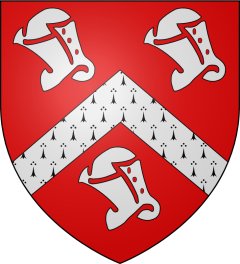
Owen Tudor’s coat of arms.

The House of Tudor that would come to rule England counted Owen its sire; the four-year-old grandson he left at his death grew up to become the first Tudor monarch, Henry VII.

Owen produced the root of this august line with Dowager Queen Catherine of Valois, the French princess Henry V had extracted as part of the price of peace after Agincourt.

That union was supposed to join the two great realms, but Henry V unexpectedly kicked the bucket in 1422, leaving an infant son who was not only unable to hold the French throne … he was too unstable to hold the English throne, either.

Unless he was a seer, suave Owen must not have been thinking dynasties when he took the Queen as his lover (and eventually his wife via a secret marriage in the early 1430s).

They produced six children, but it wasn’t the bedroom politics that did our prolific father in, at least not directly. Only decades later, when ownership of the crown was up for grabs in the War of the Roses and Owen loyally led Lancastrian forces at a battle he was unwise enough to lose, did he give up his head for the pedestrian crime of backing the wrong horse.

Owen reportedly thought he had stature enough to expect a reprieve until the very last moment, when the executioner’s ripping his collar caused him to sigh,

The head which used to lie in Queen Catherine’s lap, would now lie in the executioner’s basket.

In time, Owen’s descendants would get to pull the same trick, because the doomed cause in whose service Owen Tudor lost his life swept clear England’s political chessboard and made possible his own line’s accession.

Elizabethan poet Michael Drayton later versified Owen’s prodigious conquest in “Owen Tudor to Queen Catherine”.

When first mine eyes beheld your princely name,
And found from whence this friendly letter came;
Is in excess of joy, I bad forgot.
Whether I saw it, or I saw it not:

My panting heart doth bid mine eyes proceed,
My dazzled eyes invite my tongue to read,
Which wanting their direction, dully mist it:
My lips, which should have spoke, were dumb, and kist it,

And left the paper in my trembling hand,
When all my senses did amazed stand :
Even as a mother coming to her child,
Which from her presence hath been long exil’d,

With gentle arms his tender neck doth strain,
Now kissing it, now clipping it again;
And yet excessive joy deludes her so,
As still she doubts, if this be hers, or no.

At length, awaken’d from this pleasing dream,
When passion somewhat left to be extreme,
My longing eyes with their fair object meet,
Where ev’ry letter’s pleasing, each word sweet.

It was not Henry’s conquests, nor his court,
That had the power to win me by report;
Nor was his dreadful terrour-striking name,
The cause that I from Wales to England came:

For Christian Rhodes, and our religion’s truth,
To great achievement first had won my youth:
Th’ brave adventure did my valour prove,
Before I e’er knew what it was to love.

Nor came I hither by some poor event,
But by th’ eternal destinies’ consent;
Whose uncomprised wisdom did foresee,
That you in marriage should be link’d to me.

By our great Merlin was it not foretold,
(Amongst his holy prophesies enroll’d)
When first he did of Tndor’s name divine,
That kings and queens should follow in our line?

And that the helm (the Tudors ancient crest)
Should with the golden flow’r-de-luce be drest ?
As that the leek (our country’s! chief renown!)
Should grow with roses in the English crown –

As Charles his daughter, you the lilly wear;
As Henry’s queen, the blushing rose you bear;
By France’s conquest, and by England’s oath,
You are the true-made dowager of both :

Both in your crown, both in your cheek together,
Join Tether’s love to yours, and yours to Tether.
Then cast no future doubts, nor fear no hate,
When it so long hath been fore-told by fate ;

And by the all-disposing doom of Heav’n,
Before our births, we to one bed were giv’n.
No Pallas here, nor Juno is at all,
When I to Venus yield the golden ball:

Nor when the Grecians wonder I enjoy,
None in revenge to kindle fire in Troy.
And have not strange events divin’d to us,
That in our love we should be prosperous ?

When in your presence I was call’d to dance,
In lofty tricks whilst I myself advance,
And in a turn my footing fail’d by hap,
Was’t not my chance to light into your lap ?

Who would not judge it fortune’s greatest grace,
Sith he must fall, to fall in such a place ?
His birth from Heav’n, your Tudor not derives,
Nor stands on tip-toes in superlatives,

Although the envious English do devise
A thousand jests of our hyperbolies;
Nor do I claim that plot by ancient deeds,
Where Phoebus pasture his fire-breathing steeds:

Nor do I boast my god-made grandsire’s scars,
Nor giants trophies in the Titans wars:
Nor feign my birth (your princely ears to please)
By three nights getting, as was Hercules:

Nor do I forge my long descent to rim
From aged Neptune, or the glorious Sun:
And yet in Wales, with them that famous be,
Our learned bards do sing my pedigree

And boast my birth from great Cadwallader,
From old Caer-Septon, in mount Palador:
And from Eneon’s line, the South-Wales king,
By Theodor, the Tudors’ name do bring.

My royal mother’s princely stock began
From her great grandame, fair Gwenellian,
By true descent from Leolin the great,
As well from North-Wales, as fair Powsland’s seal.

Though for our princely genealogy
I do not stand to make apology:
Yet who with judgment’s true impartial eyes,
Shall look from whence our name at did first rise,

Shall find, that fortune is to us in debt
And why not Tudor, as Plantagenet?

Nor that term Croggen, nick name of disgrace
Us’d as a by-word now in ev’ry place,
Shall blot our blood, or wrong a Welshman’s name,
Which was at first begot with England’s shame.

Our valiant swords our right did still maintain,
Against that cruel, proud, usurping Dane,
Buckling besides in many dang’rous fights,
With Norway, Swethens, and with Muscovites;

And kept our native language now thus long,
And to this day yet never chang’d our tungue:
When they which now our nation fain would tame,
Subdu’d, have lost their country and their name.

Nor ever could the Saxons’ swords provoke
Our British necks to hear their servile yoke:
Where Cambria’s pleasant countries bounded be
With swelling Severn, and the holy Dee:

And since great Brutus first arrived, have stood
The only remnant of the Trojan blood.
To every man is not allotted chance,
To boast with Henry, to have conquer’d France:

Yet if my fortune be thus rais’d by thee,
This may presage a further good to me;
And our Saint David, in the Britons’ right,
May join with George, the sainted English knight:

And old Caer-merdin, Merlin’s famous town,
Not scorn’d by London, though of such renown.

Ah, would to God that hour my hopes attend,
Were with my wish brought to desired end !
Blame me not, madam, though I thus desire,
Many there be, that after you inquire;

Till now your beauty in night’s bosom slept,
What eye durst stir, where awful Henry kept ?
Who durst attempt to sail but near the bay,
Where that all-conqu’ring great, Alcides lay ?

Your beauty now is set a royal prize,
And kings repair to cheapen merchandise.
If you but walk to take the breathing air,
Orithia makes me that I Boreas fear:

If to the fire, Jove once in light’ning came.
And fair Egina makes me fear the flame:
If in the Sun, then sad suspicion dreams
Phoebus should spread Lucothoe in his beams:

If in a fountain you do cool your blood,
Neptune, I fear, which once came in a flood:
If with your maids, I dread Apollo’s rape,
Who cous’ned Chion in an old wife’s shape :

If you do banquet, Bacchus makes me dread,
Who in a grape Erigone did feed :
And if myself your chamber-door should keep,
Yet fear I Hermes coming in a sleep.

Pardon (sweet queen) if I offend in this,
In these delays love most impatient is:
And youth wants pow’r his hot spleen to suppress,
When hope already banquets in excess.

Though Henry’d fame in me you shall not find,
Yet that which better shall content your mind;
But only in the title of a king
Was his advantage, in no other thing:

If in his love more pleasure you did take,
Never let queen trust Briton for my sake.
Yet judge me not from modesty exempt,
That I another Phaeton’s charge attempt;

My mind, that thus your favours dare aspire,
Shows, that ’tis touch’d with a celestial fire:
If I do fault, the more is beauty’s blame,
When she herself is author of the same;

“All men to some one quality incline,”
Only to love is naturally mine.

Thou art by beauty famous, as by birth,
Ordain’d by Heav’n to cheer the drooping Earth :
Add faithful love unto your greater state,
And be alike in all things fortunate.

A king might promise more, I not deny,
But yet (by Heav’n) he lov’d not more than I.
And thus I leave, till time my faith approve,
I cease to write, but never cease to love.

Aficionados of old tyme history novelizations can also kick back with Owen Tudor: An Historical Romance.

On this day..

104 B.C.E.: Jugurtha

(Thanks to Daily Kos diarist “emperorhadrian” for licensing this guest post, originally published on that site June 24, 2007. -ed.)

The Jugurthine War was a key war in the final century of the Roman Republic.

Like the Americans in Iraq, Rome assumed that their war against Jugurtha, King of Numidia (a nation in north Africa), would be a cakewalk. They believed that Numidia was a nation of savages with a bizarre religion. They assumed that their own “shock and awe” attacks by the superior legions would decapitate and destroy the “evil doer” Jugurtha. They believed that in order to liberate the Numidians of their primitive ways, they had to impose the civilized will of the Roman state on this backward nation. Rome never expected that the Numidians would wage an insurgent war against their Roman occupiers. This war ended up dragging on for almost a decade. And in the end, it showed the depravity of the ruling party (the ultra-conservative republican Optimate party), which was sending the Roman Republic on its way to tyranny, empire and ruin.

In 148 BC, the King of Numidia, Masinissa, died. The Roman proconsul, Publius Cornelius Scipio Aemilianus, had been given authority by Masinissa to divide Masinissa’s estate. He divided it between Masinissa’s three sons, Micipsa, Gulussa, and Mastarnable. Soon after, Gulussa and Mastarnable died, leaving Micipsa as the sole King of Numidia. Around the year 134 BC, Micipsa sent Jugurtha (who was Masinissa’s grandson, but the son of another Numidian) to Spain with Scipio Aemilianius. Scipio was fighting the Celtiberians, who lived in a part of what is now Spain. Jugurtha was able to raise an army to help Scipio. Because of the valor of Jugurtha and his army at the Siege of Numantia, Scipio was able to win his war against the Celtiberians.

While fighting for Rome, Jugurtha worked alongside his future enemy, Gaius Marius. Jugurtha not only learned the superior Roman style of fighting, but he also learned of Rome’s weakness for money and thus bribery. Jugurtha described Rome as “urbem venalem et mature perituram, si emptorem invenerit” (“a city for sale and doomed to quick destruction, if it should ever find a buyer”). When Jugurtha returned to Numidia, Micipsa adopted Jugurtha, and decided to include Jugurtha in his will.

After the fall of Numantia, Jugurtha returned home with a letter from Scipio addressed to his uncle; in it, the commander praised Jugurtha’s exploits and congratulated Micipsa for having “a kinsman worthy of yourself, and of his grandfather Masinissa” (Sallust Iug. 9). On this recommendation the king formally adopted Jugurtha and made him co-heir with his own children

In 118, Micipsa died. He left his kingdom to Jugurtha and his two natural sons, Hiempsal and Adherbal. Shortly after Micipsa’s death, Jugurtha had Hiempsal killed. Adherbal fled to Rome. The Roman Senate sent a commission to Numidia to make peace. Jugurtha bribed the Romans on the commission, and thus the commission gave the better regions of the kingdom to Jugurtha.

In 113 BC, Jugurtha took his army and cornered Adherbal in his capital city of Citra. According to Sallust, Adherbal had the support of the people, but Jugurtha had the support of the best soldiers. A Roman Commission was sent to Numidia to forge a new peace. Jugurtha then bribed the Romans on this commission. The Romans thus allowed Jugurtha to storm Citra, and slaughter Adherbal and his supporters. Because Jugurtha slaughtered a number of Italian business people (including Roman Equites, or “Knights“), the Roman senate declared war on Jugurtha.

The Roman Senate sent an army under the command of the consul Lucius Calpurnius Bestia to fight Jugurtha. Bestia decisively defeated Jugurtha. But Jugurtha bribed Bestia, and thus was given unusually favorable terms. The Roman Senate viewed the favorable terms with suspicion, so it summoned Jugurtha to Rome. When Jugurtha arrived in Rome, he bribed two Tribunes, who thus prevented him from testifying. While in Rome, Jugurtha attempted to have his cousin and rival Massiva assassinated. Because of this, he was expelled from the city and returned to Numidia.

In 110 BC, the Roman Senate sent the praetor Aulus Postumus Albinus (who was the cousin of a consul for that year) to defeat Jugurtha. Because Jugurtha bribed key Romans involved in Albinus’ army (who then betrayed Albinus), Albinus was defeated.

The Roman Senate then sent the consul Quintus Caecilius Metellus to fight Jugurtha. At the Battle of the Muthul, a young Roman officer named Gaius Marius helped to reorganize Metellus’ legions, which then defeated Jugurtha. But Jugurtha was defeated because he forced his army to retreat before it could suffer heavy losses. The Romans did suffer their own heavy losses. Jugurtha disbanded his army, and had his soliders mount an insurgency to fight the Roman occupiers.

Marius returned to Rome. Dissatisfied with the slow pace of the war under Metellus, the Roman Military Assembly (one of the two Roman legislative assemblies, similar to the US Senate) appointed Marius consul (the Military Assembly, not the senate, appointed consuls). The Roman consuls had similar powers as the US President. The consulship was the highest constitutional office, and the consuls had imperium powers, which allowed them to command armies and conduct wars. The senate didn’t want Marius to be consul, because at this time it was dominated by an ultra-conservative republican party of aristocratic elites known as the Optimates. Marius belonged to the party that opposed the Optimates, the Populares. Partly because the senate didn’t like Marius, and partly because of the increasing difficulty Rome was having in recruiting armies, Marius was forced to raise his own army.

The capture of Jugurtha, from this French history of the Jugurthine War.

Marius took his army to Numidia to fight Jugurtha. But while Marius had been raising his army, Jugurtha allied with his father-in-law, Bocchus, the King of Mauretania. Marius defeated Jugurtha and Bocchus in several key battles. But much like with the American occupation in Iraq, Jugurtha’s strategy of insurgency warfare against the occupiers rendered all conventional victories irrelevant. Marius was playing a game of whack-a-mole. No matter how many times the Numidians were defeated, Jugurtha’s insurgents would regroup and keep fighting. It became clear that because of this, Rome could not defeat Jugurtha.

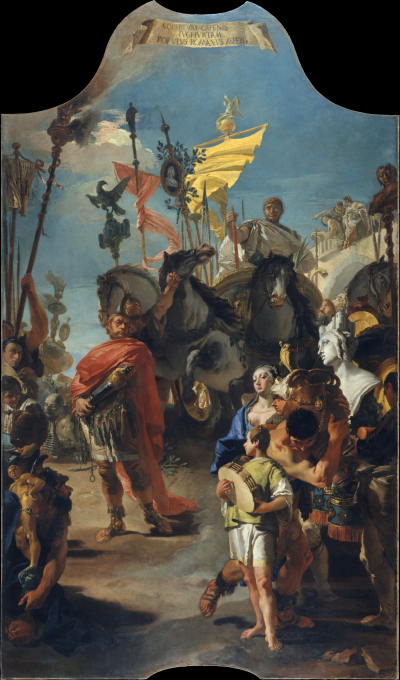
Marius sent his young Quaestor, Lucius Cornelius Sulla, to Bocchus. Sulla bribed Bocchus, and told him that Bocchus would be given a part of Numidia if he would betray Jugurtha. Bocchus then decided to give Jugurtha to Sulla. Sulla took Jugurtha to Rome, where Jugurtha was strangled in the Tullianum in Rome after marching in Marius’ January 1, 104 B.C. Triumph.


The Triumph of Marius (1729) by Giovanni Battista Tiepolo. The inscription in Latin reads “The Roman people behold Jugurtha laden with chains”.

The Jugurthine War was over. But in the process, several problems were exposed that would cause Rome serious pain in the future. Republicans in this country love to tell us that money in politics is harmless free speech. But as we saw in the Roman Republic during the Jugurthine War, money can be very corrupting. Rome almost lost the war because of money in politics, and the susceptibility of public officials to bribery.

In addition, this war saw the rise of two Romans who would play a key role in the events that directly preceded the fall of the Roman Republic. The first Roman made famous through this war was Gaius Marius. Gaius Marius would later hold the Roman Consulship an unconstitutional 7 times in 21 years (constitutionally, a Roman had to wait 10 years before being reelected consul).

The second Roman made famous through this war was Lucius Cornelius Sulla. Sulla and Marius would fight an unconstitutional civil war with each other several years after this war had ended. Sulla would illegally march his troops on Rome, and unconstitutionally legalize the mass killing of Marius’ supporters. Marius’ supporters in the senate would unconstitutionally prevent Sulla from fighting a war during one of Sulla’s consulships. Sulla would eventually seize absolute power for himself. Sulla would be the first Roman to be Dictator in almost 150 years. He would also be the first Roman in history to hold the dictatorship without the traditional six month term limit.

As dictator, Sulla would illegally change the Roman constitution to make himself and his party (the ultra-conservative republican Optimates) even more powerful. And most importantly, Sulla would set the example (of civil war on Romans, and then the seizing of absolute power) that the future tyrant Gaius Julius Caesar would follow.

In the end, the actions taken by key players in the war against Jugurtha would be repeated in the final destruction of the Roman Republic. The future triumvir Pompey would unconstitutionally hold multiple consulships in a short period of time. Crassus, another future triumvir, would illegally bribe politicians to get his way. And the future tyrant Julius Caesar would bribe, unconstitutionally hold the consulship, and become dictator for life (as Sulla had done). It was Caesar’s actions in this regard, as well as the similar actions of his adopted son and heir, Gaius Octavius (later Gaius Julius Caesar Octavianus, the Emperor Augustus) that would once and for all destroy the Roman Republic, and create the Roman Empire.

1. When when, and whenever death closes our eyelids,
2. Moving naked over Acheron
3. Upon the one raft, victor and conquered together,
4. Marius and Jugurtha together,
5. one tangle of shadows.

6. Caesar plots against India,
7. Tigris and Euphrates shall, from now on, flow at his bidding,
8. Tibet shall be full of Roman policemen,
9. And the Parthians shall get used to our statuary
10. and acquire a Roman religion;

11. One raft on the veiled flood of Acheron,
12. Marius and Jagurtha together.
13. Nor at my funeral either will there be any long trail,
14. bearing ancestral lares and images;
15. No trumpets filled with my emptiness,
16. Nor shall it be on an Atalic bed;
17. The perfumed cloths shall be absent.
18. A small plebeian procession.
19. Enough, enough and in plenty
20. There will be three books at my obsequies
21. Which I take, my not unworthy gift, to Persephone.

From Homage to Sextus Propertius, Canto VI by Ezra Pound

On this day..

1793: The smitten Adam Lux

Among all the strange and pathetic love-stories of the Revolution, when hearts were won within prison walls and wedded by the guillotine, is there another as fantastic and wonderful as that of Adam Luchs? (Source)

Adam Lux (as he’s better known, and a fitter name to his character could hardly be invented), German Republican turned French Revolution representative, was so lovestruck by the arresting figure of Charlotte Corday that it was downright … mortifying.

Many were men to whom the Norman maid played muse, like the poet Andre Chenier.

But Lux was something else.

Thrilled by this chaste heroine’s sacrificial blow against the Revolution’s monster, Lux was supposed to have fallen madly in love with the murderess the one time he actually saw her, on her serene way to the scaffold.

Eros thus yoked to Thanatos, the besotted fellow promptly hurled himself after the exaltation of death. Imitation, after all, is the sincerest form of flattery.

Certainly knowing it to be fatal, Adam Lux published under his own name a vindication of Ms. Public Enemy #1 and her “tyrannicide,” and generally went extravagantly mooning about in this sort of vein as he prepared to get his head cut off this date in 1793:

The guillotine is no longer a disgrace. It has become a sacred altar, from which every taint has been removed by the innocent blood shed there on the 17th of July. Forgive me, my divine Charlotte, if I find it impossible at the last moment to show the courage and the gentleness that were yours! I glory because you are superior to me, for it is right that she who is adored should be higher and more glorious than her adorer!

Adam came off a little needy, you’d have to say.

Not surprisingly, he didn’t get the girl in the end.

Adam Lux to Charlotte Corday
by William James Dawson

Red is the garb thou wearest, red is the deed thou hast done,
And red on a land of blood rises the morning sun.
Kings have ridden this road, conquerors mailed in gold,
But none in such red triumph as this that we behold.

Rose, thro’ a rose-red dawn, go to thy valourous fate,
Queen of all roses thou, splendid and passionate.
And lo ! at thy feet I fling, here, in the gallows-cart,
Passionate even as thine, the rose-flower of my heart.

Turn but a moment toward me, stoop in thy raiment red,
I answer thee look for look, I am warmed and comforted.
Twins are we of one womb, fated sister and brother,
Nursed on the bare bruised breasts of Freedom our great Mother!

Thou, whom none could master, proud and glorious head,
Come, O Rose, to my bosom, come when thou art dead!
They have shorn the beautiful hair, they have bound the strong fair hands,
Signal me with your eyes that love still understands!

Signal, and I will follow : I dwell where thou must dwell,
I shall know thy blood-red raiment either in heaven or hell!
Lo! at thy feet I fling, here, in the gallows-cart,
Passionate even as thine, the red rose of my heart!

On this day..

39: Gnaeus Cornelius Lentulus Gaetulicus, erotic poet

On an uncertain date likely around early October* in 39 A.D., former Roman Consul Gnaeus Cornelius Lentulus Gaetulicus (not to be confused with Publius Cornelius Lentulus) was executed at the order of Caligula for his part in some sort of plot long lost to history.

In his public life, Gaetulicus was a Machiavellian politician connected to the fallen Praetorian Guard captain Sejanus (their kids were at one point engaged to be married). He evidently survived the post-Sejanus purge with an adroit bit of written diplomacy to the Praetorian’s patron-cum-executioner the Emperor Tiberius, tactfully pointing out that the Emperor had made the same errant choice of alliance. Thus did Gaetulicus retain both his head and his career.

After a decade milking his German province, and Tiberius shuffled off the mortal coil and young Caligula now ruling the empire, Gaetulicus seemingly** involved himself in something treasonable with Marcus Aemilius Lepidus, the latter a recent fave of Caligula and briefly his designated heir.

Or, if you credit scandal-mongering Roman historian Cassius Dio‘s description of the Emperor’s deadly northward road trip, he did it out of some whim of rivalry or opportunity for pecuniary advantage.

Gaius had now spent practically all the money in Rome and the rest of Italy, gathered from every source from which he could in any way get it, and as no source of revenue in considerable amount or practicable to collect could be found there, and his expenses were pressing him hard, he set out for Gaul, ostensibly because the hostile Germans were stirring up trouble, but in reality with the purpose of exploiting both Gaul with its abounding wealth and Spain also. However, he did not openly announce his expedition beforehand, but went first to one of the suburbs and then suddenly set out on the journey, taking with him many actors, many gladiators, horses, women, and all the other trappings of luxury. When he reached his destination, he did no harm to any of the enemy — in fact, as soon as he had proceeded a short distance beyond the Rhine, he returned, and then set out as if to conduct a campaign against Britain, but turned back from the ocean’s edge, showing no little vexation at his lieutenants who won some slight success — but upon the subject peoples, the allies, and the citizens he inflicted vast and innumerable ills. In the first place, he despoiled those who possessed anything, on any and every excuse; and secondly, both private citizens and cities brought him large gifts voluntarily, as it was made to appear. He murdered some men on the ground that they were rebelling, and others on the ground that they were conspiring against him; but the real complaint was one and the same for the whole people — the fact that they were rich. By selling their possessions himself, he realized far greater sums than would otherwise have been the case; for everybody was compelled to buy them at any price and for much more than their value, for the reasons I have mentioned. Accordingly, he sent also for the finest and most precious heirlooms of the monarchy and sold them off by auction, selling with them the fame of the persons who had once used them. Thus he would make some comment on each one, such as, “this belonged to my father,” “this to my mother,” “this to my grandfather,”, “this to my great-grandfather,” “this Egyptian piece was Antony’s, the prize of victory for Augustus.” At the same time he also explained the necessity of selling them, so that no one could persist in pretending to be poor; and thus he made them buy the reputation of each article along with the thing itself.

In spite of all this he did not secure any surplus, but kept up his customary expenditures, not only for other objects that interested him — exhibiting, for example, some games at Lugdunum — but especially for the legions. For he had gathered together two hundred thousand troops, or, as some say, two hundred and fifty thousand. He was acclaimed imperator by them seven times, as his whim directed, though he had won no battle and slain no enemy. To be sure, he did once by a ruse seize and bind a few of the foe, whereas he used up a large part of his own force, striking some of them down one at a time and butchering others then masse. Thus, on one occasion, when he saw a crowd of prisoners or some other persons, he gave orders in the famous phrase, that they should all be slain “from baldhead to baldhead.” At another time he was playing at dice, and finding that he had no money, he called for the census lists of the Gauls and ordered the wealthiest of them to be put to death; then, returning to his fellow-gamesters, he said: “Here you are playing for a few denarii, while I have taken in a good one hundred and fifty millions.” So these men perished without any consideration. Indeed, one of them, Julius Sacerdos, who was fairly well off, yet not so extremely wealthy as to become the object of attack on that account, was slain simply because of a similarity of names. This shows how carelessly everything was done. As for the others who perished, there is no need of my naming over most of them, but I will mention those of whom history requires some record. In the first place, then, he put to death Lentulus Gaetulicus, who had an excellent reputation in every way and had been governor of Germany for ten years, for the reason that he was endeared to the soldiers. Another of his victims was Lepidus, that lover and favourite of his, the husband of Drusilla, the man who had together with Gaius maintained improper relations with the emperor’s other sisters, Agrippina and Julia, the man whom he had allowed to stand for office five years earlier than was permitted by law and whom he kept declaring he would leave as his successor to the throne. To celebrate this man’s death he gave the soldiers money, as though he had defeated some enemies, and sent three daggers to Mars Ultor in Rome. He deported his sisters to the Pontian Islands because of their relations with Lepidus, having first accused them in a communication to the senate of many impious and immoral actions. Agrippina was given Lepidus’ bones in an urn and bidden to carry it back to Rome, keeping it in her bosom during the whole journey.

It’s a pity that the details of this affair, whatever they were, have been lost to history. The History of Rome podcast treats this episode among a review of Caligula’s gnarly reign

According to Post-Augustan Poetry, Gaetulicus

was consul in 26 A.D., and for ten years was legatus in Upper Germany, where his combination of firmness and clemency won him great popularity. He conspired against Caligula while holding this command, and was put to death. Pliny the younger speaks of him as the writer of sportive and lascivious erotic verse, and Martial writes of him in very similar terms. His mistress was named Caesennia, and was herself a poetess.

Only a fragment (which I have not been able to locate online) of a Latin verse describing Britain remains affirmatively attributed to this poet, though he is sometimes speculatively identified with the “Gaetulicus” to whom some epigrams in the Greek Anthology (or “Palatine Anthology”) are attributed e.g.

TO APHRODITE EUPLOIA

Guardian of the seabeach, to thee I send these cakes, and the gifts of
a scanty sacrifice; for to-morrow I shall cross the broad wave of the
Ionian sea, hastening to our Eidothea’s arms. But shine thou
favourably on my love as on my mast, O Cyprian, mistress of the bride-
chamber and the beach.

* Date ballparked by public sacrifices offered in Rome on October 27 “to mark the exposure of the evil plots of Gnaeus Lentulus Gaetulicus against Gaius Germanicus.” (Agrippina: Sex, Power, and Politics in the Early Empire, which speculates at some length on what the dimensions of a Gaetulicus plot might have been.)

** Though Lepidus was executed at about the same time, and Cassius Dio suggests a connection, it’s not completely clear that they conspired together. Since Cassius Dio (and Suetonius, who also connects them in Life of Claudius), wrote generations after the events themselves, we want for dependable information.

On this day..