1936: Jose Antonio Primo de Rivera, Falange founder

On this date in 1936, the Spanish Republicans shot Don José Antonio Primo de Rivera y Sáenz de Heredia, 1st Duke of Primo de Rivera, 3rd Marquis of Estella, Grandee of Spain.

The son of Spain’s 1920s dictator, Primo de Rivera founded in 1933 the Falange, Spain’s native fascist movement.

At the October 29 founding convention that year at Madrid’s Theatre of Comedy, Primo de Rivera scathingly pilloried the wan democratic rituals that coming years’ conflict would sweep aside. “The most ruinous system of wasted energy,” he jeered at liberal democracy, where men with leadership waste their talents in hollow electoral hustling and parliamentary rigmarole while the nonsensical ephemeral whims of a formless plurality pass for the vision he attributed to the time before Rousseau ruined everything. “What alone mattered to the liberal state was that a certain number of gentlemen be sitting at the polling station, that the voting start at eight o’clock and end at four, that the ballot boxes not get smashed — when being smashed is the noblest aspiration of all ballot boxes.” (The full speech is available in Spanish here.)

Primo de Rivera espoused for Falangismo the same impulses — of unity, of destiny, of national rebirth, of the triumphant collective — that animated Europe’s similar extreme right stirrings in those years. Only 35 years before, Spain had lost her empire, near enough in memory to inform an acute ache of loss.

In a poetic sweep we will raise this fervent devotion to Spain; we will make sacrifices, we will renounce the easy life and we will triumph, a triumph that — you know this well — we shall not obtain in the upcoming elections. In these elections vote the lesser evil. But your Spain will not be born out of them, nor does our frame for action reside there. That is a murky atmosphere, spent, like a tavern’s after a night of dissipation. Our station is not there. I am a candidate, yes, but I take part in these elections without faith or respect. And I say this now, when so doing may cost me every vote. I couldn’t care less. We are not going to squabble with the establishment over the unsavory left-overs of a soiled banquet. Our station is outside though we may provisionally pass by the other one. Our place is out in the clear air, beneath a moonlit sky, cradling a rifle, and the stars overhead. Let the others party on. We stand outside vigilant; earnest and self-confident we divine the sunrise in the joy of our hearts.

Unlike the Naziism in Germany or Fascism in Italy, Falangism never grew into a force capable of conquering state power itself. Just thirty-three months after Primo de Rivera’s founding address, the Spanish Civil War erupted. The Falangists’ alliance with Francisco Franco — after the war, they would be combined with the Carlists into the only legal political association* in Francoist Spain — spelled great gains for their membership rolls but it was still the General who called the shots.**

Primo de Rivera’s share in this alliance was a voluptuous cult of personality as Spain’s preeminent right-wing martyr, fine posthumous work if you can get it mitigated only by the necessity of undergoing the martyrdom. The fascist prophet was already in prison at the time Franco struck the first blow of the war: he’d been arrested in Madrid on weapons charges. From his cell he carried on a brazen correspondence with Nationalists conniving to subvert the hated Spanish Republic, and when his activities were discovered and prosecuted that autumn in light of Franco’s July revolt they could scarcely have been better framed to incur the utmost measure of judicial wrath.

In consequence of his martyrdom, November 20 remains down to the present a hallowed day for the far right in Spain.


“Cara al Sol” (“Facing the Sun”) is the Falangist anthem; the lyrics are generally credited to Primo de Rivera.

* The Falange Española Tradicionalista y de las Juntas de Ofensiva Nacional-Sindicalista, or “Spanish Traditionalist Phalanx of the Assemblies of National-Syndicalist Offensive” (FET y de las JONS) — or less exhaustingly, the Movimiento Nacional (National Movement).

** Primo de Rivera and Franco didn’t like each other much personally, either.

On this day..

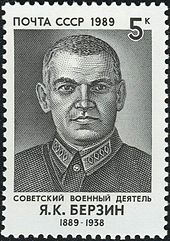
1938: Janis Berzins, Soviet military intelligence chief

On this date in 1938, the Soviet intelligence agent Janis Berzin(s) was shot in the basement of Moscow’s Lubyanka Prison.

A Latvian radical back to Riga’s chapter of the 1905 revolution,* Berzins became a trusted associate of Lenin in exile, and transitioned with the 1917 Revolution into a variety of political-security-military leadership positions in the new Soviet state.

For most of the 1924-1937 period, Berzins directed — indeed, practically createdSoviet military intelligence. He’s credited with personally recruiting the legendary World War II spy Richard Sorge; in 1936-1937 he was the chief Soviet military advisor in the Spanish Civil War under the nom de guerre “Grishin”. Russians fighting in Spain just referred to him as “the old man.” (Source)

Of course, no degree of seniority was sufficient safety during the frightful purging years of the Yezhovshchina. Once back in Moscow, Berzins fell instantly, almost randomly, over a spurious accusation of internal espionage.

His conviction was reversed after Stalin died.

* But not one of the Latvian revolutionaries who ended up in a shootout with London police.

On this day..

1940: Lluis Companys, Catalan president

“Above all, there was a belief in the revolution and the future, a feeling of having suddenly emerged into an era of equality and freedom. Human beings were trying to behave as human beings and not as cogs in the capitalist machine.

-George Orwell, Homage to Catalonia

On this date in 1940, Catalan president Lluis Companys was shot by the Spanish fascists.

Companys had held that notional office for mere hours six years before — but he’s still the last to hold it in any form at all.

Political exile was no unfamiliar terrain for Companys. As a young lawyer, his activism in the first two decades of the century had seen him incarcerated over a dozen times; in fact, his path to political respectability had entailed getting out of a Menorca prison in 1920 courtesy of the parliamentary immunity conferred by winning an election.

And he’d drawn a long sentence for an attempted 1934 rising against a center-right government — the occasion when he had become the President of the Catalan Republic on October 6, and been dispossessed of both office and state by the very next day.

That prison sentence’s reversal by the new republican government in 1936 was a bit of Pyrrhic victory for Companys’s left-wing politics — inasmuch as said republicans’ ascent was also the trigger for the nationalist revolt that resulted in the Spanish Civil War and a military dictatorship lasting until the 1970s.

As the virtual personification of Catalan national aspirations, Companys remained head of the Generalitat de Catalunya from 1933 until his death — in prison, in exile, wherever Companys went he bore along the Catalan cause.

As such, he was in the thick of the civil war’s scrap for control of Barcelona: not only against the fascists but among the left parties whose fractious alliance tore apart in 1937.

It was truly a case of riding the tiger. Companys struggled to maintain the cooperation of his alliance even while the republicans’ Soviet sponsors excommunicated anarchist and anti-Stalinist elements internally. The dreadful spectacle of internecine street fighting among the anti-fascists in May 1937 fills the final tragic pages of Orwell’s Homage, decided by the inescapable materialist circumstances: “the Government could not afford to offend the Communist Party while the Russians were supplying arms.”

Few sources direct much personal blame at Companys for what followed. Under Soviet pressure, he accepted the Communist police raids that had set off the street fighting, accepted the purges and the press censorsip, sacked anti-Stalinist minister Andres Nin from the government. (Nin was later “disappeared” and murdered.)

Who knows but that even these evil days were not still the best that could be made of a bad circumstance: whatever they were, they were not enough for republican Spain or for Catalonia.

When those dreams fell under the fascist advance little more than a year later, Companys couldn’t flee Franco far enough for safety. Soon after his 1939 escape to France, that country was overrun by militaristic rightists from the other direction — and the German occupiers happily handed Companys back to Spain as soon as they got their hands on him.

Condemned after the formality of a perfunctory trial for “military rebellion” conducted on October 14, 1940, Companys was shot the very next morning Montjuic Castle. (See Franco: A Biography)

Spain, where questions of Catalan sovereignty and the Franco years are both sensitive subjects, has never reversed the judgment (Spanish link) against Companys. However, a Barcelona promenade is named in Companys’s honor, as is a major stadium — actually the arena where the anti-fascist 1936 People’s Olympiad in opposition to the notorious master race spectacle of Berlin was to have taken place, before that whole Civil War unpleasantness.

On this day..

1936: Manuel Goded Llopis

On this date in 1936, the Spanish Republic executed Gen. Manuel Goded Llopis, who mounted an unsuccessful nationalist attack in the heart of Republican Spain, Barcelona.

Goded (English Wikipedia entry | Spanish) was born of Catalan ancestry in Puerto Rico. His family moved back to the mother country when the United States stripped that territory away in the Spanish-American War.

Goded advanced rapidly through the armed forces, becoming dictator Miguel Primo de Rivera‘s chief of staff by 1927. He was dismissed from this post for intriguing against the government, but soon found his way back to command and became (Spanish link) one of the circle of officers conspiring to check the advance of the left.

When the anti-Republican military mounted the revolt that became the Spanish Civil War, Goded was in Catalonia — freshly arrived on a mission to snatch Barcelona for the fascists at the revolt’s outset. Forces loyal to the Republican government, however, defeated Goded in the streets of Barcelona on 19 July. The general himself was captured on 11 August. A Republican court had him shot at Montjuic the very next day, along with another officer, Alvaro Fernandez Burriel.

His defeat, in the long run, might have been a gift by the Republicans to their conquerors: Goded was a partner but also a rival of Francisco Franco’s, and Goded’s presence in the postwar settlement among the nationalist victors might have introduced a fault line into the Franco regime.

On this day..

1936: Josep Sunyol, FC Barcelona President

FC Barcelona is many a sportive leftist’s major European football side of choice, thanks to the club’s longtime identification with its city’s Catalan anti-Francoism.

That identification, stretching all the way back to the club’s formative early-20th century years (“History of FC Barcelona” enjoys its own voluminous Wikipedia page) put the Barca president at the end of fascist guns on this date in 1936.

Josep Sunyol was born into the Catalan elite, and had a varied career in the public eye: left activist, parliamentary deputy, newspaper founder, and, come 1935, president of FC Barcelona. He’d been serving on the Barca board of directors since 1928. There’s a lengthy Sunyol biography here.


At the center of the rail, Sunyol (left) chats with Catalan president Lluis Companys. (Source)

It was in his political, rather than his footballing, capacity that in August 1936 — just days into the Spanish Civil War — Sunyol traveled from Barcelona to Madrid to meet with fellow Republicans.

He never made it back.

On the return trip from Madrid, Sunyol’s chauffeured car flying the Catalan senyera was stopped by pro-Franco Falangist forces in the Sierra de Guadarrama north of Madrid. It may have been only inadvertently that Sunyol crossed this checkpoint of nationalists, who were already gathering for an attack on Madrid that would eventually inspire For Whom The Bell Tolls. (Indeed, this novel is set in the Sierra de Guadarrama.)

Whatever Sunyol’s intention, he was quickly recognized and detained by his foes on the evening of August 6. Shortly thereafter, they decided to shoot him out of hand.

The civil war and the era of Franco are still sensitive topic in Spain, but FC Barcelona’s politically engaged supporters have pushed the present-day club (with partial success) to more overtly embrace its anti-fascist “martyr president”.

On this day..

1940: Cayetano Redondo, former mayor of Madrid

On this date in 1940, Cayetano Redondo was shot at Madrid’s largest cemetery.

Cayetano Redondo (English Wikipedia page | Spanish | Esperanto), a former journalist and editor, was the socialist onetime mayor of Madrid — having ascended that position during the Spanish Civil War when the previous mayor fled for Valencia as Franco attacked Madrid. Redondo was the guy with his name on the letterhead during the bloody November 1936 Battle of Madrid, when the Luftwaffe tried out terror bombing (Guernica followed in April 1937).

This “hombre de una bondad inagotable” (Manuel Albar, quoted here) was also a leading esperantist — an advocate of building international solidarity through the extension of the constructed language Esperanto.

Disdaining escape as the war ended, he was arrested when Franco’s forces finally took Madrid in 1939 and shot a year later as a rebel. (His tombstone evidently records the wrong date.)

Though Redondo was long a neglected figure, the Madrid city council recently named a street for him. So he’s got that going for him.

On this day..

1937: Camillo Berneri, anarchist intellectual

On this date in 1937, the Italian anarchist Camillo Berneri was kidnapped from his home by in Barcelona by armed paramilitaries. Berneri was shot that night.

Berneri (English Wikipedia entry | Spanish | timeline) had once been a University of Florence professor, but was forced into exile for opposing the fascist conquest of power in Italy.

When a coup threatened a similar right-wing conquest of power in Spain, Berneri organized the first column of Italian volunteers to oppose it.

International brigades poured into Spain to fight for the Republican government, but not everybody in the “popular front” was on the same side — a fact which became horrifyingly clear during Barcelona’s “May Days”, a week of internecine bloodletting in Republican Catalonia.

Anarcho-syndicalists of the CNT party and anti-Stalinist communists of POUM were the ones whose blood was mostly let; indeed, it might better be called a purge. The Moscow-backed Communist Party opposed the power of its putative comrades as much as or more than that of Franco. During the May Days, the Communists’ Catalan ally, a party called the PSUC, essentially took over Barcelona with the help of thousands of Assault Guards and killed, arrested, or dispersed the anarchists and Trotskyites.

Berneri clearly saw it coming, quoting Pravda in an April 1937 letter to the anarchist Health Minister criticizing his participation in the Popular Front government: “As for Catalonia, the purging of Trotskyist and anarcho-syndicalist elements has begun; this work will be carried out with the same energy with which it was done in the USSR.”

The British writer George Orwell served in a POUM unit, and the last third or so of his Spanish Civil War memoir Homage to Catalonia attempts to make sense of the chaotic scene.

Smitten when he arrived in Barcelona the previous December — “the first time that I had ever been in a town where the working class was in the saddle”* — the writer scoffed at the Communists’ official justification that anarchists and friends were a “counter-revolutionary” element, or even in actual league with their nationalist enemies.

It seemed queer, in the barber’s shop, to see the Anarchist notice still on the wall, explaining that tips were prohibited. ‘The Revolution has struck off our chains,’ the notice said. I felt like telling the barbers that their chains would soon be back again if they didn’t look out.

I wandered back to the centre of the town. Over the P.O.U.M. buildings the red flags had been torn down, Republican flags were floating in their place, and knots of armed Civil Guards were lounging in the doorways. At the Red Aid centre on the corner of the Plaza de Cataluña the police had amused themselves by smashing most of the windows. The P.O.U.M. book-stalls had been emptied of books and the notice-board farther down the Ramblas had been plastered with an anti-P.O.U.M. cartoon — the one representing the mask and the Fascist face beneath.

Down at the bottom of the Ramblas, near the quay, I came upon a queer sight; a row of militiamen, still ragged and muddy from the front, sprawling exhaustedly on the chairs placed there for the bootblacks. I knew who they were — indeed, I recognized one of them. They were P.O.U.M. militiamen who had come down the line on the previous day to find that the P.O.U.M. had been suppressed, and had had to spend the night in the streets because their homes had been raided. Any P.O.U.M. militiaman who returned to Barcelona at this time had the choice of going straight into hiding or into jail — not a pleasant reception after three or four months in the line.

Also a fighter of the liquidated POUM, Orwell too was proscribed: he had a job to make it out of Barcelona without winding up in someone’s dungeon or firing range. His disgust with what revolutionary Barcelona had come to would help to inform his subsequent anti-Soviet literary efforts.

Berneri, too, was an outspoken anti-Communist. Long a major intellectual in the anarchist camp, he was clearly targeted by name, and hauled from his house along with his brother-in-law Francesco Barbieri by a death squad. Their bodies turned up riddled with bullet holes the next morning.

There’s a collection of Berneri’s writings in English translation here, including one piece dated to the very day of his disappearance; also see this pdf of Berneri’s work. He was survived by his daughter, Marie-Louise Berneri, who herself became a noted anarchist activist of the 1940s.

* Orwell on Barcelona circa December 1936: “Practically every building of any size had been seized by the workers and was draped with red flags or with the red and black flag of the Anarchists; every wall was scrawled with the hammer and sickle and with the initials of the revolutionary parties; almost every church had been gutted and its images burnt … Waiters and shop-walkers looked you in the face and treated you as an equal. Servile and even ceremonial forms of speech had temporarily disappeared. Nobody said ‘Señor’ or ‘Don’ or even ‘Usted’ … Tipping was forbidden by law … revolutionary posters were everywhere, flaming from the walls in clean reds and blues that made the few remaining advertisements look like daubs of mud. Down the Ramblas, the wide central artery of the town where crowds of people streamed constantly to and fro, the loudspeakers were bellowing revolutionary songs all day and far into the night. And it was the aspect of the crowds that was the queerest thing of all. In outward appearance it was a town in which the wealthy classes had practically ceased to exist. Except for a small number of women and foreigners there were no ‘well-dressed’ people at all. Practically everyone wore rough working-class clothes, or blue overalls, or some variant of the militia uniform. All this was queer and moving. There was much in it that I did not understand, in some ways I did not even like it, but I recognized it immediately as a state of affairs worth fighting for.”

On this day..

1946: Cristino Garcia, Spanish Republican and French Resistance hero

On this date in 1946, ten* Spanish Republicans were shot — most famously including Cristino Garcia.

Garcia, a Communist veteran of the Spanish Civil War, had put his guerrilla skills to good use by joining the French Resistance during World War II.

Garcia ultimately held the rank of Lieutenant Colonel in the Resistance, and was perhaps the most individually famous of the numerous Spaniards** who fought as maquisards. His unit broke out hundreds of people before potential deportation to German death camps, and Garcia helped orchestrate the guerrilla-led liberation of Foix in August 1944. (There’s a lengthier roundup of Garcia’s career in the field in Spanish, here.)

The French had nothing but good feelings for this guy, but Garcia wasn’t looking to take a pension from De Gaulle and settle down in a vineyard. As France fell to Allies, Garcia — going on ten years a professional leftist revolutionary — headed back to Spain (Spanish link) to carry on the fight against fascism closer to home.

His tasks over a few months in 1945 ran to the less legendary: bank attacks and the like, blurring the line between “ordinary” and “political” crimes. Garcia was also detailed as a result of intra-party politicking to murder fellow-Communist Gabriel Leon Trilla (Spanish link).†

Garcia and his group were arrested shortly thereafter and faced a military tribunal on January 22, 1946. (Spanish source)

As an agent of the Spanish Communist Party, which was backed by a French Communist Party riding high on its World War II heroics, Garcia’s situation became a national cause celebre. French left parties uniformly protested the planned execution, and the government made repeated diplomatic overtures to Madrid to stay the sentence. Editorialists protested floridly.

Have we forgotten that fascism exists at our border; Was it not against all fascisms that Cristino Garcia and thousands of our Spanish brothers fought with us on our soil? Did they not fall beside us, as at the Eysses prisons, under the same Nazi bullets, for France? And today will we disown their sacrifice, their blood and their martyrdom because the fight against fascism has moved to the other side of the Pyrenees? (from the Franc-Tireur, quoted here

Incensed when Franco ignore their appeals and shot the men anyway, France retaliated by closing its border with Spain on March 1, 1946. Spain did not neglect to point out the irony that, during the war years, innumerable resistance fighters and others fleeing Naziism or the Vichy regime had taken refuge by crossing that very border. (Less stress was understandably laid on the Francoists’ onetime demand — not honored by Paris — that France close its border against escaping Republicans in 1939.)

* I believe from press reports that there were 12 total executions of Republicans Feb. 21-22, 10 of which took place on Feb. 21. However, I might be mistaken about the overall numbers or their distribution by dates. Garcia’s, certainly, took place on Thursday the 21st.

** The Resistance was blessed by with no small amount of foreign blood. (French)

† Garcia delegated this task to two subalterns, one of whom (Francisco Esteban Carranque) was shot with him on this date. The other man, Jose Olmedo, was arrested in 1947 and executed in 1948.

On this day..

1936: Virgilio Leret, the first shot in the Spanish Civil War

On this date in 1936, Spanish aviator Virgilio Leret Ruiz was shot for resisting the fascists’ opening gambit in what would become the Spanish Civil War.


The first vignette of this recent film supporting justice for victims of the civil war is voiced by film director Pedro Almodovar, who says “My name is Virgilio Leret Ruiz … I’m a pilot, head of the air force in the eastern part of Morocco. I refuse to support the uprising, and at dawn on 18 July 1936, my comrades turned me into the first military officer assassinated for fulfilling his duty.”

Leret (Spanish link, as are all the ensuing links in this post), who has the incidental distinction of having patented an early jet engine design, was, circa 1936, stationed at the Atalayon Seaplane Base on the outskirts of Spain’s Moroccan exclave of Melilla.

This would put him in the front row for the very first action of the terrible civil war — the July 17 military uprising (Spanish link) that secured Spanish Morocco for the putschists within hours.

North Africa, correctly rated as easy pickings, was to be the first target of Franco’s rising, with the main event on the Iberian peninsula following the very next day. From their standpoint, it pretty much went off without a hitch.


This pro-Franco plaque in Melilla celebrates the city’s distinction as the place where his “glorious national movement” was launched. Image (c) Joshua Benton and used with permission.

Leret’s wife Carlota, spent 4+ years locked up and wrote this book about her fellow prisoners. She later moved to Venezuela, where Leret progeny still remain.

Despite the absence of any effective resistance elsewhere in Melilla, Captain Leret scrambled from a relaxing day swimming with his family and commanded his base to hold out for the Republican government.

While it was no real threat to the rebelling officers, the gesture required a slight detour by Franco’s forces, and even a couple of casualties before the Seaplane base surrendered that night to obviously overwhelming opposition.

The next day at dawn, “half-naked and with a broken arm,” Virgilio Leret Ruiz became — along with two ensigns under his command, Armando Corral Gonzalez and Luis Calvo Calavia — the first people executed in the Spanish Civil War.

Needless to say, a great many others would follow them.

A 2011 documentary, Virgilio Leret, the Blue Knight, retrieves the reputation of this “exceptional man”, and the experience of 20th century Spain through the fate of his family.

On this day..

1937: Tom Steinbock and Juan Mirbol in Sartre’s The Wall

On an uncertain date in the Spanish Civil War, two principal characters are shot in Jean-Paul Sartre‘s first short story, “The Wall”.

“Le Mur” in French, a title also suggesting the dead spirits of Roman mythology, “The Wall” was penned in 1937 as Sartre’s personal response* to the Spanish Civil War.


Sartre published “The Wall” at almost the exact same time — summer 1937 — as Picasso finished Guernica. (Guernica was bombed in April 1937.)

“The Wall” is highly non-specific as to time and circumstance; a mention of “winter” — as of writing, the winter of 1937 was the only one yet elapsed in the conflict — and a few disembodied calendar indicators like “the 9th” and “Tuesday”.

Instead, it’s an existential reflection on the inscrutability of death. The narrator, one Pablo Ibbieta, awaits the morning’s firing squad with an International Brigade volunteer named Tom Steinbock and a Spanish innocent named Juan Mirbal.

All three of us watched [a Belgian doctor] because he was alive. He had the motions of a living human being, the cares of a living human being; he shivered in the cellar the way the living are supposed to shiver; he had an obedient, well-fed body. The rest of us hardly felt ours — not in the same way anyhow. I wanted to feel my pants between my legs but I didn’t dare; I watched the Belgian, balancing on his legs, master of his muscles, someone who could think about tomorrow. There we were, three bloodless shadows; we watched him and we sucked his life like vampires. …

In the state I was in, if someone had come and told me I could go home quietly, that they would leave me my life whole, it would have left me cold: several hours or several years of waiting is all the same when you have lost the illusion of being eternal. I clung to nothing, in a way I was calm. But it was a horrible calm — because of my body; my body, I saw with its eyes, I heard with its ears, but it was no longer me; it sweated and trembled by itself and I didn’t recognize it any more. I had to touch it and look at it to find out what was happening, as if it were the body of someone else. …

[Juan] wept: I could clearly see he was pitying himself; he wasn’t thinking about death. For one second, one single second, I wanted to weep myself, to weep with pity for myself. But the opposite happened: I glanced at the kid, I saw his thin sobbing shoulders and I felt inhuman: I could pity neither the others nor myself. I said to myself, “I want to die cleanly.”

Tom and Juan go to the wall that morning.

Pablo, an anarchist, is subjected to one last interrogation before he’s shot: the fascists are hunting a confederate of his, and they offer Pablo his life in exchange for giving up the whereabouts of this Ramon Gris. “His life had no more value than mine; no life had value,” Pablo muses. “They were going to slap a man up against a wall and shoot at him till he died, whether it was I or Gris or somebody else made no difference.” Impulsively, almost whimsically, he directs them to a cemetery as a bogus location: “It was a farce. I wanted to see them stand up, buckle their belts and give orders busily.”

Except … unbeknownst to Pablo, Ramon Gris had just moved his hiding place to that very cemetery. For reasons as nonsensical as Ibbieta’s own initial condemnation, his life is swapped for Gris’s at the last moment.

* Specifically, according to Sartre, Self-Formation, and Masculinities, after a student asked for help sneaking into Spain to fight the fascists.

On this day..