1930: Captains Fermin Galan and Angel Garcia Hernandez

On this date in 1930, two Spanish soldiers were shot for an abortive mutiny against the crown.

Fermin Galan (Spanish Wikipedia entry; most of the available online material about him is in Spanish) earned his military spurs in the Rif War in Morocco, and earned his revolutionary spurs participating in an attempted 1926 rising evocatively named La Sanjuanada. The resultant prison term shoulder to shoulder with Barcelona anarchists only radicalized Galan further. (It also gave him a chance to write.)

After an amnesty, Captain Galan was back in his fatigues commanding the garrison at Jaca.

And he was positively a firebrand; other left-leaning activists who knew he was cooking up a mutiny struggled to restrain him knowing the time was not ripe. When strikes swept Spain in November, followed by violent police suppression, Galan forced the issue, wanting waffling “revolutionaries” to commit themselves.

Galan, as he expressly stated during those feverish days, was fed up with the failures of 1926 and didn’t want to rely on pseudo-revolutionary generals in the style of Blazquez, or on the opportunistic politicians … The majority of the Jaca soldiers adored him and would follow him wherever he led. (Quoted here)

One will discern that that commitment was not forthcoming. Galan’s rising Dec. 12 was quashed; a more general rebellion slated for Dec. 15 fizzled, and Galan and one of his fellow-officers were court-martialed and quickly put to death.

According to Robin Warner,*

If authorities’ intention had been to discourage Republican support by making an example of Galan, the burgeoning legend of his self-sacrifice achieved quite the opposite effect. In the context of a well organised campaign for the release of imprisoned Republican leaders, the dead officer was given the status of a martyr. Clandestine journals and street ballads were quick to provide details of the bravery of his last moments and blame his death on royal intervention … With the accession to power of the provisional Republican Government on 14 April the figure of Galan had a place of honour at the official — and unofficial — celebrations. One of the first acts of the new regime was solemnly to honour the memory of the December martyrs and order a revision of their trial …

Galan had few illusions about the nature of the broad Republican movement which was to exploit his death. He roundly denounced “la ficcion hueca y pomposa que constituye la democracia moderna”, whose rhetoric serves to conceal the aim of perpetuating traditional privileges and blocking genuine change.

Opportunistic is as opportunistic does: that Republican movement exploited Galan’s martyrdom right into conquest of state power by the following April — inaugurating the second Spanish republic, the one that summoned Orwell and all those other starry-eyed multinational leftists (and Fermin Galan’s brother Francisco) to war to defend it against Franco.

* “The Legend of Fermin Galan,” Forum for Modern Language Studies, October 1984 XX(4).

On this day..

1936: The Sacred Heart, by Spanish leftists

On this date in 1936, anticlerical leftists in the Spanish Civil War allegedly subjected a monumental statue of Christ to a ritual “execution”.


“This picture, taken by a Paramount News-reel representative and received by air from Madrid yesterday, illustrates an outrage which has no parallel in the photographs published by “The Daily Mail” of the Spanish Reds’ war on religion. It shows a Communist firing squad aiming at the colossal Monument of the Sacred Heart on the Cerro de los Angeles, a hill a few miles south of Madrid which is regarded as the exact centre of Spain.” (Source)

This outstandingly incendiary image made for great recruiting for the Francoist enemies of the “firing squad” and gave credence to a “crusade” lexicology that insured the devout would break overwhelmingly against the Republic. (Nearly 7,000 men and women in religious orders whose deaths during the war are charged to the Republican account also helped.)

Maybe that was inevitable, anyway.

George Orwell, the English leftist who volunteered for the Spanish Republicans, noted in his Homage to Catalonia that

the people in this part of Spain must be genuinely without religious feeling — religious feeling, I mean, in the orthodox sense. It is curious that all the time I was in Spain I never once saw a person cross himself; yet you would think such a movement would become instinctive, revolution or no revolution. Obviously the Spanish Church will come back (as the saying goes, night and the Jesuits always return), but there is no doubt that at the outbreak of the revolution it collapsed and was smashed up to an extent that would be unthinkable even for the moribund C. of E. in like circumstances. To the Spanish people, at any rate in Catalonia and Aragon, the Church was a racket pure and simple. And possibly Christian belief was replaced to some extent by Anarchism, whose influence is widely spread and which undoubtedly has a religious tinge.

Be that as it may, Republican types suspected photographic fakery.

Just like its inspiration is reported to have done, this statue survived its “execution” in fine shapewas resurrected by public subscription, and can still be seen at Cerro de los Angeles outside Madrid.


The “executed” statue today. (cc) image from bigchus.

On this day..

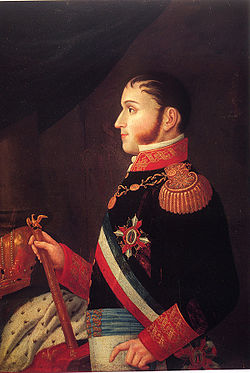
1824: Agustin de Iturbide, Emperor of Mexico

On this date in 1824, the Mexican officer who had made himself emperor was shot at the village of Padilla.

Iturbide‘s military acumen saw him through a meteoric rise in the service of what was then New Spain.

Iturbide rejected an early offer of generalship from the pro-independence leader Hidalgo in favor of spending the 1810s ably quashing the insurgency.

In a bizarre twist of fate, however, it would be Iturbide who would himself cement Mexican independence.

En route to try to finish off the last major rebel leader, Vicente Guerrero, Iturbide caught wind of the recent del Riego liberal revolt back in the mother country,* which had triggered civil war in Spain.

For the conservative royalist general, heir himself to a Basque noble lineage, the potential collapse of Bourbon authority in Spain raised the frightening specter of social upheaval.

All Iturbide’s work killing guerrillas for the sake of public order could come to naught if the Spanish monarchy collapsed or ceased projecting its power overseas … and then who knew what would emerge from the resulting power vacuum in Mexico?

So Iturbide cut a deal with Guerrero to consummate the Mexican War of Independence by separating from Madrid on an essentially conservative basis — a political breakaway without a social revolution. Independent Mexico would make nice with the Spaniards already living there, keep Catholicism as the official state religion, and get itself a constitutional monarchy of its own to insulate itself from the chance outcomes of continental politics across the ocean.

And when Iturbide marched into Mexico City and encountered a crowd conveniently imploring him to take the throne, well, who was he to deny them?

And so Iturbide transitioned smoothly from scourge of the revolution to its man on horseback,** immediately splintering the coalition that lifted him to power.


Contrary to this allegorical take on Iturbide’s coronation, he crowned himself — Bonaparte-like.

Only months after his July 1822 coronation, Iturbide shuttered Congress and began arresting the opposition. Meanwhile, Ferdinand VII had emerged from the Spanish fray as the (momentary) winner, leaving his upstart former subjects without international support.

A general that the freshly-minted emperor had himself had promoted, one Antonio Lopez de Santa Anna — yes, the Alamo guy — declared against Iturbide by the end of 1822, and come the following spring, Agustin I was a European exile, in the paradoxical position of drawing a pension from Mexico while also officially considered a traitor and outlaw.

In Tuscany and then England, Iturbide published an autobiographical justification — Statement of Some of the Principal Events in the Public Life of Agustín de Iturbide — then finally took up a much-asked-for invitation from Mexican conservatives to return and become the savior of his country against internal breakdown and a potential Spanish attack.

Founded on vainglory, this expedition was destined for fiasco; within five days of touching Mexican soil, Iturbide was serenading a firing squad with the last words, “Mexicans! I die with honor, not as a traitor; do not leave this stain on my children and my legacy. I am not a traitor, no.” Apparently they were serious about that injunction never to return.

When in Mexico City, relive happier times for our day’s subject at the Palace of Iturbide where he briefly maintained himself in the purple.


Iturbide’s palace. Creative Commons image from patricio00.

And do think twice about styling yourself Emperor of Mexico, since the only other person to claim that title also ended his reign in front of a firing squad.

* Ironically, it was a body of soldiers assembled for a reconquista of Spain’s independenceminded New World possessions that enabled del Riego to mutiny.

** Iturbide paused in the revolution’s good graces just long enough to design the Mexican flag.

On this day..

1831: Gen. Jose Maria Torrijos y Uriarte and his liberal followers

On this date in 1831, one of the great Spanish liberal officers was shot along with dozens of comrades attempting to spark a revolution.

It was a dark time for Spanish liberals under the autocratic rule of Ferdinand VII.

Jose Maria Torrijos y Uriarte (Spanish Wikipedia page) was one of the heroes of that downtrodden cause from way back, a noble-born officer who had been made a captain at the precocious age of 13 and been around for all of Spanish liberalism’s greatest early 19th century tragedies.

He was in Madrid for the ill-fated uprising against its French occupiers in 1808, and was captured en route to aid Pedro Velarde‘s last stand.

Lucky for Torrijos, and luckier still: as a prisoner, he might have been in line for the ensuing mass execution, but an aide-de-camp of General Murat let him go in gratitude for chivalrously preserving a French officer from the Spanish mob.

A few years after the Peninsular War, with independent Spain yoked to a reactionary Bourbon-backed monarchy, Torrijos’ dangerous opinions made him a prisoner once more.

This time, he was liberated by the brief ascendancy of fellow-traveler Rafael del Riego. This effusion, too, was destined for grief upon the scaffold; once more, Torrijos escaped, this time to exile.


The execution of Rafael del Riego

Pushing forty and a bit emptyhanded for all his strivings, Torrijos’ restless soul was not satisfied knocking about the shores of England. He soon assembled a company of like-minded folk (such as Robert Boyd) to make another bid at liberating Iberia. But he was induced to put ashore under the misapprehension of support, and promptly rounded up.

The Malaga governor’s message to Madrid requesting instruction returned the simple order: shoot them all.* (Spanish link)


El fusilamiento de Torrijos y sus compañeros en la playa de Málaga, by Antonio Gisbert

“A la muerte de Torrijos y sus compañeros”
by José de Espronceda (from here (pdf))

Helos allí: junto a la mar bravía
cadáveres están ¡ay! los que fueron
honra del libre, y con su muerte dieron
almas al cielo, a España nombradía.

Ansia de patria y libertad henchía
sus nobles pechos que jamás temieron,
y las costas de Málaga los vieron
cual sol de gloria en desdichado día.

Españoles, llorad; mas vuestro llanto
lágrimas de dolor y sangre sean,
sangre que ahogue a siervos y opresores,

y los viles tiranos con espanto
siempre delante amenazando vean
alzarse sus espectros vengadores.


Monument to Torrijos at Malaga’s Plaza de la Merced.

* Around 50 or so were shot. The exact figure is differently accounted by various sources; I have been unable to determine if any among them are authoritative.

On this day..

1942: Joan Peiro i Belis, Catalan anarchist

On this date in 1942, anarchist, trade unionist and anti-fascist Joan Peiro was shot with six others at Paterna, Spain.

Joan (or Juan) Peiro (English Wikipedia page | Spanish) was a Barcelona glassworker of anarcho-syndicalist politics.

As Secretary General of the Confederacion National del Trabajo (CNT) and editor of the anarchist rag Solidaridad Obrera, Peiro mixed it up in the rough-and-tumble interwar political scene, eventually becoming Minister of Industry for Republican Spain — an untoward position to more orthodox anarchists.

When the Spanish Republic lost the Civil War, Peiro fled to France, where he was nabbed and extradited.

The nationalist general Emilio Mola had said before the war’s conclusion,

Whoever is, openly or secretly, a supporter of the Popular Front, must be shot … we must sow terror … eliminating without scruple or hesitation those who do not think as we do. (Source)

In practice, reprisals weren’t that vicious (maybe because Mola himself had died in a plane crash and wasn’t managing them) — but the leadership and intelligentsia who could rally an anti-Franco political bloc were purged ruthlessly.

The imprisoned Peiro was offered — repeatedly — a sellout package to oversee Franco’s house unions, and he repeatedly refused.

He earned martyrdom for his troubles, and after Franco’s death re-entered the public sphere as the sort of bloke to name streets after. (As an anti-Stalinist, Peiro had had all the right enemies.)


Placa Joan Peiro, a major square in Barcelona.

The Spanish judiciary, however, has thus far declined (Spanish link) to overturn his sentence.

Peiro is saluted in Catalan here.

On this day..

1573: Matija Gubec, peasant revolt leader

On February 15, 1573, the brief but scintillating career of insurrectionary Matija Gubec came to a brutal end when he was publicly tortured to death in Zagreb.


You know what they say about the size of a man’s feet: Matija Gubec about to be crowned with a red-hot iron ringlet and quartered.

Gubec emerged from (to us, at least) obscurity to leadership of a short-lived peasant uprising in Croatia against Franjo Tahi (Croatian Wikipedia link), your basic feudal tyrant.

Although put down inside of two weeks, this revolt and its personification in Gubec have endured as potent national symbols in Croatia.

In the revolutionary 20th century, both left and right claimed Gubec’s standard as their own: a multiethnic company of Yugoslav volunteers fought under his name in the Spanish Civil War, as did multiple partisan units during World War II who took inspiration in his peasant class uprising. By contrast, the Ustasha conceived Gubec as

one man, who was not the exponent of any class, but … a reflection of an entire nation’s beliefs.*

Fascist and communist alike can jam to the rock opera Gubec Beg.**

* See Pavlakovic, Vjeran (2004) ‘Matija Gubec Goes to Spain: Symbols and Ideology in Croatia, 1936-1939’, The Journal of Slavic Military Studies, 17:4, 727 — 755.

** According to Pavlakovic, Gubec’s real given name is unknown and birth records suggest it might have been “Ambroz”. He was known as “Gubec called Beg,” using the Turkish term for a lord.

On this day..

1936: Antonio José, forgotten composer

On this date in 1936, the Spanish composer Antonio José was shot by Falangists during the Spanish Civil War.

The 33-year-old Burgos native (English Wikipedia page | the more detailed Spanish) was a rising young star, a writer, teacher and “folklorist” who had only that April earned plaudits for a paper on popular songs at an international musicology conference.

That July, the Spanish Civil War erupted … and the fascists clapped him in irons and shot him in the marshes near Estepar, Spain. I have not been able to find any clear documentation as to specifically how he earned the death sentence — which is not to say that the Spanish Falange deserves the benefit of the doubt for the regularity of its judicial procedures.

Despite Maurice Ravel’s (pre-Civil War) opinion that Jose would become “the Spanish composer of our century,” Jose’s work vanished into obscurity after his untimely death. Pieces like this Sonata Para Guitarra have only recently been widely rediscovered.

On this day..

1936: Edgar André

On this date in 1936, communist politician Edgar Andre was beheaded in Fuhlsbüttel Prison for treasonous complicity in the Reichstag Fire.

This 1936 German pamphlet denouncing Andre’s execution concludes: “Edgar André lives. In his spirit, we march: Despite all.”

A politician raised in Belgium, Andre had bolted the Socialist Party of Germany for the Communist Party in the early 1920’s, becoming a major labor leader in Hamburg. Andre was arrested within days of the 1933 Reichstag Fire as Adolf Hitler crushed official leftist opposition.

But Andre was not brought to trial for over three years — by which time torture had crippled and deafened him, and the political climate made the doubtful nature of the evidence against him scant protection in the courts. His conviction and sentence were a foregone conclusion.

The Spanish Civil War, which erupted over the summer of 1936 between Andre’s trial and execution, saw the service of a battalion in the International Brigades named for Edgar Andre.

Just days after Andre was beheaded, that battalion entered its first action — with German volunteers helping stave off fascist capture of Madrid. The unit’s hymn commemorated their namesake:

[audio:Das_Batallion_Edgar_Andre.mp3]

On this day..