1734: Judith Defour, in the Gin Craze

In every civilized society, in every society where the distinction of ranks has once been completely established, there have been always two different schemes or systems of morality current at the same time; of which the one may be called the strict or austere; the other the liberal, or, if you will, the loose system. … The vices of levity are always ruinous to the common people, and a single week’s thoughtlessness and dissipation is often sufficient to undo a poor workman for ever, and to drive him, through despair, upon committing the most enormous crimes. … The disorder and extravagance of several years, on the contrary, will not always ruin a man of fashion; and people of that rank are very apt to consider the power of indulging in some degree of excess, as one of the advantages of their fortune; and the liberty of doing so without censure or reproach, as one of the privileges which belong to their station.

-Adam Smith, The Wealth of Nations

On this date in 1734, Judith Defour (or Dufour; she was also known as Judith Leeford) was hanged at Tyburn, and afterwards anatomized.

Defour’s four companions in death were (male) robbers, highwaymen and housebreakers, feared but commonplace scourges of London’s propertied. Defour was a different type of terror to panic the moral sense of a metropolis that daily outgrew its denizens’ comprehensions: she throttled her two-year-old daughter “and sold the Coat and Stay for a Shilling, and the Petticoat and Stockings for a Groat. We parted the Money, and join’d for a Quartern of Gin.”


Maternal care has gone by the wayside in this detail view (click for the full image) of William Hogarth‘s 1751 print “Gin Lane”, a shocking figure who might allude to Judith Defour. This is not Hogarth’s only comment on the gin craze; in his “The Idle Prentice Executed at Tyburn” there appears to be commerce in Madame Geneva taking place in the cart to the right hand side of the frame.

Gin — short for Geneva, a corruption of the Dutch word jenever which denoted not a city in Switzerland but the potent elixir’s juniper flavoring — boomed in popularity as production advances sank its price in the early 1700s. “Cheap, widely available, and several times stronger than the traditional alcoholic beverages of the English working classes, gin was the first modern drug,” writes Jessica Warner in Craze: Gin and Debauchery in an Age of Reason.* And per-capita consumption of it increased nearly eightfold over the first half of the 18th century.

The specter of rampant alcoholism within the financial means of the working-class terrified the respectable.

“There is that predominant bewitching of naughtiness in these fiery liquors, as strongly and impetuously carries men on to their certain destruction … To recover him from this condition, he must be, as it were, forced into his liberty and rescued in some measure from his own depraved desires: he must be dealt with like a madman and be bound down to keep him from destroying himself,” wrote the Anglican clergyman and scientist Stephen Hales around the same time as Defour suffered. His earnest leap from moral shock to questionable social science inference — and even a proto-eugenics appeal — could have sprung word by word from the pen of a present-day drug warrior.

How many does it reduce to suffer the hardships of the extremest poverty, not only by wasting their substance by the continual drain to satisfy a false, vitiated appetite, but also by so enfeebling and disabling them that they have neither will nor power to labor for an honest livelihood; which is a principal reason of the great increase of the poor in this nation, as also of the much greater number of robberies that are committed of late years than were in former ages …

It is evident that in proportion as the contagion spreads farther and farther among mankind, so must the breed of human species be proportionably more and more depraved, and will accordingly degenerate more and more from the more manly and robust constitution of preceding generations. (Source)

Gin projected existential threats more imminent than the potential mongrelization of the species.

From the standpoint of Great Britain’s national output, gin’s production devoured a growing share of the grain harvest, with the perverse result that distillers keen to reassure lawmakers that their product posed no threat to the bread supply made pains to insist that they brewed their potion using only the lowest-quality crap not fit for consumption. On a more microeconomic level, gin was slated with sapping its adherent’s aptitude for the strictures of gainful employment while siphoning his revenues from more reputable tradesmen of whom, addled by alcoholic thirst, the drukard no longer cared to purchase even the barest essentials.** And the gin-houses, “some thousands of such, more than was ever known before” that popped up all over London came to be viewed as scofflaw cesspools — where the iniquitous planned their next larcenies or disposed of the proceeds from the last.

Cause and effect make a jumble, but as the Gin Craze unfolded every form of disorder, criminality, and social breakdown seemed but a link or two distant from the influence of Geneva.

We don’t know when this dark moon first threw a shadow over Judith Defour — only that she would transform her into a beast.

The daughter of poor and honest French-descended Spitalfields weavers, she was about 30 years old when she hanged. To reconstruct a timetable of her life from the scanty biographical details available us, she went to work by the time she was 10 or 12 years old as the silk winder for another weaver; she worked 11 years for that weaver, a woman, and then four more for a male weaver at which point the Newgate Ordinary says that “she fell into bad Company, and had a Bastard-Child, which died; and then she had another, the unfortunate Child lately murder’d by her.” Reading between the lines, she we might infer that her out-of-wedlock pregnancy was the cause of her dismissal. She had no education, and was not among the weaving industry’s skilled artisans. Hers was a perilous situation.

Did she fall into life’s waiting snares because of gin, or the other way around? The record gives us no indication — only that as she approaches Tyburn’s pall three or four years after her dismissal she is far along in dissipation and her employment prospects appear fleeting and piecemeal. Maybe she was already begging, thieving, or whoring, ills commonly imputed to Gin Lane. Judith’s mother would tell the court that “she never was in her right Mind, but was always roving,” although she was trying to save her daughter’s life when she said this.

In any event, Judith was shuttling her young daughter in and out of a workhouse at this point. On January 29, barely five weeks before her execution, Judith picked up little Mary from the workhouse as was her wont (forging a release order from the church), and brought her along as she went out boozing with a friend named Sukey† — “one of the most vilest of Creatures in or about the Town.”

The girl had been new-clothed at the workhouse, and as day wore on to evening and the gin ran dry, Sukey convinced Judith “to sell the Child’s Clothes, and carry it into the Fields and leave it there.” Maybe the kid would be taken in by some passing stranger, or returned to the workhouse; maybe Judith could retrieve her from the field later that night. Nasty, brutish, and short was this life and the only thing that mattered at that moment was the next drink. But in the attempt to silence the whimpering toddler they “ty’d a linen Rag very hard about the Child’s Neck, to prevent its crying out, which strangled her.” Then they walked away and sold those clothes for drink.

[S]he said, she was very sorry for what was done, that she never was at Peace since it happened, that she scarce desired to live; and therefore she made a voluntary Confession she had been always of a very surly Disposition, and untractable Creature, a Despiser of Religion, negligent in her Duty to God and Man, and would take no good Advice of her Friends, nor of any good or sober People. She drank and swore much, and was averse to Virtue and Sobriety, delighting in the vilest Companies, and ready to Practice the worst of Actions. She acknowledged the Justice of her Sentence, and died in Peace with all Mankind.

-The Ordinary of Newgate

The always-recommended BBC In Our Time podcast covers the Gin Craze here.

* We have previously featured Jessica Warner in connection with another of her books, about hanged American Revolution terrorist John the Painter.

** “Those that keep large numbers of cows near the town will tell you, that they have not had near the demand for their milk, and have been forced to sell off some part of their stock; which they attribute to mothers and nurses giving their children gin.” -Reformer Thomas Wilson, quoted in Patrick Dillon’s Gin: The Much-Lamented Death of Madame Geneva.

† Short for Susanna. This period also gives us the Beggar’s Opera and the most famous literary character of that name, Sukey Tawdry.

On this day..

1748: William Whurrier, War of Austrian Succession veteran

From the Newgate Calendar:


WILLIAM WHURRIER
Executed at Tyburn for murder, March 7, 1748, and his body hung in chains on Finchley common. (A Hard Case.)

We cannot so clearly see by the report of this trial, as the jury might have done by the evidence adduced, the malice propense necessary to constitute the conviction of murder. But, though we are by no means disposed to question a verdict of the country, yet we cannot avoid saying, that the case added to the services which the unfortunate man had rendered the king, should have proved a strong recommendation to royal mercy.

This soldier was a native of Morpeth, in Northumberland, and brought up as a husbandman; but having inlisted in General Cope‘s regiment, he served five years and a half in Flanders; when, some horses being wanted for the use of the army, he and another man were sent to England to purchase them.


General Cope is most famous today as the subject of a Scottish folk song commemorating a rout the Jacobites inflicted at the Battle of Prestonpans.

On the 11th of February, 1748, as Whurrier and his companion were walking over Finchley Common towards Barnet, the latter, being wearied, agreed with a post-boy, who went by with a led horse, to permit him to ride to Barnet, leaving Whurrier at an alehouse on the road. Whurrier having drank freely, met with a woman who appeared to be his country-woman, and with her he continued drinking till both of them were intoxicated, when they proceeded together towards Barnet; but they were followed by some sailors, one of whom insulted Whurrier, telling him that he had no business with the woman.

Whurrier suspecting there was a design to injure him, asked the woman if she had any connection with those men. She said she had not: but in the meantime the other Sailors coming up, said they came to rescue the woman; on which Whurrier drew his sword; but returned it into the scabbard without annoying any one.

A soldier riding by at this instant, Whurrier told him that the sailors had ill-treated him, and begged his assistance, on which the soldier getting off his horse, the sailors ran away, and Whurrier pursuing them, overtook the first that had assaulted him, and drawing his sword, cut him in such a manner that he was carried in a hopeless condition to a house in the neighbourhood, where he languished till the Sunday following, and then died.

the skull … was divided, as if a butcher had taken a chopper and divided the skull, so that the brains lay open.

… I judged the wound to be mortal; and upon his head being shaved, there appeared six other wounds upon the head, which went through the skin, but not into the skull; but the bone was bare, and I dressed them all. Then I made an inspection into the arm, and I found as many wounds there, from the wrist to the scapula, as I did upon the head. Upon the back part, what we call the scapula or shoulder bone, there were two wounds more … the bone of the arm was fractured by the incision, as if it had been done by a sword.

… I believe there were fifteen [wounds], and they were all at that distance from one another, that they must all have been made by separate strokes, and from these wounds the man must be in a very weak and languishing condition, and I found him so.

Surgeon’s testimony at Whurrier’s trial

It appeared by the testimony of a surgeon that the deceased had received a cut across the skull, as if done with a butcher’s chopper; so that the brains lay open; besides a variety of other wounds.

Whurrier being taken into custody for the commission of this murder, was brought to trial at the next sessions at the Old Bailey and being capitally convicted on the clearest, evidence, was sentenced to die.

After conviction he said he thought there was a combination between the woman he had met with and the sailors; and a day or two before he suffered, he procured the following paper to be published, which he called, “Whurrier’s Declaration.”

This is to let the world know that I have lived in good credit, and have served his Majesty eight years and two months. In the time of my service, I have stood six campaigns, and always obeyed all lawful commands: I have been in three battles, and at Bergen-op-zoom, during the time it was besieged. The first battle was at Dettingen, June, 1743, when his Majesty headed his army: the second was in the year 1745, April 30, at Fontenoy; the third was at Luckland, by siege; besides several skirmishes, and other great dangers.

I had rather it had been my fate to have died in the field of battle, where I have seen many thousand wallowing in their blood, than to come to such disgrace: but, alas! I have escaped all these dangers to come to this unhappy fate, to suffer at Tyburn, and afterwards to hang in chains on a gibbet, which last is the nearest concern to me; and I cannot help expressing, that it would be more beneficial to the public to employ blacksmiths to make breast-plates for the soldiers, than irons to inclose their bodies to be exposed to the fowls of the air.

I have been a true subject and faithful servant, as is well known to the officers of the regiment to which I belonged. If I had been a pick-pocket, or a thief, I should have suffered much more deservedly, in my own opinion, than I now do; for what I did was in my own defence: I was upon the king’s duty, and was assaulted by the men in sailors’ habits, who gave me so many hard blows, as well as so much bad language, that I could no longer bear it, and was obliged to draw my sword in my own defence; and being in too great a passion, as well as too much in liquor, I own I struck without mercy; as thinking my life in danger, surrounded by four men, who I thought designed to murder me; who, or what they were the Lord knows; it is plain they had a false pass, as it was proved: and that they had travelled but seven miles in nine days; but I forgive them, as I hope forgiveness: and the Lord have mercy on My soul, and the poor man’s whom I killed.

   W. WHURRIER.


Whurrier was executed at Tyburn in a group comprising six souls all told: the others were Robert Scott and Samuel Chilvers, smugglers; William Stevens and Francis Hill, housebreakers; and John Parkes, forger. Stevens was only 17 years old: “young, and entirely unacquainted with the Nature of the World,” in the words of the Newgate Ordinary who prepared the boy’s soul for its ordeal.

On this day..

1721: William Spigget, after peine forte et dure

English courts during the Bloody Code were strewn with all manner of weird pre-modern juridical relics, among which one must surely number the peine forte et dure — the “hard and forceful penalty” applied by courts against a defendant who refused to submit a plea.

The jurisdiction of criminal courts that we take for granted today initially emerged opposite potentially rival legal mechanisms for dispute resolution: ecclesiastical courts, weregild, even trial by combat. In principle, a defendant entering a plea at the bar was submitting himself to the specific jurisdiction of the court … a submission that, in principle, he could decline.

The march from that point to the present — when refusing to plead means the court simply enters an automatic “not guilty” plea on your behalf — consisted of gradually making the principle impossible in practice by dint of physical violence to force open the prisoner’s lips. It doesn’t matter if you lift a finger to defend yourself at trial, Mack, but we need you to say “guilty” or “not guilty” first.

The French term itself dates to a statute of Edward I in 1275, under the heading “The Punishment of Felons refusing lawful Trial” — one of those situations where the existence of the legislation proves the existence of the phenomenon. “Notorious Felons, and which openly be of evil Name,” the text complains, “will not put themselves in Enquests of Felonies, that Men shall charge them with before the Justices at the King’s Suit, shall have strong and hard Imprisonment (la prisone forte et dure), as they which refuse to stand to the Common Law of the Land.”

The text’s language suggests close confinement, fetters and guards, crummy rat-gnawed rations in the dumpiest hole of the dungeon: probably the king who introduced hanging, drawing, and quartering could make “hard imprisonment” quite persuasively uncomfortable.

But by the time of Queen Elizabeth, the state saw the need to narrow this potential refuge from the law down to the size of a pinprick. From the 16th century, we find that a special form of torturing to death is designed for prisoners refusing to plead:

the Prisoner is laid in a low dark Room in the Prison, all naked but his Privy Members, his Back upon the bare Ground his Arms and Legs stretched with Cords, and fastned to the several Quarters of the Room. This done, he has a great Weight of Iron and Stone laid upon him. His Diet, till he dies, is of three Morsels of Barley bread without Drink the next Day.*

“Which grievous death some resolute Offenders have chosen,” we understand, “to save their Estates to their Children.” Even this potential pecuniary loophole — the one once sought by Salem witch trials victim Giles Corey when he preferred pressing to death to the certainty of condemnation as a warlock — had vanished, for “in case of High Treason, the Criminal’s Estate is forfeited to the Sovereign, as in all capital Crimes, notwithstanding his being pressed to Death.”

The crown was trying to open an impassable gap between theory and practice, and it was accomplishing that end: this stuff happened once in a blue moon.

People threatened to withhold their plea, sure. What would follow is that a judge would read out in chilling detail everything that was about to befall the fellow (it was usually a fellow, though not always), then a bailiff would seize him and painfully tie his thumbs together right there in court, then march him off to the staking-out room to get things ready. Just showing the instruments of torture was the first rung on the torture-ladder, and usually somewhere in this whole process the defendant — be he ever so hardened — would chicken out and agree to make a plea before the first weight was ever loaded onto his torso.

Usually.

A Tyburn hanging is the focus of this post: it’s a mass execution of seven souls on the 8th of February in 1721. So the peine forte et dure did indeed do its job, force its plea, and noose its man.

But even though William Spigget/Spiggot died at the end of a rope, he was the rare soul who did go so far as to force the awful pressing torture, and to endure it for a little while.

Spigget led a robber gang of eight or so men preying on the roads out of London; one of those men, Thomas Phillips aka Thomas Cross, hanged alongside his boss. They had been caught only days before their eventual trial on January 13, and Spigget bravely, stubbornly, or foolishly refused to submit his plea. (Cross at first refused too, but he was in the chicken-out camp.)

The Ordinary of Newgate, plainly struck by the experience (and not a little aware of its potential to move copy), dwelt at greater length on Spigget’s 30 minutes under the stones than he did on the whole lives of some of the other February 8 hang-day compatriots.

Before he was Put into the Press, I went to Him, and endeavour’d to dissuade him, from being the Author and Occasion of his own Death; and from cutting Himself off from that Space and Time which the Law allowed Him, to repent in, for his vicious Course of Life: He then told me, that if I came to take Care of his Soul, he would regard Me, but if I came about his Body, he desired to be excused, he could not hear one Word. After a while, I left him, and when I saw him again, it was in the Vault, upon the bare Ground, with the Weights (viz. 350 pounds) upon his Breast. I there pray’d by him; and at Times ask’d him, why he would destroy his Soul as well as Body, by such an obstinate Kind of Self-Murder:** All his Answer was, Pray for Me; Pray for Me! In the Midst of his Groans, he sometimes lay silent, as if Insensible of Pain; then would fetch his Breath very quick and fast. Two or three Times, he complained that they had laid a cruel Weight on his Face; tho’ nothing was upon his Face, but a thin Cloth; That was however remov’d and laid more light and hollow; but he still complain’d of the prodigious Weight they had laid upon his Face; which might be occasion’d by the Blood being flush’d and forc’d up into his Face, and pressing as violently against the Veins and small Tendrills there, as if the Pressure upon them had been externally on his Face. When he had continu’d about half an Hour in the Torture, and 50 pound more of Weight had been laid on his Breast, he told the Justice of Peace who committed him, and myself, That he would Plead.

Having thus been awed by 400 pounds of the law’s majesty — and restored to something like sensibility with a splash of brandy, and several days’ rest during which Spigget’s post-ordeal health at times turned so precarious that he besought the last sacrament — both the apex robber and his henchman were easily convicted of several specific robberies upon the roads. One victim was able to identify the two as his assailants; in other cases, specific victims’ stolen goods were recovered from Spigget’s own lodgings, like Neal Sheldon’s valuable wig. Any one of these crimes would have been good enough to hang them.

Showing honor among thieves, the two men concentrated their few remarks on clearing a third confederate tried with them: the evidence against William Heater being circumstantial, and Spigget and Cross insisting that he was more incidental flunky than accomplice, his neck went un-stretched.

So why endure the hard and forceful penalty at all? By all appearances Spigget’s reason in the end resolved to pride: a violently exaggerated performance of the same criminal bravado that led so many of his peers to make a show of dying game at the gallows. “The Reasons, as far as I could learn from Him,” the Ordinary reported,

were, That he might preserve his Effects, for the use of his Family; That it might not be urged to his Children, that their Father was hanged; and that — Linsey should not tryumph over him, by saying he had sent him to Tyburn.

(Joseph Lin(d)sey was a former fellow-robber who saved his own life by turning crown’s evidence against his former mates. Spigget, we are told, was particularly galled by this betrayal “because Spigget had once rescued him [Lindsey] when he was nigh being taken, and in the defending him was wounded, and in danger of his Life.”)

As we have noted, Blighty’s seizure laws had already made the first objective a nonstarter, which leaves our man aspiring to a desperate exertion of masculine defiance. The Spigget of his own mind’s eye was a knight of the road so scornful of death that he would even let them slowly crush him to death. He fell short on that score, but dared much more than anyone had done in years, and no wonder: even the moments he endured as if hours might have been enough to shorten his years had he received an unlikely reprieve.

Sometimes he would say, that he wish’d he had dy’d in the Pressing, For that all sence of Pain was by the Pain taken from him, and he was fallen into a kind of Slumber. At other Times he express’d himself, that he was glad he did not cut himself off, by his Obstinacy, from that space the Law had allow’d him, for his Repentance, for the Sins of his whole Life.

On Monday, February 6, before the Execution, he receiv’d the Sacrament; and said that he desir’d not to Live, for he could be only a weak and unhealthy Man; and added that he could raise his Breath only in the lower Part of his Stomach

* This is not statutory language but that of a contemporary observer.

** The Ordinary really fixated on the suicide angle, just as if entering the trial were not an equally suicidal choice; the whole lot of the condemned got to hear as part of his sermon

That it was a False-Courage, for Malefactors assured that they shall dye, to lay violent Hands upon Themselves, to prevent the effects of the Law; and that if it was an Action fit for Socrates and Cato, and the greatest Heathens; it was yet too mean and indecent for the lowest Christian; as there is something Cowardly and Base, in cutting off our Lives, for fear of Pain and Shame. Nor would Sampson perhaps have obtain’d Licence from God, to Murder Himself, but that in his Person the Name of his God was mocked and ridiculed, and made a Jest for Dagon.

On this day..

1689: William Davis

Yesterday, we posted about “William Davis, the Golden Farmer” — a character in the Newgate Calendar. While the calendar is presented as straight criminal biography, its heavy dollop of authorial moralizing is a clue to scrutinize its characters before accepting their factual veracity.

The “William Davis” of the Newgate Calendar turns out to be a bit of a Frankenstein’s monster stitched together from the remains of various dead men. He appears to have obtained his name and his attributed date of execution — within a small margin of error! — from the December 21, 1689 hanging of a man named William Davis. Far from the dashing highwayman of decades’ distinction that the Newgate Calendar presents, Davis was a run-of-the-mill young ne’er-do-well who was condemned for burgling a house to the tune of £200.

Of this man’s career, we have the Ordinary of Newgate’s hurried summing-up:

William Davis desired all his dear Brethren to take warning by him, left they come to the fame punishment, telling them, That he was but 23 years of Age, and that he had been a Robber for Four years last past, not only in England, but in other Countries; and could not be contented to abide with his Parents at home, (tho’ he lived well) but run into Extravagances, keeping com pany with lewd Women, besides breaking the Sabbath day; and was guilty of all manner of enormous Sin, for which he prayed God to forgive him.

Two other men were hanged on the same occasion: Walter Mooney, for killing a coachman who refused to take them to Spitalfields; and John Peartman, “for Robbing one John Hozey upon the Road between London and Bristoll, of a Gelding Price 12 l. a Hat 3 l. a Hatband value 10 s. a Point Cap value 3 l. a Suit of Linnen for a Child value 40 s. with a Box value 6 d.”

Part of the Themed Set: The Creation of a Newgate Calendar legend.

On this day..

1754: Eleanor Connor, rogue

Seven people were hanged at Tyburn on this date in 1754.

For these minor malefactors — six thieves and a murderer, the latter of whom was ordered for posthumous anatomization — we simply cull from the day’s ordinary’s account, and focus on one Eleanor Connor.

A Catholic Irishwoman “about 35 years of age” and familiar by several aliases, she evidently refused to confide in the Protestant divine whose business it was to harrow the doomed prisoners’ souls. “How, or to what she was brought up, we have no authority to say,” her interlocutor puzzles. “No other account can be given of her, than what her behaviour has afforded, since she has been in England.”

She had been in London from a decade or so since, an inveterate pickpocket haunting “the theaters, and Covent Garden” and indeed “any public places … convenient for carrying on such practices.”

Arrested in Bristol in 1748, the hanging sentence was moderated to convict transportation. But an indenture to a distant master on the fringe of the New World wilderness was itself such a frightful fate that prisoners were occasionally known to prefer death outright; Eleanor Connor was just this side of such desperation, for she made bold to depart her prison ship shortly after it set sail by hurling herself off the deck under cover of poor weather to be retrieved from the waves by some boats hired by her partners in the underworld. While the Ordinary passes over this extraordinary gambit in a sentence or two, surely such a desperate and dangerous escape has as just a claim on poetic commemoration as any adventure of Turpin. A brine-drenched Eleanor Connor and her friends must have drank off the chills of the sea that night beside an exultant hearth.

Here she disappears from the annals of the courts, and hence from the Ordinary’s capacity to track her; by rumor he understands that she has changed her location often and her husbands nearly so much, navigating the margins as a picaro in both England and Ireland.

Around 1752 she appeared in Liverpool, making an honest go of it as a chandler. Into her thirties now and having passed through who knows what scrapes in the meantime, perhaps she was considering the limitations a criminal career based on manual dexterity might impose upon her once youth slipped away. But whether due to old habit or the capital requirements of a business startup, she did not yet abandon her diving profession and was caught picking the pocket of a gentlewoman at the marketplace. Once again she was imprisoned, and once again the camaraderie of the criminal caste came to her rescue, overpowering the turnkey on a pretended jail visit and liberating Eleanor. Whatever else one might say of this woman, she inspired the loyalty of her friends: one very much wishes we somehow had a record of her many adventures outside the gaze of the law.

Whatever they were, there were not many more of them. Soon after the band had relocated to London, our habitual cutpurse was recognized as a fugitive and taken up once more. It was a simple matter to reinstate her old suspended death sentence from that original Bristol conviction.

Condemned in February, she convinced a jury of matrons that she was quick with child … but after several months it became apparent that this was a ruse. The Ordinary is small enough to sneer at this intrepid character’s unavailing attempts to rescue her life yet again by making herself sympathetic to the magistrates: “she was not yet without some excuse, she pretended to be very weak after labour, and begged the court would take it into consideration, (a common expression, without any real meaning, among these unhappy wretches) and transport her for life; but she was ordered now to her former sentence.”

On this day..

1668: Two men and a woman, too early for Samuel Pepys

The L.P. Hartley saw about the past as a foreign country might roll a few eyes at the neighborhood history department, but one cannot dispute that the march of time has fundamentally altered many particulars of our everyday life.

Public executions are among the phenomena that ancestor generations once reckoned a routine fixture of the world, but for most of us are little but the stuff of fantastic nightmares. It requires an act of conscious imagination to project oneself into a world where expiring convicts propped up on breaking-wheels are just a part of the scenery — as in this absurd episode from Monty Python and the Holy Grail.

This date’s entry arrives courtesy of the pen of intrepid 17th century English diarist Samuel Pepys, whose faithful daily journals frequently record the public deaths occurring here and there like so many matinees.** Pepys at one level is a very accessible figure as he hustles through bourgeois banalities; that people are strung up and butchered around him and the fact rates nothing but a stray subordinate clause rudely injects that foreign past into his narrative.

On October 23, 1668, Pepys worked the day’s hanging right into an industrious calendar of business and social calls. (He attended Tyburn in the company of a surgeon, which made it a possible business trip for his companion.) Like the rest of us, Pepys wound up so pinched for time that he ran late and ended up missing the execution full stop, but he didn’t let the snafu perturb his day one bit.

Up, and plasterers at work and painters about my house. Commissioner Middleton and I to St. James’s, where with the rest of our company we attended on our usual business the Duke of York. Thence I to White Hall, to my Lord Sandwich’s, where I find my Lord within, but busy, private; and so I staid a little talking with the young gentlemen: and so away with Mr. Pierce, the surgeon, towards Tyburne, to see the people executed; but come too late, it being done; two men and a woman hanged, and so back again and to my coachmaker’s, and there did come a little nearer agreement for the coach, and so to Duck Lane, and there my bookseller’s, and saw his moher, but elle is so big-bellied that elle is not worth seeing. So home, and there all alone to dinner, my wife and W. Hewer being gone to Deptford to see her mother, and so I to the office all the afternoon.

After which Pepys turns as if to the our guilty-pleasure TMZ bookmark, and begins gossiping about the bawdy shenanigans of the royal court.

* Of course, the question depends on place as well as time; public executions are still routine in a few locales today — such as Saudi Arabia and Iran.

** Viz., the regicides as a successful sequel to the Charles I show:

I went out to Charing Cross, to see Major-General Harrison hanged, drawn, and quartered; which was done there, he looking as cheerful as any man could do in that condition … Thus it was my chance to see the King beheaded at White Hall, and to see the first blood shed in revenge for the blood of the King at Charing Cross.

On this day..

1677: John S., William Fletcher, and Robert Perkins

The Confession and Execution of the Three Prisoners suffering at Tyburn on Wednesday the 17th of October, 1677

At the Sessions of Oyer and Terminer for London, and Gaole-delivery of Newgate begun at Justice-Hall in the Old Bayly, 10 Octob. and ending on the 12 of the same Month, there were in all (as by a Printed Narrative you may already have heard) Five persons, who being Convicted on fair Tryals (per Patriam) of several capital Crimes, received Sentence of Death: But Two of them, whose Crime was stealing of two horses, appearing to be objects of mercy, as having never been concern’d in any such offences before, and seeming now extremely penitent for the same, obtained a Gracious Reprieve. The other Three were this present Wednesday 17 Octob. carryed to the place of execution, and by a shameful death surrendered their unhappie lives as Victims duely forfeited to the Justice of the Law.

These were all three old notorious offenders; two of them (taken in Gardiners-lane, Westminster) had long followed the Padd, as they called it, that is, Robbed upon the Highway: The other had made it his trade to break open houses, and pilfer away peoples Goods, being burnt in the hand but two Sessions ago: So that if such Malefactors should have longer been endured, honest Subjects would not be able either to sleep securely in their Dwellings, or travel abroad with safety on their lawful occasions; but both within doors and without, been liable to the spoils and outrages of these barbarous Savages.

To assist these poor wretches for the good of their Souls after the time of their Condemnation, the Sheriffs not onely manifested their pious Charity in sending them able Divines to instruct them, and especially Mr. Ordinary, who very laboriously discharges his weighty office on such occasions, but likewise several godly Ministers of their own accord, in Christian-compassion to their perishing condition, were pleased to visit them. Who laid before them the miserable state they were in; That now their days we [sic] numbered, nay their very hours and minutes which they had to live in this world; and yet these few minutes were all the time and opportunity they had to provide for eternity. That they were doom’d by Justice to a certain death; and though ’twas vain for them to flatter themselves with hopes of longer life in this world, yet there was means left, by a speedy, thorow, sincere and hearty repentance of their sins, and fleeing to Christ for mercy and forgiveness, to secure themselves, by vertue of his merits and righteousness, of a most happy and everlasting life in the world to come. That to such vile and sinful wretches as they had been, it was unspeakable mercy that they had yet a little space left, wherein to make peace with their God: for they might have gone on still in riot and wickedness, and been suddenly snatcht away in the very acts of their impiety Etc. These and many other pressing exhortations, together with severe threatnings to affright them and sweet promises to allure them, taken from the Word of God, were made use of, to bring them to a due sense of their sins, and to cry mightily to God for salvation. But the deaf adder refuses the voice of the charmer, charm he never so wisely All this good seed could take no root, or produce very little visible fruit on the stony ground of two of these Prisoners obdurate hearts; they not seeming (to outward appearance at least) to take that due and sensible notice of this most important counsel, as might be expected from persons in their condition. But the Spirit bloweth where it listeth. The third seemed much affected with this pious advice, and was very earnest and frequent in bewailing his sins, and condemning himself bitterly for having so wickedly mis-spent his precious time heretoforr. He acknowledged to some, that he had several years been a Thief, but not till of late upon the High-way: that at fust his Conscience would after every fact severely check him; but since custom of sinning taking away the sense, he had run on from one degree of wickedness to a greater without controul. He was very frequent in Prayer, wherein he has been heard to express himself to this effect.

Most dreadful and glorious God, though then hatest all the workers of iniquity, yet through the Mediation of they blessed son, with pity behold me a miserable sinner. Had I lived according to thy Commandments, or submitted to the Gospel of thy son, I might approach thee with the confidence of a childe: but I have been a Rebel against thee from my youth up, forgetting the God that made me, and the saviour that redeemed me, quenching and grieving the holy spirit, and slighting the endless Glory which thou hast prepared for me. Oh the precious time which I have lost, which all the world cannot call back; the wonderful love which I unthankfully rejected! How have I lived in continual acts of all kinde of Profaneness, all kind of Debanchery, whoring, swearing, Drunkenness, and especially Theft, which now has brought me to this woful, forlorn, condemned case wherein I am a shame to my friends, and burden to my self; and thou, O God, art my Terrour, who shouldot be my onely Hope and Comfort. Lord, thou knowest my secret sins, which yet are unknown to men, and all their Aggravations. Mine iniquities, Lord, have found me out; my fears and sorrows overwhelm me: a shameful death expects me in this world, and endless torments are ready to receive me in the other. But, Lord! thy Goodness is equal to thy Greatness, thy Mercy over all thy works. Good God, be merciful therefore unto me, the vilest of sinners: save me for thy abundant mercy, for the merit of thy Son, and for the promise of forgiveness which thou hast made through him; for in these alone is all my trust. Thou who didst patiently endure me when I despised thee, Oh do not refuse me now I seek unto thee, and in the dust implore thy mercy. Lord, I ask not for longer life in this world, but for life eternal; not for liberty to sin again, but for deliverance from this sinning nature, and that body of death which overwhelms me. To this purpose Lord give me thy grace to improve these few minutes, and prepare me for death and Judgement; that when I leave this world with Shame, I may be received into glory, and yeeld my departing soul with joy into the faithful hands of my Redeemer. Amen.

He behaved himself very penitently in the Cart, Prayed a considerable time by himself privately at the place of Execution; desired all people to take warning by him to avoid Idleness and Ill Company, which brought him to this Ignominious End. The other joyned in the publick Prayers, but said very little that could be heard. But all of them together suffered very patiently, and with submissive acknowledgements of the Justice of the Sentence.

(Via the invaluable Old Bailey Online)

On this day..

1750: James Maclaine

Gentleman highwayman James MacLaine hanged at Tyburn on this date in 1750.

The debauched son of a Presbyterian minister, MacLaine wasted first an inheritance and later a dowry on expensive clothes, gambling, and ladies of easy virtue; want, however, was his ticket to the immortality of the gallows when he joined fellow penniless gentleman William Plunkett to seek his revenue on the roads. (Inspiring the 1999 film Plunkett & Macleane — which uses one of several alternate spellings available for our man’s surname.)

For several months in 1749-1750 they prowled the environs of a lawless London, and notably Hyde Park, with the exaggerated courtesy demanded by romance of their profession. They found noteworthy prey: once, they stole a blunderbuss from the Earl of Eglington, though Eglington survived to suffer a noteworthy murder years later; in November 1749, they robbed M.P. Horace Walpole, even skimming his face with a pistol-ball that was inches wide from depriving posterity of the gothic novel.*
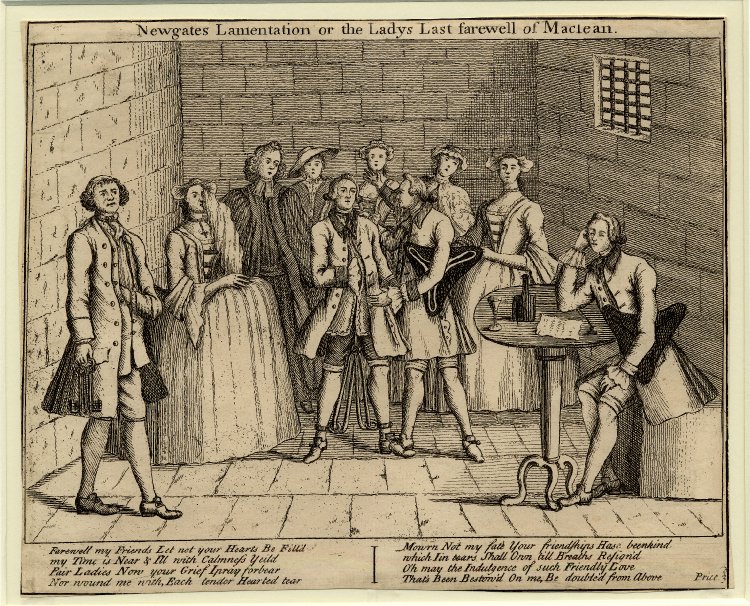
When caught** by mischance, the mannered† Maclaine became the object of public celebration, much to the bemusement of Walpole — who professed no ill will for his assailant but wondered that “there are as many prints and pamphlets about him as about the earthquake.”

Three thousand people are reported to have turned up on a sweltering summer Sunday to pay their admiration to the rogue, not excluding the very cream of society. Walpole teased his friends, court beauty Lady Caroline Fitzroy (wife of the Earl of Harrington) and her sidekick Miss Elizabeth Ashe, for presenting themselves among these masses to starfuck this latter-day Duval. “I call them Polly and Lucy,” he wrote, alluding to female conquests of the outlaw Macheath in The Beggar’s Opera, “and asked them if he did not sing,”

Thus I stand like the Turk with his doxies around.

Maclaine did not have to borrow Macheath’s ballads, for he was celebrated with verse dedicated all to him — like this “Jemmie Maclaine”, to the tune of Derry Down:

Ye Smarts and ye Jemmies, ye Ramillie Beaux,
With golden cocked hats, and with silver laced clothes,
Who by wit and invention your pockets maintain,
Come pity the fate of poor Jemmy Maclaine,

Derry down derry, etc.

He robb’d folks genteely, he robb’d with an air,
He robb’d them so well that he always took care
My lord was not hurt and my Lady not frighted,
And instead of being hanged he deserved to be knighted!

Derry down derry, etc.

William Hogarth‘s 1751 print cycle The Four Stages of Cruelty, one skeleton overseeing the operating theater where a hanged criminal is dissected is subtly labeled — Macleane.

* Walpole once remarked of the ubiquity of violent crime in London that “one is forced to travel, even at noon, as if one was going to battle.”

** Plunkett was never apprehended; it’s alleged that he ultimately escaped to North America.

† Although our man “has been called the gentleman highwayman,” the player-hating Ordinary of Newgate wrote, “and his dress and equipage very much affected the fine gentleman, yet to a man acquainted with good breeding, that can distinguish it from impudence and affectation, there was little in his address or behaviour, that could entitle him to that character.”

On this day..

1721: John Meff

John Meff hanged at Tyburn on this date in 1721 for returning from convict transportation.

If we are to credit the autobiographical account that Meff furnished the Ordinary of Newgate prior to his hanging, it was the last act in an adventuresome life. (Here’s the Ordinary’s account of the execution of Meff with three other men; here’s the Newgate Calendar entry based upon it, and which provides the quotes ensuing in this post.)

“I was born in London of French parents,” Meff begins — Huguenots who had fled Catholic harassment.

Huguenot refugees formed an important part of London’s Spitalfields weavers, and Meff apprenticed in this business until he could hang out his own shingle. But finding business too slow to support his family, he took to a bit of supplementary thieving.

Meff says that he had already once been condemned to death for housebreaking “but, as I was going to the place of execution, the hangman was arrested, and I was brought back to Newgate.”

Certainly the era’s executioners had frequent criminal escapades, but I have not found this remarkable Tyburn interruptus related in any press accounts in the 1710s. It’s possible that Meff is embellishing on the 1718 downfall and execution of hangman John Price — though Price was seized red-handed and not detained in the exercise of his office. This inconsistency has not prevented creation of a wonderful illustration, The Hangman Arrested When Attending John Meff to Tyburn, from this volume.

At any rate, Meff’s sentence was moderated to transportation to the New World, and he says that he “took up a solemn resolution to lead an honest and regular course of life … But this resolution continued but a short time after the fear of death vanished.”

Here Meff’s story really gets colorful — whether to the credit of the unsettled Atlantic economy or to the teller’s gift for embroidery we cannot say.

The ship which carried me and the other convicts was taken by the pirates. They would have persuaded me and some others to sign a paper, in order to become pirates; but we refusing, they put me and eight more ashore on a desert uninhabited land, where we must have perished with hunger, if by good fortune an Indian canoe had not arrived there. We waited till the Indians had gone up the island, and then, getting into the vessel, we sailed from one small island to another, till we reached the coast of America.

Not choosing to settle in any of the plantations there, but preferring the life of a sailor, I shipped myself on board a vessel that carried merchandise from Virginia and South Carolina to Barbadoes, Jamaica, and other of his majesty’s islands. And thus I lived a considerable time; but at last, being over-desirous to see how my wife and children fared inEngland, I was resolved to return at all adventures.

Once back, Meff says, he “quickly fell into my former wicked practices” — as if by gravity, no further explanation ventured. It’s hard not to suspect that he simply managed to escape his American indenture to continue a career in larceny, absent the whole marooned-by-pirates subplot. Men were known to tell tall tales to the Ordinary — who, after all, had their own story to sell the public through the deaths of their charges.

“The narrow escape he had experienced from the gallows ought to have taught him more wisdom than to have returned from transporation before the expiration of his time; but one would think there is a fatality attending the conduct of some men, who seem resolutely bent on their own destruction,” the Newgate Calendar’s entry concludes.

“One truth, however, is certain. It is easy, by a steady adherence to the rules of virtue, to shun that ignominious fate which is the consequence of a breach of the laws of God and our country.”

On this day..

1783: William Wynne Ryland, court engraver

On this date in 1783, British engraver William Wynne Ryland hanged at Tyburn* before a throng of gallows-voyeurs such as “had not been seen on a like occasion since the execution of Dr. Dodd.” (Morning Chronicle and London Advertiser, Aug. 30, 1783)

“[H]is evil genius prompted him, for gold, to debase his talents in engraving,” the Newgate Calendar opined. “By one fatal act, he entirely ruined his reputation as a man: but his name as an artist will ever stand in the highest estimation.”

French- and Italian-trained, Ryland was a premier court artist in his day, noted for importing stipple engraving from the continent to England. He earned a royal pension for his portraits of Hanoverian elites.


Some Ryland portraiture, from the National Portrait Gallery: King George III and his queen, Sophia Charlotte.

Although Ryland’s first attempt to parlay his draftsmanship into a print-selling business had gone bankrupt in 1771, he does not seem to have been entirely neglected by the muse of business acumen, either. Over the subsequent decade he had discharged all his previous debts and stockpiled assets to the amount of £10,000. “I am rich beyond temptation,” he protested to the jurors who tried him for his life. The Crown could produce little in the way of an immediate motive for the forgery. (“It is impossible for us to penetrate so far into the heart of man as to know what his inducements are.”)

But lucre is its own motivation, and the facts of the case weighed heavily against Ryland.

He had come into (legitimate) possession of £200 bill of exchange issued by the East India Company and dated October 5, 1780. Somehow it transpired that Ryland then exchanged two copies of this bill — one on September 19, 1782 with the banker Sir Charles Asgill, and then once again on November 4, 1782 to a banking firm with the Dickensian name of Ransom & Co.

Both bills were identical to every inspection, with the same amount, date, and cheque number, and Ryland the expert engraver could give no convincing account of the second note’s provenance. In the public’s mind, the fact that he had fled the indictment and then dramatically attempted suicide when his capture was imminent surely cinched the case.

Ryland’s attempts to inspire in the jurors a sufficient doubt as to whether the East India Company might not have accidentally circulated two identical bills was fatally undone when it turned out that a difference between the two bills could be found after all — by the paper manufacturer, who proved to the court that the second bill was inscribed on paper whose watermark established that did not exist on its purported date of issue.

this sheet of paper was made at the mill, on that particular mould, it has a defect on it; on the 21st of January, 1782, of the same mould of which this note is now shewn me, I made this sheet of paper; there is a defect of the mould, either by an injury it has received, or in consequence of the quantity of paper made on it, the bill has the same defect; and there is likewise a defect which the bill has not, so that the sheet of paper on which the bill was written, was made from that mould. This could not happen in the same places, and situations in any two moulds.

The jury needed only half an hour to convict him.

By the Morning Chronicle and London Advertiser‘s account, he was London’s star attraction on his hanging day.

At half past nine a man on the steps of newgate called out, “Mr. Ryland’s coach,” upon which a mourning-coach, that was standing opposite the Sessions-house, drew up to the door of the prison, and in about two minutes after the unhappy man walked down the steps at a brisk pace, and entered the vehicle; presently after which [fellow condemned prisoner John] Lloyd went into another mourning coach. The Ordinary of Newgate, another clergyman, a gentleman in mourning, (said to be a relation of he convict’s) and a sheriff’s Officer, went in the coach with Mr. Ryland …

These coaches, which immediately followed the Sheriffs’ carriages, having drawn a few yards from the door of the prison, two carts were drawn up; [James] Brown, [Thomas] Burgess, and [John] Edwards were tied in the first, as was [James] Rivers in the last cart …

The gallows was fixed about 50 yards nearer the park wall than usual. About five minutes before 11 o’clock, Ryland’s coach drew on the right of the gallows, as did Lloyd’s on the left; and between them the cart; soon after which a violent storm of thunder, lightning, and rain came on, when the Sheriffs gave orders for a delay of the execution. When the storm had subsided, and some time had been employed in prayer, Rivers was lifted from one into the other cart, which backing to Lloyd’s coach, he alighted therefrom, and entered the vehicle, and after the ropes had been fixed about the necks of these unfortunate men, Ryland stepped from the coach to join his unhappy fellow sufferers. After a conversation of at least ten minutes between Ryland and Mr. Villette, Ordinary of Newgate, and the same time employed in an earnest discourse between Lloyd and Burgess, all the malefactors joined in singing the hymn, called, “The Sinners Lamentation”


Editor’s note: I’m not certain whether this is the hymn alluded to.

Ryland was the object that attracted the general attention, from Newgate to Tyburn, the sound that reverberated from every quarter, amidst the immense multitude was, “Which is ryland? There, that is Ryland in the first coach!” Exclusive of the usual accommodations, a vast number of temporary stages were erected; and gentlemens and hired carriages were innumerable. Some rooms, for accommodating private companies, were actually let at the enormous rate of from six to ten guineas.

Notwithstanding the vast press of the crowd, amidst the astonishing number of horsemen, carriages, and people on foot, we have not heard that any body was materially hurt, though many were forced down and trod on.

Ryland was in mourning, and wore a tail wig … Through the whole of this trying scene [he] conducted himself with remarkable serenity and fortitude, strongly indicating that he was prepared for, and perfectly reconciled to his fate.

The wheel of fortune turning against the mighty — especially when they should hazard their lives for a needless pittance — being irresistible to other artists, Ryland is the title character of a a comedic play.

* One of the very last hangings at Tyburn.

On this day..