1729: James Cluff, on appeal

From the Newgate Calendar:

This unhappy young man was born in Clare-market, and lived as a waiter at several public-houses, in all of which he maintained an extraordinary character for diligence, obligingness, and integrity.

Mr. Payne, master of the Green Lattice, in Holborn, hired Cluff [or Clough -ed.] as a servant, and during his residence there, he fell in love with Mary Green, his fellow-servant; but she being courted by another man, constantly rejected his addresses, which frequently agitated his mind in the most violent degree.

Green’s other lover coming to see her, sat in the same box with her, and was received by her in an affectionate manner; but this did not seem to be much regarded by Cluff, who was then engaged in attending the customers: but when the lover was gone, Mr. Payne, perceiving that something had discomposed Cluff’s mind, asked him the reason of it; but could not prevail on him to tell the cause.

While Mr. Payne and his wife were at dinner in the parlour, and the girl was eating her dinner in one of the boxes, Mrs. Payne heard a noise, as if two persons were struggling, and going into the tap-room, Cluff said, “Come hither, madam.” On this she advanced, and saw the prisoner holding the deceased by the shoulders, who was sitting on the floor, and speechless, while the blood streamed from her in large quantities.

Mrs. Payne called out, “What have you been doing, James?” He said, “Nothing.” He was asked if he had seen her hurt herself? He said, No; but that he had seen her bring a knife from the cellar where she had been to draw some beer for her dinner. Mr. Payne now entered the tap-room, and then went into then cellar to discover if there was any blood there; but finding none, he accused Cluff on suspicion of having committed the murder; and instantly sent for a surgeon. When the surgeon arrived, he found that a knife had been stabbed into the upper part of the thigh, and entered the body of the girl, in such a manner that she could not survive the stroke more than a minute. [i.e., it gashed her femoral artery -ed.]

A bloody knife was found in the room, and Cluff was committed to Newgate for the murder. On his trial, the surgeon deposed that the knife fitted the wound that had been made, and that he believed the woman had not killed herself: but the jury acquitted the prisoner, from what they deemed insufficiency of evidence.

A discharge of the accused party would now have followed of course; but William Green, the brother and heir of the deceased, immediately lodged an appeal in consequence of which Cluff was brought to trial at the next sessions but one, when his case was argued with the utmost ingenuity by the counsel for and against him, but this second jury found him guilty, and he was sentenced to die.

Holy double jeopardy! Though rarely used, it was indeed formerly an option for a victim or a victim’s heir to lodge a private appeal against the purported malefactor, even one who had already been acquitted — indeed, even against one who had been convicted and then pardoned.

The distinction between a “public” and a “private” prosecution was usually more theoretical than real, since — at least until Sir John Fielding began organizing professional police in the late 18th century — even normal Crown trials often depended mostly on the exertions of the victim or friends to bring a man to book with sufficient evidence to punish him.* But in a close case, like Cluff’s, the rarely-used private appeal option could occasionally offer what amounted to a second bite at the apple.** (See Whores and Highwaymen: Crime and Justice in the Eighteenth-century Metropolis)

Perhaps tracing to the ancient weregild system of atoning crimes via direct redress by offenders to their victims, private prosecutions were completely immune from interference by a sovereign pardon. (However, they could be dropped any time the prosecuting party wished — which also made them leverage for extracting cash settlements.)

Back to the Newgate Calendar:

“I earnestly press’d upon him to glorify God by a plain Confession of his Crime, and urg’d to him the most material Circumstances, in Consideration whereof scarce any Body doubts but he committed the Fact. He could not pretend that his Master, or Mistress, who gave him the Character of a good Servant, had any Prejudice, or Ill-will to him, upon which Account they might be easy, whether he lived or died. He neither reflected on them, nor none of the Witnesses, as if they had any View in Prosecuting him, but that Justice might be executed. I urg’d him with the Surgeon’s Opinion, that it was improbable, if not impossible, for the Maid to give herself such a Wound; that she had no Knife in the Cellar; that in the first Trial, three Persons had sworn that he was Rude and Barbarous to the Deceased upon many Occasions, and upon that Account she made grievous Complaints to her Mother, and others … he continued Peremptory in his Denial. At first, indeed, he seem’d to be in Confusion, at the many pressing Instances which were made to extort a Confession from him; but recollecting himself, he denied that he gave the mortal Wound, and said, that he knew nothing at all how she came by her Death … Many of his Friends and Acquaintances came daily to visit him, while he was under Sentence, and I wish they did not divert him too much from his Duty, and that some of them did not under-hand, buoy him up with false Hopes. He hop’d to be sav’d only by the Mercy of God, through the Merits of Jesus Christ, and that he forgave all the World any Injuries done him, as he expected Forgiveness from Almighty God.”

James Guthrie, the Ordinary of Newgate

After conviction, his behaviour was the most devout and resigned that could be imagined; he exercised himself in every act of devotion, but solemnly declared his perfect innocence with respect to the murder. He was visited by his friends, who earnestly entreated him to make a sincere confession; especially as in his case it was not in the power of the king himself to grant him a pardon. In answer hereto, he freely confessed all his other crimes; but, saying he would not rush into eternity with a lie in his month, again steadily denied the perpetration of the crime of which he had been convicted. The clergyman who attended him urged him to the confession of his guilt, and even refused to administer the sacrament to him on the morning of his execution, on any other terms than those of acknowledging his crime, but nothing could shake his resolution; he still steadily persisted in his innocence.

On his way to the place of execution, he desired to stop at the door of his late master, which being granted, he called for a pint of wine, and having drank a glass of it, he addressed Mr. Payne in the following terms:

“Sir, you are not insensible that I am going to suffer an ignominious death, for a crime of which I declare I am not guilty, as I am to appear before my great Judge in a few moments to answer for all my past sins. I hope you and my good mistress will pray for my poor soul. God bless you, and all your family.”

At the place of execution he behaved in the most composed, devout, and resigned manner; and seemed to possess in the consciousness of innocence. There was a great concourse of spectators to witness his fatal end; to whom he spoke in the following manner: “Good people, I am going to die for a fact I never committed, I wish all mankind well; and as I have prayed for my prosecutors, I hope my sins will be forgiven through the merits of my ever blessed redeemer. I beg you to pray for my departing soul; and as to the fact now die for, I wish I was as free from, all other sins.”

He was hanged at Tyburn on the, 25th of July, 1729, exhibiting no signs of fear to his last moment.

The case of this man is very extraordinary. The evidence against him was at best but circumstantial; and this not supported with such strong corroborative proofs as have occasioned conviction in many other instances. No person was witness to his commission of the murder; nor was there any absolute proof that he did commit it; and from the steady perseverance with which he denied it, under the most awful circumstances, and at the very concluding scene of his life, charity would. tempt one to believe that he was innocent. Ought not this case to afford a lesson of caution to juries how they convict on circumstantial evidence? Is it not better that the guilty should escape, than the innocent be punished? All the decrees of mortals are liable to error; but the time will come when all mists shall be cleared from our sight; and we shall witness to the wisdom of those laws of Providence, which are now inscrutable to mortal eyes. Then shall we see that what appeared inexplicable to us was divinely right; and learn to admire that wisdom which, at present, so much exceeds our finite comprehension. In the mean time, we ought to adore that goodness we cannot comprehend, and rest satisfied with those dispensations, which are eternally and immutably just.

After Cluff’s hanging, his friends published a paper delivered them by the dead man “wherein [Cluff] makes a solemn Declaration that he was innocent of the Murder, and that several material Circumstances given in Evidence against him (which he particularly mentions) were untrue.” (London Journal, Aug. 2, 1729)

* Most notoriously, Jonathan Wild profiteered wildly from this system of privatized law enforcement by extracting a cut both from thieves whom he could threaten to shop for a reward, and from victims whose effects he could recover for a percentage.

** Though such proceedings would normally be handled, as Cluff’s was, by a jury trial, it was for private prosecutions that trial by combat still remained a possibility; one wonders if the accused servant considered taking his chances in the lists. This archaic legal artifact would not be abolished for ninety more years yet — after an 1818 case, Ashford v. Thornton, in which the burly accused in a private appeal successfully sued for the right to fight his wispy accuser in arms rather than in court. The magistrate gave an embarrassed ruling in the brawler’s favor (“however obnoxious I am myself to the trial by battle, it is the mode of trial which we, in our judicial character, are bound to award. We are delivering the law as it is, and not as we wish it to be”), leading the appellant to wisely back out of the case … and leading Parliament to ban private appeals and trial by combat in 1819.

When such an abolition was mooted as a means of soothing the American colonies in the early 1770s, however, conservative Lords decried the innovation as tending to “a system of ministerial despotism” that would remove a failsafe for crime victims — although Edmund Burke did allow that the ugly remnant of judicial combat “was superstitious and barbarous to the last degree.”

Have there been attempts even in 21st century Anglosphere courts to assert the right to trial by combat? Reader, there have.

On this day..

1762: Sarah Metyard and Sally Metyard, mother and daughter

(Thanks to Meaghan Good of the Charley Project for the guest post. -ed.)

On this date in 1762, Sarah Metyard and her daughter, Sarah Morgan “Sally” Metyard, were hanged at Tyburn for the horrible murder of their apprentice girl.

Sarah, a milliner, and Sally, her assistant, had taken on several female apprentices. One of those, a thirteen-year-old workhouse orphan named Anne Naylor or Nailor, was cruelly treated by the Metyards, who beat her, confined her to the attic and fed her nothing but bread and water. Twice she escaped and asked for help and twice she was dragged back by her mistresses to be tortured all over again.

After the second escape attempt, according to the entry in the Newgate Calendar, the Metyards

…put [Anne] into a back room on the second storey, tied a cord round her waist, and her hands behind her, and fastened her to the door in such a manner that it was impossible for her either to sit or lie down. She was compelled to remain in this situation for three successive days; but they permitted her to go to bed at the usual hours at night. Having received no kind of nutriment for three days and two nights, her strength was so exhausted that, being unable to walk upstairs, she crept to the garret, where she lay on her hands and feet.

While she remained tied up on the second floor the other apprentices were ordered to work in an adjoining apartment, that they might be deterred from disobedience by being witnesses to the unhappy girl’s sufferings; but they were enjoined, on the penalty of being subjected to equal severity, against affording her any kind of relief.

On the fourth day she faltered in speech, and presently afterwards expired. The other girls, seeing the whole weight of her body supported by the strings which confined her to the door, were greatly alarmed, and called out: “Miss Sally! Miss Sally! Nanny does not move.” The daughter then came upstairs, saying: “If she does not move, I will make her move”; and then beat the deceased on the head with the heel of a shoe.

This is a sad epitome of what will appear at large in too many dreadful examples on the great day of account, when all those who have counteracted, or ill discharged their relative duties of parent and child, ruler and subject, pastor and people, or any other of the superior and inferior relations in this state of trial, will look aghast at each other, in frantic despair, charging the neglect of duty, of relaxed discipline, of disobedience, and evil example to each other’s account; when all that seduce and betray each other into sin, will fill up the dire and dreadful number.

Learn hence ye parents and children of every rank, the force and importance of that admonition, preparative to a general reformation of life and manners, the neglect of which is a sure presage of a general corruption and impending destruction.

the Newgate Ordinary

Anne died a short time afterwards, and Sarah and Sally hid this fact and told everyone she had run away. They hid her body in a box in the garret for two months until the smell became too offensive, then dismembered the corpse and dumped it in a gully-hole in Chick Lane. Two watchmen found the remains on December 5, 1758.

The crime went undiscovered for years, and Sally eventually moved out of the house and in with a Mr. Rooker. Sarah, however, was afraid her daughter might tell someone what happened, and began stalking her and threatening her life. Her attempts to frighten Sally into silence backfired when Sally confronted her and alluded to the murder in front of Mr. Rooker.

Once Sarah was gone, Rooker demanded to know what they’d been talking about, and Sally spilled the beans. He went straight to the cops. (Or more precisely, to “the officers of the parish of Tottenham High Cross.”)

Sally backed up everything he told them.

Cate Ludlow and Graham Jackson record in their Grim Almanac of Georgian London,

the Metyards had to be separated in prison lest they attack each other, and would always blame the other if asked about the crimes. Unbeknownst to the gaolers, the mother had been starving herself (a fitting fate) in an attempt to cheat the gallows; a few days before the due date she fell into a fit and swooned away. She never spoke again. On 19 July 1762, before 9:00 a.m., the women were put into the cart. The ordinary had to fight to get them through the enormous crowds, and found the mother stretched out like a statue, not even seeming to breathe, though her chest twitched convulsively now and then. The daughter begged for prayers from the crowd (over the jeers and boos*), and looked about for Mr. Rooker. She added that ‘she died a martyr to her innocence.’

After they were hanged, their bodies were displayed before the public at the Surgeons’ Hall, then dissected.

* The populace reserved a special hatred for mistresses who abused their serving-girls.

On this day..

1707: John Whittingham

On this date in 1707, John Whittingham was hanged as a burglar.

The Newgate Ordinary Paul Lorrain worked, as was his wont, on Whittingham’s soul, and as was his custom published an Ordinary’s Account celebrating Whittingham’s conversion. The thief, “before he was turned off, desired the Standers-by to take Warning by him, and pray for his departing Soul. His last Words were, Lord, have Mercy upon me! Lord, forgive me my Sins! Lord Jesus receive my Soul.”

But publishing these items was not merely the Ordinary’s custom — it was, especially in Lorrain’s hands, his very lucrative business.

The Ordinary’s Account of John Whittingham is a slender one; Lorrain spends 1,164 words on it, but most of these are formulaic description of the circumstances of Whittingham’s trial and conviction, followed by a padding-out with details of Lorrain’s own sermons. Only 679 words touch on Lorrain’s specific grappling with Whittingham’s own forgettable demons. (A bog-standard Newgate collection of “Sabbath-breaking, Idleness, Gaming, keeping bad Company, and having to do with Lewd Women.”)

Once Whittingham has been disposed of, however, we come to brass tacks for the Ordinary. Sure, Whittingham might have thought his hempen strangulation was the apotheosis of a life’s tragedy of sin and redemption. Actually it was just Lorrain’s daily bread and butter, in the literal sense of the term.

A lengthy footnote immediately following the execution remarks asserts Lorrain’s prime market position in the increasingly competitive execution broadsheet business:

Whereas some Persons do frequently take the Liberty of putting out of Sham-Papers, pretending to give an Account of the Malefactors (called the Lives and Conversations of the Persons Executed) in which Papers they are so defective and unjust, as sometimes to mistake even their Names and Crimes, and often misrepresent the State they plainly appear to be in under their Condemnation, and at the time of their Death. To prevent which great Abuses, These are to give Notice, That the only true Account of the Dying Criminals, is that which comes out the Day after their Execution in a single half Sheet, about 9 in the Morning, the Title whereof constantly be gins with these Words, The ORDINARY of NEWGATE his Account of the Behaviour, &c. In which Paper (always Printed on both sides the better to distinguish it from Counterfeits) are set down the Heads of the several Sermons Preach’d before the Condemned: And after their Confessions and Prayers, and Atestation thereto under the Ordinary’s Hand, that is, his Name at length; and at the bottom the Printer’s Name, Dryden Leach; which if the Readers would but observe, they would avoid those scandalous Cheats heretofore constantly impos’d upon them.

You got that?

And then, we have 1,213 words — significantly more than Lorrain spends on Whittingham himself — that underscore just why the Ordinary’s Account brand was worth such vigorous defense.

ADVERTISEMENTS.

In few Days will be Publish’d.

THE Monthly Miscellany, or Memoirs for the Curious, occasionaly containing Divinity and Law, Philosophy Morral Natural and Experimental, Mathematicks in its several Branches, Physick Chymistry Surgery, Anotomy and Botany, Epitome of Books and News impartially done. Lives and Characters of Famous Persons as well Living as Dead, being the Life of Doctor Sherloch, Letters on several Subjects; History Poetry and Travels. For the Month of June. Sold by J. Morphew near Stationers-Hall Price, 6d. where may be had the 5 foregoing, Lives of Prince Lewis of Baden and my Lord Cutts, Mr. Jeremiah White late Chaplain to Oliver Cromwel, and D. Drake. Containing several other curious Miscellaneous Works in sundry Faculties.

THERE is now prepared and to be Sold only at Mr. Deighton’s, a Perfumer, at his Shop at the corner of Chancery-Lane in Fleet-street, the only famous Beautifying Water, for the clearing and making the Face fair, tho’ of the brownish Complexion, which by its use has been experimented to make the Skin smooth and white and also to take off all Pimples and Redness, from 2s. 6d. to 5s. a Bottle. Just Publish’d.

*** A new and exact Draught of the City of Thoulon, with all its Fortifications. The Basom for the King’s Ships of War, &c. Sold by John Philips next the Fleece Tavern in Cornhill and by B. Bragg, in Pater-Noster-Row. Where may be had a Haxagon, fortify’d with all sorts of Out-works, according to the modern Method of Fortification, useful for those who read the publick News.

A Presentative against Atheism and Infidelity. The Remains of Cardinal Du Perron, president Thumanus, Monsieur St Evremont, and other great Men. Both by Thomas Osborn in Gray’s Inn next to the Walks, and Samuel Butler near Bernard’s Inn, Holbourn.

This Day is Publish’d.

THE Diverting Muse, or the Universal Medley, Written by a Society of merry Gentlemen, for the Entertainment of the Town. The First Part. Consisting of the Husmours of a Coffee-house. Sollitary Enjoyment, or the Pleasure of Contemplation. An off-hand Epitaph upon the Weasel. A Lampoon upon two Sisters, famous Strumpets in the City The dying Husband and the joyful Wife. The Resolute Lady. The plain Dealer A Dialogue Song between a forward Youth and a young Lady The meaning Lover. London: Printed, and Sold by B. Bragg at the Raven in Pater-noster-row, 1707.
Newly Publish’d the 2d Edition of

*** The Life and Glorious History of his Grace John Duke and Earl of Malborough, Prince of the Empire, Capt. General of her Majesty’s Forces &c. containing an Account of the most Important Battles, Seiges, Negotiations &c. managed under his Auspicious Conduct; both in the Wars of Flanders and Ireland, with a large Account of the ever Memorable Battles of Hockstet and Schellenberg in Germany, also his March to the Moselle in 1705. his return to the Netherlands and forcing the French Lines near Tirlemont and his last Victory at Ramallies, with many Remarkable Passagos from his 1st advancement in the Court of King Charles the II. to this present time. Printed for John Chantry at the Sign of Lincolnsin-back Gate, Price bound one Sailling.

Jst published,

A Cry from the Desart: Or, Testimonials of the Things lately come to pass in the Cevennes, upon Oath and by other Pros. Translated from the Original. The 2d Edition. With a Preface by John Lacy, Esq ; price 8d. Sold by B. Bragge at the Raven Pter-noster-Rw; where way be had Prophetical Warnings of Marion, heretofore one of the Commanders of the Protestnes tha had taken Arms i the Cevennes, or Discourses uttered by him in London the Operation o the Spirit, and faithfully taken in Writing whilst they were spoken, price 1s. An Apology for the English Dissenters, by the Confessions of Foreign Protestant Churches, and particularly by Letters from that of Geneva, which may serve as an Answer to several Letters from the Pastors of the Church of Geneva, to the Archbishop of Canerbury, the Bishop of London, and the University f Oxford, with the Answers to them, price 6d. The Historical Catehisme: Or, an Explanation of the Old and New Testament, by way of Questions and Answers, after a more easie and familiar manner thn hitherto extant, very edifying and profitable for Children to learn, before they begin to Read the Bible. By a Reverend Divine of the Church of England.

Lately printed,

Bishop Hickman’s 14 Sermons. Ostervald’s Grounds and Principles of the Cheistian Religion, M Norris’ Theory of the World, in 2 Vols. Dr. Attetbury’s Vindication of p. Tils 14 Vo s. of Sermons against Popery. Sir ustrde Which Essays. Mr. Lewis’s Companion for the Afflictd, and the Church explained. An Essay against Idleness. A Postural Letter from a Minister to hs Parishioners, with the Christian daily Devotion. George Foxe’s last Will and Testament. Mr. Keth’s serious Call to the Quakers. Dr. Bray’s aptismal Covenant. All printed for W. Hawes, at the Bible and Rse in Ludgate-street, for whom will be speedily published, Dr. Bray’s Bibliotheca with large Additions.

THE second part of the Pulpt Fool, a Satyr; containing a distct Character of the most noted Clergy-men in the Queen’s Dominiors, Church-men and Dissenters Price 1 s. To this Satyr is annexd a paneyrick upon Archbishop Tenison, Bp. Burnet, Bp. , Dr. Sou, D. Stanhope, Dr. Lucas, Dr. Blackall, Dr. Moss, Mr. Norris, Mr. Hoadly, M. Flamstead, Mr. Graener, Mr. Stennet. Mr. Rosewl, Mr. Franks, Mr. Clark, Mr. Palmer, Mr. Calamy, Mr. Showers. Mr. Henery, Mr. Lews, Mr. Maudit, Mr Freks, Mr. Walker. Wh the Characters of near 200 Clergy-men more, eminent for prety d Learning. Printed for B. Bragge, in Patter-Nester-Row, of whom may be had, The first Part of the Pulpit Fool, a Satyr which (together with the 2d part) comprehends a general History, of tho Verse, but more especially of such as are Heterodox and ten, for Railing at protestant Dissenters.

Newly publish’d.

THE Devout Christians Companion consisting of Devotions for all Occasions. An Office for the Sick, and a Treatise for the H. Sacrament. Collected from the Works of Abp. Tiotson, Bp. Kenn, Bp. patrick, Bp. Beverge, Dr. Scots, Dr. Horneck, Dr. Stanhope &c. The 2d Edition price 2 s. 6 d. Likewise Caesar’s Commentaries of his Wars in Gaul and Civil war with popey, to which is added. Alus Hirtus, or Opius’s supplement of the Alexandriau, African, and Spanish War. With the Author’s Life. Adorned with pters from the designs of the Famous plado. Made English from the Original Latin, by Capt. Martain Blden. The 2d. Edition, 8vo. With Ntes, and a Comparison between the Antient and Modern Geography. Both printed for Charles Smith, at the Buck between the two Temple gates in Fleetstreet and Edmund Curl at the peacock without Templebar.

AT the Golden Acorn in White Fryars, Fronting Fleet-Street, London are lately come in above a 1000 Vols of Tracts, which was Collected by a Person of great eminency and worth and will be Sold at the Rates mention’d in the Post Boy, Note, these following Pamphlets may be had viz. Naked Gospel Naked Truth, Cobler of Gloster, killing no Murder, Absolum and Athitophel Religio Laiti Table o Love &c, with Acts of Parlament Proclamations Declarations &c. according to the method of William Millersale of London Stationer.

On this day..

1584: Francis Throckmorton, plotter

Francis Throckmorton (Throgmorton), was executed at Tyburn on this date in 1584 for his plot to make Mary, Queen of Scots the Queen of England, too.

The son of a prominent Warwickshire family — his father’s monumental tomb still adorns the church at Coughton, while London’s Throgmorton Street is named for our guy’s uncle NicholasFrancis was a staunch Catholic who as a 20-something man on the make did a continental tour where he huddled with papist exiles cogitating how to win England back for the faith.

Naturally many a plot centered on the Catholic Queen of Scotland Mary, who as Henry VIII’s great-niece stood well within the scope of consanguinity necessary to rule England with legitimacy. (Mary’s son James VI of Scotland and James I of England would do justice that.)

On his return to London in 1583, the subtle agents of Elizabeth’s spymaster Francis Walsingham sniffed out his project to establish a line of communication from Mary to the Duke of Guise who contemplated a pro-Mary invasion.

“I have seen as resolute men as Throckmorton stoop, notwithstanding the great shew he hath made of a Roman resolution,” Walsingham prophesied of the obdurate young man whose fidelity to his project was to be tested by torture in the Tower. “I suppose the grief of the last torture will suffice, without anye extremity of racking, to make him more comformable than he hath hitherto showed himself.”

Indeed Throckmorton did succumb.

The ensuing bust-up of his plot forms a station on Queen Mary’s own path to Calvary: the treasonable design empowered Walsingham successfully to impel creation of the Bond of Association, a sort of legal pledge to execute anyone who attempted to usurp Elizabeth. That “bond” was called in two years later by Mary’s connection to the Babington Plot, leading directly to the Scots queen’s own trial and execution.

* Throckmorton’s plot also resulted in the expulsion of Spanish ambassador Bernardino de Mendoza, an energetic spy for the Catholics’ overseas allies.

On this day..

1752: Thomas Wilford, the first hanged under the Murder Act of 1751

On this date in 1752,* Thomas Wilford hanged at Tyburn — the first person executed under the Murder Act of 1751.

Approved the previous year but just come into effect on the first of June of 1752, the Murder Act proposed “that some further terror and peculiar mark of infamy be added to the punishment of death” for homicides.**

Since even shoplifting could get you hanged at this period, actually killing someone required an extra twist on the punishment. Parliament killed two birds with one stone here by also addressing the country’s need for anatomical corpses, requiring that the bodies of hanged murderers be delivered “to the hall of the Surgeons Company” where it “shall be dissected and anatomized by the said Surgeons.”†

Wilford presented the surgeons a one-armed specimen with questionable impulse control. As a teenager, he met a prostitute named Sarah Williams in their shared workhouse, and married her, but the honeymoon did not last long. Four days later, his bride stayed out late and to his queries admitted having gone “to the Park” — whereupon Wilford grabbed a knife and slashed her neck so deep as to nearly decapitate her.

“He had no sooner committed the horrid deed than he threw down the knife, opened the chamber door, and was going downstairs when a woman, who lodged in an adjacent room, asked who was there; to which Wilford replied: ‘It is me. I have murdered my poor wife, whom I loved as dearly as my own life,'” quoth the Newgate calendar.

A simple and pathetic crime with an easy disposition for the judiciary. The Newgate Ordinary’s account has a few more details. As specified, his remains were indeed turned over for anatomization.

Another provision of the Murder Act: a death sentence for murder is to “be executed according to law, on the day next but one after sentence passed, unless the same shall happen to be the Lord’s day, commonly called Sunday.” Wilford was condemned on a Tuesday and hanged on Thursday morning; however, the predominant practice moving forward would be to issue such sentences on Fridays in order to give the doomed an extra day to prepare themselves.‡

* Thursday, July 2 was the Julian calendar date of Wilford’s hanging. Our norm has been to prefer the local date (Gregorian or Julian, depending on the country) prior to England’s changeover in 1752 — and then generally to prefer the Gregorian date thereafter. (We’ve made a few exceptions.)

England spent the first eight months of 1752 on the Julian calendar, then transitioned to the Gregorian calendar in September of that year, so in this particular instance we’re hewing it close to the bone.

I infer that the calendar switch is probably also the reason why the Newgate Calendar incorrectly attributes Wilford’s hanging to June 22: the discrepancy between the Julian and Gregorian calendars at this point was 11 days, so a later interlocutor might have supposed that July 2 was a Gregorian date that wanted subtraction. It was a confusing, 355-day leap year for Old Blighty, complete with a new New Year’s Day, so if that’s the explanation I’m inclined to give the author a mulligan for making an unnecessary date adjustment and then miscounting the number of days to adjust.

** The Act’s preamble claims that the “horrid crime of murder has of late been more frequently perpetrated than formerly, and particularly in and near the metropolis of this kingdom, contrary to the known humanity and natural genius of the British nation.” We lack dependable crime statistics for this period to verify this sense of parliamentarians.

† The Murder Act also empowered judges, at their discretion, to order a criminal hung in chains, like these blokes.

‡ The eleven other people — non-murderers — condemned at the same assize were not executed until July 13.

On this day..

1753: Dr. Archibald Cameron, the last Jacobite executed for treason

Dr. Archibald Cameron of Lochiel on June 7, 1753 became the last Jacobite executed for high treason.

The son of the Cameron clan chief who had had to take refuge in France for his role in the Jacobite rebellion of 1715, Archibald was in 1745 sent as an emissary by his older brother Donald to talk the Stuart claimant out of trying a do-over.

But it was Bonnie Prince Charlie who won the charisma check in this encounter, and ere ’45 was out Archibald was fighting under the Pretender’s colors. (Donald, too.)

Sadly for Donald and Archibald, they were as prescient as they were unpersuasive, for by the next spring the Jacobites had been decisively put down in a battle that cost the Clan Cameron alone hundreds of casualties. Both sons followed their father’s path to exile.

Archibald Cameron did, however, venture a couple of furtive visits back to his native soil, and on one of these missions he was betrayed and captured by the British. There were indeed a variety of refugee Jacobite intriguers in this period who were bold enough to canvass the heather for yet another possible rising, a circumstance which Lord Amulree credits for the severity of the Crown against our principal when it caught him.

Dispatched to London to be made an example of, Cameron was condemned to be drawn on a hurdle and cut down still alive for a traitor’s dismembering. He was, in fact, permitted to hang long enough to die, and his corpse was not quartered. After all, there’s making an example, and then there’s making a martyr.

“I the more cheerfully resign my life as it is taken away for doing my duty to God, my king, and my country,” Cameron wrote on the eve of his execution. “Nor is there anything in this world I could so much wish to have it prolonged for, as to have another opportunity to employ the remainder of it in the same glorious cause.”

On this day..

1691: William Fielding, scammer

Four men and four women stretched their necks at Tyburn on this date in 1691.

Among them we find one William Fielding, condemned for robbing three houses by using a 17th century variant of the Nigerian prince email scam:

The Prisoners came to all the Prosecutors and pretended that there was a Lady Dead who had left them Legacys, and Wheedled them to go to look after it, and the whilest Robbed their Houses; which was lookt upon as a very wicked Invention.

Proving that even confidence men are vulnerable to their own trick, however, the Ordinary of Newgate‘s dispatch from the foot of the gallows reports that Fielding

said, That he was afraid that if he might be spared that he should be tempted to Rob again, because of his extream poverty: Therefore he now submitted to dye willingly, that he might not add sin to sin, and so encrease his future punishment.

Well might he fear hellfire if he took the judiciary for his example. In a time when property was far dearer than life, Fielding himself and all but one of the other seven to hang with him (the one was an infanticidal mother) died for felony thefts of various types — ranging from the pathetic (“stealing from Charles Thurston, on the 4th of this Instant May, one Linnen Bag, value 1 d. and 20 l. in Mony”) to the ludicrous (“Robbing Daniel Leery, on the 12th Instant, in the Street, as he was going along, in St. James’s Parish, snatching his Hat and Perrywig off his Head, in the Night”).

On this day..

1726: Three molly-house sodomites

Nine men and one notorious women died at Tyburn on this date in 1726 at a more than usually raucous execution-day.

“At the Place of Execution, Map got himself loose, threw himself out of the Halter, and jump’d 3 or 4 Yards from the Cart, upon the Heads of the numerous Crowd of People, but the Officers following after him, wounded him with their Pikes, and the Executioner and some others soon brought him back again,” the Ordinary’s account remarked. “Vigous got himself free of the Halter also, which was immediately observ’d: Gillingham was the more desirous of Prayers, having the Night before taken Poyson, and conscious of his Guilt.”

And that’s just what was happening under the nooses.

Out in the audience,

Just before the Execution, a Scaffold that had been built near Tyburn, and had about 150 People upon it, fell down. A Snuff Box Maker in Castle-Street, and a Gentleman then not known, were, as ’tis believed, mortally Wounded; and about 12 other Men and Women, Maimed and Wounded in a most cruel Manner: Some having their Legs, others their Arms, &c. broke.

Some part of the Scaffold being left standing, the Mob gathered upon it again in Numbers; and in about Half an Hour more, that also fell down, and several were hurt. Soon after another Scaffold broke down, with about 100 Persons upon it; but the People that were damaged by it, being immediately carried off on Mens Backs, and in Coaches, we must defer the Particulars of that Mischief … (Daily Journal, May 10, 1726)

We will leave for a future May 9th the notorious fate of the woman, Catherine Hayes, and focus for this post on the fate of the notorious men: sodomites Gabriel Lawrence, William Griffin, and Thomas Wright.

A mere three months before, this trio had been among dozens of men rounded up in a raid on London’s thriving “molly house”.

These establishments catered to what we might anachronistically call the gay scene of Georgian London — or the molly scene, if you like, from the slang term for effeminate, cross-dressing, or homosexual men encompassing a panoply of alternate sexual identities and preferences. What these behaviors “among Christians not to be named” had in common, of course, was the opprobrium of the surrounding world.

Rictor Norton, who keeps the voluminous Homosexuality in Eighteenth-Century Enland site and wrote a book about Mother Clap’s Molly House, records a 1726 letter to the editor demanding an exemplary punishment to check the misuse of genitalia.

It being too notorious, that there are vile Clubs of Miscreants in and about this City, who meet to Practise and Propagate the detestable Sin of Sodomy, a Crime which drew down the flaming Vengeance of God upon the City of Sodom, in a Day when they had not that Light which we are bless’d with now, ’tis humbly propos’d that the following Method may not only destroy the Practice, but blot out the Names of the monstrous Wretches from under Heaven, viz. when any are Detected, Prosecuted and Convicted, that after Sentence Pronounc’d, the Common Hangman tie him Hand and Foot before the Judge’s Face in open Court, that a Skilful Surgeon be provided immediately to take out his Testicles, and that then the Hangman sear up his Scrotum with an hot Iron, as in Cases of burning in the Hand.

Old Blighty was never favored with courtroom scrotum-searings, but connoisseurs of same-sex love “must risque our necks for” it well into the next century.

But what pleasures welcomed the man who was ready to wager his life! An informant reported from that same Mother Clap’s that he

found between 40 and 50 Men making Love to one another, as they call’d it. Sometimes they would sit on one another’s Laps, kissing in a lewd Manner, and using their Hands indecently. Then they would get up, Dance and make Curtsies, and mimick the voices of Women. O, Fie, Sir! – Pray, Sir. – Dear Sir. Lord, how can you serve me so? – I swear I’ll cry out. – You’re a wicked Devil. – And you’re a bold Face. – Eh ye little dear Toad! Come, buss! – Then they’d hug, and play, and toy, and go out by Couples into another Room on the same Floor, to be marry’d, as they call’d it.

Several such informers were stalking the city’s molly-houses in the 1720s, goaded (or forced) by both police and private bluenoses. One of the resulting court records notes that “[t]he discovering of the Molly Houses, was chiefly owing to a Quarrel betwixt Mark Partridge and – Harrington: For upon this Quarrel Partridge to be revenged on Harrington, had blab’d something of the Secret, and afterwards gave a large Information of a great many others.”

Many lives hung on this lover’s spat. Mother Clap’s was raided in February 1726, but it was just the most famous of a whole series that forced into public awareness “a new, distinct molly ‘sodomite’ identity.”

The saving grace for the twoscore arrestees at Mother Clap’s was that even in Bloody Code England, a fairly high bar was required to execute for same-sex sodomy: penetratio, that is res in re (“thing in thing”)* — often quite difficult to prove.** As nobody had actually been caught in flagrante delicto, most of those initially arrested were simply released un-charged.

But the informants raise their scaly heads once more here: as they were themselves habitues of the molly circuit, they could provide firsthand eyewitness testimony about the acts of buggery several men had committed with them.

Five men were put on trial for their lives in April on the strength of accusations made by informants Mark Partridge, Thomas Newton, and Edward Courtney. The cases are described in some detail at Norton’s site: Gabriel Lawrence and William Griffin, both 43-year-old married men, were Mother Clap regulars who implausibly claimed to have no idea it was a molly house. (The place was a coffee shop/tavern.) Griffin actually lived there. Both these men were easily condemned but refused to the end to admit their proclivities to the Newgate Ordinary, and insisted that they had been framed.

Thomas Wright, seller of ale, had gone so far to set up his own molly house where he both slept with Newton, and procured Newton for his other customers. Wright, who “inclin’d to the Anabaptist-Way,” also said that Newton had perjured himself; nevertheless, he “could not deny his following this abominable Courses, only he refus’d to make particular Confessions.”

A third informant keyed two additional capital trials that didn’t end at Tyburn. George Kedger (Keger) and George Whittle (Whytle) both mounted much stronger defenses casting much greater doubt on the circumstances of their entrapment.

Charged with taking Courtney into his bed, Kedger contended that he had in fact resisted Courtney’s advances until the latter threatened to “swear my Life away”. Kedger was condemned, but pardoned. Whittle did still better by forcing his accuser to admit that he was a convict three times over and insinuating that rumors about his buggery were started by a disgruntled lodger. With a parade of character witnesses at his back, Whittle was acquitted outright.

* This was also the standard for same-sex rape; we’ve seen in these pages a man’s life hang on a question of just the tip.

** Attempted buggery — a charge which could result from making a sexual advance on another man that he rejected, or as a judicial punt when same-sex activity was afoot but no penetration could be proven — might land one a fine and a trip to the pillory. This was no mean sentence; the pillory could be quite a dangerous (sometimes lethal) ordeal for homosexuals or for anyone else.

Mother Clap herself, whose molly house we have referred to throughout this post, was also pilloried, not executed. Her eventual fate is not known; a marker in Holborn notes the former site of her famous establishment.

On this day..

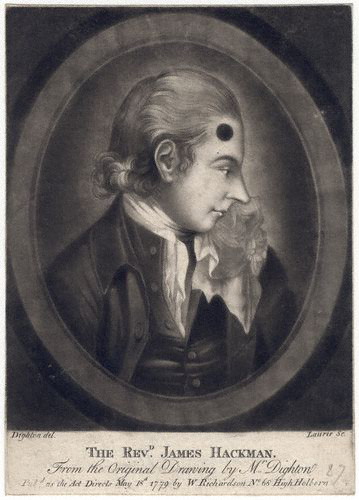
1779: James Hackman, sandwich wrecker

On this date in 1779, Londoners crowded Tyburn to witness the hanging of James Hackman for a sensational high-society murder.

Just twelve days before his date with the hemp, Hackman had walked up to Martha Ray at the Royal Opera and shot her in the head with a single-shot pistol. Then, he turned a second weapon on himself in a vain attempt to commit suicide.

The reader is not mistaken to detect here the mania of unrequited passion. Several years before the young Hackman was a handsome lieutenant introduced to Martha Ray’s social circle. She was a successful soprano on the London stage and though unmarried lived with the Earl of Sandwich as his wife in all but the illustrious name.


(cc image) from Molly Elliott.

Yes, this is the very Earl of Sandwich who pioneered the eating of things stuck between bread slices.* Sandwich — John Montagu to his parents — had other interests besides the munchies; he was the capable First Lord of the Admiralty throughout the 1770s. (As a result, Captain Cook, whose seafaring explorations were occurring at that time, kept naming islands for the Earl of Sandwich).

Domestic life for the Earl and his legal Countess — not “Earless”; that’s a different thing — wasn’t quite as satisfying. Dorothy Montagu, going gradually insane, separated from Sandwich. The lord plucked 17-year-old commoner Martha Ray — a quarter-century Sandwich’s junior — in 1759 and she lived as his mistress from there on out.*

Despite their age difference and never-formalized status they had a comfortable arrangement; Ray bore Sandwich five children** and the two appeared in public as a couple. The Earl sponsored Martha Ray’s opera career and education.

James Hackman met the Earl’s mistress around 1775 and the two formed an intimacy. Just how intimate they might have been has never been firmly established but is clear that as time passed the infatuation increasingly ran in only one direction. Hackman sold his commission in the 68th Regiment of Foot to become a Church of England deacon, perhaps angling by this expedient to woo Martha Ray away from Sandwich to a wholly respectable union.

She understandably demurred on this “opportunity” — leading the greenhorn Reverend to his blackguard act.

Hackman’s pointless waste of Martha Ray’s life and his own plucked his contemporaries’ sentimental heartstrings like nothing else. “All ranks of people … pitied the murderer’s fate,” remarks the Newgate Calendar. One newspaper report of the death sentence noted that “all present were greatly affected” at Hackman’s agitations “and however we may detest the crime, a tear of pity will fall from every humane eye on the fate of the unhappy criminal.” (General Advertiser and Morning Intelligencer, Apr. 17, 1779)

James Boswell was fascinated by the crime; he attended the trial and spilled many public and private words on its subject.

Boswell empathized with Hackman: in a report of the trial for the St. James’s Chronicle (Apr. 15-17, 1779) he opined that the “natural Effect of disappointed Love, however, shocking it may appear, is to excite the most horrid Resentment against his Object, at least to make us prefer the Destruction of our Mistress, to seeing her possessed by a Rival.” Not that Boswell condoned the murder, but “I would say to all that are conscious that their Passions are violent, Think ye that htis unfortunate Gentleman’s general Character is … worse than yours? No, it is not.”

While Human Justice is to be satisfied, let us consider that his Crime was neither premeditated‡ Cruelty, nor base Greediness. He is therefore an Object neither of Abhorrence nor of Contempt … Let us unite our fervent Prayers to the Throne of Heaven, that this our Brother may obtain Forgiveness through Jesus Christ, and be admitted in another State of Being to everlasting Happiness.

The kinship so many Londoners felt for this homicidal stalker moved print copy high and low, before Martha’s body had gone quite cold. Its most notable product was the 1780 Love and Madness, an epistolary novel of tragic passion presented via the (fictitious) letters exchanged by the supposed lovers. So heavily did this understanding of events by Hackman’s contemporaries color its subsequent remembrance that Love and Madness is also the title or subtitle of two 21st century nonfiction considerations of the affair. (1, 2 | Review of both)

Hackman for his part carried off the requisite public posture of resigned tragic nobility in the few days before he satisfied human justice. The General Evening Post, April 17-20 1779 described the execution:

This unfortunate gentleman received the sacrament in the morning with all the fervency and devotion of a sincere repenting criminal: — he repeated that affecting acknowledgment of his guilt, which on his trial drew tears from the audience, and seemed in a state of composure, unruffled with the idea of punishment, which, he said, was no more than he deserved.

At nine o’clock he came into the press-yard, where a great crowd of persons assembled to gratify their curiosity. That all might have an equal share of the sight, a lane was formed by the multitude on each side, through which Mr. Hackman passed, dressed in black, leaning on the arm of his friend the Rev. Mr. Porter, whose hand he squeezed as he muttered the solemn invocation to Heaven, not to forsake a sinner of so enormous a degree, in the trying hour of death.

Mr. Hackman was conveyed from Newgate in a mourning coach, attended by the Rev. Mr. Porter Mr. Villette, the ordinary of Newgate, and Mr. Leapingwell, a Sheriff’s officer.

He reached Tyburn about a quarter before eleven o’clock. When he arrived at the fatal tree, a cart lined with black was under the gallows ready to receive him. Mr. Porter and Mr. Villette ascended it by a pair of steps, and he followed them unsupported. As soon as he had got into it he walked forward, and fell on his knees, (a position seldom used by persons in his circumstances at Tyburn, as they always pray standing) and the Clergymen did the like, one on each side of him, where they remained praying for about fifteen minutes, then got up, when the rope was put about his neck, and tied to the gallows.

In this manner he remained praying between the two Divines for ten minutes more, when the Rev. Mr. Porter embraced him, and Mr. Villette took his leave, and both left the cart. The convict[‘]s cap being pulled over his face, he told the executioner to leave him to himself for a few minutes, and he would drop his handkerchief as a signal when he was ready, which he did after a few minutes pause, and was thereupon launched into eternity.

His whole behaviour was manly, but not bold: his mind seemed to be quite calm, from a firm belief in the mercies of his Saviour.

He wore not hat, not any bandage on his face where he gave himself the wound, that the public curiosity might not be interrupted in looking at him; saying, “that he wished to be made a public spectacle of, and hoped his death might be of service to mankind.”

He was no ways convulsed, nor was their [sic] any motion of the body that tended to shew it experienced any pain. Nothing more was to be seen than what proceeded from the jerk on quitting the cart.

The mob was more numerous than on any other occasion since the death of Dr. Dodd. It was expected Mr. Hackman would suffer at Covent-garden, and preparations were made by some speculating carpenters, who met with a mortifying disappointment.

After hanging the usual time, his body was put into a hearse, and taken to Surgeons-hall in the Old Bailey, where it was prepared for the inspection of the public.

Mr. Harkman expressed a wish to his friends, that the ceremony of anatomizing his body might be dispensed with; and that his corpse might be treated in the same manner as that of Lord Ferrers.

Mr. Hackman intimated to a particular friend, that if his remains could be deposited near those of Miss Ray he should feel inexpressible happiness in the hour of death.

A man who was standing near a dray in Oxford-street to see Mr. Hackman pass, was thrown down under one of the horses by the crowd; the horse being frightened, stamped on the man, and beat out his brains.

* Allegedly so that the Earl wouldn’t have to leave his beloved gambling table to dine.

** There is a wonderful bon mot that has enlivened compendia of anecdotes through the years, consisting of more or less the following exchange:

First speaker: You will either die on the gallows or of some social disease.

Second speaker: That depends upon whether I embrace your principles or your mistress.

Though it’s been variously attributed, it appears that the retort was originally delivered by the comic Samuel Foote to Lord Sandwich — about Martha Ray.

† Notable among the five children of Sandwich and Martha Ray: jurist Basil Montagu.

Sandwich’s wife also bore him a legitimate son, who eventually succeeded to the father’s Earldom; the title still exists today.

‡ Hackman had to be talked off simply pleading guilty but in the end he hung his trial hopes on arguing that he intended to kill himself, in Martha’s presence, and was overwhelmed by a momentary “phrensy”. A letter in his pocket meant to be delivered posthumously to his brother-in-law supported this claim; the fact that he brought two guns to meet her rebutted it.

Trial judge William Blackstone pointed out to Hackman’s jurors that the composure of the accused before and after the crime did not suggest a madman and that accepting Hackman’s claim of only an instant’s insanity could present a very slippery slope indeed for future murder prosecutions.

On this day..

1745: Martha Stracey, whore and reprobate-creature

Martha Stracey or Tracey hanged at Tyburn on this date in 1745 for assaulting a man named Will Humphreys and robbing him of one single guinea a few months before.

Stracey, about 18 or 20 years old, was a prostitute and pickpocket — “a perverse, vicious Girl, void of all good Dispositions, and wholly untractable and unadviseable, giving herself up to the vilest Company on Earth, both of Men and Women,” the Newgate Ordinary judged. The Ordinary’s accounts are a reliable feast of purple prose and do not disappoint in discoursing on the young bawd and her fall.

Having no interest in honest work and “renounc[ing] every thing resembling Goodness or Virtue,” she “went idling her Time away on the Streets with her hellish wicked Companions, who induc’d her to commence Whore, upon which she turn’d a meer reprobate-Creature” and “became known to all the Constables, and inferior Officers of Justice in that End of the Town.” Stracey, says the Ordinary, “own’d she was naturally inclined, and not over-persuaded by others, as some of them may or do alledge in Extenuation of their Guilt.”

During the night of Dec. 22-23, Humphreys testified, Stracey and Humphreys met on the Strand. According to Humphreys, she approached him unbidden, and when Humphreys insulted her, two men clobbered him as Stracey skillfully went through his pockets in a few seconds and plucked out the gold coin.

Stracey claimed the affair began when Humphreys “pulled me into an alley, and wanted to be concerned with me.”

No other eyewitnesses could testify to the substance of their rendezvous, but Humphreys’s story about the mysterious male accomplices who after thumping him went on their own way and left Stracey alone with him mid-robbery has the definite whiff of a cover story. The jury — perhaps searching for some grounds to avoid sending the woman to the gallows* — even asked the arresting constable, William Dunn, whether Humphreys’s clothes were really dirty, since he claimed to have been knocked down in the scuffle. (The constable didn’t know.)

But the simple fact was that Stracey did have Humphreys’s gold guinea, whether she achieved by main force or plucked it during a roadside assignation. With the convenient disappearance of her supposed goon squad, Humphreys was now able to seize the hustler on the spot and drag her to the watch. Constable Dunn had someone “search her behind and before (I ask pardon, my Lord)” and finally found the guinea under Martha’s profane tongue.

Before her execution, Stracey did confess that she had stolen the gold piece, under the circumstances that Humphreys’s shady account might lead one to infer:

Martha own’d the Fact she died for, that meeting a Man in the Street in the Evening, about Nine or Ten o’Clock, they speedily came to speak of an Agreement about a certain Affair; and as they were adjusting Matters, Martha thought fit to examine the Gentlemen’s Pockets, and amongst other Things, finding a Guinea, she robb’d him of it, as he Swore against her, and upon this she was convicted of a Street-robbery, one of the greatest Crimes in the Eye of the Law. She did not well remember the Circumstances of this robbery, as being very Drunk, which all of them generally are, when attempting to perpetrate so soul and black Crimes in an audacious manner.

Martha owned her committing of several robberies of this Kind before, she being a constant Street-walker , but did not well remember the Circumstances of the Robbery, she died for, nor the others which were conceal’d, it being impossible to recollect them, for the was always dead Drunk when they were committed. She was very ignorant of Religion, and what Things pertained to the state of her Soul; I endeavoured to instruct her, as the Brevity of Time allow’d, but she was of a mean Capacity and slow of Understanding, and had been so accustomed to do Evil, that she could scarce do any Thing that was good.

* The denomination of the stolen coin made “pious perjury” impossible.

On this day..