1804: Louis-Antoine-Henri de Bourbon-Condé, duc d’Enghien

It was worse than a crime, it was a blunder on this date in 1804.

Napoleon shocked, just shocked, his admirers and more especially his foes by having a royal relative ventilated at Vincennes for the trifling offense of plotting against his life.

The particular allegations against him may have been formulated with greater haste than precision, but the duc d’Enghien actually had been taking English coin to overthrow Republican France for the past decade, and nonchalantly avowed as much at his drumhead tribunal.


The Duke awaiting execution in the predawn gloom in the moat of the Chateau de Vincennes. The pathos of the accompanying dog is mandatory for this scene, as in this Harold Piffard illustration. This spot is now marked with a monument.

After surviving one too many assassination attempts, Napoleon was in the market for someone to make an example of, and the Bourbon scion, hanging about the French frontiers conniving with the English, certainly qualified.

The dispatch of his military commission, which rammed through a conviction the night of the 20th and arranged the fusillade immediately thereafter, raised self-righteous hackles among rival monarchs who had little enough compunction of their own about politically expeditious regicide.

Conventional disdain for the shooting (as with this (pdf) from the Fourth Estate), reached far and wide, and appears in Tolstoy’s War and Peace as a subject for (spurious) gossip in the Russian salons.

The group about Mortemart immediately began discussing the murder of the Duc d’Enghien. The vicomte said that the Duc d’Enghien had perished by his own magnanimity, and that there were particular reasons for Bonaparte’s hatred of him.

The vicomte told his tale very neatly. It was an anecdote, then current, to the effect that the Duc d’Enghien had gone secretly to Paris to visit Mademoiselle George; that at her house he came upon Bonaparte, who also enjoyed the famous actress’ favors, and that in his presence Napoleon happened to fall into one of the fainting fits to which he was subject, and was thus at the duc’s mercy. The latter spared him, and this magnanimity Bonaparte subsequently repaid by death.

Pierre Bezukhov, the novel’s spirit-questing Russian noble then in the thrall of the Little Corporal, has the rashness to defend d’Enghien’s execution.

“The execution of the Duc d’Enghien,” declared Monsieur Pierre, “was a political necessity, and it seems to me that Napoleon showed greatness of soul by not fearing to take on himself the whole responsibility of that deed.”

Though that defense went over like a lead balloon with the partygoers (and with Tolstoy), others have ventured to stand in the breach for the Corsican, who assuredly attracts far more opprobrium as a commoner shooting a royal traitor than he would have had their bloodlines been reversed. Bonaparte enthusiasts, like those of the Napoleon podcast, are particularly susceptible to such impolitic sentiment.

[audio:http://napoleon.thepodcastnetwork.com/audio/tpn_napoleon_20060920_011.mp3]

But Louis-Antoine-Henri normally gets better sympathy than that, as he did with the like of Chateaubriand, who resigned his Napoleonic commission in outrage.

And his death — far more notable than anything he did in life — is supposed to have occasioned the quip, “C’est pire qu’un crime, c’est une faute”: “it is worse than a crime, it is a blunder.” (Or, “it is worse than a crime, it is a mistake.”) Often attributed to Talleyrand, it was more likely uttered by his machiavellian mirror image, Joseph Fouche.

(See here for more on the phrase’s lineage. Talleyrand was so strongly in support of d’Enghien’s death that he is sometimes accused of steamrolling Napoleon on the subject. The wily minister destroyed some evidence and effected a timely volte-face when Bonaparte fell.)

The First Consul — he would crown himself Emperor later in 1804 — never had use for any such soft-pedaling, and unapologetically avowed the Duke’s execution literally to the end of his life.

Dying in exile on St. Helena years later, it is said, Napoleon read a calumny upon the d’Enghien shooting in the English press and promptly hauled out his already-completed will to insert in his own hand his lasting justification for the affair.

I caused the Duc d’Enghien to be arrested and tried, because that step was essential to the safety, interest, and honour of the French people, when the Count d’Artois* was maintaining, by his own confession, sixty assassins at Paris. Under similar circumstances, I should act in the same way.

* The Comte d’Artois was, at the time of Napoleon’s writing, the heir presumptive to the restored Bourbon monarchy — and he did indeed succeed in 1824 as Charles X. In 1804, the future king was in exile in Britain funding hits on Bonaparte and kindred counterrevolutionary stuff. For adherents of the much-disputed theory that Napoleon was poisoned in his island captivity, d’Artois figures as a possible instigator of the murder.

On this day..

1809: Mary Bateman, the Yorkshire Witch

It’s the bicentennial today of the unnatural passing of the Yorkshire witch.

Mary Bateman ran her fraudulent fortune-telling business under the name “Mrs. Moore”, and had some years’ success separating fools from their money without running afoul of the law.

In fact, she outlived her fatal crime — plying with poisoned puddings a bilked couple, lest they realize their medium was defrauding them — by months, even continuing to leach money off the surviving husband after her ministrations had killed the wife.

Let’s just say she knew how to pick her clientele.

When the sucker finally got wise to the scam,* the jig was up for Mary in a sensational trial. (It’s recounted at length here — and capped by what must have a grimly comic spectacle when Mary attempted to plead her belly and the women in the courtroom bolted for the exits to avoid impaneling on a jury of matrons to adjudge the claim. The judge ordered the doors shut up before his jury pool could escape.)

Three days after conviction, she was hanged at York Castle before a crowd of thousands, who subsequently paid (.pdf) to see her corpse (and to get cured cuts of her skin as charms: even unto death, Mary had ’em swallowing her snake oil).

After execution, Mary Bateman’s body was given over for dissection in Leeds — remaining a curio worthy of public preservation to this day at that city’s Thackray Medical Museum. (Update: The museum reports that Ms. Bateman’s remains were only on loan from Leeds University, and have since been returned.)

* Source of enlightenment? Not the death of his wife, but the fact that magical financial windfalls promised by the Yorkshire witch had failed to materialize after two-plus years of paying her.

On this day..

1938: A pig, experimentally

EXECUTION TEST MADE WITH PIG

San Quentin’s Lethal Chamber Tried Out

SAN QUENTIN, March 19 [1938]. (AP) A runt pig* died today in a slow-motion test of San Quentin’s lethal gas chamber.

The test required thirty-five minutes before the pig was formally pronounced dead, but prison officials said “nowhere near that time” would be necessary for execution of a condemned convict in the gas chamber.

The trial execution was conducted in slow motion to enable prison officials and guards to learn details of the operation. The test was conducted by representatives of the manufacturers of the chamber.

* According to the Los Angeles Times (whose March 24, 1938 edition captions a photograph of Warden Court Smith peering inquisitively through the gas chamber’s window), it was “a little thirty-pound brown pig.” According to the backgrounder in When You Read This, They Will Have Killed Me — which concerns an altogether more famous gas chamber subject — the swine was “a 155-pound pig named Oscar, raised on the prison farm.”

On this day..

1789: Catherine Murphy, Britain’s last burning at the stake

On this date in 1789, Catherine Murphy was led past the hanging bodies of her husband and their other male codefendants at Newgate Prison, secured to a stake, and put to the last burning at the stake in English history.

The convicted coiners — counterfeiting rated as high treason at the time — were the last heirs to gender-specific execution methods before the Treason Act of 1790 gave coin-shaving ladies equal access to the halter.

Though Murphy thereby earned an unenviable historical footnote, the de facto practice on the scaffold had long since been changed to spare lawmen the spectacle of a woman roasting to death. Murphy, in fact, was killed by hanging — and the “burning” part of the sentence only imposed upon her corpse. (This, however, was still more than enough: NIMBYing prison neighbors appalled by the stench of burning flesh had lent their support to the Treason Act’s reforms.)

On this day..

2006: Yuan Baojing, gangster capitalist

On this date in 2006, one of Beijing’s wealthiest plutocrats (along with two of his relatives) caught a lethal injection for the shady side of his business.

Yuan Baojing, “stock market whizzkid”, had risen from the nameless masses of China’s countryside to prosper in “Red” China’s authoritarian capitalism.

Though worth billions (or at least hundreds of millions), Yuan went down over the trivial sum of $9 million — the amount he reckoned a business associate had taken by fraud.

But then, it’s always impolite to count the corpses stuffed into the pillars of capital. The surprise here is that Yuan got caught: he’d hired a dirty cop to kill that business partner, but after the plot failed the cop started blackmailing the tycoon. Yuan responded by hiring his brother and cousin to pop the cop.

Yuan survived a scheduled execution the preceding October by transferring billions in assets to the Chinese government — understandably triggering some complaints about fair play.

Those billions bought him five months.*

On this date, he and his hirelings were given a public trial in Liaoyang, followed by an immediate lethal injection in one of China’s mobile execution vans.

* The mogul’s wife, Tibetan dancer Zhou Ma, was herself swindled during this period as she spread around cash trying to save her husband’s life.

On this day..

2005: Mohammed Bijeh, the desert vampire

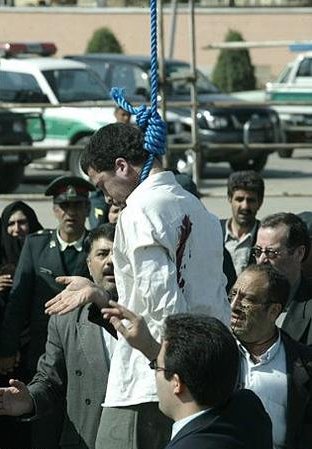
On this date in 2005, Iran “desert vampire” was flogged to the point of collapse and hanged before a bloodthirsty throng in Pakdasht.


Mohammed Bijeh collapses during his flogging (top); then, as he is hoisted by a crane — with what one would take to be the stab wound from a victim’s brother visible on his back. More frightful photos of this execution here.

Bijeh confessed to raping and murdering 16 boys age 8 to 15 over a yearlong spree.

His modus operandi? Lure them into the desert on the pretext of hunting animals.

Unsurprisingly a figure of intense public hatred, Bijeh stolidly endured his own death before a jeering mob.

Riot police held back the angry crowd, but at one point a brother of one of the victims managed to break through and stab Bijeh in the back.

After 100 lashes, the desert vampire was noosed to a crane arm by one of the victims’ mothers, and hoisted 10 meters into the air for public strangulation, to the cheers of onlookers who had to be restrained from savaging the body when it was finally brought down.

An accomplice, Ali Baghi, somehow avoided execution and got off with whipping and a prison term.

On this day..

1957: Burton Abbott, reprieved too late

On this date in 1957, the phone outside San Quentin’s gas chamber rang with a governor’s reprieve for Burton Abbott … but the execution was already underway.

Abbott was convicted of abducting and murdering 12-year-old Stephanie Bryan — a notorious crime that poet Sharon Olds, then a San Francisco teenager about the same age as the victim, memorialized in verse.

Then dirt scared me, because of the dirt
he had put on her face. And her training bra
scared me—the newspapers, morning and evening,
kept saying it, training bra,
as if the cups of it had been calling
the breasts up—he buried her in it,
perhaps he had never bothered to take it
off. They found her underpants
in a garbage can. And I feared the word
eczema, like my acne and like
the X in the paper which marked her body,
as if he had killed her for not being flawless.

Strong though ultimately circumstantial evidence connected Abbott to the crime, and the accused coolly maintained his own innocence at trial and thereafter. (The Oakland Museum has an extensive collection of photographic negatives from the trial.)

Abbott convinced his mom, but not many others — see this comment thread, for instance.

His last hours on March 15 were a rush of activity for a defense team that had fought for any possible angle to avert his death. A flurry of communications to Gov. Goodwin Knight delayed the execution once, and then secured a second stay just as the Abbott was being prepared for his fate.

By the time the phone rang, Abbott was already shrouded in cyanide fumes.

Goodwin’s Secretary Joseph Babich: Has the execution started?
Warden Harley O. Teets: Yes, sir, it has.
Babich: Can you stop it?
Teets: No, sir, it’s too late.

On this day..

1551: Alice Arden, husband killer

On this date in 1551, Alice Arden was put to death for one of 16th century England’s most shocking crimes.

Stuck in what one gathers was a dull marriage of political convenience, Alice Arden took up with a lover, Richard Mosby.

Although the whole scene was tolerated by her husband, Alice and Richard conspired to have Thomas murdered, because nobody would ever suspect the vivacious wife and her paramour to be behind the unexplained death of her husband. (And, Alice reckoned, Thomas “was so evil beloved that no man would make inquiry after his death.”) Holinshed‘s chronicle saw fit to include this tabloid-esque crime in its narrative of English history.

Arden’s wife, Mistress Alice, young, tall, and well favoured of shape and countenance, formed a criminal connection with a paramour, named Mosbye, a black, swart man. Mosbye had been servant to Sir Edward North, Alice’s father in law; and then settled as a tailor in London. The infatuated wife, lost to all sense of duty and morality, conspired with Mosbye to put an end to her husband’s existence, in order that she might marry the profligate black, swart man.

They employed as their confederates one John Green, a Faversham tailor; George Bradshaw, a goldsmith of the same town; and one Black Will, of Calyce (Calais), a murderer, which murderer was privily sent for to Calyce by the earnest sute, appoyntment, and confederate of Alice Arden and Thomas Mosbye.

The conspirators watched Master Arden walking in Poule’s (St. Paul’s Cathedral, the nave of which was a public promenade in those days), but could not find an opportunity to murder him; they then lay in wait for him on Rainham Down, and a second time in the Broomy Close (two places near Faversham), but on all these occasions failed in obtaining an opportunity.

The wicked wife then laid a plot for murdering her husband in his own house. She procured the services of Mosbye’s sister, Cicely Pounder, and of two of Arden’s domestic servants, Michael Saunderson and Elizabeth Stafford. On a particular day selected Sunday, too Black Will was hidden in a closet at the end of Arden’s parlour. After supper, Arden sat down to play some kind of game with Mosbye; Green stood at Arden’s hack, holding a candle in his hand, to shaddowe Black Will when he should come out; and the other conspirators had their cue. At a given signal in the game, Black Will came with a napkyn in his hand, and sodenlye came behind Arden’s back, threw the said napkyn over his hedd and face, and strangled him; and forthwith Mosbye stept to him, and strake him with a taylor’s great pressing iron upon the scull to the braine, and immediately drew out his dagger, which was groat and broad, and therewith cut the said Arden’s throat.

Having failed to convincingly position the body, and thereby leading police straight back to her house, Alice was immediately implicated in the crime. The conspiracy unraveled and the various people involved were brought to swift and merciless justice, including one poor bastard who had known nothing of the plot but had inadvertently supplied the credentials of that colorful assassin “Black Will” by decrying him as a murderous villain.

Alice Arden herself was burned in Canterbury while her confederates suffered various executions in various places around a country duly scandalized by the bold crime.

Six lives were taken for that of a worthless miser who connived at his wife’s infidelity. It was a sign of the horror inspired by husband murder among the Elizabethans. (Source*)

Indeed, the homicide and resulting executions kept as public scandal so long that the tale was reproduced as an Elizabethan tragedy, Arden of Faversham, in the 1590’s.

A possible uncredited Shakespeare play, it can be read for free in The Shakespeare apocrypha

Gentlemen, we hope youle pardon this naked Tragedy,
Wherin no filed points are foisted in
To make it gratious to the eare or eye;
For simple trueth is gratious enough,
And needes no other points of glosing stuffe.

FINIS.

Intriguingly, Richard Helgerson argues in Adulterous Alliances: Home, State, and History in Early Modern European Drama and Painting that this play restores some relevant political context to the Arden crime that Holinshed, perhaps deliberately, obscures. The Arden of Faversham victim is an apparatchik of the Duke of Somerset, a connection perhaps exaggerating Thomas Arden’s rank but not his position as the king’s man, with some important sponsors. Alice Arden and Richard Mosby, too, were national-level elites, Helgerson says.

The very (still-standing) Arden house was obtained through the English Reformation‘s dissolution of the monasteries; the London transplant Arden apparently used his (some must have felt) ill-gotten lands and power to impinge upon the prerogatives of his neighbors.

Helgerson doesn’t quite have an ah-ha conclusion to the tale, but the suggestion of a more layered meaning lurking behind what typically plays as straight Tudor police blotter throws a different light on the affair.

Arden’s appropriation of the abbey lands in Faversham finds its counterpart in Mosby’s appropriation of Alice Arden’s body … Seen this way, adultery is no longer a purely private crime … [but] rather a vehicle for thinking about history, for thinking, in particular, about that “improvement in the sovereignty” that was responsible both for the emergence of politic history and for the dissolution of the English monasteries, including Faversham Abbey.

* This source also supplies the date of March 14. However, the date is difficult to come by generally, and it may not be fully dependable.

On this day..

1858: Felice Orsini, Italian revolutionary

On this date in 1858, Italian revolutionary Felice Orsini calmly lost his head for the nation.

Something of a celebrity revolutionary, Orsini joined the independence movement of Giuseppe Mazzini and embarked on a generation’s worth of conspiracy, covert operations and prison spells and prison breaks which he himself voluptuously recounted in hot-selling autobiographical tomes.

Orsini became convinced that French ruler Louis Napoleon* was the chief obstacle to Italian unification, and accordingly chucked a bomb at the dictator’s carriage on January 14, 1858.

Ever theatrical, the condemned Orsini addressed a letter to Louis Napoleon while awaiting execution. In it, he urged the emperor to take up the Italian cause.

Whether mindful of the prospect of another Orsini waiting for his carriage, remembering his own youthful plotting with the Italian carbonari, or simply for reasons of French statecraft, Napoleon did just that. His alliance with the Piedmont state in northwest Italy (for which France received Savoy and the French Riviera in exchange) helped it absorb most of what now constitutes the Italian state.

Within three years of Orsini’s death, only a reduced papal enclave around Rome and the Austrian holdings around Venice separated the peninsula from unification.

In life, Orsini had been a prominent advocate of the Italian cause and played to packed houses in England. In death, he was felt further afield than that.

Tacking to a moderate stance on slavery abolition ahead of his presidential campaign, Abraham Lincoln condemned the late radical abolitionist John Brown as another Orsini — “an enthusiast [who] broods over the oppression of a people till he fancies himself commissioned by Heaven to liberate them. He ventures the attempt, which ends in little else than his own execution.”

Among Lincoln’s officers in the coming Civil War would be Charles DeRudio, the anglicized name of Orsini co-conspirator Carlo di Rudio.

Di Rudio had drawn a death sentence himself for the Orsini plot but was spared (pdf) by the clemency of his intended victim. He would go on to fight in the Battle of the Little Bighorn where he once again managed to cheat death.

* aka Napoleon III. He was the grandson of Josephine’s guillotined first husband.

On this day..

D

Due to a weakness for occasional meta content, this blog actually had its 500th post a few weeks ago.

March 13, 2009, however, marks the 500th consecutive sun of daily death-blogging, dating from Executed Today’s launch on Halloween 2007.

That this milestone falls on Friday the 13th is, of course, wholly accidental.

Special thanks on this occasion to my many excellent guest posters and interviewees, without whom I could scarcely have mustered 500 days of stamina.

(Additional milestone: the 500,000th recorded page view for this site will also take place in the next couple of days.)

On this day..