1934: Ernst Roehm, SA chief

On this date in 1934, in the coda to Hitler’s Night of the Long Knives purge of the Nazi party, the emerging dictator had his longtime ally shot.

Bavarian World War I veteran Ernst Röhm (Roehm) had been a National Socialist brawler of the earliest vintage: after the armistice, he was among the Freikorps paramilitaries to topple the short-lived Munich Soviet. He joined the NSDAP’s predecessor, the German Workers’ Party, before Hitler himself, and he stood trial with the future Fuhrer after helping Hitler attempt the Beer Hall Putsch. They were so tight, Hitler politely ignored Röhm’s open homosexuality.

But most importantly, Röhm was the energetic organizer of the Sturmabteilung, or SA — the party’s private army ready at arms for street battles with Communists, roughing up Jews, Praetorian Guard duty for party brass, and various and sundry other unpleasantries.


An SA brownshirt tosses a book on the pyre at a May 10, 1933 book burning.

Röhm grew the SA like a weed. At well over 4 million men by the time of Hitler’s Chancellorship, it greatly outnumbered the army itself.

This gave Röhm personal designs on absorbing the army into his paramilitary instead of the other way around, and it gave Röhm the literal boots on the ground to manifest his own commitment to the “Socialist” bits of the “National Socialist” project. His noises about the “second revolution” to come after the Nazis had already obtained state power were most unwelcome.

“One often hears voices in the bourgeois camp to the effect that the SA have lost any reason for existence, but I will tell these gentlemen that the old bureaucratic spirit must yet be changed in a gentle or, if need be, an ungentle manner.”

-Röhm, Nov. 5, 1933 (Source)

Well, those gentlemen weren’t about to wait around to be changed in an ungentle manner. Hitler was induced to sacrifice the man who raised him to power in favor of those who could keep him there, personally arrested his old friend and aide-de-camp as the June 30 purge got underway.

A sucker for nostalgia, Hitler didn’t have Röhm killed outright — the fate of many others in those terrible hours — but instead shipped him to Stadelheim Prison in Munich.* After due consideration, though, the treacherous chancellor did what he was always going to do.

Alan Bullock, in Hitler: A Study in Tyranny, described the final scene.

Hitler ordered a revolver to be left in his cell, but Röhm refused to use it: “If I am to be killed, let Adolf do it himself.” According to an eyewitness at the 1957 Munich trial of those involved, he was shot by two S.S. officers who emptied their revolvers into him at point blank range. “Röhm wanted to say something but the S.S. officer told him to shut up. Then Röhm stood at attention — he was stripped to the waist — with his face full of contempt.”

A nice twist of the Long Knife by its wielders: they justified the purge on the grounds of an imminent coup attempt by the dead SA boss,** branding the murders of Röhm and his comrades … the Röhm-putsch.

* The same prison where the White Rose resistance members were later executed.

** Reinhard Heydrich supplied a dossier implausibly alleging Röhm was on the take from the French.

On this day..

1569: Three Huguenot Parisians

France during its intractable 16th century Wars of Religion was a scary place to be on the wrong team at the wrong time — nowhere more so than Catholic Paris, for its Protestant Huguenot minority. This, after all, is the city that Henri IV had to capture by conversion, with that quotable bow to temporal expediency, “Paris is worth a mass.”*

On this date in 1569, that settlement lay decades in the future … but looming around the corner was the era’s signature atrocity, the St. Bartholomew’s Day massacre.

But Paris was already on tenterhooks in the 1560s as an abortive peace gave way to another installment of armed conflict, the “third war”, and the city girded itself against Huguenots without and within.


The state of the discourse: Catholic anti-Huguenot propaganda (click for larger image) from 1562 shows the heretics mounting a Catholic priest on the cross and shooting him. (Hey, don’t say it could never happen)

The September, 1568 Edict of Saint-Maur deprived Protestants of religious freedom, and municipal regulations confined most Huguenots to their homes — one part religious discrimination, one part pre-emptive crowd control in a city liable to pop out an anti-Huguenot pogrom at any moment. That happened in January to our day’s victims, Philippe and Richard de Gastines (father and son, respectively) and their in-law Nicolas Croquet, when a crowd attacked their home on suspicion of celebrating a Protestant Last Supper.

the seizure of the Gastines, along with several of their relatives and neighbors, took place amid widespread public disturbances … “The Huguenots were so hated by the Parisian populace that, if the king and authorities had let them have their way, there would not have been one [Huguenot] in the whole city who was not attacked.” De Thou added that crowds of people followed after the magistrates of Parlement when they left the Palais de Justice and so threatened them that they eventually pronounced a death sentence against the Gastines for a crime that would ordinarily have warranted banishment or a mere fine.**

The crowd also destroyed the subversive house. Upon the site of the former residence, the Parisian parliament erected a pyramid surmounted by a crucifix — the “Croix de Gastines”. This popular monument of religious chauvinism was maintained against a royal demand to demolish it for two-plus years, until the Marshall of France finally did so by force.†

But the Gastines were remembered by the Huguenot party, too.

The Protestant French poet Agrippa d’Aubigne, who grew up during this delirious age, retrieved the story of their martyrdom — and the somewhat incidental fact that Richard de Gastines had also been (non-capitally) convicted for a minor incident of supposed heretical evangelizing while languishing in prison — and made Gastines the eloquent exponent of Protestant fidelity in d’Aubigne’s poetical magnum opus, Les Tragiques. The relevant bit, rousing other prisoners to embrace the torments of martyrdom, is available in French here. (There’s a bit more about d’Aubigne’s martyr-making in this book.)

* And also the city where a Catholic assassin murdered that monarch.

** Barbara Diefendorf, “Prologue to a Massacre: Popular Unrest in Paris, 1557-1572,” The American Historical Review, Dec., 1985

† The Marshal literally had to shed blood to repel the throng attempting to defend the Croix. Frustrated of its public monument, the mob proceeded to sack two neighboring homes believed occupied by Protestant fellow-travelers. Both those domiciles were again of mob violence during the St. Bartholomew’s Day Massacre. (Diefendorf)

On this day..

1934: Night of the Long Knives

In the dark hours this date in 1934, a bargain with the devil was sealed in blood.

Months before, even mere hours before, it was still possible for longstanding adherents of the National Socialist Workers’ Party to demand the “Socialist” part of the program.

The SA and the SS will not tolerate the German revolution going to sleep and being betrayed at the half-way stage by non-combatants. … It is in fact high time the national revolution stopped and became the National Socialist one. Whether [the bourgeoisie] like it or not, we will continue our struggle — if they understand at last what it is about — with them; if they are unwilling — without them; and if necessary — against them.

Populist, not Bolshevik. (In fact, stridently anti-communist.) Nevertheless, a distinct menace by the have-nots against the haves.*

Especially so because they were the words not of some impotent scribbler but of Ernst Roehm, commander of the the Nazis’ paramilitary brownshirts. And threatening, too, for Adolf Hitler for this same reason: his ascension the previous year to the Chancellorship had entailed terms with a German elite who needed but mistrusted the man’s mass party. Something was going to have to give.

The Communist exile Leon Trotsky’s 1933 analysis of the infant Nazi Germany’s dynamics proved prescient.

The banner of National Socialism was raised by upstarts from the lower and middle commanding ranks of the old army. Decorated with medals for distinguished service, commissioned and noncommissioned officers could not believe that their heroism and sufferings for the Fatherland had not only come to naught, but also gave them no special claims to gratitude. Hence their hatred of the revolution and the proletariat. At the same time, they did not want to reconcile themselves to being sent by the bankers, industrialists, and ministers back to the modest posts of bookkeepers, engineers, postal clerks, and schoolteachers. Hence their “socialism.”

German fascism, like Italian fascism, raised itself to power on the backs of the petty bourgeoisie, which it turned into a battering ram against the organizations of the working class and the institutions of democracy. But fascism in power is least of all the rule of the petty bourgeoisie. On the contrary, it is the most ruthless dictatorship of monopoly capital. … The “socialist” revolution pictured by the petty-bourgeois masses as a necessary supplement to the national revolution is officially liquidated and condemned.

The Night of the Long Knives this date took those blades to the “socialists”, to the men like Roehm whose dreams of redistribution were reckless enough to picture his working-class militia supplanting the German army proper.

As its price of power, the Nazi leadership purged these dangerous elements.

At 2 a.m. this date, Hitler flew to Munich to personally arrest Roehm on the pretext of averting an imminent coup by Roehm’s SA.** Elsewhere in the Reich, coordinated arrests and summary executions destroyed the Nazi party’s “left”, and throughout this date, and continuing into the next, did not scruple to sweep up whatever other conservative elements Hitler considered unreliable.

It was a dangerous but ultimately decisive move. Albert Speer saw Hitler on July 1, and remembered him ebullient at the triumph.

Hitler was extremely excited and, as I believe to this day, inwardly convinced that he had come through a great danger. … Evidently he believed that his personal action had averted a disaster at the last minute: “I alone was able to solve this problem. No one else!”

The final death toll is uncertain. Hitler copped to 77 in a speech to the Reichstag two weeks later which chillingly claimed that “in this hour I was responsible for the fate of the German people, and thereby I became the supreme judge”; it is likely that the true number is much higher. But its effect went far beyond those immediately killed: it tamed the SA’s independence, and permanently subordinated it to the military; and, it brought Adolf Hitler the dictatorial power that would make the succeeding years so fruitful for this blog.

Among those known to have been seized and executed and/or murdered this date:

Roehm himself died on July 2, initially spared for his many good offices for the Nazi cause before Hitler realized he could not leave him alive.

The armed forces, apparently the day’s big winner, would pay a price of their own for the arrangement.

“In making common cause with” the murderous purge, observed William Shirer in The Rise and Fall of the Third Reich, “the generals were putting themselves in a position in which they could never oppose future acts of Nazi terrorism.” As the quid for the quo, soldiers were soon required to swear “unconditional obedience” to Adolf Hitler, and this oath would give countless Wehrmacht officers sufficient reason or excuse to eschew resistance to their leader until much too late.

Barely a month after the Night of the Long Knives, the ancient German President Hindenburg died in office. Hitler, who now commanded the clear allegiance of his nation’s elites and had savagely mastered his own party besides, succeeded the powers of Hindenburg’s vacant office along with those of his own Chancellorship and became the German Fuehrer.

* When the Nazis were knee high to the Weimar Republic, their party program sought such radical stuff as abolition of rentier income, generous old-age pensions, and nationalizing trusts.

** The historicity of any actual coup plot is generally dismissed, although the event is still known in German by the expedient sobriquet the Nazi leadership gave it, Roehm-putsch.

On this day..

1925: Sheikh Said Piran, Kurdish rebel

Early this morning this date in 1925, just hours after his condemnation for an eponymous rebellion against the newborn Turkish Republic, Sheikh Said Piran was publicly hanged.

This founding member of the Kurdish anti-Ankara martyrology had sparked a momentarily-successful rising against Turkey, fired by grievances that have not ceased to resonate since.

The secular nationalist Kemal Ataturk‘s intent to “Turkify” its peoples. The Kurdish populace’s frustrated national ambitions, indifferently bartered away by distant great powers dismembering the Ottoman Empire.* Ataturk’s abolition of the Caliphate.

“Oppressive and vile towards the Kurds,” Sheikh Said declared. (pdf)

For several years we have been able to read in the newspapers and official documents about the oppression, insults, hatred, and enmity that the Turk Republic [sic] accords to the Kurdish notables and dynasties. There is a lot of evidence available from authentic sources that they want to subject the Kurdish elite to the same treatment to which they subjected the Armenians

The February revolt quickly made him master of the majority-Kurdish eastern province of Diyarbakir, but a massive Turkish counterattack drove him east, encircled him, and had the Sheikh in irons by mid-April.

The government arrogated martial law powers to itself and appointed Orwellian courts called Independence Tribunals to prosecute Kurdish elites, rebels or no. (Some Kurdish intelligentsia were hailed to Diyarbakir from Istanbul.) Hundreds hanged, without even counting wholesale extrajudicial retribution against Kurdish civilians.

the repression of the 1925 rising was accomplished with a brutality which was not exceeded in any Armenian massacres. Whole villages were burnt or razed to the ground, and men, women and children killed.


Mass hanging of Kurds at Diyarbakir, May or June 1925 (Source)

Despite prosecutors’ avowed intention to extirpate the separatist sentiment “root and branch,” it hasn’t exactly put the whole Kurdish issue to bed.

Just ask Kurdish guerrilla Abdullah Ocalan, who received on this very same date 74 years later his own Turkish death sentence (since commuted).

* A past-is-prologue artifact from the time: the “Issue of Mosul“, a prickly international relations dispute over control of the historic city, accurately suspected to be sitting on a lot of oil.

Turkey claimed it as part of its historic heartland, but Great Britain had seized it just before World War I ended and wound up hanging onto it for the embryonic Iraqi state. Kurds who also considered it part of their homeland got short shrift altogether. It’s still disputed today among Iraqis, situated as it is just on the edge of Kurdish Iraq.

On this day..

1899: Ologbosere, of the Benin Empire

On this date in 1899, British forces occupying Benin City hanged a local tribal leader for the massacre whose perpetration had justified London’s, er, “humanitarian” intervention.

The locale of today’s post is “Benin”, but it’s important to note that this is not the modern country of Benin but rather the land just to the east currently situated in southern Nigeria — which was then the Benin Empire, at the tail end of a very long run.

Ruled from Benin City (also presently in Nigeria), this great African state had been in direct contact with European countries since the 15th century.

By the 19th, of course, it had waned with colonial incursions — but Benin itself had sagely declined to extend “free trade” to the powers that meant to dominate it, nor to cede sovereignty by signing a “protectorate” arrangement.

It was only a matter of time before Britain (or someone else) made an offer Benin couldn’t refuse.

In January 1897, a British expedition attempting to enter Benin during a religious festival against the orders of its oba (king) was slaughtered by a Benin force led by the oba‘s son-in-law, Ologbosere (alternatively, Ologbosheri). Britain claimed it was a diplomatic mission; Benin apparently believed the deputation meant to attack.

Regardless, the tactical victory would prove a strategic debacle.


New York Times, Jan. 21, 1897. The last paragraph of this article innocently observes that “the country is said to be very rich, and it would not be surprising to find that one result of the punitive expedition would be the annexation of the whole territory to the British possessions in West Africa.”

The circumstances of this encounter remain murky and hotly disputed to this day. (Here’s a Benin-sympathetic take.) We at Executed Today are confident that a global superpower would never misrepresent its intentions nor engineer a provocation in order to unseat a resource-rich dictator.

As we learn from the London Times (June 12, 1897),

The object of the mission is described as peaceful, and one version even asserts that the party were unarmed … it was intended to send a party to Benin city to ask the King to remove the obstacles which he places in the way of trade …

The King and his capital have a bad reputation. He is a “Ju Ju” follower and addicted to human sacrifices, the gruesome remains of which are to be found in abundance in his capital. He is said recently to have threatened death to the next white man who attempted to visit him, and there is but too good reason to fear that he has kept his word. A military expedition against him probably would have been necessary in any event sooner or later.


Why, less than a teaspoon of Ju-Ju is enough to …

Dispatched within days, the retaliatory Benin punitive expedition sacked Benin City by the end of February, sending its reigning oba into exile. The Benin Empire had fallen; as the journalist had predicted, it was folded into Britain’s colonial administration.

Punitive force personnel reported a veritable bloodbath perpetrated within Benin City by its outgoing administration, including that trump taboo, human sacrifice.

Naval intelligence officer R.H. Bacon wrote,

The one lasting remembrance of Benin in my mind is its smells. Crucifixions, human sacrifices, and every horror the eye could get accustomed to, to a large extent, but the smells no white man’s internal economy could stand. …

Blood was everywhere; smeared over bronzes, ivory, and even the walls, and spoke the history of that awful city in a clearer way than writing ever could. And this had been going on for centuries! Not the lust of one king, not the climax of a bloody reign, but the religion (save the word!) of the race …

the atrocities of Benin, originating in blood lust and desire to terrorise the neighbouring states, the brutal love of mutilation and torture, and the wholesale manner in which the caprices of the King and Juju were satisfied, could only have been the result of stagnant brutality …

[I saw] a crucifixion tree with a double crucifixion on it, the two poor wretches stretched out facing the west, with their arms bound together in the middle. The construction of this tree was peculiar, being absolutely built for the purpose of crucifixion. At the base were skulls and bones, literally strewn about; the debris of former sacrifices … and down every main road were two or more human sacrifices.

The synoptic reports of two other officers are excerpted in this tome; e.g.,

Seven large sacrifice compounds were found inclosed by walls … [containing earthen] altars [that] were covered with streams of dried human blood … [and] open pits filled with human bodies giving forth the most trying odours.

Whilst Britain set about making Benin safe for the olfactory nerves of long-barred merchandisers, Ologbosere persisted in the bush for more than two years. He was finally snared with the connivance of some local tribal chiefs keen to do business with the new boss.


Ologbosere, captured.

Tried on June 27 — just one day before his actual execution; the verdict, of course, foreordained — Ologbosere was damned by those chiefs’ testimony that the strike force he had led back in 1897 to precipitate the intervention “was not sent to kill white men — and we therefore decide that according to native law his life is forfeited.”

Ologbosere said otherwise, to no avail.

The king told me that he had heard that the white men were coming to fight with him, and that I must get ready to go and fight the white men … when all the people called the mass meeting at Benin City and selected me to go and fight the white men, I went. I had no palaver with the white men before.

The day I was selected to go from Benin City to meet the white men all the chiefs here present were in the meeting, and now they want to put the whole thing on my shoulders.


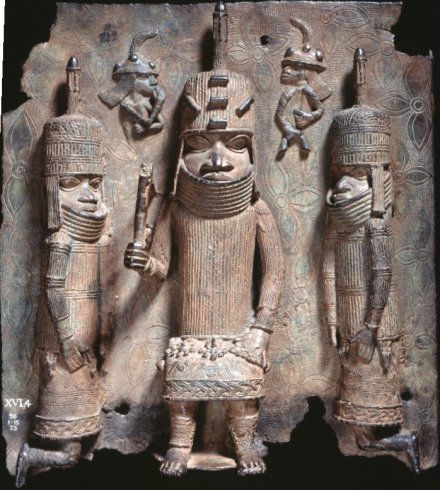
Great Britain’s punitive expedition also resulted in the capture of many hundreds of metal objects scattered to European museums and collections — collectively known as the Benin Bronzes. (It’s a misnomer: they’re actually brass.)

Hocked to defray the expense of their plundering, their diffusion around the empires’ continent helped broaden European appreciation for African art, and influenced modernist art movements. (Notably (pdf) German expressionism: tons of the bronzes ended up in Germany, and many can still be seen at Berlin’s Ethnological Museum.)

Nigeria, and the successor obas of Benin, have for decades besought their return in vain.


Cultural encounter: this Benin “bronze” shows the oba with two attendants, and the smaller floating heads of two European (Portuguese) traders.

More on this object, and its place in the story of Benin and Europe, in this episode of the BBC’s History of the World in 100 Objects; or, at the “bronze’s” page at the British Museum website.

On this day..

1845: Not William Weaver, defended by Abraham Lincoln

This date in 1845 was the appointed hanging of William Weaver, the first convicted murderer in Champaign County, Illinois.

While drunk, Weaver shot to death one David Hiltibrau and despite the able representation of one Abraham Lincoln was speedily convicted. (pdf)

Where the rail splitter failed, fortune prevailed.

“A few days — or nights rather — before that set for his execution,” we read,

a friendly auger passed to him afforded the means of escape. Just then delays were dangerous to poor drunken Bill Weaver, for Sheriff Lewis had the rope and scaffold ready, so he did not await a farewell word from friends, but sped away to the North, as the winds go. At that time the tangled forests and the untramped prairies afforded unexcelled means for seclusion and escape, and the condemned man, once a mile from town, might well bid farewell to every fear of being caught and hanged, as he doubtless did. Years afterward Weaver was heard from in far Northern Wisconsin, a useful, law-abiding citizen. No effort was ever made to bring him back from his delicious exile.

On this day..

1944: Krystyna Wituska, thanks to a bad romance

(Thanks to Meaghan Good of the Charley Project for the guest post. -ed.)

On this date in 1944, 24-year-old Krystyna Wituska [Polish language link] was guillotined inside the Halle-Saale Prison in Germany.

She’d been convicted of espionage and treason in relation to her activities with the Polish Underground.

Although for months she had feared the Germans were on to her, it wasn’t Krystyna’s own actions that lead to her arrest in October 1942. No, it was the ghost of lovers past.

A short time before, the Nazis had picked up a former boyfriend of hers who was coincidentally also involved with the Underground. The couple had been engaged at one time, but they hadn’t seen each other since 1938 and Krystyna’s passion for him had long since cooled. It was merely a remarkably unlucky chance that the Gestapo happened to find her name in his apartment.

Krystyna’s death sentence was confirmed in May 1943, but over a year passed before she was actually put to death.

During the interval she kept in touch with her family and friends by mail. Her letters, punctuated with requests for items like food and warm clothing, were remarkably cheerful and upbeat in spite of her gloomy surroundings.

Don’t think she was in denial about her fate, however, for she alluded to it frequently.

“I am not distressed that I must die,” she wrote to one acquaintance in August 1943. “If you have a good understanding of life, you know how to accept death. The important thing is to maintain one’s human dignity to the end.”

A collection of Krystyna’s prison letters was published in Poland in 1970. In 1997 an English language edition appeared, edited by Irene Tomaszewski and titled I Am First a Human Being: The Prison Letters of Krystyna Wituska.

In 2010, she was conferred the Order of Rebirth of Poland for her services to her country.

On this day..

1790: Thomas Bird, the first federal execution under the U.S. constitution

This date in 1790 saw the first federal execution under the auspices of the recently ratified U.S. Constitution, when English mariner Thomas Bird hanged in Portland, Maine. (At the time, still part of Massachusetts.)

This book is also available here, and via the author’s Portland, Me., History Blog, or on order from any bookstore.

Today, we’re pleased to interview author Jerry Genesio, whose Portland Neck: The Hanging of Thomas Bird compellingly reconstructs this once-forgotten story — a small British slave ship making landfall in a North American city only recently torched by the British, where it is found that its violent captain has been murdered at sea in unclear circumstances.

In the aftermath of the American Revolution, the one man to pay life for John Connor’s life was the one British sailor aboard the ship.

Besides a captivating account of an 18th century American capital trial, Portland Neck features biographies of all the principal characters. Portlanders will also especially enjoy a 25-page appendix on the topography of the town at the dawn of the American Republic.

This was a British subject who killed a British victim on a British ship in international waters. Was there any question of whether a U.S. court had jurisdiction?

The people who were on the vessel when it was captured — one was British, one was Norwegian, one was American, and there was a 12- or 14-year-old African boy named Cuffey.

They came under U.S. jurisdiction because in the constitutional convention (article 3, section 2), the federal courts were given jurisdiction of admiralty and maritime cases.

The Supreme judicial court in Massachusetts — Maine was part of Massachusetts then — apparently considered bringing the case before its judges, but then the constitution overruled that when it was ratified.

And then they had to wait for the federal courts to be organized, because they didn’t exist yet. They languished in jail for almost a year while the courts were being organized.

In Chapter II, you describe Thomas Bird’s ship, the Mary, operating on the Guinea coast. It’s a small ship basically working the coast and rivers, making small sales of one or two slaves to the large slavers waiting to cross the Atlantic. There must have been whole niches of the slavery industry occupied by these sorts of small-timers.

Oh, yes. The large slave ships that carried several hundred, three, four hundred in their hold — they were too large to get too close to the coast of Africa. So they would anchor perhaps a mile offshore, and they would wait for these smaller ships, like the sloop Mary — Captain Connor was in business with people in London who sent him down there just to go up the rivers to various villages where they knew there were wars going on, and when there were wars, the captives would be sold to slavers. (They also traded ivory and gold.)

When they got slaves, crews like the Mary‘s would go to the ships who had been there the longest, because they knew they would get the best price. They were known to have been there as long as a year trying to fill their cargo, and the slaves they held were liable to die while they waited. Slave ships couldn’t even allow the slaves topside because they would jump overboard if they could and try to swim for shore.

Incidentally, the Google book project has many slave captain logs online. I was able to read about the ports that Captain Connor and Thomas Bird actually visited, and it gave me such a wealth of information, and I could practically see where they were.

Ed. note: here are a few from Genesio’s bibliography, all free at Google books:

You’ve compiled this book despite a paucity of primary trial data, and there are some spots where you’re clearly reading between the lines. How difficult was the historiography on Portland Neck?

There’s not a complete trial record. Even the examination before the court — the scribe tried, apparently, to write down all of their answers, but he did not write down the questions.

My concern is more around the scribe. Was the scribe hearing these answers properly? Was the scribe hard of hearing? One of them was replaced in the process. Was the scribe able to keep up? He was writing with a quill pen, after all.

And then, on top of all of that, they did not indicate on the court record who was the scribe, who did the questioning, and who wrote the answers down. And the prisoner never signed it!

And you felt that at some level, they targeted the Englishman out of this multinational crew.

I believe that people are so influenced by the events of their times — look at World War II and how we viewed the Japanese and the Germans, or the people involved in the war in Vietnam.

These people on the jury, the foreman on the grand jury, many of them were Portland residents whose homes had been burned by the British just 14 years earlier. The war had just ended seven years earlier.

Every one of the court officials on the prosecutors’ side were all officers in the Revolutionary War. [Notably, the U.S. marshal who actually carried out Bird’s hanging, Henry Dearborn. He took part in the decisive Battle of Yorktown and would go on to become Thomas Jefferson’s Secretary of War, as well as the namesake of the city of Dearborn, Michigan. -ed.]

All of these things influence what was going on. And the fact that they acquitted the Norwegian kid and executed the Englishman makes me feel, certainly, that there was a strong influence there that was hostile to Thomas Bird. But what actually happened and how people felt, we’re just too far away — but I suspect that played a role.

Thomas Bird claimed in his dying statement, knowing that he was to be hung in a couple of hours, that he did not kill John Connor. The lawyers desperately tried to get then-President Washington to give him a commutation, and Washington refused to do it.


Information wants to be free, y’all. The newspaper editor tried to sell a broadside with the condemned man’s final narrative, but public pressure eventually forced him to put it in the July 26, 1790 Cumberland Gazette.

How did you come by this story?

When I was working at Portland Public Library and I ran into a couple of lines referring to a Thomas Bird in books by William Willis and William Goold.

In Goold’s book, Portland in the Past, he actually interviewed a fellow named Charles Motley who was in his 90s, and this interview took place in the 1880s. Motley was the youngest child of the jailer who held Thomas Bird, and Charles Motley, and he describes being five years old and being allowed into the cell where Thomas Bird would carve them little toy boats. With a knife! Then when Thomas Bird was executed, there was a note about the jailer’s wife, Emma Motley, taking all seven children away, to the other side of the land from Portland, so that they wouldn’t know what was going on. They were probably playing with Thomas’s boats as he was being hanged. So it was obvious that the Motley family held this Thomas Bird in high regard, and I got to thinking, I want to know more about this guy.

He (Motley) was five years old at the time, and, with his older brother Edward, at the request of Bird, was often admitted by his father to the cell and spent much time there. The prisoner made them toy ships and boats … At the time of the execution, Mrs. Motley, the mother of the boys, took them over back of the Neck to be out of sight of the gallows, as the whole family had become interested in the fate of Bird.

Goold

For a couple of years, I couldn’t find much of anything. Finally, I took the time to go down to the federal archives in Waltham, Mass., I found a little manila folder that was like a bar of gold. It had 12 little sheets written in quill, and it’s as much of a record of the trial as exists.

The other question in my mind is, why has nobody written about this before? I think maybe it’s because it’s something of an embarrassment, which reinforces my belief that maybe this hanging should not have taken place.

Thomas Bird, if they really suspected he was a participant, should have been punished, but probably shouldn’t have been hung. Unfortunately in those days, captains were like gods on their little wooden worlds. Even though, based on the testimony, [the victim] John Connor was a brutal drunk who beat his men mercilessly. Connor murdered his first mate on that voyage.

It’s sad because Bird probably saw America as some sort of refuge — he probably didn’t expect that he might be hanged for this crime. He’d been at sea since age eight, and all through the [American] Revolution he had been on both American and British ships. The British navy kept impressing him and making him serve on British warships, and he kept deserting and signing up for American ships instead.

One other interesting aspect of this story is that when Thomas Bird was looking for a ship to sign on with and signed on with the Mary, he might just have signed up on the HMS Bounty, because the Bounty was tied up at Wapping before its voyage to Tahiti. Had he signed on with the Bounty, he wouldn’t have fallen into American hands, but he might not have fared any better.

How thick on the ground were slaves and slavers in New England at this time?

There were a lot of slave captains, a lot of owners. Their home ports were in Boston or in Portland. Normally, when they came back to their home port, the product they were carrying was rum and molasses. Slaves would be delivered in the South or in the West Indies, separate legs in the triangle trade.

What’s your next project?

I’m working on a family genealogy.

After that, maybe something about Captain John Lovewell. He was a bounty hunter who went hunting for Indian scalps. In 1725 he was living in Massachusetts, and he got the court to authorize 10 pounds per scalp, and he recruited a small army and took off looking for Indians and found the Pequawket here in Fryeburg, Maine. They were not warriors, they were farmers.

Lovewell and a Scaticook named Paugus ended up killing each other at a battle at a pond now called Lovewell’s Pond.

Lovewell is the namesake of the town of Lovell. A couple of people have written Lovewell’s story, but I wanted to write it from the perspective of the Indians. And not only the Indians, but the true perspective — because John Lovewell was a bounty hunter, not a hero. He was willing to kill farmers who hadn’t killed anyone for their scalps.

On this day..

1986: Jerome Bowden

A quarter-century ago this date, a “scared” mentally disabled prisoner named Jerome Bowden was electrocuted in Georgia for a crime many think he did not commit.

Bowden drew a death sentence for a robbery-murder on the strength of two very suspect pieces of evidence:

  • the accusation of a juvenile co-defendant who might well have been the real murderer; and
  • a signed confession Bowden could barely understand

While present-day DNA exonerations are fortunately forcing reconsideration of the ubiquitous problem of false confessions, Bowden’s was understandably doubted even before his execution.

Asked to explain his signature on a document obviously beyond his capacity to compose himself, he gave a confused answer that seemed to indicate he’d been led to sign it by a suggestion that it would keep him out of the electric chair.

“Detective Myles had told me this here … Had told me about could help me, that he could, you know, which I knew that confessing to something you didn’t take part in was-if you confess to something that you didn’t do, as if you did it, because you are saying that you did.”

(This remark inspires us to re-issue our occasional reminder: do not talk to the police.)

Bowden’s assent to this fatal “admission” sadly evokes the characteristic eagerness to please one often encounters in the developmentally disabled — sometimes, as with Joe Arridy, to their own destruction.

It’s noticeable, too, in Bowden’s incongruously ingratiating last statements, recordings of which were taken and subsequently leaked publicly. This and others are available at SoundPortraits.org.*

[audio:Jerome_Bowden_last_statement.mp3] [audio:Jerome_Bowden_last_statement_addendum.mp3]

Bowden had been evaluated with an I.Q. of 59 at the age of 14, the examiner reporting him “functioning at the lower limits of mild retardation. He has little or no insight into his situation … He is easily distracted and has a tendency to act on impulse regardless of the consequences.”

And even though the authorities hustled through a test the day before his execution that reckoned Bowden with an I.Q. of 65 — still solidly below the conventional threshold for mental disability, but good enough for the Georgia Board of Pardons and Paroles — the whole affair shook the state. It “unsettled more than a few persons in government and law enforcement,” the Atlanta Constitution later editorialized.

Its [the state’s] reasoning was grievously faulty. Whether Bowden understood his fate or not, whether he knew right from wrong — he was indisputably handicapped …

Most states have progressed beyond the dated right-wrong standard in weighing such cases … and ask: Could the defendant help himself? There is compelling evidence that Bowden could not …

brute whimsy was given full sway. For the state of Georgia, it was a willful lapse of decency.

Atlanta Constitution, July 1, 1986 editorial**

This lapse of decency rippled over the months ahead until Georgia in 1988 became the first state to enact a law barring the execution of the mentally disabled.

Maryland followed suit the next year, but the U.S. Supreme Court held in the 1989 decision Penry v. Lynaugh that executing such prisoners did not constitute “cruel and unusual punishment”.

While that decision was reversed in 2002, the putative ban on executing the mentally disabled in the United States remains very far from a bright line. It’s up to the states themselves to decide who falls under that definition,† and at least some have given ample indication that they’re prepared to exploit any expediency necessary to get a fellow onto death row, or keep him there. Earlier this very week, Texas (of course) put to death a man of dubious competence, Milton Mathis, essentially by cherry-picking its data and having federal appellate review barred on a technicality.

A quarter-century on, those ripples started by Jerome Bowden still have a way to go.

* We’ve previously featured another recording in this set of a particularly frightful botched electrocution.

** Both Constitution quotes, and the childhood IQ examiner quote, as cited in Robert Perske’s Unequal Justice?.

† As an irony of its early adoption, Georgia later found itself with an unusually stingy legal standard for protecting disabled defendants from the death penalty.

On this day..

1786: David Nelson, but not William Horbord

This date in 1786 offers us the fine legal salami-slicing of how to stanch a race war with a noose.

Our salami’s name is David Nelson, a furloughed veteran of the Queen’s Rangers in the late American Revolution relocated to the environs of Fredericton, New Brunswick.

There, he and a fellow veteran named William Horbord or Horboard shot dead a native Maliseet for stealing their hog.

This brought neighboring peoples to a deadly tense standoff. The Maliseet demanded justice for their victim; white Canadians demanded … well, the right to shoot Maliseet without fear of their own neck.

Nelson and Horbord went right on trial, but how to finesse the situation?

According to an exhibit that unfortunately seems to have vanished from the Virtual Museum of Canada, natives “camped out around the presiding Judge Kingsclear’s home.” That must have got his commute off to an awkward start each day.

So a Solomonic compromise obtained: after the two were duly convicted and doomed to hang, Nelson, the principal offender, was measured for his coffin … while Horbord, deemed less culpable, received a pardon.

Now that’s gallows diplomacy.

On this day..