1938: Yakov Peters, Siege of Sidney Street survivor

On this date in 1938, a Soviet purge claimed (among others*) Yakov (Jacob) Peters, former Cheka executioner and once the subject of a headline-grabbing trial in England.
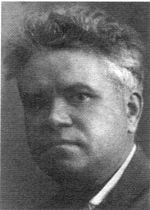
Peters was a trusted (and ruthless) operator in the Soviet internal police from the start of the Revolution: he helped interrogate Lenin‘s would-be assassin Fanya Kaplan in 1918.

And he was the guy Trotsky had on speed-dial when Cheka founder Felix Dzerzhinsky was arrested by the Left SRs during their abortive 1918 uprising against their erstwhile revolutionary allies, the Bolsheviks.**

Dzerzhinsky was disarmed and locked in a room. his assistant, M.I. Latsis, was captured in the Cheka Lubianka headquarters. “No point in taking him anywhere, put this scum against the wall!” shouted a sailor, but one of the leaders, Alexandrovich, intervened, saying, “There is no need to kill, comrades; arrest him, but do not kill.” Dzerzhinsky’s assistant Yakov Peters was urgently summoned by Trotsky, who ordered him to crush the uprising by attacking the Left Eser headquarters. Alexandrovich was caught at a railway station, and Latsis, whom he had saved from execution, personally shot him. Mass executions in Cheka prisons followed. (Source)

Like a lot of old Bolsheviks, Peters’s early service to the cause didn’t age too well. He ran afoul of some bureaucratic intrigue or point of party discipline or other and caught a bullet in 1938. (Khrushchev rehabilitated him.)

For anyone in England watching the fate of this distant apparatchik, the proximity to bloodbaths would have had a familiar hue.

Peters was one of a gang of Latvian revolutionaries who came to cinematic public attention in London when, in the course of being rounded up for a December 1910 murder, they engaged the police in a stupendous East End firefight on January 2, 1911 — the Siege of Sidney Street. (It’s also known as the Battle of Stepney.)

Armed like soldiery, the Latvians easily outgunned the bobbies who had them hemmed into a cul-de-sac, and they fired on John Law with ruthless effect. This necessitated a call to the Scots Guard — whose deployment was okayed by Home Secretary Winston Churchill, the latter captured on film that day awkwardly milling about the scene of the urban combat.


(Translated directly to the city’s cinemas as soon as that same evening, Churchill’s image came in for public catcalls owing to his support for a relatively open immigration policy for eastern Europeans.)

This incident was a landmark in crime, policing, media — recognizably modern in its trappings of nefarious immigrant terrorists, politicized state funerals for policemen, and of course, the live-on-the-scenes camera work.

Since Britain was a ready hand with the noose at this time, one might think an execution would have been just the denouement.

However, responsibility for the policememen slain in the affray had been officially assigned to a different gang member, George Gardstein — who was killed when the besieged house burned down — and there was little usable evidence against those who were finally put on trial for the gang’s various crimes. Most of the witnesses were dead, fled, or completely unreliable, so the surviving Latvians all walked.

(Since the identity of one of the first guys to start shooting when the police rang always remained murky, there are some theories — such as in this out-of-print book — that Peters himself had been one of the gunmen on-site, and/or that he could be identified with the absconded and never-captured gang leader “Peter the Painter”.)

Whatever the exact measure of blood on Yakov Peters’s hands from Sidney Street, there would be a lot more where it came from.

While Peters went off to his different fate in revolutionary Russia, the dramatic scene he left behind has naturally attracted continuing retrospective attention in England. The testimony of witnesses, who also recollect the shootout’s anti-immigrant fallout, is preserved in this BBC Witness radio program:

[audio:http://downloads.bbc.co.uk/podcasts/worldservice/witness/witness_20110127-0950a.mp3]

And, on this BBC Four television special:

* e.g., Russian Civil War officer Nikolay Gikalo and Romanian Jewish revolutionary Leon Lichtblau.

** And in favor of resuming Russia’s ruinous involvement in World War I!

On this day..

1930: William Henry Podmore, inculpated

On this date in 1930, criminal forensics claimed an apparent — albeit controversial — victory with the hanging of William Henry Podmore.

Podmore was noosed by a chain of circumstantial evidence investigators used to connect him to a murder scene — that, specifically, of his former employer Vivian Messiter, whose badly decomposed corpse was found tucked in a garage nine months after it went missing.

The ensuing investigation went like a Roaring Twenties version of CSI.

First, famed pathologist Bernard Spilsbury established a cause of death: blunt force to the skull, apparently delivered by a bloodied hammer found nearby.

After that, it was a matter of connecting some malefactor to the handle of the hammer.

[A] scrap of paper, about two inches square, which was found behind a barrel in [the] garage … led ultimately to the conviction of the murderer. This fragment was caked with dirt and soaked in oil, and had been repeatedly trodden under foot, and the problem was to remove the dirt and oil, without also removing the pigment of the copying ink pencil.

After numerous experiments with various makes of copying ink pencil, petroleum spirit was found to be suitable for the purpose, and a message from a man calling himself “W. F. Thomas” was left upon the paper. Until then, it was not known that anyone of the name of “Thomas” (an alias of Podmore) had been in any way connected with the victim.*

This was still very far from placing a fellow on the gallows until a further bit of investigative prestidigitation produced an apparent motive:

a leaf from a note-book showing indentations which had, presumably, been made by the pressure of a pencil on another leaf of the book subsequently torn out. By means of photography with the use of oblique lighting to illuminate the edges of the indentations, words relating to bogus orders, with the initials of “Thomas,” were rendered visible.*

From such paper was the crown able to craft a case which the reader will readily discern: Podmore, a mechanic only temporarily in Mr. Messiter’s employ, had entered some fraudulent transactions upon which he claimed a commission, and a fatal altercation presumably ensued upon Messiter’s discovering the con. The fact that Podmore was already wanted for fraud and robbery elsewhere did not help the defendant’s situation.

The “Garage Murder” investigation played out for months throughout 1929, much of which Podmore spent in jail on the other larceny charges while the cloud of suspicion gathered over him. In early March 1930, trial bulletins on counsels’ disputes over this novel evidence — its admissibility, its weight and application to the theory of the crime, and the sleuthing techniques employed to gather it — filled the papers almost daily.


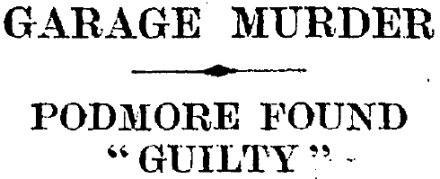
The “Blog” of “Unnecessary” Quotation Marks agrees. (Headline from London Times, March 10, 1930)

Evidence that fit “like a crossword puzzle” (in the summing-up of the state’s attorney) nevertheless did not amount to anything so ironclad that Podmore wanted for public support: in the couple of weeks between a rejected appeal and Podmore’s execution, 12,000 people signed a petition for his reprieve, including 79 Members of Parliament.**

(Those crossword forensic clues had been buttressed by that classic recourse of the prosecutor, dubious jailhouse-snitch testimony as to the convenient spontaneous confession of the accused allegedly delivered to perfect strangers in the most injurious possible situation: that such specious evidence might have proved decisive in a matter of life and death seems to have moved a lot of signatures to the clemency petition.)

Given the circumstances, the Home Secretary took the unusual step of issuing a statement on its denial of this measure to calm the “disquiet in the public mind” — and expressing his confidence beyond any “scintilla of doubt as to the prisoner’s guilt.”†

* C. Ainsworth Mitchell, “Scientific Documentary Evidence in Criminal Trials,” Journal of Criminal Law and Criminology Vol. 23, No. 2 (July-August, 1932)

** London Times, April 16, 1930

† London Times, April 21, 1930. “I searched for many days,” Secretary Clynes said after the hanging (Times, April 23, 1930), “in the hope that I would find a reason for recommending a reprieve. I searched in vain.”

On this day..

1988: Stanislaw Czabanski, the last in Poland

On this date in 1988, in its last full year of Communist rule, Poland carried out its last hanging.

Stanislaw Czabanski, who killed a woman in Tarnow, was hanged in Krakow’s Montelupich Prison.

According to this 1996 survey of worldwide death penalty trends by British death penalty abolitionist Peter Hodgkinson,

In Poland, courts of regular jurisdiction rendered altogether 318 final death sentences between 1956 and 1988 (the last full year of communist rule), that is, on average, 10 death sentences per year … Seven death penalty sentences were passed on average each year in the 1960s; this number almost doubled in the 1970s. The decade of the 1980s was marked by the emergence of Solidarity, the first independent civic body ever in existence in a communist country, by the imposition of Martial Law in December of 1981, and by the repressive political climate in the subsequent years. However, one notices a pronounced decrease in the number of death sentences compared to the previous decade. Altogether sixty such sentences were passed between 1980 and 1988, an average of 7.7 per year … Jaruzelski‘s military regime used more carrots than sticks when dealing with the political opposition.

The contemporary artistic reflection of elites’ growing concern over capital punishment was the 1989 Krzysztof Kieslowski flick critiquing the death penalty in his Dekalog series.

Though Poland continued to hand out death sentences until the mid-Nineties, a moratorium on actual executions took hold.

One can, of course, never say what shall be for all time; while death penalty abolition was a condition for Poland’s European Union membership, the conservative-nationalist Kaczynski brothers have openly mooted reintroducing capital punishment.

On this day..

1996: John Martin Scripps, British serial killer

On this date in 1996, the first westerner hanged for murder in Singapore got his deserts in Changi Prison.

Mild-mannered John Martin Scripps had created a sensation in the city-state for turning South African tourist Gerard Lowe into a sack full of dismembered body parts at Clifford Pier.

“The tourist from hell” argued in defense that it had all been a gay panic after Lowe came onto him. Not a bit of it.

Turns out Scripps, recently absconded from British custody after his latest in a series of drug and theft arrests,* had used the same chop-shop m.o. on a Canadian mother and son in Thailand and, as with Lowe, leached their electronic assets thereafter.

(Ever the jet-setter, Scripps was also a suspect in three other murders — of two Brits in Central America and of an American male prostitute in San Francisco.)

“John disappeared on several trips and went to the United States and South-East Asia,” his Mexican ex-wife said later. “I knew something awful was happening, but I could not believe he had started killing people.”

After conviction, Scripps declined to appeal or petition for clemency, saying he wanted the law to take its course quickly. He was hanged alongside two drug traffickers.

* He’d learned butchery in prison — so well that he’d talked about opening a shop when he got out. Which is sort of what he did.

On this day..

1982: Khalid Islambouli and the assassins of Anwar Sadat

With Egyptian President Hosni Mubarak’s recent unwilling separation from power, we remember today how he got into power in the first place — for this was the execution date in 1982 for the assassins of his predecessor, Anwar Sadat.

Here’s some raw-er footage:

The murdered president inherited the office from the first name in pan-Arab nationalism, Gamal Abdel Nasser.

Sadat led Egypt through the turbulent 1970s, fighting a war against Israel and then making peace with its Jewish neighbor to regain the Sinai, and generally proving himself more adept at the job than many had assumed.

But the secular dictatorship was increasingly afflicted by that then-emerging, now-familiar specter, Islamic fundamentalism — specifically aggrieved by those Camp David Accords, but also confronting Sadat’s neoliberal economic realignment and political disaffection.

Khalid Islambouli, the man who actually got Sadat, was a 26-year-old officer with an illicit affiliation to the Egyptian Islamic Jihad.

At an October 6, 1981 military parade, Islambouli led an orchestrated hit, leaping from military vehicles to bombard the presidential dais with grenades and automatic weapon fire.

Sadat was dead before he reached the hospital, and his office assumed by his vice president — Hosni Mubarak.

Unsurprisingly, he played rough with the assassins.

A military tribunal ultimately convicted 22 people of participating in the plot, sentencing five to death. While the state press was obviously supportive of the verdict,

Many Egyptians interviewed by Reuters considered the death sentences fair. “It is up to President Mubarak now to show his people that terrorism is unacceptable in Egypt by approving the sentences”, a shopkeeper said.*

And Mubarak did … albeit carefully.

Five self-proclaimed Muslim fundamentalists convicted of assassinating President Sadat of Egypt were executed at dawn today hours after their plea for mercy had been rejected by President Mubarak.

The two assassins who had been in the Army were executed by firing squad and the others, civilians, were hanged at a remote military base outside Cairo …

News of the executions was carried briefly on Cairo radio, then dropped from subsequent broadcasts. The evening newspaper did the same, an indication that the authorities may be sensitive to possible public reaction, Muslim fundamentalism being widespread in all the Egyptian universities.**

The precaution was, perhaps, well-taken.

Muslim fundamentalism would gain steam in Egypt during the years ahead, drawing a severe state response.

Islambouli’s younger brother Showqi almost accomplished an all-in-the-family twin killing by coming within a whisker’s breadth of assassinating Mubarak in 1995. The family name is still honored in the breach by other Muslim militants: there’s an “al-Islambouli Brigades of al-Qaeda” in Pakistan and an “al-Islambouli Brigades” in Chechnya.

* London Times, March 8, 1982

** London Times, April 16, 1982 (under an April 15 dateline)

On this day..

1942: Anton Schmid

(Thanks to Meaghan Good of the Charley Project for the guest post. -ed.)

On this day in 1942, Sergeant Anton Schmid was executed for high treason. His crime: saving the lives of Jews in Nazi-occupied Vilna, Poland (now part of Lithuania and called Vilnius).

Schmid was born in Vienna and owned a radio shop there before he was drafted into the German Army following the Anschluss in 1938.

After Germany’s invasion of Russia in mid-1941, Schmid was put in charge of a unit in Vilna, tasked with collecting and reassigning soldiers who had been separated from their units. He witnessed the sufferings of the Jewish population in the Vilna Ghetto and was so horrified, he decided to take action.

Schmid used his position in the military to help Jews by employing them as workers for his unit, forging papers to get them out of prison and out of the ghetto, and using Army trucks to escort them away from the city.

At great personal risk, he would go into the ghetto to hand out food and warn the inhabitants when the Germans were planning roundups. In dire situations he would even hide people in his own apartment to protect them from the Nazis. He maintained close contact with Jewish resistance organizations and assisted their activities in a variety of ways.

According to one account by a Jewish woman who was herself killed later in 1942,

[Schmid] would mock the Jews and say how easily they could be fooled, and at the same time tried to find out what the Germans were planning. As soon as he learned something new, he would tell his Jews and order them to tell their friends so that they could hide until the situation stabilized … He negotiated on their behalf like a dedicated father, without fear of being punished if he was found out. He put them in his working place and provided them with food and drink. He gave them soup and bread. In short, in those chaotic days of massacres he managed to save dozens of Jews …

Although the Jewish Underground warned Schmid that his activities had become too widely known and he was in great danger, he refused to put a stop to his effort to save the Vilna Jews. In response to their concerns he reportedly said that if given a choice between “living as a murderer and dying as a rescuer,” he would choose to die.

He saved an estimated 250 to 300 people before his arrest in January or February 1942.

At his court-marshal, his attorney tried to say Schmid had taken the Jews out of the Vilna Ghetto because he thought they could better serve the Reich elsewhere. Schmid refused to allow this, however, openly proclaiming that he had been trying to save Jewish lives. He was convicted on February 25 and sentenced to die.

In a letter to his wife and daughter, just days before his death, he tried to explain himself:

Here there were a great many Jews who were being rounded up by the Lithuanian militia and shot to death in a meadow outside the city, groups of 2-3,000 at a time. On the way there, they were smashing children against trees and such like. You can imagine how I felt … You know how I am with my soft heart. I couldn’t think otherwise and helped them… This is a heavy blow for us, but please forgive me. I was just behaving like a human being and didn’t want to hurt anyone.

In 1967, twenty-five years after his death, Schmid was honored as a Righteous Gentile by Yad Vashem. His widow attended the ceremony on his behalf and accepted a medal reading “Whoever saves one life, saves the entire world.”

A street in Vienna and a military base in Germany are named after him.

On this day..

1967: Aaron Mitchell, Ronald Reagan’s first and only execution

On this date in 1967, Aaron Mitchell was gassed in California on the authority of a governor holding his first elected office — Ronald Reagan, future U.S. president and emerging avatar of conservative white ressentiment in the turbulent 1960s.

It was only 23 days after California’s last previous execution, in January 1963, that Mitchell killed a white cop during a shootout occasioned by his abortive bar robbery. He’d been on death row fighting execution ever since, with a few dozen others who had been there even longer.

That gummed-up death penalty process, for which the Golden State is so well-known today, was most vividly symbolized at the time by the 12-year death row odyssey of Caryl Chessman.

And it had been among the many grievances catalyzing a conservative backlash against the civil rights movement, the Great Society, anti-war protesters, permissive social mores … the whole aspect of Sixties counterculture and American liberalism.

Ronald Reagan was born to wield the sword against it all. The sword, or some little cyanide pellets.

Reagan, a film actor, had cut his political teeth as a spokesman for General Electric and against commie plots like Medicare.

After famously backing the failed 1964 presidential bid of Barry Goldwater, Reagan emerged as the favored son of the New Right, and in his first foray into electoral politics, steamrolled over incumbent Democrat Edmund Brown in California’s 1966 gubernatorial election.

Reagan had an undoubted gift for packaging the sometimes unpalatable ennui of his potential constituencies into soundbites that respectable people could repeat in public, which talent proved essential to his bright political future.

“Why is it,” he demanded during the campaign, “that no street in our city is safe for women after dark?” (Los Angeles Times, September 21, 1966) Stung by Republican attacks on rising crime rates, Gov. Brown had vainly pushed a tough-on-crime platform of his own in 1966.

Too little. Too late.

“Mr. Reagan is outspokenly in favor of capital punishment and he has just been elected by a tremendous majority,” said Jesse James Gilbert, 41, who has languished on Death Row for two years.* “If the courts begin to reflect his thinking, he will be in a position to become the greatest butcher governor in history.”

–Los Angeles Times, Dec. 4, 1966

What a different world it was from today’s that a major paper unabashedly used a death row prisoner’s own voice for analytical comment. Still, that same article noted (not in Gilbert’s voice, but as a plain fact on the ground) that “even a single execution could endanger Reagan’s chances for reelection or stifle voices which are beginning to urge him to seek the Republican Presidential nomination in 1968 or 1972.” A different world indeed.

Reagan had outspokenly run on capital punishment, however, and there’s such a thing as feeding your base. He surely was not going to execute nobody.

Mitchell was the man in line, and he certainly fit that not-safe-to-walk-the-streets-at-night angle, if you catch the drift. In an Ebony (June 1967) profile of his last days, Mitchell emerges at once radicalized and resigned, his four years awaiting death spent “researching and studying the race problem.”

“Every negro ever convicted of killing a police officer has died in that gas chamber,” Mitchell said on the day of his death. “So what chance did I have?”**

When the aide in charge of the clemency application is overtly pro-Scrooge future Attorney General Edwin Meese … not much chance, no.

So on this date, and in spite of an energetic protest outside San Quentin, a suicide attempt inside it, an open line to the governor’s office just in case, and a hysterical mother (who fled Mitchell’s clemency session in tears two days before, complaining that it was “a sham hearing”), Mitchell became the 501st person put to death since the state moved all executions from county auspices into state prisons.†

The 502nd would not take place until another quarter-century had elapsed.

Cold comfort to Mitchell, but Reagan himself did not vindicate Jesse Gilbert’s worst fears, and did not present the execution rubber-stamp of a later political generation; for his time and place, being visibly willing to approve some executions amply proved his credentials. (Newsweek called the governor a “man of conviction” after the Mitchell execution. (Source) Mission accomplished.)

Reagan would stay the next death date on his watch, that of Daniel Allen Roberts, over questions of mental competency; later in 1967, he would do the same for Robert Lee Massie just hours ahead of execution so that Massie could testify in another trial, inadvertently providing a bullet point in the conservative critique of death penalty squeamishness.

And in the event, the Great Communicator would be spared any great need to answer for a significant slate of individual clemency decisions. It was judicial activity far more than executive reticence that stayed the hand of California’s executioner; only one more execution after Mitchell’s took place in all of the U.S. before the country slipped into a complete death penalty moratorium from which it would not emerge for another decade.

And when the Reagan-appointed California Chief Justice Donald Wright authored a 1972 opinion striking down that state’s death penalty laws, it emptied death row outright.‡ (Sparing, among over 100 others, Charles Manson and Sirhan Sirhan.)

Capital punishment is impermissibly cruel. It degrades and dehumanizes all who participate in its processes. It is unnecessary to any legitimate goal of the state and is incompatible with the dignity of man and the judicial process. Our conclusion that the death penalty may no longer be exacted in California consistently with article I, section 6, of our Constitution is not grounded in sympathy for those who would commit crimes of violence, but in concern for the society that diminishes itself whenever it takes the life of one of its members. Lord Chancellor Gardiner reminded the House of Lords, debating abolition of capital punishment in England: “When we abolished the punishment for treason that you should be hanged, and then cut down while still alive, and then disembowelled while still alive, and then quartered, we did not abolish that punishment because we sympathised with traitors, but because we took the view that it was a punishment no longer consistent with our self respect.”

–California v. Anderson

That would not stand as the final word on capital punishment in California, but by the time other condemned prisoners had come to the end of their appeals, they were the concern of different governors.

Reagan left the California governor’s mansion in 1975 during the death penalty’s long hiatus; as U.S. president from 1981 to 1989, the death penalty was only just coming back online from that period, and that at the state level. Beyond platitudinous approval of the trend, Reagan never had to put his own signature on a federal death warrant.

So as it turned out, Aaron Mitchell was the first, last, and only man so distinguished.

And Reagan’s minuscule career execution count was hardly the anomaly that it might now appear. Prior to Reagan, the last Chief Executive who had actually entered the White House having previously forwarded any fellow to the executioner was … Dwight Eisenhower.

* Gilbert is the appellant in the 1967 U.S. Supreme Court decision Gilbert v. California, reversing his conviction because of a police lineup identification unconstitutionally obtained without his lawyer’s knowledge.

** The cop-killing Mitchell wasn’t getting any love from the beleaguered Brown administration, either; Brown almost had a shot to pull a Ricky Ray Rector with Mitchell during the campaign, but the prisoner won a judicial stay just 24 hours from execution in May 1966.

The now-former governor was quoted after Mitchell’s actual 1967 execution expressing general support for Reagan’s non-clemency in spite of Brown’s own philosophical opposition to capital punishment.

† A journalist who witnessed the gassing later described it as something less than a triumph of the killing arts.

as the gas hit him, his head immediately fell to his chest. Then his head came up and he looked directly into the window. For nearly seven minutes he sat up that way, with his chest heaving, saliva bubbling between his lips. He tucked his thumbs into his fists, and finally his head fell again … I believe he was aware many minutes … He appeared to be in great anguish

‡ “A mockery of the constitutional process,” fumed (pdf) Reagan, who claimed that Wright had told him he backed capital punishment. (See Governor Reagan: His Rise to Power)

On this day..

Unspecified year: Snowball’s animal fifth column

“Four days” after an unspecified “early spring” date in George Orwell’s classic allegory of Soviet communism, Animal Farm, a show trial and mass execution of animals purporting to work for the book’s Trotsky figure signals the titular farm’s unmistakable collapse into dystopia.

In the book, a revolution of animals displaces the farm’s human owner, Jones — the hated ruler of the ancien regime.

The farm’s early cooperative elan soon shatters, with a pig bearing the unsubtle name of Napoleon becoming the revolution’s autocrat, and fostering a paranoid security climate against phantasmal plots by his fellow swine and onetime comrade, the exiled Snowball.

Let’s watch.

Napoleon ordered all the animals to assemble in the yard. When they were all gathered together, Napoleon emerged from the farmhouse, wearing both his medals (for he had recently awarded himself “Animal Hero, First Class”, and “Animal Hero, Second Class”), with his nine huge dogs frisking round him and uttering growls that sent shivers down all the animals’ spines. They all cowered silently in their places, seeming to know in advance that some terrible thing was about to happen.

Napoleon stood sternly surveying his audience; then he uttered a high-pitched whimper. Immediately the dogs bounded forward, seized four of the pigs by the ear and dragged them, squealing with pain and terror, to Napoleon’s feet.0 …

The four pigs waited, trembling, with guilt written on every line of their countenances. Napoleon now called upon them to confess their crimes. … Without any further prompting they confessed that they had been secretly in touch with Snowball ever since his expulsion, that they had collaborated with him in destroying the windmill, and that they had entered into an agreement with him to hand over Animal Farm to Mr. Frederick. They added that Snowball had privately admitted to them that he had been Jones’s secret agent for years past. When they had finished their confession, the dogs promptly tore their throats out, and in a terrible voice Napoleon demanded whether any other animal had anything to confess.

The three hens who had been the ringleaders in the attempted rebellion over the eggs now came forward and stated that Snowball had appeared to them in a dream and incited them to disobey Napoleon’s orders. They, too, were slaughtered. Then a goose came forward and confessed to having secreted six ears of corn during the last year’s harvest and eaten them in the night. Then a sheep confessed to having urinated in the drinking pool — urged to do this, so she said, by Snowball — and two other sheep confessed to having murdered an old ram, an especially devoted follower of Napoleon, by chasing him round and round a bonfire when he was suffering from a cough. They were all slain on the spot. And so the tale of confessions and executions went on, until there was a pile of corpses lying before Napoleon’s feet and the air was heavy with the smell of blood, which had been unknown there since the expulsion of Jones.

When it was all over, the remaining animals, except for the pigs and dogs, crept away in a body. They were shaken and miserable. They did not know which was more shocking — the treachery of the animals who had leagued themselves with Snowball, or the cruel retribution they had just witnessed. In the old days there had often been scenes of bloodshed equally terrible, but it seemed to all of them that it was far worse now that it was happening among themselves. Since Jones had left the farm, until today, no animal had killed another animal.

Animal Farm was published in 1945. In this 1954 British animated feature, the downer of an ending — with the corrupt pig rulers becoming literally indistinguishable from people — was dumped in favor of an ending where the animals revolt again.

On this day..

1943: Elise and Otto Hampel, postcard writers

(Thanks to Meaghan Good of the Charley Project for the guest post. -ed.)

On this day in 1943, a working-class German couple were executed for treason and sedition in Berlin, Germany: Otto and Elise Hampel’s reign of postcard-writing terror had finally come to its conclusion.

On the surface, the Hampels seemed like two very ordinary people. Elise had an elementary school education and worked as a domestic servant before she married Otto in 1935. Otto, a World War I veteran six years older than Elise, was a factory laborer.


Two of the treasonous postcards.

They lived modest, anonymous lives in Berlin and doubtless would have continued to do so if Elise’s brother, a soldier in the German Army, had not been killed in action in France in 1940.

Elise’s brother’s death was the catalyst for the Hampels’ tragically brave and utterly ineffectual two-year campaign of resistance against Hitler’s Germany.

Together the couple hand-wrote over 200 postcards and leaflets speaking out against the Nazi regime. The postcards urged people not to serve in the German Army, to refuse to donate to Nazi organizations, and generally do everything they could to resist the government. Otto and Elise scattered the cards in mailboxes, stairwells and other locations all over Berlin. The idea was that people would find the cards, read them and show them others, and thus the seed of rebellion would take root.

What actually happened was that almost all the cards were delivered to the authorities immediately. Nobody wanted to be caught in possession of such dangerous words.

Because of the sheer number of postcards and the long duration of their distribution, the Gestapo at first thought they were dealing with a much larger group of traitors. Doubtless they were frustrated that this riffraff, who couldn’t even write properly (the postcards were full of grammatical errors and misspellings), were able to evade them for so long. But the Hampels’ resistance activities eventually caught up with them.

They were unrepentant after their arrests in October 1942, and had little to say for themselves, beyond Otto’s statement that he was “happy” about protesting against Hitler. Roland Freisler‘s People’s Court duly condemned them to die for “preparation for high treason” and “demoralizing the troops.” They were executed by guillotine in the Plötzensee Prison.

For some reason, unlike their equally courageous, foolish and doomed counterparts in the White Rose, the Hampels’ story didn’t really catch on with historians.

They were saved from oblivion by the dangerously unstable, drug-addicted author Rudolf Ditzen, aka Hans Fallada, who came upon their Gestapo file after the war.

His 1947 novel, Every Man Dies Alone, written in just 24 days, is closely based on Elise and Otto’s story. This book was Fallada’s swan song; he died weeks before its publication. Titled Jeder stirbt für sich allein in Germany, it was not translated into English until 2009 — but it then became a runaway bestseller in the United States and (under the title Alone in Berlin) in Great Britain.

On this day..

1945: Kim Malthe-Bruun, Yours, but not forever

(Thanks to Meaghan Good of the Charley Project for the guest post. -ed.)

On this day in 1945, Kim Malthe-Bruun was executed by firing squad in the Vestre Fængsel Prison in Copenhagen. His crime was being a member of the Danish Resistance Movement in German-occupied Denmark; he had stolen a customs boat and used it to smuggle arms from Sweden to Denmark to be used against the Nazis.

Kim was born in Saskatchewan, Canada in 1923, and moved to Denmark at the age of nine with his sister and mother. He quit school at seventeen to become a merchant seaman, then joined the Danish Resistance in 1944. Kim was arrested on December 19, 1944, held in various detention cells over the next few months, tortured, and condemned to die, along with three other members of his resistance group. Doubtless the Nazis were anxious to execute them all while they still could; Germany’s surrender was less than a month away.

In 1949, Kim’s mother, Vibeke Malthe-Bruun, published a collection of his letters and diary entries. The book, titled Kim, became a bestseller in Denmark and made Kim revered as a national hero. It was published in English in 1955, under the title Heroic Heart: the Diary and Letters of Kim Malthe-Bruun. Most of the sources about him are in Danish.

Kim’s writings reveal him to be a deeply sensitive and caring young man, wise beyond his years. On April 4, two days before his death, Kim wrote his last letter to his girlfriend, Hanne, urging her to go on with her life:

I don’t expect you to forget me. Why should you forget something so beautiful as that which existed between us? But you mustn’t become a slave to this memory … Don’t let it blind you and keep you from seeing all the wonderful things life has in store for you. Don’t be unhappy …

You will live on and you will have other beautiful adventures, but promise me — this you owe to everything I have lived for — that never will the thought of me come between you and life … Gradually as bigger and more important things appear, I shall glide into the background and be a tiny speck of the soil out of which your happiness and your development will keep on growing …

You see, Hanne, one day you will meet the man who will be your husband. The thought of me will flash through you, and you will perhaps deep down have a vague, uneasy feeling that you are betraying me or something in you which is pure and sacred. Lift up your head once more, Hanne, look straight into my eyes which are smiling at you and you will understand that the only way to betray me is by not completely following your natural instincts. When you see him, let your heart go out to meet him — not to drown your sorrow but because you truly love him.

He closed with:

Yours, but not forever.

The author Lois Lowry was inspired by Kim’s story and based a character on him in her book Number the Stars. The novel, which is about the rescue of the Danish Jews, won the 1990 Newberry Medal, one of the most prestigious awards in children’s literature.

On this day..