1978: Seventeen officers in Somalia

Seventeen army officers were shot this day on the outskirts of Mogadishu for attempting to overthrow Somali dictator Siad Barre.

“The executions were carried out by by a firing squad formed of soldiers of the armed forces and were witnessed by thousands of people from all areas of Mogadishu,” said Mogadishu radio.

The abortive April 9 coup attempt seems to have been precipitated by Somalia’s ill-fated intervention in neighboring Ethiopia’s Ogaden region, a bloody little Cold War sideshow that saw both the U.S. (from Ethiopia, to Somalia) and Soviet Union (from Somalia, to Ethiopia) switch sides. Some of the officers concerned feared that Siad would come a-purgin’ after the last Somali forces slunk home on March 15, 1978.

The condemned (per this source) were:

  • Col Mohamed Sheikh Osman “Cirro”
  • Maj Siad Mohamed Jama
  • Maj Ibrahim Mohamed Hersi
  • Maj Siad Jama Nur
  • Capt Mohamed Ahmed Yusuf Aganeh
  • Capt Abdisalan Elmi Warsame
  • Capt Bashir Abshir Isa
  • Capt Abdillahi Hasan Nur
  • Lt Abdi Osman Ugas
  • Lt Abdirahman Maalin Bashir
  • Lt Adan Warsame Abdillahi
  • Lt Abdillahi Mahamud Guled
  • Lt Mohamed Abdullahi Husein (Gorod)
  • Lt Abdulwahab Ahmed Hashim
  • Lt Abdulqadir Gelle Omar
  • Sgt Farah Mohamed Halwo
  • Director Abdulqafar Warsame Abdilleh

But they’re perhaps most memorable for a coup participant not among their number, Abdullahi Yusuf Ahmed, who fled to Kenya and founded from exile the Somali Salvation Democratic Front, eventually one of the principal entities resisting the Barre regime. Ahmed served as President of Somalia from 2004 to 2008, but his government was unable to gain control of the notoriously fractious state or to end Somalia’s ongoing civil war.

On this day..

1943: Leonard Siffleet, beach beheading

On this date in 1943, Australian World War II commando Leonard Siffleet was beheaded on Aitape Beach in Papua New Guinea, along with two Ambonese, H. Pattiwal and M. Reharing

A photograph of the Japanese soldier Yasuno Chikao an instant before he strikes off Siffleet’s head was taken from the body of a Japanese casualty later in the war. Published in Life magazine, it became one of the war’s most iconic photos.

On this day..

1983: Maurice Bishop, Prime Minister of Grenada

On this date in 1983, Grenadian Prime Minister Maurice Bishop was shot with seven supporters during the chaotic struggle of power that precipitated a U.S. invasion.

The charismatic Bishop grew up on the small British Commonwealth island in the south Caribbean, attended the London School of Economics, and became the leader of the Marxist New Jewel Movement.

In 1979, Bishop and the NJM overthrew the paranormal government of Eric Gairy (he’s famous for his controversial judging in the wild 1970 Miss World pageant).

Leftist governments in the hemisphere were just the sort of thing to irk the Yankee hegemon. Collaboration with Cuba and Nicaragua to build an airstrip on Grenada … could that open the door for Soviet air support when the Sandinistas invaded Harlingen, Texas?

Ironically, it would be an intra-party Communist coup against the fellow-Communist Bishop that provided the pretext for said hegemon to stanch this existential threat.

A deputy, one Bernard Coard, ousted Bishop in October 1983, apparently a factional dispute in the NJM along ideological lines. Bishop broke out of house arrest and led a march on Coard’s position on this date, contesting his control of the government; the march was broken up and its leadership collared — and, later that day, disposed of.

The Reagan administration didn’t care two figs about Maurice Bishop, but a scene of general chaos offered it all the pretext necessary* to invade on Oct. 25. To save from the red menace, oh, let’s say, a few American med students, plus a little thing called the free world.

Whew!

Years later, that provocative airstrip bears Maurice Bishop’s name.

Audio of several Bishop speeches can be had here; others can be found on YouTube.

* Another possible precipitating factor: a U.S. Marines barracks in Lebanon was spectacularly bombed by terrorists on Oct. 23, 1983, forcing (eventually) American withdrawal. The New Jewel Movement turned out to be an opponent more in Washington’s wheelhouse.

On this day..

1999: Zein al-Abidine al-Mihdar, Yemeni terrorist

On this date in 1999, Yemen executed (in its own inimitable style) terrorist Zein al-Abidine al-Mihdar, for orchestrating a kidnapping of western tourists.

A Xerox executive among the party of kidnapped tourists relates her post-captivity search to understand her ordeal.

The drama had unfolded in December of 1998, when a convoy of 16 (mostly British) foreign tourists spending the traditional Christmas in Yemen was seized by the Islamic terrorist group Islamic Army of Aden-Abyan.

The very next day, a massive Yemeni army raid busted up the kidnappers and freed the hostages — all, except for the four who were killed in the affray.

Tried for the kidnapping (a capital crime itself) and those resulting deaths — although some victims slated the army and its aggressive response for those lost souls — three men were condemned death.

“The only dialogue,” al-Mihdar told his judges, “should be with bullets.” And so for him, a bullet had the last word. (The other two condemned men drew commutations.)


Al-Mihdar’s followers promised revenge were he executed. Given that the Islamic Army of Aden claimed responsibility for the 2000 bombing of the American warship USS Cole while it refueled at Aden — Khalid Almihdhar, one of the 9/11 hijackers allegedly affiliated with the IAA, participated — it might well have done just that. (However, the IAA as a distinct terrorist entity petered out in the 2000s.)

By the by, the U.S. is basically at war in Yemen now. Better still: that tribal country is also a proving-grounds for brave new assertions of heretofore undiscovered American presidential prerogatives, like the right to assassinate other Americans.

On this day..

1975: The Balibo Five, before the invasion of East Timor

On this date in 1975, five Australia-based journalists were slain in East Timor: executed (ahem, “allegedly”) by Indonesian security forces preparing to invade the former Portuguese colony.

The Balibo Five — Australians Greg Shackleton and Tony Stewart; Britons Brian Peters and Malcolm Rennie; and New Zealander Gary Cunningham — worked for two different Australian networks, but were together filing reports from the village of Balibo during the tense run-up to the December 1975 Indonesian invasion.

Just weeks before this date, the more Indonesian-friendly faction in the newly-independent statelet had been routed into Indonesian West Timor by the revolutionary Fretilin. Indonesian security forces were “covertly” probing into East Timor; to those on the ground, it was obvious that an attack was imminent.

Just three days after Greg Shackleton filed that broadcast, he was dead, along with all those colleagues who had been so moved by their Timorese hosts.

The Anglo journos had counted on their passports to protect them, and prominently advertised their Australian affiliations, believing that Indonesia’s western-backed dictatorship would not risk alienating its Cold War allies. By the official story — it’s still Indonesia’s official story — the Balibo Five nevertheless managed to all find their way into the crossfire when Indonesian troops overran Balibo on October 16.

But western sponsorship of this impending incursion went much deeper than the reporters imagined.

Much to the dismay of the men’s families, Canberra proved quite amenable to burying the matter rather than create a diplomatic incident. It even took a pass on the subsequent execution of another Australian who came to Timor Leste to investigate what happened to the Balibo Five — and was himself killed during Indonesia’s full-scale invasion.

Nevertheless, a considerable body of evidence has accumulated to the effect that the journalists’ death was the cold-blooded elimination of eyewitnesses who “could have testified that there was indeed an invasion by Indonesian troops.”

Australian filmmaker Robert Connolly last year fired new interest in the case by releasing Balibo, a dramatic feature film (shot on location in Balibo with Timorese extras) based on Jill Jolliffe’s book about the journalists.

Balibo is endorsed by East Timor’s president, and banned in Indonesia.

On this day..

1942: Three Doolittle raiders

On this date in 1942, three captured American airmen who had bombed Japan in the Doolittle Raid were shot in Tokyo.

The Doolittle Raid — named for its commander, Jimmy Doolittle — was America’s April 1942 retaliation for the Japanese attack on Pearl Harbor a few months before.

The mission: bomb the Japanese homeland.

Later in the war, American advances in the Pacific would enable the Yankee to do this regularly. In 1942, it was all but a suicide mission.

The plan involved launching 16 B-25s from an aircraft carrier — an unprecedented feat in itself — to fly light with arms and heavy with fuel to just make it 400 miles to Honshu, and with any luck on to China before the tanks ran dry.

Considering that the bombers had to launch in a panic when the carrier group was spotted a couple hundred miles too early, the raid’s success was downright miraculous: all 16 bombers made it on to (or near enough) the mainland without being shot down, where the crews bailed out and, for the most part, escaped to allied forces. Jimmy Doolittle would title his autobiography I Could Never Be So Lucky Again.

But not all were quite as lucky as Lt. Col. (later, General) Doolittle.

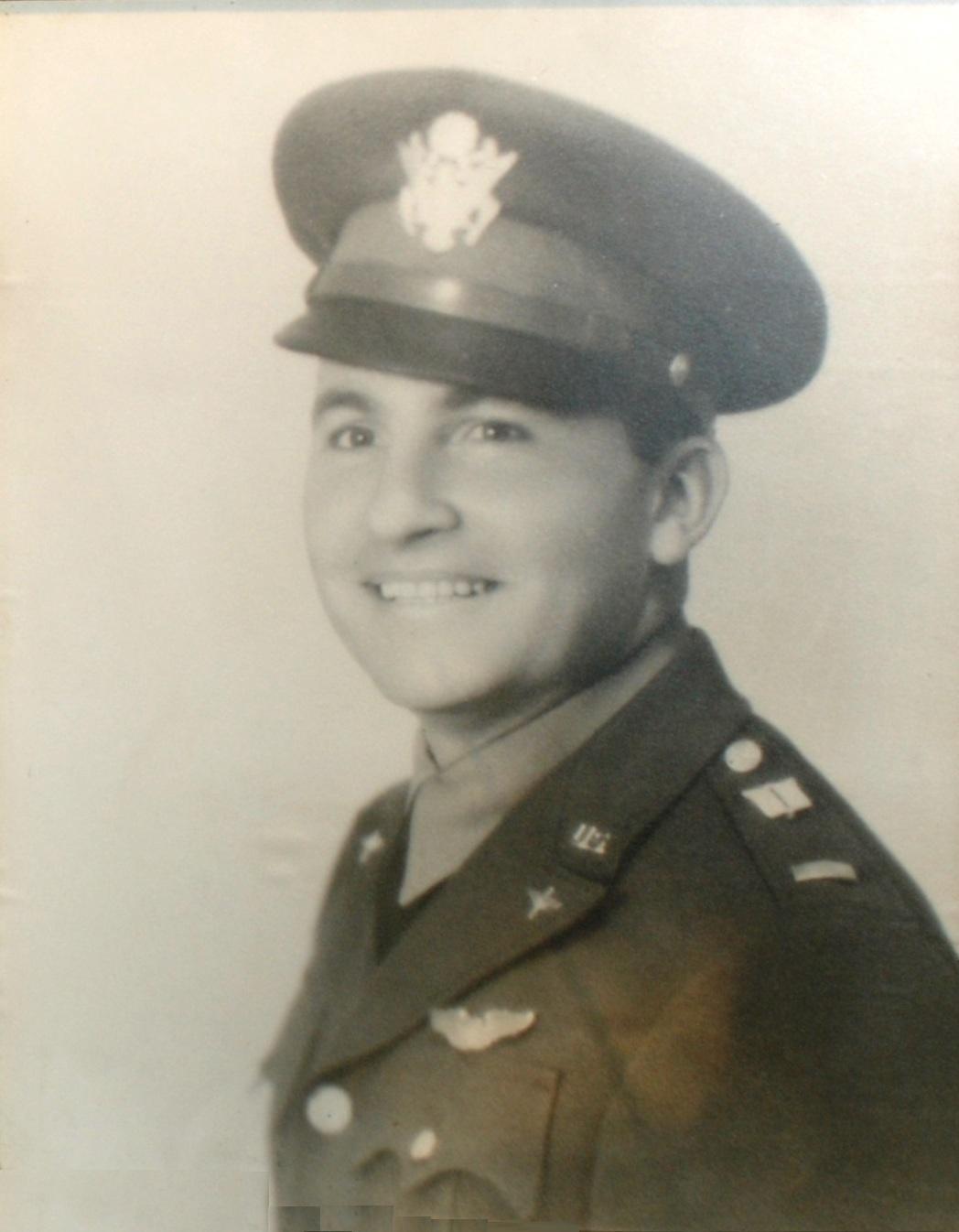
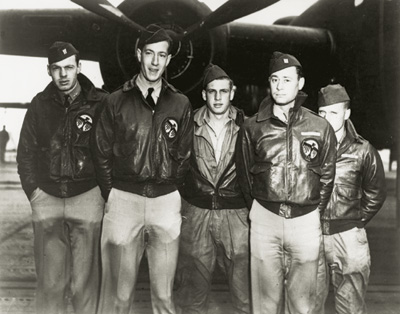
Farrow (left) and Hallmark. Spatz was a member of Farrow’s crew, and is pictured center in that plane’s crew shot here.

Two (out of eighty) drowned when their ride was ditched in the drink. Eight others were captured by the Japanese.

Four of those eight captives would survive the war to tell the tale. A fifth died in captivity. And the other three — pilots William Farrow and Dean Edward Hallmark, and (for somewhat unclear reasons) gunner Harold Spatz — were shot this day in a Shanghai cemetery following a sketchy military trial which condemned them for hitting civilian targets.

Designed largely for its psychological effect, the morale-boosting Doolittle raid has attracted interest from countless other sources who treat it in greater depth. DoolittleRaid.com and DoolittleRaider.com both provide detailed online information about the raid.

For more traditional media, one could do worse than bomber pilot Ted Lawson’s book, and its subsequent propaganda film adaptation, Thirty Seconds Over Tokyo.

On this day..

1920: Frank Campione, “are they really going to hang me?”

(Thanks to Robert Elder of Last Words of the Executed — the blog, and the book — for the guest post. This post originally appeared on the Last Words blog here. Fans of this here site are highly likely to enjoy following Elder’s own pithy, almanac-style collection of last words on the scaffold. -ed.)

“Are—they—really—going—to—hang—me? Don’t— let—them. Save me. Jesus—Mary—Joseph. My little baby! My wife! . . . I’m—going—my—rest. Take— care—me. Where are you, Mr. Meisterheim [his jailer]? Talk to me.”

Meisterheim: “Be brave, Frank. It’ll be over in a minute.”

“Shake hands once more then. Are they—really going—to hang me?”

— Frank Campione, convicted of robbery and murder, hanging, Illinois.
Executed October 14, 1920

Part of the Cardinella Gang, Campione and company were responsible for more than four murders and 250 holdups and burglaries, according to authorities. The gang killed Albert Kubalanzo for $6.30.

During the months he was in jail and on trial, Campione sang lullabies to his pillow night and day. Even when admitting that he had been feigning madness, Campione held the pillow. “I’ll die happy if you let me keep this pillow with me,” he said. “It reminds me of my baby son.”

On this day..

1927: Martyrdom of Five Christeros

Artist unknown. The inscription reads:

Execution of Cristeros by federal soldiers on the outskirts of San Gabriel, Jalisco, October 8, 1927. On the same site, the soldiers were ambushed, suffering the same fate.

On this day..

1924: Frank Johnson, the first electrocuted in Florida

On this date in 1924, “colored male” Frank Johnson was electrocuted in Florida.

He was, in fact, the very first to die in the Sunshine State’s electric chair.


The original Florida electric chair.

“Old Sparky” (numerous electric chairs shared this nickname) was brand new here in the Roaring Twenties, a jerry-built contraption outfitted with “homemade accessories” to replace the icky old gallows with a brave new world’s brave new mankiller.


Top: a scantily-detailed penitentiary “personnel card” for Frank Johnson. Middle: details of the execution. Bottom: Florida’s official typed list of its early executions.

All images are from this Florida Department of Corrections page.

This same furniture that killed Johnson would ultimately take the lives of 265 men and one woman — notables from Giuseppe Zangara to Ted Bundy, milestones like John Spenkelink, and scores of strange and forgotten perps among them.

Notoriously error-prone by the end of its run, the device was finally replaced in 1999.

On this day..

1922: C.C. Stassen, white miner

On this date in 1922, white miner Carel Christian Stassen was hanged in South Africa for murdering two blacks during the recent Rand Rising.

Also known as the Rand Rebellion or Rand Revolt, this rising saw a strike by white miners transmuted into outright insurrection … before being ruthlessly suppressed.

This seminal event in 20th century South Africa is also a classic study in the indeterminate solidarity of race and class, and would help set the stage for the apartheid system to come.

In the years preceding the Rand Revolt, an aristocracy of skilled white miners found itself, er, undermined by the sinking price of gold and the vast pool of underpaid black miners who had long been consigned to strictly unskilled jobs.

When white miners went on strike as the calendar turned to 1922, it was — self-consciously — in defense of white privilege: specifically, a color bar protecting white semi-skilled positions from black competition which white mine owners intended to breach.

In a context where the vast majority of mine workers overall were black, the strikers rallied under the banner,

“Workers of the world, unite and fight for a white South Africa!”


Note the sign in the lower left with the racialized twist that old labor slogan.

Inspiring stuff.

The strike’s peculiar dynamics bear all manner of historical inquiry. In its opening months, South Africa’s native black laborers were entirely left out, neither engaged as potential allies (obviously) nor targeted as “scabs” or enemies (more surprisingly).

But this just-among-whites dispute broke out of the family around March 7-9 when — on the very eve of military conflict with Jan Smuts‘ government — rumors swept the white strikers’ communities “that the natives were fighting the Whites … and that the Strikers and Police were working in conjunction to suppress the natives,” that “the kaffirs will kill us all.”

The quotes are actual period citations given in Jeremy Krikler’s 1999 article “The Inner Mechanics of a South African Racial Massacre,” in The History Journal, Dec. 1999. Krikler’s subsequent book, White Rising: The 1922 Insurrection and Racial Killing in South Africa, explores this topic in much greater detail.

In Richard Seymour’s summary,

they took their appeal to be part of the white community seriously, and in their murders dramatised their desire to be in solidarity with the institutions of white supremacy that were about to massacre them: it was as if to re-direct the fire onto the ‘real’ menace, as opposed to the respectable white workers who only wanted their fair share.

C.C. Stassen was one of those conducting dramatic murder — in his case, of two natives in what Stassen insisted was self-defense against an aggressive black mob.

As one can discern from his presence in these pages, however, Stassen’s homicides did not arouse a sentiment of solidarity among the country’s owners. Shortly after crushing the revolt in March (around 200 people died) they gave notice of their preference for class consciousness above race consciousness, hanging Stassen over the objections of labor unions in South Africa and abroad.

The legacy of the Rand Rising and the hangings of Stassen and others was the Pact Government, an alliance of white miners and Afrikaans farmers that ousted Smuts in a 1924 election.

Even though this new state arrangement proceeded to firm up race privilege in the mining sector with the piquantly named “Colour Bar Act”,* it did so on the basis of the victors’ terms established by the Rand Revolt.

The Pact Government … … ensure[d] that skilled work on the mines remained the preserve of whites, [but] it made no attempt to reverse what the mine owners had achieved: the expulsion of whites from a range of semi-skilled occupations … White wages fell markedly and labour militancy was terminated. The Rand — site of enormous battles in the early twentieth century — never again saw a significant white mineworkers’ strike. The curtain came down upon an epoch of white labour. Whatever revolutionary tradition it had had, was rooted out forever.

–White Rising

* The National Party that enacted the Colour Bar Act would, when it next controlled the government in 1948, establish apartheid.

On this day..