1949: Antoun Saadeh

On this date in 1949, Lebanese writer and political leader Antoun Saadeh was shot following a failed coup by his Syrian Social Nationalist Party.

Born to a globetrotting journalist, the young polyglot Saadeh was living abroad in Brazil when his native Lebanon fell from the collapsing Ottoman Empire into French hands.

He returned in 1930 to Lebanon an irredentist on the make and churned out a prodigious literary output: fiction, newspaper stories, political pamphlets.

It was his vision for a “Greater Syria” that would define the man’s legacy, and cause his death. In 1932 he secretly founded the Syrian Social Nationalist Party to advocate for a vast Syrian state encompassing what now comprise Syria, Lebanon, Jordan, and Israel/Palestine. At its most ambitious this prospective state dreamt itself inscribed upon the whole Fertile Crescent from the Tauras Mountains to the Persian Gulf.

The SSNP still exists in Syria and Lebanon to this day, but it was a big cheese in the French Mandate by the late 1930s — when the imminent end of colonialism put the future shape of the entire region into question. Saadeh, harried by French authorities who had clapped him in prison a couple of times, emigrated to Argentina and carried on the struggle through exile publications.

In 1947, Saadeh returned to a rapturous reception in now-independent Lebanon:

But his pan-Syria idea was distinctly at odds with what had happened on the ground. Whatever the colonial roots of the borders that had been set down, they defined not only zones on a map but elites with an interest in their maintenance. Lebanon’s founding “National Pact” arrangement among Christians and Muslims also committed all involved to Lebanon as an independent state not to merge with Syria.

So despite (or rather because of) Saadeh’s popularity, the SSNP faced renewed crackdowns in 1948. Revolutionaries, reformers, and pan-Arabist types were surging throughout the region thanks to the distressingly shabby performance of Arab armies in their 1948 war to strangle Israel in its crib. (Lebanon fielded only a tiny force in this fight which also won no laurels; instead, Israel began its long tradition of occupying southern Lebanon.) Saadeh was certainly alarmed by the birth of a Zionist state so inimical to his own programme; “Our struggle with the enemy is not a struggle for borders but for existence,” he declared in 1948.

On July 4, 1949, the SSNP put its muscle to the test by attempting to seize state power in Lebanon — and disastrously failed. Saadeh had traveled to Damascus hoping to gain the support of the Syrian military dictator Husni al-Za’im;* instead, al-Za’im simply handed Saadeh right back to Lebanese authorities who had him tried in secret and swiftly executed.

* A gentleman who would himself be overthrown and executed just a few weeks hence.

On this day..

1911: Daniel “Nealy” Duncan, posthumous pardon candidate

On this date in 1911, still professing his innocence, Daniel “Nealy” Duncan hanged in the county jail at Charleston, South Carolina.

“Short, thick set and very black,”* Duncan was, at length, arrested for the murder of a King Street tailor named Max Lubelsky. Poor Mr. Lubelsky had been discovered on June 21, 1910 as he lay dying of a fractured skull — the bloody cudgel rudely enhanced with a nail abandoned beside its victim was the only clue, besides someone in the neighborhood who thought they noticed “a negro, dressed in a blue suit, wearing a derby hat”** who left the store around the time of the midday attack. The attacker’s purpose was robbery.

With very little to go on, police “rounded up a number of characters” and, the papers forthrightly reported, gave these black men “the ‘third degree'”: that is, tortured them.

Granting that we find ourselves at this moment at the nadir of race relations in the Jim Crow south, these officers conceived themselves acting in good faith, torture and all. They were not utterly indiscriminate; several of the beaten-up suspects were able to produce an alibi and were duly released with their newly acquired welts. But in the absence of a witness (or knuckle-assisted self-incrimination) they had little to work with.

And so the assailant remained a mystery.

There matters still stood on July 8 when the widow Mrs. Lubelsky came racing out of her late husband’s store with blood streaming down her own face, crying murder at the top of her lungs.

To take up the narration reported in the next day’s edition of The State,

Just then a negro emerged and two men, Isaac Goodman and Moses Needle, who were passing, gave chase of the negro. He was caught a few blocks distant and promptly turned over to Police Officer Stanley and Detective Levy, who had also taken up the chase. Protesting his innocence and declaring that another negro had attempted to kill the woman, Daniels was taken to the station house amidst great excitement and the patrol wagon did not roll off any too soon from the excited neighborhood …

The State has given us an incriminating narration, but if we begin from our suspect’s denial it is not too difficult to conceive the scene otherwise — a bystander swept into the chaos as the panicked Mrs. Lubelsky barges out of her shop, the sudden attention of a crowd which the newsman gives us to understand was wound up enough for a lynching. You’d run, too.

The traumatized Mrs. Lubelsky insisted that it was Duncan who attacked her; this is one of the few pieces of palpable evidence we have in the case, though eyewitness error is a frequent factor in wrongful convictions. She would have glimpsed her assailant for a moment, dashed out of the store in a panic, then a fleeing man was chased down and hauled back to her — perfect cues for her memory to fix this man with all sincerity as the picture of her assailant.

And whatever the cliche about criminals returning to the scenes of their crimes, few are bold enough to repeat a literally identical attack days apart. It was basically just by analogy that the July 8 assault was held to place Duncan at the scene of the murder 17 days before; the vague description of the blue-suited man who might or might not have had anything to do with the murder could have fit Duncan or numerous other people. A local black man said that Duncan had been in the area on the day Max Lubelsky was killed, which would scarcely rise to the level of circumstantial even were one to discount the possible confirmation bias (or police pressure) introduced by Duncan’s arrest.

One would like to think (forlorn hope!) that a jury in 2015 would demand better than this to stretch a man’s neck … but in Charleston in 1910, it was enough to surpass reasonable doubt.†


The State, Oct. 8, 1910.

Duncan’s insistence on innocence was passed down in his own family and in the Mother Emanuel African Methodist Episcopal Church whose congregation the hanged man once belonged to. In these halls, he is widely understood to have been an innocent man and this conclusion has not wanted for latter-day advocates.‡

The case surfaced to the broader public recently, with a push around the centennial of Duncan’s hanging to have him posthumously exonerated. The measure failed on a 3-3 vote in 19112011.

Left: Dead Weight, a historical novel based on the Duncan case; right: Charleston’s Trial, a nonfiction account.

Duncan was the last person hanged in Charleston, but not the last in South Carolina; there was a double execution in December of 1911 before the Palmetto state adopted electrocution beginning in 1912.

* The State (Columbia, S.C.), June 11, 1911.

** The State, June 22, 1911.

† The supernaturally inclined took notice from the August 1911 hurricane that devastated Charleston as a portend of Duncan’s innocence — and nicknamed it “the Duncan storm”.

‡ 2010-2011 media accounts indicated that the victim’s descendants did not share such confidence in Duncan’s innocence.

On this day..

1941: Numberless Poles and Jews by Felix Landau’s Einsatzkommando

(Thanks to Meaghan Good of the Charley Project for the guest post. -ed.)

On this date in 1941, near the city of Lvov in eastern Poland (now called Lviv and part of Ukraine), an Einsatzgruppe—mobile Nazi killing squad—shot an unknown number of Poles and Jews. We know a little bit about what happened because of Felix Landau, a young SS Hauptscharführer of Austrian origin, who kept a diary of his experiences in the Einsatzkommando.

The diary has been translated and published in several anthologies; this version of it comes from “The Good Old Days”: The Holocaust as Seen by Its Perpetrators and Bystanders, edited by Ernst Klee, Willi Dressen and Volker Riess.

Landau was a Nazi of the Old Guard who’d been involved in National Socialist activities since the age of fifteen, served time in prison for his role in the assassination of Engelbert Dollfuss, and ultimately became a naturalized German citizen. He volunteered for the Einsatzkommando on June 30, 1941 — the same day the Wehrmacht arrived in Lvov — and went right to work.

It should be emphasized that Landau was not, by SS standards, a particularly vicious man. He rapidly became disillusioned with the kommando, writing that he preferred “good honest open combat.” In his first diary entry he referred to “scum” who “did not even draw the line at children” and also wrote, “I have little inclination to shoot defenseless people — even if they are only Jews.”

Yet shoot them he did, and he described it in his diary in a flat, matter-of-fact way.

Often he simply put down the dry numbers, as on July 22: “Twenty Jews were finished off.”

Other times, Landau recounted his gruesome work in chilling detail. And so it was on July 4, when over 300 people were killed. His entry describing that day is worth quoting at length:

One of the Poles tried to put up some resistance. He tried to snatch the carbine out of the hands of one of the men but did not succeed. A few seconds later there was a crack of gunfire and it was all over. A few minutes later after a short interrogation a second one was finished off. I was just taking over the watch when a Kommando reported that just a few streets away from us a guard from the Wehrmacht had been discovered shot dead.

One hour later, at 5 in the morning, a further thirty-two Poles, members of the intelligentsia and the Resistance, were shot about two hundred meters from our quarters after they had dug their own grave. One of them simply would not die. The first layer of sand had already been thrown on the first group when a hand emerged from out of the sand, waved and pointed to a place, presumably his heart. A couple more shots ran out, then someone shouted — in fact the Pole himself — “shoot faster” What is a human being? […]

The stench of corpses if all pervasive when you pass the burnt-out houses… During the afternoon some three hundred more Jews and Poles were finished off. In the evening we went into town for an hour. There we saw things that are almost impossible to describe… At a street corner we saw some Jews covered in sand from head to foot. We looked at one another. We were all thinking the same thing. These Jews must have crawled out of the grave where the executed are buried. We stopped a Jew who was unsteady on his feet. We were wrong. The Ukrainians had taken some Jews up to the former GPU citadel. These Jews had apparently helped the GPU persecute the Ukrainians and the Germans. They had rounded up 800 Jews there, who were supposed to be shot by us tomorrow. They had released them.

We continued along the road. There were hundreds of Jews walking along the street with blood pouring from their faces, holes in their heads, their hands broken and their eyes hanging out of their sockets. They were covered in blood. Some of them were carrying others who had collapsed. We went to the citadel; there we saw things that few people had ever seen. […] The Jews were pouring out of the entrance. There were rows of Jews lying one on top of the other like pigs whimpering horribly. We stopped and tried to see who was in charge of the Kommando. “Nobody.” Someone had let the Jews go. They were just being hit out of rage and hatred.

Nothing against that — only they should not let the Jews walk about in such a state.

Writing on July 6, Landau described himself as “psychologically shattered” — not due to what he had just seen and done, but because he was homesick and especially missed his girlfriend Trude. He complained of not being able to find stationery to compose a letter to her. (Landau was forever fretting when they weren’t able to write to each other, constantly worried she would leave him.)

He was, however, able to find “a lovely big traveling bag” for only 3.80 reichmarks.

Just another day on the job.

It is often said that the reason the Nazis stopped using the Einsatzgruppen to kill Jews and started using gas chambers was because it was more efficient: they could kill more people in less time using gas. This isn’t true. The Einsatzgruppen’s shooting at Babi Yar, for example, killed more than 33,000 people in two days. Gas chambers could not have done better than that.

In fact, the reason for the switch to the quieter, cleaner method of gassing had more to do with the effect the shootings were having on the Einsatzkommando men themselves. Men would rapidly develop what, in the modern parlance, would be called post-traumatic stress disorder; many were ruined for life. Given the conditions Landau described in his diary, it’s no wonder.

August Becker, a gas van inspector, later stated, “The men in charge of the Einsatzgruppen in the East were increasingly complaining that the firing squads could not cope with the psychological and moral stress of the mass shootings indefinitely. I know that a number of members of these squads were themselves committed to mental asylums and for this reason a new and better method of killing had to be found.”

The first gas vans wouldn’t be created until December 1941, however, and gas chambers came later still. In the meantime, the Einsatzgruppen traveled from town to town, massacring civilians everywhere they went.

As for Felix Landau: in late 1941 he moved in with Trude, and they married in 1943 after Landau divorced his first wife. He and Trude divorced in 1946, though, and that same year he was recognized and arrested for war crimes. Escaping from an American prison camp, he adopted an alias name and lived in plain sight as an interior decorator.

In 1959 he was arrested again and ultimately sentenced to life in prison for his role in the killings, but pardoned in 1973. Felix Landau died a free man in 1983, at the age of 73.

On this day..

1921: Richard and Abraham Pearson, the Coolacrease killings

On this date in 1921, an Irish Republican Army detail detained Richard and Abraham Pearson at their farm in rural County Offaly.

While the Pearson brothers watched in horror along with their mother, three sisters, and other family members, the Republicans readied the kindling to fire the family house. Then, Richard and Abraham were executed by an IRA firing detail.

The shooters were inexperienced as executioners and nobody delivered a coup de grace, so the Pearson brothers took hours to bleed to death from their assortment of debilitating torso wounds; Abraham did not expire until the next morning, some 14 hours later.

It might perhaps be said that few places exemplify like Ireland after its dirty war of independence Faulkner’s bromide that the past is never dead, and it’s not even past.

The Irish network RTE exhumed these once-past Killings at Coolacrease in a 2007 broadcast —

— claiming that the evangelical Protestant Pearsons were essentially targeted by neighboring Catholics on grounds of sectarian bigotry and/or an interest in pinching their 341 acres. (The surviving Pearsons emigrated to Australia and their land was indeed broken up and distributed.)

This line, whose upshot obviously impugns Irish Republicanism, occasioned a furious counterattack from that sector arguing that the Pearsons were punished for a much more prosaic reason: that they had shot at and wounded IRA volunteers who were setting up a roadblock by cutting down trees at the perimeter of the Pearson farm.

The family patriarch, William Pearson, was away at the time and later filed for compensation from London, noting that “I was always known as a staunch Loyalist and upholder of the Crown. I assisted the Crown Forces on every occasion, and I helped those who were persecuted around me at all times.” “Crown Forces” in this instance would have been the hated paramilitaries, the Black and Tans, who pack their own upshots.

Extrajudicial executions might perhaps rate among the inevitable casualties of a tooth-and-claw war over the nation’s destiny, but so too are the clash of interpretive meanings given them by later generations. Even eighty-odd years later, the urgent need to confute RTE’s “revisionist” gloss on the Pearson executions led almost immediately to a book of essays by Republican historians.

On this day..

1948: Tessie Hutchinson, Lottery winner

June 27 — of 1948, implicitly — was the setting for Shirley Jackson‘s classic short story “The Lottery”.


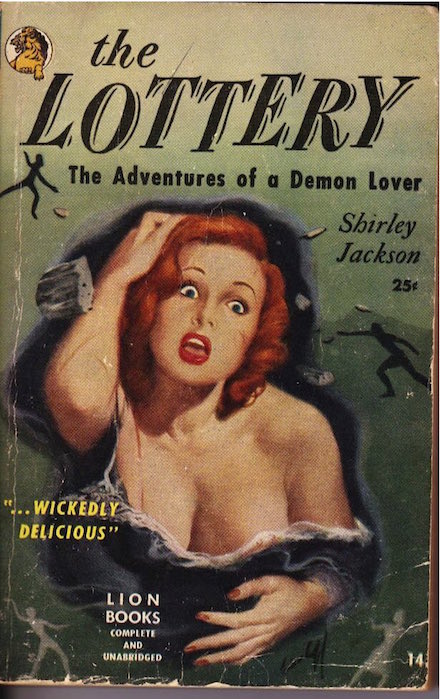
Before we dive into the grim stuff, here’s a hilariously campy pulp cover (mis)interpretation.

Less an “execution” than a human sacrifice — the village old feller’s folksy “Lottery in June, corn be heavy soon,” evokes a primal flash of blood trickling off the maize-god’s altar — the titular event is an annual tradition for a tiny American town. Though unnamed, the town and some of its denizens were patterned on North Bennington, Vermont, where Jackson was living as the wife of a professor at Bennington College.

The setting was entirely contemporary to the story’s publication, right down to the day: it hit print in the June 26, 1948 edition of The New Yorker magazine. And what took Jackson two hours to write has continued to disturb and perplex generations of readers.

In “The Lottery” (available online here (pdf)), friendly townsfolk gather “in the square, between the post office and the bank” to enact a curious civic ritual dating to a time and purpose they no longer even remember.

We see each household’s father draw a slip of paper from a battered old box and although we do not understand the reason we grasp from the dark atmosphere afoot in the crowd that something ominous is unfolding.

After the last slip is drawn,

there was a long pause, a breathless pause, until Mr. Summers. holding his slip of paper in the air, said, “All right, fellows.” For a minute, no one moved, and then all the slips of paper were opened. Suddenly, all the women began to speak at once, saving. “Who is it?,” “Who’s got it?,” “Is it the Dunbars?,” “Is it the Watsons?” Then the voices began to say, “It’s Hutchinson. It’s Bill,” “Bill Hutchinson’s got it.”

“Go tell your father,” Mrs. Dunbar said to her older son.

People began to look around to see the Hutchinsons. Bill Hutchinson was standing quiet, staring down at the paper in his hand. Suddenly. Tessie Hutchinson shouted to Mr. Summers. “You didn’t give him time enough to take any paper he wanted. I saw you. It wasn’t fair!”

“Be a good sport, Tessie.” Mrs. Delacroix called, and Mrs. Graves said, “All of us took the same chance.”

“Shut up, Tessie,” Bill Hutchinson said.

Tessie has good cause to fear. A second drawing now ensues among the five members of the Hutchinson family — Tessie and Bill, plus their three children.

And as soon as Tessie reveals the slip of paper with the black spot, her friends and even her family (“someone gave little Davy Hutchinson a few pebbles”) immediately turn on her and stone her to death.

“I hoped, by setting a particularly brutal ancient rite in the present and in my own village to shock the story’s readers with a graphic dramatization of the pointless violence and general inhumanity in their own lives,” Jackson explained.

On this day..

1906: Richard Ivens, hypnotized?

On this date in 1906, “with terror stamped on his colorless face and almost in a state of collapse,” Richard Ivens hanged for a murder that remains to this day an unsettling indictment of witness reliability — even when it is his own crime the witness describes.

The tenor of the crime and of its consequent sensation — a Chicago society matron sexually assaulted by a young hoodlum who proceeds to garrot her with a wire — is readily apparent in the headlines of the day; editors from coast to coast plunged into their thesauruses to titillate their subscribers with the most bombastic invective


Baltimore American, Jan. 14, 1906.

As this image also indicates, Ivens confessed soon after he was detained. (He reported finding, or “finding”, the body to his father and the two of them went to the police; the police immediately detained the youth, separated from Ivens pere.)

Usually, a confession is the “and shut” part of an open-and-shut case. Indeed, for most of human history, given a paucity of useful forensic evidence, legal cases have come down to eyewitnesses and confessions: hence the formalization of torture as part of the investigative process courts of bygone years.* A perpetrator’s own testimony against himself is the evidentiary gold standard.

Today, this long-unquestioned bedrock of criminal justice is dissolving. A quarter or more of the wrongful-conviction exonerations from death row have been cases involving false confessions; witness testimony by victims or third parties has frequently been shown to be unreliable. Our behavioral models once implied that the brain stored memories like a faithful photograph, a view suggesting that witnesses could be either accurate or liars without much room in between. Today, it’s ever more widely understood that memories are constructed, and reconstructed, amid the interpolations of fragmentary data and the subtle feedback of others’ suggestion and influence.

But Ivens put this idea to the test more than a century ago. Backed by friendly alibi witnesses who placed him away from the scene of the murder, Ivens recanted his confession and “declared that the police locked him up in a room at the police station with a number of officers and that their questioning so confused him that he said ‘yes’ to everything they asked him.”**

Perhaps this was just the gambit of a desperate defense counsel with few cards to play. But it did briefly make the Ivens case a referendum on the reliability of the confession.

Ivens intimated that the circumstances of his interrogation might have intimidated him into confessing, but his subsequent claim to have no memory at all of those events led a defense “alienist”, J. Sanderson Christison, to argue that the whole story of the crime had been planted in his mind when he was in a hypnotic state.
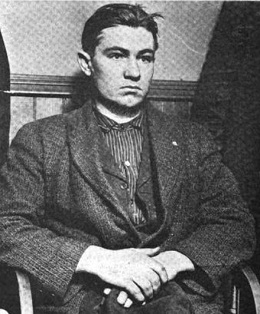
According to Christison, this Chicago Tribune photo of the accused a few hours after his arrest “shows the hypnotic expression of face in passive attitude.”

Christon’s pamphlet excoriating the way the young man was handled makes interesting reading. Titled “The ‘Confessions’ of Ivens”, its core thesis that Ivens was “dominated by police statements” is a strikingly forward-thinking one.†

we find in the “confessions” a mixture of fact with “suggested” fiction … he was first forcefully charged with the crime in a brutal manner and after being confounded and subjugated, a current of leading questions were put to him on a stupid police hypothesis, so that the first “confession” is composed of a few vague and contradictory statements. And it is both evident and acknowledged that all the other official “confessions” are the products of question suggestions, almost entirely.

For Christison, Ivens was a dull and easily controlled personality; the doctor’s explication of “hypnosis” suggests to modern eyes a laughably Mephistophelean sleepy, verrrry sleeeeepy caricature. But maybe we would do better to view it as the best framework available in 1906 to grasp the incomprehensible circumstance of a person accusing himself of a crime: the most ready illustration of outside influences entering the mind. A century later, we are only just now developing an understanding of wrongful confessions that might be shared widely enough to speak with mutual understanding about disorientation, suggestibility, leading questions, confirmation bias, and the malleability of memory.

But by any name, the notion was not ridiculous to Christison’s peers.

Christison consulted with Hugo Munsterburg, the German-American psychologist credited with founding the field of forensic psychology: Munsterburg shared Christison’s opinion, and expounded on it (without mentioning Ivens by name) in his subsequent magnum opus On The Witness Stand:

the accused was hanged; yet, if scientific conviction has the right to stand frankly for the truth, I have to say again that he was hanged for a crime of which he was no more guilty than you or I, and the only difference which the last few months have brought about is the fact that, as I have been informed on good authority, the most sober-minded people of Chicago to-day share this sad opinion.

I felt sure from the first that no one was to be blamed. Court and jury had evidently done their best to find the facts and to weigh the evidence; they are not to be expected to be experts in the analysis of unusual mental states. The proof of the alibi seemed sufficient to some, but insufficient to others; most various facts allowed of different interpretation, but all hesitation had to be overcome by the one fundamental argument which excluded every doubt: there was a complete confesslon. And if the sensational press did not manifest a judicial temper, that seemed this time very excusable. The whole population had been at the highest nervous tension from the frequency of brutal murders in the streets of Chicago. Too often the human beast escaped justice: this time at last they had found the villain who confessed — he at least was not to escape the gallows.

For many years no murder case had so deeply excited the whole city. Truly, as long as a demand for further psychological inquiry appeared to the masses simply as “another way of possibly cheating justice” and as a method tending “towards emasculating court procedure and discouraging and disgusting every faithful officer of the law,” the newspapers were almost in duty bound to rush on in the tracks of popular prejudice.

[I]f I examine these endless reports for a real argument why the accused youth was guilty of the heinous crime, everything comes back after all to the statement constantly repeated that it would be “inconceivable that any man who was innocent of it should claim the infamy of guilt.” Months have passed since the neck of the young man was broken and “thousands of persons crowded Michigan Street, jamming that thoroughfare from Clark Street to Dearborn Avenue, waiting for the undertaker’s wagon to leave the jail yard.” The discussion is thus long since removed to the sphere of theoretical argument; and so the hour may be more favourable now for asking once more whether it is really “inconceivable” that an innocent man can confess to a crime of which he is wholly ignorant. Yet the theoretical question may perhaps demand no later than tomorrow a practical answer, when perhaps again a weak mind shall work itself into an untrue confession and the community again rely thereon satisfied, hypnotised by the spell of the dangerous belief that “murder will out.” The history of crime in Chicago has shown sufficiently that murder will not “out.”

It is important that the court, instead of bringing out the guilty thought, shall not bring it “in” into an innocent consciousness. Of course in a criminal procedure there cannot be any better evidence than a confession, provided that it is reliable and well proved. If the accused acknowledges in express words the guilt in a criminal charge, the purpose of the procedure seems to have been reached; and yet at all times and in all nations experience has suggested a certain distrust of confessions.

Munsterburg wrote this under the heading of “Untrue Confessions” but he did not exempt himself from susceptibility to the hypnotic tricks of the mind: Munsterburg himself once found his house burgled, and realized that the evidence he subsequently gave about what he found was wildly inaccurate. “In spite of my best intentions, in spite of good memory and calm mood, a whole series of confusions, of illusions, of forgetting, of wrong conclusions, and of yielding to suggestions were mingled with what I had to report under oath, and my only consolation is the fact that in a thousand courts at a thousand places all over the world, witnesses every day affirm by oath in exactly the same way much worse mixtures of truth and untruth, combinations of memory and of illusion, of knowledge and of suggestion, of experience and wrong conclusions.”

We do know at a minimum that Ivens was being interrogated alone for a number of hours by officers who evidently presumed him to be guilty. Right down to the present day, any number of fully cogent adults (many still languishing in dungeons as I write this) have falsely implicated themselves in terrible crimes during similar confinements, under manipulative interrogation techniques evincing much more interest in getting to “yes” than probing truth. (Just one of many reasons we caution the reader against ever talking to the police.)


Lexington Herald, March 20, 1906.

The Richard Ivens case, needless to say, is impossibly cold. It is quite difficult from several generations’ distance to form a convincing affirmative confidence in Ivens’s innocence. But as all those involved for good or ill have gone to their own graves too, perhaps it is enough for us to leave that door open just crack — enough to let in the humility before we print a man’s epitaph.


Wilkes-Barre Times, June 22, 1906.

* Of relevance: a suspect tortured into a confession was usually required to repeat the confession free of torture in open court in order for it to count. Such people did sometimes refuse to do so and even blame the torture for having given a previous incriminating statement; the standard reward for such reticence was, naturally, more torture.

** Baltimore American, March 20, 1906. This is the Chicago Police Department we’re talking about.

† Christison is also noted for theories about the shapes of the ears as criminal indicators, and the pamphlet explicitly cites Ivens’s phrenological characteristics as exculpatory. We all have our hits and our misses.

On this day..

1953: Istvan Sandor, underground Catholic

On this date in 1953, Istvan Sandor was hanged in Communist Hungary

Sandor was a printer noted as a mentor to younger Catholics — including the orphanage that shared his print-shop’s building.

When his Salesian order was suppressed in 1950, Sandor had to continue this work underground, practically inviting martyrdom. At one point his superiors in the order urged him to flee Hungary; Sandor stubbornly stuck around under an alias.

This shadow existence was bound to be a fleeting one. The Hungarian secret police kept close tabs on him, and when it found that he was in contact with a guard close to the party leadership, it made a national security case out of the affair — arresting nine of its own spooks, five priests, and several civilians.

In a secret military trial, Sandor and three others were condemned to death by hanging for plotting against the state. One of those sentences was modified to life imprisonment, but the other three hanged on June 8th. Their families only got definitive word of their fate in 1955.

Sandor was officially rehabilitated by the post-Communist government in 1994. In 2013, Pope Francis beatified him.

“We celebrate in him the hero who was true to his calling as a Salesian brother, even at the cost of his life,” Cardinal Peter Erdo said at a mass on that occasion. “We respect in him the exceptional labourer who taught youth the love of work. We stand deeply moved before the victim of a show trial who was tortured, sentenced to death and executed based on false testimony.”

On this day..

1940: 32 innocent Poles

(Thanks to Meaghan Good of the Charley Project for the guest post. -ed.)

On this day in 1940, in the tiny village of Celiny in Nazi-occupied Poland, German soldiers and gendarmes stood 32 Polish citizens against the wall of a house and shot them all to death.

The victims of the shooting had, by the Germans’ own admission, done nothing to deserve their fate. They were killed in reprisal for crimes committed by others: namely, the murder of a German gendarme the previous day.

Seventy years later, the inhabitants of Celiny shared their memories of the incident with British historian Mary Fulbrook:*

Two Poles had apparently become involved in a dispute with the gendarme, provoked by a disagreement over the legality of ordering a certain dish in a local hostelry: that particular cut of meat was not supposed to be available to Poles under the rationing system introduced by the German administration. The Poles initially succeeded in escaping from the fracas by bicycle, but were caught up by the gendarme, on a motorbike, in Celiny; here, a further scuffle had ensued, in the course of which the gendarme was fatally wounded.

In a slightly different version of the story, the German gendarme had not even been killed by the Poles but had died as a result of crashing when, somewhat inebriated as well as angry, he took a corner too fast in pursuit of the two Poles. Whatever the truth of the matter, the latter knew they were in for trouble and rapidly escaped; they were nowhere to be tracked down.

The Germans had previously registered prominent local citizens to serve as hostages for just this sort of situation. But everyone on the registration list was forewarned by their friends and family and went into hiding to avoid arrest.

The next morning, unable to find any of their hostages, the local German authorities got together and argued for a full three hours over what to do. In the end they settled on a plan: They went to the prison in the nearby city of Sosnowiec and grabbed 32 inmates who had been “incarcerated for all the manner of reasons, including minor infringements of the most trivial of the new rules imposed by the German occupation, political resistance, and sheer bad luck.”

The men’s bad luck got even worse: the 32 men (29 Catholics and three Jews) were trucked fifteen miles back to Celiny, taken to the scene of the fight from the night before, stood in a row against the wall and shot dead at point-blank range.

Nearly three-quarters of a century later, Fulbrook visited the site of the massacre:

The wall against which the thirty-two people were shot remains pockmarked by the bullet holes, daubed now with dashes of red paint to intimate their bloody origins; there is a memorial stone, for which money had arduously to be raised among the local community; and fresh flowers were often laid there, to keep the memory of former compatriots and relatives alive.

The memorial stone lists the names of the 29 Catholic victims, but not the names of the Jews, apparently because the townspeople didn’t know who they were.

Fulbrook notes that this incident seems insignificant when put into context of the “enormity of other crimes that were soon to engulf the area.” Indeed, she says, “This incident would scarcely bear mention in comparison with the crimes committed on an infinitely larger scale at Auschwitz.”

But to the tiny village it was devastating and not easily forgotten — a small emblem of the countless nameless Poles casually put to execution in those years.

Andrzej Wróblewski

The Polish artist Andrzej Wróblewski created this series of eight paintings titled Rozstrzelania (Executions) in 1949, the year he turned 22. (They have no specific connection to the Celiny executions.)

* Mary Fulbrook was interviewed about her Holocaust research in this New Books In History podcast.

On this day..

1946: Ion Antonescu

Romania’s wartime fascist dictator Ion Antonescu was shot on this date in 1946.

Antonescu (hand raised) and Adolf at Nazi headquarters in June 1941. Behind them are Ribbentrop and Keitel.

An army officer who worked his way up to the brass via his exploits in the Second Balkan War and then in World War I, Antonescu emerged as a major nationalist politician in the interwar period. He was the elite political figure who allied with Corneliu Codreanu‘s Iron Guard movement.

Antonescu became the Defence Minister in a a far-right government, was temporarily shouldered out of the state by King Carol II‘s coup, and then re-emerged as the leading alternative when Carol’s government was undone by the tectonic political crises in the run-up to World War II. After territorial concessions wrung by Romania’s neighbors triggered protests against the king in Bucharest, Antonescu on September 5, 1940, forced Carol to transfer dictatorial power to him — and shortly thereafter, he forced Carol to abdicate altogether.*

That left Carol’s son Michael the figurehead of state, and Ion Antonescu the actual strongman — at least, once he tamed the Iron Guard.

Antonescu oriented Romania towards Hitler’s Germany, including a fairly enthusiastic involvement in the Holocaust.**

For Germany, it was an important alliance: Romania’s oil fields were essential to powering the Reich’s mechanized army. And Romania ultimately fielded the largest Axis army other than Germany and Italy themselves with well over one million men under arms by the summer of 1944. For Romania, well, opportunism is as opportunism does: as Antonescu put it, echoing an ancient argument, “in today’s circumstances a small country which is under threat, such as ours, does not do what it wishes, but what it can.”

The Romanian “General Antonescu Army Group” joined the fateful invasion of the Soviet Union. Romanian divisions were prominent at Stalingrad where some 150,000 were lost as casualties or prisoners.

The turn of the war’s tide put Romania in a grievous dilemma whose parameters ran something like this:

  • Maintain Antonescu’s personal grip on power
  • Maintain the territorial expansion Romania had achieved early in the war
  • Exit the war without going down in Germany’s Gotterdammerung

… pick one of three. Provided it’s the last one.

As the Red Army approached from the northeast and American bombers struck from Italy and North Africa, Antonescu scrambled to sound out what kind of a deal he could cut with the Allies.

Antonescu might perhaps have negotiated without the desperation due his position,† and dilated with his decreasingly patient enemies while the Germans flattered him with the dream that he could still retain conquered Bessarabia (present-day Moldova). Only with the Soviet army on his doorstep was Antonescu finally disabused of the statesman’s dream and office both — when King Michael ousted Antonescu and immediately switched Romania to the Allied side.‡ This move accepted the Soviet occupation that was about to become a fait accompli, and put Romanian soldiers into the field for the last months of the war fighting against their former German allies.

It also put Antonescu into Soviet custody. He rode out the war under guard in Moscow, then was shipped back to postwar Romania where he would serve as the feature attraction of the People’s Tribunals.

One hundred eighty-seven people answered war crimes charges to these bodies; there were 13 death sentences, but only four were actually executed.§ All four — Transnistria governor Gheorghe Alexianu, Interior Minister Constantin Vasiliu, and Foreign Minister Mihai Antonescu (no relation — were shot on this date at Jilava. The executions were filmed.

* Carol went into exile, never to see his native soil again. He died in Portugal in 1953.

** “Of all the allies of Nazi Germany, Romania bears responsibility for the deaths of more Jews than any country other than Germany itself,” according to a 2003-2004 commission. “Efforts to rehabilitate the perpetrators of these crimes are particularly abhorrent and worrisome. Nowhere else in Europe has a mass murderer like Ion Antonescu, Hitler’s faithful ally until the very end, been publicly honored as a national hero.” (The full report is available here; the quoted lines come from its executive summary.)

† Berlin was keeping an eye on Romania’s separate-peace feelers, too, and had prepared a plan to occupy Romania should it attempt to desert the Axis. This is precisely the fate that befell Nazi-allied Hungary … but in Romania’s case, Germany never had the moment to implement the plan.

‡ Michael was, like his father, forced into exile in 1947; he did not return to Romania until after the collapse of Communism. Now in his nineties, King Michael is still alive as of this posting and remains the claimant should Romania ever re-establish its monarchy.

§ Six of the 13 death sentences were delivered in absentia. Notable among those fled souls was the Hungarian writer Albert Wass: Wass had escaped to the United States, which refused repeated appeals by Communist Romania to deport him. There is a running struggle in both Hungary and Romania over whether to rehabilitate Wass or posthumously rescind his death sentences. (Postwar Hungary condemned him, too.)

On this day..

1915: Kassim Ismail Mansoor, purveyor of coffee and treason

A century ago today, an Indian Muslim named Kassim Ismail Mansoor was hanged by the British in Singapore as a traitor.

The treason in question concerned the dramatic mutiny some months previous of Singapore’s 5th Light Infantry — Muslims who had feared that they would be dispatched to World War I’s European charnel house. (Ironically, the British brass had no such intent: they already considered these troops too unreliable, for some reason.)

Many of the mutineers were shot en masse by summary court-martial.

Our man Mansoor was not a fighter but a civilian coffee-shop proprietor. Having come into the confidence of some of his countrymen enough to know the mutinous thrust of their grievances, he made bold put in writing an appeal to the Rangoon consul of the Ottoman Empire — Britain’s wartime enemy — for the intervention of Turkish warships that could pick up their disaffected Muslim brethren and turn together against the British. Unfortunately for Mansor, that missive fell into British hands.

A 1937 retrospective series in the Straits Times on the distinguished career of Mansoor’s defense counsel, Sir Vincent Devereux Knowles, dives into the case here: 1, 2. Knowles, it says, knew his task was quite hopeless.

On this day..