1525: Jacques de La Palice, “lapalissade”

On this date in 1525, a French marshal was executed during a crucial battle of the France-vs-Habsburg Italian War, beginning a long posthuous journey to a wordplay gag.


The Battle of Pavia, by Ruprecht Heller (1529).

The Battle of Pavia is best remembered for the fate — not lethal, but much more damaging to statecraft — of King Francis I of France, who was captured on the field by the Holy Roman Emperor Charles V.* Francis spent two years in comfortable but discomfiting imperial custody until he agreed to the humiliating Treaty of Madrid ceding vast tracts of French territory (notably Burgundy) to Charles.**

For all that, Francis kept his head and eventually resumed his station. Jacques de La Palice (English Wikipedia entry | the much longer French) did not exit the Battle of Pavia nearly so well.
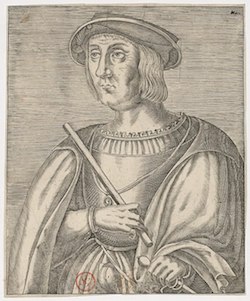
The lord of La Palice (or Lapalisse), grandson to a comrade of Joan of Arc, our man had spent a lifetime bearing French arms; he’d been personally knighted by King Charles VIII for his prowess at age 15 in his very first engagement.

The great bulk of his time ever since had been spent on various campaigns in Italy, where France remained more or less continuously at war against the Holy Roman Empire until 1559.

Fighting up and down the peninsula, La Palice earned the impressive rank of Grand Master of France, and it had nothing to do with his chess acumen. He’d actually retired to the pleasures of domesticity after being captured in 1513 at the Battle of the Spurs — so named for the panicked spurring a fleeing French cavalry gave to their horses — only to be recalled to his post in 1515.

Late in 1524 he was among the host accompanying King Francis’s march to recover France’s on-again, off-again transalpine beachhead of Milan. This objective the French achieved with scant resistance, but the expedition turned disastrous in a further advance to Pavia. There, 9,000 imperial troops were dug in to defend; unable to take the city by storm the French put it to siege, fatally overextending themselves.

Come the following February, the Habsburgs had cut Pavia off from Milan and the French encampment was weakened by defecting mercenaries. On the morning of February 24, the imperial forces mounted an attack on the French that turned into a comprehensive slaughter. La Palice was captured early on by the Habsburgs’ landsknecht mercenaries and executed by them at some point later on during the fight. Although his fate was a bit more premeditated, he was only one of many blue-blooded commanders who lost their lives on the field that dark day for France† — suspending French ambitions in Italy, if only for a few years.

The knight’s alleged feats are celebrated in a ballad known as “La chanson de la Palisse” (“The Song of La Palice”). Rather, there are dozens of versions of that ditty, dating from the 16th to the 18th century, of unknown original authorship but agglomerated by the French poet Bernard de la Monnoye into a humorous caper in the 18th century.

This poem presumably (though not certainly) began as a genuine praise song for the dead marshal, opening with this garment-rending stanza:

Hélas, La Palice est mort,
Il est mort devant Pavie ; 
Hélas, s’il n’était pas mort, 
Il ferait encore envie.

Alas, La Palice is dead, 
He died before Pavia; 
Alas, if he were not dead, 
He would still be envied.

Somewhere along the way fulsome became winsome — perhaps via deliberate spoof or maybe the well-known phenomenon of old-timey letter s written to look like f, transforming the verse into a comical tautology:

s’il n’etait pas mort, / Il ferait encore envie (“if he was not dead he would still be envied”)

s’il n’etait pas mort, / Il serait encore en vie (“if he was not dead he would still be alive”)

It’s thanks to this amusing misreading that the French tongue today enjoys the term lapalissade, meaning a laughably obvious truism — and in Monnoye’s composition the entirety of the lyrics consist of such jests; e.g.

Monsieur d’la Palisse is dead,
He died before Pavia,
A quarter of an hour before his death,
He was still alive.

He was, by a sad fate, 
wounded with a cruel hand.
It is believed, since he is dead,
that the wound was mortal.

Regretted by his soldiers,
he died worthy of envy;
And the day of his death
was the last day of his life.

He died on Friday,
the last day of his age;
If he had died on Saturday,
he would have lived more.

(That’s just an excerpt; the much longer full French verse is available at the song’s French Wikipedia page.)

* Ample unverifiable folklore attaches an event so memorable as the capture of a king; a site such as this is bound to note the one that reports that Francis might have been killed on the spot by rampaging foes but for the timely intercession of a young Spanish soldier named Pedro de Valdivia … who would go on to become the conquistador of Chile, and eventually an execution victim himself.

** Francis renounced the treaty as soon as he was released, on the accurate grounds that it was made under duress. In this betrayal of honor, he did his kingdom much the better turn than his distant predecessor John II had done when, captured by the English during the Hundred Years’ War, he dutifully set about extracting from his subjects the ruinous ransom and even returned voluntarily to English custody when he could not fulfill the terms of his parole.

† Another corpse at the Battle of Pavia was Richard de la Pole, Plantagenet pretender to the English throne ever since his brother had been executed back in 1513.

On this day..

1595: Robert Southwell

February 20, 1594-5, [Father Robert] Southwell, a Jesuit, that long time had lain prisoner in the Tower of London, was arraigned at the King’s-bench bar. He was condemned, and on the next morning drawn from Newgate to Tyburn, and there hanged, bowelled and quartered.

-Chronicle of John Stow

Youngest child in a gentry household of Catholic-leaning Norfolk, Robert Southwell was for holy orders and martyr’s laurels from the jump; in 1576 at the tender age of 15, he made for Douai and its English seminary, noted for training missionary priests who would return secretly to Elizabethan England to court torture and death for the Word. Within a decade he was a prefect at the English College in Rome and a fully armed and operational member of the Society of Jesus.

In 1586, Southwell sailed for his homeland with fellow Jesuit Henry Garnet, who would one day go to the gallows for Guy Fawkes’s Gunpowder Plot.

For Southwell, the pen was mightier than such detonations.

“St. Peter’s Complaint” (Excerpt)
by Robert Southwell

Ah! life, sweet drop, drown’d in a sea of sours,
A flying good, posting to doubtful end;
Still losing months and years to gain new hours,
Fain times to have and spare, yet forced to spend;
Thy growth, decrease; a moment all thou hast.
That gone ere known; the rest, to come, or past.

Ah! life, the maze of countless straying ways,
Open to erring steps and strew’d with baits.
To bind weak senses into endless strays,
Aloof from Virtue’s rough, unbeaten straits
A flower, a play, a blast, a shade, a dream,
A living death, a never-turning stream.

Quietly nestled in as the house confessor to Catholic noblewoman Anne Howard, Southwell scratched out page after page to fortify the hearts of the beleaguered Old Faith — standard stuff like martyrology testimony concerning his brother priests, overt manifestos like An humble supplication to Her Maiestie, and literary bestsellers admired by Protestant countrymen like Mary Magdalene’s Funeral Tears and his verse collection St. Peter’s Complaint, and Other Poems.*

This last appeared posthumously. After three years’ imprisonment — “I am decayed in memory with long and close imprisonment, and I have been tortured ten times,” the imminent martyr said of his handling by notorious Catholic-hunter Richard Topcliffe; “I had rather have endured ten executions” — Southwell was brought to the bar on February 20, 1595, to answer as a traitor and put to the traitor’s death the very next day.

Though less widely familiar now, his literary output was well-known and highly regarded long after he died, and perhaps influenced many other writers including Shakespeare. The Catholic Church elevated Southwell to sainthood in 1970.

* A couple of Southwell’s epistles are preserved in the 1741 volume Memoirs of Missionary Priests.

On this day..

1883: Vasudev Balwant Phadke dies on hunger strike

Vasudev Balwant Phadke died on hunger strike against his British captivity on this date in 1883.

The “father of armed rebellion” in India, Phadke radicalized while working as a clerk in Pune and arose as a prominent revolutionary in 1875 whipping up protests against the British for deposing the Maharaja of Baroda State and for the grinding agricultural crisis.

He took his sharp anti-colonial oratory on a then-novel barnstorming tour, and eventually formed the Ramosi Peasant Force — an armed peasant insurgency consisting of a few hundred souls.

Its successes were more of the local and symbolic variety — most notably, he got control of the city of Pune for a few days — but they sufficed to draw a price on Phadke’s head which eventually found a seller. (Phadke had made contemptuous reply by issuing his own bounty on the Governor of Bombay, a purse that was not claimed.) Even after capture, he briefly escaped by tearing his cell door off his hinges.

Needing to defuse his power as a potential martyr, the British gave him a term of years rather than a death sentence, and they moved him to Aden, Yemen, to serve it. Phadke overruled the sentence and clinched his martyr’s crown by refusing food until he succumbed on February 17, 1883.

There’s an eponymous 2007 biopic celebrating this Indian national hero, clips of which can be found in the usual places.

On this day..

1945: Walraven van Hall, banker to the Resistance

Wally van Hall, the Dutch banker, fraudster, and national hero, was executed by the Nazi occupation on this date in 1945.

Walraven — to use his proper given name — was born into a well-heeled family, the brother of eventual Amsterdam mayor Gijs van Hall.

The man’s expertise in the occult crafts of banking gained an unexpected heroic cast during World War II when Wally became the “banker to the Resistance,” quietly sluicing the funds needed to support anti-occupation movements.

Notably, he plundered the present-day equivalent of a half-billion Euro from the Dutch National Bank by swapping fraudulent bad bonds for good ones.

This profession was no less dangerous for being so esoteric. He was betrayed by an informer who was himself executed in revenge by the Resistance; van Hall has posthumously received his country’s Cross of Resistance as well as Israel’s recognition as Righteous Among the Nations for his aid to Dutch Jews. He’s the subject of the 2018 film The Resistance Banker.

On this day..

1597: Jaakko Ilkka, Cudgel War victim

On this date in 1597, Jaakko Ilkka, leader of a great Finnish peasant rebellion called the “Cudgel War”, was put to death at at Old Isonkyron Church.

This evocatively named disturbance broke out in the last days of 1596, so the reader will perceive that the cudgels didn’t have much by way of legs; it took place in a Finland which was then still a part of Sweden. In a typical peasant rising pattern, they won a few early encounters wrong-footing the nobility before heavy soldiery was properly mobilized and smashed the revolt.

While the peasants had usual peasantry grievances, most notably crushing levies to fund fruitless wars with Russia, they might also have been somewhat goaded into insurrection as an outgrowth of the schism then opening up between rival claimants to Swedish rulership within the royal family: Finnish lords, who were remaining loyal to exiled King Sigismund, had blocked some appeals that the farmers attempted to advance to the Swedish court of Sigismund’s usurping uncle Duke Charles. When Sweden’s parliament denied Charles funding for a punitive war against his disobedient Finnish lords, he made some public remarks musing about what a good thing it was that the lords’ subjects still had the right to take matters into their own hands. Clearly the man missed his calling as a Twitter troll.

A wealthy landowner from the city of Ilmajoki, Ilka (English Wikipedia entry | Finnish) found his way into a leadership position though he might not have been anything like an moving spirit. No matter, his was the name on the marquee by the end which meant his was the minimum sacrifice necessary for a laying down of cudgels. He was bludgeoned to death at Old Isonkyron Church and his body gibbeted on a breaking-wheel.

Famous to Finns, Ilkka has been interpreted by a wide variety of literary and dramatic efforts.

On this day..

1800: Kyra Frosini, Ioannina socialite

The Greek socialite Kyra Frosini was executed in Ioannina on this date in 1800 as an adulteress.

Euphrosyne Vasileiou, to use her proper name, was the niece of the Bishop of Ioannina who made use of the frequent business absences of her wealthy Greek husband to carry on a torrid affair with the son of the Ottoman governor. This set her up to be the most famous prey in a dragnet when that legendary governor, Ali Pasha, decided that a morality crackdown was in order.

She was arrested along with 17 other women on January 10, and the very next night all save one were drowned at Ali Pasha’s order in Lake Pamvotida. It’s not known for certain why Ali Pasha did this, although it’s generally presumed that Kyra Frosini was the primary target for reasons surely ultimately tracing in some fashion to the sensitivity of her liaison.

Her death incensed the Greek community and it adhered itself in legend more than fact to that country’s growing national aspirations. She’s been the subject of various artistic products ever since, from verse to opera to screen; you’ll need Greek for the dialogue in this 1959 Grigoris Grigoriou product but the closing plummeting-into-water scenes translate visually.

On this day..

546: Croesus

It was perhaps around the winter outset of 546 BCE that the Lydian king Croesus was captured and executed or spared by the Persians.

Famed for his wealth — he funded the construction of the Temple of Artemis, one of the Seven Wonders* — Croesus was heir to a 600-year-old empire dominating western Anatolia. Herodotus credits the Lydians as the inventors of coinage, a likely basis for the “rich as Croesus” expression.

Would that he had been so rich in wisdom.

In perhaps 547 BCE, Croesus launched a war against the rising power on his eastern border — the Persian Achaemenid Empire, led by Cyrus the Great. In a classic ancient own-goal, Croesus got the thumbs-up for this adventure from the Oracle of Delphi, who told the Lydian envoys that if Croesus fought Persia, he would destroy a great empire.** That empire turned out be his own.

After fighting to a stalemate in the autumn of 547, Croesus retired to his capital of Sardis to winter, believing war would abate with the end of the campaigning season — even dismissing his allies until the spring.

Cyrus surprised him instead, marching aggressively on Sardis and putting it to siege after routing a much larger Lydian army at the Battle of Thymbra.† It wasn’t long before the Persians found an ill-defended entrance into the city’s citadel via a mountain ascent, and fulfilled the Pythian priestess’s prophecy.

We have no certain record of Croesus’s actual fate; the histories for him come from later Greeks, whose accounts are contradictory and even folklorish; J.A.S. Evans suggests in a 1978 scholarly exploration that the Greeks were equally in the dark about the matter but that “Croesus had become a figure of myth, who stood outside the conventional restraints of chronology.”

Herodotus renders his version thus, turning the action on Croesus’s remembrance of a previous encounter with the Greek wise man Solon, who had counseled him that wealth is not happiness:

The Persians gained Sardis and took Croesus prisoner. Croesus had ruled fourteen years and been besieged fourteen days. Fulfilling the oracle, he had destroyed his own great empire.

The Persians took him and brought him to Cyrus, who erected a pyre and mounted Croesus atop it, bound in chains, with twice seven sons of the Lydians beside him. Cyrus may have intended to sacrifice him as a victory-offering to some god, or he may have wished to fulfill a vow, or perhaps he had heard that Croesus was pious and put him atop the pyre to find out if some divinity would deliver him from being burned alive. So Cyrus did this.

As Croesus stood on the pyre, even though he was in such a wretched position it occurred to him that Solon had spoken with god’s help when he had said that no one among the living is fortunate. When this occurred to him, he heaved a deep sigh and groaned aloud after long silence, calling out three times the name “Solon.” Cyrus heard and ordered the interpreters to ask Croesus who he was invoking … He explained that first Solon the Athenian had come and seen all his fortune and spoken as if he despised it. Now everything had turned out for him as Solon had said, speaking no more of him than of every human being, especially those who think themselves fortunate.

While Croesus was relating all this, the pyre had been lit and the edges were on fire. When Cyrus heard from the interpreters what Croesus said, he relented and considered that he, a human being, was burning alive another human being, one his equal in good fortune.

In addition, he feared retribution, reflecting how there is nothing stable in human affairs. He ordered that the blazing fire be extinguished as quickly as possible, and that Croesus and those with him be taken down, but despite their efforts they could not master the fire.

Then the Lydians say that Croesus understood Cyrus’ change of heart, and when he saw everyone trying to extinguish the fire but unable to check it, he invoked Apollo, crying out that if Apollo had ever been given any pleasing gift by him, let him offer help and deliver him from the present evil.

Thus he in tears invoked the god, and suddenly out of a clear and windless sky clouds gathered, a storm broke, and it rained violently, extinguishing the pyre.

Even in this one text, Cyrus both does and does not execute Croesus, a figure whose proportions of historicity and legend are impossible to measure. In different variants of this tragic fall, Croesus puts up his own pyre for desperate self-immolation like the Steward of Gondor

… or it is or is not successfully extinguished. A post-pyre Croesus then goes on to become a dutiful slave of Cyrus, the relationship of conquered and conquering kings full of aphorism and fable-ready vignettes with no dependable historical warrant.

* For the pedants in the room, the “Seven Wonders” roster was composed later in antiquity, and the Temple of Artemis made the list based on its rebuild version after the one put up by Croesus had been torched by the fame-seeking Herostratus.

** Croesus rated the Delphic oracle’s advice highly. Aesop, the fable guy got himself executed by the Delphians by misbehaving while in the course of delivering a tribute from Croesus.

† Allegedly, the unnerving sight of Cyrus’s camels arrayed for battle panicked the Lydian cavalry into flight.

On this day..

1591: Marigje Arriens

On this date in 1591, the Dutch “witch” Marigje Arriens was burned at the stake.

A 70-year-old Schoonhoven folk healer, Arriens (English Wikipedia entry | Dutch) was accused of enspelling some little twerp and driven into the whole copulating with Satan in exchange for supernatural powers thing common to many witch trials.

A fairly well-known witch hunt victim, she’s the dedicatee of Swedish metal band Bathory‘s* “Born for Burning”.

* The band’s name of course pays tribute to a whole other historic atrocity.

On this day..

304: Saint Eulalia

December 10 is the aptly wintry feast date of Saint Eulalia of Merida, a virginal girl of age 12 to 14 who was martyred for the Christian faith under Diocletian‘s western empire wingman Maximian.

With the headstrong zeal of youth, Eulalia escaped from a pastoral refuge arranged by her mum and belligerently presented herself to the pagan authorities, daring them to martyr her. The pagans were game.

Because God abhors immodesty, He sent a timely snowfall to protect the martyr’s nudity from the prurient gaze of her killers, making Eulalia the informal patron saint of snow. (More officially, she’s a patron of runaways, as well as of Merida, Spain, where she died, and Oviedo, Spain, where her remains are enshrined in the cathedral.)

A hymn to St. Eulalia by the ancient poet Prudentius which greatly multiplied her fame in Christendom salutes her for “[making] her executioners tremble by her courage, suffering as though it were sweet to suffer.”

[She] stood before the tribunal, amidst the ensigns of the empire, the fearless Virgin.

“What madness is this,” she cried,

which makes you lose your unthinking souls? Wasting away your love in adoring these chiselled lumps of stone, whilst you deny God the Father of all? O wretched men! You are in search of the Christians: lo! I am one; I hate your worship of devils: I trample on your idols; and with heart and mouth I acknowledge but one God.

Isis, Apollo, Venus, all are nothing; Maximian, too, is nothing; they, because they are idols; he, because he worships idols; both are vain, both are nothing.

Maximian calls himself lord, and yet he makes himself a slave of stones, ready to give his very head to such gods. And why does he persecute them that have nobler hearts?

This good Emperor, this most upright Judge, feeds on the blood of the innocent. He gluts himself on the bodies of the saints, embowelling those temples of purity, and cruelly insulting their holy faith.

Do thy worst, thou cruel butcher; burn, cut, tear asunder these clay-made bodies. It is no hard thing to break a fragile vase like this. But all thy tortures cannot reach the soul.

At these words the Praetor, maddening with rage, cried out:

Away, Lictor, with this senseless prattler, and punish her in every way thou canst. Teach her that our country’s gods are gods, and that our sovereign’s words are not to be slighted.

Yet stay, rash girl! Would I could persuade thee to recall thy impious words before it is too late! Think on all the joys thou thus wilt obtain; think on that noble marriage which we will procure thee.

Thy family is in search of thee, and thy noble house weeps and grieves after thee, their tender floweret so near its prime, yet so resolved to wither.

What! are nuptials like these I offer not enough to move thee? Wilt thou send the grey hairs of thy parents into the tomb by thy rash disobedience? Tremble at least at all these fearful instruments of torture and death.

There is a sword which will sever thy head; there are wild beasts to tear thee to pieces; there are fires on which to burn thee, leaving to thy family but thy ashes to weep over.

And what do we ask of thee in order that thou mayest escape these tortures? Do, I beseech thee, Eulalia, touch but with the tip of thy finger these grains of salt and incense, and not a hair of thy head shall be hurt.

The Martyr answered him not: but full of indignation, spat in the tyrant’s face; then, with her foot, upsets idols, cakes, and incense.

Scarce had she done it, two executioners seize her: they tear her youthful breast, and, one on each side, cut off her innocent flesh even to the very ribs. Eulalia counts each gash, and says:

See, dear Jesus, they write thee on my flesh! Beautiful letters, that tell of thy victory! O, how I love to reac them! So, this red stream of my blood speaks thy holy name!

Saint Eulalia by John William Waterhouse (1885) is one of the most unique and outstanding exemplars of the Pre-Raphaelite style.

Thus sang the joyous and intrepid virgin; not a tear, not a moan. The sharp tortures reach not her soul. Her body is all stained with the fresh blood, and the warm stream trickles down the snow-white skin.

But this was not the end. It was not enough to plough and harrow up her flesh: it was time to burn: torches, then, are applied to her sides and breast.

Her beauteous locks dishevelled fell veiling her from worse than all their butchery, the stare of these wretches.

The crackling flame mounts to her face, and, running through her hair, surrounds and blazes over her head. The virgin, thirsting for death, opens her mouth and drinks it in.

Suddenly is seen a snow-white dove coming from the martyr’s mouth, and flying up to heaven. It was Eulalia’s spirit, spotless, eager, innocent.

Her soul is fled: her head droops, the fire dies out: her lifeless body sleeps in peace, while her glad spirit keeps feast in its ethereal home, and this sweet dove rests in the house of her most High God.

The executioners, too, see the dove issuing from the martyr’s mouth: astonished and trembling they flee from the spot. The lictor, too, is seized with fear and takes to flight.

‘Tis winter, and the snow in thick flakes falls on the forum, covering the tender corpse of Eulalia, which lay stiffening in the cold, with its fair pall of crystal.

Ye men that mourn at funerals, weeping and sobbing out your love for the dead, ye are not needed here: give place. God bids his elements, O Eulalia, do the honours of thy exequies.

On this day..

1938: Kasym Tynystanov, Kyrgyz intellectual

On this date in 1938, Kyrgyz intellectual and statesman Kasym Tynystanov was executed during Stalin’s Great Purge.


Kasym Tynystanov, on modern Kyrgyzstan’s 10-som bill.

Born in tsarist Russia’s mountainous frontier with Qing China, Tynystanov (English Wikipedia entry | Russian | Kyrgyz) was blessed by the exertions of his father and a local mullah with literacy — a gift shared by only about one in 40 of his countrymen.

He graduated from the Kazakh-Kyrgyz Institute of Education in Tashkent in 1924 and went on to a career in letters — literal letters, as he’s credited with being the first to regularize the Kyrgyz tongue in Latin characters. He would publish several works on the Kyrgyz language; he also compiled the oral folklore of his people, and wrote verse of his own.

Tynystanov served as People’s Commissariat of Education and chaired the language and literature organ of the Kyrgyz Research Institute of Culture.

In 1938 he received Stalinism’s customary reward for the conscientious public servant and was accused as a counterrevolutionary nationalist and shot. The Soviet Union officially rehabilitated him in the post-Stalin era.

On this day..