1907: Joseph Jones, no workhouse

Another great hang-day post today from the Facebook page of our friends at Capital Punishment UK, in which we discover one Joseph Jones, teetering on the edge of destitution,

hanged at Stafford on the morning of Tuesday the 26th of March 1907. Henry Pierrepoint and William Willis carried out the execution. Jones is reported to have told Pierrepoint “This is a damned sight better than the workhouse.”

On this day..

1752: James Lowry, despotical nautical

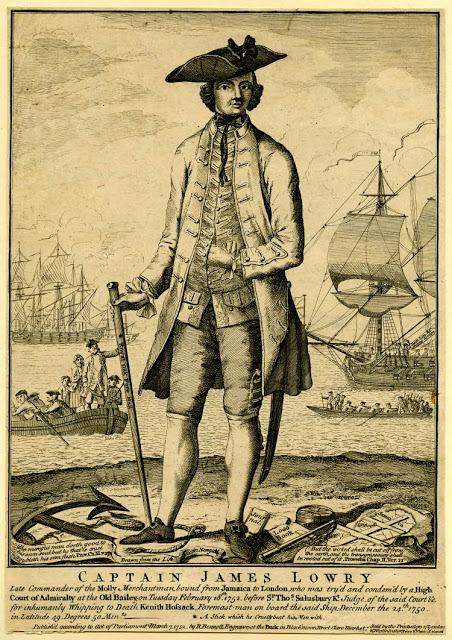
On this date in 1752 the tyrannous Scottish sea captain James Lowrey or Lowry was hanged at London’s execution dock for beating a crew member to death.

Lowr(e)y came to public notice in 1751 after the return to English shores of his merchantman, the Molly, from a run to Jamaica: ten of his ex-crew subscribed a public advertisement accusing him of murdering their mate on board, to which Lowry replied with advertisements accusing those accusers of mutiny.

Right away the British public knew it had a page-turner on its hands.

The captain had become unreasonably enraged with Kennith Hossack for lagging in his duties as he recovered from an illness, and upon a purported accusation of theft he had the mariner tied up and personally battered him about the head using a doubled-over rope as his cudgel, on Christmas Eve no less. Hossack at last dropped dead, at which point the heartless captain slapped his man and denounced him for “shamming Abraham” (i.e., feigning injury to skip work). Lowry evidently really had it in for Hossack, for the first mate explained that “I don’t know that he ever came upon deck twice in a week without beating him: my heart has bled for him many and many a time.” In the mate’s opinion, these beatings were always for no adequate reason.*

That’s a remark from the Admiralty Trial of Captain Lowry, where his former seamen developed the picture of an intolerably Queeg-like commander liable to take bitter umbrage if his men managed an illicit extra ration of sugar or rum, a guy who carried around a beating-cane with its own name (“the Royal Oak Foremast”) just in case he felt like doling out a disciplinary bludgeon. Three days after Hossack’s death, he came to blows with the second mate; two days after that, a fed-up crew “took the command from him” and ran the ship themselves, although they did not forcibly confine him.

Once the ship put in at Lisbon for repairs on the return journey, Lowry lodged a piracy complaint against his crew, but despite the incredibly serious charges and countercharges, everybody sailed on together for home thereafter, each party perhaps silently calculating the odds that the other would dare to press the case further as against getting on about their lives. Lowry does not appear to have made himself scarce until his former comrades went public with their claims, although once they did so he incriminatingly avoided the thief-takers and the small private reward set upon his capture for a few weeks.

On March 25, 1752, the brute was carried from Newgate Prison to the Execution Dock on the Thames, in a cart surmounted by a silver oar emblematic of the Admiralty. There he was hanged, and his body afterwards put in irons and displayed in infamy down the river at Blackwall.


Lowry pictured as part of a “Scotch Triumvirate” of Caledonian evildoers, along with the Scottish officer William Cranstoun, blamed for seducing Mary Blandy to the gallows, and the more mysterious “Major James MacDonald” whose papers suggest involvement in the South Sea Bubble 32 years prior (?). I’m in good company with my confusion on this MacDonald fellow, as the British Museum can’t identify him either. Check out britishtars.com for a fascinating exposition on the iconographic detail of the Lowry images in this post; we have also featured in this narrative several additional links to that same site’s various posts about the events on the Molly.

We have revisited a few times in these pages the intense commercial bustle among publishers of crime ephemera — in England as well as Ireland. Naturally this headline-grabbing execution excited plenty of competitive hawking.

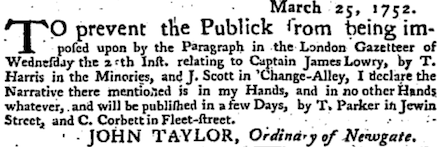
Two examples appear below; the first of them is by a pair of publishers named Harris and Scott; the second, by Parker and Corbett, who at this time had the deal to publish the Ordinary of Newgate’s accounts. Harris and Scott were first to the market here, in an environment where rapidity counted for a lot; the Ordinary wanted to be sure the public knew that his “official” (according to him) version would be soon forthcoming, so he burdened the pages of London newspapers and even his own Ordinary’s Account of ‘regular’ Tyburn criminals with adverts to that effect.


This image from the London General Advertiser of March 26, 1752, one of several papers to carry the notice. For more on the relationship between publishers and crime in this era, see Print Culture, Crime and Justice in 18th-Century London by Richard Ward

Read on below to enjoy both.

* In fact, one nugget from this case is that an adequate reason for corporal punishment at sea might sit at a much higher threshold than we commonly assume today. Although the Royal Navy was (in)famous for the discipline of the lash, multiple experienced sailors testified at this trial that they never knew floggings or beatings to occur on merchant vessels.

On this day..

1540: Hans Kohlhase, horse wild

On this date in 1540, the legendary outlaw Hans Kohlhase — a crime victim turned revengeful crime lord — executed* in Berlin. It’s a classic case of stubborn cusses escalating a minor property dispute.

En route to the Leipzig fair in 1532, Kohlhase (English Wikipedia entry | German) was stopped by a Saxon nobleman who confiscated some of his horses. In dueling publications years later, Kohlhase would charge that Guenther von Zaschwitz accused him of stealing the horses; von Zaschwitz countered that Kohlhase looked suspicious and got uppity with his retainers when questioned.

Proceeding to Leipzig in a huff, Kohlhase obtained the commendations necessary to confirm his identity and then demanded his property back from von Zaschwitz. The lord agreed … if Kohlhase would pay for the horses’ days of upkeep in his stables. Just a little crap sandwich from the neighborhood bully. Kohlhase didn’t feel like having a bite of it.

Fast forward a couple of years. Suits in the courts bogging down, Kohlhase at his wit’s end resorted to an older form of redress, one consecrated by centuries of tradition but now forbidden by a landmark 1495 legal reform: he declared a feud. Kohlhase really vented his spleen in this one, not bothering as a plausibly wronged party to play for hearts and minds but rather pronouncing his vendetta against the whole Electorate of Saxony.

Thus “justified,” he turned out-and-out bandit, gathering a crew of desperados to his banner and robbing with opportunistic promiscuity while staying a step ahead of a bounty issued against him by Elector Johann Frederick I. To repeat: this is all over a question of who foots the bill for a feedbag. Even Martin Luther tried to talk this vengeful fury off his grudge.

What is just, you will do justly, says Moses; wrong is not justified by other injustice … What you rightly do, you do well; if you can not obtain justice, there is no other advice than that you suffer injustice … Therefore, if you desire my council (as you write), I advise, accept peace.

Kohlhase accepted only the peace of the grave.

The German romanticist Heinrich von Kleist immortalized (and renamed) this uncompromising litigant in the novella Michael Kohlhaas; the same story has been re-adapted for cinema several times more.

* No surviving document specifies whether the execution was by breaking wheel or beheading.

On this day..

1819: John Van Alstine

John Van Alstine was (incompetently) hanged two hundred years ago today for murdering Schoharie County, N.Y., deputy sheriff William Huddleston — whom he bludgeoned to death in a rage when Huddleston turned up to execute a civil judgment forcing the sale of Van Alstine’s property to service a debt. The man acknowledged having a ferocious temper.

“It is not a year since I stated in Judge Beekman’s presence, (and, I stated it as the firm conviction of my mind), that there were two things I should never come to — the state’s prison and the gallows,” the confessed murderer mused in his public reflections, below. “How often have these words occurred to me since the regretted 9th, and taught me the vanity of human boasting, and the weakness of human resolution, when opposed to long indulged passions.”


This document has also been transcribed here.

On this day..

1780: Elizabeth Butchill, Trinity College Cambridge bedding-girl

A Cambridge University servant was hanged on this date in 1780 for infanticide.

Elizabeth Butchill made her way turning down the beds for the boys attending Trinity College, work she had secured via her aunt who held the same position. She somehow got pregnant, an event which does not appear to have inordinately exercised her eventual judges perhaps by virtue of its very obviousness; as Frank McLynn wryly observes, “It does not need the imagination of a novelist to reconstruct the events that led her to the gallows.”

She was surely desperate to avoid social opprobrium and unemployment, so we find from the Newgate Calendar that “she confessed that she was delivered of a female child on Thursday morning [January 6, 1780], about half past six o’clock, by herself; that the child cried some little time after its birth; and that, in about twenty minutes after, she herself threw the said infant down one of the holes of the necessary into the river, and buried the placenta, &c. in the dunghill near the house.”

“Modest, patient, and penitent” during her confinement awaiting the noose, Butchill died

firm, resigned, and exemplary. She joined with the minister in prayer, and sung the lamentation of a sinner with marks of a sincere penitent, declaring she had made her peace with God, and was reconciled to her fate. Desiring her example might be a warning to all thoughtless young women, and calling on Jesus Christ for mercy, she was launched into eternity amidst thousands of commiserating spectators, who, though they abhorred the crime, shed tears of pity for the unhappy criminal.

Whether the nameless infant’s nameless father shared those tears is a matter for the novelist’s imagination.

On this day..

1984: James Hutchins

James W. Hutchins was gassedexecuted by lethal injection in North Carolina on this date in 1984.

Hutchins was “credited” with the largest one-day slaughter of North Carolina law enforcement officers in 1979. An altercation with his teenage daughter* led to a domestic disturbance call, which led eventually to three dead cops all killed in separate shootings.

Hutchins shot Captain Roy Huskey by ambush when he responded alone to the 911 call. Several minutes later, a deputy named Owen Messersmith rolled up to check on the situation since Huskey hadn’t checked in. Messersmith quickly realized the reason, but was shot through the window of his patrol car as he slammed into reverse and “the vehicle drifted backwards across the street and came to rest in a ditch with Messersmith’s body slumped over the steering wheel, causing the horn to blow without stop.” (Wikipedia) The third victim, state highway patrolman Robert L. Peterson, pulled Hutchins over for speeding as the latter fled in his car.

Only by this point did the garbled and chaotic communications flying through dispatch radios that day finally coalesce sufficiently to give cops on the scene a full picture of what was going on: Peterson, for instance, is thought to have been entirely innocent of the knowledge that a suspect in a double shooting was at large in the area.

At any rate, the ensuing manhunt brought Hutchins into custody and a postscript as a part of political lore: in a sort of Ricky Ray Rector play, Democratic Governor Jim Hunt theatrically staged Hutchins’s execution date and denial of clemency in the run-up to his 1984 Senate campaign. But Rector’s sacrifice at least had the excuse of success: not so Hutchins’s. No matter Hunt’s tough-on-crime credentials, he was still trounced at the polls by goggle-eyed racist Jesse Helms.

There’s an independent film about the events in this notorious murder spree, titled Damon’s Law.

* Hutchins was pissed that she spiked the punch for her high school graduation party with vodka.

On this day..

1953: Abel Danos, le mammouth

On this date in 1953, the French gangster and Nazi collaborator Abel Danos was shot as a traitor.

Once a small-time crook for the milieu criminal syndicate, Danos upon his arrest went way beyond turning state’s evidence and offered his goon talents to the German police. From 1941 to 1944 he murdered people — he’s believed to have personally executed over 100 French Resistance members during the war — for salary as a member of the French Gestapo. Though arrested at the end of the war, he made a sensational escape and got into the robbery outfit Gang des Tractions Avant; he fatally shot both Italian and French police in that vocation. Career-wise you have to credit the man for focusing on his core value-adds while remaining flexible to embrace new opportunities.

“Le mammouth” — so nicknamed for his heavy build — went extinct courtesy of a firing squad at Fort Monte-Valerien, refusing a blindfold after a last swig of rum.

There’s a 2006 French-language biography of Abel Danos, by Eric Guillon.

On this day..

1889: Samuel Rylands, the first hanged at Shepton Mallet

On this date in 1889, the already-venerable prison at Shepton Mallet — which dates to 1610 and was England’s oldest working jail until its closure in 2013 — began its illustrious era as an execution site.

Samuel Reyland/Ryland/Rylands (press accounts used all three variants) bludgeoned, slashed, and strangled to death 10-year-old Emma Jane Davies in Yeobridge, Somerset, on January 2nd of that same year. Some newsmen eagerly attributed to the Yeobridge Murderer a wish “to emulate the London tragedies,” i.e., the Ripper slayings of late 1888. If Rylands’s confession is to be believed, it might have traced instead to a brain injury.


From the Western Mail, Feb. 26, 1889.

Shepton Mallet would remain a site for civilian executions until 1926; it was also favored as the American military prison during World War II, and 18 U.S. military executions took place there.

On this day..

1695: Highwayman Biss

This ballad transmits to posterity via the Pepys collection of late 17th century ephemera stashed by that famed diarist Samuel Pepys. (In these pages, we’ve already met Mr. Pepys lurking about various executions.)

The Penitent Highway-man: Or, The Last Farewel of Mr. Biss, Who was Born at Shaftsbury, in Wiltshire, and was arrain’d and found guilty, and accordingly received Sentence of Death, and was Executed at Salisbury, on the 12th of March, 1695.

To the Tune of, Russel’s Farewel, &c.

Good People all I pray attend,
and listen now to me,
A sad Relation here I send
of Biss in Shaftsbury:
A noted Highway-man he was
who on the Road did ride,
And at the length it came to pass,
he was condemn’d and dy’d.

When he was to his Tryal brought,
and at the Bar did stand,
He for no kind of favour sought,
but there held up his Hand,
Declaring to the pantient Judge,
who was to try him then,
He should not bear him any grudge,
he wan’t the worst of Men.

He said, The Scriptures I fulfill’d,
though I this Life did lead,
For when the Naked I beheld,
I clothed them with speed:
Sometimes in Cloth and Winter-frize,
sometimes in Russet-gray;
The Poor I fed, the Rich likewise
I empty sent away.

What say you now my honour’d Lord,
what harm was there in this?
Rich wealthy Misers was abhorr’d
by brave free-hearted Biss.
I never robb’d nor wrong’d the Poor,
as well it doth appear;
Be pleas’d to favour me therefore,
and be not too severe.

Upon the Road a Man I met,
was posting to a Jayl,
Because he could not pay his Debt,
nor give sufficient Bayl:
A kind and loving Friend he found,
that very day of me,
Who paid the Miser forty Pound,
and set the Prisoner free.

Tho’ he had got the Guinneys bright,
and put them in his Purse,
I follow’d him that very night,
I could not leave him thus;
Mounting my prancing Steed again,
I crost a point of land,
Meeting the Miser in a lane,
where soon I bid him stand:

You borrow’d forty Pounds, you know,
of me this very day,
I cannot trust, before you go
I must have present pay:
With that I seiz’d & search’d him round,
and rifl’d all his store,
Where straight I got my forty Pound,
with twenty Guinneys more.

The Judge he made him this reply,
Your Joaks are all in vain,
By Law you are condemn’d to Dye,
you will no Pardon gain,
Therefore, Repent, repent with speed,
for what is gone and past,
Tho’ you the Poor did clothe and feed,
you suffer must at last.

That word was like a fatal sword,
it pierc’d him to the heart;
The Lord for Mercy he implor’d,
as knowing he must part
With all his Friends and Pleasures too,
to be as I have said,
At Salsbury to Peoples view,
a sad Example made.

His melting Eyes did over-flow
with penitential Tears,
To see his dismal Overthrow,
just in his strength of Years.
O kind and loving Friends, he cry’d,
take warning now by me,
Who must the pains of Death abide,
this day in Salsbury.

In grief and sorrow now I pass
out of the World this day,
The latter minute’s in the glass,
therefore good People pray,
That as this painful Life I leave,
the Lord may pity take,
And in his arms my Soul receive,
even for his Mercies sake.

On this day..

1802: Robert Snooks, “They can’t start the fun until I get there!”

James Snook(s), who is remembered as Robert Snooks — a possible corruption of “Robber Snook” — was a career robber with a record. He hanged on this date in 1802 for mugging the Tring Mail postboy, an adventure that grossed 80 quid worth of notes ransacked from correspondence he left strewn on Boxmoor.

His decision to discard a distinctive saddle with a broken strap cracked the case for authorities and a reward for his capture went abroad — a reward claimed by “William Salt, a postboy of Hungerford, in Berkshire” who “was born in the same town as the prisoner, where they were play-fellows” and so recognized him immediately on Saturday night driving his chaise through Marlborough Forest and chased down and overpowered Snook whose resistance to his old chum did not extend to use of the “two loaded pistols … in his coat pocket.” (all quotes from the London Morning Chronicle of December 9, 1801)

Tried at the Hertford assizes, he was found to have spent notes known to be in the Tring Mail and on that basis* condemned on a Tuesday … to be dispatched with dispatch that Thursday morning on Boxmoor, near the site of the robbery. “It’s no good hurrying,” he allegedly quipped to gawkers while enjoying a last drink at a nearby pub. “They can’t start the fun until I get there!”

A weathered stone erected a century later marks the supposed place of his burial, and can be visited at Hemel Hempstead. For reasons that elude my understanding, a number of sites including Wikipedia as of this writing claim that this gentleman was the last person executed in England for highway robbery. That’s not even close to accurate.

* The postboy he attacked could not identify him positively, since the crime occurred at night.

On this day..