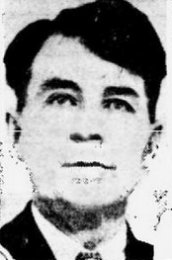
1897: Harvey DeBerry, raving like a madman

(Thanks to Meaghan Good of the Charley Project for the guest post. -ed.)

On this date in 1897, a 23-year-old black man named Harvey DeBerry was hanged for sexually assaulting his employer’s daughter.

His offense, this sexual assault, was a new one under the Tennessee statutes, different from the crimes of rape and attempted rape, and DeBerry was the first person in Shelby County to be convicted of it.

DeBerry was a live-in laborer on the Eigiman farm in Frayser Station, Tennessee, and his wife was the farm’s cook. Mr. and Mrs. Eigiman had three children aged seven, five and two. It was the oldest child, Elenora, that DeBerry assaulted on October 8, 1896.

At the time of the crime, Mr. Eigiman was in the hospital in Memphis recuperating from a fractured skull and a broken leg. Mrs. Eigiman went to see him that day, leaving her children in the care of the DeBerrys. She left Elenora in bed in her nightgown, because the little girl said she wasn’t feeling well.

When Mrs. Eigiman returned at the end of the day, Elenora was still in bed, crying and acting as if she was in pain. She refused to tell her mother what was wrong, and cried and moaned all night.

The next morning, her mother stripped the bed and found blood on the sheets. Mrs. Eigiman confronted her daughter, and Elenora said Harvey DeBerry had come into her room, lain on top of her and hurt her. That same day, a doctor was called to examine the victim. His findings, according to court documents, were as follows:

He found the child highly excited, nervous, and trembling; that the person of the child was swollen, and very tender to the touch; that the parts showed acute inflammation and swelling; that he found a purulent discharge, and a slight rupture of the hymen; that penetration had been partial, but not complete; that the acute inflammation, purulent discharge, and swelling indicated that the injury was recent. During the course of the examination the physician asked the child who hurt her, and she replied that ‘Harvey hurt her.’ The mother was not present when the child made this statement.

Harvey DeBerry fled when Mrs. Eigiman and Elenora confronted him with their accusations.

He turned up soon enough, though, living in Arkansas under the alias Frank Berry, and was extradited to Tennessee for trial. He was represented by a father-and-son team of black lawyers and offered two witnesses in his defense: a washerwoman who said there was no blood on Elenora’s clothing, and someone who said he and DeBerry were harvesting corn together at the time of the crime.

However, the prosecution was able to prove that DeBerry’s alibi witness was mistaken about the date, and the washerwoman had laundered Elenora’ clothing a full month before she was attacked.

Elenora testified about her experience at the trial, saying the reason she hadn’t immediately told her mother about the attack was that Harvey had threatened to kill her if she breathed a word about what he had done. The defense tried to convince the court that another man had abused the little girl, but Elenora denied this on the stand.

A jury acquitted DeBerry of two counts of rape, but convicted him of “assault and battery upon a female under ten years of age, with intent to unlawfully and carnally know her.” What exactly constituted “rape” when there was scant to no penetration was a grey area in Anglo jurisprudence, but with the sexual assault law it was six of one and a half-dozen of the other: both rape and sexual assault were capital offenses.

On the scaffold DeBerry was sobbing and appeared terrified.

A newspaper said later that his last words were “the ravings of a madman. There was no connection of coherency in what he said.”

When he stood on the trap and the sheriff pulled the lever, nothing happened. After an agonizing moment, a deputy stepped forward and pulled it a second time. This time the trap worked and DeBerry fell, cleanly breaking his neck. He was pronounced dead within twelve minutes.

As to whether he confessed before he died, the sheriff and the minister refused to say.


For a bit of period context, the same date that DeBerry hung lawfully saw the summary lynching of an unknown tramp in Manheim, Illinois, outside Chicago. That man attempted to outrage a farmer’s wife but was fought off by the “muscular German woman,” then led a desperate chase through woods and cornfields for half an hour until one of the pursuing posse finally plunked him with a gunshot.

The wounded assailant was searched for identity papers (none turned up), then instantly strung up on the nearest sturdy tree. (Source: The News and Observer (Raleigh, NC), Aug. 20, 1897)

On this day..

1929: James Horace Alderman, Prohibition rum-runner

On this date in 1929, James Horace Alderman, the “King of the Rum Runners” or the “Pirate of the Gulf Stream”, was hanged at a custom-built gallows at a Florida Coast Guard base.

Alderman grew up in Florida’s Ten Thousand Islands and therefore became at home on the sea — even taking Teddy Roosevelt out as a fishing guide at one point, according to Florida Pirates: From the Southern Gulf Coast to the Keys and Beyond.

But as he came into his own, his business on the high seas was smuggling, often Chinese immigrant workers trying to sneak into the U.S. from Cuba. It’s rumored that Alderman killed some of these people, too.

Either way, Prohibition made for a much more profitable racket hauling liquor from Caribbean manufacturers to the Everglades, where it could take a train ride and be distributed all the way up the Atlantic coast.

On August 27, 1927, a Coast Guard cutter stopped and boarded Alderman’s speedboat and seized fifty barrels of whiske. Even worse, Alderman shot two of the cutter’s boarders dead.

Alderman’s case might look pretty open and shut, but Floridians proved to be extremely resistant to hosting a federal execution. (The feds at this point generally administered executions in their own name, but at the execution sites of whatever state the malcreant happened to live with. Julius and Ethel Rosenberg, for example, simply died in New York state’s iconic electric chair.

The final judicial decision on this strange question so far from the long-ago deliberations at Liberty Hall came down like this: Florida’s facilities could be barred to the federal government, and that they should carry out the execution on nearby federal property. The U.S. Coast Guard was forced to build a temporary gallows for Alderman inside its seaplane hangar and base no. 6. (Here’s Alderman’s detah warrant, if you’re into that sort of thing.) A short drop from the platform led to an agonizing 12-minute strangulation.

Because Florida itself had only a few years prior ditched hanging in favor of the electric chair, Alderman’s execution was the last judicial hanging in (but not by!) the state of Florida.

On this day..

2001: Jeffrey Doughtie, “It started with a needle and it is ending with a needle”

(Thanks to Robert Elder of Last Words of the Executed — the blog, and the book — for the guest post. This post originally appeared on the Last Words blog. Fans of this here site are highly likely to enjoy following Elder’s own pithy, almanac-style collection of last words on the scaffold. -ed.)

“For almost nine years I have thought about the death penalty, whether it is right or wrong and I don’t have any answers. But I don’t think the world will be a better or safer place without me. If you had wanted to punish me you would have killed me the day after, instead of killing me now. You are not hurting me now. I have had time to get ready, to tell my family goodbye, to get my life where it needed to be. It started with a needle and it is ending with a needle.”

— Jeffrey Doughtie, convicted of robbery and murder, lethal injection, Texas.
Executed August 16, 2001

Doughtie had a $400-a-day drug habit, which he financed by selling stolen property. He had once worked for the antique store in Corpus Christi where he sold much of his loot. One day, after shooting a mix of heroin and cocaine, Doughtie beat the store’s proprietors to death with a piece of metal tubing. He confessed to the murders.

On this day..

1812: William Booth, forger

On this date in 1812, William Booth was hanged at Stafford for counterfeiting.

Booth might have murdered his brother John, who was found beaten to death in a Warwickshire stable in 1808. He defeated that charge for want of evidence.

But he would not be two times lucky before the bar.

As a “farmer” living on 200 acres, he enjoyed the privacy to build his own mint, complete with forged royal stamps for churning out banknotes — more than enough cause to hang a man should he be caught, which Booth was. He was a difficult fellow to arrest, the Bury and Norwich Post reported (Aug. 19, 1812), because his farmhouse turned out to be “a little fort, full of trap-doors, and barred and bolted like a bastile.”

Booth’s engineering acumen might have come in handy for his executioners. As a broadside notes, the gallows Booth

ascended with a firm and steady step, but turned his back upon the populace almost immediately; after some time spent in prayer, the rope was adjusted, and a signal being given by the malefactor, (throwing his handkerchief from him that he was ready to submit to his fate,) the drop sunk, when, shocking to relate, by the cord slipping from the fatal tree, the unfortunate man fell from the top of the gallows upon the platform, a distance of eight or ten feet, where he remained motionless and insensible for some minutes.

The stunned prisoner was gradually revived, and redoubled his pieties. The fall must have rendered the noose unusable, because for some reason a delay ensued sufficient to stretch out the proceedings to two full hours, all of which Booth spent in the shadow of the gallows. Even when they finally had him trussed up and ready to hang again, they needed a do-over: Booth once more dropped his handkerchief, but the drop embarrassingly failed to dislodge. Booth, who had twice prepared himself to walk to the brink of death only to twice survive, asked for his handkerchief back once the apparatus had been fixed so that he could re-drop it.

Having faced two capital trials, and two executions, Booth couldn’t even get buried right on the first time. Apparently a re-drawing of the county line required his remains to be exhumed and re-interred, giving rise to a ballad, “Twice Tried, Twice Hung, Twice Buried”.

(Although this version proposes twice hanged and once drowned: suffice to say, Booth lived an interesting death.)

On this day..

1480: The Martyrs of Otranto

On this date in 1480, Ottomans invading Otranto, Italy conducted a mass execution of prisoners.

Landing at the southern Italian city on July 28, the Ottoman force quickly overwhelmed Otranto. (Otranto rashly slew the messenger come to offer a merciful capitulation, only to find that its garrison began deserting within days.) On August 11, the Turks took the city by storm. Thousands died on that day’s bloodbath, including the Archbishop of Otranto.

Surviving women and children were sold into slavery. Men over age 15 had the choice of conversion — or death.

“Now it is time for us to fight to save our souls for the Lord!” a Christian shoemaker is said to have exhorted his 800 fellow prisoners. “And since he died on the cross for us, it is fitting that we should die for him.”

The acclaim greeting this call signaled inflammation ahead for the Turkish headsmen’s rotator cuffs. They had 800 faithful souls to dispatch to their eternal reward this date at the place still known as the Hill of Martyrs. (When in Otranto, visit it by taking the via Ottocento Martiri, just off via Antonio Primaldo — that’s the name of the militant shoemaker.)


The remains of the Otranto martyrs, arrayed as relics in the Otranto cathedral. (cc) image from Laurent Massoptier.

Historical novel set during these vents.

This, at least, is the most pious version of the story. The mass execution certainly did occur, but some latter-day historians like Francesco Tateo have argued that martyrdom is not attested by any of the contemporaneous sources, and the specifically religious understanding of events was only read in after the fact.

On whatever grounds one likes, Italy’s fractious city-states were deeply alarmed by the appearance on their shores of the all-conquering Turks. “It will always seem as if the funeral cross is borne before me while these barbarians remain in the boundaries of Italy,” wrote the Florentine humanist Poliziano.* (Source, a nonfiction book which covers Otranto in some detail.)

In the ensuing months, they rallied together vowing to expel the invaders.

Fortunately for this coalition, the Ottoman sultan Mehmed the Conqueror died in May 1481, and a brief period of internal conflict within the Ottoman empire over the succession perhaps led it to allow its Otranto outpost to wither on the vine. The Turks made peace and withdrew from their potential beachhead not long after, having held the city for just over a year. The bodies of the martyrs were said to have been found uncorrupted by decay.

The Catholic church beatified the 800 martyrs in 1771, but their final elevation to sainthood occurred only in 2013, just three months ago as I write this. They were in the very first group canonized by the new Pope Francis — although the canonization was approved by his predecessor Benedict XVI on the same day that Benedict resigned his pontificate. Considering current relations between the respective faiths, it was seen as a potentially impolitic move.

“By venerating the martyrs of Otranto, we ask God to protect the many Christians who in these times, and in many parts of the world, are still victims of violence,” Pope Francis said at the canonization Mass, diplomatically not naming any of those parts of the world.

* At the same time, Florence (in common with other Italian polities) had trade and diplomatic relations with the Ottomans.

On this day..

1997: Chiang Kuo-ching, Taiwan wrongful conviction

On this date in 1997, Taiwanese airman Chiang Kuo-ching was shot for the rape-murder of a five-year-old girl the previous September.

Chiang was nominated as a suspect by a fellow enlistee just a day after the little girl’s body was found in a privy gutter.

So, he and three other early suspects were given “lie detector” tests. Because Chiang was the only one of these who “failed” to acquit himself by this ludicrous mummery, he became the subject of implacable official tunnel vision.

The case was referred — illegally and arbitrarily — to the country’s intelligence services, who subjected Chiang to 37 hours of torture in order to extract a confession: beatings, threats, sleep deprivation, and private screenings of “his victim’s” autopsy.

Chiang broke, and admitted to the crime.

That admission was the star witness against him in his ensuing military trial. Chiang had retracted it by then — but that was much too late to help himself, especially since potentially exculpatory forensic evidence was intentionally withheld from his defense.

As it turned out, the bloody handprint and the DNA trace recovered from the scene didn’t match Chiang at all. No evidence connected him to the crime, except the evidence of truncheons.

Another airman, Hsu Rong-chou, eventually admitted to the killing. (He’d already been convicted in two other child molestation cases, in 1997 and 2003.) In 2011, Hsu received an 18-year prison sentence for the crime that took Chiang Kuo-ching’s life. Chiang was posthumously acquitted that same year.

The latter-day reversal of the sentence was so sensational that Taiwan’s legislature enacted a special law to increase the compensation Chiang’s family received. The family also got an extraordinary televised apology from President Ma Ying-jeou, who bowed three times before an image of the wrongfully executed man.

On this day..

1936: Manuel Goded Llopis

On this date in 1936, the Spanish Republic executed Gen. Manuel Goded Llopis, who mounted an unsuccessful nationalist attack in the heart of Republican Spain, Barcelona.

Goded (English Wikipedia entry | Spanish) was born of Catalan ancestry in Puerto Rico. His family moved back to the mother country when the United States stripped that territory away in the Spanish-American War.

Goded advanced rapidly through the armed forces, becoming dictator Miguel Primo de Rivera‘s chief of staff by 1927. He was dismissed from this post for intriguing against the government, but soon found his way back to command and became (Spanish link) one of the circle of officers conspiring to check the advance of the left.

When the anti-Republican military mounted the revolt that became the Spanish Civil War, Goded was in Catalonia — freshly arrived on a mission to snatch Barcelona for the fascists at the revolt’s outset. Forces loyal to the Republican government, however, defeated Goded in the streets of Barcelona on 19 July. The general himself was captured on 11 August. A Republican court had him shot at Montjuic the very next day, along with another officer, Alvaro Fernandez Burriel.

His defeat, in the long run, might have been a gift by the Republicans to their conquerors: Goded was a partner but also a rival of Francisco Franco’s, and Goded’s presence in the postwar settlement among the nationalist victors might have introduced a fault line into the Franco regime.

On this day..

1703: Tom Cook, Ordinary’s pet

On this date in 1703,* Thomas Cook was hanged at Tyburn.

Cook — or the Gloucester Butcher, to use the sobriquet that advertised his prize fights — was convicted of giving a constable a fatal rapier thrust during a mob affray.

As he faced execution in prison, Cook continued to insist that he didn’t do it. But he still gratified the ministrations of the Newgate Ordinary Paul Lorrain by admitting to a life of sinfulness:

that he had frequently stoln [sic] Sheep, and done many ill things … He acknowledg’d he had been a grievous Sinner, a great Swearer and Drinker, an Adulterer, a Prophane and Lewd Wretch, and a sworn Enemy of those who were employ’d in the Reformation of Manners; and that for some years past he had made it his great Business to Fight for Prizes; an Exercise which the Pride of his Heart carry’d him to, which he now looks upon as most Heathenish and Barbarous, and which, with all other the wicked Practices of his Life, especially his slight of Religion, he does detest and abhor … and in the Words of a Dying-Man (who by the just Providence of God, came to suffer a shameful and untimely Death, in the primer of his years) he exhorts all those of his Acquaintance, and others that live loosely and particularly that follow this Wicked Sport of Prize playing, to reform betimes, and apply themselves to that which is virtuous and laudable, lest if they cdo continue any longer in their ill way, the Wrath of God fall upon them, and they come to the same, or worse Punishment thatn himself.

But still, he didn’t kill the cop, he said. (This, actually, was a common enough dodge among the Ordinary’s patients: it enabled them to satisfy the confessor, and the weight of social conventions he pressed on them, while also persisting with a denial of this crime one might be invested in maintaining. Whether true or no, Cook must have been unusually persuasive to pass off a story that would ordinarily be held to characterize an “obstinate” prisoner.)

Paul Lorrain, who held the Ordinary of Newgate office from 1700 to 1719, absolutely adored a good conversion story; his profession after all was ministering to prisoners. Lorrain ate all this reform-themselves-betimes stuff right up.

Two days after Cook’s execution, Lorrain compared the hanged pugilist to the Biblical patriarch Enoch at an overwrought funeral sermon (titled “Walking With God”): proof positive that even the most wretched sinner could taste God’s redemption. Cook’s “Soul is now enjoying an honourable and happy Life in God’s Glorious Kingdom,” Lorrain averred.

This was mainstream theology, but not a universal opinion.

Cook’s fellow convicts in Newgate regarded the repentant condemned as an unctuous hypocrite and didn’t share the Ordinary’s susceptibility to the actual-innocence claim Cook smuggled into his big confession of general lifelong sin.**

One of those fellow convicts in 1703 was Daniel Defoe, who met Lorrain while incarcerated and took a violent personal dislike to the prelate.

Defoe (who would later put a dismissal of the Ordinary in the mouth of his great heroine Moll Flanders) retorted to Lorrain’s published sermon with a scathing pamphlet titled “A Hymn to the Funeral Sermon”. In it, he mocks Lorrain’s racket peddling the public† broadsheets which almost invariably celebrate the gallow’s-foot conversions of his innumerable malefactors. After all, when

Men of Infamy should rise,
By Ladders to Ascend the Skys …
What need we Mortifie and Pray
If Gibbets are the Shortest Way?
In what disguise Religion may be drest,
The crooked Paths of Priest-craft Paint?
Where lies the Secret, let us know,
To make a Sheep-stealer a Saint?
Or bid me tell them that ’tis all a Jest;
What need they point out other ways,
Since Earthly Rogues can Merrit Holy Praise?
If this Wise Precedent the World receives,
Newgate shall ne’re be call’d a Den of Thieves.


Not related to Cook or to Defoe, this 1882 Puck cartoon (via the Library of Congress) makes Defoe’s same discomfiting point graphically: the soul of the hanged murderer ascends into angelic choirs, his crimes literally wiped away by his confessor — while that of his victim, slain unawares while unpurged sin weighs his conscience, wallows in hell. “The Murderer’s Straight Route to Heaven — Bringing Religion into Disrepute,” runs the caption.

* Cook had had a last-minute reprieve from joining a July 21 hanging date; in his account for that date, Paul Lorrain called out Cook by name to take “a happy Warning” from the right conduct of those gallows-birds.

** In 1706, two other men coming up for hanging made a point of insisting to Lorrain that the fighter who “with such an Air of seeming Repentance to his last breath deny’d his crime” did commit the murder.

† According to Lincoln Faller (“In Contrast to Defoe: The Rev. Paul Lorrain, Historian of Crime”, Huntington Library Quarterly, Nov. 1976), Lorrain left an estate of £5,000 at his death in 1719. His salary as Ordinary was something in the neighborhood of £35 per annum. Defoe overtly accuses Lorrain in “Hymn” not merely of profiteering but of taking payola to frame a gratifying obituary for a hanged criminal: “Pulpit praises may be had / According as the Man of God is paid.”

On this day..

1949: John George Haigh, the Acid Bath Murderer

On this date in 1949, Britain’s “Acid Bath Murderer”* was hanged by Albert Pierrepoint at Wandsworth Prison.

The name really tells you all you need to know about this enduringly infamous serial killer.

John George Haigh drained puddles of deathly sludge into the pipes at 79 Gloucester Road in London and 2 Leopold Road, Crawley, West Sussex.

He wasn’t a criminal mastermind, but he had that one good idea, and the doggedness to keep going with what worked through the latter half of the 1940s. Serving a previous sentence for fraud, Haigh impressed himself with a jailhouse experiment revealing the efficacy of sulfuric acid for completely dissolving the body of an unfortunate mouse. Perhaps he had been motivated to the test by the memory of a notorious trial in France featuring the same disposal-of-remains expedient. Perhaps he thought it up all by himself.

Shortly after obtaining his parole, Haigh put the insight to foul use by whacking his wealthy former employer over the head and stuffing him into a 40-gallon drum in his Gloucester Road basement. William McSwan’s body dissolved over two days in a sulfuric acid bath. Haigh poured the remnant ooze down a manhole and moved into McSwan’s house, telling the victim’s parents that their son had ducked out to avoid World War II conscription. Once the war ended and the questions came, Haigh made slurry of mom and dad, too.

Undoubtedly a sociopath, Haigh didn’t murder out of compulsive love of taking life. He had a cold, pecuniary motive. “I discovered there were easier ways of making a living than to work long hours in an office,” he wrote of the earlier, non-homicidal frauds and thefts that had started his criminal career. “I did not ask myself whether I was doing right or wrong. That seemed to me to be irrelevant. I merely said, ‘That is what I wish to do.’ And as the means lay within my power, that was what I decided.”

Now the means lay within his power to appropriate a fellow’s pension and estate by disappearing him into a vat of chemicals. Why should he ask himself whether that was right or wrong?

Haigh had blown through the McSwan’s fortune by 1948, and started dissolving hand to mouth. In February of that year, the killer lured a doctor and his wife to his new acid bath station in Crawley. These he shot dead, and rendered as per usual into vitriol compote. But he got sloppy the following year by targeting a wealthy widow who actually shared his same apartment block; when she was reported missing, the neighbor with the criminal record went right into the suspect filter. A search of Haigh’s workshops turned up papers tying him to all three sets of murders … as well as a nearby dump whose “yellowish white greyish matter” yielded “28 lb. of melted body fat, part of the left foot eroded by acid, three gallstones, and 18 fragments of human bone eroded by acid.” (London Times, April 2, 1949) Preserved dentures proved a match for the late Olive Durand-Deacon.

Haigh was a pragmatist, as always.

“Tell me, frankly, what are the chances of anybody being released from Broadmoor?” he chattily asked one guard, referring to the high-security psychiatric facility he intended to inhabit. But his problem would be getting into it. Haigh’s jury needed only minutes to dismiss his longshot insanity defense, and condemn the Acid Bath murderer to die.**

Haigh hanged a mere three weeks after sentence, not even six full months from his last murder.

* Not to be confused with the “Brides in the Bath” murderer. Best just to stick to showers.

** Legal oddity: the Daily Mirror described Haigh as a “murderer” during his trial — that is, before his lawful conviction. Haigh was able to land the editor of this paper in the clink himself for this accurate, prejudicial epithet.

On this day..

1786: Tom, “faithful, industrious, healthy slave”

(Thanks to Meaghan Good of the Charley Project for the guest post. -ed.)

On August 9, 1786, in the state of Franklin (in what is now eastern Tennessee), a black slave named Tom was hanged for murder.

Tom had poisoned John Fuller Lain, a white man. The circumstances of the murder and Tom’s motive for it have been lost to history; all we know is that Lain was not his owner. Tom’s owner, William Evans, actually hired counsel to defend him, but the court refused to hear it.

Tom was imprisoned in July of that year, tried and convicted on August 8 and put to death the next day.

Aptly for a man of Franklin, Evans was concerned about the Benjamins. He filed a lawsuit against the sheriff for wrongful destruction of his personal property, but this was dismissed. Doggedly, on May 2, 1799 — nearly thirteen years after Tom’s death — Evans petitioned the General Assembly asking to be reimbursed for the value of the dead man, whom he described as “faithful, industrious, healthy slave … in the prime of life.”

Edwards reckoned Tom was worth £100. A hundred people signed the petition, but the General Assembly — by now the Tennessee General Assembly, since “Franklin” had failed as an independent entity — refused to cough up the funds.

On this day..