1828: Manuel Dorrego, Governor of Buenos Aires

On this date in 1828, Argentine independence hero Manuel Dorrego was shot in Buenos Aires — a casualty of that country’s unfolding civil war.

Dorrego (English Wikipedia entry | the more detailed Spanish), the youngest son of a Portuguese merchant, became a brilliant soldier of his country with an adventuresome career in the Argentine War of Independence, at one point taking refuge in exile in Baltimore, U.S.

If one likes, that sojourn in a functioning republic firmed up Dorrego’s commitment to federalism — the principle that would animate a decades-long internal conflict over division of power in the newly independent state.

Argentina’s federalists approved a distribution of power to its constituent regions; the opposing unitarians wanted a strong central government in Buenos Aires.

And they did not confine their disputes to pamphlets.

Resistance from the provinces to overweening Buenos Aires and Argentina’s unitarian first president Bernardino Rivadavia helped precipitate that gentleman’s fall from power and the dissolution of the national government.

Dorrego became Governor of Buenos Aires in August 1827, and exercised de facto head of state powers — for instance, he formally accepted the treaty ending hostilities in the Argentina-Brazil War.*

But a rough customer of the unitarian camp, Gen. Juan Lavalle, overthrew Dorrego’s government and mounted a terrifying purge of federales.**

Beginning, of course, with Dorrego himself, who was given one hour’s advance notice of his entirely extrajudicial shooting.

Most of the detailed information available online about this martyr is in Spanish — see here, here, here, and here, for instance.

* The fruit of this treaty was the independent state of Uruguay, as each side gave up trying to take that territory from the other by force.

** Until Lavalle was ousted by the next great unitarian leader, Juan Manuel de Rosas.

On this day..

1942: Klava Nazarova, Hero of the Soviet Union

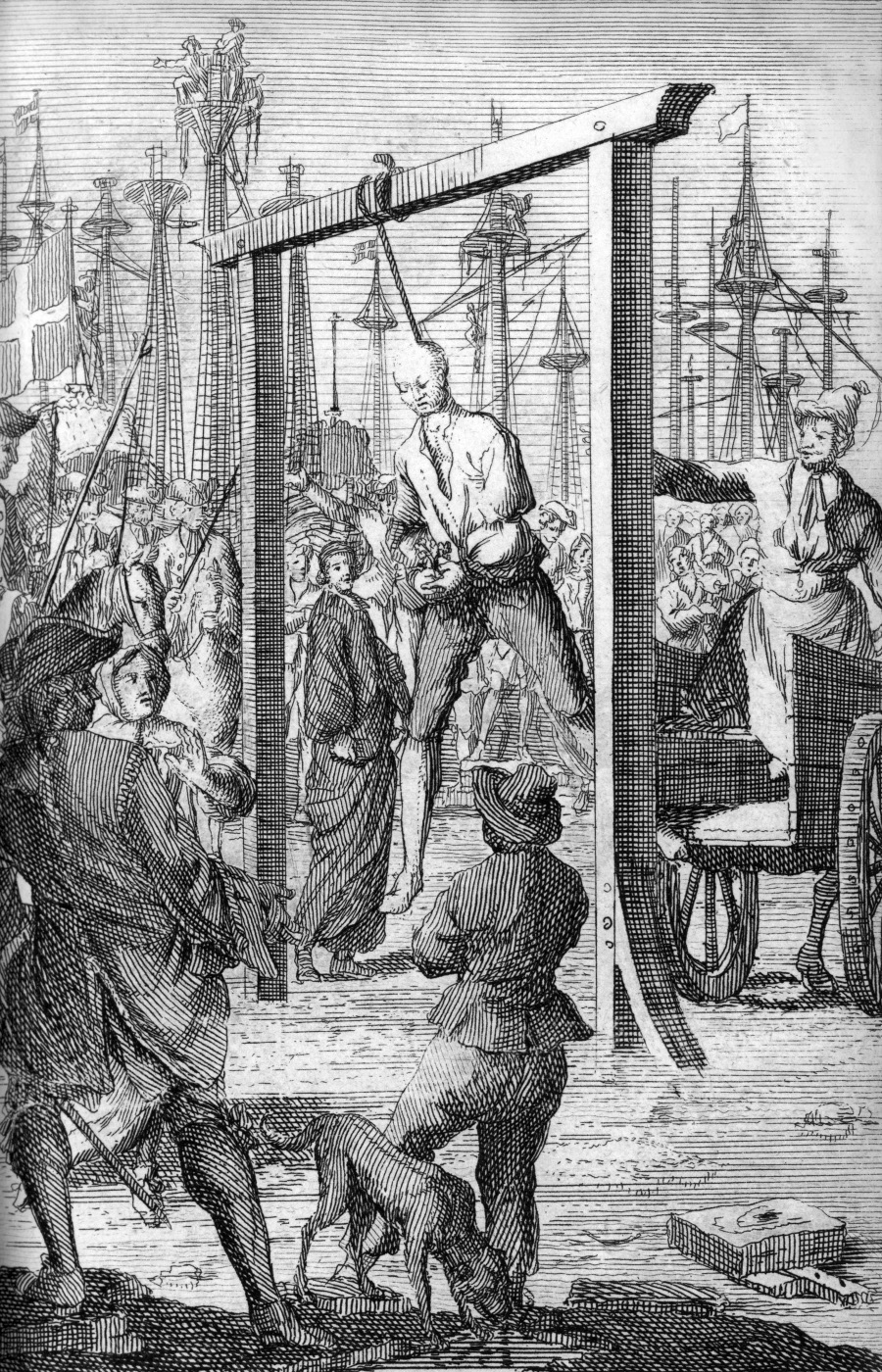
On this date in 1942, Klava Nazarova and five other Soviet partisans were hanged by the Wehrmacht in and around Ostrov.


Image from a fantastic collection of illustrations of Soviet female heroes at this Dutch-language forum thread.

Nazarova was a 21-year-old Komsomol member in the town of Ostrov when Nazi Germany invaded the Soviet Union in 1941.

The Germans overran Ostrov’s Pskov oblast en route to Leningrad for that city’s legendary siege, leaving Nazarova to apply her leadership talents to the finer points of partisan warfare.

She was captured with five other resistance members in November 1942, and the six executed in a traveling spectacle of the macabre this date: Nazarova and another young woman, Nura Ivanova, were hanged together in the main square of Ostrov; then, the party rolled out to the neighboring village of Nogino for the hanging of a middle-aged husband-and-wife couple; last, Nikolai Mikhailov and Konstantin Dmitriev got that treatment in yet another nearby village, Ryadobzha.

Klava Nazarova is one of three women from the Great Patriotic War designated as Heroes of the Soviet Union. (The others are Maria Kislyak and Zoya Kosmodemyanskaya.) We think it meet to mark her martyrdom to the strains of the great Soviet war anthem “Svyaschennaya Voyna” (“Holy War”).

Rise up, huge country,
Rise up for a fight to the death!
With the dark fascist force,
With the damned horde.

[audio:http://download.sovmusic.ru/m/saintwar.mp3]

On this day..

2006: Two Egyptians who just wanted to watch the game

Nineteen-year-old shoe-shiner Hosni Ramadan Mahmoud Ahmed and his friend Ramadan Abu Al-Magd Azab were hanged in Qena, Egypt on this date in 2006 for murdering Ahmed’s two-year-old stepdaughter.

“Apparently infuriated that the crying baby was disrupting their viewing of a football match on television,” read the crime blotter. “Ahmed smashed the two year old’s head against a wall and electrocuted her.

“The two men then dumped her body in a nearby school.”


Egypt football fans would like to enjoy the game in peace. (cc) image from blogdroed.

On this day..

1718: Stede Bonnet, gentleman pirate

On this date in 1718, the Barbados buccaneer Stede Bonnet was hanged for piracy in Charleston, S.C.

Bonnet had few of the typical swashbuckler’s resume-builders during this Golden Age of Piracy: he was neither a mariner by trade nor a desperate outlaw by circumstance, but a wealthy English landowner in Bermuda.

“He had the least Temptation of any Man to follow such a Course of Life, from the Condition of his Circumstances,” wrote the pseudonymous author (alleged to be Daniel Defoe) of A General History of the Pyrates. But as age thirty hove into view and the seven-year itch demanded scratching, Bonnet undertook an abrupt career change “said to have been occasioned by some Discomforts he found in a married State.”

Bonnet’s version of a cherry-red convertible was a six-gun sloop named Revenge,* which he tricked out from his ample inherited fortune and took cruising for action on the North American coast.

Or, just get this Victorian satire free from Google books.

He raided from New England to the Carolinas, fell in with Blackbeard (which more credible cutthroat charismatic promptly appropriated Bonnet’s hireling** crew), lost his ship, got it back, turned himself in, got a pardon … the rich guy packed plenty of adventure into little more than a year of raiding, but he never seems to have advanced his freebooting skills past the “gentleman hobbyist” level.

South Carolina ships captured Bonnet near Cape Fear, which is actually North Carolina, but never mind: South Carolinians well remembered this character from his involvement with Blackbeard’s recent blockade of Charleston.

Bonnet got gentleman’s quarters upon detention, and his elite education enabled him to favor the colony’s governor with a simpering plea for clemency.

Honoured Sir,

I have presumed, on the Confidence of your eminent Goodness, to throw my self, after this manner, at your Feet, to implore you’ll graciously be pleased to look upon me with tender Bowels of Pity and Compassion; and believe me to be the most miserable Man this Day breathing: That the Tears proceeding from my most sorrowful Soul may soften your Heart, and encline you to consider my dismal State …

if I had the Happiness of a longer life in this World … I’ll voluntarily put [wickedness] ever out of my Power, by separating all my Limbs from my Body, only reserving the Use of my Tongue, to call continually on, and pray to the Lord, my God, and mourn all my Days in Sackcloth and Ashes to work out confident Hopes of my Salvation …

Good grief.

All of which pathos was unwisely belied by an escape attempt which made pardon completely untenable.

Most of Bonnet’s captured crew was hanged en masse on Nov. 8; Bonnet managed to drag on several stays of execution before he followed them from his comfortable digs to the common gallows. A stone monument marks the spot.

* There were many pirate ships Revenge, including that of famous women pirates Anne Bonny and Mary Read and that of the Dread Pirate Roberts. There’s also a band “The Pirateship Revenge”.

** Bonnet paid his crew out of his own pocket, a practice at odds with the more egalitarian pirate norm of crews taking like shares and choosing (or demoting) their own captains.

On this day..

1603: The men of the Bye Plot, but not those of the Main Plot

On this date in 1603, priests William Watson and William Clark were executed for a dramatic (that is, harebrained) plot “to take away ‘the KINGE and all his cubbes.'”

The year was 1603, the first in the reign of James I. (However, he’d been James VI of Scotland since the tender age of 13 months, when his mother Mary, Queen of Scots had been forced to abdicate. He made himself quite a reputation for witch-hunting.)

With the death of the Protestant Queen Elizabeth and all her schismatic Anne Boleyn mojo, hard-pressed English Catholics greeted Jamie’s ascension hopeful of relief from official persecution. Although raised Protestant, both his parents had been Catholic.

Watson was one of these hopeful adherents, and hastened himself to Scotland as Queen Elizabeth lay ailing to extract from the future English monarch the soothing blandishments of good favor that future monarchs make.

When toleration was not extended to Catholics upon the new king’s elevation in late March 1603, the disenchanted Watson almost immediately embarked on a preposterous scheme to

assemble force and strengthe, and on Midsommer-day last, in the night, to come to the Parke pale at Grenewich, to enter in by the gardein with a key, that should be borowed; and when the numbers were come in, there should be a watche set at the dores of principall persons, and at the passages; and then to goe up to the KING’S loding. And when they cam to the KING, they should surprise his person, and carry him to the Tower, and they would move him for 3 things: — 1, for there pardon; 2, for tolleration of relligion; 3, for assuraunce thereof, to preferre Catholiques to places of credit, as WATZON the priest to be Lord Keper; GREY, Erle Marshall; GEORGE BROOKE, Lord Treasorer; and MARCAM, Secretary. They concluded to cutt of many of the Privy Councill, and to have made a Proclamation, purporting howe the KING had bene misled, and to have had many things reformed. They determined to have possessed the principall ports of the realme, and to have kept the KING in the Towre a quarter of a yeare.

The Bye Plot was ironically busted by other Catholics — Jesuits, as distinct from “secular clergy” (clergy not affiliated with an order) like Watson. Jesuits and secular clergy were at loggerheads in this period over tactics, church structure … more or less everything. The need to steal the thunder of whatever restore-the-Church scheme the Jesuits might be cooking up might have helped precipitate Watson into such immediate and desperate disaffection.

At any rate, these other more respectable fathers of the church blew the whistle on the Bye Plot lest it provoke anti-Catholic pogroms, and you’d have to concur with their estimate that taking the king hostage is the sort of thing that would have prompted some blowback.

In the course of rolling up the now-exposed Bye Plot, investigators also caught wind of the parallel Main Plot, courtesy of one conspirator who was involved in both and unable to hold his tongue under torture.

The Main Plot was a sketchier affair to a similar end, allegedly among Catholic-sympathizing nobles to depose James for his cousin. As befits its title, the Main Plot implicated much bluer blood than Watson’s: Lord Cobham,* Baron Grey, and the knighted soldier Griffin Markham.

Oh, and a guy you might have heard of by the name of Walter Raleigh.

All these Main Plot gentlemen were likewise condemned to death. December 9, 1603 was the date appointed for Watson and Clark to expiate the Bye Plot in the grisly manner that commoner priests were wont to suffer in that age — they as the undercard to the beheadings of Cobham, Grey, and Markham. (Raleigh was on deck for a later date.)

The drama that unfolded on the Winchester scaffold that day was wonderfully narrated in the correspondence of Sir Dudley Carleton and well worth extracting at length.

The two priests that led the way to the execution were very bloodily handled; for they were both cut down alive; and Clarke, to whom more favour was intended, had the worse luck; for he both strove to help himself, and spake after he was cut down. They died boldly both … Their quarters were set on Winchester gates, and their heads on the first Tower of the castle.

…

Warrants were signed, and sent to Sir Benjamin Tichborne, on Wednesday last at night, for Markham, Grey, and Cobham, woh in this order were to take their turns … A fouler day could hardly have been picked out, or fitter for such a tragedy. Markham being brought to the scaffold, was much dismayed, and complained much of his hard hap, to be deluded with hopes and brought to that place unprepared. One might see in his face the very picture of sorrow; but he seemed not to want resolution … [and] prepared himself to the block. The sheriff, in the mean time, was secretly withdrawn … whereupon the execution was stayed, and Markham left upon the scaffold to entertain his own thoughts, which, no doubt, were as melancholy as his countenance, sad and heavy. The sheriff, at his return, told him, that since he was so ill prepared, he should yet have two hours respite, so led him from the scaffold, without giving him any more comfort, and locked him into the great hall … The lord Grey, whose turn was next, was led to the scaffold by a troop of the young courtiers … and thereupon entered into a long prayer for the king’s good estate, which held us in the rain more than half an hour; but being come to a full point, the sheriff stayed him, and said, he had received orders from the king, to change the order of the execution, and that the lord Cobham was to go before him … he had no more hope given him, than of an hour’s respite; neither could any man yet dive into the mystery of this strange proceeding.

The lord Cobham, who was now to play his part, and by his former actions promised nothing but matiere pour rire, did much cozen the world; for he came to the scaffold with good assurance, and contempt of death. … [he] would have taken a short farewel of the world, with that constancy and boldness, that we might see by him, it is an easier matter to die well than live well.

He was stayed by the sheriff, and told, that there resteth yet somewhat else to be done; for that he was to be confronted with some other of the prisoners, but named none. So as Grey and Markham being brought back to the scaffold, as they then were, but nothing acquainted with what had passed, no more than the lookers-on with what should follow, looked strange one upon the other like men beheaded, and met again in the other world. Now all the actors being together on the stage (as use is at the end of a play,) the sheriff made a short speech unto them, by way of the interrogatory of the heinousness of their offences, the justness of their trials, their lawful condemnation, and due execution there to be performed; to all which they assented; then, saith the sheriff, see the mercy of your prince, who, of himself, hath sent hither to countermand, and given you your lives. There was then no need to beg a plaudite of the audience, for it was given with such hues and cries, that it went from the castle into the town, and there began afresh, as if there had been some such like accident. And this experience was made of the difference of examples of justice and mercy; that in this last, no man could cry loud enough, ‘God save the King;’ and at the holding up of [the previously executed] Brookes’s head, when the executioner began the same cry, he was not seconded by the voice of any one man, but the sheriff. You must think, if the spectators were so glad, the actors were not sorry; for even those that went best resolved to death, were glad of life … Raleigh, you must think (who had a window opened that way), had hammers working in his head, to beat out the meaning of this strategem. His turn was to come on Monday next; but the king has pardoned him with the rest, and confined him with the two lords to the Tower of London, there to remain during pleasure.

Turns out that James wanted to do only the minimum amount of butchery necessary to establish his bona fides, and it sure seems like the mercy play proved a public relations triumph.** Raleigh was left by this reprieve languishing in the Tower for years, before his own final adventure saw him to the block after all in 1618.

Would you like some bootless speculation that Raleigh’s being caught up in this mess led him to nurture during his imprisonment a decade-long grudge against William Shakespeare and eventually murder the playwright? Of course you would.

In the world of more demonstrable historical consequences, the failure of these plots and continuing frustration with Catholics’ lot under a new boss who seemed a lot like the old led two years later to the ne plus ultra of English sectarian terrorism, Guy Fawkes‘s Gunpowder Plot to blow King James and his court straight to kingdom come.

* Cobham was a descendant of John Oldcastle and is supposed to have forced Shakespeare to redact the family name in his Henry V plays — giving us, instead, the character of Falstaff.

** One is obliged to notice Carleton’s disquieting footnote indicating that the entire affair was staged so well that someone almost actually lost his head:

… there was another cross adventure; for John Gib could not get so near the scaffold, that he could speak to the sheriff, but was thrust out amongst the boys, and was fain to call out to sir James Hayes, or else Markham might have lost his neck.


Topical sourcing: Mark Nicholls, “Treason’s Reward: The Punishment of Conspirators in the Bye Plot of 1603” The Historical Journal, Vol. 38, No. 4 (Dec., 1995).

On this day..

1828: Joseph Hunton, forger

On this date in 1828, Quaker forger Joseph Hunton was hanged at Newgate Prison.

The very model of petit bourgeois hustle, Hunton was a versatile businessman who variously engaged in slop-selling, linen-draping, sugar-baking, and warehousing, before turning his craft to that most lucrative of all trades, money-minting.

Hunton circulated bills of exchange fraudulently drawn on dead people, and easily traced back to his hand. Ever the assiduous merchant, Hunton was arrested trying to flee England — with a letter in his pocket to post for the Times correcting that paper’s inflated account of his graft to a more modest figure.

Since the reputation that preceded him was otherwise a good one, and since executions for white-collar crime suffered declining popularity, Hunton had “every reason to expect that the mercy of the Crown will be extended to the unhappy object of public commiseration.” (The London Times, Nov. 21, 1828, evidently an error-prone source on the subject of J. Hunton.) Even Nathan Mayer Rothschild, one of the founders of that family’s banking empire, signed a petition for Hunton along with other eminences of the London financial district. This sentiment, the Times observed (Dec. 6, 1828)

proves sufficiently that in the opinion of the commercial public, fraud is not an appropriate subject for capital punishment … The human heart, we say, in the 19th century, revolts at such a retribution for such a transgression … [which] flies in the face of those feelings which attest, because they go far to constitute, the advancement of mankind in civilization and humanity. The penalty of death was enacted for the sake of the monied interest,–the monied interest, by this petition, loudly proclaim that they deem the penalty unnecessary!

Little wonder the Newgate Calendar noticed “a very general belief … that a respite would most certainly arrive for him even so late as on the morning fixed for his death. His safety was considered almost certain, and many were scarcely persuaded that he would really suffer even at the moment when the fatal cord encompassed his neck.”

But it was not so.


Some things never change.

Though 1828 is many decades before England developed its exacting “drop tables” calculating the precise length of rope meant to hang a fellow of a given stature, the accounts of Hunton’s hanging are at pains to note that, because Hunton himself was so short, his rope was made longer than that of the three unconnected fellow-convicts who hanged with him. Table or no, the executioner knew his craft: Hunton died instantly, or appeared to.

(Another Quaker once an intimate of Hunton later became notable gallows fodder himself, John Tawell. Tawell was the first criminal captured with use of the telegraph.)

On this day..

2008: One man pardoned during hanging

There were two hangings reported this date at the prison in the southern Iranian city of Kazeroun (or Kazerun).

One Kourosh was executed for murdering a 52-year-old in 2004.

And someone named Abolfazl — well, he was much, much luckier. The parents of his victim availed their right to pardon him, although they waited until after the hanging had commenced to do so.

I believe (because how often can this happen in one town?) that this is the failed/survived execution attributed by Amnesty International to 2 December — which Amnesty argues “illustrates the inherent cruelty of the death penalty.”

The original link given by the Amnesty press release is now dead, but this source links the same article and says it cites 7 December; this Persian news story positively attributes the event to dawn on 17 Azar on the Iranian calendar, which corresponds to 7 December.

Not seven seconds had passed when the murder victim’s mother gave her pardon. Moments later, the victim’s father gave consent. Thus, immediately the accused was brought down from the gallows and given CPR while he was transferred to hospital.

Abolfazl survived. This story sported the headline “the sweet end of an execution.”

On this day..

1209: The Oxford clerks

On an uncertain date speculatively identified with December 6, in either 1208 or (more usually attributed) 1209, the near-riotous townspeople of Oxford hanged two or three student “clerks” at that settlement’s famous university.

About this time, a certain clerk engaged in the liberal arts at Oxford killed a certain woman by accident and when he found that she was dead he decided to flee.

But when the mayor of the city and many others who had gathered found the dead woman they began to search for the killer in his house which he had rented together with three of his fellow clerks.

Not finding the man accused of the deed they seized his three fellow clerks who said they were wholly ignorant of the murder and threw them into prison; then a few days later they were, by order of the King of the English, in contempt of the rights of the church, taken outside the city and hanged.

When the deed had been done, both masters and pupils, to the number of three thousand clerks, left Oxford so that not one remained out of the whole university; they left Oxford empty, some engaging in liberal studies at Cambridge and some at Reading.

–The Flowers of History, as translated for the Beeb

This ugly affair rooted in the ancient conflict between university and town caused much of the ancient academy‘s student population to flee town — some proceeding to found Oxford’s rival institution Cambridge. (This pdf short story on the Cambridge site dramatizes events.)

The conflict between the town and university at Oxford over this bloodletting persisted until 1214 when a Papal legate settled the dispute in favor of the university.

The authors of the hanging were required to carry the bodies to an honorable resting place, and the town was required to host a dinner for poor students once every year — on St. Nicholas‘s day, Dec. 6, which on that basis has become associated with the otherwise never-specified date of the unfortunate clerks’ demise.

On this day..

1640: Bishop John Atherton, buggerer

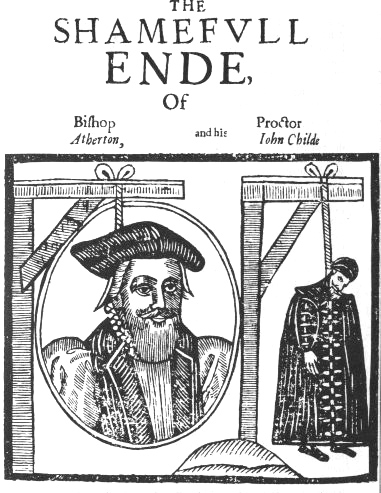
On this date in 1640, John Atherton achieved the unenviable distinction of being the only Anglican bishop hanged for buggery.* (His proctor, and alleged lover, John Childe, got the same treatment a few months later.)


Suppose a Devill from th’infernall Pit,
More Monsterlike, then ere was Devill yet,
Contrary to course, taking a male fiend
To Sodomize with him, such was the mind
Of this Lord Bishop, he did take a Childe
By name, not years, acting a sinne so vilde
-From the text of the pamphlet this image decorates

The Oxford-educated Englishman was appointed Lord Bishop of Waterford and Lismore by King Charles‘s hated governor Thomas Wentworth.

It may well have been the internecine politics of the day that claimed Atherton’s life, just as the civil wars they engendered in the ensuing decades claimed the original trial records.

While posterity is left to speculation, Atherton was defended in print in those years as well. (Defended as no homo, that is — not defended on principle against ubiquitous anti-gay laws.) If it wasn’t really a voracious sexual appetite (not exclusively same-sex**), goes this argument, it was intra-Protestant infighting, with Atherton’s successful clawback of land for the weak Irish Anglican church stepping on the toes of the local land barons who had recently expropriated it.

This politics outside the boudoir argument gets compelling treatment in Mother Leakey and the Bishop, a historical investigative thriller that links Atherton to a weird ghost story† in his native Somerset — that of “Old Mother Leakey,” the Minehead ghost.

Mother Leakey was Atherton’s mother-in-law, and Somerset family members claimed she haunted them — including with a message for the bishop that one of his sisters-in-law actually went to deliver in Ireland. The message isn’t known; in legend, this was a warning from beyond against the prelate’s ungodly behavior; in reality, it was more probably a family shakedown.‡

Despite the skepticism of the Leakey family’s own contemporaries, the facts, allegations, suppositions, and pure flights of fancy somehow managed to blend and recombine into a lasting tale of the paranormal that Minehead still retails to this day.

And it goes right back to the public opprobrium Bishop Atherton endured — as described in that 1641 hanging pamphlet:

“demonstrates the link between the stories of Mother Leakey and Bishop John Atherton … in a highly readable and often entertaining fashion”

… through pride, high fare, and lustfull life,
Incest committed with the Sister of his wife,
For which he sued his pardon, and then fled
To Ireland, where a worser life he led

…

He surely warned was to mend his life,
By his own Sister Master Leakies wife,
Which Master Leakies Mother being dead,
And in her life-time conscious how he led
His lustfull life, her Ghoast in gastful wise
Did oft appeare before her Sisters Eyes,
But she feare-strucken durst not speak unto it,
Till oft appearing forced her to doe it:
Then thus she spake, Mother in Law what cause
You from your rest, to my unrest thus drawes?
Who answered, daughter tis the wicked life
Your Brother leads, warne him to mend his life;
If not, then plainely tell him tis decreed,
He shall be hangd, bid him repent with speede:
Then shall my restless spirit be at rest,
And not till then; Thus vanisht. She addrest
Herselfe for travaile, Into Ireland went
With this sad message unto him was sent:
Which how he tooke to heart may plaine appeare
By the slight answer he returned her,
What must be, shalbe: If I must, I must dye,
Mariage, and hanging, come by destiny.
Thus scoft her counsell, sent her back, and when
Shee was returnd, he grew farre viler then
He was before, if Viler man may be,
For one bad Act before, committed three.

* According to Who’s Who in Gay and Lesbian History, Atherton and Childe were the second pair of alleged homosexual lovers executed in the British Isles. The first was the Earl of Castlehaven in 1631, along with his manservants.

** “[O]ne should note the compound sexual nature of the ‘sodomy’ charge in this context, a portmanteau omnibus of non-procreative sex, which is what ’sodomy’ was widely held to be.”

† Walter Scott footnotes this legend in Rokeby: “Mrs Leakey … dispatched her [daughter-in-law] to an Irish prelate, famous for his crimes and misfortunes, to exhort him to repentance, and to apprize him that otherwise he would be hanged; and how the bishop was satisfied with replying, that if he was born to be hanged, he should not be drowned.”

‡ Archbishop William Laud dispatched a team of ghost-whisperers to investigate the Leakey story well before the ectoplasm hit the fan for Atherton, and they weren’t buying: “certainly it is a fiction and a practice … it may be some money business.” Bishop Atherton had left home under a cloud with the suspicion that he’d had an affair with his wife’s sister, and this was part of the eventual Irish complaint against the horny goat.

On this day..

1896: Fred Behme, evangelical Methodist

On this date in 1896, McLeansboro, Ill. hosted its only hanging.

German emigre Fred Behme was settled into married life when he converted from Catholicism to Methodism.

Unfortunately — so Behme saw it — his wife Mary didn’t hew to the old cuius region, eius religio principle where the man of the house was concerned, and stuck with the bishop of Rome for the salvation of her immortal soul.

And there’s just something about the zeal of a convert.

Fred Behme’s domestic missionary work grew more violent (pdf), and eventually his battered spouse moved out; when Fred coaxed her back, and found out that she’d baptized their infant son into idolatrous Catholicism while living apart from him, he chose Easter Sunday to commit what one newspaper called “one of the most hideous and blood-thirsty crimes that ever stained the good name and honor of McLeansboro”: Fred got the other kids out of the house, he attacked Mary with an axe,

drug her by the hair into the yard, and beat in the side of her head. He covered the body with corn fodder. He then took the little boy [whom Mary had baptized] to the barn and hanged him by the neck until he died. (Source)

Though the hanging was invitation-only, it was visible from McLeansboro’s public square and large crowds gathered to witness the hirsute Protestant check out with a short speech in German.

Wikipedia alleges (without a clear source indication) that one G. Phil Hanna was among this multitude, and that seeing Behme strangle to death on an inexpertly deployed rope launched a lifelong interest in the hangman’s craft that would culminate when Hanna pinch-hit on the execution team that carried out America’s last public hanging 40 years later. Others of less august accomplishment no less vividly recalled their (and their town’s) one-time walk through the valley of death.


The family that prays together … (The perp is the bearded man; the victims are the woman seated next to him, and the child in her lap.)

On this day..