2003: Paul Hill, anti-abortion martyr

Five years ago today, minister Paul Hill was put to death by lethal injection for murdering an abortion provider and a clinic escort nine years before.

Hill rose to prominence in the early 1990’s as a fire-eating abortion foe, who openly preached the righteousness of defending unborn life by force — a divisive position among anti-abortion activists that got him excommunicated from the Presbyterian church.

On July 29, 1994, in the abortion conflict’s ground-zero of Pensacola, Fla., Hill put his theology into action by gunning down Dr. John Britton and his septuagenarian escort, along with Britton’s wife (who survived the shooting).

Creepy. It sure looks like the song and image pairings were done in earnest, not in irony.

He never betrayed the least scruple about his act, hoping only to use his trial to present a “justifiable homicide” defense; the judge’s suppression of this line was and remains a grievance of Hill’s fellow-travelers against the judiciary.

Nor did Hill betray the least concern to die for his beliefs; if anything, in dropping appeals that would at the least have prolonged his life, he cut a figure thirsty for the martyrdom he attained this day.

To what end?

Hill left a plentiful documentary record — like this manifesto, among the pro-Hill documents collected on the Army of God website:

I knew that [killing an abortion provider] would uphold the truths of the gospel at the precise point of Satan’s current attack (the abortionist’s knife). While most Christians firmly profess the duty to defend born children with force (which is not yet being disputed by the government) most of these professors have neglected the duty to similarly defend the unborn. They are steady all along the battleline except at the point where the enemy has broken through. I was certain that if I took my stand at this point, others would join with me, and the Lord would eventually bring about a great victory.

One can question whether this proved to be the case or not. The infamy (in most circles) of the killing arguably dampened enthusiasm for the cause, at least as measured by the sulfur level on clinic sidewalks. At the same time, Hill’s was only the most spectacular instance of a campaign to terrorize abortion providers that drove many out of business and made some areas of the country virtual abortion-free zones.

Whatever may have surprised him about the way the issue played out over the 1990’s, he was serene about his choices when interviewed the day before his execution.

To some in the movement, he’s a holy martyr, the John Brown of slavery’s modern-day parallel.

And even if Paul Hill’s name is taboo in the respectable public discourse of abortion today, with four relatively young rock-ribbed anti-Roe v. Wade votes now entrenched at the Supreme Court, it’s far from obvious that Hill won’t get what he was after all along … even if he didn’t live to see it.

Part of the Themed Set: Judging Abortion.

On this day..

1724: Half-Hangit Maggie Dickson

Allegedly on this date in 1724, a young woman was hanged at Edinburgh’s Grassmarket for concealing her pregnancy.

Any number of details in this horrible/wonderful story are shaky, including the date: some sources make it 1728, a few say 1723, and only a handful attest a specific calendar date. Nobody seems to doubt the tale in the main, however — and it’s certainly excellent enough lore to deserve even a heavily asterisked entry.

Deserted by her husband, young Maggie Dickson took lodgings at an inn in exchange for work, and became pregnant by either the innkeeper or his son. (Again — details in the various sources available read like a game of telephone.) Since single* pregnant working-class women had about as many employment options as birth control options, Maggie kept quiet about her condition in the interest of keeping her job.

And since male parliamentarians figured their job was to keep young lasses of loose character and modest means on the straight and narrow by criminalizing their options, Maggie’s sleight-of-womb put her in violation of a law against concealing a pregnancy. (The same situation was playing out elsewhere in the British sphere at this time.)

When the resulting infant turned up dead, the trail led straight to Dickson … but the concealment of the pregnancy and birth were capital crimes on their own, making it immaterial whether it had been a miscarried pregnancy, an act of infanticide, or simply one of the many early 18th century babies to die in the cradle. The law was an indiscriminate instrument to prevent women terminating their pregnancies.

Nothing noteworthy about the hanging itself is recorded; it seems to have been one of the routine public stranglings of the age, and even the scuffle over the body between family and medical students hunting dissection-ready cadavers was a normal occurrence.

The family won. And en route to Musselburgh for burial, Maggie started banging on the inside of the coffin, and was forthwith revived. Officials decided the sentence of hanging had already been carried out … and her awestruck neighbors suddenly started seeing Maggie sympathetically

And they all lived happily ever after. This day’s principal, at any rate, gained a foothold in adequate prosperity, bore more children, and answered to the nickname “Half-Hangit Maggie Dickson” all the many more years of her life.

The story passed into legend; the dates, as we’ve alluded, fuzzed. One entrepreneurial English broadside publisher of the 19th century even transported the affair to February 1, 1813 — four years after a Concealment of Pregnancy Act reduced the penalty for Maggie Dickson’s “crime” to penal servitude. And near the site of the not-quite-Passion, should you call sometime in Edinburgh, you can raise Half-Hangit Maggie a pint at Maggie Dickson’s Pub.

I’le crye as fu’ o’ tears an egg,
‘Death, I’ve ae favour for to begg,
That ye wad only ge a flegg,
And spare my life,
As I did to ill hanged Megg,
That graceless wife

-Broadside, ‘The last speech and dying words of John Dalgleish, Hangman of Edinburgh’

* Technically, she was still married but separated.

Part of the Themed Set: Judging Abortion.

On this day..

1538: Cratwell, a hangman

This yere, the first daye of September, beinge Sondaye, at Clerkenwell, where the wrestlinge is kept, after the wrestlinge was done, there was hanged on a payre of gallowes, newe made, in the same place, the hangman of London and two more for robbinge a bouth in Bartlemewe fayre, which sayd hangman had done execution in London since the Holy Mayde of Kent was hanged, and was a conninge butcher in quarteringe of men.

A Chronicle of England During the Reigns of the Tudors, from A.D. 1485 to 1559

On this day..

1593: Pierre Barrière, undeterringly

On this date in 1593, a would-be assassin of France’s King Henri IV was broken on the wheel.

An Orleans boatman turned Catholic League soldier in France’s internecine Catholic-Huguenot wars, he was among the numerous Catholics who looked askance at victorious Huguenot Henri IV‘s expeditious conversion to Catholicism.

In the months while Henri IV still held Paris under siege, the Jesuit father Jacques Commolet had called for his assassination from the pulpit. The Bourbon’s (nominal) switch to Catholicism with the words “Paris is worth a mass” had not persuaded hard-core Catholic partisans of the king’s sincerity.

Henri was a practical guy. And with civil slaughter afoot for most of the late 16th century, he took a dim view to loose talk about assassinations, especially his.

The safety of the king’s person was a paramount consideration of magistrates during this period. Thirty years of political assassinations during which the rule of law proved largely ineffective in bringing the guilty to justice had ultimately left a fundamental law of France, the inviolability of the king’s person, subverted. Magistrates … focused their attention on re-establishing the enforcement of this law …

Pierre Barriere was nabbed for planning to subvert that inviolability — arrested August 27, tried August 30, horribly broken on the wheel August 31.

Henri would keep the throne 17 more years, laying the basis for French absolutism. But continual assassination bids — nearly 20 documented — would pursue him throughout his reign … until one finally got him.

On this day..

1850: Prof. John Webster, for the timeless conflict between donors and academics

On this date in 1850, a 57-year-old Harvard professor expiated upon a gallows at Boston’s Leverett Square the murder of one of the university’s donors.

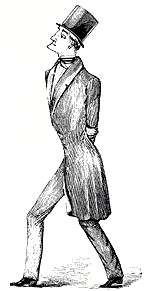
The buzz of Boston in 1849-50, the Parkman-Webster murder case began with the disappearance of one of the crimson’s great benefactors, George Parkman, a Boston Brahmin known for his Ministry of Silly Walks gait about town (see right). According to Oliver Wendell Holmes, Sr. (who appeared as a witness at the trial of Parkman’s accused murderer), “he abstained while others indulged, he walked while others rode, he worked while others slept.”

Also, he inherited a ridiculous sum of money, and was tight with the debtors to whom he lent it.

Back before collection agencies, Parkman disappeared in November 1849 while making the rounds to shake down his borrowers. Within days, suspicion settled on Harvard anatomy and geology professor John Webster, who had squandered his own pile of money buying rock collections and maintaining appearances and such, and sank into desperate hock to the jutting-chinned ambulator who had helped him land the Ivy League appointment in the first place.

A weighty circumstantial case soon formed against Webster, with the invaluable aid of a snoopy janitor who turned up human remains in the office and testified to incriminating-sounding conversations.

Elites-on-elite crime epidemics always churn the scandal mills. Henry Wadsworth Longfellow’s wife Fanny wrote a friend,

You will see by the papers what dark horror overshadows us like an eclipse. Of course we cannot believe Dr. Webster guilty, bad as the evidence looks. … Many suspect the janitor, who is known to be a bad man and to have wished for the reward offered for Dr. Parkman’s body. … I trust our minds will be soon relieved, but, meanwhile, they are soiled by new details continually.

“Harvard professors do not often commit murder,” or so they say. (This was still a century before Robert McNamara.)

Boston high society was about to see a whole different side of Harvard.

Although perhaps individually explicable — anatomists had plausible reasons to have human remains at work, and other anatomists than Webster could have had access to his office — the cumulative weight of Webster’s ham-handed attempts to declare that he had paid up his debts to Parkman just before the latter’s mysterious disappearance, of the discovery of what (disputed) dental forensics declared to be Parkman’s dentures, of the ghastly appearance of a torso (disputedly) declared to be Parkman’s stuffed in a tea chest at Webster’s offices started to really make the man look guilty.

In view of a mediocre defense, the jury convicted Webster of whacking his own professional benefactor, in the university building erected on said benefactor’s donated plot of land.

Talk about donor recognition.

While the prof’s seeming post-conviction acceptance of guilt — in a plain strategem to secure clemency — and generally shifty demeanor have cemented him as the definitive perpetrator in the standard historical reading,* Fanny’s snobbish take on the “bad man,” janitor (and moonlight body-snatcher) Ephraim Littlefield, has not been entirely lost to the tradition.

At the end of the day, everything about the case is circumstantial — indeed, besides being historically noteworthy for the first use of dental forensic evidence in a murder trial (forensics we might find rather speculative and unconvincing today), Webster’s case generated a landmark ruling from the judge’s jury instruction establishing “reasonable doubt” as the threshold for criminal conviction rather than the “absolute certainty” Webster’s prosecutors had no hope of attaining; that ruling influences American jurisprudence down to the present day.

And one cannot but notice how many of the circumstances — creepily playing Sherlock Holmes with a freelance dig into the professor’s furnace to discover charred bones, for instance — were provided by the fellow-suspect-turned-star-witness Littlefield, who niftily reaped the $3,000 reward for his offices in substituting Webster for himself under the pall of suspicion.

According to peripatetic crime blogger Laura James, a forthcoming (2009) book promises to revisit the sensational trial, “to examine all the intricacies for ourselves — not aided by the eager voice of the janitor.”

* Bemis, one of the prosecutors, wrote the go-to source on the Webster trial, available from Google Books; another contemporaneous account is here.

On this day..

1966: Sayyid Qutb

On this date in 1966, author and intellectual Sayyid Qutb was hanged for plotting to overthrow the Egyptian state.

Qutb — whose names can be transliterated many ways (Saïd, Syed, Seyyid, Sayid, or Sayed; Koteb, Kotb, Qutub or Kutb) — was one of the most influential Islamist thinkers of the 20th century, and helped shape the ideas of Osama bin Laden.

A traditionally-minded Muslim civil servant in a westernizing Egypt, Qutb’s journey to radicalism is traditionally dated to his late 1940’s study abroad in the U.S. at what is now the University of Northern Colorado, where the decadence, materialism, and lax morality of the global hegemon saw him seeing existential evil in the everyday all around him:

The American girl is well acquainted with her body’s seductive capacity. She knows it lies in the face, and in expressive eyes, and thirsty lips. She knows seductiveness lies in the round breasts, the full buttocks, and in the shapely thighs, sleek legs — and she shows all this and does not hide it.

Qutb left Greeley, Colo., in 1950 with a master’s degree and an intention to mount an Islamic revolution in his home country that would implement sharia and keep shapely thighs safely under wraps. (Qutb never married, bemoaning the scanty pickings of pure fish in the sea. He may have faced the gallows a virgin.)

He hooked up with the outlawed Muslim Brotherhood, landed in Egypt’s famously savage prisons (future president Anwar Sadat was one of his judges), and the experience of torture hardened his commitment to a vanguard-led revolution. He kept up his prolific writing output, penning perhaps his most notable work, Milestones (the text was later used against him at his capital trial).

Qutb’s release in 1964 was only for a few months, before Egyptian security got wind of a new Muslim Brotherhood plot to overthrow the government and rounded up Qutb as the supposed ringleader — or just railroaded him because it didn’t like where he was going with passages like

there are many practical obstacles in establishing God’s rule on earth, such as the power of the state, the social system and traditions and, in general, the whole human environment. Islam uses force only to remove these obstacles so that there may not remain any wall between Islam and individual human beings.

With the benefit of hindsight, one can readily imagine that his martyr’s death did not squelch his movement, but greatened his stature to admiring eyes.

But it was hardly a direct path into an un-critiqued hall of martyrs in an undifferentiated “radical Islam”. While Qutb had his own influence in Egypt, Cairo has managed to keep the lid on the Muslim Brotherhood. Qutbism, however, was exported to Saudi Arabia — which intentionally imported it for various practical and geopolitical reasons — where it flourished, often in a fractious relationship with official Saudi Wahhabism.

One of Qutb’s students was the uncle of Ayman al-Zawahiri, and the hanged intellectual greatly influenced Zawahiri’s own path into radicalism and to al-Qaeda. Since September 11, of course, the path Qutb himself followed has become of much more pressing interest to the West as well as within the Muslim world.

Some noteworthy works by Sayyid Qutb

On this day..

1807: James McLean, twice

On this date in 1807, James McLean survived one hanging but not a second at Batavia, N.Y.

Subject of the first public execution in Genesee County, the drunken Scottish immigrant had axed to death a fellow squatter in an argument … and then a second man who ran to his victim’s aid … and then almost a third who was saved by flight.

This minor execution is the subject of an extensive historical inquiry* by a descendant of one of the victims full of period color: the defendant claiming the (then-recognized) right to a jury consisting of half non-citizen aliens as a “jury of his peers”; the billing receipts for the manhunt and the gallows construction (including gallons of brandy for the guards); and the indeterminate legends about what happened when the rope broke the first time.

The story has been told and retold that during the hanging the rope broke and McLean fell to the ground, shaken and stunned but alive. While another rope was being secured, McLean was reputed to remark, “As I killed two men, I deserve two hangings.” Another version has McLean protesting a second hanging since he had been convicted of only the one murder and had already been hung for that.

However, a historian’s recounting of the era’s newspaper accounts claims

that when the weight fell, the rope broke and McClean fell to the ground. He soon recovered from the shock and rising to his feet, expressed a strong desire not to be “hung again.” Some insisted that one hanging was a fulfillment of the law. Others, however, thought differently and informed McClean that “as he had killed two men, he ought to be hung twice.”

* The writer’s use of “gibbet” to mean an apparatus for a “sudden suspension” hanging, where the prisoner is not dropped but jerked into the air by a countervailing weight, is non-standard; “gibbet” means a gallows (or certain types of gallows structures, if you’re persnickety about it), and became a verb signifying the salutary posthumous display upon such a structure of an executed prisoner’s remains.

On this day..

1979: Eleven by a Firing Squad in Iran

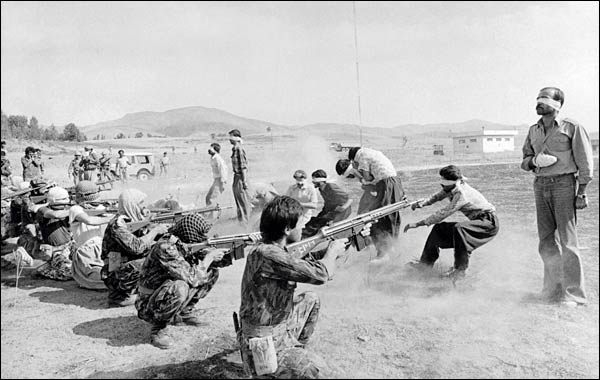
On this date in 1979, the only anonymous photograph to win a Pulitzer Prize captured nine Kurdish rebels and two of the Shah’s policemen executed by firing squad in revolutionary Iran.

This shot, one of a series taken of the event with the permission of the judge who condemned the men to immediate death in a half-hour trial at the Sanandaj airfield, ran the next day in the Iranian paper Ettela’at, whose editor prudently kept the photographer’s identity secret. Within two days, the stunning photo had rocketed around the world.

It won the Pulitzer Prize for Spot News Photography the following spring, still credited anonymously.

Two years ago, the Wall Street Journal revealed — with the photographer’s permission — the identity of the man who shot this indelible image: Jahangir Razmi, who had gone on to a career as one of Iran’s top photographic journalists. He came to New York to collect the prize 27 years late.

The article breaking the story is still available on the Journal‘s website, and on the personal site of reporter Joshua Prager. An NPR story discussing the search for Razmi’s identity is here.

On this day..

1945: John Birch, Society man

On this date in 1945, according to a fringe faction of American conservatism, the first victim of the Cold War was shot by Chinese Communists at Suchow, China, near Xi’an.

John Birch, a military chaplain proselytizing in China and an agent of the CIA’s precursor entity Office of Strategic Services, had the kind of portfolio sure to rub Mao’s boys the wrong way.

Apparently it was his personality that got him into trouble.

On recon duty days after the end of World War II, he bumped into a patrol of Red Chinese. According to Time, he failed his diplomacy check.

As the scene has been reconstructed, Birch argued violently with the Communist officer who wanted to disarm him. Birch was seized and shot after his hands had been tied. The Communists then bayoneted him at least 15 times and tossed his body on a heap of junk and garbage.

“In the confusing situation,” said [Birch’s commanding officer Major Gustav] Krause last week, “my instructions were to act with diplomacy. Birch made the Communist lieutenant lose face before his own men. Militarily, John Birch brought about his own death.”

Days after World War II — how does that square with your international Communist conspiracy? The incident was not especially notable at the time, but some elements later conceived John Birch the first American casualty of Communism during the Cold War, and in this guise he became the namesake of the John Birch Society (Wikipedia entry | homepage — evidently forward-thinking enough to have grabbed their own three-letter acronym)

Here’s candy magnate and founder Robert Welch, Jr., explaining:

Despite the young lieutenant’s credentials as a martyr of evangelical anti-Communism, the oft-loopy Society’s relationship to the mainstream conservative movement and the Republican Party it took over was never completely comfortable and eventually came to a definite sundering.

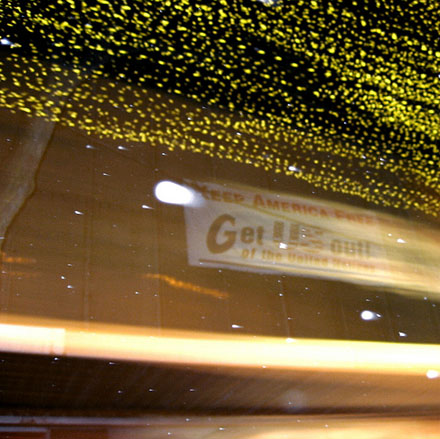
The Society soldiers on, its “Get US out of the United Nations” billboards a minor fixture of Americana from Port Angeles, Washington to this one in Ypsilanti, Michigan.

On this day..

1993: Ruben Cantu, an innocent child?

On this date in 1993, Texas gave a lethal injection to a young man for murder — a crime many involved in the case no longer believe he committed, since the sole witness against him has recanted.

Ruben Cantu was only 17 years old at the time of the crime, and for that reason would not be eligible for execution today. But according to a Houston Chronicle investigation (the story is also mirrored here) 12 years after his death, he shouldn’t have been eligible then because he might not have done it. Cantu himself may have kept a street code of silence to his death.

Lise Olsen — interviewed by NPR here — blew up the case; Cantu’s jury forewoman and the district attorney who tried him for his life are among those who have publicly regretted their roles in what has emerged one of the most compelling cases of an executed innocent in the modern American death penalty era. Nobody could possibly have predicted that pitiable public defender resources and an extremely aggressive capital punishment regime could result in such a thing.

The subsequent (and still current) Bexar County District Attorney checked it out (threatening to prosecute the recanting witness) and declared everything proper. So don’t worry about it. What could she possibly have to gain from a whitewash?

On this day..