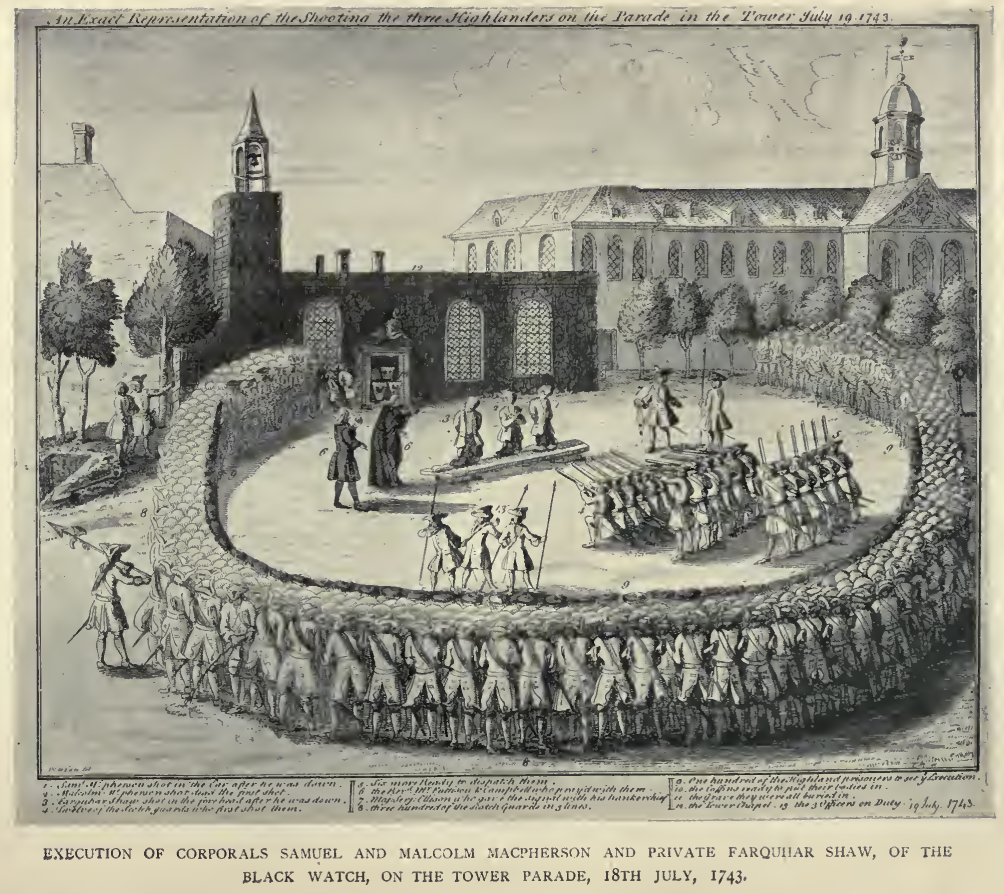
1743: The Black Watch mutineers

On this date in 1743, three leaders of the Scottish “Black Watch” were shot in the Tower of London for mutiny.

The recruits of the 43rd Highland Regiment of Foot* had been assured that their service would remain in-country only, and given that there was continental war raging at the time this was valuable assurance indeed — or would have been, if not for the propensity of military recruiters to lie wantonly.

The Black Watch were inveigled to London on the premise that they were to be reviewed by His Majesty King George II.

Once there, they caught wind of an actual or rumored plan to ship them on to the continent … or worse, to swelter in the West Indies. About a hundred of their number upped sticks and set off back for native hearth and heather. Alas for them, they were intercepted by General George Wade** and returned to London for court-martial as mutineers. Save for three perceived ringleaders, Corporals Malcolm McPherson and Samuel McPherson, and private Farqhuar Shaw, who were shot in the Tower, the rest had sentences commuted … to punitive overseas deployments from Gibraltar to the aforementioned dreaded West Indies.

As for the remaining, un-deserted corps of the regiment? It got shipped off to Flanders, just as it feared.

* Later renumbered as the 42nd Regiment — hence this musical tribute to the “Forty Twa'”:

** Wade’s renown in defeating the imminent Jacobite rebellion of 1745 would earn him tribute in an impolitic stanza of “God Save the King” that is rarely performed.

Lord, grant that Marshal Wade
May, by thy mighty aid,
Victory bring.
May he sedition hush
And, like a torrent, rush
Rebellious Scots to crush.
God save the King.

On this day..

1931: Charles Simpson, “make it snappy”

(Thanks to Robert Elder of Last Words of the Executed — the blog, and the book — for the guest post. This post originally appeared on the Last Words blog. Fans of this here site are highly likely to enjoy following Elder’s own pithy, almanac-style collection of last words on the scaffold. -ed.)

Make it snappy.

— Charles H. Simpson, convicted of murder, hanging, California. Executed July 17, 1931

Known as “the Torch Slayer,” Simpson was already a convicted car thief and burglar when he entered Albina Voorhies’s grocery store. Simpson had known Voorhies because she rented the building from his father. Recognizing him, Voorhies turned her back to get him some cookies. That’s when Simpson struck her in the back of the head with a police club. Simpson eventually tied her to a chair, hit her again, and poured coal oil on her clothes, which he then set on fire. Simpson’s nerve faltered — he tried to take Voorhies to the bathroom to put the fire out — but by then the fire had spread. Panicking, Simpson left her in the store to bury the club and burn the clothes he wore.

Simpson could give no reason for his actions other than robbery. He had taken three dollars from the cash register.

On this day..

1860: George Waines, forensically boned

From the Melbourne Argus of 14 July 1860:


The case of the convict [George] Waines appears to excite considerable interest in the public mind, especially since it has become known through our columns that he made a confession which had not previously been made public. We are now in a position to place before our readers the confession of the wretched man, and also the fact that his death-warrant has reached the sheriff, to be carried into execution on Monday next. [Monday, July 16, 1860 -ed.]

Upon a careful perusal of the confession, it will be found that the prisoner’s version of the whole circumstances connected with the crime would, if true, very materially alter the character of the offence for which he is condemned to die. It will be remembered that the hypothesis presented to the jury was that the prisoner went to the house of the Hunts, and in cold blood murdered them in order to escape a pecuniary liability. [Waines owed them 50 quid. -ed.]

His confession now made, under sentence of death, would show a state of things so entirely different, that had he revealed the facts in the first instance, the probabilities are, although in strictness of law the act might have amounted to legal murder, a jury would have been inclined to find a verdict of the lesser crime of manslaughter, or, at all events, that the Executive would mitigate the punishment to that of the minor offence. It is remarkable also that, although Waines admitted to several persons the fact of his having murdered the Hunts, the circumstances attending the commission of the crime were never clearly elicited until his present confession; and, indeed, as, far as they were elicited, a reference to the evidence would go to show that the deed was perpetrated under the smart of an imputation cast upon his wife.

The second point on which the confession, if true, would affect his case, is as to the identity of the bones of Mary Hunt. According to his statement, it would appear that every vestige of the remains of that unfortunate woman was destroyed before he exhumed the body of her husband, thereby showing that the medical testimony was wholly at fault in convicting him of the murder of Mary Hunt. With regard to this last point the convict is most anxious that the fact should, before — or even after — his execution be investigated; and certainly with regard to the science of medical jurisprudence, it is most desirable that such a course should be adopted, even with a view of proving whether or no the conviction is not a wrongful one. In the administration of criminal justice the slightest irregularity has frequently been held sufficient to warrant a commutation of punishment. A remarkable instance of this is on record where a learned judge, in sentencing a man to death, omitted to direct that he should be buried within the precincts of the gaol, the consequence of which omission was that the prisoner was set at large.

The convict, by his confession, offers to state what “he did with the bones of Mary Hunt,” on receiving an assurance that the bones which were deposed to as being hers should be subjected either before or after his death to surgical examination.

At the interview with which Waines was favoured the wretched man made the following extraordinary and startling statement. He confessed to having murdered both the man and wife in the manner detailed in his written statement, and that he buried them as therein mentioned. After a lapse of eight months, finding that inquiries were being made about the Hunts, he, understanding that he could not be found guilty if the remains were not identified, proceeded to disinter the bodies, with the intention of burning them to ashes. The night which he chose for this purpose happened to be bright moonlight, and his description of the dreadful scene is horrific in the extreme. His mind had been for a considerable period in a dreadful state, and at midnight he proceeded to his revolting task. He first disinterred the body of Mary Hunt, which he describes as being in a state of decomposition, with the rotten clothes clinging to the bones. On that lovely night he lighted a fire, and putting the ghastly remains on it, burned every vestige to ashes.

After having done so he found one piece of bone, a few inches in length, which, in his desire to destroy every trace of the unfortunate woman, he took up and pulverised with his hands.

The prisoner states that, having so destroyed every trace of the wife, he next proceeded to exhume the body of the husband, with the intention of destroying it in like manner. He so far succeeded in his horrid purpose as to disinter the body, when he became on that lovely moonlight night so perfectly horror-stricken, that he says he was wholly unable to proceed with his terrible work. He states that then, finding himself so perfectly unnerved, he hurriedly gathered the bones together, put them in a sack, and, rushing to the banks of the river, threw them into a waterhole. At this time the moon shone out brightly, and the wretched man states that, standing on the banks for a few minutes, he saw the sack with its ghastly contents rise to the surface. Horror-stricken as he was, he pulled it ashore, and filling the sack with earth and stones, finally sunk it. He admits that when in prison he made the confession to Brown, the detective, which led to his conviction; but it certainly is now a serious question whether, if this confession be true, a conviction of this kind ought to be confirmed, seeing the frightful consequences that might ensue from persons being found guilty of murder without clear proof of the corpus delicti.

In this case Waines was, on the surgical evidence that the bones were those of a white woman, convicted of the murder of Mary Hunt. If his confession be true — and under the circumstances there can scarcely be any reason for doubting it — the bones were those of a man, and although he confesses to the crime, it is not difficult to perceive how easily an innocent man might be convicted on similar testimony.

The following is the confession, as stated in the letter of Waines to his counsel:

Melbourne Gaol, July 8.

As a poor unfortunate prisoner now under sentence of death, which sentence I believe to be irrevocably fixed, I hope you will pardon me for taking the liberty of writing to you. I wish to inform you that, before I die, I have got what I think a duty to perform, likewise a request to make; and to show you that it is what I think as much a duty as a favour, I confess at once that I am guilty of the murder of Mary Hunt but not wilfully, as Brown stated in court. At the same time, I do not feel justified in doing it; but I hope, by a deep repentance and sorrow for my past conduct, and by faith in Jesus Christ, who died to save sinners, of whom I am chief, that the Lord will pardon my sins. It was not done for the money; I had no call to do it for that; it was done for Mrs. Hunt calling my wife a b—- w—-. After I had paid Hunt all that was due to him, he asked me if I would let them have the hut to live in for a fortnight. I told him I could not, as I had got a married couple coming the next day, and they would want to live in it. With that Mrs. Hunt spoke up, and said, “That’s the doings of that b—- w—- at the Wannon. She knows that I want to stop in the hut until you come from Portland.” When she said that, I was just going to the wood-heap with the axe in my hand, and I struck her over the head, and she fell. Hunt was at the wood-heap at the same time, and took up a lump of wood, and ran at me to strike me, and I struck him instead; and that is the way they carne by their death, which I was very sorry for; but I could not call back what was done. I thought once of confessing it; but I afterwards turned afraid of it, thinking I might be blamed and executed for it, as though I had done it wilfully. I afterwards buried them in separate places, for eight months. I then took the body of Hunt, and put it in the river. I never cut it up. The bones came separate when I took them out from where I buried them. As for Mary Hunt’s body, I can call God to be my witness that there never was a bone of Mary Hunt’s in the river, nor yet before the coroner’s jury. And I can say with truth, that had the witnesses sworn nothing but the truth, although I was guilty, neither judge nor jury would have found me so. I do not say this to screen myself; if I did, I should not plead guilty. The doctors not being so clever as they profess to be, and knowing they must pronounce it to be one of the two, they pronounced it to be that of a female, which I can call God to be my witness that there is not one female bone among them. I will make a full confession to the public, with the hope that it may be a warning to some one who may not have sufficient guard over his temper as was the case with myself. I think it my duty, and my request is, to beg of the Government to have the bones brought to Melbourne, which, if they would, I know they have got the means of proving what they are, and I am as certain as I am of my death that there is not one female bone among them. If the Government will do that, I will then tell them where Mary Hunt’s body is. My conscience tells me that it is quite as equal a duty of the Government to have the bones tested as what it is of me to make a confession. The expense would be very little, and time very short; and although I be guilty, it might be the means of saving some one that was innocent at some future time, by being a caution to Government how careful they ought to be, in a case of life and death, in taking a doctor’s evidence, by giving a random guess at a thing I am certain they do not understand. I have no doubt but they will try to keep the Government from doing it on account of their own credit. If the Government will not do it on account of delaying my execution — if they will only promise me to do it after I am dead, and bring the same to the eyes of the public, I will then tell them before I die what I did with Mary Hunt’s bones. I am convicted of my own confession [Waines was entrapped by a detective who posed as a fellow-prisoner and elicited his admission -ed.], and I think it ought to be proved, which it might have been if they had taken my words for it. When they pronounced it to be a female, at the first I told them it was not, and the evidence of Chaffe will show it. He swears that I told him it was that of a man — and that I can swear, and swear the truth, till the last moment I have to live. What I said with reference to Hunt’s going away, it was quite natural I should say to clear myself if I could. But what I say now the Government, if they wish, can prove to be the truth; and if they will, I think they might still have mercy on me, and save my life, when they prove the truth of my statement and the doctor’s error. Even if they do not save my life, it will be some satisfaction for them to know that the doctors were wrong. If I were not certain that they are, I would not say so. I know the doctors in Melbourne can prove it; and, therefore, I should only be keeping myself longer in suspense, which would be worse than death. As to other charges which have appeared in the papers, I can only say, with a clear conscience to my last moment, they are all lies, raised by my enemies with the hope, in my opinion, of poisoning the mind of the Government, from fear that I should have a chance of escape by the point of law which was reserved. I was never charged with anything in my life before of which I need fear anyone knowing. I hope the Government, after convicting me by my own statement, will feel it their duty to prove my statement thoroughly correct, when they have got the means of doing it so easily; and if they do, I call God to be my witness, they will find what I have stated to be the truth.

GEORGE WAINES.


Sir, I am quite satisfied that you have done all you possibly could in defending my cause and trying to save my life, although you were unable to do so. For what you have done, may the Lord bless you!

I think, sir, if you would be so kind as to ether see or petition His Excellency the Governor, he might grant my request, and have the remains of the body brought to Melbourne. If he would, I call God to be my witness that they will find them to be as I have stated. If you will do so, I am quite certain that whatever extra charge you make for your trouble, either Mr. Scott or my poor wife will pay you, whether you save my life or not. I admit the sentence is just as regards my guilt, but I think, as regards the law, my life ought to be spared. I think it quite unreasonable to execute a prisoner for the murder of a woman on the evidence of the body of a man, which man I was not tried for. Had they tried me for the murder of the man instead of the woman, I should never have written this.

Sir, – will you please to let me have an answer to this,

Your obedient servant,

GEORGE WAINES.

On this day..

1928: Seven electrocuted in Kentucky

On this date in 1928 — Friday the 13th — the Bluegrass State tied a terrible record that still stands to this day by sending seven men to the electric chair on a single day. (New York, the electric chair pioneer, had carried out a sevenfold electrocution in 1912.)

The prolific history writer/blogger Mike Dash fielded a Reddit question with some detail about this event, here; Dash notes that Kentucky habitually carried out (smaller) multiple-execution batches during this period, likely for reasons of administrative convenience moreso than record-hunting.

For additional particulars, we excerpt a summary of their cases from the Owensboro (Kentucky) Messenger of the same date.

Milford Lawson

Milford Lawson was convicted in the Whitley circuit court at Corbin, in 1926, for the killing of John Stansberry. Stansberry, who lived with his wife and daughter on Main street in Corbin was awakened by an alarm at his door at midnight. He was shot to death by Lawson when he opened the door to answer the alarm. The sixteen year old daughter of Stansberry witnessed the shooting. Stansberry was killed instantly.

Orlando Seymour

Orlando Seymour was indicted jointly with William Huddleston for the killing of Will Schanzenbacher in Louisville. Huddleston was given a life sentence and Seymour, who actually did the killing, was given a death sentence. Mr. Schanzenbacher had charge of a coal yard in Louisville. It was known to the two defendants that he was in the habit of carrying the receipts of each day home with him in the afternoon in a tin box. Huddleston and Seymour planned to hold him up and rob him. It fell to the lot of Seymour to do the actual holding up, while Huddleston waited in the car. When demanded by Seymour to give up his money, Mr. Schanzenbacher, instead of acceding to his demands, started to run away and was shot down by Seymour.

Hasque Dockery

Hasque Dockery was tried in the Harlan circuit court in 1926 and given the death penalty for killing Mrs. Elizabeth Howard. Dockery was guilty of a triple murder, having killed Mrs. Howard, Joe Jenkins and Mrs. Jenkins at the same time. He appears to have been estranged from his wife, who was living with Bradley Howard and his wife and the Jenkins family. It appears that Dockery went to that house on the night of the killing search for his wife and without provacation [sic] shot and killed Mrs. Howard, Joe Jenkins and his wife. Charles Howard, a young boy, escaped only by running. Dockery also fired one shot at him.

Charles P. Miltra

Charles P. Miltra was indicted jointly with Carl Hord in the Jefferson circuit court for the murder of Marion A. George in 1926. George opera[t]ed a grocery store at First and Magazine streets in Louisville. This murder was committed in pursuit of a plan which the two defendants had entered into to rob Mr. George. It was agreed that Hord should go into the store and call for cigarettes and that Miltra was to follow, and while Mr. George was getting the cigarettes he was to cover him with the pistol and demand the money. That part of the program was carried out, but Mr. George grabbed a meat cleaver and struck Miltra with it. Miltra then fired two shots, the first missing George but the second piercing his abdomen. Miltra escaped and went to St. Louis where he was arrested a few days after the tragedy and upon his return to Louisville made a voluntary confession. The peculiar defense was interposed for Miltra, that he should not be held responsible for the shooting of George because he was rendered unconscious by the lick which George inflicted upon him with the meat cleaver and did not know that [sic] he was doing when he shot Mr. George. This contention, however, was overruled by the court on the idea that malice is not necessarily confined to specific intention to take the life of the person killed, but it may include an intention to do an unlawful act whose result will probaably [sic] deprive another person’s life.

James Howard

James Howard, negro, was given the extreme penalty in the Jefferson circuit court for the murder of his common law wife, Lucy Buckner. He stabbed his victim to death with a knife. This killing took place April 17, 1926. It is disclosed by the evidence that Howard ran his victim down and stabbed her to death while she was trying to escape from him. Howard was jealous of another negro, which appears to have incited the killing.

Clarence McQueen

Clarence McQueen, negro, was indicted in the Harrison circuit court and given the death penalty for the murder of Louis Williams, another negro. McQueen is a negro about forty years of age. He and Williams were neighbors and had been friends for a long time. On April 25, 1927, while under the influence of liquor, McQueen, who had a shotgun, came upon Williams on the river bank where they became involved in a difficulty and McQueen shot Williams to death. He then escaped and was not apprehended until September, 1927, when he was returned to Cynthiana and placed on trial.

William Moore

William Moore, negro, was indicted and tried in the Jefferson [… omitted text …] Anna Eslick, who appears to have been his sweetheart, and who was the wife of another negro. This killing took place in the absence of any eye witness, but while the evidence against Moore was largely circumstantial, at the same time it was practically conclusive that Moore killed the woman, by beating her to death with a beer bottle.

The state of Georgia supplemented the day’s grim toll with a “mere” double electrocution of Sam Gower and Preddis Taylor, while two men more, Will Burdo and Greene Kirk, hanged in separate executions by two Mississippi counties.

On this day..

1391: Amerigot Marcel, cast down

(Thanks to medieval scribbler Jean Froissart for the guest post, an episode narrated in his famous chronicle. -ed.)

During the time of the assembling of this body of men-at-arms in France, for an expedition to extend the Christian faith, and gain renown, there were other men-at-arms wholly given up to plunder in Limousin, Auvergne, and Rouergue, who, in spite of the truce [pausing the Hundred Years’ War], were continually doing mischief to the countries which thought themselves in security.

The King of France had caused the truce to be publicly notified to the captains of the freebooters, particularly to Perrot le Béarnois, governor of Chaluçet, Amerigot Marcel, and others, who were publicly named in the act, and were assured that if the truce were in the smallest degree infringed, those guilty of it should be corporally punished, without hope of mercy. Some of the captains, fearful of a disgraceful death, or of incurring the king’s indignation, kept the peace very well; others did not, for which they paid severely, as you will hear in the continuation of this history. You have before heard it related in these chronicles, indited and arranged by me, Sir John Froissart, treasurer and canon of Chimay, how peace had been agreed upon with many of the captains of castles in Auvergne and other places, by the mediation of John, Count d’Armagnac, and the Dauphin of Auvergne, to whom they had surrendered their castles for different sums of money; and that they had undertaken to accompany the count to Lombardy, or whithersoever he might lead them.

Count d’Armagnac and the dauphin had laboured hard to gain over these captains, and the country had submitted to be heavily taxed in order to get rid of them: however, Amerigot Marcel and his garrison still continued to do much mischief, and could not be induced to join the count.

Fond of plundering, he resolved to continue it, and having a desire to gain possession of a strong fort called La Roche de Vendais, he and his companions set out thither, and when they had gained the place fortified it, and made it as strong as they could. This done, they began to overrun the neighbouring country — to make prisoners and ransom them. They laid in stores of flesh, meal, wax, wine, salt, iron, steel, and other necessaries; for nothing came amiss to them that was not too hot or too heavy. The inhabitants of the country were much astonished at this, for they thought themselves in perfect security on account of the truce; but these robbers seized whatever they pleased in their houses, or in the fields, calling themselves the Adventurers. Amerigot and his men became the terror of the whole neighbourhood. The countries of Auvergne and Limousin were in a continual state of alarm because of him, and the knights and squires, with the townsmen of Clermont Montferrant, and Riom, and the towns on the Allier, resolved to send notice of their situation to the King of France.

When it was known to those companies who had been disbanded, and were now out of pay, that Amerigot Marcel was continuing the war, many of them came to offer him their services, and he had very soon more than he wished; none of them asked for pay, but solely to be retained by him, for they well knew that those under him would gain a sufficiency from the overplus of the plunder which he gave up to his men. Sometimes he made excursions in the upper parts of the district, and sometimes in an opposite direction; nothing was talked of in Auvergne and Limousin but the robbers of La Roche de Vendais, and greatly was the country frightened by them.

The garrison of Chaluçet, under command of Perrot le Béarnois, steadily adhered to the truce, and were much angered when they learnt that Amerigot was thus harassing the country. The King of France and his council, on hearing the harm that Amerigot and his companions were doing, immediately turned their attention to the matter, and sent the Viscount de Meaux with a large body of men to oppose them. Amerigot was preparing to ravage the country between Clermont and Montferrant, when it was told him that the viscount was advancing, and this intelligence made him defer his intended excursion, for he foresaw that his fortress would be attacked.

Tolerably near to La Roche de Vendais was another fort, called St. Soupery, under the government of Amerigot, where his wife resided, and whither he had sent the greater part of his wealth; he gave orders for the servants and horses to be received into the fort until better times. La Roche de Vendais was naturally strong, and the present garrison had fortified it by every means in their power; it was separated from the high mountains that surround it, and seated on an insulated rock, one side of which the garrison had so strongly fortified that it could only be approached in front, and attacked by skirmishes. The force under command of the Viscount de Meaux advanced and laid siege to the place; it was about the middle of August, the weather was warm and pleasant, and all the knights were comfortably lodged under huts made of green boughs.

The siege of La Roche de Vendais lasted nine weeks, and during it there were constant skirmishes between the two parties, in which many were wounded. The garrison had much the advantage of the besiegers, and I will tell you how; they could sally out whenever they pleased, for it would have required at least 6,coo men to have completely surrounded this castle. When the siege first took place Amerigot felt that he was acting wrong; but to turn the matter as much to his advantage as he could, and if possible to preserve La Roche de Vendais, he determined to send one of his men to England with credential letters to the king and the Duke of Lancaster. Accordingly, with the advice of his uncle, Guyot du Sel, who was with him in the fort, he instructed a well-educated varlet, and sent him off with three letters, one to the king, another to the Duke of Lancaster, and the third to the king’s council. The man performed his journey satisfactorily, and was fortunate enough to find the king, his two uncles of Lancaster and York, with the council, at the palace of Westminster, considering the affairs of Northumberland, and what force they should send thither, for the Scots no way observed the truce.

The messenger of Amerigot soon obtained a hearing, and having been well tutored, and not afraid of speaking, after delivering the letters, he explained so eloquently the reason of his coming, and the wishes of his master, that he was attentively listened to, and was at length told that the king would write to the Viscount de Meaux, and the Duke of Berry, in the manner Amerigot had desired. The Duke of Lancaster promised to do the same, and that the letter should be delivered by an English squire attached to him; that Derby the herald should cross the sea, and accompany them when they gave their letters, in order to aid their success, for he was well known to many lords in Auvergne, particularly to the Duke of Berry. Amerigot was delighted on his messenger’s return, and told him that he had done justice to his commission, for which he would reward him handsomely. The English Squire and Derby set out at once for La Roche de Vendais, and, when arrived at the place where the besiegers lay, inquired for the quarters of the Viscount de Meaux, to whom they presented their letters. The viscount, after examining the seals, read the contents of the letters several times over, and then said to the squire and the herald, “My fair sirs, the intelligence you have brought demands full consideration; I will advise upon it, and you shall soon have my answer.”

The Squire and herald then withdrew, and a council was moved, before which the viscount laid the letters he had received; the knights were much surprised how intelligence of the siege could have been carried to England for such letters to come from them, as the siege had not lasted one month. “I will tell you what I imagine,” said the viscount: “this Amerigot is a cunning fellow, and the moment he perceived we intended to besiege him, he sent a person to England to request such letters might be written as these now before you, which I shall obey or not as I please.” Upon this the messengers were introduced again, and the viscount told them to take back word that he was a subject of the King of France, and had been ordered thither by him: “In consequence, my fair sirs,” he continued, “I shall strictly obey the commands I have received, and loyally acquit myself of my duty; of course, then, I shall not move hence until I have possession of the fort and garrison, which now holds out against me and my companions.”

The squire and herald then took their leave, by no means contented with the message they had received. “We have had ill-success,” said the squire, “we must wait on the Duke of Berry.” “Yes, he is lord of the whole country,” said Derby, “and if he will order the viscount to decamp he must do so, for he dare not disobey him.” They went accordingly to the duke, who when he received the letters read them twice over, and then gave such courteous answers that both were satisfied; for he said, from his affection to his cousins, he would do all in his power to comply with their request; he therefore exerted himself to have the siege of La Roche de Vendais raised, and wrote to the viscount to this effect, engaging that if Amerigot Marcel were left in quiet possession of his fort, he should not hereafter molest the country, and that he should make reparation to the King of France for having offended him.

The viscount, on receiving this intimation, said to his companions, “Gentlemen, we shill never have peace, since the Duke of Berry supports Amerigot; the duke commands me to raise the siege the instant I have read his letter; but, by my faith, I will do no such thing.”

I must now relate what happened to Amerigot, and to his fort. Amerigot had a quick imagination, and concluding from the continuance of the siege that the letters from the King of England and the Duke of Lancaster had failed, he thought of another expedient, which was to leave his castle, and ride night and day to the garrisons in Perigord, and other places, to seek succour from other pillagers, and entice them by fair speeches to enter Auvergne for the sake of plunder, and then to advance some morning or evening to La Roche de Vendais, and capture the knights and Squires before it, which would bring them more than 1oo,ooo francs for their ransoms, without counting smaller articles of pillage. He explained his whole plan to his uncle, Guyot du Sel, and asked his opinion. Guyot replied that he very much approved of it. “Well, uncle,” said Amerigot, “since you approve I will undertake it, only I must beg that during my absence you never sally out of the castle, nor open the barriers.” “It shall be so,” answered Guyot: “we will remain shut up here until we hear from you.”

Within three days after Amerigot left the castle attended only by a page, and without the besiegers being aware of his absence. The castle continued to be assaulted as usual, and on one occasion Guyot du Sel, forgetful of his promise to Amerigot, was induced to sally forth, when he was surprised by an ambuscade, and obliged to surrender the place. News of the loss of La Roche de Vendais was carried to Amerigot Marcel as he was raising troops to break up the siege, and on learning that it was occasioned by an imprudent sally of Guyot du Sel, he exclaimed, “Ah, the old traitor by St. Marcel, if I had him here I would slay him; he has disgraced me and all my companions; this misfortune can never be recovered.”

Amerigot Marcel was indeed sadly cast down; he knew not from whom to ask advice, nor whether to return to Auvergne or to go to Bordeaux, send for his wife, and have his fortune brought thither by little at a time. If he had followed this plan, he would have done well; but he acted otherwise, and, as the event will show, suffered for it. It is thus Fortune treats her favourites; when she has raised them to the highest pitch of her wheel, she suddenly plunges them in the dirt — witness Amerigot Marcel.

The foolish fellow was worth, as was believed in Auvergne, more than 100,000 francs in money, which he lost in one day, together with his life. I therefore say that Dame Fortune played him one of her tricks, which she has played to several before, and she will do the same to many after him. In his tribulation, Amerigot bethought himself of a cousin he had in Auvergne, a squire, by name Tournemine, to whom he resolved to apply and ask for advice. This he did, and attended only by one page entered the castle of his cousin, with whom he thought to meet with a good reception, but he was disappointed; for his cousin immediately arrested him, and shortly after he was conveyed to Paris, where his head was cut off, and his four quarters affixed over four different gates. Such was the sad end of Amerigot Marcel; I know not what became of his wife, or of his wealth. I have dwelt very long on his actions, that I might illustrate his life and death; for, in such a history as this, both good and bad actions must be spoken of, that they may serve as an excitement or warning in times to come. Had Amerigot turned his mind to virtue he would have done much good, for he was an able man-at-arms, and of great courage; but having acted in a different manner, he came to a disgraceful death.


Detail view (click for the full image) of an illustration of Amerigot Marcel’s execution from a gorgeously illustrated 1470s edition of Froissart’s chronicle.

On this day..

1958: Peter Manuel, the Beast of Birkenshaw

Serial killer Peter Manuel hanged at Glasgow on this date in 1958.

U.S.-born to Scottish parents, “the Beast of Birkenshaw” was convicted of seven murders around Lanarkshire between 1956 and 1958 but suspected of more than twice that many.

He had previous convictions for sexual violence and rape was a factor in some murders, such as 17-year-old Anne Kneilands in 1956 (for which he was never convicted due to insufficient evidence) and 17-year-old Isabelle Cooke in 1957 (whose body he located for police with the chilling words, “I’m standing on her now”). Others were more cold and almost gratuitous, like Peter and Doris Smart and their ten-year-old son Michael whom he all shot dead on New Year’s Day 1958, after which he simply relaxed in their Uddingston house for a week and took care of the cat.

Manuel defended himself at trial, with the usual results; however, latter-day investigations have argued that police in building this extremely high-profile case buried evidence of Manuels’ severe mental illness that might have saved him from the gallows.

“I am now more convinced than ever that the authorities played down Manuel’s psychopathic personality in the days ahead of his execution, because they had come to the conclusion that he should not receive a reprieve,” Aberdeen University legal scholar Richard Goldberg told the BBC in 2009. (The BBC broadcast, which no longer appears to be available online, aired Manuel’s voice for the first time.)

Manuel was the third-last person hanged in Scotland; only Anthony Miller in 1960 and Henry John Burnett in 1963 succeeded him before the UK’s death penalty abolition.

On this day..

1507: Paolo da Novi, Doge of the people

Paolo da Novi, the Doge of Genoa for a few days that spring, was beheaded on this date in 1507.

The silk dyer was borne to the apex of power in his French-dominated Mediterranean city-state by a popular anti-oligarch revolt dating to 1506, “goaded to fury by the impertinence of the young nobles, and weary of the rapacity of the French governor.” (And also backed by the Holy Roman Empire, France’s great peninsular opponent of the Italian Wars.)

Mindful of losing his precious beachhead in the north, the French king Louis XII promptly set out to chastise the rebels: in fact, that’s just what he’s on his way to do in this Jean Bourdichon miniature:

The horseman’s cocksure pose here would be fully justified by events, for he quickly brought Genoa to a total surrender. Later on in the same series by the same illustrator — all for Jean Marot‘s* history in verse La Voyage de Genes — we find the Genoese imploringly at Louis’s mercy.

Louis had little mercy for these disobedient subjects, least of all for the “Doge of the people” who had fled by sea only to be betrayed by his ship’s captain for a cash reward. He was beheaded before the Ducal Palace (present-day Piazza Matteotti) on July 10; thereafter his severed head surmounted Grimaldina tower and his quartered corpse adorned the gates of the city.

La Superba today decorates a piazza with the name of this artisan-martyr.

* This poet was eclipsed in his own field by his son, Clement Marot.

On this day..

1985: Hezekiah Ochuka, ruler of Kenya for six hours

On this date in 1985, Kenya air force private Hezekiah Ochuka was hanged for his August 1, 1982 coup d’etat.

By ethnicity a politically marginalized Luo, Ochuka led a putsch of junior airmen whose announcement of leadership over the radio startled Kenyans rising for their breakfast on August 1, 1982.

That leadership lasted only six hours before forces loyal to the ethnically Kikuyu president Daniel arap Moi suppressed it. Some 300 souls were killed in the course of events.

The subsequent security sweep took up not only the putschists themselves but exploited the opportunity to crack down on prominent opposition figures — men like Jaramogi Oginga Odinga and George Anyona, who were tossed into the brutal Nyayo House torture center essentially for being anti-Moi politicians — and beyond them thousands of ordinary Kenyans thought vaguely proximate to sedition by virtue of their politics, lineage, or station in life.

Ochuka himself fled to neighboring Tanzania hoping to find asylum; instead, he was extradited back to Kenya for capital trial and hanged along with two of his collaborators, Corporals Bramwel Injeni Njereman and Walter Odira Ojode, in a badly botched execution.

These men retain to this day the distinction of being the last judicially executed in Kenyan history, even though Kenya still has the death penalty on its books.

On this day..

1591: Ralph Milner, Roger Dickenson, and Laurence Humphrey

(Thanks to the English Catholic Alban Butler for the guest post on three martyrs during Elizabethan England. This entry originally appeared in Butler’s hagiographical magnum opus Lives of the Saints which is in the public domain, although updated recent editions are also to be had from the usual booksellers. July 7 is the feast date for all three men described in this post; Dickenson and Milner were actually put to death on that date, while Humphrey’s execution date appears to be unrecorded. -ed.)

In this year [1591] there suffered at Winchester, on July 7, BB. Roger Dickenson and Ralph Milner, and on a date unknown Bd Laurence Humphrey.

Milner was a small farmer, or even a farm-labourer, and brought up a Protestant. Upon contrasting the lives led by his Protestant and Catholic neighbours, to the great disadvantage of the first, he put himself under instruction and was received into the Church; but on the very day of his first communion he was committed to prison for the change of religion. Here he was kept for a number of years, but his confinement was not strict and he was often released on parole, when he would obtain alms and spiritual ministrations for his fellow prisoners, and also use his knowledge of the country to facilitate the movements and work of missionary priests. In this way he made the acquaintance of Father [Thomas] Stanney, s.j., who afterwards wrote a memoir of him in Latin, and with the same priests assistance a secular priest, Mr Roger Dickenson, came to live in Winchester. He was a Lincoln man, who had made his studies at Rheims, and for several years he worked in the Winchester district, helped by Milner.

The first time Mr Dickenson was arrested his guards got so drunk that he was able to escape, but the second time, Milner being with him, they were both committed for trial: Dickenson for being a priest, Milner for “relieving” him. At the trial the judge, being somewhat pitiful for Blessed Ralph, who was old and had a wife and eight children looking to him, recommended him to make one visit as a matter of form to the Protestant parish church, and so secure his release. But, says [Richard] Challoner, Milner answered, “Would your lordship then advise me, for the perishable trifles of this world, or for a wife and children, to lose my God? No, my lord, I cannot approve or embrace a counsel so disagreeable to the maxims of the gospel.” As Father Stanney states that Milner was entirely illiterate, we must assume that this is a paraphrase of his reply. These two suffered together, one of the most moving couples in the whole gallery of English martyrs.

At the same assizes seven maiden gentlewomen were sentenced to death for allowing Bd Roger to celebrate Mass in their houses, but were immediately reprieved; whereupon they asked that they might die with their pastor, seeing that they undoubtedly shared his supposed guilt and should share also in his punishment: but they were returned to prison.

Laurence Humphrey was a young man of Protestant upbringing and good life who, having undertaken to dispute with Father Stanney (referred to above), was instead himself converted. Father Stanney in a brief memoir speaks very highly of the virtues of his neophyte and his energy in instructing the ignorant and relieving the needs of those in prison for their faith. But Humphrey being taken seriously ill, he was heard to say in delirium that “the queen was a whore and a heretic”; his words were reported to the authorities, and before he was well recovered he was committed to Winchester gaol. At his trial he confessed his religion, but denied memory of ever having spoken disrespectfully of the queen; he was nevertheless condemned, and hanged, drawn, and quartered in his twenty-first year.

On this day..

1791: Joseph Wood and Thomas Underwood, children

A sad selection from the Newgate Calendar:

JOSEPH WOOD AND THOMAS UNDERWOOD

Two Fourteen-year-old Boys, executed at Newgate, 6th of July, 1791, for robbing another Boy

Court to William Beadle. What age are you?

Fifteen.

Are you acquainted with the nature of an oath; supposing you do not speak what is true now, in the testimony you are going to give against the prisoners at the bar, what will become of you?

I shall go to hell, my Lord.

On the 17th of May, did you see the prisoners at the bar, or either of them?

Yes, I saw them both; I was on the other side of London-bridge; I never was in London before, I was asking for a lodging, and they brought me over to Saltpetre-bank, it was past six in the evening; then they knocked me down, took my money out of my pocket, and took my clothes which I had in a bundle; I lost five-pence: the clothes consisted of a jacket, a waistcoat, a shirt, and a pair of trowsers; I am very sure of the prisoners, I never saw them before, I never was in London before; my clothes were found on Joseph Wood , he was in a shop selling them in Rosemary-lane; a gentleman went and caught him, I was in the shop, and saw them there myself.

Old Bailey records

All the parties in this case were mere children, the malefactors being but fourteen years of age each, and the prosecutor no more than twelve!

Though of this tender age, yet were the two prisoners convicted as old and daring depredators. So often had they already been arraigned at that bar where they were condemned that the judge declared, notwithstanding their appearance (they were short, dirty, ill-visaged boys), it was necessary, for the public safety, to cut them off, in order that other boys might learn that, inured to wickedness, their tender age would not save them from an ignominious fate.

The crime for which they suffered was committed with every circumstance of barbarity. They forcibly took away a bundle, containing a jacket, shirt and waistcoat, from a little boy, then fell upon him, and would probably have murdered him had they not been secured. They had long belonged to a most desperate gang of pickpockets and footpads; but they were so hardened and obstinate that they would not impeach their companions, though the hopes of mercy were held out to them if they would make a confession, so that the villains might have been apprehended.

They were executed at Newgate, the 6th of July, 1791, apparently insensible of their dreadful situation.

On this day..