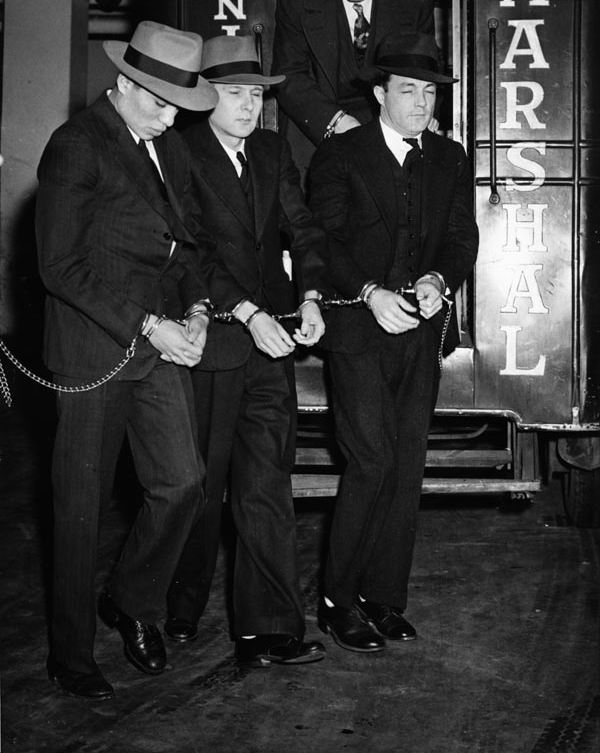
1919: Not Joseph Cohen

This day in 1919 was the closest Joseph Cohen came to the electric chair in Sing Sing. His walk may have been 7 minutes, or possibly 11 minutes, away, but Cohen was not to die this day at the hands of the State of New York, nor at the hands of any state on any day. Instead, he would be gunned down 13 years later as a free man.

Cohen was a wealthy, influential poultry merchant in New York City, and he had a bone to pick with fellow poultryman Barnet Baff, also known as the “Poultry King”. Baff had repeatedly rebuffed other poultry merchants in their efforts to fix prices and charge an exorbitant per-truck fee for poultry handling. That was probably because Baff was making this kind of bonus cash by feeding starving chickens sand and gravel immediately before slaughter. His shady practice was great for sale and terrible for resale.

This did him no favors among other poulters of the city.

By 1913, Baff had become the target of the collective ire of several people in the poultry industry, including Cohen, Ippolito Greco, Tony Zaffarano, and Antonio Cardinale — and possibly still more rivals in the New York Live Poultry Dealers’ Association. That year, a cadre of poultry merchants took up a collection to either frighten or kill Baff.*

Initially, a bomb was placed at his home, allegedly only to “frighten” him. In August of the following year, with Baff insufficiently frightened, the group actively sought to kill their target. At least one attempt was foiled, but on November 24, Baff was gunned down at the West Washington Market in Harlem.**

(c.f. this book for information.)

The murder nearly ended in a trio of executions and several long prison sentences. Instead, it cost just two men modest prison terms and uncovered the sordid underbelly of New York poultry sales.

Details about what actually happened are muddled significantly by various parties coaching witnesses in testimony.† As the story unfolded in the press, several investigators were accused of trying to push blame from Italians to Jews. Ultimately, the New York Attorney General managed to build up a case against several major players in the New York poultry scene and the then-lightweight New York mob scene.

The first break came in 1916 when Carmine diPaolo was arrested for an assault in the Bronx. He mentioned to police that he had been approached by Greco about carrying out the murder, but had backed out before it could be finished. DiPaolo then saw Giuseppe Archiello get paid by Greco after the killing. Archiello’s interrogation implicated Frank Ferrara, Cardinale, Zaffarano, Greco, and Greco’s brother, but it did not point to a source of the estimated $4,500 that was dispersed among the participants in the murder. Archiello was tagged as one of the gunmen and sentenced to death.

Ferrara was next on the docket, charged with driving the getaway car for the two killers. This was when Gaetano Reina was fingered as the other gunman. Ferrara’s story changed repeatedly and significantly, though, and he later insisted that Reina’s name had been fed to him. Ferrara’s conviction led to a death sentence that the state hoped to use to get Ferrara to name names at the top of the food chain.

The breakthrough witness was Cardinale, who had joined the Italian Army during World War I but was involved in the plots against Baff from the start. He was taken to New York by way of a somewhat shaky international agreement that circumvented the American/Italian extradition treaty, and his lawyer — not coincidentally the same as the lawyer for Ferrara and Archiello — convinced him to give up the big names: Joseph D. Cohen, brother of Chief Chicken Inspector Harry Cohen (aka “Kid Griffo”); his brother Jacob Cohen; Moses “Chicken Moe” Rosenstein; David Jacobs; William Simon; and Abe Graff. (Cardinale smartly moved back to Italy after giving testimony.)

Ferrara also decided to “come clean”, telling investigators that Ignazio “Jack” Dragna and Ben “Tita” Rizzotta were in his getaway vehicle. He also noted that he had left this duo out of his original story for fear of reprisal, going with the state-fed names of the gunmen instead.

The six conspirators were brought into court, with the court leaning on testimony of Cardinale, Ferrara, and Joseph Sorro, whom Cardinale said was also involved in several attempts to intimidate Baff. Simon’s indictment was thrown out, while Jacob Cohen and Jacobs were acquitted. Rosenstein pled guilty and helped New York gain a death sentence for Cohen and 10-20 years for Graff.

The convicted Cohen went after the state repeatedly, pointing out the massive inconsistencies in the witness testimony that led to his indictment and conviction. Indeed, Cardinale — who dragged Cohen into this in the first place — claimed two gunmen, neither of whom was currently in Sing Sing. Sorro, meanwhile, was brought up on multiple perjury charges.

Cohen’s execution was postponed seven times, then commuted to life in prison on February 4, 1920, by Governor Al Smith. Cohen was released on November 24, 1921. Officially, he could have been retried, but the state refused.

Archiello’s lawyer‡ insisted that, thanks to Sorro’s perjury, it was no longer clear that Archiello was a gunman. The court agreed to a second trial, and Archiello — who had significant connections in the Harlem mob — pled guilty to manslaughter, receiving a suspended sentence instead of death.

Meawhile, Dragna, Rizzotta, and Reina all walked. Dragna moved to Los Angeles and headed the Los Angeles crime family until the 1950s; he may have had a hand in former leader Joseph Ardizzone’s disappearance. Reina became kingpin of the Lucchese crime family in Brooklyn, and got killed by Lucky Luciano.

The Baff murder was atypical in the mob world, in that it featured Italian families doing their dirty work in the traditionally non-Italian field of poultry. The unusual arrangement made the murder an awkward affair that uncomfortably exposed a lot of powerful people. Organized crime was significantly more, well, organized by the time that Prohibition rolled around, and future gangland business murders were handled with a more diligent eye toward shielding bankrollers from blame.

Cohen and Jacob opened up a tailor shop in Manhattan, which put them right in the Italian mafia’s business wheelhouse. He and brother Barney were both shot to death in 1932, and their killers have never been identified.

* In an unusual twist to this already twisted case, Baff may have even partially paid for his own murder.

** Baff was killed just weeks after 18 members of Cohen’s Live Poultry Dealers’ Protective Association were indicted on fraud and racketeering charges.

† The state even employed one Philip Musica, a sort of proto-Barry Minkow with his own zany criminal story. His first foray into business was attempting to sell $250 of human hair to the tune of some $370,000. It’s not clear what the link between “Step 1: Get Hair” and “Step 3: Profit” was, but his misrepresentation of the goods was enough to earn him a federal sentence. Musica spent little time in prison, turning instead into a paid investigator in New York State’s employ during the Baff affair.

He jumped straight to Step 3 for his services and retired around 1916. Musica changed his name to Frank Donald Coster and in 1920 started Girard & Co. — a hair tonic company that was likely a front for a bootlegging operation. Right around the time the old Musica was indicted for perjury in the Baff case, F. Donald Coster bought the pharmaceutical company McKesson & Robbins. Musica expanded its drug enterprise but also did side business of building up paper assets and phantom sales to bolster the company’s apparent value by about $18m. It came crashing down when the company’s treasurer tried to find out why McKesson & Robbins didn’t insure their drug warehouse (turns out “it doesn’t exist” isn’t a good reason to give your accountant).

Musica committed suicide in 1938 as federal agents closed in, and the episode spawned new accounting regulations. McKesson is now the 14th-largest business in the U.S.

‡ The lawyer for Archiello and Cardinale, Walter Rogers Deuel, was brought up by the New York State Bar Association for suborning perjury, but he continued to practice law. And Deputy Attorney General Alfred Becker, who, according to one article, “was conspicuous during the war for uncovering German and Red plots,” was also accused of misconduct, though nothing appears to have come of that charge.

On this day..

1754: Eleanor Connor, rogue

Seven people were hanged at Tyburn on this date in 1754.

For these minor malefactors — six thieves and a murderer, the latter of whom was ordered for posthumous anatomization — we simply cull from the day’s ordinary’s account, and focus on one Eleanor Connor.

A Catholic Irishwoman “about 35 years of age” and familiar by several aliases, she evidently refused to confide in the Protestant divine whose business it was to harrow the doomed prisoners’ souls. “How, or to what she was brought up, we have no authority to say,” her interlocutor puzzles. “No other account can be given of her, than what her behaviour has afforded, since she has been in England.”

She had been in London from a decade or so since, an inveterate pickpocket haunting “the theaters, and Covent Garden” and indeed “any public places … convenient for carrying on such practices.”

Arrested in Bristol in 1748, the hanging sentence was moderated to convict transportation. But an indenture to a distant master on the fringe of the New World wilderness was itself such a frightful fate that prisoners were occasionally known to prefer death outright; Eleanor Connor was just this side of such desperation, for she made bold to depart her prison ship shortly after it set sail by hurling herself off the deck under cover of poor weather to be retrieved from the waves by some boats hired by her partners in the underworld. While the Ordinary passes over this extraordinary gambit in a sentence or two, surely such a desperate and dangerous escape has as just a claim on poetic commemoration as any adventure of Turpin. A brine-drenched Eleanor Connor and her friends must have drank off the chills of the sea that night beside an exultant hearth.

Here she disappears from the annals of the courts, and hence from the Ordinary’s capacity to track her; by rumor he understands that she has changed her location often and her husbands nearly so much, navigating the margins as a picaro in both England and Ireland.

Around 1752 she appeared in Liverpool, making an honest go of it as a chandler. Into her thirties now and having passed through who knows what scrapes in the meantime, perhaps she was considering the limitations a criminal career based on manual dexterity might impose upon her once youth slipped away. But whether due to old habit or the capital requirements of a business startup, she did not yet abandon her diving profession and was caught picking the pocket of a gentlewoman at the marketplace. Once again she was imprisoned, and once again the camaraderie of the criminal caste came to her rescue, overpowering the turnkey on a pretended jail visit and liberating Eleanor. Whatever else one might say of this woman, she inspired the loyalty of her friends: one very much wishes we somehow had a record of her many adventures outside the gaze of the law.

Whatever they were, there were not many more of them. Soon after the band had relocated to London, our habitual cutpurse was recognized as a fugitive and taken up once more. It was a simple matter to reinstate her old suspended death sentence from that original Bristol conviction.

Condemned in February, she convinced a jury of matrons that she was quick with child … but after several months it became apparent that this was a ruse. The Ordinary is small enough to sneer at this intrepid character’s unavailing attempts to rescue her life yet again by making herself sympathetic to the magistrates: “she was not yet without some excuse, she pretended to be very weak after labour, and begged the court would take it into consideration, (a common expression, without any real meaning, among these unhappy wretches) and transport her for life; but she was ordered now to her former sentence.”

On this day..

1938: Anna Marie Hahn, serial poisoner

On this date in 1938, serial poisoner Anna Marie Hahn was electrocuted in Ohio.

The Bavarian-born immigrant had arrived to Cincinnati espoused to a young telegraph operator. Hahn herself tried her hand at a bakery but soon tired of the tedium of honest work and set herself up better in the lucrative business of elder abuse.

Using an ancient ploy still effective to this day, the “plump and pretty” young woman flitted about the German emigre circles of Cincinnati advertising herself as a live-in caretaker for senior citizens. Once retained, she was in a position to price-gouge for her “services”, pilfer from the estate, and even to so insiniuate herself into her clients’ good graces as to enter their wills. Her first victim, Ernest Kohler, actually left her a boarding house: pretty good work compared to rolling out dough before the sun came up.

Using a variety of poisons,** Hahn killed off five known victims during the Great Depression, making off with tens of thousands of dollars in the process that she largely squandered on gambling.*

The first woman to die in Ohio’s electric chair, Hahn was reportedly stoic until her last hours. Then, overcome by desperation, she slid into a state of collapse and even at the last moments of life bawled “incoherent” pleas to a warden who of course had no authority to help her. Robert Elder of Last Words of the Executed (both blog and book) — quotes her frightful last words thus:

Good-bye all of you and God bless you … Mr. Woodard [the warden], don’t do this to me. Think of my boy. Can’t you think of my baby? Isn’t there anybody who will help me? Is nobody going to help me?

* One clever fellow, George Heiss, escaped her clutches when he grew suspicious of a mug of beer she presented him; when Hahn refused to sample it herself, he sacked her — but he did not report her.

** Her husband tipped police off by reporting that she had a bottle in the house literally labeled “poison”. (It was croton oil.)

On this day..

1948: Sam Shockley and Miran Thompson, for the Battle of Alcatraz

On this date in 1948, Sam Shockley and Miran Edgar Thompson were gassed at San Quentin Prison for the failed prison break that led to the Battle of Alcatraz.

One of the bloodiest events to mar the history of that storied penal island, the “battle” began as an attempt by prisoners to break out of C and D Blocks and seize an an imminent afternoon prison ferry.

And like many prison breaks, preparations at once diligent, desperate, and ingenious were foiled by mischance … leaving only a hopeless, deadly shootout.

The revolt, which is narrated blow by blow here, began on May 2, 1946 in C Block, when two prisoners overpowered a guard. One of them, Bernard Coy — destined to die in the following days’ siege — had spent his last weeks on this earth fasting for this very moment: now, he disrobed and, with the help of a contraband bar-spreading gadget, squeezed his emaciated frame through some bars to gain access to a gallery connecting to D Block. The prisoners had the patrol patterns of the guards in the vicinity down to a “T”; the man walking this gallery was in his turn surprised and disarmed by Bernard Coy, who proceeded to lower the guard’s keys and a number of weapons to his accomplices.

Now armed, Coy was able to force his way into D Block where he released more prisoners from locked cells, including accomplices — and the eventual subjects of this day’s post — Shockley and Thompson.

So far, things couldn’t have gone much better. Only one obstacle remained: a locked door to access the yard that would take them to the Alcatraz launch and a rendezvous with their unsuspecting ride to freedom. And this, of course, is where it all went wrong.

Despite capturing a number of guards during the course of their progress, the aspiring escapees realized that they didn’t have the key for the cell house door. The escape siren went up while they were still stuck.

Having taken the trouble to come this far, the inmates did not abandon the enterprise but devolved it into futile violence, firing out of their locked-up redoubt for no better reason than that they had the guns. Patrol boats began to arrive; word soon got around the city — the gunfire was audible to Golden Gate Bridge motorists — and ordinary San Franciscans congregated near the shore to watch while “thousands of rounds of ammunition and tracer bullets split the night sky as thousands watched from hilltops and piers on both sides of the bay.” (From the San Francisco Chronicle‘s coverage; after an initial fusillade, prison officials waited until dark fell on the evening of May 2 to resume the attack.)


Press get as close as they can to the riots.

For Thompson, at least, this was familiar territory: he’d wound up in Alcatraz because, while being transported to jail on a federal kidnapping charge, he had slain an Amarillo, Texas officer making an unsuccessful bid for freedom.

Marines recently hardened in the Pacific theater helped orchestrate the plan of attack: after re-taking the cell blocks — which were found, contrary to worst fears — in relative calm, the trapped escapees were driven by grenades into a corridor where troopers could fire at them. By the morning of May 4, the lifeless bodies of Coy and two others were stretched out in that hall.


From left: Clarence Carnes, Sam Shockley, and Miran Thompson.

Shockley, Thompson, and a 19-year-old Choctaw named Clarence Carnes survived to face capital charges for the two guards killed in the fray. Carnes, already serving a life sentence for murder, enjoyed the mercy of an additional life sentence in this case, owing to his youth, and to testimony that he had disobeyed the orders of his confederates to execute captured guards.* Shockley and Thompson were not so fortunate.

This affair is dramatized in the 1987 TV movie Six Against the Rock.

* Carnes’s burial on Choctaw land after he died in Massachusetts of AIDS in 1988 was financed by crime lord Whitey Bulger, who served time in Alcatraz from 1959 and grew close to Carnes.

On this day..

1848: James Langford, violent drunk


Charleston Southern Patriot, January 22, 1847


Trenton State Gazette, July 1, 1847


Trenton State Gazette, September 22, 1847


Baltimore Sun, Dec. 12, 1848

On this day..

2009: Hu Minghua and Su Binde, child abductors

China on this date in 2009 executed two men for trafficking kidnapped children.

“The crimes of children trafficking are on the rise,” said a spokesman for the Supreme People’s Court. “Children trafficking gangs now have clearer division of work and more children of migrant workers have been abducted.”

Kidnapping has been a major problem in China for many years, one which authorities have fought in vain with ever-strengthened legal sanctions. Needless to say the executions marked this date hardly abated the trend.

Up to 70,000 children are thought to disappear by abduction in China every year — particularly boys, for whom there is a lucrative market.

The men executed Nov. 26, 2009 seem to have emerged right from this unfortunate suq: 55-year-old 55-year-old Hu Minghua of Yunan Province was condemned for trafficking seven different children, plus heroin besides; 27-year-old Su Binde of Henan Province had six child abductions to his name over the course of just 10 months. (Su also led an armed robbery gang in Liuyuan Township that killed at least one man.)

On this day..

1950: Norman Goldthorpe, knot botch

On this date in 1950, Norman Goldthorpe hanged at Norwich prison.

Goldthorpe’s was an open-and-shut case. In a drunken fury when his married lover ditched him for the hubby, Goldthorpe tracked down a 66-year-old prostitute he knew and strangled her to death. Neighbors had seen him coming and going.

Because the realm’s veteran lead hangmen, Albert Pierrepoint and Stephen Wade, had been engaged for an execution in Scotland, the job fell to Harry Kirk. Kirk had been an assistant executioner, a job that entailed helping measure the drop of the rope and set up the gallows, but he had never been the head executioner. That job required actually noosing the prisoner and throwing the lever to drop the trap. The difference wasn’t merely one of degree, but of kind … as Kirk (and Goldthorpe) unpleasantly discovered.

Syd Dernley, the assistant executioner turned memoirist whose career we’ve touched on before, was Kirk’s number two. As he recalled, the whole engagement started off in, er, mortifying fashion.

Having checked into Norwich prison and completed their pre-hanging walk-through, Dernley and Kirk were killing time on the eve of the hanging with a prison guard. Dernley had brought along a book of dirty jokes and before long it had the three of them in uproarious laughter. That is, until “there was a loud pounding on the floor.”

The young screw stiffened, and the smile frozen on his face for an instant before it was wiped away by a sick look of understanding. “Oh Christ!” he exclaimed. “Oh bloody hell!”

A feeling of apprehension hit me in the stomach.

“Don’t make any more noise,” said the screw, now white-faced, in a whisper. “It’s the condemned cell down below … they must be knocking on the ceiling with something.”

Think about that one the next time you recollect your worst faux pas.

Well, this wasn’t even Kirky and Dernley’s worst of the Goldthorpe job.

Moments after Goldthorpe dropped 7 feet, 8 inches down through the Norwich jail trap, Dernley remembered, “I heard the most spine-chilling sound I ever heard in an execution chamber. From the pit came a snort … and then another snort … and another and another! The rope was still, the head seemed to be over … but there were noises coming from under the hood!”

Blessedly for all concerned, the wheezing stopped within a few moments. Dernley maintains in his book that Goldthorpe’s neck was actually broken, the snorts an involuntary muscular contraction. But he admitted otherwise in a subsequent interview: “I feel that it was a bad job — the man was dying on the rope. It had not broken his neck, but he was dead a couple of minutes afterwards.”

After fretting a nervous hour away while the body dangled for the regulation time, the hangmen finally got a look at what went wrong: the linen hood tucked over the man’s head in his last instant of life had snagged in the eye of the noose, and jammed it up before it could tighten all the way.

In Dernley’s estimation, the rookie hangman botched it by going too fast. Pierrepoint, who had hundreds of executions to his credit, was famous for his lightning-quick hangings, with nary a wasted motion. Dernley relates one instance where the master, in a showoff mode, lit a cigar and set it down before commencing the hanging procedure, and was in time to pick it back up for a puff before it went out while his prey twisted at the bottom of a taut rope. But Pierrepoint’s speed, which helped define the Platonic ideal of an execution for Britain’s last generation of hangmen, was not an end unto itself but a product of the master’s expertise.

Kirk “had been trying to go too fast,” Dernley wrote. “He was trying to show that he was as quick as Pierrepoint. When he put the noose round Goldthorpe’s neck he should have seen that the bag was not properly down; maybe he did, maybe he thought it was near enough, and let it go.”

It was the last hanging Harry Kirk ever worked.

On this day..

1834: James Graves, Trail of Tears precursor

On this date in 1834, the Cherokee James Graves was hanged in Spring Place, Georgia, for murder. He’s the only person ever executed in Georgia’s Murray County.

But he was also a sad waymarker on the way to a much larger tragedy.

It happened that in 1834 the state of Georgia’s long-simmering conflict with the indigenous Cherokee nation was coming to a nasty head. In the infancy of the American Republic, it had made a pact placing the Cherokee under the protection of the United States.

By the 1820s, however, Cherokee land had been nibbled away and the white citizens of Georgia started clamoring for a proper ethnic cleansing: forcibly expelling the Cherokee to the western frontier.

The immediate territorial conflict became joined to a conflict over federal jurisdiction, because the Cherokee had their treaty with the United States (not with Georgia) and its terms were supposed to be guaranteed by Washington (not Milledgeville). As the Georgia legislature enacted laws stripping the Cherokee of land and self-rule, the Cherokee appealed in federal courts.

The Cherokee notched a major win in the 1832 Worcester v. Georgia, when the U.S. Supreme Court held that Indian affairs were the domain of the federal government and individual states had nothing to say in the matter.

But to give a sense of where the wind was blowing, this is the very decision about which U.S. President (and notorious Indian-killer) Andrew Jackson is supposed to have remarked, “John Marshall has made his decision; now let him enforce it.” The quote itself is probably apocryphal but the atmosphere of lawless confrontation was very real indeed.

James Graves was convicted by a Georgia jury in September 1834 of murdering a white man several years prior on Indian land … or rather, on what Georgia said was now no longer Indian land.

The Supreme Court directed Georgia to stay the hanging and appear at a January 1835 hearing.

Governor William Lumpkin* would have none of it. Grandstanding in a communique to an all but universally supportive legislature, he vowed to ignore the court’s order.

Any attempt to infringe the evident rights of the State, to govern its entire population, of whatever complexion, and punish all offences committed against its laws within those limits … I consider a direct usurpation of power. … Such attempts demand the determined resistance of the States … I shall wholly disregard all such unconstitutional requisitions, of whatever character or origin, and, to the utmost of my power, protect and defend the rights of the State, and use the means afforded me to maintain the laws and Constitution of the same. (Nov. 7, 1834)

Two weeks later, Georgia hung James Graves, stay or no stay. There would be no hearing in Washington that January.

“What is to be done with Georgia?” lamented the Nantucket Inquirer (Dec. 13, 1834). “Will another presidential proclamation, full of big words and bombastic threats, be issued against her, for having nullified the U.S. claim of sovereignty over the Indians, and for having hanged the copper-skinned citizen Graves, in defiance of the interdict of one of Gen. Jackson’s judges?”

They already knew the answer: “O, no! — Why? Van Buren counts upon the vote of Georgia at the next presidential election!” (Van Buren did not in fact carry Georgia.)

In 1835, the U.S. foisted a dubious new treaty on the Cherokee by getting a minority faction to sign off on Indian removal, and shortly thereafter forced the Cherokee west on the Trail of Tears.

* Lumpkin County, Georgia is named for him. That’s not too shabby, but he almost hit big-time when the city of Terminus proposed to rename itself Lumpkin. Lumpkin declined and the city is today known as Atlanta.

** Georgia conducted another execution, that of George Tassels, under similarly contested circumstances a few years before Graves.

On this day..

1784: Richard Barrick, Massachusetts highwayman

(Thanks to Robert Elder of Last Words of the Executed — the blog, and the book — for the guest post. This post originally appeared on the Last Words blog. Fans of this here site are highly likely to enjoy following Elder’s own pithy, almanac-style collection of last words on the scaffold. -ed.)

I then went to Boston, and got in company with one John Sullivan … we went to Winter’s-Hill, and there robbed one Mr. Baldwin, for which crime Sullivan and myself are to suffer Death, as being the just reward of our demerits.

— Richard Barrick, convicted of highway robbery and murder, hanging, Massacusetts. Executed November 18, 1784

Richard Barrick was born in Ireland in February 1763 and brought up in the Foundling Hospital. He was an apprentice to a silk-weaver and lived with him for three years. But during those years, he was treated poorly and so he eventually left the silk-weaver and joined a gang of thieves. When he was caught, the authorities agreed to pardon him if he entered on board one of his Majesty’s ships. After arriving in New York, Barrick and some others robbed many people and became a notorious and wanted man. He was an accomplice to murder of a man they first robbed. He was eventually caught by a British Colonel and convicted.

On this day..

1813: Ezra Hutchinson, teen rapist

On this date in 1813, 19-year-old Ezra Hutchinson was hanged in the western Massachusetts village of Lenox for raping a 14-year-old named Lucy Bates.

Hutchinson passed the girl by (mis)chance on the road on his way home, and arriving there reflected what an inviting target she made — so he turned and followed her path into the wilderness until he overtook her.

Reproduced here is the pamphlet issued over his signature on the day of his execution with the informative title, “The solemn address and dying advice of Ezra Hutchinson: who was executed at Lenox, Mass. November 18, 1813, for a rape on the body of Miss Lucy Bates.” In it, we find a mostly penitent Hutchinson, who owns and laments his adolescent lewdness, still bold enough to “forgive” his victim her testimony against him. A footnote by the pamphlet’s editor explains:

for several weeks previous to his execution, he was uniform in declaring, that he supposed the girl had really consented to what was done. The girl in her testimony had said that having resisted to the utmost of her power, until her strength failed, she finally, through weariness and fright, sank almost lifeless to the ground. Here is an apparent contradiction; but it is easily reconciled in the eye of charity, by supposing, that when she fainted, and ceased any longer to resist, he honestly thought that she yielded her consent, though in truth she did not.

On this day..