1832: Samuel Sharpe, “I would rather die upon yonder gallows than live in slavery”

On this date in 1832, Jamaican national hero Samuel Sharpe died upon the gallows for instigating the slave revolt that would (help to) end slavery.

Samuel Sharpe, an educated slave who was also a Baptist deacon, was the moving spirit behind the attempted general strike that became the Christmas Rebellion.

That time of year was less than festive for Jamaica’s enormous slave population, for Saint Nick opened the short window for harvesting the island’s sugar cane.

Samuel Sharpe and collaborators had the wit to realize that being depended upon to bring in the cash crop that made life comfortable for their owners put the slaves’ hands upon a potent economic lever. In the last few days of 1831, they pressed it.

The “passive resistance” thing didn’t last long, however, and the “strike” transmuted into a rebellion — the cause swiftly taken up by thousands of slaves around the island who torched crops. Given the small (less than 20) white body count,* the “violence” appears to have been directed against the instruments, rather than the perpetrators, of their enslavement.

Not so the reprisals.

The rebellion was suppressed within days, and over 300 put to death for it (in addition to 200 slave casualties during the pacification itself). There’s an absorbing BBC Witness episode about this affair available as a podcast here.

Sharpe was the last of those executed.

But his revolt is widely thought to have given impetus to the British parliament’s deliberations over the ensuing months that ultimately led to the Slavery Abolition Act (1833).

What [abolitionist MP William] Wilberforce was endeavoring to win from the British senate by his magic eloquence the slaves themselves were endeavoring to gain by outbreaks and violence. The combined action of one and the other wrought out the final result. While one showed that slavery was wrong, the other showed that it was dangerous as well as wrong. Mr. Wilberforce, peace man though he was, and a model of piety, availed himself of this element to strengthen his case before the British Parliament, and warned the British government of the danger of continuing slavery in the West Indies. There is no doubt that the fear of the consequences, acting with a sense of the moral evil of slavery, led to its abolition. The spirit of freedom was abroad in the Islands. Insurrection for freedom kept the planters in a constant state of alarm and trepidation. A standing army was necessary to keep the slaves in their chains. This state of facts could not be without weight in deciding the question of freedom in these countries … I am aware that the insurrectionary movements of the slaves were held by many to be prejudicial to their cause. This is said now of such movements at the South. The answer is that abolition followed close on the heels of insurrection in the West Indies, and Virginia was never nearer emancipation than when General Turner kindled the fires of insurrection at Southampton.

Frederick Douglass

Sharpe, today, is an official national hero of Jamaica. The place in Montego Bay that he hanged is known as Sam Sharpe Square, and his face adorns the currency.

* Contrast with the much smaller, much bloodier rebellion of Nat Turner in the U.S., which preceded the Christmas Rebellion by a few months.

On this day..

1894: Emile Henry, because there are no innocent bourgeois

On this date in 1894, Emile Henry was guillotined in Paris for bombing the Cafe Terminus three months before.

Yale history professor John Merriman (see him lecturing on the Paris Commune) explores how Henry’s bombing “ignited the age of modern terror.” (Review.) (Another.)

A bourgeois youth who, disgusted at the gross economic exploitation of the Gilded Age, had turned against his class with the fury only the apostate can command, Émile Henry had chucked a bomb into the chic cafe of the Parisian Gare Saint-Lazare a week after the execution of Auguste Vaillant.

Henry’s act killed only one, but electrified the country.

The Terminus bombing stood out in an era of violent anarchist ferment for its target selection: not a prince or president or parliamentarian, but the faceless multitudes of the bourgeoisie (formerly) secure in their metropolitan repose — who, in their indifference to the misery of workers assented to and profited from the more infamous repressions wrought by their plenipotentiaries.

Henry was completely explicit about his intent: “there are no innocent bourgeois.”

Recognizing the hopelessness of his legal position, he proudly admitted the charges against him and mounted an eloquent defense for the wider world of his version of anarchist terror.

I had returned to Paris at the time of the Vaillant affair, and I witnessed the frightful repression that followed the explosion at the Palais Bourbon. I saw the draconian measures which the government decided to take against the anarchists. Everywhere there were spies, and searches, and arrests. A crowd of individuals were indiscriminately rounded up, torn from their families, and thrown into prison. Nobody was concerned about what happened to the wives and children of these comrades while they remained in jail.

The anarchist was no longer regarded as a man, but as a wild beast to be hunted everywhere while the bourgeois Press, which is the vile slave of authority, loudly demands his extermination.

But, gentlemen of the bourgeoisie, you have reckoned a little too much without your host. You arrested hundreds of men and women, you violated scores of homes, but still outside the prison walls there were men unknown to you who watched from the shadows as you hunted the anarchists, and waited only for the moment that would be favourable for them in their turn to hunt the hunters.

… The bomb in the Cafe Terminus is the answer to all your violations of freedom, to your arrests, to your searches, to your laws against the Press, to your mass transportations, to your guillotinings. But why, you ask, attack these peaceful cafe guests, who sat listening to music and who, no doubt, were neither judges nor deputies nor bureaucrats? Why? It is very simple. The bourgeoisie did not distinguish among the anarchists. Vaillant, a man on his own, threw a bomb; nine-tenths of the comrades did not even know him. But that meant nothing; the persecution was a mass one, and anyone with the slightest anarchist links was hunted down. And since you hold a whole party responsible for the actions of a single man, and strike indiscriminately, we also strike indiscriminately.

Perhaps we should attack only the deputies who make laws against us, the judges who apply those laws, the police who arrest us? I do not agree. These men are only instruments. They do not act in their own name. Their functions were instituted by the bourgeoisie for its own defence. They are no more guilty than the rest of you. Those good bourgeois who hold no office but who reap their dividends and live idly on the profits of the workers’ toil, they also must take their share in the reprisals. And not only they, but all those who are satisfied with the existing order, who applaud the acts of the government and so become its accomplices, those clerks earning three or five hundred francs a month who hate the people even more violently than the rich, that stupid and pretentious mass of folk who always choose the strongest side — in other words, the daily clientele of Terminus and the other great cafés.

That is why I struck at random and did not choose my victims! The bourgeoisie must be brought to understand that those who have suffered are tired at last of their sufferings; they are showing their teeth and they will strike all the more brutally if you are brutal with them. …

We will not spare the women and children of the bourgeois, for the women and children of those we love have not been spared. Must we not count among the innocent victims those children who die slowly of anaemia in the slums because bread is scarce in their houses; those women who grow pale in your workshops, working to earn forty sous a day and fortunate when poverty does not force them into prostitution; those old men whom you have made production machines all their lives and whom you cast on to the waste heap or into the workhouse when their strength has worn away?

At least have the courage of your crimes, gentlemen of the bourgeoisie, and grant that our reprisals are completely legitimate.

In that pitiless war which we have declared on the bourgeoisie, we ask for no pity. We give death, and we know how to endure it. So it is with indifference that I await your verdict. I know that my head is not the last you will cut off; yet others will fall, for the starving are beginning to know the way to your great cafes and restaurants, to the Terminus and Foyot. You will add other names to the bloody list of our dead.

You have hanged in Chicago, decapitated in Germany, garotted in Jerez, shot in Barcelona, guillotined in Montbrison and Paris, but what you will never destroy is anarchy. Its roots are too deep. It is born in the heart of a society that is rotting and falling apart. It is a violent reaction against the established order. It represents all the egalitarian and libertarian aspirations that strike out against authority. It is everywhere, which makes it impossible to contain. It will end by killing you.

Clemenceau, who witnessed the beheading at the Place de la Roquette, saw in the ghastly white 21-year-old crying “long live anarchy!” in the predawn gloom this morning in 1894 “the face of a tormented Christ, terribly pale, implacable in expression, trying to impose his intellectual pride upon his child’s body … let those for the death penalty go, if they dare, to smell the blood of La Roquette.”

Five weeks later, the French president who had refused to spare Henry was himself assassinated by another anarchist.

The clip above uses an actual 1893 anarchist hymn to dynamite, that fruit of the chemical science whose pyrotechnics were held to catalyze social change. Henry, who probably hummed the song a few times in his life, must have approved the songwriter’s philosophy.

Tant mieux s’il éclate parfois en faisant beaucoup de victimes
Chez nos ennemis les bourgeois cela nous venge de leurs crimes

For more on Henry’s place in the era’s revolutionary ferment, enjoy this lecture by Dynamite Club author John Merriman as part of his course European Civilization, 1648-1945.

[audio:http://openmedia.yale.edu/projects/courses/fall08/hist202/mp3/hist202_14_102208.mp3]

On this day..

1896: Dr. Jose Rizal, father of the independent Philippines

December 30 is Rizal Day (Araw ng Kabayanihan ni Dr. Jose Rizal in Tagalog) in the Philippines, for the execution that date in 1896 of the great martyr of Philippine independence.

Also available free at gutenberg.org (the HTML version is very well-illustrated).

At Jose Rizal’s birth in 1861, it had been 340 years since Magellan had reached (and died at) the Philippines under the Spanish flag.

In Rizal’s century of romantic nationalism, independence movements stirred abroad in the Spanish Empire … too weak yet in the Philippines and elsewhere during the mid-1800s, but unmistakably prefiguring those national destinies that this day’s victim would come to embody.

Oddly, Jose Rizal was not even the most “revolutionary” of his farming family’s 11 children. That distinction went to older brother Paciano, who was under an official cloud before Jose hit adolescence for his relationship with the Gomburza priests, and would later serve as a brigadier general in the revolutionary army of Emilio Aguinaldo.

Jose was less strident — and more brilliant.

Though reputedly an adept fencer and crack shot with a pistol, the renaissance man’s gifts ran more to the life of the mind.

At the Universidad Central de Madrid, the University of Paris, and the University of Heidelberg, Jose Rizal studied ophthalmology and anthropology, and pursued the variegated artistic interests of his youth.

His two novels published from Europe, Noli Me Tangere and El Filibusterismo*, both criticized colonial authorities and their Vatican adjutants and struck nationalist chords that put him on the Spanish government’s watch list.

“I die without seeing the dawn brighten over my native land! You, who have it to see, welcome it — and forget not those who have fallen during the night!” -From Noli Me Tangere

Rizal also penned essays and editorials in a less symbolic vein, like this one skewering the stereotype of the lazy native by turning the mirror upon colonial agents who were waiting to prey on the fruit of native labor:

How is it strange, then, that discouragement may have been infused into the spirit of the inhabitants of the Philippines, when … they did not know whether they would see sprout the seed they were planting, whether their field was going to be their grave or their crop would go to feed their executioner? What is there strange in it, when we see the pious but impotent friars of that time trying to free their poor parishioners from the tyranny of the encomenderos by advising them to stop work in the mines, to abandon their commerce, to break up their looms, pointing out to them heaven for their whole hope, preparing them for death as their only consolation?

Man works for an object. Remove the object and you reduce him to inaction The most active man in the world will fold his arms from the instant he understands that it is madness to bestir himself, that this work will be the cause of his trouble, that for him it will be the cause of vexations at home and of the pirate’s greed abroad. It seems that these thoughts have never entered the minds of those who cry out against the indolence of the Filipinos.

(This essay and both novels are available in the original Spanish and in English at gutenberg.org, along with various translations of Rizal’s various fiction and non-fiction work.)

Fire-eating stuff in the eyes of the Spanish crown, but Rizal wasn’t the bomb-throwing type himself.

As the Philippine Revolution that would break the Spanish yoke on the islands took shape in the summer of 1896, Rizal applied to go to Spanish Cuba to treat victims of the yellow fever, and even explicitly disavowed the revolution.

Countrymen: I have given proofs, as well as the best of you, of desiring liberty for our country, and I continue to desire it. But I place as a premise the education of the people, so that by means of instruction and work they may have a personality of their own and that they may make themselves worthy of that same liberty. In my writings I have recommended the study of the civic virtues, without which there can be no redemption. I have also written (and my words have been repeated) that reforms, to be fruitful, must come from _above_, that those which spring from _below_ are uncertain and insecure movements. Imbued with these ideas, I cannot do less than condemn, and I do condemn, this absurd, savage rebellion, planned behind my back, which dishonors the Filipinos and discredits those who can speak for us. I abominate all criminal actions and refuse any kind of participation in them, pitying with all my heart the dupes who have allowed themselves to be deceived. Go back, then, to your homes, and may God forgive those who have acted in bad faith.

This stance on the revolution — the fact that he thought and wrote but never struck a blow — has engendered some controversy over the rightfulness of Rizal’s place in the national pantheon, as has his anti-clericalism and a disputed Vatican claim that Rizal retracted his criticisms of the Church before his death. One Spanish contemporary called Rizal “the Tagalog Hamlet.”

But mostly he is seen as the Spanish government at the time saw him, and as many revolutionaries did as well: as the lodestar of the Philippines’ national aspirations.

Rizal was arrested en route to his humanitarian assignment in Cuba and returned to Manila to face trial for sedition, rebellion and conspiracy, by which point, of course, the verdict was quite preordained. He was shot in the back by a firing squad, uttering the Christ-like last words “consummatum est” — “it is finished.”

Rizal’s execution, and the events preceding it, are depicted in this long excerpt of a 1998 film:


Jose Rizal’s execution.


Near the spot Rizal was actually executed, his martyrdom depicted in statuary.

There are any number of Jose Rizal tribute sites online. JoseRizal.ph and JoseRizal.info are two good places to delve deeper.

* A filibuster is a private military expedition, and more typically associated with Anglo American campaigns against the Spanish-speaking lands to the south, like those of William Walker.

On this day..

1945: The Belsen war criminals

On this date in 1945, British hangman Albert Pierrepoint executed eleven guards of the Bergen-Belsen concentration camp and two other Nazis in occupied Hameln.

Liberated only eight months before these hangings, Belsen provided the to-us-familiar store of Nazi atrocity stories. Forty-five sat in the dock at the Belsen trial under British military authority, including the notorious camp commandante Josef Kramer — better known as the Beast of Belsen — and the “Angel of Death” Irma Grese.

Those two, and nine others less distinctively nicknamed, faced the gallows. (They were hanged together with two other war criminal convicts not connected to the Belsen trial, Georg Otto Sandrock and Ludwig Schweinberger, for a total of 13.)

On December 13, 1945, Pierrepoint hanged Grese; then, Elisabeth Volkenrath; and then, Juana Bormann, each individually. Finally, the men were then dispatched in pairs.

(Other than Kramer, the most notable was Nazi doctor Fritz Klein, who gave this reading of medical ethics when queried while the camps were still operating: “My Hippocratic oath tells me to cut a gangrenous appendix out of the human body. The Jews are the gangrenous appendix of mankind. That’s why I cut them out.”)


Of all this batch, Irma Grese, the “beautiful beast”, enjoys the liveliest afterlife.

If one finds her pretty, then she was a pretty young thing — only 16 when she hitched herself to the SS; turning 22 during her fatal postwar trial.

Stalking the camp with her whip, and (rather conveniently) cited with the ravenous sexual appetite a B-movie screenwriter would give such a character, part of her siren song is plainly the fetishistic magnetism of Nazi women.

But in the numerous discussion threads about Irma Grese, any number of her advocates will emerge.

Can we leave it at the fascination that female war criminals inspire? Certainly few 22-year-old Einsatzgruppen men have the mitigatory evidence of a coming-of-age in farming and retail so lovingly emphasized, the precise measure of complicity in genocide analyzed in such detail (pdf).

Grese, perhaps, strikes as impressionable, in the youthful sense of absorbing one’s place from the world one inhabits. Her hangman wrote that “[s]he seemed as bonny a girl as one could ever wish to meet.” As a camp guard, she wins promotions; to her interrogators, she accepts responsibility equal to Himmler’s; among those condemned at the Belsen trial, she alone is defiant.

In that guise — and whether or not it is rightly attributed to her — she presents back to her interlocutor those timeless questions of personal identity and moral responsibility: where does abnormal psychology leave off into perfectly conventional psychology that just happens to occupy an abnormal world?

On this day..

1793: Madame du Barry, who hated to go

On this date in 1793, Madame du Barry — shrieking pitiably in terror — was guillotined in Paris.

Versaille costume dramas have made great hay with the courtesan who became the mistress of Louis XV, and her catty court rivalry with Marie Antoinette. (Madame Tussaud’s still-on-display Sleeping Beauty figure was also created way back in 1763 in her likeness.)

More portraits of Madame du Barry here.

The sovereign’s bed implied a station of wealth and extravagance, but the low birth that caused Marie to turn up her nose didn’t much help this day’s victim standing with the Jacobins.

Poor Madame du Barry, at 50 years of age, had not lost an ounce of her considerable zest for life … and her apparently ingenuous joie de vivre while the Revolution raged looks somewhere between innocent and daft.

While nobles were scrambling to get out of France, the Comtesse born Jeanne Bécu shuttled back and forth over the English Channel in 1792 to settle her jewelry accounts … and decided to stay in France, returning after the September Massacres no less. Later, she would detail to her gaolers where she had stashed her baubles around her estate, in the delusion that they could buy her life — or at least, “did not each word give her a second of time?”*

She’s remembered for the uncommon scene she made being hauled to the guillotine this date — in a time when the scaffold’s pageantry demanded a stoic public dignity from the guillotine’s victims, the Comtesse came apart, and begged the crowd for her life so frantically and heart-wrenchingly that the executioners felt hurried to dispatch her lest the scene turn against them.

Even to the last, hopeless second she implored Sanson,

Encore un moment, monsieur le bourreau, un petit moment.**

One could make the case that if more clients of the national razor had displayed such naked humanity to onlookers, the guillotine‘s technical and social capacity for mass butchery might have been lessened.

Whether true or not, she gives us a glimpse, oddly unusual in these pages, of unadulterated fright — of that visceral instinct to cling to life, even under the blade, even for one little moment more.

Dostoyevsky, who knew whereof he spoke would write in The Idiot,

After all this honour and glory, after having been almost a Queen, she was guillotined by that butcher, Samson. She was quite innocent, but it had to be done, for the satisfaction of the fishwives of Paris. She was so terrified, that she did not understand what was happening. But when Samson seized her head, and pushed her under the knife with his foot, she cried out: ‘Wait a moment! wait a moment, monsieur!’ Well, because of that moment of bitter suffering, perhaps the Saviour will pardon her other faults, for one cannot imagine a greater agony.

Spare a thought for that moment of bitter suffering, next time you … uh, dine on cauliflower?

* This line, obviously in the vein of her famous last request to the headsman, is from Memoirs of the Comtesse Du Barry, actually a 19th century work of historical fiction by Baron Etienne Leon Lamothe-Langon.

** “One moment more, executioner, one little moment!”

On this day..

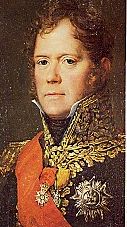
1815: Michel Ney, the bravest of the brave

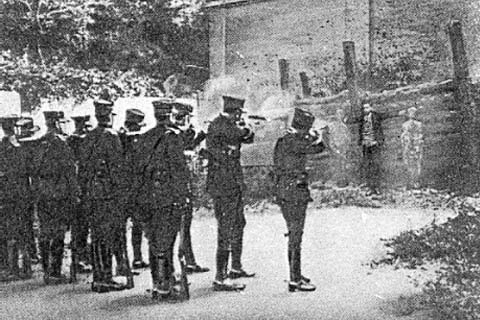
On this date in 1815, Napoleonic Marshal Michel Ney faced a squad of French troops un-blindfolded and gave them the last order of his wild career:

Soldiers, when I give the command to fire, fire straight at my heart. Wait for the order. It will be my last to you. I protest against my condemnation. I have fought a hundred battles for France, and not one against her… Soldiers Fire!

The carrot-topped commander, just seven months Napoleon’s senior, had like the Corsican distinguished himself at arms during the French Revolution.

He shone thereafter as a ballsy* cavalry officer in the Napoleonic Wars — Bonaparte called him le Brave des Braves (“the bravest of the brave”).

Hitching your star to Napoleon’s was a good career move, for sure.

Until right about …


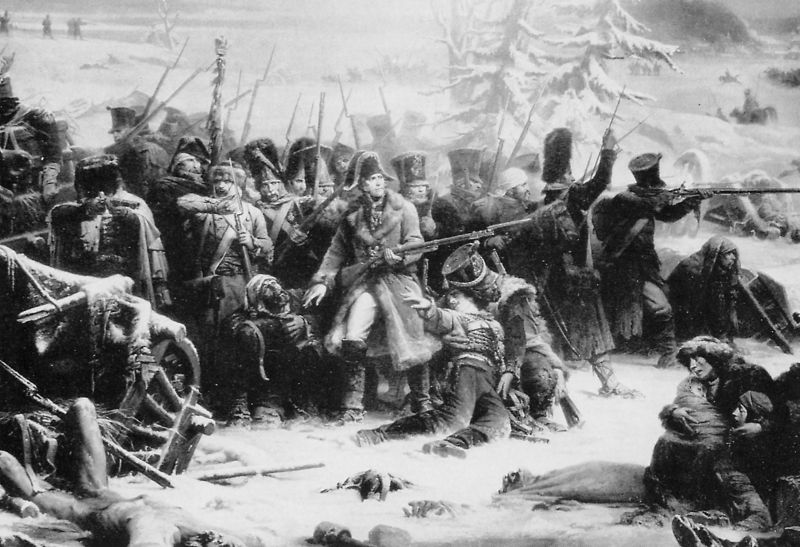
Michel Ney was named Prince de la Moskowa after the Battle of Borodino 1812. Things kind of went downhill from there.

“[W]e are told of the greatness of soul of the marshals, especially of Ney — a greatness of soul consisting in this: that he … escaped to Orsha abandoning standards, artillery, and nine-tenths of his men.” -Leo Tolstoy, War and Peace

Ney was able to keep things cool with Louis XVIII, but when Napoleon returned from Elba and Ney marched out to capture him, both Marshal and army deserted to the old emperor.

Ney often takes a rap for fouling up the reunion tour with a characteristically reckless cavalry charge during the Battle of Waterloo.

But his real problem was that he couldn’t make up his mind or stir his spirit or just plain read the writing on the wall well enough to get out while the getting was good. Though the Bourbons gave him every opportunity to blow town and spare the new-look ancien regime the embarrassment of having to try him, Ney didn’t do it — causing the king to fume,

By letting himself be caught, he has done us more harm than he did [defecting to Napoleon] on the 13th of March!

A vengeful Chamber of Peers, full of radical more-royalist-than-the-king types, gave him no quarter.

The near-unanimous conviction and death sentence were agreed by the Peers around midnight as December 6 became December 7, and the Bravest of the Brave led out near the Luxembourg Garden that very morning to suffer the sentence passed upon him.

The Bravest of the Brave, a 19th-century general history of the man, is available free on Google Books, as are two volumes of memoirs (1, 2) published posthumously by his family.

French speakers can find other free 19th century texts on Ney linked here.

* His reputation for unshakable courage notwithstanding, John Elting says Ney was also a deft hand at executing a cavalry retreat.

On this day..

1922: Robert Erskine Childers, for carrying the gun of Michael Collins

On this date in 1922, Robert Erskine Childers was shot by the Irish Free State for carrying a gun its founding colossus had gifted him.

Many Irishmen were executed on either side in this terrible time, but Childers cuts a unique figure among them.

To begin with, he wasn’t all that Irish — “that damned Englishman,” fellow Republican turned Civil War enemy Arthur Griffith called him. The London-born son of a British scholar and an Irish mother, Childers was a lifelong Protestant, itself an anomaly since Irish nationalism mapped (and still maps) strongly to Catholicism.

You’d think he’d be a loyal man of the empire. Early on, that’s just what he was.

In his twenties, Childers volunteered for the Boer War, and he would later say the rank savagery and underlying injustice of England’s war “changed the whole current of my life and made me a Liberal and a Nationalist.” (Source.)

Laying down the sword, Childers took up the pen and wrote several books of military history. (Long since into the public domain, at least two can be read free online: War and the Arme Blanche, German Influence on British Cavalry.) He also wrote a novel, The Riddle of the Sands, that has a (debatable) claim as the first spy novel. Riddle has never gone out of print since it was published in 1903, though it is also available free online.

Both in fiction and nonfiction, Childers’ warnings against the German challenge to British hegemony were prophetic, but he was himself becoming a man divided. 1914 saw him running German guns to Irish nationalists aboard his yacht Asgard … and then signing up for the royal navy when World War I erupted.

The British crackdown on the Easter Rising during the war completed his radicalization; he moved to Dublin and turned his eloquence against the British.

Here, Childers was swept into the tragedy of the Irish War of Independence, and the civil war that followed it; though both were in the delegation that produced the contentious Anglo-Irish Treaty, Childers broke with Michael Collins over it and backed the IRA nationalists who fought the Irish Free State.

After Collins’s assassination, emergency laws promulgated the death sentence for anyone caught armed without authorization. Childers was a writer, not a partisan, but he was arrested in early November with a small sidearm — a gift Michael Collins had given him, back when they were on the same side. It was a time of bloody justice, and they threw the book at him.

Childers knew as well as Collins had that the internecine conflict would have to end. He checked out with awe-inspiring forgiveness; summoning his 16-year-old son to prison the night before his execution, Childers extracted a promise that the boy would find everyone who signed his death warrant … and shake their hands. (Young Erskine Hamilton Childers eventually became President of Ireland.)

Childers himself likewise shook the hands of his own firing squad, one by one. His last words (reported in a number of slightly different variations) were lightheartedly addressed to them:

Take a step or two forwards, lads. It will be easier that way.

On this day..

1927: Father Miguel Pro, “Viva Cristo Rey!”

On this date in 1927, the anti-clerical Mexican government made the emblematic martyr of the Cristero War.

This video is in Spanish, but the storyline is pretty easy to follow — young man finds faith, lives faith, dies faith.

Miguel Pro‘s dying cry, “Viva Cristo Rey!” — “Long live Christ the King!” — was a refrain of Cristeros, anti-government guerrillas who in the late 1920’s fought the revolutionary Mexican government’s attempts to forcibly restrict the power of the Catholic Church.

That conflict had been brewing for years, an outgrowth of Mexico’s own complex history of colonization and development — measures to restrict the church’s size, wealth, and social reach had been mooted and sometimes implemented well back to the middle of the 19th century.

Early in the 20th, the confrontation was merely a twist on its classic form: liberal state-builders and the Catholic hierarchy were (or increasingly saw themselves as) diametrically opposed in their vision for Mexico.

That conflict came to a head under president Plutarco Elias Calles, an irreligious northerner with a project of national capital development for whom the church’s intransigence from its agrarian strongholds was most unwelcome … and who seemed to delight in provoking Rome with sport like mandatory physicals for priests, not neglecting to publicize the incidence of venereal disease thereby revealed.

Liberals had already brought about drastically reduced clerical privileges in the Mexican Constitution of 1917; its somewhat draconian measures were neither fully enforced nor fully resisted, but initiated a period where the two hostile institutions rudely grappled for their respective spheres of influence on the ground.

Calles was the rudest grappler of all, and his 1926 Calles Law pushed for anti-clericalism stricter than the letter of the constitution … and sparked armed resistance.

It was an exceptionally dirty war with routine summary executions on both sides and thousands of Catholic refugees — a dangerous environment for any priest with legal sanctions against basically every practice of the vocation. (Photos of Cristeros, some in heroic resistance and others in grisly martyrdom, can be eyeballed here.)

Pro, a Jesuit who like many was forced underground, was under state surveillance and got picked up in the aftermath of an assassination attempt against a prominent politician. He was chosen to make an example of — without an actual trial, possibly because there’s no actual reason to think he was involved in the bombing.

Looking at these pictures of Pro’s last moments, it’s hard to believe that they were taken and circulated at government direction to cow the Cristero movement. Fail.


Led out to execution in a police courtyard. The place of his death today is (bizarrely) Calle Loteria Nacional.


Calmly at prayer before his death, under the eye of the firing squad commander.


Pro himself refused a blindfold. But why state authorities carrying out the execution with an eye towards public relations would allow him to die in this pose is anyone’s guess.


He blessed and forgave the firing squad, of course.


Just beginning to topple at the moment the bullets struck him.


Like many firing squad executions, this one failed to kill its victim with the ceremonial volley. Pro was finished off with a coup de grace.

Calles was simultaneously — the key measures were also enacted in 1926 — involved in a confrontation with the United States over oil rights, a situation that came to the brink of war, with Washington saber-rattling about “Soviet Mexico”. It’s tempting to wonder whether the two situations weren’t related, especially since the new American ambassador* who had arrived only the month before Pro’s execution would ultimately negotiate both situations’ resolutions.

While the natural resource politics went their separate way, the Mexican Revolution’s anti-clerical strain didn’t so much disappear by negotiation as fade away over decades, with regular new outbreaks.

One thinks of Mexico today as such so staunch a Catholic country that it’s hard to imagine that some of these provisions were only officially repealed in 1998.

As for Pro, he’s welcome in Mexico by now — celebrated by Pope John Paul II who ultimately beatified him, and the inspirational source of this hymn whose refrain is his famous last cry.

There’s a faithful site in his honor here, and apparently a shrine to him in Houston, Texas run by a group pushing for his canonization.

* The American ambassador in question, Dwight Morrow, invited Charles Lindbergh on a goodwill tour to Mexico, where the aviator would meet the diplomat’s daughter not long after Miguel Pro’s martyrdom. Little could Lindbergh and Anne Morrow suspect that their love match would set them on the path to their own famous encounter with capital punishment.

On this day..

1538: John Lambert, “none but Christ”

On this date 470 years ago, John Lambert was burned to death at London’s Smithfield market for heresy.

One possible way to read the early progress of the English Reformation is as an initial flowering of Protestantism followed — after the execution of Anne Boleyn — by a reactionary crackdown by the monarch.

In this telling, John Lambert (born John Nicolson or Nicholson) marks the turning point, the man in whose blood Henry VIII etched his warning against doctrinal liberality.

John Lambert cooked his goose by picking a theological dispute with a pastor in London. He didn’t buy into transubstantiation, the Catholic doctrine (still extant today) that the bread blessed on the altar became the literal body of Christ.

Though the Anglican church would ditch this belief soon thereafter, it came down hard on Lambert in a show trial attended by Thomas Cromwell, Thomas Cranmer, and all the Tudor big wheels whose heads were at that point attached to their shoulders.

The king himself — who here reminds one of the the stout defense of the sacraments that in his early Catholic period had earned him the papal honorific “defender of the faith” — debated theology with the accused, though mostly he left it to his august councilors.


John Lambert disputing before Henry VIII. Early 19th c. illustration.

But the crowned head made his doctrine as plain to the audience as the consequences of crossing it.

The pro-Lambert account from which this extract is drawn is available free on Google books:

At length [Lambert] was worn out with fatigue, having been kept five hours standing …

Night coming on, the King being desirous to break up this pretended disputation, said to Lambert, “What sayest thou now, after all this pains taken with thee, and all the reasons and instructions of these learned men? Art thou not yet satisfied? Wilt thou live or die? What sayest thou? Thou has yet free choice.” Lambert answered, “I yield and submit myself wholly unto the will of your Majesty.” Then said the King, “Commit thyself into the hands of God, and not unto mine.” Lambert replied, “I commend my soul unto the hands of God, but my body I wholly yield and submit unto your clemency.” Then said the King, “If you do commit yourself unto my judgment, you must die, for I will not be a Patron unto heretics.” And then turning to Lord Cromwell he said, “Cromwell, read the sentence of condemnation against him:” which was accordingly done.

A few months later, Henry induced Parliament to pass the Act of the Six Articles, essentially establishing Catholic doctrine — sans Pope, obviously — as the basis for the Church of England and criminalizing dissent.

What to make of this trial and the policy it represented is open to dispute. In a simple telling, Henry realizes his Reformation is running away from him, or becomes wise to discomfiting reforms that Cranmer or Cromwell are pushing. Too, the ebb and flow of Henry’s “Reformation” has sometimes been seen as a product of the shifting balance between reformers and conservatives advising the crown; Protestant martyrologist John Foxe favored this approach since it enabled him to celebrate a John Lambert without indicting the monarch by blaming advisors.

Lambert’s death is also sometimes interpreted in light of the international situation, as the Catholic powers of France and the Holy Roman Empire had made peace, potentially (along with Scotland) encircling England with Popish foes who might conceivably be less belligerent with a move towards traditional doctrine.*

But maybe that’s all a good deal more explanation than is needed for the old defender of the faith. G.W. Bernard’s consideration of The King’s Reformation argues that Lambert isn’t so pivotal after all:

[H]istorians who see … the trial of Lambert as some sort of turning point are greatly mistaken. There was absolutely nothing new in Henry’s policy in November 1538. Ever since radical — Zwinglian — notions on the mass had come to influence some within England, Henry had reacted firmly and boldly. This was not something that only came late in the 1530s, when he supposedly woke up to what Cromwell and Cranmer had been doing in his name but without his knowledge. It was there from the start. As early as March 1535 a proclamation fiercely denounced strangers who had presumptuously rebaptised themselves and who denied that the blessed and most holy sacrament of the altar was really the body of Christ. If there was a novelty in autumn 1538, it was the perception that such heresies were spreading through the realm and that heretics with a high profile, such as Lambert, needed to be dealt with publicly so that others might learn from their unhappy example. … Henry surely blasted against sacramentarians for the straightforward reason that he sincerely believed them to be wicked.

As for Lambert himself, he met an especially cruel version of the none-too-pleasant sentence of burning alive, allegedly being lifted by pikestaffs from the flame when his legs were burned off to prolong his suffering. He is said to have continued to call out the inspirational last words, “None but Christ! None but Christ!”

* It was against this alliance that Cromwell would arrange the king’s ill-fated marriage to German princess Anne of Cleves, a debacle that helped Cromwell lose his own head.

On this day..

1887: Parsons, Spies, Fischer and Engel, the Haymarket Martyrs

On this date in 1887, the Chicago political machine hanged four at Cook County Jail to defend civilization from the eight-hour day.

The Haymarket martyrs, as they would be remembered ere the hysterical atmosphere of their sentencing had passed, were four from a group of eight anarchist agitators rounded up when a never-identified person threw a bomb at Chicago police breaking up a peaceful rally. The bomb killed one cop; the indiscriminate police shooting that followed killed several more in friendly fire, plus an uncertain number of civilians.

The incident occurred just days after nationwide strikes began on May 1, 1886, in support of the eight-hour day. Nowhere were the tensions greater than Chicago, an epicenter of militant organizing. When tens of thousands poured into the streets on May 1, the Chicago Mail darkly said of high-profile radicals Albert Parsons and August Spies,

Mark them for today. Hold them responsible for any trouble that occurs. Make an example of them if trouble does occur.

Sure enough …

Most of the eight hadn’t even been present at the time the bomb was thrown, but the state put anarchism itself on trial under the capacious umbrella of “conspiracy,” in a proceeding so absurdly rigged that a relative of a slain cop was on the jury. Quoth the prosecutor,

Law is upon trial. Anarchy is on trial. These men have been selected, picked out by the grand jury and indicted because they were leaders. They are no more guilty than the thousand who follow them. Gentlemen of the jury; convict these men, make examples of them, hang them and save our institutions, our society.

That was the argument for hanging them. And right-thinking burghers applauded it.

Seven of the eight were condemned to die; two had their sentences commuted, but the other five refused to ask for clemency on the grounds that, innocent, they would “demand either liberty or death.” One of those five, Louis Lingg, painfully cheated the hangman by setting off a blasting cap in his mouth the night before his execution. (Lingg might have made, though seemingly not thrown, the mysterious bomb.)

The others — Parsons and Spies, along with Adolph Fischer and George Engel — hanged together, with their epitaphs upon their lips — literally so for Parsons, whose parting remark is at the base of the Haymarket Martyrs Monument*

“The time will come when our silence will be more powerful than the voices you are throttling today.”

“Throttle” was right, as the Chicago Tribune reported the next day, taking up when the trap was sprung:

Then begins a scene of horror that freezes the blood. The loosely-adjusted nooses remain behind the left ear and do not slip to the back of the neck. Not a single neck is broken, and the horrors of a death by strangulation begin.

Six years later, Illinois Gov. John Altgeld granted the free pardon the hanged men had demanded to the three surviving Haymarket anarchists. There is no institutional mechanism to determine erroneous executions in American jurisprudence — a fact that occasionally leads to smugly circular avowals that nobody recently executed has ever been “proven” innocent — and death penalty researchers Michael Radelet and Hugo Bedau believed as of this 1998 paper (pdf) that Altgeld’s executive statement flatly asserting the injustice of the Haymarket convictions was the most recent official acknowledgment of a wrongful execution in U.S. history. If true, its uniqueness would be understandable: the gesture cost Altgeld his political career.

Long gone as all these principals are, the legacy of Haymarket remains very much with us, and not just as a magnet for digital archives like this, this and this (don’t miss the brass gallows pin).

May 1, now rich with the symbolism of the Haymarket Passion, was soon selected by the international labor movement as the date to resume the eight-hour-day push — thus becoming the global workers’ holiday it remains to this day.

* Opposing interpretations of the Haymarket affair — which can be the “Haymarket riot” or the “Haymarket massacre,” depending on where you line up — were marked by opposing memorials. The police memorial was itself eventually bombed by the Weather Underground, and subsequently squirreled away from easy public view. Paradoxically, the Haymarket Martyrs Monument has been federally dignified as a National Historic Landmark.

On this day..