1692: Giles Corey, “more weight!”

Monday, September 19, 1692. About noon, at Salem, Giles Corey was press’d to death for standing mute; much pains was used with him two days, one after another, by the Court and Capt. Gardner of Nantucket, who had been of his acquaintance: but all in vain.
Diary of Salem witch trials judge Samuel Sewall

Pressing to death — peine forte et dure — was a brutal procedure that wasn’t technically a method of execution: courts used it to extract a plea from a defendant, since the law of the time (altered in the 18th century) would not allow criminal proceedings to get underway without one.

Procedure: stake a fellow down and start piling crushing weight on his chest for hours or days until he agrees to enter a plea and start the trial.

For the sufficiently obstinate prisoner, it was a manner of exiting the world quite a bit more unpleasant than hanging. But it came with one significant advantage: since one died without a capital conviction, one could pass on one’s property rather than having it confiscated by the state. For Giles Corey, that was worth two days of agony.

PROCTOR: And Giles?

ELIZABETH: You have not heard of it?

PROCTOR:* I hear nothin’, where I am kept.

ELIZABETH: Giles is dead.

(He looks at her incredulously.)

PROCTOR: When were he hanged?

ELIZABETH (quietly, factually): He were not hanged. He would not answer aye or nay to his indictment; for if he denied the charge they’d hang him surely, and auction out his property. So he stand mute, and died Christian under the law. And so his sons will have his farm. It is the law, for he could not be condemned a wizard without he answer the indictment, aye or nay.

PROCTOR: Then how does he die?

ELIZABETH (gently): They press him, John.

PROCTOR: Press?

ELIZABETH: Great stones they lay upon his chest until he please aye or nay. (With a tender smile for the old man.) They say he give them but two words. ‘More weight,’ he says. And died.

PROCTOR (numbed — a thread to weave into his agony): ‘More weight’.

ELIZABETH: Aye. It were a fearsome man, Giles Corey.

Arthur Miller‘s The Crucible

Hard core, that Giles Corey.

Giles Cory pleaded not guilty to his indictment, but would not put himself on Tryal by the Jury (they having cleared none upon tryal) and knowing there would be the same witnesses against him, rather chose to undergo what death they would put him to. In pressing his tongue being forced out of his mouth, the Sheriff with his Cane forced it in again, when he was dying. He was the first in New England that was ever prest to death. (Source)

* Arthur Miller availed himself some dramatic license in The Crucible; among the more trifling was that the historical John Proctor was actually hanged a month before Giles Corey’s death.

On this day..

1842: Francisco Morazan, Central American statesman

On this date in 1842, church bells throughout Central America tolled in celebration of the death by firing squad of the great liberal statesman Francisco Morazan.

Morazan monuments litter Central America. Colombian writer Gabriel Garcia Marquez once claimed (he later backed away from it) that this equestrian job in Tegucigalpa, Honduras was actually a remaindered statue of Napoleonic general Michel Ney.

The self-educated soldier and politician rose to helm the short-lived Federal Republic of Central America after it broke free of Spain (and a brief hitch with Mexico) but before it splintered into Guatemala, Honduras, Nicaragua, El Salvador and Costa Rica.

After beating conservative forces in the field, Morazan forced upon them a slate of liberal reforms that had the knives out for him for a decade-plus: free speech, civil equality, separation of church and state guaranteed by the expulsion of clergy. As this patronizingly favorable biography from the late 19th century wrote,

His ambition was for the advancement and development of Central America; and while the means he used cannot be entirely approved, his purpose should be applauded. His crusade was quite as important in the civilization of this continent as the bloody work England attempted to accomplish in Egypt and the Soudan. He was better than his race, was far in advance of his generation …

Thanks, racist uncle.

Anyway, the Federal Republic fell apart in the late 1830s as its constituent statelets broke apart and the familiar conservatives-landowners-priests coalition started getting the upper hand on Morazan. After an 1842 landing that briefly established him as ruler of Costa Rica (he had also had shifts as the head of state of El Salvador and of Honduras), he overreached with an announcement for universal conscription to form an army that would reunite the Central American state.

“Posterity,” he said before the bullets felled him, “shall do us justice.”

On this day..

1909: Madanlal Dhingra, Indian revolutionary

A century ago today, the first Indian revolutionary martyr to be hanged in England was put to death at Pentonville Prison.

Madanlal Dhingra (or Madan Lal Dhingra) was a bright young scion of a loyalist Indian family that disowned him when he took to radical politics.

As an engineering student in London, Dhingra quaffed the martyr’s cup by assassinating Sir William Curzon Wyllie, a career imperial official spending his golden years keeping tabs on nationalist types among England’s Indian students. (Evidently, he could have been doing his job better.)

Dhingra rejected the legitimacy of the British court, disdained a defense, and was sentenced to death on the first day of trial. His martyrdom being the shared object of both the prosecutors and the offender, he was not long for the world — supposedly checking out with the well-turned last words,

My only prayer to God is that I may be re-born of the same mother and I may re-die in the same sacred cause till the cause is successful.

Dhingra is a noteworthy martyr to the cause of Indian independence now, but like anything else things weren’t so black and white at the time. Gandhi was not down with Dhingra — Gandhi’s own differences with Hindu extremists would eventually cost him his life — and plenty of Indian liberal types shared his abhorrence.

On the other hand, a subversive Brit like poet Wilfrid Scawen Blunt filled his blog-like diary with admiration for the assassin during the weeks of his celebrity — writing of this date, for instance:

They have done me the honour of choosing [my birthday] for Dingra’s execution, thus making of it an anniversary which will be regarded as one of martyrdom in India for generations.

And reflecting later, after the hanging:

People talk about political assassination as defeating its own end, but that is nonsense; it is just the shock needed to convince selfish rulers that selfishness has its limits of imprudence.

Other subjects of the Empire were inclined to agree.


From the Aug. 19, 1909 London Times.

On this day..

1628: Johannes Junius “will never see you more”

On this date in 1628 was burned in Bamberg (former) Burgomaster Johannes Junius, a civic official caught up in the frenetic witch-hunts of Bavaria in the Thirty Years’ War.

Fellow townspeople under torture accused him; Junius eventually did the same, copping to the stock stuff witch trials knew just how to use:

there had come to him a woman like a grass-maid … And thereafter this wench had changed into the form of a goat, which bleated and said, “Now you see with whom you have had to do. You must be mine or I will forthwith break your neck”. Thereupon he had been frightened, and trembled all over for fear. Than the transformed spirit had seized him by the throat, and demanded that he should renounce God Almighty, whereupon Junius said, “God help me”, and thereupon the spirit vanquished through the power of these words. Yet it came straightway back, brought more people with it, and persistently demanded of him that he renounce God in Heaven and all the heavenly host, by which terrible threatening he was obliged to speak this formula: “I renounce God in Heaven and his host, and will henceforward recognize the Devil as my God”.

After the renunciation he was so far persuaded by those present and by the evil spirit that he suffered himself to be baptized by the devil in the evil spirit’s name. The Morhauptin had given him a ducat as dower-gold, which afterward became only a potsherd.

He was then named Krix. His succubus was called Vixen (Füchsin). Those present had congratulated him in Beelzebub’s name and said that they were now all alike.

Etc.

What survives of him among the thousands of similar unfortunates is the illicit letter in his own hand describing those tortures in detail … a reminder (regrettably current) of the reality of crippled limbs and ripped flesh and the meager limits of human hardiness that surround a word like “torture”.

July 24, 1628

Many hundred thousand good-nights, dearly beloved daughter Veronica. Innocent have I come into prison, innocent have I been tortured, innocent must I die. For whoever comes into the witch prison must become a witch or be tortured until he invents something out of his head and – God pity him – bethinks him of something.

I will tell you how it has gone with me.

When I was the first time put to the torture, my brother-in-law, Dr. Braun, Dr. Kotzendorffer, and two strange doctors were there. Then Dr. Braun asks me; “Kinsman, how come you are here?” I answer, “Through falsehood and through misfortune”. “Hear, you,” he retorts, “you are a witch. Will you confess it voluntarily? If not, we’ll bring in witnesses and the executioner for you”. I said, “I am no witch; I have a pure conscience in the matter. If there are a thousand witnesses, I am not anxious, but I’ll gladly hear them”.

Then the Chancellor’s son was set before me, who said he had seen me. I asked that he be sworn and legally examined, but Dr. Braun refused it. Then the Chancellor, Dr. George Haan, was brought, who said the same as his son. Afterward Höppfen Ellse. She had seen me dance on Hauptsmorwald, but they refused to swear her in. I said: “I have never renounced God, and will never do it – God graciously keep me from it. I’ll rather bear whatever I must”.

And then came also – God in highest Heaven have mercy – the executioner, and put the thumbscrews on me, both hands bound together, so that the blood spurted from the nails and everywhere, so that for four weeks I could not use my hands, as you can see from the writing.

Thereafter they stripped me, bound my hands behind me, and drew me up on the ladder. Then I thought heaven and earth were at an end. Eight times did they draw me up and let me fall again, so that I suffered terrible agony. I said to Dr. Braun, “God forgive you for thus misusing an innocent and honorable man”. He replied, “You are a knave”.

And this happened on Friday, June 30, and with God’s help I had to bear the torture. When at last the executioner led me back into the cell, he said to me, “Sir, I beg you, for God’s sake, confess something, whether it be true or not. Invent something, for you cannot endure the torture which you will be put to; and, even if you bear it all, yet you will not escape, not even if you were an earl, but one torture will follow another until you say you are a witch. Not before that,” he said, “will they let you go, as you may see by all their trials, for one is just like another”.

Then came George Haan, who said the commissioners had said the Prince-Bishop wished to make such an example of me, that everybody would be astonished.

And so I begged, since I was in wretched plight, to be given one day for thought and a priest. The priest was refused me, but the time for thought was given. Now, my dearest child, see in what hazard I stood and still stand. I must say that I am a witch, though I am not – must now renounce God, though I have never done it before. Day and night I was deeply troubled, but at last there came to me a new idea. I would not be anxious, but, since I had been given no priest with whom I could take counsel, I would myself think of something and say it. It were surely better that I just say it with mouth and words, even though I had not really done it; and afterwards I could confess it to the priest, and let those answer for it who compel me to do it . . . And so I made my confession, as follows; but it was all a lie.

Now follows, dear child, what I confessed in order to escape the great anguish and bitter torture, which it was impossible for me longer to bear.

Then I had to tell what people I had seen (at the witch sabbat). I said that I had not recognized them. “You old knave, I must put the torturer at your throat. Say – was not the Chancellor there?” So I said yes. “Who besides?” I had not recognized anybody. So he said: “Take one street after another. Begin at the market, go out on one street and back on the next”. I had to name several persons there. Then came the long street (die lange Gasse). I knew nobody. Had to name eight persons there. Then the Zinkenwert – one person more. Then over the upper bridge to the Georgthor, on both sides. Knew nobody again. Did I know nobody in the castle – whoever it might be, I should speak without fear. And thus continuously they asked me on all the streets, though I could not and would not say more. So they gave me to the torturer, told him to strip me, shave me all over, and put me to the torture. “The rascal knows one on the market-place, is with him daily, and yet won’t name him”. By this they meant Burgomaster Dietmeyer: so I had to name him too.

Then I had to tell what crimes I had committed. I said nothing. . . “Hoist the knave up!” So I said that I was to kill my children, but I had killed a horse instead. It did not help. I had also taken a sacred wafer, and had buried it. When I had said this, they left me in peace.

Now, dearest child, here you have all my acts and confession, for which I must die. And they are sheer lies and inventions, so help me God. For all this I was forced to say through dread of the torture beyond what I had already endured. For they never leave off with the torture till one confesses something; be he ever so pious, he must be a witch. Nobody escapes, though he were an earl. If God send no means of bringing the truth to light, our whole kindred will be burned. God in heaven knows that I know not the slightest thing. I die innocent and as a martyr.

Dear child, keep this letter secret, so that people do not find it, else I shall be tortured most piteously and the jailers will be beheaded. So strictly is it forbidden. . . . Dear child, pay this man a thaler. . . . I have taken several days to write this: my hands are both crippled. I am in a sad plight. . . .

Good night, for your father Johannes Junius will never see you more.

Junius adds, in the margin, a touching gesture towards posthumous healing by asking no bitterness be kept against his false accusers.

Dear child, six have confessed against me at once: the Chancellor, his son, Neudecker, Zaner, Hoffmaisters Ursel, and Hoppfens Elsse–all false, through compulsion, as they have all told me, and begged my forgiveness in God’s name before they were executed. . . . They know nothing but good of me. They were forced to say it, just as I myself was. . . .

Haan, Junius’s accuser, was also burned at the stake.

Their mutual inquisitor, Dr. Braun, was arrested in 1629 — tortured — confessed — and burned as well. (Source)

On this day..

1826: The Decembrists

On this date* in 1826, five leaders of the Decembrist revolt were hanged at St. Petersburg’s Peter and Paul fortress for their abortive eponymous uprising eight months before.

The most renowned and romantic of Russia’s hapless liberals, the Decembrists were a secret clique of idealistic young officers, many of whom had cut their teeth chasing Napoleon’s grande armee out of Russia in 1812.

In Russia’s complex interaction with the West — its ideas, its political institutions, its ways of life — these were the westernizers, who saw constitutionalism as the way of the future.

Upon the mysteriously sudden death of Tsar Alexander I, an irregular succession to the second-oldest surviving brother, Nicholas I, gave our day’s doomed and gallant youth cause to occupy St. Petersburg’s Senatskaya Square to uphold the rights of the first brother — and more to the point, to uphold the constitution to the extent of constraining the monarchy.


Decembrists at Senate Square, as depicted by Karl Kolman.

Uh … Now What?

This badly organized affair failed in its aim to attract the mass of soldiery and, constitutionalists as its organizers were, did not even aim at mobilizing the general populace.

After the initial heady rush of marching into the square in the name of liberty, the Decembrists were left in a standoff against a much larger force of loyalists. When the latter started shooting, that was that.

Those that survived faced trial, with five — Peter Kakhovsky, Kondraty Ryleyev, Sergei Muravyov-Apostol, Mikhail Bestuzhev-Ryumin and Pavel Pestel — initially sentenced to drawing and quartering.

“Mere” hanging was deemed sufficient for the purpose. That would be about the maximum embrace of liberalism by the Russian autocracy, whose lesson from the uprising was to crack down against any hint of forward-thinking politics — ultimately an unsuccessful strategy for the Romanov dynasty.

St. Petersburg’s Senate Square — renamed Decembrist Square by the Soviet government — where the action happened. The iconic equestrian statue of Peter the Great, commissioned by Catherine the Great and unveiled in 1782, witnessed it all; the statue acquired its enduring moniker, “The Bronze Horseman”, from a poem of the same title penned in 1833 by Alexander Pushkin, a friend of several Decembrists.

One of the greatest works of Russian literature, Pushkin’s “Bronze Horseman” weaves an ambiguous Decembrist-tinged critique of cruel imperial power and overreach into a complex narrative of St. Petersburg whose upshot is still up for lively literary debate. “The Bronze Horseman’s crag rose up before the poet on an empty square,” wrote one historian, “washed with the blood of those who rebelled on December 14, 1825”

Appalling there
He sat, begirt with mist and air.
What thoughts engrave His brow! what hidden
Power and authority He claims!
What fire in yonder charger flames!
Proud charger, whither art thou ridden,
Where leapest thou? and where, on whom,
Wilt plant thy hoof?

“They don’t even know how to hang you …”

When the hangings were carried out, Kakhovsky, Muravyov-Apostol and Ryleyev all had their ropes break; while some in the crowd anticipated the old prerogative of mercy for any prisoner who survives an execution, they just got re-hung instead. “Unhappy country,” quipped Ryleyev as the fresh nooses were fixed up, “where they don’t even know how to hang you.”**

Other Decembrists not condemned to the unreliable craftmanship of the Russian gallows were shipped to Siberia, where they invigorated the cultural life of the Lake Baikal city of Irkutsk — many of them famously followed by their “Decembrists’ wives,” an iconic type that continues to denote heroically sacrificial loyalty since the women had to renounce their own right to return to European Russia.

These, at least, had a place to call their own, however distant. But the class of Russian elites to which they belonged would be thrust into a trackless wilderness by their failure (in the Decembrist rising and otherwise) to carve out some distinct place for themselves. Russia’s long reckoning with modernity still had many years to run.


A worn postcard of a 19th century Russian painting depicting (perhaps) a political prisoner in the Peter and Paul Fortress.

* July 25 was the date on the Gregorian calendar; per the Julian calendar still in use in Russia at the time, the date was July 13.

** Ryleyev was quite the saucy one, having fought a “mysterious” duel with Pushkin in 1823, and instigated (and served as second at) a famous St. Petersburg jilted-love duel in 1825 that cost the lives of both antagonists.

A poet himself and a romantic to the point of fanaticism, Ryleyev wrote odes extolling executed national heroes like Artemy Volynsky and Severyn Nalyvaiko, seemingly alluding (as in this excerpt from the latter work) to his anticipation of joining them.

I know full well the dire fate
Which must upon the patriot wait
Who first dare rise against the foe
And at the tyrant aim the blow.
This is my destined fate

On this day..

1574: Gabriel de Lorges, accidental regicide

On this date in 1574, Gabriel de Lorges was beheaded in Paris for treason.

Known by the time of his death as the Comte de Montgomery (English Wikipedia entry | French) — though the title was punitively stripped from the man and his heirs, causing him to spit at the scaffold, “tell my children, if they are not able to reclaim their position, I curse them from the grave” — Lorges’ treason was going Protestant and fighting for the Huguenots in the wars of religion ravaging France.

But his claim to fame, and indeed (if quite unjustly) one of the explicit charges laid against him, was a regicide that fueled those wars and helped bring down the Valois dynasty.

The ol’ lance-in-the-eye

The vigorous 40-year-old French king Henri II seemingly had the Valois in good shape and anti-Huguenot policy firmly in the saddle.

In 1559, though, the sporting monarch put his own butt in the saddle at a joust with our day’s principal, then a captain of Henri’s Scots Guards (and a Catholic).

Gabriel’s shattered lance somehow found a chink in the king’s visor and managed to tolchock the royal gulliver just beside the eye.* After a week and a half in agony, Henri succumbed to the injury.**

Henri’s sudden death was bad news for France, because the oldest† of his seven children was only 15 years old, and feeble. He died the next year.

As the widowed Italian queen Catherine de’ Medici struggled over the ensuing decades to find a stable Valois heir among her brood, the aggressively Catholic House of Guise‡ flexed its political muscle to the resentment of the Bourbons and the Huguenot lords, and pitched France towards civil war.

Our errant knight, meanwhile, although forgiven by the dying Henri II, had despairingly retired and hurled himself into study that soon converted him to the Protestant party.

Quickly distinguishing himself as perhaps the ablest Huguenot commander, Montgomery was in Paris in 1572 during an ostensible truce for interparty dynastic nuptials when the Catholic faction sprang the St. Bartholomew’s Day massacre.

Though Montgomery was a specific target for assassination that day, he somehow managed to escape. He gave the Catholics fits for the two years left him, enough that the crown tried to buy him off. (Like most Protestants, he was distrustfully defiant after the horrors of St. Bartholomew’s Day.)

He was finally overcome in 1574; as Henri’s second son had just kicked the bucket without an heir, Catherine assumed the regency while a third boy was fetched from Poland, and got herself some gratifying but untoward revenge on the inadvertent author of her family’s unfolding ruin.

No time was lost in condemning [Montgomery] to the penalties of high treason; he was beheaded at the Greve, his body quartered, and his family degraded from their nobility. Previous to his execution, he was cruelly tortured to make him confess the existence of the late admiral‘s conspiracy, but the pain drew no such acknowledgment from him, and mangled and wounded as he was, he went to the scaffold with remarkable serenity. We have an account, given by a contemporary, of his steady attachment to his principles: “He would not confess to the Archbishop of Narbonne, who went to him in the chapel to admonish him; nor would he take or kiss the crucifix, which is usually presented to those who are being led to execution; nor in any way attend to the priest, who had been placed in the cart by his side. A cordelier thinking to draw him out of error, began to speak to him, and said that he had been abused. Looking at him steadily, he answered, ‘How! abused? and if I have been it is by those of your order: for the first person who ever handed me a Bible in French, and made me read it, was a cordelier like you; and therein I have learned the religion which I hold, which alone is the true religion, and in which, having since lived, I wish now by the grace of God to die.'”

(Some sources place Montgomery’s execution on May 27, which I believe confuses his date of death with his date of capture.)

Just like Montgomery himself, the Huguenot cause proved resistant to every policy of Catherine or the Guises; this day’s execution only screwed up the nerve of a party that had been given notice on St. Bartholomew’s Day that their lot must be to conquer or die. Since Henri II’s boys could neither, over 30 years’ time, produce an heir nor master their foes at arms, the Huguenots conquered when the throne finally passed to a Bourbon.

A public-domain biography of Gabriel de Lorges, comte de Montgomery, can be enjoyed by French-speakers here. For the English-speakers, Alexandre Dumas’ fictionalized treatment, The Two Dianas, is freely available in translation.

* French surgeon Ambroise Pare attended the dying monarch. Pare’s grim description of the king’s injuries appears in this biography of the physician, which also reports that Henri’s caregivers

secured the heads of four criminals that had been beheaded and experimented upon them with a lance in order to ascertain the probable course of the splinters.

** The fatal joust is alleged to be one of the vindicated prophecies of Nostradamus. Prophecy or no, the family had bad luck with sports; Henri came in line for the throne when his older brother dropped dead after playing tennis.

† Henri II’s immediate heir Francis II was married to Mary, Queen of Scots. After the death of her husband, she unhappily shipped back out to Scotland to contest the English throne, with unsatisfactory results.

‡ More about the House of Guise before, during and after this period from this public domain text.

On this day..

1867: Emperor Maximilian I of Mexico, “Archdupe”

On this date in 1867, a firing squad disabused a Habsburg heir of his pretensions to the throne of Mexico.

A little bit loopy, a little bit liberal, and fatally short of common sense, Ferdinand Maximilian Joseph* decamped from the easy life at his still-under-construction dream palace outside Trieste for an exalted title that really meant playing catspaw for Napoleon III‘s Mexican land grab.

(To assuage the pangs of imperial adventurism upon our tender-headed hero, Maximilian had been “invited” to assume the Mexican throne by a convention handpicked to do just that.)

There the puppet emperor with the silver spoon in his mouth found himself pitted in civil war against the Amerindian peasant from the school of hard knocks: Benito Juarez, one of Mexico’s great liberal statesmen.

As the tide turned in favor of Juarez and the liberals, and Napoleon’s attention increasingly fixated on problems closer to home, the French threw in the towel.

But Maximilian had too much honor or too little sense to heed his patron’s advice to get out while the getting was good; sticking it out with “his people,” he was captured in May, 1867.

Juarez desiring to give any future bored European nobles second thoughts about New World filibustering, Maximilian got no quarter.**

While Louis Napoleon emceed a world’s fair on the other side of the planet, Maximilian was shot with two of his generals, Miguel Miramon and Tomas Mejia.


Manet’s The Execution of Maximilian, showing an obvious compositional debt to Goya’s Executions of the Third of May. Further analysis: written English; video Spanish.

Maximilian’s widow Charlotte — “Carlota”, when trying to blend with her adoptive subjects — descended into a long-lived madness back in the Old World, but was rumored to have borne with one of Maximilian’s French officers an illegitimate child who would go on to become an infamous Vichy collaborator.

Books about Emperor Maximilian

This sensational affair attracted plenty of coverage in the ensuing years; as a result, there is a good deal of topical material from near-contemporaries now in the public domain. Maximilian in Mexico: A Woman’s Reminisces of the French Intervention 1862-1867 (Gutenberg | Google Books) is a zippy read.

* Brother to Austrian Emperor Franz Joseph.

** Spanish trial records are here. European appeals for clemency poured in, but Maximilian had doomed himself with the “Black Decree” of 1865, ordering summary executions of captured Republicans.

The time for indulgence has gone by: it would only encourage the despotism of bands of incendiaries, of thieves, of highwaymen, and of murderers of old men and defenseless women.

The government, strong in its power, will henceforth be inflexible in meting out punishment when the laws of civilization, humanity, or morality demand it.

Juarez answered the clemency appeal of Princess Salm-Salm with solemn words:

If all the Kings and Queens in Europe [pled for Maximilian] I could not spare that life. It is not I who take it; it is the people and the law, and if I should not do their will the people would take it and mine also.

On this day..

1947: Shigematsu Sakaibara, “I obey with pleasure”

In the evening of June 18, 1947,* six convicted Japanese war criminals were hanged** by the U.S. Navy War Crimes Commission on Guam.


An unidentified Japanese prisoner ascends the gallows on Guam.

The most lastingly notable of the six was Rear Admiral Shigematsu Sakaibara, who was hanged for ordering (and perhaps in one instance, personally conducting) an infamous mass execution on Wake Island that has already appeared in these pages.

According to Judgment at Tokyo:

For some, the hanging of one of these six men had been a horrible tragedy and perhaps even a mistake. Rear Adm. Shigematsu Sakaibara had enjoyed the reputation of “gentleman soldier” and protector of the common man. Hailing from a wealthy family near Misawa in Tohokhu province, some 450 miles north of Tokyo, Sakaibara never forgot his roots. Forever poking fun at the fast-paced Tokyo lifestyle, the rear admiral touted the value of rural living, the integrity and honesty of those who lived in Japan’s rugged north country, and Tokyo’s need to recognize their great contributions to the war effort. Contemplating a postwar political future, he would be following in the footsteps of his politically influential family in northern Japan. That future was linked to championing the rights of returning veterans and other have-nots. Misawa had indeed had a heroic reputation as an important navy town and base for years. Sakaibara had assisted in the training exercises held there for the Pearl Harbor attack plan in late 1941. His future seemed golden no matter who won the war. But what some in his command called “The 1943 Incident” changed all that.


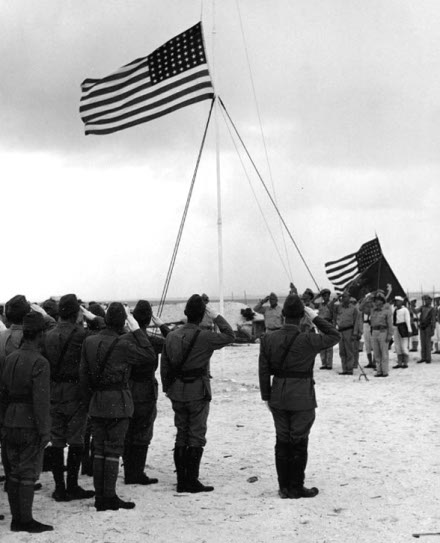
Shigematsu Sakaibara (right foreground) surrendering Wake Island on September 4, 1945.

These events, Sakaibara admitted in his trial, had taken place in an atmosphere of near starvation and impending doom. The defense counsel especially emphasized that point, asking the commission to understand and respect the pressures and strains on Sakaibara at the time of the incident. But the commission was not in a forgiving mood. In the chaos of retreat or not, innocent civilians had been murdered.

… Unfortunately for Sakaibara, several members of his former command expressed surprise on the witness stand when asked about the desperate situation on Wake in 1943. These men insisted that Sakaibara and his defense team’s description of a starving, chaotic Wake was an exaggerated one. There had been no unexpected miseries, confusion, or sense of peril, they said. Sakaibara’s fate was sealed.

True to form, defendant Sakaibara offered a very literate final statement to the commission. In contrast to so many of his colleagues on trial in Tokyo, on Guam, or elsewhere, Sakaibara, albeit with carefully picked words, admitted he was guilty of rash and unfortunate actions. He appeared especially convincing when he noted that he wished he had never heard of Wake Island. But his most memorable comments involved his own view of morality in war. A nation that drops atom bombs on major cities, the rear admiral explained, did not have the moral authority to try so many of his countrymen. With Hiroshima and Nagasaki in mind, Sakaibara claimed there was little difference between himself and the victors over Japan. With that statement a legend grew, particularly in his home town, of Sakaibara, the victim of American revenge.

… As late as the 1990s, some people there, not necessarily of the World War II generation, still bowed in reverence to Sakaibara family members out of respect for the “sacrificed” gentleman soldier.

His last words:

I think my trial was entirely unfair and the proceeding unfair, and the sentence too harsh, but I obey with pleasure.

* Some sources places the executions on June 19; the U.P. wire story, dated June 19th, referred to the hangings occurring “last night,” and the preponderance of evidence I have been able to locate appears to me to support the 18th rather than the 19th.

** An interesting bit of interservice-rivalry color on proceedings in Guam, courtesy of Prisoners of the Japanese:

The United States Navy had hanged fewer than a handful of men in more than a hundred years … Now on Guam they had all kinds of Japanese to try and sentence to death … They had to requisition an Army executioner to show them how to hang. He was a lieutenant with silver-rimmed glasses, a leading-man moustache, and a paunch. He used the traditional British drop formula, but he was an innovator as well: He invented a method of lowering the dead body to the stretcher without having to cut the rope.

On this day..

1076: Waltheof II, Earl of Northumbria

On this day in 1076, William the Conqueror had Northumbrian Earl Waltheof II beheaded for treachery — the only major noble executed by the Norman king.

Waltheof in the comics! (Or see him trade up to battle-axe here.) According to Reality Fiction, Waltheof had a colorful afterlife as a literary character whose reputed exploits grew more prolific with age; he was a popular saint in the next generations. Some also consider Waltheof a possible ancestor of Robin Hood.

When the Norman Conquest brought William the Conqueror to power, the nobles didn’t know the Normans would be able to keep what they’d won … and being nobles, they started plotting.

Multiple revolts shook the northern marches where Waltheof had his domain, and the burly Northumbrian, according to skald Thorkill Skallason, was a Norman-killing machine.

Waltheof burned a hundred
Of William’s Norman warriors
As the fiery flames raged;
What a burning there was that night!

Our day’s principal made nice with the Conqueror and even got dynastically wedded to William’s niece, Judith.

But his fame as a warrior and strategically positioned estates soon had conspirators wooing him for another run at rebellion — the Revolt of the Earls, which would turn out to be the last serious resistance to the last successful invasion of Britain.

Waltheof either (accounts are radically at odds) signed on and then got cold feet, or got entrapped into it, or didn’t join but also didn’t report it when he found out, or got shopped for political reasons by his Norman bride. (Judith, suspiciously, got to keep his huge tracts of land after Waltheof lost his head for the property-confiscating offense of treason.)

Whatever the case, he was soon obliged to throw himself on the mercy of the king. He got a royal wife as his first prize for a brush with treason. His second prize was, he was decapitated.

Waltheof is supposed to have made such a delay at the scaffold with the Lord’s Prayer that the headsman got impatient and lopped off his dome after the words “Lead us not into temptation.” Devotional legend says that the severed head completed the prayer.

Thorkill Skallason remembered the last English earl still keeping it real under William’s rule.

William crossed the cold channel
and reddened the bright swords,
and now he has betrayed
noble Earl Waltheof.
It is true that killing in England
will be a long time ending;
A braver lord than Waltheof
Will never be seen on earth.

Another quarter-millennium elapsed before another English earl — Thomas Plantagenet, Earl of Lancaster — was put to death in the realm.

Waltheof’s story is told in detail in the context of The history of the Norman conquest of England, available free from Google books, and directly from the relevant primary documents here.

On this day..

1831: Mariana de Pineda Muñoz, Spanish liberal

On this date in 1831, Mariana Pineda died for her flag.

The problem, in the eyes of feckless royal troglodyte Ferdinand VII, was that Pineda’s flag stood for “Equality, Freedom and Law.”

The widowed 27-year-old (English Wikipedia page | the much more detailed Spanish) had become a devotee of the liberal Zeitgeist that contended in post-Napoleonic Europe with absolutism.

Spain had had the briefest of flings with liberal government in 1812, only to have Ferdinand reverse Spain from one of the most progressive governments in Europe to one of its most backward. The man even reintroduced the Spanish Inquisition.

By the 1830’s, tensions between constitutional liberals and unreconstructed royalists had Spain on the point of civil war, which would in fact erupt upon Ferdinand’s death two years hence.

Mariana Pineda swam with liberal circles, even helping a death-sentenced cousin escape prison. In 1831, the authorities found a flag in her home embroidered with the “Equality, Freedom and Law” slogan.

Pineda refused to name accomplices, and Ferdinand threw the book at her. Pineda remained adamant.

Before suffering public garrotting in her native Granada (while the offending flag was burnt before her), Pineda declared,

“The memory of my ordeal will do more for our cause than all the flags in the world.”

Her prediction wasn’t so far off.

Pineda’s posthumous repute as heroine has migrated from the particular cause of her day to the general pantheon of Spain. These days, a Granada public holiday (festivities held in the square named in Pineda’s honor) commemorates her sacrifice. Her name is also a byword for the struggle of women to win full political participation (there’s a Centro Europeo de Las Mujeres “Mariana de Pineda”). And martyred playwright Federico García Lorca turned her story into a theatrical classic — his first successful play.

On this day..