1849: Ugo Bassi, nationalist priest

Measure thy life by loss instead of gain;
Not by the wine drunk, but the wine poured forth
For love’s strength standeth in love’s sacrifice;
And whoso suffers most hath most to give.

-From Harriet King‘s poem “Ugo Bassi’s Sermon in the Hospital”

On this date in 1849, the Garibaldian priest Ugo Bassi was shot in Bologna along with fellow-nationalist Count Livraghi.


Statue of Ugo Bassi at Bologna’s via Ugo Bassi.(cc) image from Biblioteca Salaborsa.

Detail view (click for full image) of Bassi and Livraghi being escorted to execution.

Bassi was a penniless Barnabite priest famous for his powerful oratory* and his national enthusiasms. He signed right up for Garibaldi‘s national movement in the heady liberal revolutions of 1848-49.

“Italy is here in our camp,” he would say of the Garibaldian forces readying their (ultimately unsuccessful) defense of the Roman Republic.** “Italy is Garibaldi; and so are we.”

Alas, in this engagement, Italy had a lot fewer guns than the French.

The new French ruler Napoleon III, who had himself been in youth a revolutionary carbonaro in Rome, saw foreign policy advantage in backing the exiled Papacy and overthrew the Republic.†

Garibaldi escaped to exile, but many of his subalterns did not. Bassi was captured unarmed — he didn’t even bear arms in battle — and Pius IX, once thought a fellow-traveler by the liberals, did not hesitate to hand him to the Austrians for punishment. The Habsburgs stood equally to lose from any gains of the Risorgimento, and accordingly gave Bassi a perfunctory military trial, then had him shot immediately in Bologna.

For crowning his open-hearted life with this sacrifice, Ugo Bassi instantly became, from that day to this, one of the best-honored Italian patriots.

He possessed at once the simplicity of a child, the faith of a martyr, the knowledge of a scholar, and the calm courage of a hero … If ever Italy comes to be united may God restore her the Voice of Ugo Bassi … The name of Ugo Bassi will be the watchword of the Italians on the day of vengeance!

Garibaldi

* Anecdote associated with Bassi once he came to firing up the Bolognese for Garibaldi: a poor girl who could give nothing to the cause spontaneously chopped off her own hair and handed it to him. This is the event depicted by Bassi’s fellow-Bolognese Napoleone Angiolini, Ugo Bassi sui gradini di San Petronio.

** Topical incidental: the Roman Republic lasted only a few months, but its constitution abolished the death penalty … so it can count as the first nation to abolish capital punishment in constitutional law.

† Earning Napoleon III the permanent wrath of Italian nationalists.

On this day..

1759: Eugene Aram, philologist

On this date in 1759, Eugene Aram was hanged at York for murder.

Aram was the son of a gardener, but taught himself Latin and Greek and made himself a respected schoolteacher.

Aram had a special gift for languages, and began research on a never-completed comparative lexicology of the Celtic tongue — correctly intuiting, if not the identity of the distant common mother tongue, the concept of what is now understood as the common progenitor of the related Indo-European languages.

the ancient Celtae, by the numberless vestigaes left behind them, in Gaul, Britain, Greece, and all the western parts of Europe, appear to have been, if not the aborigines, at least their successors, and masters, in Gaul, Britain, and the west; — that their language, however obsolete, however mutilated, is at this day discernible in all those places which that victorious people conquered and retained: — that it has extended itself far and wide, visibly appearing in the ancient Greek, Latin, and English, of all which it included a very considerable part; and, indeed, it still unquestionably, forms a most important ingredient in all the languages of Europe. (Source at archive.org | Google books)

His might have been an illustrious name in linguistic history. Instead …

In 1745, when Aram was already 40 and teaching in Knaresborough, a strange event occurred: a friend of Aram’s named Daniel Clark made the rounds of local merchants “buying” (on credit) a variety of portable valuables … and then promptly disappeared. Aram was suspected of some part in this sketchy affair and detained using the expedient of an outstanding debt pending investigation that would yield a more satisfactory charge.

Aram, however, paid off his arrears in cash. Since no real grounds existed to hold him, he walked away, and immediately left Knaresborough.

There the matter rested for 13 years, time that Aram spent immersed in his language work.

Justice delayed was not to be denied, however. Finally, in 1758, the accidental discovery of a body in Knaresborough rekindled interest in the case (even though the body turned out not to be Clark’s). Thirteen years on, the matter unlocked with amazing ease; Aram’s wife (left behind in Knaresborough when our man blew town) had her suspicions, which led to a mutual friend of Aram’s and the victim, who gave authorities the correct location of Clark’s theretofore undiscovered body. (Namely, St. Robert’s cave.) Upon that considerable credibility the mutual friend (Houseman by name) accused Aram of the murder. Since the wife was also prepared to swear she had heard all these men, and Clark among them, conspiring shadily together, Aram was in the stew.

As a proper Enlightenment man, learner of languages, inquirer of science, writer of poetry, and author of dark and vengeful deeds, Aram didn’t bother with a barrister but defended himself, and very ably in the judgment of his observers.

“His defense was an ingenious plea of the general fallibility of circumstantial evidence,” records this encyclopedia. But he had to stick to generalities because (as he admitted after conviction) he was actually quite guilty, and Aram “seemed really more carried away by the abstract philosophy of his argument, than impressed by the terrible relation it bore to his fate.” The lengthy Newgate calendar entry on his case preserves some of these sorties.

He would eventually ascribe his own motive not to greed of gold but suspicion of cuckoldry. Houseman, who was probably just as involved (and probably in his part for greed) appears to have escaped the noose.

Aram became a potent literary reference for his countrymen as a partially sympathetic, Janus-faced creature: the thoughtful scholar encumbered by his guilty conscience, or one whose potential gift to all mankind is undone by his injury to one man.

Edward Bulwer-Lytton wrote a novel about Aram. In Thomas Hood‘s poem “The Dream of Eugene Aram”, the titular killer is tormented by the recollection of what he has done.

“Oh God! that horrid, horrid dream
Besets me now awake!
Again — again, with dizzy brain,
The human life I take:
And my red right hand grows raging hot,
Like Cranmer‘s at the stake.

“And still no peace for the restless clay,
Will wave or mould allow;
The horrid thing pursues my soul —
It stands before me now!”
The fearful Boy looked up, and saw
Huge drops upon his brow.

That very night while gentle sleep
The urchin’s eyelids kissed,
Two stern-faced men set out from Lynn,*
Through the cold and heavy mist;
And Eugene Aram walked between,
With gyves upon his wrist.

Wodehouse, Orwell, W.G. Wills all also dropped Eugene Aram literary references in their day.

* The town in Norfolk where Aram was hanging his hat when he was finally arrested.

On this day..

1301: False Margaret, Norwegian pretender

(Thanks to Meaghan Good of the Charley Project for the guest post. -ed.)

This is the feast date for the early Christian martyr Saint Margaret the Virgin of Antioch (only one of many saints named Margaret).

Margaret might in principle be of interest to this site as the patroness of the falsely accused, and one of the saints who spoke to Joan of Arc, but her star has fallen quite a bit since its medieval heyday on the celestial all-star team; considering the doubtful historicity of this bog-standard Diocletian martyr, the Catholic Church has dropped some of her celebrations.

So instead we’ll turn to a namesake of Margaret’s — well, namesake once removed.

We don’t know the date or even the season in 1301 when the so-called False Margaret and her husband were executed for fraud and treason: he by beheading, and she by burning at the stake.

The pair had made an audacious grab for the Norwegian throne the previous year. The story was told in detail in a nineteenth-century Icelandic history.

The False Margaret (whose true name has been lost to history, as has that of her husband) claimed to be Princess Margaret, known as the Maid of Norway, who was supposed to have died a decade before. How she got the idea to do this is a mystery. It seems unlikely that she came up with the plan on her own, but if she didn’t, then who set her up?

The actual Maid of Norway was the daughter of Eric II of Norway and a mom also named Margaret, this Margaret the daughter of Alexander III of Scotland. Said couple’s marriage treaty specified that if Alexander died without sons, and his daughter had children by Eric, those children would succeed to the throne of Scotland.

This is precisely what happened: Alexander died in 1286 without a legitimate son to succeed him, leaving his kingdom to the three-year-old Norwegian princess.

Technically speaking, the Maid of Norway was Queen of Scots from 1286 until her death. But since she was never crowned and never set foot on Scottish soil, some lists of Scottish monarchs do not include her name. She remained in Norway for the next several years and a selected group of guardians tried to maintain control of the country for her.

On, for the laughter, harps he pressed,
The feast’s right royal quarter; —
But west the ship fared, ever west
With Eric’s little daughter

-From “King Haakon’s Banquet Hall”, by Henrik Ibsen (pdf link)

Eric set about arranging a marriage for his daughter, eventually settling on the future Edward II of England, who was then Prince of Wales. Margaret set off for Scotland in 1290, with the plan that the English wedding would be arranged once she arrived.

Alas, the Maid of Norway never saw Scotland.

In September or October of 1290, en route, she died suddenly somewhere in the vicinity of the Orkney Islands, which were then Norwegian territory. She was only seven years old.

Her death set off a crisis in Scotland as more than a dozen heirs competed for the vacant throne, and this eventually lead to the Wars of Scottish Independence.

But did little Margaret really die?

In 1300, a woman arrived in Bergen, Norway on a German ship, claiming to be the lost princess. She said she had not died but had in fact been “sold” by one of her female attendants and sent to Germany, and had married there. By this time, Eric II had died without male issue and his brother, Haakon V, had become King of Norway.

In spite of the fact that (a) the Maid of Norway’s body had been returned to Norway and was identified by her father and (b) the False Margaret appeared to be about 40 years old when the Maid would have been 17, the False Margaret’s claims drew considerable popular support.

Why? A theory was put forth by the 19th-century Scottish historian John Hill Burton:

The announcement of so portentous an event [meaning the Maid’s death], through indistinct rumors, naturally caused men to talk and doubt. There was none of the solemn detail that might be expected to attend on a royal death, even though less heavily laden with a perplexing future. We are not told of any who were present, of the disease or its progress, of the spot where she died, or the place where she was buried. The time of death is only inferred … The whole affair has left on Scandinavian history a shadow of doubt, in the possibility that the child might have been spirited away by some one of those so deeply interested in her disappearance, and consequently, that it may be an open question whether the royal line of the Alexanders really came to an end…

It should be emphasized that there is no evidence of any conspiracy surrounding the Maid’s death and no evidence of her survival past 1290. Her own father, who had no apparent reason to lie, viewed the body and identified it as his daughter.

But people will talk, and believe what they want, and so the False Margaret found support for her wild story.

Ironically, even if she had been the real Maid of Norway, the False Margaret was not a serious rival to her uncle Haakon; her sex would have prevented her from ruling. But, as the Norwegian historian Peter Andreas Munch noted,

Her pretensions … might, nevertheless, have been extremely distasteful to him, and probably not altogether free from danger in the future, if, as was not at all unlikely, they should be made use of by the party of nobles who were discontented with his absolute government. This party would willingly have thrust him from the throne … but before they could hope to do so they must have a pretender to the crown of the old royal stock to set up opposition to him. [ … ] And for this purpose there would have been none more suitable than Margaret, if she could be conjured from the dead again.

This woman had to be dealt with. There was no getting around it.

Since the False Margaret and her husband were not executed until 1301, a year after their arrival in Norway, it seems likely that there must have been some official investigation into her claims. If so, the records of this have been lost. What seditious nobles might have hoped to gain through her has likewise slipped into a speculative fog. But False Margaret was clearly a matter of highest statecraft at the time: the executions were delayed until King Haakon could personally come to Bergen to see them carried out.

Embarrassingly, the False Margaret’s cause did not die with her. Her supporters actually erected a church to our friend Saint Margaret near the place of her execution. (The church is no longer extant.)

On this day..

1844: Gabriel de la Concepcion Valdes, “Placido”

On this date in 1844, Cuban poet Gabriel de la Concepcion Valdes was executed in Matanzas for conspiring to overthrow Spanish authority on the island.

His mother (who gave him up to an orphanage) was a Spanish dancer. His father (who adopted him back) was a “quadroon” barber. Valdes, aka Placido (Spanish link, which is true of most available online resources about him) grew up as a free mixed-race youth in a slave society.

This situated him in the privileged (relative to plantation slaves) but precarious position of the petty bourgeoisie, menaced not only by the prospect of economic reversal but by the vicissitudes of Spanish policy towards his caste — whose growth many colonial officials fretted warily.

Though Placido made his bread apprenticing as a print-maker and later making turquoise combs, he made his fame by dint of literary gift that was celebrated throughout Cuba and abroad. His “La siempreviva” won a literary competition when he was just 25, and led to an invitation to visit Spain (Placido declined it); the Cuban-born, naturalized Mexican poet Jose Maria Heredia visited Cuba in 1836 and made a point to look up Placido; and according to the out-of-print Cuba’s Romantic Poet: The Story of Placido by Frederick Stimson, the young Cuban was wildly popular with North American slavery abolitionists as well.

Placido is less well-remembered beyond his home island today, but arguably rates as Cuba’s most distinguished Romantic poet.

In the 1830s especially, when civil war in Spain put the reigning monarch on the liberal side, Placido was able to exploit the opening to write openly of Cuban political aspirations.

His La Sombra de Padilla, dedicated to Spain’s “wise and exalted Queen”, imagines one of Spain’s martyred comuneros charging him to venture his life for liberty against absolutism.

Better to fall prey to La Parca [the Grim Reaper]
Than to a despotic Monarca

But notwithstanding the war in Iberia, the exalted Queen still put Cuba under special (read: repressive) law. Placido’s prominence, having advocated for much more freedom than Cuba was slated to enjoy, subjected him to automatic Spanish suspicion as more authoritarian governance arrived in the 1840s.

The poet was arrested in the Conspiración de La Escalera (Conspiracy of the Ladder, so named for the structure its accused were tortured upon). This purported plot to raise a slave revolt may or may not (pdf) have really existed, but the crackdown it authorized sure did. Indeed, despite the “slave revolt” bogeyman, it was overwhelmingly free blacks whom the Spanish suppressed in this affair.

Gariel de la Concepcion Valdes, known as “Placido”, was shot with ten others, “miserable instruments of the most depraved machinations of immoral men, men who deserve the curse of the living and the opprobrium of generations to come,” just a week after his conviction.

The appointed lot has come upon me, mother,
The mournful ending of my years of strife,
This changing world I leave, and to another
In blood and terror goes my spirit’s life.

But thou, grief-smitten, cease thy mortal weeping
And let thy soul her wonted peace regain;
I fall for right, and thoughts of thee are sweeping
Across my lyre to wake its dying strains.

A strain of joy and gladness, free, unfailing
All glorious and holy, pure, divine,
And innocent, unconscious as the wailing
I uttered on my birth; and I resign

Even now, my life, even now descending slowly,
Faith’s mantle folds me to my slumbers holy.
Mother, farewell! God keep thee — and forever!

-Valdes, “Farewell to My Mother”

There are volumes of Placido’s poetry (in the original Spanish) freely available via public-domain Google books offerings here and here, with a short thumbnail biography here. For the nonfiction biographical exploration of Placido’s life, and detailed critical analysis of his poetry, this Vanderbilt master’s thesis (pdf) is highly recommended.

On this day..

1740: Artemy Volynsky

On this date in 1740, the Russian politician Artemy Volynsky was beheaded in St. Petersburg.

Volynsky, as famously corrupt as he was famously able, had worked himself up from Peter the Great’s dragoons into the circles of high statecraft but lost a power struggle in the notoriously cruel court of Empress Anna. He’d made it all the way to Anna’s cabinet, but there made himself the rival of powerful Baltic grand chamberlain Ernst Johann von Biron: in political terms, Biron and the fellow Balt who ran foreign policy had a west-facing, German orientation, while Volynsky looked east to Central Asia, India, and China; in personal terms, Biron was the lover of the queen, and Volynsky … was not.

After Volynsky beat up a poet, Biron had the excuse to have him investigated and was able to construct as treasonable some private correspondence about changing the way things are done in Russia, Biron thereby ridding himself of the rival.


Just a few months after Volynsky’s execution, Anna herself died, leaving an ill-starred one-year-old heir and an uncertain political situation.

In the event, Biron and his fellow Germanophiles were driven out of court by the Russian grandees, who then constructed the late Volynsky — by all indications as cutthroat and grasping as anyone else at court — as a patriotic martyr vis-a-vis the detested late ascendancy of the Baltic types.*

As a result, in 1741, a modest monument (later aggrandized) was set up to Volynsky et al at St. Sampson’s Cathedral.**

Further to that same end, the scaffold-bound 19th century Decembrist poet Ryleyev (Ryleev) paid his own tribute to Volynsky in verse. So far, I’ve only found Ryleyev’s “Volynsky” in Russian, but here’s a little taste [courtesy of blog friend Sonechka] of the gist:

He who resists the overweening
Expects no reward and asks for none
And forgetting even himself
Sacrifices all to the motherland.
Against the cruel tyrants
He will be free even in chains
At execution justly proud
And ever after exalted.


In that same vein, Ryleyev’s contemporary Ivan Lazhechnikov featured Volynsky as the protagonist of his historical novel The Ice Palace or The Ice House,† again whitewashing the man’s ample stock of disreputable qualities.

The book’s title alludes to a famous structure put up in the winter of 1739-1740 for the royal court’s amusement, a vast frozen edifice 20 meters tall and 50 meters wide, designed by the architect Pyotr Yeropkin … a Volynsky ally who ultimately shared Volynsky’s fate on June 27, 1740.

This sounds great, but the decadent amusement park soon became the scene for one of imperial Russia’s more infamous and bizarre horrors: Anna forced an ex-prince who had been demoted to court jester for marrying a Catholic to wed a homely Kalmyk serving-girl, with whom he would have to pass a “wedding night” naked in that icebox. (Somehow, they managed to survive.)


The yellow-clad Anna dances merrily while her terrified servants/prey brace to survive a winter night on the ice bed. Detail view; click for the full painting.

Volynsky’s machiavellian contribution to the ghastly scene had been to associate this spectacle with a celebration of Anna’s name day.

This bit of sucking up didn’t buy him quite enough time when it was all said and done, but it reminds of Volynsky’s highly mitigated claim on eternal exaltation.

* Remembered as the Bironovshchina. Compare to the Yezhovshchina, at the height of Stalin’s purges: why don’t these things ever get named for the actual chief executive?

** Saint Sampson the Hospitable has a June 27 feast date; the cathedral was dedicated in his honor because that was also the date, in 1709, of Russia’s watershed victory over Sweden at the Battle of Poltava.

† There’s more about this novel in the context of both 19th century literature and Volynsky’s own era in this pdf dissertation extract, pp. 7-22.

On this day..

1575: The intrepid Torii Suneemon

On this date in 1575* a Japanese soldier was crucified under the walls of his castle … and entered his country’s folklore.

Torii Suneemon was a footman of the Okudaira family late in Japan’s fratricidal Warring States Period.

The Okudaira, allies of the wars’ eventually-victorious Tokugawa clan, found themselves besieged by the Takeda. This would result in the important Battle of Nagashino.


Kurosawa’s masterpiece Kagemusha imagines the Takeda where the (real) late daimyo Shingen was succeeded after his (real) 1573 death (fictitiously) by an imposter thief posing as the great commander. In the film, the imposter is unmasked and deposed, but witnesses the climactic Battle of Nagashino … and then makes a futile charge under the Takeda banner after that side is slaughtered.

After an initial Takeda attempt to take the fortress by storm, the Takeda settled in for a brief siege — knowing the defenders to have only a few days’ supplies on hand. Enter Torii Suneemon.

Under cover of darkness on the night of the 22nd-23rd, Suneemon slipped out of the Yagyu gate and picked his way through Takeda tripwires to escape the investment … and summon help.


Torii Suneemon embarks on his mission: 19th century woodblock print of Yoshitoshi‘s “24 Accomplishments of Imperial Japan” series. The same artist also depicted that event in this triptych.

He made it on the 23rd to Tokugawa Ieyasu and Oda Nobunaga, who upon hearing his report pledged to dispatch a relief force the very next day.

Alas for him, Suneemon’s attempt to sneak back into the encircled fortress to deliver the good news was detected on the 24th, and he came as a prisoner to the Takeda commander. The Takeda prevailed upon their helpless captive to exchange his life for a signal service: approach the fortress walls and shout to the garrison that no help was on the way.

This Suneemon agreed to do.

The legends differ as to whether he walked on up to deliver this bogus bad news, or whether the Takeda lifted him up on a cross to impress upon their new agent the penalty for any funny business. Either way, Torii Suneemon had the last laugh: he immediately began hollering to the defenders that help was coming if they could just hang on a few more days.


Torii Suneemon goes off-script. Another Yoshitoshi creation, from here or from this detailed French post.

The besiegers, of course, crucified him immediately … but everyone could appreciate the doomed man’s heroism.

While the grateful Okudaira elevated his family to samurai rank, even an enemy Takeda commander who witnessed the event was so moved that he adopted the image of the defiantly crucified soldier for his battle standard.

Heck, there’s apparently even a Japanese monument in San Antonio, Texas that compares Suneemon to the Alamo defenders.

Nor was the brave soldier’s sacrifice in vain. The garrison did hold on — and their allies did relieve them, and did rout the Takeda in the resulting Battle of Nagashino. (The scenario is widely reproduced in video games nowadays).

* Some sites give this as “May 16”, but I believe the primary sources here actually indicate the 16th day of the 5th month on the traditional Japanese lunisolar calendar. This date corresponds to June 24, 1575 of the Julian calendar. (1570s conversion aid in this pdf, or use this converter).

On this day..

1416: Jerome of Prague, the first Hussite martyr

On this date in 1416, the Council of Constance had Jerome of Prague burned at the stake in the town square.

This eloquent, injudicious theologian studied at Prague, Oxford, Paris, Cologne, Heidelberg … accumulating Master’s degrees along the way like a career graduate student, but repeatedly finding himself run off the premises on suspicion of heresy.

Jerome’s “heresy” was an excessively combative hostility to ecclesiastical corruption. And although Jerome was known for his rapier tongue, he didn’t always find the pen mightier than the sword: he got into a few physical scraps with his foes.

While in England, he copied out a manuscript of preacher John Wycliffe — whose radical piety (or pious radicalism) inspired the rebellious Lollard movement.

Back on the continent, Jerome fell in with Jan Hus. Ten years Jerome’s senior, Hus was and remains the first name in Bohemian religious reform, and the “Hussite” church he founded still retains his name.

After Hus unwisely accepted a guarantee of safe conduct to dispute at the Council of Constance, the more ornery Jerome slipped into town to propagandize on his mentor’s behalf. After placarding his way to trouble, he slipped back out and must have thought he’d had his cake and eaten it too … until he was caught in the Black Forest.

Jerome spent nearly a full year in a dungeon — the Council met for four years; it had a massive schism to sort out — and at one point the privations of imprisonment led him recant. He later bitterly regretted that concession to “pusillanimity of mind and fear of death,” but on a strictly doctrinal level Jerome of Prague wasn’t anti-Catholic: he just wanted the church to be less of a bunch of corrupt, overweening racketeers.

By the time he was ready to answer for himself, and his soul, he was well past any spirit of capitulation. A witness to the procedure wrote of Jerome on trial for his life:

I have never seen any one, who, in pleading, especially in a capital offence, approached nearer the eloquence of the ancients, whom we so greatly admire. It was so amazing to see with what fluency of language, what force of expression, what arguments, what looks and tones of voice, with what eloquence, he answered his adversaries and finally closed his defence. It was impossible not to feel grieved, that so noble, so transcendent a genius had turned aside to heretical studies, if indeed the charges brought against him are true.

When that part of his indictment was read in which he is accused of being “a defamer of the papal dignity, an opposer of the Roman pontiff, an enemy of the cardinals, a persecutor of the prelates and clergy, and a despiser of the Christian religion,” he arose, and with outstretched hands and with lamenting tones, exclaimed: “Whither now, conscript Fathers, shall I turn myself? Whose aid can I implore? Whom supplicate, whom entreat for help? Shall I turn to you? Your minds have been fatally alienated from me by my persecutors, when they pronounced me an enemy of all mankind, even of those by whom I am to be judged. They supposed, should the accusations which they had conjured up against me, seem trivial, — you would, by your decisions, not fail to crush the common enemy and opposer of all, — such as I had been held up to view, in their false representations. If, therefore, you rely upon their words there is no longer any ground for me to hope.”

Some of them he wrung hard by the sallies of his wit; while others he overwhelmed with biting sarcasms; and from many, even in the midst of sadness, he forced frequent smiles, by the ridicule which he heaped upon their accusations.

At length, launching out in praise of John Huss who had been condemned to the fire, he pronounced him a good, just, and holy man, altogether unworthy of such a death, — adding that he was also prepared to undergo, with fortitude and constancy, any punishment whatsoever, yielding himself up to his enemies and the impudent lying witnesses, “who would, at length, have to give an account of all they had uttered, before God, whom they could not possibly deceive.” Great was the grief of all that stood around him. Thee was a universal desire among them to save so noble a personage, could his own consent be obtained. Persevering, however, in his opinions, he seemed voluntarily toseek death; and continuing his praise of John Huss, he declared that man had never conceived any hostility to the church of God; but that it was to the abuses of the clergy, and the pride, pageantry and insolence of her prelates alone he felt opposed; for, since the patrimony of the church was due, in the first place, to her poor; then to her guests; and finally to her on workshops; it seemed to that good man, a shameful thing, to have it expended upon courtezans and in banquets; for the sustenance of horses and dogs, the adornment of garments and other things unworthy of the religion of Christ.

Most exalted was the genius of which he showed himself possessed! Often was he interrupted in his discourse by various noises; and greatly vexed by those who carped at his opinions; yet he left none of them untouched, but equally avenging himself upon all, he either covered them with confusion, or else compelled them to hold their peace. A murmur arising against him, he paused for a moment; and then, having admonished the crowd, proceeded with his defence, — praying and beseeching them to suffer one to speak whom they would soon hear no more. At none of the noise and commotion around him did he tremble, or lose, for a single instant, the firmness and the intrepidity of his mind.

“You will condemn me iniquitously and unjustly,” he prophesied to his judges, “and when I am dead, I shall leave remorse in your consciences and a dagger in your hearts; and soon, within a hundred years, — you will all have to answer me, in the presence of a Judge most high and perfectly just.”

Reports differ as to the subsequent standing of all these men’s souls. But for the church as a going earthly concern, Jerome nailed it almost exactly: 101 years after he followed Jan Hus to the stake,* that long-suppressed spirit of reform irrevocably splintered papal authority.

* In the very same spot where Hus himself was burnt.

On this day..

1958: Khosrow Roozbeh

On this date in 1958, Iranian communist Khosro(w) Roozbeh was shot in Qezel Qal’eh prison.

“A popular teacher at the Military Academy, Rouzbeh was the author of a number of pamphlets on chess, artillery warfare, and, together with Ovanessian, the country’s first political lexicon,” blurbs Tortured Confessions: Prisons and Public Recantations in Modern Iran.

He was also not only a communist, but a radical within the context of Iran’s communist Tudeh Party.

After the 1953 CIA-backed coup restored the Shah of Iran, his government persecuted Tudeh activists as a fifth column.

Thousands were arrested, and brutally tortured into betraying their comrades. While most weren’t put to death, Roozbeh was both a true militant — he opposed moderates’ attempt to make common cause with the liberal Mossadegh government that the Shah had deposed — and the organizer of a network of military infiltrators. The British embassy called him the “Red Pimpernel” for his uncanny talent for slipping traps and getting about in disguise. But that act never has a long shelf-life.

Roozbeh was finally winged in a 1957 shootout and taken into custody, where he was tortured into his own confessions (e.g., that he had assassinated Tudeh members who were too willing about their police collaboration). After spending his last night on this planet putting NaNoWriMo to shame by cranking out a 70-page political manifesto, he’s supposed to have met his executioners defiant to the last, refusing a blindfold and crying “Long Live the Tudeh Party of Iran! Long Live Communism! Fire!”

But the volley that silenced Roozbeh’s cry can be seen in retrospect to mark the definitive elimination of communism from Iran’s political stage, the piece de resistance for SAVAK’s campaign of suppression.

After Roozbeh, Tudeh slipped into irrelevancy (Spanish link) … leaving little but the outsized myth of its most renowned martyr.

On this day..

1942: José Abad Santos, Chief Justice

On this date in 1942, Jose Abad Santos was shot by the Japanese forces occupying the Philippines.

Brother of a famous socialist agitator who fought the Japanese from the bush, Jose Santos had an impeccably mainline elite career: university degrees in America, corporate lawyering gigs, followed by a stint in the Ministry of Justice and elevation to the high court.

In December 1941, Santos administered the oath of office to re-elected president Manuel Quezon even as the archipelago was being invaded by the Japanese. Quezon would evacuate, forming a government-in-exile.

Santos preferred to stay, and would spend his last remaining weeks as the Philippines’ Acting President.

“It is an honor to die for one’s country,” he would say to his son, after their capture. (The son survived.) “Not everybody has that chance.”


Santos (who’s also been on stamps) is pictured in the back left on the 1000-peso bill. (The woman at bottom front is another executed patriot, Josefa Llanes Escoda.)

On this day..

1671: Zrinski and Frankopan, Croatian conspirators

He who dies honorably lives forever.

-Fran Frankopan

On this date in 1671, Croatian noble Fran Krsto Frankopan and his brother-in-law Petar Zrinski were beheaded by the Austrian empire at Wiener-Neustadt Prison.

The Zrinski-Frankopan Conspiracy — or Magnate Conspiracy — was the product of great powers chess in central Europe … and specifically, of the frustration of these lords in the frontier zone between the Austrian and the Ottoman Empires at being a sacrificial pawn.

Instead, they’d take control of their own destiny and be a self-sacrificial pawn.

Croatia and Hungary had been on the perimeter of Hapsburg authority for generations, and seen the rising Ottomans push well into Europe.

In the latest of innumerable wars, the Austrians had trounced the Ottomans, potentially (so the Croats and Hungarians thought) opening the door for reconquest of lost territory. Croatia in particular had been nibbled away by Ottoman incursions into a “remnant of a remnant.” Emperor Leopold I thought otherwise: he had Great Games to play in western Europe as well and didn’t find this an auspicious moment to go all in in the east.

Rather than following up his victory by trying to run the Turks out of their half of divided Hungary, or out of Transylvania, Leopold just cut an expedient peace on status quo ante terms quite a bit more favorable to Istanbul than the latter’s military position could demand.

The aggrieved nobles started looking around for foreign support to help Hungary break away.

This scheme never came to anything all that palpable, perhaps because the operation’s leading spirit Nikola Zrinski got himself killed by a wild boar on a hunt, and definitely because no other great powers wanted to get involved in the mess.

Zrinski (or Zrinyi) was also a noteworthy Croatian-Hungarian poet, as were the remaining conspirators.

The boar-slain’s younger brother Petar, his wife Katarina, and Katarina’s half-brother Fran Frankopan, also better litterateurs than conspirators, inherited the scheme’s leadership, and its penalty.


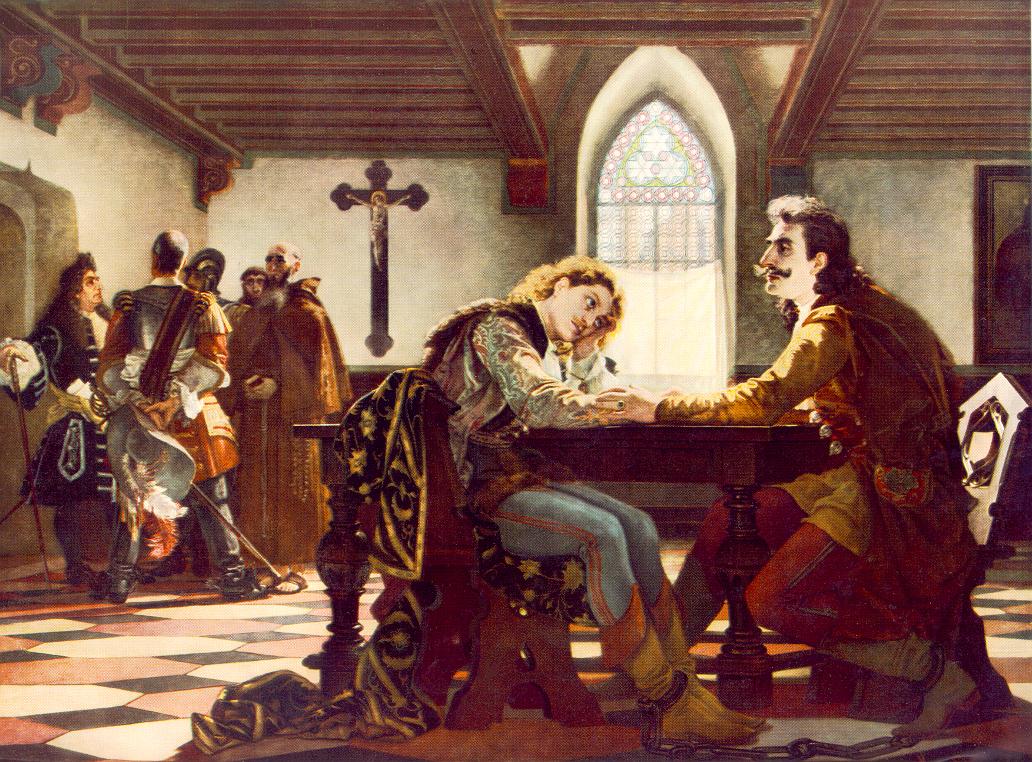
Zrinski and Frankopan in the Wiener-Neustadt Prison, by Viktor Madarasz (1864)

Royal vengeance against the plot shattered two mighty noble houses: the Zrinskis were all but destroyed by the seizure of their estates. The Frankopans — an ancient and far-flung family whose Italian Frangipani branch was even then about to yield a pope — were done as major players.

After these executions, anti-Hapsburg sentiment metastasized in Hungary into outright rebellion.

But in what was left of Croatia, the loss of the two largest landholders spelled the end of effective resistance until the era of 19th century romantic nationalism — when our day’s unfortunates were recovered as honored national heroes.

Zrinski and Frankopan are pictured on modern Croatia’s five-kuna bill, and were both reburied in Zagreb Cathedral after World War I finally claimed the Austrian Empire. (They also got memorial plaques in Wiener-Neustadt) Their mutual relation Katarina Zrinski, who avoided execution but was shut up in a convent, was a writer as well, and has ascended to the stars of founding patriotess, seemingly the go-to namesake for most any Croatian women’s civic organization. (Dudes honor the House of Zrinski by slapping the name onto sports clubs.)

On this day..