I am full of ambition and hope and of full charm of life. But I can renounce all at the time of need, and that is the real sacrifice. These things can never be hinderance in the way of man, provided he be a man. You will have the practical proof in the near future.
On this date in 1931,* India revolutionary Bhagat Singh was hanged by the British in Lahore, together with Shivaram Rajguru and Sukhdev Thapar. The hanging was surreptitiously done, on the evening before it was officially scheduled, with the men’s cremated ashes scattered into the nearby Satluj River.
Statue of the three March 23 martyrs near Amritsar, Punjab, close to the Pakistani border. (cc) image from Alicia Nijdam.
Though only 23 years of age when he hanged, Singh’s renown as a nationalist freedom-fighter was already considerable. It has not lessened in the intervening decades.
Till that time I was only a romantic revolutionary, just a follower of our leaders. Then came the time to shoulder the whole responsibility. … I began to study in a serious manner. My previous beliefs and convictions underwent a radical change. The romance of militancy dominated our predecessors; now serious ideas ousted this way of thinking. No more mysticism! No more blind faith! Now realism was our mode of thinking.
“It takes a loud noise to make the deaf hear,” read their leaflet, vindicating the (non-lethal) ordnance.
Singh’s arrest, along with a fellow bomb-tosser, was an intended consequence, but the official pursuit of the case against him also led back to Singh’s fellow-revolutionaries and bomb-manufacturers. Some of these were induced to inculpate Singh, Rajguru, and Thapar to the theretofore-unsolved murder of Lahore policeman John Saunders in December 28.
Saunders had been mistakenly assassinated: Singh et al took him for John Scott, a police superintendent who ordered a baton charge against protesters and personally helped beat to death one of the independence movement’s revered fathers.
While the law wrapped its coils about him, Singh led a successful hunger strike for better prison conditions, and kept churning out writing.
His example of sacrificial revolutionary ardor — not to mention his leftist politics — kept him a popular martyr figure for years after his death, all the way down to the present day.
Climactic execution scene from the 2002 Hindi flm The Legend of Bhagat Singh — one of many different cinematic adaptations of his story.
The Shaheedi Mela (Martyrdom Fair) is observed across Punjab each March 23 in honor of these men.
A spirit of hatred and revenge took possession of me. I had numerous fights in defense of what I believed to be my rights and those of my countrymen. I believed we were unjustly deprived of the social rights that belonged to us.
On this date in 1879, legendary Californio outlaw Tiburcio Vasquez was hanged in San Jose.
Born to a respectable family (his grandfather was the first mayor of San Jose) when the land was under Mexican control, Vasquez was among the many chagrined to find themselves demoted to second-class citizenry by the norteamericanoconquest of the Mexican-American War.
That occurred when Vasquez was in his early teens, and soon thereafter the young man was plying California’s ill-policed byways with the whole litany of depredations characteristic of the frontier outlaw: livestock rustling, highway robbing, shopkeep stickups.*
One of the latter furnished the proximate cause of his death and probably the most infamous single incident among his exploits: an armed robbery in Tres Pinos** that resulted in three shooting deaths and a serious manhunt.
For Vasquez, the end of the rope (last word: “Pronto”) was just the last act of a legendary career, of poetry and horsemanship and countless enchanted inamoratas. He was renowned in his own time, and has graduated since into a mythical, and potently symbolic, figure of the other peoples of the Golden West.
For this anniversary of Tiburcio Vasquez’s execution, we’re pleased to welcome John Boessenecker, author of the recent biography Bandido: The Life and Times of Tiburcio Vasquez . (Find another topical interview with this same author here.)
How did you separate fact from folklore researching this outlaw? How much do we really know about him?
Generally speaking the whole genre of outlaws and lawmen is sort of known for bad research and myths and crazy stories. It tends to attract — here I’m denigrating myself– people who are a little off. Like myself. The movie buffs tend to get reality mixed up with what they’ve seen in the movies.
The whole genre has attracted poor research and sensational writers since the days of the dime novels. Though there are real historical groups: the Wild West History Association is probably the best example — True West magazine and Wild West magazine do a god job of publishing authentic history.
With Vasquez in particular, he became a folk hero in his own lifetime to disadvantaged Hispanics.
He was personally very well-liked; as a general rule, he didn’t rob Hispanics (although he did from time to time); he paid for safe harbor and food; he was a terrific dancer; he wrote poetry to is female admirers. He was a bigger-than-life personality, sort of the life of the party.
Among the larger Hispanic community as he became more notorious in the 1870s, he became a folk hero in his own lifetime. A lot of the myths are exaggerations of things he really did.
When the colonized cannot earn a living within the system, or when they are degraded, they strike out. The most physical way is to rebel. This can be done in an organized way, as was done by Juan Cortina in Texas, or it can express itself in bandit activity. An analysis of the life of Tiburcio Vasquez clearly demonstrates that, while in the strict sense of the word he was a criminal, at the same time his underlying motivation was self-defense. Some Anglo-American folklorists have attempted to portray Tiburcio Vasquez as a comical and oversexed Mexican bandit … dismiss[ing] the legitimate grievance of Chicanos during the nineteenth century. While it is true that Tiburcio Vasquez was an outlaw, many Mexicans still consider him a hero.
His outlaw career seems like it’s bound up in this Anglo-Hispanic cultural collision. To what extent does that influence how he’s “read” by others?
His life is sort of a microcosm of what was going on. The first portion of my book deals with the rise and fall of the native settlers of California.
With the loss of California in the Mexican-American War and then the discovery of gold, they became second-class citizens in their own land. So Vasquez becomes a folk hero — he robbed stagecoaches, thumbed his nose at the sheriff, and got away.
But he was also a bandit.
In the 1960s, the so-called Chicano historians (pdf) latched on to Vasquez, and they actually believed he was a Robin Hood figure or a “social bandit”. This is a total crock.
You find these same outlaw myths in all cultures. Vasquez is no different, though he’s better documented than most. People would sing corridos about him.
There were some quotes by him that says that he was driven to it, the Anglos drove me to it — but that’s no different from Jesse James or Billy the Kid saying they were driven to it, even if it’s true. Most of these guys I’m talking about are or were history professors; they should have known better.
What led you to this story?
When I was a kid in the early 60s I watched all the westerns. Clint Eastwood and Steve McQueen were my favorite. But then I wanted to know, was there a Wild West here in California? So when I got into high school I went and read everything I could get my hands on about early California history.
Vasquez and Black Bart were pretty much the most famous early California outlaws. So I started researching Vasquez in high school, and collected information for about 40 years, but it took me another four years to write it.
There’s never been a biography about Vasquez. There were three paperback books published about him, one after he was captured and two right after he was hanged — they’re not dime novels, but they’re sort of semi-fictional. There have been many magazines, many book chapters since, but everything published about him has just been a rehash of those three books. (n.b. — here’s a pdf of one of those original 1870s books -ed.)
It must have been a compelling story for you to stick with it for 40 years.
It’s just sort of a great story from early California. Vasquez was very colorful.
He fell under the influence of a guy named Anastacio Garcia when he was about 16 years old, and his parents seem to have separated. He had a large family; all of them were extremely honest. One of his brothers was a very prominent rancher; another brother served a term as a justice of the peace in Los Angeles County.
Vasquez, possibly because his father wasn’t around, fell under the influence of Garcia and got involved in the Roach-Belcher feud. Garcia was a hired gun, and the two of them were involved in a brawl in a Fandango house in 1854 and one of them killed a local constable. Tiburcio Vasquez fled Monterrey and never appeared openly after that.
But he basically did not change.
He was engaged to Garcia’s sister when he was 17 and she apparently broke it off. That seemed to have embittered him because he never had another serious relationship again with another woman. He was a real rounder, he got shot over women, took off with the wives of other gang members.
That was very foolish — that’s what got him the noose, when a cuckolded gang member testified against him at trial. He never made any effort to change; he was what you call a career criminal.
He was a very cultured person, and even if you compare him to more modern-day criminals like Clyde Barrow or Pretty Boy Floyd or John Dillinger, none of them had that kind of culture. He really was sort of the prototype of that sort of charismatic bandit who at the same time is both charming and deadly.
Probably the thing to me that was the most fascinating was the information I dug up about his family: his parents, his sisters who were very loyal to him; his brothers who all tried to get him to go straight. I was very pleased to meet the descendants of some of his brothers, so it was fascinating to reconstruct his family life to try to explain his personality.
So what was the nature of that bandit career?
Well, he wasn’t a remorseless killer, though he was involved in nine murders — he always said it was someone else.
The one that he was hanged for, his gang killed three people in a robbery. He claimed someone else pulled the trigger. Some witnesses said it was Vasquez himself, but under the law then and now, if you band together to commit a felony and someone dies, everyone involved is culpable for murder.
He’d been doing a lot of robberies before then, but he’d do them in remote areas. He tried not to kill anyone; he’d tie people up — but he was also involved in a lot of gunfights. Basically he’d shoot to escape. In doing the research I found that he had fired into a brothel in Santa Cruz and wounded three people; another time he fired into a stagecoach station.
One of the great Vasquez stories is, he gets out of San Quentin and he goes to San Juan Bautista which is one of the most picturesque villages in California then and now — it was one of his favorite hangouts. One of his gang members, Salazar, had tried to go straight. Vasquez shows up at San Juan and finds out that Salazar has married this gorgeous 15-year-old named “Pepita” and he and another gang member lust after her and get her to run off with the gang. So Salazar comes gunning for him; they have a gunfight right there in front of the mission, and Salazar shoots Vasquez through the chest and damn near kills him. His gang gets him out of it … the girl gets pregnant, evidently with Tiburcio’s child and she dies of a botched abortion. It’s sort of the Vasquez story in a microcosm, it looks pretty romantic on the surface and you look a little deeper and it becomes pretty grisly.
He gave a lot of interviews after he was captured and they give color to the story. There’s the natural human inclination to paint yourself in the best light.
None of which helped him avoid execution.
His hanging was actually the most publicized hanging in the history of the Pacific coast; newspapers came from Canada, New York all over the country to witness the hanging.
He was hanged in front of a big crowd, a thousand people or more present. People climbed trees and telegraph poles became the jailhouse was packed. The sheriff had 300 or 400 invitations issued and then many many more were clustered around.
Executed Today would be remiss not to add that our day’s gallows-bird was the namesake of the Vasquez Rocks, a small Natural Area Park north of Los Angeles where the outlaw used to hide out.
This striking triangular rock formation, thrust out of the earth by tectonic action, has been used extensively in film productions of every genre since at least the 1930s, including with almost compulsive frequency in the Star Trek franchise — e.g., Captain Kirk fighting the Gorn:
* There’s a good deal of material about Tiburcio’s career linked here.
We’ve previously noted in these pages Francisco del Rosario Sanchez, one of the Dominican Republic’s founding heroes, who in 1861 was shot for propounding independence.
That date, February 27, also happens to be the Dominican Republic’s Independence Day celebration — because a year to the date before her death, Maria Sanchez, her brother, and others of the anti-colonial La Trinitaria proclaimed independence from a bloody 22-year Haitian occupation.
Maria Sanchez, together with another woman named Concepcion Bona, made the first Dominican Republic flag.
Sanchez and Bona’s original flag for the Dominican Republic.
This was all well and good, until the resulting head of state steered the Dominican Republic towards recolonization by Spain, as a hedge against reconquest by Haiti. La Trinitaria types took an understandably dim view of this gambit, so busting them up was part of the deal.
Many of the country’s founding heroes, including brother Francisco, were chased into exile; Maria was rounded up by the new government and tortured for information about the Trinitarian “plots” against the new regime. She refused to name any names, and was shot on the country’s first independence anniversary.
“The sovereignty of a people cannot be argued about, it is defended with a gun in the hand.”
-Sandino
On this date in 1934, the first name in Nicaraguan anti-colonial resistance was abducted and summarily executed by the Nicaraguan National Guard.
From 1927 until his death, Sandino led an armed peasant insurgency from the Nicaraguan mountains against the Yankee imperialists and the domestic dictatorship they backed.
Washington had had its nose (and its marines) in Managua’s business for decades, continuously occupying the Central American country since 1912. The Marine Corps saw this country’s people as
Densely ignorant … little interested in principles … naturally brave and inured to hardships, of phlegmatic temperament, tough, capable of being aroused to acts of extreme violence, they have fought for one party or the other without considering causes since time immemorial … a state of war is to them a normal condition.*
All this was the time of Sandino’s own coming-of-age. The son of a wealthy landowner and his domestic servant, Sandino grew up with the unprivileged and the working classes, eventually asorbing an eclectic mix of that period’s revolutionary ideologies.
From 1927 he took to the Segovia and began writing the playbook for the 20th century guerrilla: mobile infantry irregulars, striking from familiar-to-them forest cover, melting away among sympathetic campesinos.
The “Colossus of the North” — Sandino made no bones about his foe; his personal seal showed an American marine being killed — invariably described him as a “bandit” because he also raided towns to commandeer food, clothing, and medicine.
“Washington is called the father of his country; the same may be said of Bolivar and Hidalgo; but I am only a bandit, according to the yardstick by which the strong and the weak are measured.”
-Sandino
The strong, in this case, found little public appetite for the steady attrition of servicemen, and the U.S. employed a familiar strategy of its own: “Nicaraguanizing” the conflict by building up a National Guard to do the dirty work domestically.
That Guard’s head was headed by Anastasio Somoza — the very son of a bitch of whom FDR said, “but he’s our son of a bitch.”
While it’s hardly the only country to have been favored with an American son of a bitch, you could say that Nicaragua has been the American empire’s very own heart of darkness. Washington’s initial interest in the place after the Spanish-American War concerned preventing a canal project to compete with Panama. It invented dive-bombing to hunt Sandino. And it ranged around the world and outside the law to battle Sandino’s successors under the aegis of a modern imperial presidency.
Small wonder that an official anthem of the movement denounces “The Yankee / The enemy of all humankind.”
In the immediate aftermath of the American departure in January 1933, Sandino began coming to terms with the the country’s new president: the Sandinistas disarmed in exchange for amnesty and land. But Somoza, who at this point was “only” the head of the National Guard, was building up his own power … and he meant to have done with this inconvenient insurgent.
After Sandino left a presidential meeting on this date, at which the erstwhile rebel negotiated for his continuing demand to disband Somoza’s Guardia, Sandino was stopped at the gates by Guardsmen. They took Sandino, his brother, and two of his generals and marched them off to be shot. Then the Guard forcibly broke up the Sandinista remnants. Somoza soon seized official power for himself; his family ruled, and plundered, Nicaragua until 1979. Washington never called them bandits.
While Sandino vanished (the whereabouts of his remains are unknown), his revolutionary vision and praxis also persist down to the present day.
Sandinismo (aging much better than Somocismo) would influence Fidel Castro and Che Guevara during the Cuban Revolution.
The United States, of course, went right back to war against its long-dead “bandit” foe.
* From Julian C Smith’s officially commissioned History of the Guardia Nacional de Nicaragua (1933), as quoted in Michael J. Schroeder’s “Bandits and Blanket Thieves, Communists and Terrorists: The Politics of Naming Sandinistasin Nicaragua, 1927-36 and 1979-90,” Third World Quarterly, Vol. 26, No. 1 (2005).
On this date in 1794, French Revolution firebrand Jacques Roux committed suicide to avoid execution during the Terror.
Roux was a Catholic vicar on the eve of the Revolution, and “of the many priests who had left the church to join the Revolution none was more articulate and socially aware.”
He became a leading exponent of the radical enragés, a faction that really took the Revolution’s purported egalite to heart.
In early 1793, Roux was an official representative to the execution of Louis XVI — one can read his minimalistic report here; knowing that Roux was a priest, Louis tried to press him for some spiritual aid, and was rebuffed. “I am only here,” Roux answered icily, “to lead you to the scaffold.”
The man’s invective against the merchant classes packed considerably more heat.
Freedom is nothing but a vain phantom when one class of men can starve another with impunity. Equality is nothing but a vain phantom when the rich, through monopoly, exercise the right of life or death over their like. The republic is nothing but a vain phantom when the counter-revolution can operate every day through the price of commodities, which three quarters of all citizens cannot afford without shedding tears.
…
For the last four years the rich alone have profited from the advantages of the Revolution. The merchant aristocracy, more terrible than that of the noble and sacerdotal aristocracy, has made a cruel game of invading individual fortunes and the treasury of the republic; we still don’t know what will be the term of their exactions, for the price of merchandise rises in a frightful manner, from morning to evening.
Unfavorably contrasting the new haves with the ancien regime is the sort of thing that gets you into trouble in a bourgeois revolution.
Burdened by multiple wars, and then by poor harvests, France’s economy was a mess. Later that same year, Paris’s urban poor, the sans-culottes, invaded the Convention to force anti-hoarding and price control measures. Roux didn’t create that situation: he just had the nerve to risk his neck talking about it.
But by then, that prim ascetic Robespierre had already begun hounding Roux. He would hound him to his death.
Kropotkin‘s anarchist history, The Great French Revolution, 1789-1793, valorizes the courageous former priest. In Kropotkin’s narration, we find Roux ordered transferred out of ordinary police court to the Revolutionary Tribunal on some spurious charge of financial impropriety.*
Knowing what that meant, Roux stabbed himself in court thrice with a knife. The president of the court hastened to his assistance and displayed much friendliness towards him, even giving him the kiss of civic brotherhood, before he was removed to the Bicetre prison. In the prison infirmary Roux “tried to exhaust his strength,” as it was reported to the procurator of the Revolutionary Tribunal, Fouquier-Tinville, by opening his wounds; and finally he succeeded in stabbing himself once more, this time mortally, through the lung.
In terms of present-day iconographic potential, the French Revolution probably did not produce a more outstanding radical leftist; Roux’s direct critique of economic power clearly marks him as a forerunner of subsequent generations’ communist and anarchist movements … as well as even more contemporary voices.
And undoubtedly, Roux’s project remained (and remains) unfinished. Surveying the scene after the Terror, Roux’s onetime ally Jean-Francois Varletremarked, “In my country there has only been a change of dress.”
“I decapitated with my blessed right hand the head of the American Jew, Daniel Pearl, in the city of Karachi, Pakistan. For those who would like to confirm, there are pictures of me on the Internet holding his head.”
Warning: Although the filming was botched, this execution video still has plenty of gore and a severed head.
On this date in 2002, American hostage Daniel Pearl was executed by his captors in Karachi, Pakistan.
The 38-year-old Wall Street Journal reporter had been abducted January 23 by Islamic radicals while pursuing an interview with a (mistakenly) suspected handler of shoe bomber Richard Reid. Instead of being taken to the interview, Pearl was disappeared and held hostage for a variety of implausible demands targeting the United States’ relationship with Pakistan’s military government.
The reporter’s death this day was not confirmed until late February, when his killers released a video on the Internet interspersing images of American and Israeli violence with footage of Pearl speaking — and then, horrifically, of Pearl being beheaded with a knife.** It was the first of several hostage–beheading videos various militants would release in the next few years.
Pearl’s captors drew a direct line from his Jewishness to his murder in the statements they forced him to make:
My name is Daniel Pearl. I am a Jewish American from Encino, California USA … I come from, uh, on my father’s side the family is Zionist … My father’s Jewish, my mother’s Jewish, I’m Jewish … My family follows Judaism. We’ve made numerous family visits to Israel … Back in the town of B’nei Braq there is a street named after my great grandfather Chayim Pearl who is one of the founders of the town.
It was the more startling because Pearl himself was a very secular Jew. Pearl did not set out to be a martyr for his cultural or religious heritage: that identity as the identity was thrust upon him.
And it’s been suggested that it was thrust upon Pearl’s captors as well, whose object in kidnapping an American reporter might have been a much more parochial kidnapping commonplace — publicity, cash — but who became politically boxed in when their hostage was publicized by the media as a “Jewish-American reporter”. One of the emails the captors had pre-drafted actually announced Pearl’s release. It was edited after the kidnapping … to announce Pearl’s execution within 24 hours, as a Mossad agent. Al-Qaeda’s Khalid Sheikh Mohammed seems to have been summoned from outside the abductors’ circle as a ringer with the captors unsure of how to dispose of their prey.
As an investigative reporter, Pearl’s own work had in some notable instances countered the preferred narratives of American hegemony. For instance, his reporting rubbished American charges that the Khartoum pharmaceutical factory Bill Clinton ordered bombed in 1998 was actually a chemical weapons plant. His work in Kosovo led him to contradict the most bellicose “genocide” allegations from that region’s dirty ethnic war.
He was a star reporter in the prime of his life, a man who poured out words that defined a career and a public persona. From February 1, 2002, suddenly and without justice, that text was torn from his hands. In its place, during the charged months after September 11 and the American invasion of Afghanistan, came a silent Rorschach blot.
Pearl, the Jewish martyr. Pearl, the victim of blowback. Pearl, the journalistic icon. Pearl, the naive liberal in the heart of darkness. Pearl, the mandate for waterboarding and Iraq.
Pearl, the object lesson.
Pearl, the axe for others’ grinding.
Omar Sheikh, a Pakistani militant reportedly linked to Britain’s MI6 and the author of the kidnapping, was arrested within days of Pearl’s murder. He remains imprisoned under sentence of death in Pakistan for the crime.
* Mohammed also claimed that he wanted to kill Pearl personally to “make sure I got the death penalty” if he were eventually arrested.
** Among the many bone-chilling details to emerge from the subsequent investigation, it became clear that the actual murder was not shown — only some quick flashes of re-enacted throat-cutting — because the cameraman missed the shot of the kill.
On this date in 1902, Kommandant Gideon Jacobus Scheepers was shot by the British for his exploits in the Boer War.
The young Dutch-descended Scheepers (here’s his Afrikaans Wikipedia page) was a soldier from the still-independent Boerstates which were being reduced in this war to British dependencies.
In 1901, late in the proceedings, Scheepers took a column of irregulars into the British Eastern Cape Province and wrought havoc behind the lines. Some exploits are the stuff of legend, like the time he rode into a town, released all the Boer prisoners, locked up the British magistrate, and hauled down the Union Jack — to the delight of the Boer locals.
He would spend that year giving the British much better than he got, but the war was also infamously dirty.
According to David Harrison’s The White Tribe of Africa: South Africa in Perspective, “Scheeepers’ men also flogged and shot natives who helped the British, looted as well as burned farms, and executed Boer ‘traitors’.”
Was any of that criminal?
Since Scheepers was over enemy lines, the Boers who joined him could be held liable for treason … but that didn’t hold for Scheepers himself. His execution turned on holding these unsavory acts as war crimes: his 30-count charge sheet included seven arsons, seven murders, and various and sundry abuses of prisoners and blacks. Scheepers was really sore about the last; natives were supposed to be kept out of the fighting, but the prisoner very credibly insisted that the ones he “murdered” were under arms as scouts for the British.
“We Afrikaners will never find justice under the English,” Scheepers wrote as a prisoner. “Everything is for the kaffirs.”
(There’s a vociferous defense of Scheepers from a pro-Boer history here, and a more sober one by a London press correspondent here.)
Scheepers is read the death warrant on January 17, 1902 — before Graaf-Reinet townspeople assembled by British orders.
For non-Loyalist Boers and for many throughout the world — the U.S. House of Representatives even moved a resolution calling for Scheepers to be accorded POW status according to the Geneva Convention — it smacked of a setup.
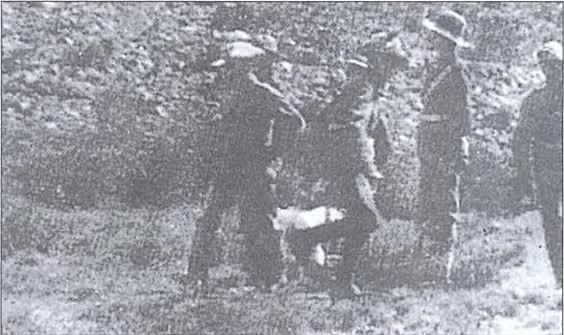
Gideon Scheepers (mostly obscured by his guards) tied to a chair for execution.
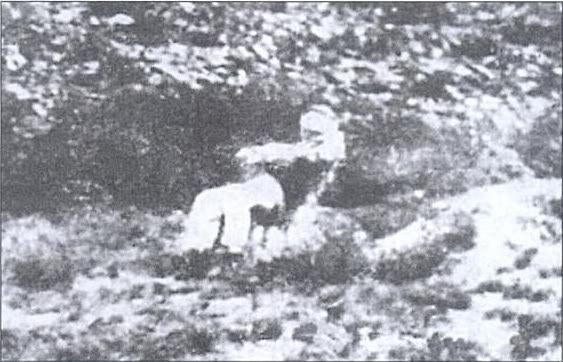
Just shot, Gideon Scheepers slumps backward in his chair.
While martyrdom guaranteed Scheepers a lasting legacy, bizarre posthumous turns helped elevate it into legend. When the dead man’s family turned up after hostilities to retrieve his bones, the grave turned out empty, leading to a years-long saga with colorful frauds presenting bogus remains, a mentally ill man doing the Grand Duchess Anastasia act and claiming to be Scheepers, and the actual corpse remaining stubbornly elusive.
The bereaved mother’s ultimately fruitless search for her son’s final resting place inspired the poem “Gebed om die Gebeente”(“Prayer for the Bones”), by D.J. Opperman. (Here’s a translated version.) That verse was recently set to music as a cantata by composer Hendrik Hofmeyr.
Scheepers’ allies, however, had simply been beaten in the field. On May 31, 1902 they capitulated to the British.
If we are asked why in 1978 a memorial should be erected for a man who died in 1902, then the answer is simple. The life and work of this man was such that history placed him in the heroes’ gallery and nothing and no one can deprive him of that place.
Never averse to breaking a few eggs, Gandhi led her country (sometimes autocratically) for four terms from 1966 to 1984, sandwiched around a stint under a legal cloud for political corruption.
She backed East Pakistan’s breakaway from India’s neighbor and rival, but also negotiated a Kashmir settlement with her Pakistani opposite number; oversaw the Green Revolution; pushed ahead with a nuclear weapons program; maneuvered between American and Soviet foreign policy.
The omelet that cost her life was the June 1984 Operation Blue Star, when she had the Indian military storm a Sikh shrine that armed militants had turned into a virtual fortress, even using tanks and artillery in the shrine’s residential area.
Although the operation “worked,” hundreds — maybe a thousand or more — lost their lives and the shrine itself suffered heavy damage.
Sikhs were incensed — including, apparently, Beant Singh and Satwant Singh, two Sikh bodyguards of the Prime Minister who probably ought to have been reassigned. Maybe that’s just hindsight speaking, after they took the opportunity afforded by an escort assignment on Halloween 1984 to suddenly gun down their charge.
Beant Singh was shot down on the spot by other guards, but Satwant Singh was arrested.
He and Beant Singh’s uncle and alleged inciter Kehar Singh would later stand trial for their lives — but not before the assassination triggered an apparently government-blessed four-day anti-Sikh pogrom. The disturbing orchestration and four-figure body count of this infamous affair remain sensitive subjects on the subcontinent to this day, especially insofar as nobody has ever been punished for it.
The accused assassins were not so lucky — although they were more than content to accept martyrdom for avenging Operation Blue Star.
I have no hatred for any Hindu, Muslim, Christian, neither hatred for any religion. After my Shaheedi, let no Sikh throw any rock at any Hindu. I am not in favor of any retaliation or bloodshed over my Shaheedi. If we do create bloodshed, then there is no difference between us and Rajiv Gandhi. I am proud of the task that I did! I do ardas in front of Waheguru! If I am blessed with a human life, then give me a death of the brave when I am hanged. Forget one life, if I could I would give up a thousand lives to kill dushts like Indira Gandhi, and laugh as I become Shaheed by hanging.
The killers were then and are still held in high regard by many Sikhs. (Satwant’s fiancee even married his picture.)
Indira Gandhi’s son Rajiv Gandhi followed her as head of state — and followed her fate when he was assassinated by Tamil terrorists in 1991. The Nehru-Gandhi family remains a powerful force in Indian politics.
Two politically sensitive cases, otherwise unrelated to one another, were joined in hanging at Iran’s Evin Prison on this day last year, possibly in a tit for tat following the November assassination of a nuclear physicist.
Ali Saremi
Ali Saremi cut the highest profile of the two, a 63-year-old member of the People’s Mujahedin of Iran (PMOI, aka MEK or MKO).
The PMOI/MEK/MKO, originally a Marxist revolutionary group opposing the dictatorship of the Shah, split with the theocratic Iranian Revolution.
Camp Ashraf was still there when the U.S. invasion rolled into Baghdad in 2003. (As of this writing, it’s only just now being closed.) While MEK has long been considered a terrorist organization, including by the U.S. State Department,* Iraq’s new occupiers also found this nest of exiles a convenient ally for its own campaign against Iran’s mullahs.
The organization has been much in the news of late both as a bargaining chip in regional diplomacy, and for lavishly bankrolling a lobbying campaign to get off everybody’s official terrorism lists — positioning itself as simply an Iranian opposition group. (It claims to have renounced violence.)
From Tehran, of course, there’s much less gray shading: the MEK is an enemy.
Saremi, a longtime member, was arrested four times for his association with the group.
The first time was in 1976; the last, and ultimately fatal, in 2007. He had just returned from Camp Ashraf to visit his son and commemorate the anniversary of Iran’s late-1980s mass execution of prisoners, an atrocity that claimed a large share of MEK sympathizers in apparent retaliation for the organization’s aforementioned wartime aid to Baghdad.
Saremi got the all-purpose mohareb death sentence — roughly, “waging war against God,” which can potentially compass any resistance to the Islamic Republic — basically for having a going association with PMOI. According to NCRI, Saremi’s prosecutor alleged that
[h]e visited Ashraf and during that he received necessary trainings and returned to the country … and eventually he was arrested in August 2007 for his repeated activities and participation in counter revolutionary ceremonies and gatherings in support of PMOI and dispatching reports to this grouplet (PMOI). During a search in his house some CDs, films, pictures from PMOI and hand written organizational documents linked to the grouplet were found and confiscated.
Ali Saremi’s portrait and memory are now powerful props for the MEK terrorism de-listing campaign.
Ali Akbar Siadati
Also hanged this day was a man named Ali Akbar Siadati, about whom only sketchy information appears to be available.
Siadati was condemned for spying for Israel from 2004 until his arrest in 2008, allegedly supplying Iran’s foe a wide range of sensitive military information — a crime to which Siadati confessed, according to the state news agency IRNA.
Who Siadati was, how he had access to military intelligence, and why (apart from money) he might have betrayed it seems to be publicly obscure.
On this date in 1872, China’s Panthay Rebellion came to an end with the surrender, suicide, and execution — in that order — of Du Wenxiu.
The Panthay Rebellion (also known as the Du Wenxiu Rebellion) was one of several cataclysmic revolts to shake foundering imperial China in the 19th century.
This one was centered in the city of Dali (also known as Talifoo) in the southeastern Yunnan Province, near the Burmese border.* The rebels in question were the Hui people, a predominantly Muslim ethnic group who had been pushed around for years by Qing officials and by the ethnic Han.
The backstory of Han-on-Hui ethnic cleansing in the 1840s makes for harrowing reading, lowlighted by the 1845 massacre of 8,000 Hui in Baoshan.
An even more ambitious operation in May 1856 went down in Kunming, where a massacre — Qing officials publicly posted a directive to “kill [the Hui] one and all”** — claimed several thousand more and razed the city’s mosques. This outburst spawned an attempt at wholesale ethnic cleansing throughout the province … but that attempt blew back on its perpetrators by triggering a rebellion that would require a generation to tame.
The unexpected tenacity of Hui resistance was multiplied by the disadvantages for the Chinese state of operating in a distant and mountainous territory, and its preoccupation with the much larger simultaneous Taiping Rebellion. Though these considerations were not sufficient to dissuade local officials from picking the fight in the first place, they would help them come to regret it.
Hui resistance quickly coalesced into an organized rebellion, and that rebellion overran Dali by the end of the year, establishing itself as the seat of an independent kingdom called Pingnan Guo. Meanwhile, the onset of the Second Opium War left China incapable of contemplating a reconquest.
Du Wenxiu, the half-Han Islamic convert rebel leader acclaimed Sultan Sulaiman of Dali, was therefore left with some operating room to establish a Hui state. He led a pluralistic nation (for the Hui themselves were and are a pluralistic identity) in the western half of Yunnan, stretching from the Tibetan frontier almost to Kunming. (They came close but never quite managed to take this city).
Alas, in due time and with sufficient stability elsewhere in China the Pingnan state came under withering attack from the late 1860s. It sought help from the British as a potential foil against Chinese power, but the aid was not forthcoming and probably would have been too little and much too late. The Pingnan / Panthay / Hui state
ended much as it had begun — in a bloody massacre of the Hui populace. On 26 December 1872, imperial troops surrounded Dali, the Pingnan capital. Du Wenxiu, in a move that he hoped would spare the lives of the city’s residents, made the decision to hand himself over to the Qing general. Swallowing a fatal dose of opium as his palanquin carried him to the Qing encampment, Du was already dead by the time that he was delivered to the Qing commander. Not to be robbed of the gratification of killing him themselves, Qing officials hastily dragged Du before the Qing troops to be decapitated.† According to Emile Rocher, a French adviser to the provincial officials in Yunnan at the time, Du’s head was encased in honey and sent to the emperor.
Du’s sacrifice, however, was in vain. Three days later, imperial troops began a massacre that, according to the government’s own conservative estimates, took ten thousand lives by the time it was concluded — four thousand of the victims were women, children, and the elderly. Hundreds drowned trying to escape from Dali by swimming across Erhai Lake. Others attempted to flee through the narrow passes at either end of the valley. All were chased down and slain by the Qing troops. The imperial soldiers were ordered to cut an ear from each of the dead. These grisly trophies filled twenty-four massive baskets and, together with Du’s severed head, were sent to Beijing, where they served as a silent and unequivocal corroboration of the Pingnan regime’s bloody demise.**
Du Wenxiu was within living memory when the Qing themselves fell; shortly after that happened, an honorary tomb was constructed for the martyred rebel outside Dali.
* “Panthay” is a Burmese word for Chinese Muslims.
** David Atwill, “Blinkered Visions: Islamic Identity, Hui Ethnicity, and the Panthay Rebellion in Southwest China, 1856-1873,” The Journal of Asian Studies, Nov. 2003. This article and/or Atwill’s book (review) on the same subject appear to be the ultimate source of nearly every accessible English resource on the Panthay Rebellion.
† According to the London Times (Aug. 27, 1873) the aides and litter-bearers who accompanied the dying Du to the Qin camp were also beheaded for their troubles. It ballparks the ensuing butchery at 40,000 to 50,000 souls.


 Born to a respectable family (his grandfather was the first mayor of San Jose) when the land was under Mexican control, Vasquez was among the many chagrined to find themselves demoted to second-class citizenry by the norteamericano

 Martyrdom was the family business.
 From 1927 until his death,
  Roux was a Catholic vicar on the eve of the Revolution, and “

 The young Dutch-descended Scheepers (

 Ali Saremi cut the highest profile of the two, a 63-year-old member of the
