On this date in 1944, Dutch Resistance hero Boy Ecury was shot by the occupying Germans.
Ecury (English Wikipedia entry | Dutch) grew up in Oranjestad, capital of the Dutch-controlled Caribbean island of Aruba, but had packed off to the Netherlands to finish school by the time World War II broke out. He spent the early Forties with a Resistance group sabotaging German assets and the like.
This insurgent clique eventually got rolled up, and Boy Ecury was arrested on November 5, 1944. He had only that one night to enjoy the legendary hospitality of the occupiers before he and several others of his group were shot the next day.
The young martyr’s body was repatriated to Aruba after the war and buried with honors; a public memorial still stands to him in Oranjestad.
Boy’s sister, the venerable poet Nydia Ecury, just passed away earlier this year.
On this date in 1865, Baptist deacon Paul Bogle was hanged at the Morant Bay courthouse for his part in that locale’s eponymous rebellion.
Third World’s “1865 (96 degrees in the shade)” celebrates Paul Bogle: “Today I stand here a victim the truth is I’ll never die”
Bogle helped lead of the protests-cum-riots that became that rebellion.
Baptists played an essential role in the affair, which has led some to call it the “Native Baptist War”. And indeed, Baptism had long intertwined with underclass resistance: Jamaica’s most famous slave rebel, Samuel Sharpe, was also a Baptist deacon. A previous royal governor in Jamaica had once warned that “the worst evil which hangs with a menacing aspect over the destinies of this island is the influence exercised with baneful effect by the majority of Baptist missionaries.”
From the standpoint of the powerful in Jamaica and Britain, 1865 would vindicate that warning.
A (white) Baptist missionary named Edward Underhill had penned a January 1865 letter bemoaning the miserable condition of most Jamaicans and starkly disputing received wisdom that blacks were just too lazy to work: “The simple fact is, there is not sufficient employment for the people; there is neither work for them, nor the capital to employ them.” (Underhill later wrote a book on the events, The tragedy of Morant Bay, a narrative of the distrubances in the Island of Jamaica in 1865.)
Underhill’s letter got into public circulation and as a result there were a number of “Underhill meetings” perhaps comprising an “Underhill movement” on the island in 1865 — essentially a going social campaign that rooted deeply in Jamaica’s native Baptist communities. Though “native Baptists” is a vague term, it distinguishes not only black from white but, in the words of Mary Turner, a whole “proliferation of sects in which the slaves developed religious forms, more or less Christian in content that reflected their needs more closely than the orthodox churches, black or white.”
William Gordon had switched his religious allegiance to native Baptist and was known to speak at Underhill meetings: that’s part of what got him hanged.
Likewise, our day’s focus, Paul Bogle, was a native Baptist minister, in the St. Thomas-in-the-East parish — and it was the protest of Bogle and his supporters against an unjust prosecution that started the whole rebellion off.
Statue of a militant Paul Bogle (that’s a sword in his hands) outside the Morant Bay courthouse where all the trouble started. (cc) image from dubdem sound systems.
There was, accordingly, an immediate reward out on Bogle’s head, and an immediate demonization in the respectable English press. There, he was “the notorious Paul Bogle,” in the words of one letter to the editor (London Times, Nov. 18 1865), in whose Baptist chapel rebellious “panthers” wantonly “drank rum mixed with gunpowder and the brains of their victims.”
By the time that letter had been dispatched, Bogle’s purported orgies had long since been interrupted: captured by Maroons, he was delivered to custody, instantly tried, an hanged that very day in a batch of 18 rebels.
A horror to Victorian planters, Bogle has won the reverence of posterity as a freedom fighter and national hero.
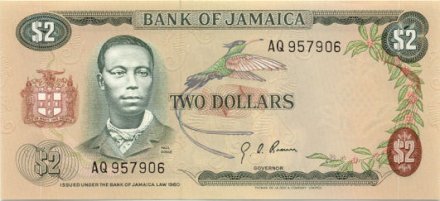
Paul Bogle on the (now out-of-circulation) Jamaican two-dollar bill.
“No incident of the dreadful story” of Morant Bay, wrote Edward Underhill, “produced a more painful impression than the arrest, trial, and execution of Mr. G.W. Gordon” this date in 1865.
The son of a white planter and a mulatto slave, George William Gordon was an able businessman and became a Jamaican assemblyman.
In that capacity, he was a vocal critic of British colonial maladministration, an advocate for blacks, and a political foe of Jamaica’s governor, Edward John Eyre. He’d already had government commissions canceled because of his politics.
Gordon had nothing to do with the Morant Bay outbreak. He was away from the disturbance altogether, in Kingston, when it broke out.
But he was regarded by many white elites as a class enemy, and Eyre did not intend to miss this opportunity to eliminate him. A few years later, a French tribunal would express the rationale as it cracked down on the Paris Commune: guilty or no, “a prudent and wise Government must rid itself [of troublemakers] when it finds a legitimate occasion to do so.”
Accordingly, Gordon was arrested by civil authorities in Kingston — he actually turned himself in when he heard there was a warrant out on him — and then transferred into the hands of the drumhead military tribunals that were operating in the conflict zone, obviously with the intent of terminating a gadfly.
[Kingston authorities] were not the ministers or apparitors of the martial authority, and did not possess the power to take up Mr. Gordon for the purpose of handing him over to the martial law. Nevertheless, they did it. They did it by the exercise of the strong hand of power, because it was thought that a conviction could not be got at Kingston. It was altogether unlawful and unjustifiable. To Mr. Gordon it made the difference of life or death.
Gordon, in his last letter to his wife, took it all in an understandably contemptuous stride:
General Nelson has just been kind enough to inform me that the court-martial on Saturday last has ordered me to be hung, and that the sentence is to be expected in a hour hence, so that I shall be gone from this world of sin and sorrow.
I regret that my worldly affairs are so derranged: but it cannot be helped … I never advised or took part in any insurrection. All I ever did was to recommend the people who complained to seek redress in a legitimate way … It is however the will of my heavenly Father that I should thus suffer in obeying His command, to relieve the poor and needy, and to protect, as far as I was able, the oppressed …
do not be ashamed of the death your poor husband will have suffered. The judges seemed against me; and from the rigid manner of the Court, I could not get in all the explanations I intended. … It seemed that I was to be sacrificed.
Much of what Governor Eyre did in those desperate days skirted, at best, the edges of what might be legally colorable. But at least those instances, in the main, were directed at people alleged to have been actual rebels or rioters. Eyre could safely expect wide latitude where the security of the realm was at stake.
In Gordon, however, there was a man whose crime was nothing other than to have sympathized with the real and crushing plight of the lower orders and advanced their cause politically. Eyre’s magistrates made that fact alone into sedition, and twisted the rules of their own courts-martial to pin it on Gordon.
Given the exceptionally lawless nature of this scenario — and Gordon’s own visibility as a colonial elite — his became the lightning-rod case for English liberals incensed at Eyre’s behavior. John Stuart Mill, Charles Darwin, Herbert Spencer, and others demanded Eyre’s prosecution for the affair, Thomas Huxley writing for the faction,
the killing of Mr. Gordon can only be defended on the ground that he was a bad and troublesome man; in short, that although he might not be guilty, it served him right.
I entertain so deeply-rooted an objection to this method of killing people — the act itself appears to me to be so frightful a precedent, that I desire to see it stigmatised by the highest authority as a crime.
It can hardly surprise the reader, versed as we are by this late date in official impunity, that not Eyre nor any lieutenant was ever thus stigmatised.
While Eyre evaded due punishment, Gordon could not escape the plaudits of posterity. He’s been honored as a Jamaican National Hero, and the very building where the present-day parliament sits is called the Gordon House in his honor.
On this date in 1817, Mexican War of Independence heroine Gertrudis Bocanegra was publicly shot in her native town of Pátzcuaro for treason.
Bocanegra (English Wikipedia entry | Spanish), a literate Enlightenment woman was already 45 years old when the rebellion against the Spanish empire broke out.
Her husband and son joined Hidalgo‘s forces, in which service they would lay down their own lives.
Gertrudis Bocanegra kept a safe house, gathered supplies and money, shuttled messages … until Spanish authorities arrested her in 1817 and tortured her for information. (Need one even ask if the noble Bocanegra informed on her compatriots?)
She’s known as La Heroína de Pátzcuaro and is the namesake for, among other things, a plaza in that city and the striking Biblioteca Gertrudis Bocanegra, where one can find this:
Bocanegra’s own execution is also shown in the mural — in the lower right, obscured by the bookshelves in the photograph above, but captured in detail in this Spanish blog post.
On this date in 1763, the mestiza Philippines national hero Maria Josefa Gabriela Carino Silang was captured and summarily hanged — along with a number of the soldiers she had led against the Spanish.
Gabriela took primary leadership of a 2,000-strong rebel army after its co-leader, her husband Diego, was assassinated by his enemies in May 1763.
Said enemies were the Spanish colonial authorities, whom Diego and his helpmate Gabriela had raised revolt against and with an army wielding homemade muskets and blowguns, driven from the capital of Ilocos Sur. It was Great Britain’s occupation of the Philippines during the Seven Years War that opened the opportunity for the rebellion: the British even appointed Diego Silang governor of the province his army was in the process of conquering. They just didn’t actually help him.
Spain’s assault on the rebels, once organized, was sufficiently overwhelming to drive Gabriela Silang out of the city of Vigan, and then to repel her counterattack — the occasion for her capture and her death.
Gabriela Silang is memorialized in a number of monuments and place names in the Philippines; the women’s organization GABRIELA also engineered its acronym to pay tribute to her.
When said heavy–handed monarch was deposed by his own uncle Frederick, Clement turned privateer … and when said deposing-uncle Frederick died in 1533, Clement entered the ensuing civil war between supporters of the still-imprisoned ex-king Christian II and those who backed Frederick’s own son Christian III. This was also a social and political war over the Reformation.
Clement went to war for his former boss, Christian II, instigating a 1534 North Jutland uprising of the Catholic peasantry that in October of that year trounced the Protestant noble army sent to suppress it at the Battle of Svenstrope Mose (Svenstrop Bog or Moor).
That battle clinched Clement’s reputation as one of the great peasant-rising leaders, and also clinched for Clement the fatethatusuallybefalls such characters. Shortly after, Clement’s aristocratic ally cut his own deal with Christian III and abandoned the rabble to a vicious counterattack. In December 1534, General Johan Rantzau stormed the rebel strongholdof Aalborg, slaughtering two thousand peasants, reducing freeholding farmers to tenants, and bringing Clement home in chains for a grand finale.
The captured commander languished in his dungeon awaiting the conclusion of the civil war. It took a good year under siege for Rantzau to bring Copenhagen to heel, but once that city capitulated in August 1536, Clement was brought out of storage for use as a victory cigar. (Danish link)
On September 9, 1536, wearing a lead crown to mock his ambition, Clement had his head chopped off, and his remains were dismembered and set up for public display.
On the evening of this date* in 1707, Pierre Fatio was secretly shot by arquebusers in a Geneva prison.
This Swiss Gracchus — classically-minded contemporaries could hardly fail to draw the parallel — was a magistrate and a rising member of the patrician oligarchy that ran nominally democratic Geneva.
But despising the side his class bread was buttered, Fatio (English Wikipedia page | French) took up the standard of the masses … or at least the masses of the bourgeoisie, whose universal-propertied-male suffrage was belied by the power exercised by Geneva’s magnates club, the “Petit Conseil” of 25 who actually ran the city-state.
Pierre Fatio really looks less like a revolutionary and more like a would-be liberal reformer. What started all the trouble was Fatio’s January 1707 sponsorship of a measure for a secret ballot and a little less nepotism: a modest downward redistribution of power.
Then as now, the powerful resisted.
From the pulpit the ministers cried at the top of their lungs against the people … accusing the people of rebellion against the magistrates, of insubordination to the laws, of enjoying only disorder and fomenting divisions, violating the oath which promises to be good and loyal to the city. (Source)
Oligarch apologists went on and on about these secret-balloteers having “broken all the bonds of society” (Benedict Calandrini) as the popular clamor for a bit of state accountability grew. In political-philosophy terms, this manifested itself as a debate between whether the sovereignty of the people (again, meaning the propertied male people) actually implied that these sovereigns were entitled to govern.
And the Little Council won the debate the old-fashioned way: by crushing its opponents as seditious, with the military aid of their brother-oligarchs at neighboring Swiss cantons. Several popular-sovereignty types were killed or exiled (French link) in mid-1707.
Its government is a mixture of Aristocracy and Democracy; but as the principal and most ancient families use their utmost endeavours to derogate from, and by slow degrees destroy the privileges of the citizens, in order to draw the power over to themselves, and perpetuate themselves in their posts, this practice is attended with frequent murmurings, and in these last times an insurrection had began, which would have broken out into a great fire, if Zurich and Bern had not sent wise and able deputies to extinguish it, and afterwards a good number of troops to garrison the city, which at present seems to keep quiet, though with evident prejudice to the liberty of its citizens. (Vendramino Bianchi in Relazi one del paese de Svizzeri (1708), quoted in this book
Fatio was the last and most noteworthy to go, and the council was so nervous about the “murmurings” if it should behead him in public, it determined its death sentence in secret: apt climax for a struggle over state accountability.
Rather than risk further disturbances, it simply dispatched its agents directly to Fatio’s cell where they informed him that he was condemned, and had him shot inside the prison without further ado.
“I would look with great honor on being the martyr of liberty,” a cool Fatio is said (by his party, naturally) to have remarked upon hearing his condemnation.
Martyr he may have been, but unlike the Roman Gracchi, Pierre did not have a brother to catch up his falling torch: Pierre’s, who was already among the Little Council, went ahead and voted for his sibling’s execution.
The martyr had more impressive family in cousin Nicolas Fatio de Duillier, a mathematician and Isaac Newton collaborator. Still more noteworthy heirs were kin of spirit, not of blood: one David Rousseau lost his state job for supporting Fatio’s movement … and Rousseau’s famous Genevan grandson would become the favored philosopher of the coming revolutionary age.
* I really hate to contradict the 7 September date that’s carved into marble, but as best I can interpret the documentation, Fatio’s sentence was finalized on the day of 6 September and executed within just a few hours that very evening. See e.g. the 6 September document excerpted in fn 1 here.
You have heard of mother Nottingham, who for her time was pretty well skilled in casting of waters: and after her, Mother Bombye; and there is one Hatfield in Pepper-Alley, hee doth prettie well for a thing that’s lost. There’s another in Coleharbour, that’s skilled in the Planets. Mother Sturton in Goulden-lane, is Fore-speaking: Mother Phillips of the Banke-side is for the weaknesse of the backe: and then there’s a very reverent Matron on Clarkenwell-Green, good at many things: Mistris Mary on the Banke-side is for recting a Figure: and one (what doe you call her) in Westminster, that practiseth the Booke and the Key, and the Sive and the Shears: and all doe well, according to their talent. For myselfe, let he world speake.
This date marks the 400th anniversary of the Pendle witches‘ hanging — perhaps the most notorious witchcraft execution in English history.
Eight women and two men — Alizon Device, her brother James Device, and their mother Elizabeth Device of the Demdike family; Anne Whittle and her daughter Anne Redferne of the Chattox family; Jane Bulcock and her son John Bulcock; Alice Nutter; Katherine Hewitt; and Isabel Robey* — hanged together this date at Lancaster’s Gallows Hill after being tried over the preceding 48 hours; they, along with a woman named Jennet Preston hanged at York on July 29, comprise the Pendle Witches.
It’s an extraordinarily sad case.
The prosecution of the Pendle witches bubbled out of a witches’ brew of circumstances particular to early-17th century England. There was, to begin with, a new(ish) English king, James I and the guy had a major jones for hunting those early modern supernatural terrorists, witches.** The guy even wrote his own book, Daemonologie, to establish “that such divelish artes have bene and are … [and] what exact trial and severe punishment they merite.” A 1604 law had accordingly broadened the reach of the death penalty for supposed instances of sorcery.
Coming as this did in the aftermath of the Tudor Reformation, the nebulous concept of “witchcraft” was handy as well for clamping down on any excessively Catholic practices that might strike the right authorities as subversive, intransigent, or impious. Lancashire where we lay our scene was just such a Catholic-leaning zone.
Lancashire also had, as almost everywhere in the Isles, its share of “cunning folk” — workers of everyday folk magic whose widely tolerated practices could also be taken by a hostile viewer as Catholic superstition and/or hard-core infernal trafficking.
So, these are the brew’s ingredients. Add wool of bat and tongue of dog, stir vigorously … and serve with a length of hemp.
Curses
The Pendle witches brew started bubbling with a freak incident: a cunning woman named Alizon Device (you’ll recognize her name from the list of the hanged, above) tried to beg some needles from a passing peddler. The latter refusing her, Alizon cursed him, just like you do when you’re cut off in traffic.
Except in this case, the peddler promptly suffered a stroke.
Everyone was spooked at this apparent effusion of transmundane malevolence, nobody more so than Alizon herself. She became the first arrestee, and in the end would go the gallows convinced of her own sorcery.
She also started accusing others of occult involvement, either from a sense of panicked guilt or a blithe ignorance that the new legal regime would be interpreting folk spells as capital crimes. This led her bizarre instance of passing-peddler-popping to become a full-on witch hunt.
Alizon Device came from a whole family, the Demdykes or Demdikes, of cunning-women, and she implicated her own grandmother for having taught her the witchy ways. (Grandma would be spared the ignominy of hanging because she suffered the ignominy of dying in the filthy dungeon.) Alizon also accused a rival family, the Chattoxes, themselves well-known as “witches”, and she also implicated the matriarch of that family, Anne Whittle. The dreadful progress of the ensuing investigation, in which the feuding locals hanged each other with the aid of an ambitious local magistrate, is widely available — thanks to the record one lawyer witness to the proceedings set down in his credulous 1613 chapbook The Wonderfull Discoverie of Witches in the Countie of Lancaster.
Foiled Again
Once these initial arrests were in the books, Alizon’s mother Elizabeth apparently convened a solidarity meeting at a hut with the diabolically menacing name of Malkin† Tower. Dining on stolen mutton, and on Good Friday no less, they may have worked out a plan to liberate the prisoners from Lancaster Castle (at least, the Demdike prisoners). But the magistrate got wind of this confabulation and burst in to arrest those participants, too. As these secondary circles were pulled into the investigation, so too were past years of community gossip about these “witches”, of various folk who had died unexplained and various mishaps that befell people whom the witches didn’t like.
These superstitions seem to have been shared by the witches themselves, at least many of them. The Demdikes and Chattoxes used clay figures, human remains, and little effigies of victims with the intent of hurling evil at their enemies. Causality aside, Alizon Demdike did curse the peddler. “Witches think sometimes that they kill, when they do not, and are therefore as culpable, as if they did,” said their contemporary, pastor John Donne.
To augment the assorted confessions and counter-accusations among the accused, Elizabeth Device’s nine-year-old daughter Jennet Device (little sister of the original peddler-curser Alizon) was summoned up to provide coached testimony against her siblings Alizon and James, against her mother, and against those at the Malkin Tower meeting. Several of these latter would be convicted of non-capital crimes or even acquitted outright, but little Jennet’s testimony doomed her own family.
Although not the first time a child had provided evidence, it was a landmark in normalizing minors’ accusations — jurisprudence advocated by James’s Daemonologie. “Children, women and liars,” the sovereign announced, “can be witnesses over high treason against God.”
In later life, Jennet appears to have been caught up in the same trap, when she was accused of witchcraft by a 10-year-old boy. A judiciary grown more cautious by then did not put her to death … but she (unless it was a different person also named Jennet Device) died in prison.
And the acceptability of this sort of children’s testimony, duly documented for country JP’s in Michael Dalton’s Country Justice, containing the Practice, Duty, and Power of Justices of the Peace, would be the lethal linchpin of the witch trials 80 years later across the Atlantic — in Salem, Massachusetts.
This miserable event has informed any number of artistic productions from the 17th century stage to the present-day Pendle Sculpture Trail. Pendle and Lancashire, as bywords for witch superstitions, now trade handsomely on the unfortunate fame.
Many there have also pushed (thus far unsuccessfully) for an official posthumous pardon of the hanged witches.
And the nearby village of Roughlee even erected a statue in 2012 to the hanged Alice Nutter … a gentlewoman (i.e., of considerably higher class standing than her fellow condemned) whose reason for attending the Malkin Tower meeting remains mysterious.
* Isabel Robey is an outlier case; as of this writing, she’s not even named as one of the Pendle witches on the Wikipedia page as it seems she was not associated directly with the Malkin Tower crowd — merely a bystander who got caught up in the storm of denunciations. She was, however, hanged on Gallows Hill for witchcraft on August 20. There’s a lengthy attempt at reconstructing her story in the face of scant documentation here (pdf).
** All well and good for us moderns to pooh-pooh James’s supernatural obsessions, but the man’s security concerns were very real.
† The BBC documentary has Malkin as slang for “shit”; this page proposes that the word can signify a cat, a bindle, a scarecrow, or “an awkward woman.”
On this date in 1942, 39-year-old French/Ukrainian novelist Irene Nemirovsky was gassed at the Auschwitz Concentration Camp in Poland.
She was a victim of the Nazis’ racial laws: anyone with even one Jewish grandparent, even if they themselves did not practice the Jewish religion, could be considered a Jew. Nemirovsky, born to a wealthy Russian-Jewish family in what is now the Ukraine, had converted to Catholicism in 1939 — sincerely, insofar as anyone can discern.
Irene Nemirovsky fled Russian territory after the Bolshevik Revolution and spent a short time in exile in Finland and Sweden before eventually settling in France. There she married a banker, had two daughters, and published her first novel in 1930.
The book, called David Golder, was about a ruthless businessman (described by modern readers as “a Bernie Madoff of her time”) who in old age and poor health begins to regret the way he lived his life. It was a success and was made into a 1930 film.
Although she was widely acclaimed as a writer in France, even by anti-Semites, she was denied citizenship in 1938. By then she had lived in the country for twenty years.
Following the German invasion of France in 1940, Nemirovsky’s books were pulled off the presses and she was required to wear the yellow star. If she and her family had succeeded in obtaining French citizenship, this would have provided some protection; the French were reluctant to deport their own Jews, filling the cattle cars with foreigners instead. Irene was instead classified as a “stateless person of Jewish descent” and the high-ranking Nazi official Ernst Kaltenbrunner called her a “degenerate artist of deluded Jewish hegemony.”
The “stateless” Irene was arrested on July 13, 1942. She had time to write a letter to her family, asking them not to worry about her, before she was deported to Auschwitz four days later.
Although she survived the initial selection and was tattooed with a prisoner number, it was reported a month later that she had died of typhus, a common and deadly disease in the concentration camps. However, later investigation showed she had in fact been sent to the gas chamber. Her husband was also gassed in Auschwitz in November of that year, but their two children survived the war.
One of Nemirovsky’s books, All Our Worldly Goods, was posthumously published in France in 1947. However, for sixty years following the war this once-famous author was largely forgotten.
In 2004, however, she became a literary sensation when a previously undiscovered manuscript, Suite Francaise, hit the press. The “suite” consisted of two books out of a projected five, titled “Storm in June” and “Dolce”. Irene had written them while in hiding in 1940. When she was arrested she gave the manuscripts in a suitcase to her daughter Denise, who safeguarded them all those years.
The book was received to great acclaim and became a bestseller, and publishers blew the dust off her novels from the 1930s and brought them back into print. In 2007, another of Nemirovsky’s works, Fire in the Blood, was published. The book was a companion to Suite Francaise — and like Suite, Nemirovsky had worked on it while in hiding during the Nazi occupation.
Nemirovsky never escaped controversy, in her life or after her death. Several critics and scholars have accused her of being an anti-Semite, a “self-hating Jew,” as detailed in this article from the Australian publication The Age.
Novelist Paul LaFarge charged her as “a Jew who disliked other Jews.” Primo Levi‘s biographer wrote of her, “She has taken on board the idea that Jews belong to a different, less worthy ‘race’, and that their exterior signs are easily recognizable: frizzy hair, hooked noses, moist palms, swarthy complexions, thick black ringlets, crooked teeth…”
There is evidence to support this assertion.
Some of her books were serialized in anti-Semitic magazines, and during the occupation Irene also wrote a letter to Marshal Petain, head of France’s collaborationist Vichy government, to say she disliked Jews and shouldn’t be classified as a Jew, racial laws notwithstanding. Her husband wrote a similar letter to the German ambassador after her arrest, saying his wife “did not speak of the Jews with any affection whatsoever.” The ambassador never bothered to reply.
Irene, however, also has her defenders in this matter: “She didn’t dislike Jews,” said one. “She disliked some Jews. Big difference.” Patrick Marnham, who wrote the introduction to the reprinted David Golder, argued that, “Her choice of an unsympathetic Jewish character [in the book] does not make Nemirovsky anti-Semitic; any more than Robert Louis Stevenson was anti-Scottish because he created the diabolical figure of Ebenezer in Kidnapped.”
You could argue that if she appeared to be anti-Semitic it was because she was trying to conceal her own Jewish origins and thereby protect her family from the deadly consequences. Her daughters believed this was the reason for her assertions that she hated Jews.
In any case, whatever Irene may have said or thought about her religious origin did not save her life. She was just one of many thousands of Christian converts who fell victim to Nazi Germany’s madness.
Irene’s younger daughter, Elisabeth Gille, who died in 1996, wrote a novel titled Shadows of a Childhood which was based on her parents’ disappearance. She had only been five years old when Irene was arrested. In 2010, Olivier Philipponnat and Patrick Lienhardt published the first major biography of Irene, The Life of Irene Nemirovsky, 1903-1942.
The investigations following upon the recent raids on Anarchist dens here prove the existence of a revolutionary plot on a vast scale and show that there was a systematically organized “college” … where bombs were manufactured and instruction in explosives was given … The prisoners talk freely of their “heroic conduct” and “noble design,” while refusing to impart any informaton incriminating those working behind the scenes and furnishing the funds. They all confess, however, that their minds have been fired by writings in the Press and speeches on platforms.
–London Times
It’s a timeless story, really; with a tweak here or there, the excerpt above could do for reportage on seditious movements by the hundredfold. As it happens, its dateline is May 11, 1908 — Calcutta.
Separatist stirrings on the subcontinent were then manifesting themselves in the explosive revolutionary language of the day, and the chief magistrate of that ancient city of Calcutta — Kingsford by name, as in charcoal — was a character notorious for his harshness toward the movement. The year before, he’d had a 15-year-old flogged for trying to stop a British soldier beating Indian activists.
Among the more militant types excited to wrath against Kingsford was an 18-year-old Bengali who would have the privilege of martyrdom for the cause of national self-determination.
Khudiram Bose sought the judge out in Muzaffarpur and, with another young revolutionary, attempted to assassinate him in April 1908 by tossing a couple of bombs into Kingsford’s carriage.
Minor problem: it was the wrong carriage.
Instead of popping the nefarious judge, the bombs killed the wife and daughter of a barrister.
The other assassin committed suicide when cornered by police, but Bose would meet his end via the judiciary.
Bose played his patriotic martyr’s role to the hilt in the few brief weeks before his hanging, and found himself on the leading edge of a growing movement of anti-British bombers. “People are prepared to do anything for the sake of swarajya [home rule] and they no longer sing the glories of British rule,” one contemporary newspaper (quoted here) put it. “They have no dread of British power. It is simply a question of sheer brute force.” The editor was convicted of seditious libel.
One can now find plentiful Khudiram Bose hagiographies celebrating the youthful freedom fighter … regardless of his target selection.

 Ecury (English Wikipedia entry | Dutch) grew up in Oranjestad, capital of the Dutch-controlled Caribbean island of Aruba, but had packed off to the Netherlands to finish school by the time World War II broke out. He spent the early Forties with a Resistance group sabotaging German assets and the like.
 The son of a white planter and a mulatto slave,

 Clement (
 This Swiss
  This miserable event has informed any number of
 Although she was widely acclaimed as a writer in France, even by anti-Semites, she was denied citizenship in 1938. By then she had lived in the country for twenty years.
 Among the more militant types excited to wrath against Kingsford was
