On “a beautiful autumn day” this date in 1941, four dozen French leftists were executed by that country’s occupiers as punishment for the murder of a German officer.
On October 20, 1941 — sixteen months into the German occupation — a pair of Communist commandos assassinated the Feldkommandant of Nantes, Lt. Col. Karl Hotz (French link).
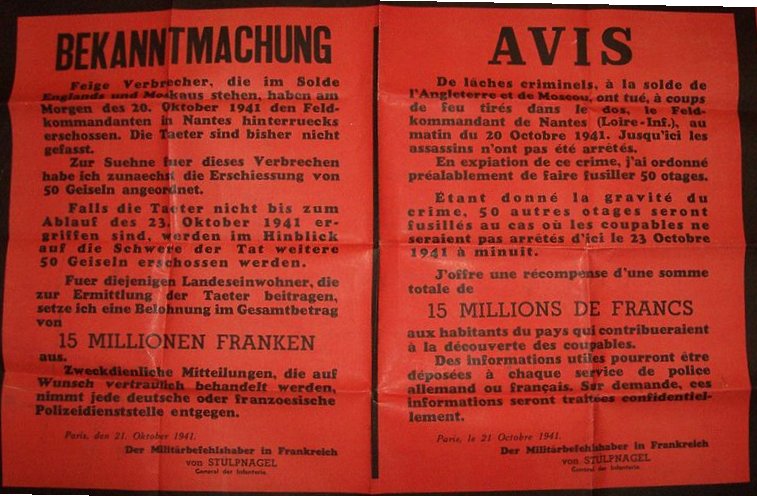
News of this crime went straight to Adolf Hitler himself, who personally ordered a fearful reprisal.
The list of the executed hostages as published Oct. 23 in L’oeuvre
Accordingly, the collaborationist Petain government was induced to select 50 persons from among the ranks of detained German political prisoners. Pierre Pucheu, who would later be executed himself,* intentionally selected Communist types in an effort to confine the retaliation to fellow-travelers.
On this date, those 50 — well, 48, but who’s counting?; the numbering can get dodgy in these mass-execution scenarios — were put to death at three different locations: five at Fort Mont-Valerien; sixteen at Nantes; and most notoriously, 27 internees of Choisel (French link) at Chateaubriant.**
In three different batches of nine, the 27 reds and trade unionists were fusilladed into the ranks of Gallic martyrdom. They remain among the most emblematic French martyrs of the occupation; there’s a cours des 50-Otages named for them in Nantes, and various streets that bear individual victims’ names — such as Rue Jean-Pierre Timbaud in Paris. (Timbaud was a Communist steelworker.)
Monument to the martyrs of Chateaubriant. Image (c) Renaud Camus and used with permission.
He made headlines in 2009 when current French President Nicolas Sarkozy had added to the educational curriculum the reading of Moquet’s brave-but-sad last letter to his family: the decision drew some rather mean-tempered fire because of Moquet’s political persuasion. In the end, the text bore a fairly universal reading that could play inoffensively to posterity — like its postscript injunction,
“You who remain, be worthy of the 27 of us who are going to die!”
There’s a thorough roundup of the Oct. 22 executions (including poetic tribute) here.
* Vindicating Winston Churchill’s prophecy to the Times upon receiving news that “These cold-blooded executions of inocent people will only recoil upon the savages who order and execute them.” (Oct. 25, 1941, as cited in the The Churchill War Papers, vol. 3)
** Fifty more were supposed to be executed if the assassins weren’t promptly turned in, but that second batch never took place. (There was, however, a different batch of 50 executed on October 24 in retaliation for a different political assassination. Maybe they just all ran together.)
On this date in 1985, poet Benjamin Moloise was hanged in Pretoria for murdering a (black) policeman in apartheid South Africa.
Moloise’s controversial execution occurred in the context of violent resistance to apartheid in South Africa’s black townships and an ultimately fatal crisis for the apartheid state.
The black majority, long treated as second-class citizens by the white powers-that-be, turned to increasingly confrontational tactics aiming to break official power at the township level. Attacks on black officials and police officers who administered state authority at that level were part and parcel.
Moloise was convicted in a plot to kill such an officer in 1983. (The African National Congress claimed responsibility for the killing, and said that Moloise wasn’t involved.)
His hanging approached as the township rising grew into a mass movement that the hardline government of P.W. Botha answered mostly with force* — so, little surprise that Botha spurned both American and Soviet entreaties not to hang Moloise and little surprise that the execution further escalated racial violence.
Furious black protesters rioted in downtown Johannesburg itself, which (like much of white South Africa) had theretofore remained mostly immune to the violence gripping the townships. Here’s a French news report on Moloise’s execution and its aftermath.
All of which dovetailed with a dramatic fall in South Africa’s international position, vividly symbolized by the months-long collapse of the rand — which bled about three-quarters of its value in 1985. International outrage at the blood shed to enforce South Africa’s color line subjected it to a cascade of diplomatic and economic sanctions in the mid-1980s.
Apartheid went out with the Cold War at the end of the decade — vindicating Moloise’s poetic final message, subsequently a staple message at anti-apartheid rallies.
I am proud to be what I am …
The storm of oppression will be followed
By the rain of my blood
I am proud to give my life
My one solitary life.
* It had implemented a state of emergency that very summer. At the same time, Botha pursued tweaks around the edges of apartheid to preserve it: weeding out “petty apartheid” provocations like whites-only/coloreds-only facilities, and implementing a new constitution with a tricameral, race-based parliament.
On this date in 1964, South Vietnam executed a 17-year-old Communist for a plot to assassinate American Secretary of Defense Robert McNamara.
The young electrical worker and Viet Cong urban guerrilla Nguyen Van Troi was nabbed in the spring of 1963 trying to off both McNamara, famous for the megatonnage he would bestow on Southeast Asia, and U.S. ambassador Henry Cabot Lodge, Jr.
(Later, when the South Vietnamese client president whose guests these men ostensibly were was being shot in an armored personnel carrier with the Americans’ blessing, Ngo Dinh Diem might have had cause to wish this youth’s inhospitable gesture had not been undone by his men. Lodge was a particularly vocal advocate in the Kennedy administration for overthrowing Diem.)
For the months leading up to his public shooting, he became an international cause celebre; North Vietnam would later milk his martyrdom with a postage stamp, an award, and numerous public streets.
The international reach of his case was underscored when a Venezuelan revolutionary cell kidnapped an American officer shortly before Troi’s execution, and threatened to shoot him in retaliation. (They didn’t.)
Against this, South Vietnam counterposed the unedifying spectacle of a 17-year-old patriot put to death, energetically declaiming at the stake while cameras rolled,
It is the Americans who have committed aggression on our country, it is they who have been killing our people with planes and bombs…. I have never acted against the will of my people. It is against the Americans that I have taken action.
Naturally, he became a worldwide leftist martyr. There’s an Estadio Nguyen Van Troi in Cuba; American actor Troy Garity, son of Jane Fonda from her “Hanoi Jane” days, is also named for Nguyen Van Troi.
Robert McNamara, meanwhile, had many, many years yet to live, and many, many more Vietnamese deaths to burden his conscience.Troi’s widow wrote a 1965 book about him, out of print but still available on the used book market.
On this date in 1354, Cola di Rienzi (or Rienzo) was slain by a miserly Roman mob — rather a lynching than an execution, but by any name the tragic end to one of history’s most amazing political careers.*
“Almost the only man,” in the estimation of his admiring biographer Edward Bulwer-Lytton,** “who ever rose from the rank of a citizen to a power equal to that of monarchs without a single act of violence or treachery.”
So magnetic was that era’s revival of classical learning that young Rienzi’s plebeian parents found a way on an innkeeper’s wages to immerse the boy in Cicero, Seneca, and the rest. As Gibbon put it, “the gift of a liberal education, which they painfully bestowed, was the cause of his glory and untimely end.” (Surely this is an object lesson for present-day families contemplating the daunting cost of university education.)
And the oratorical gifts he thereby developed found ready exercise lamenting Rome’s medieval degradation.
This View of the Campo Vaccino actually dates to 1636, but you get the idea. “Campo Vaccino”: that’s “cow pasture,” also known (to you, me, and Julius Caesar) as the Roman Forum.
Rome had bled away the grandeur of its imperial past without recovering the liberty of its populace. A haughty and dissolute aristocracy tyrannized the brackish city: a brawl between rival factions took Rienzi’s own brother’s life, with no prospect of justice.
Added to this civic humiliation (though only fortuitous for Rienzi’s political opportunity), the papacy itself had decamped for its captivity in Avignon.
What to do?
How about — overthrow the bastards?
Astonishingly, for Rienzi, to dare was to do: on Pentecost in 1347, he rallied a Roman mob and proclaimed the Republic re-established — taking for himself the ancient honorific of Tribune and the real power of an autocrat. The nobility routed in disarray, or else submitted to the sudden new authority.
For the balance of the year, Rienzi’s word was law in Rome, and as a messianic, popular dictator he cleared woods of bandits, imposed the death penalty for (all) murderers, and beat the aristocracy’s re-invasion with a citizen militia. He audaciously began to resume the primacy of the caput mundi: as “Tribune”, Rienzi summoned delegations from the other Italian cities, and presumed to arbitrate the disputes of neighboring kingdoms. Audacity veered into delirium as he pressed demands on the likes of the Holy Roman Emperor. He acquired a taste for fine wine and good clothes.
“Never perhaps has the energy and effect of a single mind been more remarkably felt than in the sudden, though transient, reformation of Rome by the tribune Rienzi,” Gibbon marveled. “A den of robbers was converted to the discipline of a camp or convent: patient to hear, swift to redress, inexorable to punish, his tribunal was always accessible to the poor and stranger; nor could birth, or dignity, or the immunities of the church, protect the offender or his accomplices.”
But almost as soon as Rienzi’s republic began, the man fell: another invasion found the Roman in the street deaf to the alarm bells, and Rienzi fled.
“He was a dreamer rather than a man of action,” is the charge of the Catholic encyclopedia; excitable, injudicious, spendthrift, and prey to the “Asiatic” emoluments of his station.
This career alone would merit a remembrance, but Rienzi had a second act.
Richard Wagner’s first hit opera — though hard to come by in the wild nowadays — was Rienzi, der Letzte der Tribunen (synopsis), from a libretto based on Bulwer-Lytton’s homage.
After a long spell in exile, he was captured by the Holy Roman Emperor and transferred to the papacy, where he remained comfortably imprisoned for a couple of years. When the pontiff’s hat changed heads to Innocent VI, the latter freed the illustrious ex-Tribune and dispatched him back to Rome under the title of Senator — intending him a catspaw to re-assert the supremacy the papacy had abandoned by moving away.
Within weeks of arrival in 1354, Rienzi again made himself master of the city.
And within months thereafter, he had fallen again — to his death.
He is charged in this last term with severity (the execution of a high-born freebooter, Fra Monreale, in particular), with avarice and abuse of power and once more with political incompetence.
Gibbon claims that Rienzi “contracted the habits of intemperance and cruelty: adversity had chilled his enthusiasm, without fortifying his reason or virtue; and that youthful hope, that lively assurance, which is the pledge of success, was now succeeded by the cold impotence of distrust and despair.” We incline to prefer Bulwer-Lytton’s more generous estimation of a man who with no resource save his own brilliance twice recovered to his low-born person the tattered remnants of the purple and dared against a thousand mighty antagonists to lift it on the standard of the Gracchi. Flaws, and they fatal, he possessed in abundance: but greatness even more.
At any rate, all the scolds upon Rienzi’s imperfections were so much froth in 1354. He certainly did not succumb to the greater virtue of the polis, but merely to its shortsighted refusal to bear a levy:
it was from a gabelle on wine and salt that he fell. To preserve Rome from the tyrants it was necessary to maintain an armed force; to pay the force a tax was necessary; the tax was imposed — and the multitude joined with the tyrants, and their cry was, “Perish the traitor who has made the gabelle!” This was their only charge — this the only crime that their passions and their fury could cite against him.
Rienzi’s eloquence, so often his decisive weapon, failed to move the shortsighted mob that besieged him, and he was hauled to a platform in the Capitol where public executions had been performed at his behest. “A whole hour, without voice or motion, he stood amidst the multitude half naked and half dead: their rage was hushed into curiosity and wonder: the last feelings of reverence and compassion yet struggled in his favour; and they might have prevailed, if a bold assassin had not plunged a dagger in his breast.” (Gibbon)
If this amazing character’s contradictions seem difficult to reconcile and his actions sometimes perplexing, Bulwer-Lytton argues in Rienzi’s defense that we must view him as a complex man ultimately fired not by political ambition but by religious zealotry. One thinks of Savonarola, the prim monk who mastered Florence and perished in flames, save for the essential detail: Rienzi’s loss “was bitterly regretted … for centuries afterwards, whenever that wretched and degenerate populace dreamed of glory or sighed for justice, they recalled the bright vision of their own victim, and deplored the fate of Cola di Rienzi.”
Statue of Rienzi in Rome. (cc) image from ZeroOne.
* And surely in keeping with the time-honored way for Roman chiefs to fall.
** We’ve encountered Bulwer-Lytton glancingly in these pages; his novel Zanoni climaxes with the beheading of its fictional title character in one of the last carts of the French Revolution’s Terror, and he wrote a novel (savaged by Thackeray) about executed intellectual Eugene Aram. The “biography” in question for this piece is actually a work of historical fiction, Rienzi, Last of the Roman Tribunes; the quoted sections are from Bulwer-Lytton’s (non-fiction) afterword.
On this date in 1816, Spain hanged the leaders of a breakaway former New World possession in a vain effort to maintain control of what is now Colombia.
The United Provinces had leave of several years for this foolishness before the Peninsular War ended with the restoration of Ferdinand VII, who promptly dispatched a massive expedition under the notorious command of Pablo Morillo to bring these disobedient satellites to heel … and to hemp.
The gentlemen whose death-day we commemorate today were the ones at the seat of government when the music stopped playing. Those positions, and even the forms of government itself, had been regularly reshuffled in the Patria Boba as federalist and anti-federalist, republican and royalist, threw their respective weights (and armies) around.
Morillo, who is still infamous in Colombia for his cruelty, had the most weight of all.
As Morillo’s reconquista invaded the Provinces, Camilo Torres (English Wikipedia page | the much more detailed Spanish) resigned the presidency. Torres is best-remembered now as the author of the Memorial de Agravios (Spanish link; it translates as “Memorial of Grievances” or, more Office Space-ishly, “Memorandum of Grievances”).
This incendiary document prophetically insisted that
the union between America and Spain [rest on] the just and competent representation of its people, without any difference among its subjects that they do not have because of their laws, their customs, their origins, and their rights. Equality! The sacred right of equality. Justice is founded upon that principle and upon granting every one that which is his.
Torres, his predecessor and vice president (same guy) Manuel Rodriguez, and several other ministers of state were nabbed together trying to make an escape to sea.
Morillo had them subjected to a snap trial, and Torres and Rodriguez were executed this date along with Pedro Felipe Valencia (Spanish link) and Jose Maria Davila; simultaneous property confiscation left the men’s survivors penniless. (Later, Simon Bolivar would personally support the widow Torres.)
Once hemp got through with the necks this day, old-fashioned blades did their redundant work: Torres’s head was hewed off and mounted in Bogota for public viewing.
It’s noteworthy that the author of this sort of nasty warning to the public would later sign his name opposite his New World antagonist Simon Bolivar in a Treaty of Armistice and Regularization of War (more Spanish) undertaking to stop murdering prisoners and non-combatants and fight only “as do civilized peoples” — one of the seminal documents in the development of human rights and the law of war.
Spanish speakers may appreciate this timeline site on the life and times of Camilo Torres.
* Torres, that Colombian Tom Paine, took some overt inspiration from the recent American Revolution, arguing that “to exclude the Americas from such representation … would forever alienate their desires for such a union.” After all,
If the English government had taken such an important step, perhaps today it would not rue the separation of its colonies. But a feeling of pride and a spirit of vanity and superiority led to the loss of those rich possessions.
It was on this date 1873 that the Modoc leader Kintpuash, known as Captain Jack, was hanged with three comrades by United States forces after the Modoc War.
Reading from a familiar script, the encroaching whites had squeezed Modocs off their ancestral land and onto a reservation — in fact, the reservation of another, rival tribe. Jack led his people off that uncomfortable lodgings, bidding to return home in 1865 — only to be rounded up and re-confined.
A second attempt to break out would result in his execution.
When an actual fight broke out at the inevitable surrender negotiation, outright skirmishing ensued as everyone reached for their guns.
Jack’s forces broke away, now with the U.S. Army in earnest pursuit. They fell back to the rough volcanic terrain at present-day Lava Beds National Monument in northern California — and specifically to a defensible natural fortification that now bears Captain Jack’s name.
Modoc firing position within Captain Jack’s Stronghold. (cc) image courtesy of Eric Hodel.
From Captain Jack’s Stronghold, the Modoc held off a larger army assault.
Dee Brown relates the tragedy of the fruitless monthslong aftermath, of “peace” negotiations under a gathering siege, in the classic Bury My Heart at Wounded Knee
“Who will try them?” Jack asked. “White men or Indians?”
“White men, of course,” Meacham admitted.
“Then will you give up the men who killed the Indian women and children on Lost River, to be tried by the Modocs?”
Meacham shook his head. “The Modoc law is dead; the white man’s law rules the country now; only one law lives at a time.”
“Will you try the men who fired on my people?” Jack continued. “By your own law?”
Meacham knew and Captain Jack knew that this could not be done. “The white man’s law rules the country,” the commissioner replied. “The Indian law is dead.”
You gotta look forward, not back.
In the Modoc camp, militants like Hooker Jim were gaining sway, and by disputing his leadership and even his manhood eventually persuaded/forced Captain Jack to ambush the U.S. general in charge during one of their interminable parleys.
Far from striking a decisive blow at the head of the enemy, this anathematized Captain Jack and triggered a massive, and this time successful, army incursion. Jack persisted on the run for a few months, but he was finally captured wih the help of Modoc turncoats — including that former radical Hooker Jim, who induced him to kill the general in the first place.
“You intend to buy your liberty and freedom by running me to earth and delivering me to the soldiers. You realize that life is sweet, but you did not think so when you forced me to promise that I would kill that man, [General] Canby … I thought we would stand side by side if we did fight, and die fighting. I see now I am the only one to forfeit … Oh, you bird-hearted men, you turned against me.”
-Jack to Hooker Jim
Captain Jack was hanged at Fort Klamath, Oregon after a perfunctory trial all in English, with no lawyer to plead the case. (The gallows was put up outside the courtroom during the trial.) The executed Modocs’ corpses were shipped back to the Smithsonian in Washington, D.C. (rumor had it that they appeared for a time as circus attractions), and only returned to the Modoc in 1984.
During the purges of the 1930s, Josef Stalin showed a particular relish for eliminating the Old Bolsheviks whose red credentials predated the revolution. (And potentially, outshone his own.)
Zinoviev
On this date in 1936, one of the oldest of them, Grigory Zinoviev, was shot with his longtime ally Lev Kamenev.
These guys had been major movers and shakers among the early Bolsheviki, adherents of Lenin during the first decade of the century when the aspiration for a Communist Russia seemed hopelessly far-fetched. Zinoviev rode with Lenin from Switzerland to Petrograd in the famous sealed train after the February Revolution toppled the tsar. (Not so Kamenev: he was serving time in Siberia, but was freed by the revolution.)
In the years that followed, both played leading roles in the Soviet government despite their impolitic opposition to the Bolshevik coup in October.
Kamenev was briefly head of state in 1917, and he married Leon Trotsky’s sister. Zinoviev was the longtime head of the Communist International, in which capacity he showed Moscow’s public face for communist movements in other countries. Bela Kun was another ally of Zinoviev’s.)
In this capacity, he’s known in British history for the “Zinoviev letter”, a purported summons to Anglo agitation that was actually a dirty trick dropped before an election to help the Tories sweep to power.*
Those were the good old days — when Lenin was fading away and Zinoviev, Kamenev, and Stalin were the “troika” running things. They should have checked with the Romans how triumvirates work out.
Because of their alliance, Zinoviev and Kamenev provided the decisive support that enabled Stalin to remain General Secretary of the party after the public airing of Lenin’s Testament warning against him. Without Zinoviev and Kamenev at this crucial moment, Stalin probably could not have survived politically; the name Koba might have gone into history books as little more than a terror to the paperwork of some forgotten bureau. (And the pre-revolutionary Caucasus!)
Having been helpfully maintained in his position against Lenin’s dying wish, Stalin soon marginalized these formerly useful creatures. Their last decade was doomed to a spiral of failing power struggles, sinking rank, furtive dissension, and craven submission to party discipline.
Stalin at length destroyed them at the first great Moscow show trial, the Trial of the Sixteen — which hyped a “Trotskyite-Zinovievite” plot in a nicely Orwellian twist. (Despite Kamenev’s marital connection, Trotsky was actually a political rival.) The charge sheet must have reminded the defendants on every one of their dwindling days of the alliance with Trotsky they could have made back when they mattered.
The Trial of the 16 defendants would help to write the script for succeeding acts of this awful theater: after fighting the allegations, Zinoviev and Kamenev agreed to plead guilty on private assurances that their lives would be spared.
But once he had their “admissions” on the record, Stalin altered the deal.
Not only Zinoviev and Kamenev, but all 16 from the trial of the 16 were shot shortly after midnight this date.
From exile, their “conspirator” Trotsky called it the “end of an epoch”.
His obituary for Zinoviev and Kamenev minces no words about the men’s personal shortcomings (“they lacked sufficient character”), but still achieves a certain elegaic sympathy for these former fellow-travelers and their shared movement, now swallowed by Stalinism.
I have had the occasion to hear tranquil petty bourgeois tell me in the days between the beginnings of the trial and my internment: “It’s impossible to understand Zinoviev … He is so lacking in character!” And I would reply: “Have you yourselves experienced the full weight of the pressure to which he has been subjected for a number of years?” Unintelligent in the extreme are the comparisons, so widespread in intellectual circles, of the conduct in court of Danton, Robespierre and others. These were the instances of revolutionary tribunes who found the knife of justice suspended over them, directly in the midst of the arena of struggle; at a time when they were in the full flower of their strength, with their nervous system almost untouched and, at the same time, when they despaired of all hope of salvation.
…
[By contrast] For ten years they [Zinoviev and Kamenev] had been enveloped by clouds of slander paid for in heavy gold. For ten years they had swayed between life and death, first in a political sense, then in a moral sense, and lastly in a physical sense. Can one find in all past history examples of such systematic, refined and fiendish destruction of spines, nerves and all the fibers of the soul? Zinoviev or Kamenev would have had more than ample character for a tranquil period. But the epoch of grandiose social and political convulsions demanded an extraordinary firmness of these men, whose abilities secured them a leading place in the revolution. The disproportion between their abilities and their wills led to tragic results.
On this date in 1594, legendary Japanese outlaw and folk hero Ishikawa Goemon was boiled to death in oil for attempting to assassinate Toyotomi Hideyoshi.
And he’s supposed to have had his son thrown into the kettle* with him, and, boiling to death himself, to have held the boy aloft out of harm’s way.
Just what his beef with national unifier Toyotomi Hideyoshi might have been is also subject to the exigencies of the story at hand. Let it be oppression or something, good enough for one of those classic outlaw-with-a-heart-of-gold retorts against condemnation for his thieving career.
It is you who are the robber who stole the whole country!
He gets to be the title character of the 2009 film Goemon:
Thanks to the inevitable marketing tie-ins, the world also has a Goemon action figure.
Personally, and especially because I would lose all these nifty accessories, I much prefer the adorable Goemon Cosbaby series.
* As a result of this famous exit, a Goeomon-buro (Goemon bath) in Japanese refers to a large iron kettle-shaped bathtub.
On August 6, 1942, in the Warsaw Ghetto, Polish/Jewish hero Janusz Korczak marched with his orphans to the death trains and into legend.
The man, his activities in the ghetto, and above all his famed final walk to the Umschlagplatz, are mentioned in many books and memoirs about the ghetto.
Korczak’s real name was Henryk Goldschmidt. He took the name Janusz Korczak (pronounced “ya-nish kor-chok”) for his writing and it wound up taking over his entire life, a la Mark Twain.
Born in an observant Jewish household in Warsaw (which was then Russian Territory) in either 1878 or 1879,* he became man of the house after his father suffered a nervous breakdown in 1889 and eventually had to be hospitalized.
By thirteen, bored by school, he was writing poetry and learning foreign languages by himself. He went to medical school and served as a military doctor with the Russian Army in the Sino-Japanese War of 1905-1906. Eventually he was promoted to the rank of major.
Korczak’s true calling wasn’t in medicine, however, but in writing and in working with children. He found himself drawn to neglected and abused youngsters, and believed in treating every child with honesty and respect.
While he was in China with the military, his first book, Child of the Drawing Room, became famous in Poland. He didn’t realize he was a celebrity until he returned home.
He tried to distance himself from his writing and his fame and be an ordinary pediatrician, but people wanted to see him, to the extent that they would pretend their children were sick in order to entice him to their homes.
Korczak wrote later that one woman claimed her sons had the flu and, when he made a house call, insisted on serving him tea.
“Have you been writing anything lately?” she asked.
“Prescriptions,” he replied, and left, realizing he’d been had.
In 1910, he gave up his medical practice to start an orphanage for Jewish children age seven to fourteen. His institution was very different from most of that time and place, for Korczak had very democratic ideas: the children wrote their own newspaper and had their own parliament and court system.
If one child had a falling-out with another, the urchin could “sue” and bring a case to be decided before the orphanage court, which met once a week. (Even teachers and other staff members could be sued.) The orphanage court also held trials for children accused of violating one of the home’s rules.
Children were rewarded for good behavior, and spanked only as a last resort. Every child had a private, lockable drawer to hold their most precious belongings. Korczak carefully monitored the children’s health and also acted as a sort of informal therapist, encouraging them — most of them orphans from backgrounds of desperate poverty and abuse — to talk about their feelings. The children called him Pan (“Mister”) Doctor.
When World War I broke out, Korczak left the orphanage to serve in the Army again. He left it in good hands, however, in the care of teachers and staff he had trained himself.
“All the world is submerged in blood and fire, in tears and mourning,” he wrote sadly of his war experiences.
It was while in the trenches on the Eastern Front that he began writing a book on child development, titled For The Love of a Child. In 1918, the war finally ended, Poland became a free and independent nation, and Korczak returned to his orphans in Warsaw.
He stayed busy, setting up a second orphanage in 1919, and afterwards writing King Matt the First. The novel, a children’s story about a young boy who becomes king and puts the country’s children in charge, became a bestseller throughout the country in the wake of the calamity lately unleashed by the grown-ups. The sequel, King Matt on the Desert Island, was also a commercial success.
Korczak continued to work for his children, however; he consulted at Warsaw’s juvenile court, and in 1928 founded third orphanage, called Our Home, which had attached dormitories for teachers-in-training and was intended for Catholic children.
In 1925, Korczak wrote another book called When I Am Little Again, told from the point of view of a middle-aged teacher and meant to be read by both children and adults.
He started a children’s newspaper, the Little Review, in 1926. Saying he wanted to “defend children” in his new paper, he invited children from all over Poland to write and tell him the stories of their lives. The newspaper lasted until 1939.
He also hosted a hugely popular radio show, using the name “Old Doctor.” The program was terminated in 1937, however, after only a couple of years; Korczak’s employers with the radio station were reluctant to keep a Jew on the air. When his identity became known, the right-wing press castigated him, saying that as Jew he could never be a real Pole and shouldn’t be allowed to educate Polish children.
Like any public figure, Korczak had his critics. Anti-Semites called Our Home “a new nest of Masonry and potential Communism erected in the heart of the capital.” Communists said his institutions weren’t Communist enough; Zionists criticized him for not directing the children towards a life in Palestine; religious Jews said there wasn’t enough religion in the orphanages while assimilationist Jews said there was too much.
Yet Korczak’s methods worked.
In a follow-up study he conducted of all the former residents 21 years after the first of his institutions was opened, he found that only a few had turned to crime or prostitution as adults. The same could not be said for children who graduated from other children’s homes in Poland.
During the 1930s, many of Korczak’s friends encouraged him to move to Palestine to escape the growing problems in Poland. He actually visited a kibbutz there, but he couldn’t make up his mind whether or to go; he had trouble leaning Hebrew and wasn’t sure a man of his age could start a whole new life.
“I don’t have forty years to spend in the desert,” he wrote to a friend.
Germany’s invasion of Poland in 1939 settled the question for him; leaving the country was no longer an option. Korczak volunteered for the Army again, but was turned down due to his age.
As the Nazis tightened their strangehold around Poland and Poland’s Jews, Korczak did the best he could to shied his orphans from the chaos, suffering and bigotry around them.
He turned his pen to appeals for funds for the children. As a protest against the occupation, he walked around the city openly in his old Polish Army uniform as well as the required Star of David armband.
The uniform proved surprisingly useful: he told a friend that when he went door to door asking for money for the children, “Some people are generous, but not everyone. If they’re difficult, I just undo my coat and reveal my Polish uniform. They get so nervous about having someone in uniform in their place that they give me something just to make me leave.”
The Warsaw Ghetto opened in 1940, and the orphanage was outside its boundaries, so they had to move. (Later, the Germans reduced the size of the ghetto, and Korczak’s orphanage had to relocate again.)
The Warsaw Ghetto was a kind of hell for Jews; allotted rations of only 800 calories a day — if they could get that — people died in droves of starvation and related diseases, including typhus and tuberculosis, as well as deliberate murder by the Nazis and their collaborators.
As recorded in Betty Lifton’s biography, a gentile friend, Igor Newerly, offered to help Korczak escape this fate:
“Everyone’s worried about your going into the ghetto with the children,” Newerly told him. “Just say the word and we’ll get you false identity papers to live on our side.”
“And the children?”
“We’ll try to hide as many as we can in monasteries and private homes.”
Korczak put down his cigarette, took off his glasses in their cheap round metal frames, and began wiping them with his handkerchief as he always did when he was stalling for time.
Finally, he asked: “Do you realize how difficult it would be to hide one hundred and seventy Jewish children — that’s that’s how many we have now.”
“We’d try,” Newerlv repeated.
“But can you guarantee me that every child will be safe?”
Newerly shook his head sadly: “I’m afraid that’s impossible. We can’t guarantee anything” — he
paused — “even for ourselves.”
Korczak thanked his friend, but turned him down. He would take his chances in the ghetto. His decision was sensible for the time — the “Final Solution” had not been conceived of, and no one knew what the eventual fate of the ghetto residents would be.
Lifton records:
On the day they were scheduled to depart, November 29, the children lined up in the courtyard as rehearsed, while Korczak made a final inspection of the wagons filled with the coal and potatoes that he had so arduously procured on his daily rounds. The children waved goodbye sadly to the Polish janitor, Piotr Zalewski, who was staying behind to care for the house. His face was swollen almost beyond recognition from the beating he had received the day before when he and the laundress had applied to the Nazi police for permission to go into the ghetto with the orphans. The Germans had thrown the laundress out, but detained Zalewski for questioning. Didn’t he know that Aryans were no longer allowed to work for Jews? When the janitor replied that after twenty years of service he considered the orphanage his home, the Germans thrashed him with whips and rifle butts.
[…]
The orphans tried to sing as they marched out of the courtyard and into the street, clutching their few possessions. The green flag of King Matt, with a Jewish star on one side, flew over the little parade as it made its way through the teeming streets the short distance to 33 Chlodna Street. When they reached the place where the wall cut along Chlodna, slicing its “Aryan” half off from the ghetto, they found German and Polish police at the gate demanding identification, as if they were crossing a foreign border.
Within the ghetto, Korczak continued his activities for children’s welfare.
He tirelessly solicited aid for the orphanage to keep the children clothed and fed. He and others held benefit concerts and poetry readings, and put posters all around the ghetto saying “OUR CHILDREN MUST LIVE” and “A CHILD IS THE HOLIEST OF BEINGS.”
He took the job as director of a hopelessly underfunded shelter that housed a thousand children; in spite of his efforts, the mortality rate there was sixty percent.
Everywhere children were dying of starvation and disease on the streets or in filthy, overcrowded hovels; Korczak lobbied for the creation of a sort of hospice where they could at least breathe their last in clean, quiet surroundings.
For himself he functioned mostly on pure willpower. It was hard for him to eat when he knew the children were hungry. Five shots of pure alcohol a day, mixed with water, provided precious calories.
Yet his health was failing. His friends noticed how emaciated he had become: “ill, wasted and stooped.” He had a persistent cough and a doctor who examined him diagnosed him with pulmonary edema. Nightmares interrupted his sleep. “How hard it is to live,” he wrote, “how easy to die!”
Yet he carried on.
In the summer of 1942, it became increasingly apparent that the ghetto would be liquidated. Igor Newerly approached Korczak again and offered to help save whoever he could.
Korczak declined his offer again, but gave him his diary for safekeeping — a sign that Korczak, too, knew the end was coming. He had decided to throw his lot in with the children.
In July, the Nazis announced that there were “too many Jews” and they were sending away the children, the old, the sick and anyone else who could not work. Orphans, of course, would be at the top of the list. Resettlement meant death, and many of the ghetto residents knew it, although a substantial number clung to the hope that they would be placed in work camps and find someway of surviving a little longer.
Adam Czerniaków, the Warsaw Ghetto Chairman and Korczak’s personal friend, took his own life rather than supervise the deportations.
For the next few weeks, people were marched or dragged to the death trains, packed inside and driven off to the Treblinka Extermination Camp for gassing.
Many people tried to hide, for the most part unsuccessfully, to escape being deported. Some of the ghetto residents were so hungry that they volunteered to go, because the Nazis promised bread and marmalade to anyone who reported of their own accord.
Korczak’s orphanage’s turn came on August 6. He and the staff had made up their minds earlier: all of them would go together. And they would go quietly, in an orderly fashion, so as not to frighten the children.
Their walk to the death trains, witnessed by thousands, has passed into Holocaust legend.
Lipton records:
The Germans had taken a roll call: one hundred and ninety-two children and ten adults. Korczak was at the head of this little army, the tattered remnants of the generations of moral soldiers he had raised in his children’s republic. He held five-year-old Romcia in one arm, and perhaps Szymonek Jakubowicz…
Stefa followed a little way back with the nine- to twelve year-olds. There were Giena, with sad, dark eyes like her mother’s; Eva Mandelblatt, whose brother had been in the orphanage before her. Halinka Pinchonson, who chose to go with Korczak rather than stay behind with her mother. There were Jakub, who wrote the poem about Moses; Leon with his polished box; Mietek with his dead brother’s prayer book; and Abus, who had stayed too long on the toilet.
There were Zygmus, Sami, Hanka, and Aronek, who had signed the petition to play in the church garden; Hella, who was always restless; big Hanna, who had asthma; and little Hanna with her pale, tubercular smile; Mendelek, who had the bad dream; and the agitated boy who had not wanted to leave his dying mother. There were Abrasha, who had played Amal, with his violin; Jerzyk, the fakir. Chaimek, the doctor; Adek, the lord mayor. , and the rest of the cast of The Post Office, all following their own Pan Doctor on their way to meet the Messiah King. One of the older boys carried the green flag of King Matt, the blue Star of David set against a field of white on one side. The older children took turns carrying the flag during the course of their two-mile walk…
The young protagonist of Jerry Spinelli’s novel Milkweed described it this way:
The orphans were going by. They were marching. Their heads were high and they were singing the song I had learned. I sang along with them. Not one was dressed in rags. Everyone wore shoes. Doctor Korczak lead the way…
“The very stones of the street,” wrote Yehoshue Perle, another chronicler, “wept at the sight of the procession.”
As the group waited for the trains to leave, Korczak’s many friends were seeking out anyone with influence, desperately trying to get them out of Umschlagplatz and back to the orphanage to die another day.
It was said that a German officer, who had been a fan Korczak’s King Matt books as a child, offered him the chance to leave — without the children. Korczak refused.
His presence kept the children calm; if he left them they might panic. He knew what was coming, and he knew he could not force the children to face death alone. The fact that he was in such poor health and probably would not have survived the war in any case does not make his sacrifice any less.
Eventually the orphans and the staff boarded the train and were hauled away. There were no survivors. His name is listed on a memorial stone at the site where Treblinka once stood — the only such stone with a name on it.
Korczak’s legacy is not just in books; his name and image have been used in a lot of memorabilia over the years, and have appeared on stamps in Poland, Israel and Germany. In 1991, Polish filmmaker Andrzej Wajda made a film about Korczak and his last march. There are four statues of him in Warsaw, and a school for street children in Thailand is named after him.
From Andrzej Wajda’s Korczak.
* His year of birth is uncertain; Korczak himself may not have known it.
On this date in 1946, Soviet Gen. Andrei Vlasov and 11 fellow members of the Russian Liberation Army were condemned to death in Moscow for German collaboration, and immediately hanged.*
Vlasov was at the peak of his career at the outset of World War II, and earned a decoration for his part in defending Moscow against the Nazi invasion.
And then, as a German prisoner, he switched sides.
The conversion of a top Soviet general, who now professed anti-bolshevism, was a stupefying propaganda coup for Germany, and the recent hero of Moscow was quickly employed authoring anti-Soviet leaflets and persuading POWs of the virtues of working for Berlin.
Somewhat more guarded were the Germans when it came to forming up the military unit our defector was supposed to be head of, the Russian Liberation Army, a phantom force of patriotic anti-communist Russians fighting for their country’s self-determination free of Uncle Joe.
In reality, this “army” didn’t exist beyond the patches slapped onto the various anti-Soviet Russians who signed up to fight against the motherland. And it’s not too hard to reckon why.
Though Russian nationalism might be an expedient club to beat the Red Army with, it was just as liable to boomerang on a Reich itself bent on eastward expansion. A German interrogator of Vlasov in 1942 writing of the captive officer’s notions of national renewal concluded his report editorially (Russian link), “Russia for hundreds of years has constantly threatened Germany, regardless of whether it was the tsarist or the Bolshevik regime. Germany is not interested in reviving the Russian state.”
Besides, given the Nazis’ racial ideology, could these Slavs be trusted in a pinch? Enough to hand them their own command structure? The thousands of eastern front POWs who volunteered to serve Berlin could be suspected of having made the devil’s choice due less to principled anti-Stalinism than the fearful privations of a German camp. (Vlasov himself is often accused of changing teams for some venal reason of cowardice or greed.)
Only late in 1944, when the prospective long-term problems of Russian nationalism had been rendered academic to Berlin by the progress of the war, did the scattered collaborator units get organized into an actual army under Vlasov’s command.
The ineffectual ROA only got into one real scrap with the Red Army, and confirmed German suspicions about Slavic reliability in the last days of the war by turning its German guns against the SS in support of the Czechs’ Prague Uprising.
But surely nobody counted on returning to Stalin’s good graces with this last-second conversion.
From that successful engagement, Vlasov’s men fled out of Prague towards the American occupation zone, desperate not to be taken by the Red Army.
They made it. But after just a few days in American hands, Vlasov was turned over at a Russian checkpoint.
Though structured by the Allied powers’ Yalta accords, which stipulated repatriation into Stalin’s hands of any Soviet citizens held in the West, Vlasov’s handover might at the moment have been part of what must have been innumerable quid pro quo arrangements to sort out command and control in the disaster area late dignified as the Third Reich.
Historian Patricia Wadley has hypothesized that Vlasov’s detention by the Soviets conditioned the landing just an hour later of an airlift to evacuate the airman’s POW camp Stalag Luft I from behind Soviet lines.
However they got their hands on him, the Soviets made no mistake once they had him. Most of Vlasov’s junior officers were executed, and his rank and file dispatched to Siberia. The brass got a three-day trial — in camera, not a show trial; they were still defiant — from July 30 to August 1, with the inescapable result.
Vlasov’s legacy after the fact remains debatable. In the official Soviet story, of course, he’s a Nazi collaborator and that’s that. Aleksandr Solzhenitsyn attempted to vindicate Vlasov in The Gulag Archipelago, and one can find pro-Vlasov posts and tributes — but post-Communist Russia has shown no interest in overturning the verdicts against the ROA.
One might allow him sincerity in his convictions, but only at the cost of allowing that his movement had no independent force in the war save what Germany breathed into it for Germany’s own reasons. Something like that holds true for nearly every human being caught up in the eastern front in those terrible years.
Some have characterized Vlasov a vile collaborator; others have seen him as a Russian national hero. Neither description quite fits. Andrei Andreevich Vlasov, given to drink and fits of fatalism and inertia in captivity, lacked the sterling character deemed essential for a martyr. On the other hand, the ROA chief was anything but a Nazi — he caused his German supporters discomfort with his strong Russian nationalism and his personal refusal to lend his voice to the prevailing, official anti-semitism. He possessed neither a Quisling‘s moral blindness to questions of patriotism nor a Joan of Arc‘s penchant for self-immolation. He came closer to the mean of most humans, aptly personifying the nightmarish predicament which confronted millions of the Eastern Front’s victims. Vlasov, like multitudes of other helpless Soviet citizens, was cruelly pulverized between the enormous and unfeeling millstones of Nazism and Communism. Shuffled about Europe’s wargame board, first by Stalin, then by Hitler, Vlasov was a pawn in the epic struggle just like the lowliest POW or forced laborer. He fantasized a Russia minus Marx, and though his failure was complete, he still came closer than any other Russian since the Civil War to fulfilling that dream.
-Mark Elliott, “Andrei Vlasov: Red Army General in Hitler’s Service,” Military Affairs, Apr. 1982
* Vlasov’s execution was announced in Pravda on Aug. 2, but with no reference to the precise time. (The sentence was certainly issued in the very early morning of Aug. 1.) Though some sources continue to list Aug. 2 as Vlasov’s execution date, Aug. 1 seems much better attested.



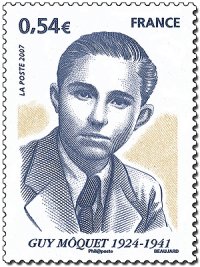 The youngest, 17-year-old Guy Moquet (you can find his name on the Paris Metro) was the son of an exiled Communist parliamentarian (French link).
 Moloise’s controversial execution occurred in the context of
  The young electrical worker and Viet Cong urban guerrilla


 The man, his activities in the ghetto, and above all his famed final walk to the Umschlagplatz, are mentioned in many books and memoirs about the ghetto.


