2006: Saddam Hussein

One year ago today, Saddam Hussein was hanged in “the hell that is Iraq” — his riposte to the mob scene at his gallows, transmitted worldwide by way of illicit footage shot with a cell phone.

Caution: This video contains graphic footage. You knew that already.

How it was then:

Who could follow in his footsteps?

On this day..

1849: Not Fyodor Dostoyevsky

“Brother, I am not dejected or crestfallen. Life, life is everywhere, life is in us ourselves, not outside. Near me will be people, and to be a person among persons and stay him forever, to not be cast down or despondent no matter what the misfortunes are – therein lies life, therein lies its purpose. I realized that. This idea entered my flesh and blood. Yes! It’s true! The head that created and got accustomed to the higher demands of the spirit, that head is cut off from my shoulders. What’s left are the memories and images created and not reified by me. They will ulcerate me, indeed! What I have left is my heart and the same flesh and blood, which can love, suffer, pity, and remember, and this is life, after all …” (quote — in Russian; the translation is mine)

The square — now named Pionerskaya Ploschad’ — where Dostoyevsky faced a mock execution. Image used with permission.

This slightly rambling epistle is authored by a titan of the world literature, a schizophrenic, a gambler, a true believer, a sufferer, a humanitarian, an epileptic, a Russian, a philosopher, a St. Petersburger, the Writer. Let us forgive him a certain incongruity of thought, since that letter was his first salute to a newly acquired chance to live.

On this date in 1849, Dostoevsky, along with some 20 other condemned, was brought out to St. Petersburg’s Semyonovsky platz. They were meant to be shot for affiliation with the Petrashevsky circle, a group of idealistic young intellectuals, apologists of Fourier and fervent advocates of socialism. Just like the generation of aristocrats (alas, some of them will be featured on this macabre blog) before them and generations of intelligentsia (whose destiny is equally unenviable) after them, Petrashevtsy gathered at Petersburg’s flats, read articles and concerned themselves with the fate of the permanently-rising-from-the-knees Motherland.

The formal charges brought upon Dostoevsky were quite bizarre: he listened to a story that criticized the army; had in his possession an illegal printing press; read an open letter to the circle from Belinsky to Gogol which excoriated the church and government; and participated in a regicide plot. The latter accusation Fyodor Mikhailovich vehemently denied, for indeed he was not a bloodthirsty revolutionary, but a proponent of the peaceful Christ’s teaching (this affliction with Christian philosophy was incidentally somewhat of a mauvais ton among the predominantly atheistic circle).

It always seemed to me that Dostoevsky’s participation in the Petrashevky circle was a tribute to the epoch’s fad. It was the imperfections of human nature, not the peculiarities of a hypothetical social structure, that concerned him greatly. The world’s wrongdoings result from something rotten in a man’s soul, and once those internal blemishes are erased, the external harmony emerges. “Beauty will save the world”, a cliché instilled in every Russian by a literature teacher in 10th grade, a phrase attributed to Christ-like kniaz’ Myshkin, and one of Dostoevsky’s most important statements: inner beauty is vital, the rest is a consequence.

The military court condemned Dostoevsky to death. The general-auditor amended this decision and recommended a lighter punishment: “… deprive of all fortune and send to hard labor in fortresses for eight years”. The final resolution of Nicholas I reduced the sentence to four years, “and then [relegate] to [the rank of] private … declare clemency only at the moment when everything is ready for execution”.

“Life is a gift, life is happiness, every minute could be a century of happiness …” continued Dostoevsky his letter. In three days, he received a prisoner’s dress, a fur coat, and valenki. He was put in shackles and dispatched to Siberia …

Novels and Short Stories by Dostoyevsky

On this day..

1882: Guglielmo Oberdan

On this date in 1882, Italian nationalist Guglielmo Oberdan was hanged for attempting to assassinate Austrian Emperor Franz Joseph.

“I will throw my corpse between the emperor and Italy and Italian youth will at least have an example.” (quote)

A native of Trieste, a melting pot of Italian and Slovenian ethnicities, Oberdan was of mixed parentage but identified with an Italy coming of age just as he himself did.

Trieste was a treasured Habsburg jewel, the empire’s most consequential port. So Franz Joseph’s visit to celebrate the city’s 500th anniversary under the Austrian crown was undertaken with no less heartfelt sincerity than the enthusiastic student had in packing a suitcase full of explosives in greeting.

Police intercepted this memorable gift and young Oberdan as well, and in short order he swung from the gallows — thousands of worldwide petitioners, Victor Hugo among them, notwithstanding — still urging cocksure verses of national redemption.

As a handsome young martyr who had chosen his Italian identity, Oberdan’s name and face became fare for boulevards, piazzas and monuments … doubly so for the boy’s dispatch contemporaneous with Italy’s cynical Triple Alliance pact with Austria-Hungary that sternly apprenticed the infant nation’s irredentist spirit to realpolitik under the sway of the man now reviled as the “Emperor of the Hangmen.” Nor would it appear a fate unworthy of his deed that he should personify in death all the impulsive romanticism his country had not strength enough to effect.

Oberdan is the subject of a rousing (and murderous — the refrain is “Morte a Franz, viva Oberdan!”) patriotic song dating from the 1880’s:

On this day..

43 B.C.E.: Cicero

On this date in 43 B.C.E., the 63-year-old Roman statesman Cicero, fleeing the proscription of the Second Triumvirate, was caught and decapitated near his villa south of Rome.

Arrogant, eloquent and opportunistic, Cicero was a polarizing figure in his forty years in the public eye. He was a Senator from an upstart family who espoused the conservative Republican cause, and a master rhetorician. Twenty years earlier, he had received the honorific Pater Patriae for steering the Roman Republic through the Catiline conspiracy.

But not Cicero nor any other Roman had healed the social rot in which Catiline’s plot sank roots. The Republic continued to weaken even as Cicero poured out the volumes of rhetoric and philosophy for which later generations would celebrate him.

Ironically, Cicero survived the resumption of civil war in 49 B.C.E. despite backing the losing faction; it was the (momentary) peace between Marc Antony and Octavian that doomed him: to consolidate power, the dictators proscribed numerous political rivals.

Cicero, a bitter nemesis of the assassinated populist Julius Caesar and his heir apparent Antony, was among the casualties.

Plutarch described the scene:

[H]is assassins came to the villa, Herennius a centurion, and Popillius a tribune, who had once been prosecuted for parricide and defended by Cicero; and they had helpers … Herennius hastened on the run through the walks, and Cicero, perceiving him, ordered the servants to set the litter down where they were. Then he himself, clasping his chin with his left hand, as was his wont, looked steadfastly at his slayers, his head all squalid and unkempt, and his face wasted with anxiety, so that most of those that stood by covered their faces while Herennius was slaying him. For he stretched his neck forth from the litter and was slain, being then in his sixty-fourth year. Herennius cut off his head, by Antony’s command, and his hands — the hands with which he wrote the Philippics.

It would be too glib to say that the Republic died with him, for Cicero himself recognized that Caesar’s war had already fatally compromised it. When Antony and Octavian at length returned to arms to settle their accounts with one another, nothing but the pantomime would remain.

After a bloody century, Rome had her peace at last.

[T]he first example, prototype, and original of tyranny has been discovered by us in the history of our own Roman State, religiously founded by Romulus … We have observed Tarquin, not by the usurpation of any new power, but by the unjust abuse of the power which he already possessed, overturn the whole system of our monarchical constitution.
-Cicero, “On The Commonwealth”

The BBC’s In Our Time does Cicero in podcast form here.

Part of the Themed Set: The Fall of the Roman Republic.

On this day..

1581: Edmund Campion, Ralph Sherwin and Alexander Briant

On this date in 1581, three English Catholic martyrs were hanged, drawn and quartered at Tyburn, casualties of the bloody confrontation between religious and secular power of the English Reformation.

Edmund Campion — later sainted — was the towering figure among them and the great attraction for those that thronged the Tyburn scaffold on a rain-drenched Friday.

A brilliant Oxford scholar once tipped as a possible future Archibishop of Canterbury, Campion abjured his Anglican holy orders in favor of Rome — a mortal peril in Elizabethan England.

He slipped away to Ireland, then to the continent and safety. But at age 40, after nearly a decade abroad, the missionary zeal of the converted called him back to Albion as part of a secret Jesuit mission. Hunted from the day he set foot back in Britain, he survived a year on the run, an underground minister to an illicit faith.

Though priestly investiture alone technically made him capitally liable, a government with millions of Catholic citizens grappled for some firmer ground upon which to condemn the renowned intellectual. Since Campion succumbed neither to torture nor to blandishments, nor to the surreal interludes when he was hauled out of his dungeon and made to debate with the Crown’s theologians, he was finally convicted on the strength of made-to-order witness testimony to the effect that his mission had some vague upshot of undermining Queen Elizabeth’s hold on her subjects.

In effect, it was very much like convicting him for his faith: the Anglican-Catholic conflict had crystallized, and dozens of priests would follow the route of Campion in the years to come. Between a mutually implacable state and church, either flesh or soul must burn.

Not a few of those who trod the martyr’s path would take inspiration from the beatific Jesuit — as young Henry Walpole, whose own route to Calvary is said to have begun when he was spattered by Campion’s blood this day and come full circle to his own execution 15 years later. Walpole’s embrace of martyrdom fairly glows from his proscribed tribute to Campion:

Hys fare was hard, yet mylde & sweete his cheere,
his pryson close, yet free & loose his mynde,
his torture great, yet small or none his feare,
his offers lardge, yet nothing coulde him blynde.
O constant man, oh mynde, oh vyrtue straunge,
whome want, nor woe, nor feare, nor hope coulde chaunge.

…

Yee thought perhapps, when learned Campion dyes,
his pen must cease, his sugred townge be still.
But yow forget how lowd his deathe yt cryes,
how farre beyond the sownd of tounge or quill.
yow did not know how rare and great a good
yt was to write those precious guiftes in bloode.

That famous eloquence was Campion’s legacy, so overwhelmingly so that he presents in the lineup of men who might have written Shakespeare.

His best-know work was “Campion’s Brag”, the scornful nickname his foes gave to an apologia he produced while underground in England … and to whose steady words Edmund Campion proved true this day:

[B]e it known to you that we have made a league — all the Jesuits in the world, whose succession and multitude must overreach all the practices of England — cheerfully to carry the cross you shall lay upon us, and never to despair your recovery [to Catholicism], while we have a man left to enjoy your Tyburn, or to be racked with your torments, or consumed with your prisons. The expense is reckoned, the enterprise is begun; it is of God, it cannot be withstood. So the Faith was planted: so it must be restored.

But Protestant England did withstand the enterprise. The generation to come saw Catholic ideas and writing put to withering siege, Campion’s not least among them. For all the tribute of history to the man of Christlike fortitude, it is by no means apparent that the enjoyments of Tyburn and the kindred “practices of England” did not, after all, lay a cross heavier than English Catholics could bear.

On this day..

1941: Zoya Kosmodemyanskaya

On this date in 1941, Soviet partisan Zoya Kosmodemyanskaya was hanged by the Wehrmacht for sabotaging buildings behind German lines near Moscow.

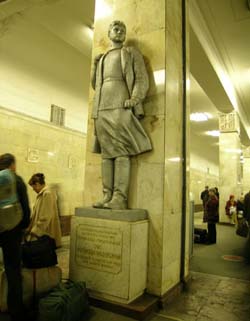
A statue of Zoya Kosmodemyanskaya stands vigil over Moscow’s World War II-era Partizanskaya metro station. Image used with permission.

One of the most famous Soviet war heroines and the first woman decorated as Hero of the Soviet Union during World War II, the 18-year-old had quit school to volunteer for a partisan unit only a few weeks before her hanging as Russia mobilized against Hitler’s race towards Moscow.

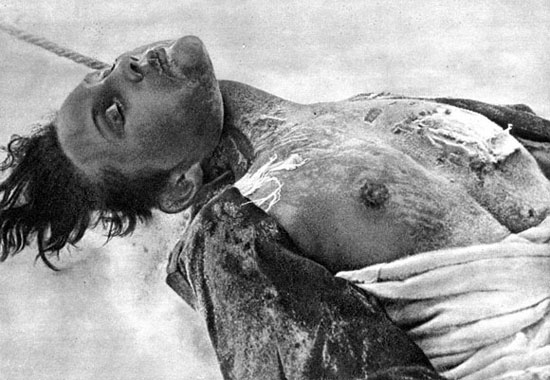
Known simply as “Tanya”, the nom de guerre which was the only information she volunteered during two days of torture, the power of the press offered her apotheosis into a propaganda coup for the Kremlin, and a symbol of courage that would long outlive Stalin. Before the public execution, the Nazis paused to photograph the scene; Kosmodemyanskaya availed the lull to harangue the Germans — “you can’t hang all 190 million of us!” — and call on the Russian villagers present to resist occupation.

Her bayoneted, mutilated body hung on the gibbet until the Red Army recaptured the village; witnesses related the tale of her dying heroism to a newsman.

It was only after the story of “Tanya” hit the press in January 1942 that her identity was established … and then promulgated widely. Anonymous and obscure in death, Zoya Kosmodemyanskaya would inspire millions and become the heroic emblem of other women partisans.


Soviet propaganda poster unabashedly modeled on the already-iconic image of Zoya Kosmodemyanskaya’s abused corpse.

Zoya, a 1944 Soviet film, was scored by Dmitri Shostakovich.

Part of the Themed Set: Women Against Fascism.

On this day..

1919: Felipe Angeles

On this date in 1919, Mexican hero General Felipe Angeles was shot at dawn in Chihuahua, hours after a military tribunal condemned him for rebellion.

Angeles, a humane and cosmopolitan socialist, had tacked a unique course through the dangerous Mexican Revolution. The career artillerist’s military counsel was a high card in the hands of the revolutionaries, and helped to make the coruscating career of Pancho Villa. Crucially, Angeles advised Villa to seize the mines of Zacatecas, dealing a mortal blow to the putschist Huerta government by throttling its currency at the source.

But that brilliant maneuver countermanded an order of the Revolution’s moderate political face, Venustiano Carranza, and both personality conflicts and support for more radically redistributionist measures soon sundered the Villa factions’ alliance with Carranza.

Angeles hitched his destiny to Pancho Villa and is historically recalled as the “angelic” opposite number to the famed guerrilla’s other top military henchman, the murderous Roberto Fierro. The three lend themselves almost implausibly to allegorical literature — “the decisive biographical proof of Villa’s duality … found in the two men closest to him, equidistant and extreme extensions of his nature.” (Enrique Krauze)

Angeles aimed, perhaps, at a statesmanship that might have remembered him the father of his country.

‘It was the recurrent dream of the impotent revolutionary intellectual: to play Plato to some powerful but pliant popular caudillo.’ This may well be an accurate analysis of Angeles, who probably had ambitions to be president of Mexico, with Villa as the power behind the throne but based in Chihuahua, allowing Angeles free rein to implement radical reforms in the capital

… Angeles probably saw Villa as a tabula rasa on which he could imprint his ideology. The problem was that Villa had no taste for abstract thought; as [John] Reed remarked ironically: ‘You had to be a philosopher to explain anything to Villa.’

To the grief of both, Villa neglected Angeles’ expertise when the Villists faced Carranzo at arms. Against advice, Villa abandoned Mexico City, failed to attack when the constitutionalists were tenuous, then spurned guerrilla operations for a frontal assault into the teeth of a foe with numerical superiority and lethal tactical advances culled from the slaughterhouse of World War I.

All was postscript after the Battle of Celaya — Villa maintaining for a few years as a bandit force and famously raiding New Mexico while his strategist drifted into exile in Texas before returning to Mexico on a quixotic peacemaking mission that led him instead to a show trial.

Angeles’ end came with the all the dignity of his romantic age. Before his judges — before all the world — he gave “full and clear expositions of his history and his ideas about everything from politics to ontology. It was clear that he knew this was his end, and he seems to have written a kind of intellectual memoir in the protracted answers … he was not defeated morally so much as physically.”

Angeles himself arranged particulars of his own execution with the Carranza men detailed to shoot him. He enjoys posthumous esteem commensurate with his qualities in life:

On this day..

1695: Zumbi dos Palmares

On this date in 1695, Zumbi dos Palmares, the last leader of Brazil’s most famous free colony of fugitive slaves, was captured by the Portuguese and summarily beheaded.

From the very beginning of European settlement in the New Wold, Maroon communities of escaped slaves, free-born blacks, Indians, poor whites, and mixed-race outcasts formed at the fringes of slave states.

Colonial power did not welcome their presence.

Consequently, the community of Palmares faced repeated harassment from the Portuguese and the Dutch West Indies Company from the time of its establishment around 1600 — even as it burgeoned into a kingdom of over 30,000 inhabitants.

Zumbi, a black free-born in Palmares, was kidnapped by such a sortie and raised with a missionary priest who taught him Portuguese and Latin. At 15, he escaped and returned to Palmares, quickly rising to prominence and in 1678 overthrowing his adoptive uncle King Ganga Zumba when the latter attempted to accept peace under Portuguese rule.

Zumbi’s skepticism was vindicated when the followers of Zumba who had defected to Portugal were re-enslaved, but free Palmares soon faced intensified Portuguese pressure. In 1694, artillery finally battered its largest settlement into submission — forcing its ruler into the bush, where he long eluded capture.

In Zumbi’s honor, November 20 is a Brazilian celebration of national pride and especially pride for those of African descent … while the king who would not be a slave has lent his name, somewhat paradoxically, to an international airport.

On this day..

1915: Joe Hill

On this date in 1915, songwriter, poet and labor activist Joe Hill was shot in Utah for the murder of a local butcher.

Even before his execution, the Swedish immigrant was widely thought to have been railroaded for his IWW affiliation.

Though state authorities had little use for the worldwide clemency bid whose backers included U.S. President Woodrow Wilson — powerless to intervene officially, since the execution was a state matter — Hill walked spryly into his martyrdom. The strange post-mortem career of his totemic ashes is the least of the ways Hill lives on.

His dauntless last message to fellow Wobbly Bill Haywood — “Don’t waste any time mourning. Organize.” — is a permanent fixture on pins and placards among every stripe of left activist. The songs he wrote remain in print — and in performance.

And the Depression-era tribute ballad “I Dreamed I Saw Joe Hill Last Night” can seamlessly serenade ripped-from-the-headlines footage, as a Paul Robeson rendition does in these clips of 1998 protests against then-New York City Mayor Rudy Giuliani.

On this day..

1720: Captain John “Calico Jack” Rackham

On this date in 1720Nov. 18, 1720, the pirate captain “Calico Jack” Rackham was hanged together with his crew by the British governor of Jamaica.

Nicknamed for his flamboyant clothing, the Bristol-born buccaneer plundered the West Indies during the “Golden Age of Piracy”, having ousted his former captain Charles Vane. Rackham is chiefly remembered to history for two who were not hanged with the rest of his crew: Anne Bonny and Mary Read, rare female pirates who served aboard Rackham’s ship.

Immortalized by Daniel Defoe in his pseudonymous A General History of the Pyrates, Bonny and Read came to piracy by different paths but were both every bit the part and leaders aboard their ship — “very profligate, cursing, and swearing much, and very ready and willing to do any Thing on board.” Bonny, at least, was Rackham’s lover — having eloped with him from her husband.

Upon capture, both women “pleaded their bellies” to escape the gallows, and though it’s unclear whether either really was pregnant, it seems the gambit spared both from execution.

Read died in prison shortly after, while Bonny vanished from history — prompting speculation that she had escaped, secured a pardon, been ransomed by her wealthy father, and/or returned again to piracy under a different guise. Reportedly, she castigated Rackham at their last meeting in prison for lying drunk below decks while only the women resisted the capture of their ship: “I am sorry to see you here Jack, but if you had fought like a man, you need not be hanged like a dog.”

As the world’s best-known women pirates, Bonny and Read are recalled as anything from sexualized historical curios to action heroines to proto-feminists.

They feature in Disneyland’s “Pirates of the Caribbean” ride, the Witchblade comic book series, utopian theorizing, popular history … and the occasional action figure.

Update: A much more detailed foray into the lives of these daring women is at Scandalous Women.

Also, I posted this under the wrong date: it should be Nov. 18. Balls.

On this day..