401 B.C.E.: Clearchus of Sparta

Around this time in the late autumn or early winter some weeks following the Battle of Cunaxa, the general of a Greek mercenary army — along with most of its other commanders — was treacherously seized by a Persian satrap and summarily beheaded.

In the train of the Peloponnesian War‘s devastation, sturdy Greek hoplites with bills to pay found a lucrative gig backing a Persian prince‘s bid to seize the throne.

The prince marched the Hellenes deep into Persia before falling in battle at Cunaxa in Mesopotamia, a discomfiting scenario alike for the stranded but still-potent invading army and the somewhat outclassed Persians.

The seizure around this day of the veteran soldier and former tyrant of Byzantium Clearchus — lured under color of friendship — aimed to crush the Greeks’ morale, but instead feathered the laurels of “the Ten Thousand”. This “marching Republic” hastily self-organized and proceeded upon an astonishing escape, intrepidly fighting its way north over the ensuing year to the Black Sea, and thence to hearth and home.

The Greeks’ perseverance offers one of classical antiquity’s stock testimonies to the resilient polis — and at this stage, practically the last breath of that dying spirit. More to the immediate point, it illustrated strikingly the Persian army’s vulnerability to the phalanx, exploited to decisive effect in the century to come by Alexander the Great.

One of the replacement generals, Xenophon, immortalized the Greeks’ march in the Anabasis.

After the generals had been seized, and the captains and soldiers who formed their escort had been killed, the Hellenes lay in deep perplexity — a prey to painful reflections. Here were they at the king’s gates, and on every side environing them were many hostile cities and tribes of men. Who was there now to furnish them with a market? Separated from Hellas by more than a thousand miles, they had not even a guide to point the way. Impassable rivers lay athwart their homeward route, and hemmed them in. Betrayed even by the Asiatics, at whose side they had marched with Cyrus to the attack, they were left in isolation. Without a single mounted trooper to aid them in pursuit: was it not perfectly plain that if they won a battle, their enemies would escape to a man, but if they were beaten themselves, not one soul of them would survive?

Haunted by such thoughts, and with hearts full of despair, but few of them tasted food that evening; but few of them kindled even a fire, and many never came into camp at all that night, but took their rest where each chanced to be. They could not close their eyes for very pain and yearning after their fatherlands or their parents, the wife or child whom they never expected to look upon again. Such was the plight in which each and all tried to seek repose.

The tale’s motif was borrowed for a 1965 novel of a New York gang struck leaderless making its way out of hostile territory, later adapted for a cult 1970’s film:

On this day..

1793: Sydney Carton posing as Charles Darnay

On an unspecified date in December 1793 is set one of literature’s immortal execution scenes, when ne’er-do-well Sydney Carton heroically goes to the guillotine in the place of his aristocratic doppleganger Charles Darnay at the climax of A Tale of Two Cities.

In Charles Dickens‘ classic 1859 novel of the French Revolution, Darnay, the good-hearted scion of the cruel Evremonde line, falls prey to the Revolutionary Terror.

The dissolute, tormented Carton is the respectable Darnay’s literary dark twin, whose appearance he also happens to strikingly resemble. Driven by an unrequited love for Darnay’s wife, who stands in danger not only of losing her husband but of following him to the scaffold, Carton contrives to switch places with the doomed noble.

While those saved by his sacrifice flee for England, Carton goes to the guillotine in a batch of 52 condemned prisoners,* one of them a sweet and frightened girl he comforts tenderly.

His prophetic thoughts as he awaits the blade form the conclusion of the novel, and the last sentence ranks among literature’s most recognizable lines.

“I see that I hold a sanctuary in their hearts, and in the hearts of their descendants, generations hence. I see her, an old woman, weeping for me on the anniversary of this day. I see her and her husband, their course done, lying side by side in their last earthly bed, and I know that each was not more honoured and held sacred in the other’s soul, than I was in the souls of both.

“I see that child who lay upon her bosom and who bore my name, a man winning his way up in that path of life which once was mine. I see him winning it so well, that my name is made illustrious there by the light of his. I see the blots I threw upon it, faded away. I see him, fore-most of just judges and honoured men, bringing a boy of my name, with a forehead that I know and golden hair, to this place — then fair to look upon, with not a trace of this day’s disfigurement — and I hear him tell the child my story, with a tender and a faltering voice.

“It is a far, far better thing that I do, than I have ever done; it is a far, far better rest that I go to than I have ever known.”

A Tale of Two Cities is one of thousands of public-domain books available for free at Project Gutenberg. Stanford’s “Discovering Dickens” community reading project guide annotates the novel here.

* Never one for understatement, Dickens crowds his mass execution tableau with far too many extras. “The Terror” is usually dated from September 1793 through July 1794, but only during its bloodiest last two months would so many as 52 have been guillotined together; at the time of Carton’s execution, half as many would have constituted a large group.

On this day..

43 B.C.E.: Cicero

On this date in 43 B.C.E., the 63-year-old Roman statesman Cicero, fleeing the proscription of the Second Triumvirate, was caught and decapitated near his villa south of Rome.

Arrogant, eloquent and opportunistic, Cicero was a polarizing figure in his forty years in the public eye. He was a Senator from an upstart family who espoused the conservative Republican cause, and a master rhetorician. Twenty years earlier, he had received the honorific Pater Patriae for steering the Roman Republic through the Catiline conspiracy.

But not Cicero nor any other Roman had healed the social rot in which Catiline’s plot sank roots. The Republic continued to weaken even as Cicero poured out the volumes of rhetoric and philosophy for which later generations would celebrate him.

Ironically, Cicero survived the resumption of civil war in 49 B.C.E. despite backing the losing faction; it was the (momentary) peace between Marc Antony and Octavian that doomed him: to consolidate power, the dictators proscribed numerous political rivals.

Cicero, a bitter nemesis of the assassinated populist Julius Caesar and his heir apparent Antony, was among the casualties.

Plutarch described the scene:

[H]is assassins came to the villa, Herennius a centurion, and Popillius a tribune, who had once been prosecuted for parricide and defended by Cicero; and they had helpers … Herennius hastened on the run through the walks, and Cicero, perceiving him, ordered the servants to set the litter down where they were. Then he himself, clasping his chin with his left hand, as was his wont, looked steadfastly at his slayers, his head all squalid and unkempt, and his face wasted with anxiety, so that most of those that stood by covered their faces while Herennius was slaying him. For he stretched his neck forth from the litter and was slain, being then in his sixty-fourth year. Herennius cut off his head, by Antony’s command, and his hands — the hands with which he wrote the Philippics.

It would be too glib to say that the Republic died with him, for Cicero himself recognized that Caesar’s war had already fatally compromised it. When Antony and Octavian at length returned to arms to settle their accounts with one another, nothing but the pantomime would remain.

After a bloody century, Rome had her peace at last.

[T]he first example, prototype, and original of tyranny has been discovered by us in the history of our own Roman State, religiously founded by Romulus … We have observed Tarquin, not by the usurpation of any new power, but by the unjust abuse of the power which he already possessed, overturn the whole system of our monarchical constitution.
-Cicero, “On The Commonwealth”

The BBC’s In Our Time does Cicero in podcast form here.

Part of the Themed Set: The Fall of the Roman Republic.

On this day..

1944: Lilo Gloeden, Erich Gloeden and Elisabeth Kuznitzky

On this date in 1944, Berlin housewife Elisabeth “Lilo” Gloeden was beheaded with an axe in Plotzensee Prison, along with her husband and mother.

They had been sentenced — and intentionally made an example of — just three days before for hiding a fugitive from the July 20 Plot to assassinate Hitler.

As Martin Gilbert observes in The Second World War: A Complete History, the fury of Hitler’s domestic crackdown came in inverse proportion to Germany’s fortunes in war.

[The family’s] fate was then publicized, as a warning to anyone else who might try to shelter the enemies of the Third Reich.

The fate of that Reich could not, however, be seriously in doubt. On the day of Lilo Gloeden’s execution, American troops drove the Germans from Mackwiller, in the Saar, inside Germany’s pre-war frontier. In Hungary, the Red Army entered Eger, less than twenty-five miles from the central Slovak frontier.

Part of the Themed Set: Women Against Fascism.

On this day..

Feast Day of St. Catherine of the Wheel

This date annually is the feast of iconic — perhaps mythological — Christian martyr Saint Catherine, said to have been put to death in the 4th century for her faith.

St. Catherine in a 700-year-old stained glass at St. Mary’s Church of Deerhurst. Image courtesy of the Sacred Destinations Travel Guide.

One of the most popular Catholic saints, St. Catherine was reputed to have been a beautiful young maiden of Alexandria — so wise as to convert every pagan scholar sent to dispute her, so devoted as to be mystically betrothed to Christ.

Catherine was condemned by one of the last pagan rulers of Rome to torture on a breaking wheel, which shattered when it touched her — so she was simply beheaded. (The story is related in didactic iconography in this triptych.)

Despite this inauspicious debut, the breaking wheel was Catherine’s iconic attribute, by which her frequent appearances in devotional art can be recognized.

This gruesome instrument of torture was also known as the “Catherine wheel” in medieval Europe, from which English derives the deceptively winsome-sounding name of a firework.

The saint became the patron of those condemned to this horrific death as well as a diverse swath of the wider society: wheelwrights, mechanics, and other laborers who worked with wheels for apparent reasons; teachers, philosophers and scribes for her learning; girls, virgins and young maids for her purity. Single women seeking husbands still offer her supplication:

St. Catherine, St. Catherine, O lend me thine aid
And grant that I never may die an old maid.
A husband, St. Catherine.
A handsome one, St. Catherine.
A rich one, St. Catherine.
A nice one, St. Catherine.
And soon, St. Catherine.

Catholic recountings of the saint’s legend can be read here and here. More St. Catherine’s Day customs are enumerated here.

On this day..

1695: Zumbi dos Palmares

On this date in 1695, Zumbi dos Palmares, the last leader of Brazil’s most famous free colony of fugitive slaves, was captured by the Portuguese and summarily beheaded.

From the very beginning of European settlement in the New Wold, Maroon communities of escaped slaves, free-born blacks, Indians, poor whites, and mixed-race outcasts formed at the fringes of slave states.

Colonial power did not welcome their presence.

Consequently, the community of Palmares faced repeated harassment from the Portuguese and the Dutch West Indies Company from the time of its establishment around 1600 — even as it burgeoned into a kingdom of over 30,000 inhabitants.

Zumbi, a black free-born in Palmares, was kidnapped by such a sortie and raised with a missionary priest who taught him Portuguese and Latin. At 15, he escaped and returned to Palmares, quickly rising to prominence and in 1678 overthrowing his adoptive uncle King Ganga Zumba when the latter attempted to accept peace under Portuguese rule.

Zumbi’s skepticism was vindicated when the followers of Zumba who had defected to Portugal were re-enslaved, but free Palmares soon faced intensified Portuguese pressure. In 1694, artillery finally battered its largest settlement into submission — forcing its ruler into the bush, where he long eluded capture.

In Zumbi’s honor, November 20 is a Brazilian celebration of national pride and especially pride for those of African descent … while the king who would not be a slave has lent his name, somewhat paradoxically, to an international airport.

On this day..

1520: Stockholm Bloodbath

On this date in 1520, four days after the Danish King Christian II gained the Swedish throne, nearly 100 prominent supporters of Swedish independence were executed en masse as a civil war’s apparent victors purged their enemies.

The Stockholm Bloodbath followed years of conflict between supporters of the Danish-dominated Kalmar Union and independence advocates under the banner of Sten Sture the Younger. With Sture’s death in battle earlier in 1520, the unionists had gained the upper hand. Stockholm, the last outpost of resistance, had held against four months’ siege before accepting a general amnesty in exchange for capitulation.

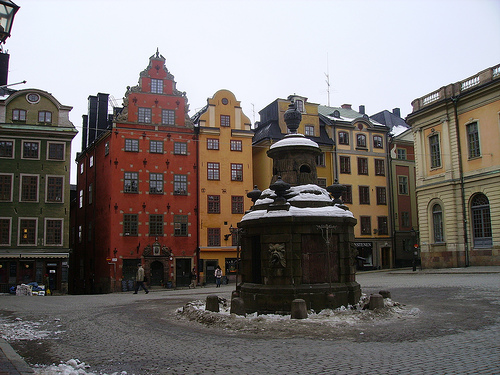
But with the city in hand, Christian — known to Swedish history as “Christian the Tyrant” — had its leaders charged for having deposed during the conflict the pro-union Archbishop Gustav Trolle, construed as an offense against the Church not in the temporal authority’s power to reprieve. Less than 24 hours after this legal maneuver was sprung, public beheadings of prelates, merchants and burgomasters were underway at Stortorget* — and Sture’s remains were exhumed and posthumously burnt at the stake.

Stortorget

It proved a Pyrrhic victory for the Danish party.

Inside of three years, Christian himself had been deposed with multiple lands and factions throughout his realm in open revolt. Gustav Vasa, whose father had been one of the Stockholm Bloodbath’s victims, would not only decisively break Denmark’s hold on Sweden but found the Vasa Dynasty under which Sweden would burgeon into one of Europe’s great powers.

*One Hans Brask survived the purge despite having endorsed the removal of Archbishop Trolle. Brask supposedly placed a note under his seal on this document saying “To this I am forced and compelled.” This cunning device gave the Swedish tongue the word Brasklapp — a secret reservation.

On this day..

1936: Edgar André

On this date in 1936, communist politician Edgar Andre was beheaded in Fuhlsbüttel Prison for treasonous complicity in the Reichstag Fire.

This 1936 German pamphlet denouncing Andre’s execution concludes: “Edgar André lives. In his spirit, we march: Despite all.”

A politician raised in Belgium, Andre had bolted the Socialist Party of Germany for the Communist Party in the early 1920’s, becoming a major labor leader in Hamburg. Andre was arrested within days of the 1933 Reichstag Fire as Adolf Hitler crushed official leftist opposition.

But Andre was not brought to trial for over three years — by which time torture had crippled and deafened him, and the political climate made the doubtful nature of the evidence against him scant protection in the courts. His conviction and sentence were a foregone conclusion.

The Spanish Civil War, which erupted over the summer of 1936 between Andre’s trial and execution, saw the service of a battalion in the International Brigades named for Edgar Andre.

Just days after Andre was beheaded, that battalion entered its first action — with German volunteers helping stave off fascist capture of Madrid. The unit’s hymn commemorated their namesake:

[audio:Das_Batallion_Edgar_Andre.mp3]

On this day..

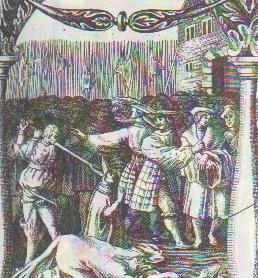
1589: Peter Stubbe, Sybil Stubbe and Katharina Trump

On Halloween in 1589, the “Werewolf of Bedburg” was put to a horrible death for a supposed slew of crimes committed in lupine form in the environs of the German city of Cologne.

Our knowledge of the strange case of Peter Stubbe comes primarily from a single surviving account, and with many of the potential supplementary sources lost to the ravages of time and war, interpretations are inevitably speculative.

Stubbe reportedly confessed under (or facing) torture to having practiced witchcraft and claimed to have received a magic belt from the infernal powers enabling him to transform into a wolf. The doomed man owned, during the quarter-century riot of sin that ensued this youthful acquisition, to rape, murder, cannibalism, incest, filicide, slaughtering livestock and keeping a succubus in his bed. (Authorities were unable to recover this potent belt, and sighed that Satan must have reclaimed it.)

For these crimes, he was broken on the wheel, beheaded, then burnt — the latter punishment shared with his daughter and his mistress, apparently implicated as accessories.

Was there a real wolf terrorizing the vicinity? Was Stubbe an actual murderer with a supernatural cover story? Was he nursing a genuine delusion of lycanthropy? Did he back the wrong faith as strife over Protestantism rent Germany? Or was he just unluckily caught up in an instance of demonic hysteria?

Whatever the individual circumstances of Stubbe’s death might have been, it occurred during a surge of panic over the venerable superstition of were-beasts and shapeshifters (particularly pronounced in France) coeval with Europe’s crises of religious and political authority on the eve of the Thirty Years’ War.

Yet this troubled period bore the germ of a modernity whose pervasive social changes would upend, among other things, the idea of a real werewolf. As the sixteenth century closed, both medical and theological understandings of “werewolfism” increasingly located it in the realm of the psychological instead of the supernatural.

Within a few years of Stubbe’s torture, werewolves had left the hands of magistrates for those of doctors … bound eventually for the pens of screenwriters with Halloween fare in mind.

On this day..