1655: Massacre of Waldensians

On this date in 1655, Catholic forces under the Duke of Savoy carried out a notorious massacre of Waldensians* in the Piedmont.

This interesting, excommunicate sect had persisted for centuries in those hard-to-reach places in Alpine foothills, intermittently ignored and hunted. After Martin Luther, many Protestants inclined to see them as a proto-Reformation movement, or even a counter-papal apostolic succession reaching back to ancient Christianity.

At any rate, they sure weren’t Catholic.

And our friend the Duke decided — perhaps piqued by the murder of a missionary Catholic priest, or for whatever other reason — to mount one of those heresy-extirpating sorties and make them Catholic in 1655.

On April 17, the Marquis of Pianezza appeared with an overwhelming force of mixed Piedmontese, French, and Irish** troops. They conducted a few skirmishes, then made nice with the Waldensian civic leaders and induced them to quartering their troops temporarily further to some expedient pretext.

Alas! alas! these poor people were undone. They had received under their roof the executioners of themselves and their families. The first two days, the 22d and 23d of April, passed in peace, the soldiers sitting at the same table, sleeping under the same roof, and conversing freely with their destined victims …

At last the blow fell like a thunderbolt. At four of the clock on the morning of the 24th April the signal was given from the Castle of La Torre. But who shall describe the scenes that followed? On the instant a thousand assassins began the work of death …

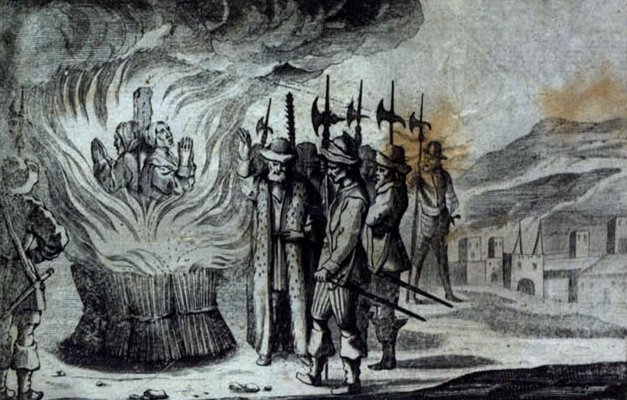
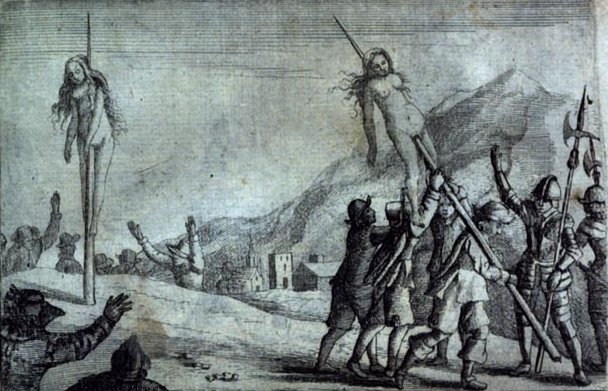
Little children were torn from the arms of their mothers, and dashed against the rocks; or, more horrible still, they were held betwixt two soldiers, who, unmoved by their piteous cries and the sight of their quivering limbs, tore them up into two halves. Their bodies were then thrown on the highways and the fields. Sick persons and old people, men and women, were burned alive in their own houses; some were hacked in pieces; some were bound up in the form of a ball, and precipitated over the rocks or rolled down the mountains … Some were slowly dismembered, and fire applied to the wounds to staunch the bleeding and prolong their sufferings; some were flayed alive; some roasted alive; others were disembowelled; some were horribly and shamefully mutilated, and of others the flesh and brains were boiled and actually eaten by these cannibals.

Source, whose atrocity accounts channel those in this French tome

Without doubting the capacity of man’s inhumanity to man, the cannibalism charge reminds that we’re dealing with propaganda alongside historiography. And what great propaganda — like, babies-torn-from-incubators great.

Thumbnails (click for a larger, disturbing view) of selected images of this date’s atrocities from Samuel Morland’s The History of the Evangelical Churches of the Valleys of Piedmont

And there’s little doubt as to the overall savagery of the affair, which could well have become the opening salvo in a full-scale sectarian cleansing campaign. (A later addendum to Foxe’s Book of Martyrs narrates the ensuing Piedmontese armed struggle, petering out before any definitive resolution in the field.)

Outrage at this hecatomb spread in Protestant Europe — which would also refer to the day’s doings as the “Bloody Easter,” since it corresponded with the eve of that celebration as reckoned by the Julian Calendar (source).

It was felt especially in Protectorate England, which intervened diplomatically.

A “day of solemn fasting and humiliation” was promulgated in Albion, along with collections for the relief of the survivors. Oliver Cromwell personally put £2,000 into the kitty.

More importantly, he dispatched diplomat Samuel Morland† to force the House of Savoy to lay off the persecution; in fact, he threatened to disrupt high statecraft between England and France unless the French twisted arms on behalf of the Waldensians.

Written correspondence for Morland’s diplomatic tour addressed to Louis XIV of France and various other continental potentates, as well as a fiery bit of oratory that Morland delivered to Savoy, all seem to have originated from the pen of Republican scribbler John Milton — the future author of Paradise Lost.‡

Milton, for whom the whole thing was more than just a day job, was further moved to put his umbrage at the slaughter into sonnet form:

Avenge O Lord thy slaughter’d Saints, whose bones
Lie scatter’d on the Alpine mountains cold,
Ev’n them who kept thy truth so pure of old
When all our Fathers worship’t Stocks and Stones,

Forget not: in thy book record their groanes
Who were thy Sheep and in their antient Fold
Slayn by the bloody Piemontese that roll’d
Mother with Infant down the Rocks. Their moans

The Vales redoubl’d to the Hills, and they
To Heav’n. Their martyr’d blood and ashes sow
O’re all th’ Italian fields where still doth sway

The triple Tyrant: that from these may grow
A hunder’d-fold, who having learnt thy way
Early may fly the Babylonian wo.

* The Waldensians in question here are interchangeably known as the Vaudois for their geographic region, actually above the Piedmont and abutting the Swiss region also known as Vaud. (These pages have visited the latter.)

** Fresh from being on the receiving end of another infamous massacre.

† Morland is more regarded for his post-Restoration labors as an inventor; he created an early calculator and internal combustion engine.

‡ The speech in particular is not definitively attributed; see Robert Fallon, “Milton in Government: Denmark and Savoy,” Milton Quarterly, May 1989.

On this day..

1457: The Wallachian boyars

This date was Easter Sunday in 1457, which would make it the date associated with one of the more memorable displays of theatrical brutality by Wallachian proto-vampire Vlad Tepes, aka Vlad Dracula or Vlad the Impaler.

Having only just ascended the less-than-secure throne of Wallachia, a frontier principality pinched between the Hungarian and Ottoman Empires, the 25-ish prince and onetime Ottoman hostage had a bone-chilling inauguration plan to shore up his security both internal and external.

He threw a big party in Targoviste for the nobles of the realm … and had a little surprise waiting for them. It wasn’t an Easter egg hunt.

He asked the assembled noblemen:
“How many princes have you known?”
The latter answered
Each as much as he knew best.
One believed that there had been thirty,
Another twenty.
Even the youngest thought there had been seven.
After having answered this question
As I have just sung it,
Dracula said: “Tell me,
How do you explain the fact
That you have had so many princes
In your land?
The guilt is entirely due to your shameful intrigues.”

With ample proof of the boyars’ deceit and treacherous intents, Dracula decided it was timely to inflict upon them an exemplary punishment … mass impalement …

The oldest Romanian historical chronicle records the event two centuries later. It had taken place in the spring of 1457, during the Easter celebrations that the boyars were attending at the palace … “when Eastern Day came, while all the citizens were feasting and the young ones were dancing he [Dracula] surrounded them [the boyars] … led them together with their wives and children, just as they were dressed up for Easter, to Poenari, where they were put to work until their clothes were torn and they were left naked.” In actual fact, this episode, which is also recalled by the Greek historian Chalcondyles and firmly anchored in popular folklore, involved some two hundred boyars and their wives, as well as leading citizens of Tirgoviste … They were seized by Dracula’s men as they were finishing their meal in the main banqueting hall of the palace, following the elaborate Easter ritual at the Paraclete Chapel. In Dracula’s ingenious mind, one aspect of the punishment had a utilitarian purpose: the reconstruction of the famous castle high up on the Arges … On the way out of the chapel the old boyars and their wives were apprehended by Dracula’s henchmen and impaled beyond the city walls. The young and able-bodied were manacled and chained to each other and then marched northward under the vigilant eye of Dracula’s men.

This was revenge a decade in the making for the boyar class having toppled Vlad’s father and murdered Vlad’s elder brother in 1447.

But personal score-settling aside, Vlad’s sanguinary housekeeping had a statecraft dimension as well. It enabled him to centralize power in his own person, and had the happy side effect of speeding creation of a secure mountain fastness — Poenari Castle, which is one of several structures answering to the lucrative name of Castle Dracula.

While Vlad is (in)famous for his iron fist (and well-oiled spikes), it’s perhaps harder to say with confidence how much good this slaughter did him. Wallachia’s security situation was fundamentally defined by its neighbors no matter how cruel Vlad Tepes might be.

Vlad got some more impaling under his belt defending his country from Ottoman invaders (you’ll be shocked to learn that many boyars were more than happy to help the sultan get rid of this tyrant), but he was clapped in prison by the Hungarian ruler Matthias Hunyadi in 1462, lived most of the rest of his life in exile, and then died in battle attempting a Wallachian comeback in 1476. So basically, he got a few good years in … plus that whole latter-day afterlife he enjoys as tourist magnet, alleged literary inspiration, and nationalist icon.

And that’s more than one can say for most of the 15th century rulers who weren’t impaling their boyars.

On this day..

Unspecified year: Snowball’s animal fifth column

“Four days” after an unspecified “early spring” date in George Orwell’s classic allegory of Soviet communism, Animal Farm, a show trial and mass execution of animals purporting to work for the book’s Trotsky figure signals the titular farm’s unmistakable collapse into dystopia.

In the book, a revolution of animals displaces the farm’s human owner, Jones — the hated ruler of the ancien regime.

The farm’s early cooperative elan soon shatters, with a pig bearing the unsubtle name of Napoleon becoming the revolution’s autocrat, and fostering a paranoid security climate against phantasmal plots by his fellow swine and onetime comrade, the exiled Snowball.

Let’s watch.

Napoleon ordered all the animals to assemble in the yard. When they were all gathered together, Napoleon emerged from the farmhouse, wearing both his medals (for he had recently awarded himself “Animal Hero, First Class”, and “Animal Hero, Second Class”), with his nine huge dogs frisking round him and uttering growls that sent shivers down all the animals’ spines. They all cowered silently in their places, seeming to know in advance that some terrible thing was about to happen.

Napoleon stood sternly surveying his audience; then he uttered a high-pitched whimper. Immediately the dogs bounded forward, seized four of the pigs by the ear and dragged them, squealing with pain and terror, to Napoleon’s feet.0 …

The four pigs waited, trembling, with guilt written on every line of their countenances. Napoleon now called upon them to confess their crimes. … Without any further prompting they confessed that they had been secretly in touch with Snowball ever since his expulsion, that they had collaborated with him in destroying the windmill, and that they had entered into an agreement with him to hand over Animal Farm to Mr. Frederick. They added that Snowball had privately admitted to them that he had been Jones’s secret agent for years past. When they had finished their confession, the dogs promptly tore their throats out, and in a terrible voice Napoleon demanded whether any other animal had anything to confess.

The three hens who had been the ringleaders in the attempted rebellion over the eggs now came forward and stated that Snowball had appeared to them in a dream and incited them to disobey Napoleon’s orders. They, too, were slaughtered. Then a goose came forward and confessed to having secreted six ears of corn during the last year’s harvest and eaten them in the night. Then a sheep confessed to having urinated in the drinking pool — urged to do this, so she said, by Snowball — and two other sheep confessed to having murdered an old ram, an especially devoted follower of Napoleon, by chasing him round and round a bonfire when he was suffering from a cough. They were all slain on the spot. And so the tale of confessions and executions went on, until there was a pile of corpses lying before Napoleon’s feet and the air was heavy with the smell of blood, which had been unknown there since the expulsion of Jones.

When it was all over, the remaining animals, except for the pigs and dogs, crept away in a body. They were shaken and miserable. They did not know which was more shocking — the treachery of the animals who had leagued themselves with Snowball, or the cruel retribution they had just witnessed. In the old days there had often been scenes of bloodshed equally terrible, but it seemed to all of them that it was far worse now that it was happening among themselves. Since Jones had left the farm, until today, no animal had killed another animal.

Animal Farm was published in 1945. In this 1954 British animated feature, the downer of an ending — with the corrupt pig rulers becoming literally indistinguishable from people — was dumped in favor of an ending where the animals revolt again.

On this day..

277: Mani, dualist

It was perhaps on this date, that the prophet Mani — he of Manichaeism — underwent his Passion at the hands of the Sassanid Empire in a Gundeshapur prison.

The actual date of this event is an Aramaic (lunar) date whose year is unrecorded, so it attaches only uncertainly to the Julian calendar. (2 March 274 is another possibility, as are other dates in the mid-270s.)

Perhaps more to the point for this blog is that Mani’s “crucifixion” as celebrated by his followers was a literary exultation: the 60-year-old died in prison after 26 days in chains, maybe even sooner than his captors had intended. After Mani “rose [from his body] to the residences of his greatness [in] the heights, and he met his shape,” the Sassanids decapitated the corpse to make the whole scene more properly resemble the awful majesty of an offended sovereign.

But even as merely a metaphorical “execution,” Mani’s martyrdom merits mention.

Born into a Judaic-Christian sect, Mani (also known as Manes) experienced a conversion, went east for enlightenment, and returned with a syncretic theology of a good spirit world and an evil material one — and east-meets-west twist, in other words, on gnosticism, rooted in both Christianity and Buddhism. (And Zoroastrianism, dominant in Persia at this time — to Mani’s ultimate grief.)

This seems like the sort of thing that someone ought to have revived in California in the 1970’s.


Shrine of Mani as Buddha in Quanzhou, China.

Alas, though it once spanned the Eurasian landmass all the way to China, Manichaeism today is extinct except for its linguistic remnant … the word “manichean”.

Most of us won’t do so well as to thrust our fame into the dictionary, but Mani’s shape-in-the-heights can’t be altogether satisfied with this word’s connotation of jejune, black-and-white dualism — as in a “Manichean struggle with a single overarching enemy called terrorism”.

The man wrote his own holy book, after all, and it’s a bit more elegant than the likes of neoconservative foreign policy.

the first precept for hearers is this: …they shall not kill …, [and] they shall forgive those creatures who provide them with meat for food so that they do not kill them as if they were evil people. But dead flesh of any animals, wherever they obtain it, be it dead or slaughtered, they may eat …

And the second precept for hearers is that they shall not be false and they shall not be unjust to one another … he shall walk in truth. And a hearer shall love [another] hearer in the same way one loves one’s own brother and relatives, for they are children of the living family and the world of light.

And the third precept is that they shall not slander anybody and not be false witnesses against anybody of what they have not seen and not make an oath in falsehood in any matter …

From the Shabuhragan (pdf)

Now is that so bad?

Manichaeism found favor (though not a conversion) with the broad-minded and long-reigning king Shapur I. (Shapur is most famous in the West as the Persian ruler who captured the Roman emperor Valerian.)

But one of Shapur’s less impressive heirs was persuaded by the sectarian Zoroastrian priesthood — for whom the Manicheans were an upstart rival — to bust Mani.

It seems they were able to make use of the prophet’s distaste for war to question his patriotism. Some things never change.

The founder’s laying down his life hardly slowed the faith’s growth; instead, it prospered as one of the more successful entrants in the confusing late-antiquity hustle and bustle of competing cults. Dualism was a hot mystical trend literally from ocean to ocean, and nobody proselytized it like Mani’s followers.

“In its Manichaean form,” observes Johannes van Oort, “Gnosticism once was a real world religion.”

Had it stayed that way, there’d be endowed chairs of Manichean gnosticism at every university and politicians conspicuously rubbing shoulders with Manichean clergy and Major League sluggers with WWMD bracelets. Instead, it’s a metonym for naivete. Them’s the breaks.

In the West, at least, the lost sect’s unflattering reputation comes by way of no less a personage than St. Augustine of Hippo.

You know what they say about the zeal of converts? Well, Augustine used to know Manichaeism from the inside.


St. Augustine Sacrificing to a Manichaean Idol, 15th century painting by an unknown Flemish master.

After spending his twenties as an enthusiastic Manichean, the future Church Father (re)converted to orthodox* Christianity and turned on his former philosophy with vehemence.

His Confessions denounces a Manichean bishop with whom he once had an unsatisfying audience — “Faustus by name, a great snare of the devil.” That association might very well be the etymological root of that great literary devil-bargainer Dr. Faust.

One could, at the minimum, follow a thread from Augustine’s establishment anti-dualism to the Middle Ages practice of calling any dualistic heresy — Bogomilism, Catharism, whatever — “Manichean”, and the intertwining of those forbidden gnostic traditions with Christendom’s devil mythology.


Medieval image of St. Augustine confounding devilish heresies.

At the same time, Augustine’s philosophy draws much of its enduring appeal from that very dualism, absorbed at such a formative age that the writer late into life was still repelling Christian colleagues’ accusations of immutable Manichaeism — “like an Ethiopian can not change his skin, nor the leopard his spots.” Augustine’s City of God proceeds from opposing that virtuous spiritual metropolis to the corruption of the City of Man.**

Moreover, Johannes van Oort concludes,

Nowhere in the early church before 400 does there appear to be such a tender and appealing piety, along with such a prominent place given to the Christ, except for Augustine and the Manichaean writings … In some essential features of Augustine’s spirituality we may perceive one of the most important channels through which the Gnostic religion of Manichaeism has exercised a lasting influence on western culture.

* Manichaeism, at least in the North African context where Augustine engaged it, is probably best thought of as one of the competing strands within the Christian community rather than a rival religious edifice. (Gnosticism’s capacity to syncretize with varying spiritual traditions has always been essential to its appeal.) Manicheans themselves insisted that they were secta, within Christianity, not schisma, like the pagans.

** Augustine had particular cause to be down on the prospects of the City of Man: at the time of writing, Rome had just been sacked by the Visigoths.

On this day..

1716: Four Jacobite rebels at Liverpool

We doubt this entry can stack up to the one preceding for melodrama, but not every rebel on the gallows can be a peer of the realm or a guardian of the chalice of Christ. Big names get the big headlines, but other folk make up their smaller fame by their greater volume.

From the interesting Lancashire Memorials of the Rebellion, we learn of the unhappy fate of several dozen Jacobite rebels in a chapter titled, “The Prisoners Tried at Liverpool, and Their Sentences.”

At the beginning of January 1716, the Government sent down a commission of Oyer and Terminer, to try the prisoners who had been distributed in the various prisons of Lancaster, Chester, and Liverpool. As Liverpool had the reputation of being in the Whig interest [i.e., the Hanoverian, anti-Jacobite party], having sent to Parliament two Members of this party, it was conceived expedient, that the trials of so many rebels, which, under the most favourable circumstances, could not fail to have caused much factious excitement and sensation, should take place in a town, more devoted to the Whig cause than any other in Lancashire.

The judges appointed for the trial were Mr. Baron Burry, Mr. Justice Eyre, and Mr. Baron Montague, who, on the 4th of January, set out, with all their attendants, from London. For the sake of making an impression upon the country, they travelled leisurely through all the towns upon the route, so as to occupy seven days on the journey. On the 11th of the same month, they arrived at Liverpool.

Upon the day following, January 12th, the judges opened their commission; the Grand Jury were summoned, and the court sat. There had been Commissioners previously appointed to take precognitions of such as were made witnesses in reference to the fact of rebellion at Preston; which, having been laid before the Grand Jury, bills of indictment were found against 48 of the prisoners.

Copies of the Indictments were then given to the persons against whom the bills were found, and the court was adjourned for eight days, in order to afford the prisoners legal time to prepare their defense …

n the 20th of January the Court again sat, between which date and that of the 9th of February following, it is said that 74 persons were tried.

Thirty-four of these wretches drew death sentences, which were meted out in a sort of traveling road show in the realm’s northern reaches to make sure everybody got the message.

That show’s closing performance was on this date.

Liverpool, Feb. 25th. — The circuit of the Hangmen here ended.On this day suffered Mr. Burnett of Carlops, a most active gentleman in the Rebellion, along with Alexander Drummond, and two Northumberland gentlemen, viz., George Collingwood and John Hunter.

In the High Sheriff’s account is the following item: “Feb. 25. Charge of executing Bennet” [Burnet] “and three more at Leverpoole, £10, 3s.”

On this day..

1799: Heshen forced to commit suicide

It was on this date that notoriously corrupt Chinese minister of state Heshen or Ho-Shen was forced to commit suicide in lieu of execution.

The able child of a Manchu military officer, Heshen came of age in the long reign of the emperor Qianlong.

That Heshen rose above his modest station with this monarch’s favor was the source of no small resentment. Rumors circulated that the attractive young former bodyguard reminded the emperor of a lost, beloved concubine — with all that implies.

“Elegant in looks, sprucely handsome in a dandified way that suggested a lack of virtue,” a Korean diplomat described Heshen.

Whatever there might have been to the homosexuality angle, Heshen exploited the imperial protection to gorge himself on the state’s revenues; he’s reported to have filled the bureaucracy with clients who saw to it that Heshen got a yuan out of every tael that passed through state business in the last quarter of the 18th century. He even dynastically married his own son to one of Qianlong’s daughters.

It was the peak of the Qing dynasty’s glory, and the dawn of its imperial stagnation. Heshen — resplendent, omnipotent, and sunk in vice* — remains to this day its persona par excellence.

As long as the emperor lived, Heshen had a virtual free hand.

But as soon as the emperor died — on February 7, 1799, at the age of 87 — the successor** Jiaqing destroyed him.

Citing Heshen’s inability to suppress the nettlesome White Lotus and Miao rebellions, Jiaqing arrested and tortured the former retainer into copping to all manner of offenses both mortal and venial.

My thoughts dwell ever on the Confucian precept: ‘For three years after a parent’s death none of his former surroundings should be changed.’ …

But as regards Ho Shen, his crimes are too grave to admit of possible pardon … Ho Shen is a deep-dyed traitor, lost to all moral sense, who has betrayed his Sovereign and jeopardised the State. As self-constituted dictator he has usurped supreme authority.

Seeing the man’s abrupt change of fortunes, Heshen’s people in the bureaucracy fell over each other to denounce him.

He was condemned to the horrific expiation of “slow slicing”; however, given “the undesirability of executing the chief Minister of State like a common felon in the public square,” Jiaqing “allowed him the privilege of committing suicide, as a mark of high favour and out of regard to the dignity of the nation.”

A principal accomplice was made to witness Heshen ceremonially hanging himself; then the accomplice was reprieved of his own death sentence and sent into exile.

The new sovereign found his nation’s dignity sufficiently upheld by the doomed man’s melancholy inventory of loot destined (of course) for the re-appropriation of the Qing … and sufficiently outraged that, upon discovering weeks after the some artifact Heshen had failed to enumerate,

Had these facts come to Our knowledge before the 18th day of the 1st Moon [i.e., February 22], we should assuredly have decreed Ho Shen’s decapitation, even if We had spared him the lingering death and dismemberment.

However, he has already been permitted to commit suicide, and thus luckily escaped the extreme penalty of public execution. We do not, therefore, insist on his corpse being hacked to pieces.

Jiaqing had better to worry about his own now-declining state, which was about to be hacked to pieces by encroaching European powers.

Having made an example of Heshen and a handful of his most visible allies, he was still saddled with the endemic structural corruption Heshen had fostered in the institutions of Qing governance.

“Historians have tended to see Jiaqing’s failure of nerve in purging the bureaucracy of all tainted officials as something of an original sin whose commission predetermined the dynasty’s steady decline,” writes William T. Rowe of this turning point. “But given the need for at least some continuity in routine administration, it is not at all clear that he could have acted otherwise.”

(Hey, at least he did make the few examples. Not everyone even does that much.)

And so Jiaqing struggled in vain to maintain China’s fading prestige; his reign would witness economic erosion and a burgeoning opium trade that eventually led it to war with the British and humiliating western domination.

Since a sclerotic bureaucracy at once crushing in its expanse, helpless in its effect, and riven with self-dealers, is a timeless theme (especially in China), Heshen persists as a lively emblem of corruption.

Heshen’s luxurious mansion — which was also among Jiaqing’s indictments — still stands; today, it’s a museum.

* It bears remembering that it is principally by the testimony of Heshen’s enemies that we know him.

** Technically, Jiaqing had been ruling since Qianlong symbolically “abdicated” in 1796; in reality, Qianlong continued to run the realm until his death.

On this day..

1714: Various rebel slaves in the Cape Colony

This site has previously noticed a milestone 1714 execution in the Dutch Cape Colony of South Africa.

That execution of a black slave and his white lover was exceptional — and, of course, the chronicles of the Cape are replete with less exceptional fare, the humdrum penal brutality of an 18th century colony disposed of in a sentence of two between reports of smallpox outbreaks, price fluctuations, the transit of slave ships, and all the other business of frontier life.

A slave condemned to be burnt alive for arson; another to be hanged for theft … Two white men hanged for desertion, sheep-stealing, and attempt to murder … A Javanese “Guru” sentenced to death for instigating slaves to run away, harbouring and arming them … Matthys of Ternate punished for running away and cattle theft, &c. Sentenced to be hanged … A slave hanged for breaking into the house of Lieutenant Captain Slotsboo … Five slaves sentenced to be broken, and a female slave to be scourged … Two soldiers sentenced to run the gantlope …

And so on.

This date marks a number of such executions for a minor slave revolt (incidents of slave insubordination also pepper the Colony records). At three full entries in the chronicle, 16 implicated slaves, and some spectacularly savage punishments, it must have been one of the more noteworthy of its day; what the colonial register leaves us is just enough to suggest the forgotten suffering and resistance of the half-nameless chattel of yesteryear.

1714.

January 7 — Some 16 fugitive slaves who had conspired, armed themselves, and did much mischief. They resisted the officers of justice, shot a soldier, and murdered a Hottentot woman. They were now brought up for examination.

February 7 — The sentences passed on the fugitive slaves, and the whole history of the case. “Tromp” to be empaled alive, and to remain in that position till he dies. “Cupido” to be put on a cross, his right hand to be cut off, and with “Neptunus” to be broken on the wheel, and then to be left on a hurdle until dead. “Titus” to be broken with the coup de grace. Jeroon and Thomas to be hanged; three others to be scourged and have their right heels cut off. The eleventh prisoner is merely to look on, and afterwards to be sent home; paying the costs however.

February 8 — The empaled convict found strangled in the morning. He had received some linen from a kind friend during the night for the purpose. He would otherwise have been still alive.

On this day..

1550: The leaders of the Prayer Book Rebellion

On this date in 1550, the leaders of England’s Prayer Book Rebellion were hanged, drawn, and quartered at Tyburn.

When Henry VIII dropped dead in 1547 and pitched his contentious realm and dubious progeny into the mid-Tudor crisis, Henry’s old theological henchman Thomas Cranmer really got to work.

During the unsteady regency of Henry’s sickly heir, Cranmer would push frenetically to make the religious reformation that his former boss never completely backed. The Archbishop sent to the continent for Protestant theologians like Peter Martyr who could help him “do away with doctrinal controversies and establish an entire system of true doctrine.”

The piece de resistance of Cranmer’s project was his Book of Common Prayer — a reformed liturgy, and in English, to go with the new English Bible. Many centuries — and revisions — later, it’s still the basis of Anglican services and of rites in many other Protestant denominations.

In 1549, it debuted to decidedly mixed reviews.

Enforced by Parliament’s Act of Uniformity, the Book of Common Prayer replaced all Latin liturgies on Whitsunday 1549, and for many of England’s Catholics, it was one affront too many. (The country’s bumpy economic realignment couldn’t have helped matters.)

On Whitmonday, traditionally-minded parishioners in West Devon unimpressed* with this newfangled vernacular service forced their local cleric to break out the old vestments and say Mass in Latin. State attempts to enforce the ban soon produced a martyr for the cause — one William Hellyons, melodramatically impaled on a pitchfork — and a march to Exeter that spiraled into outright revolt, heavy with suppressed Cornish nationalism.

We, the Cornishmen, whereof certain of us understand no English, utterly refuse this new English.

Religion, theology, the liturgy, the text of the Scripture … these were things that early modern Europeans were ready to fight and die for.

Yet the most problematic demand made by the men of Cornwall was probably not for the dead tongue of Latin, but for a partial reversal of the Dissolution of the Monasteries.

Since this considerable plunder of Church wealth had been widely redistributed to the English gentry, talk about repossessing it really emptied the pews of potential allies.

At any rate, neither Latin nor monastic restoration would be provided as carrots; London under Lord Protector Edward Seymour instead put down the rising with the more customary stick.

After the bloody Battle of Clyst Heath and the conclusive Battle of Sampford Courtenay, English troops rounded up and summarily executed survivors and sympathizers.

Such principals as remained were reserved a more awful fate: drawing and quartering at Tyburn. These seem to be the chaps who endured it:

  • Henry Bray, Mayor of Bodmin
  • Landowner and military leader Humphrey Arundell
  • Landowner John Wynslade
  • Thomas Holmes
  • John Bury

Bill Ind, Anglican Bishop of Truro, made news in 2007 acknowledging “that the English government behaved brutally and stupidly” in crushing the rebellion.

The Book of Common Prayer was never translated into Cornish, a circumstance sometimes credited with speeding the tongue‘s demise.


A stone commemorates the Prayer Book Rebellion at Penryn. (cc) image from Drewhound

* Petitioning:

We wyll haue the masse in Latten, as was before.

We wyll haue the Sacrament hang Oller the hyeghe aulter, and there to be worshypped as it was wount to be, and they whiche will not thereto consent, we wyll haue them dye lyke heretykes against the Holy Catholyque fayth.

We wyll haue . . . images to be set vp again in euery church, and all other auncient olde Ceremonyes vsed heretofore, by our mother the holy Church.

We wyll not receyue the newe seruyce because it is but lyke a Christmas game, but we wyll haue oure old seruice of Mattens, masse, Euensong and procession in Latten as it was before.

On this day..

Unspecified Year: The Robbers of Nordenshaw

This Yule, we present an ancient Danish ballad which “is probably too true a picture of the lawless conduct of men of the highest rank, and of a state of things not confined at that period to the islands of Denmark.”

The Robbers at Nordenshaw

The Robbers lurking at Nordenshaw*
From out the green-wood creep,
And march by night to the farmer’s house,
Their Yule with him to keep.**

They’ve march’d away to the farmer’s house
With each in hand a spear;
“Come, cousin, see, we are kith and kin,
“Tap us thy Christmas beer.

“And, farmer, lodge us all tonight,
“And well with liquor ply,
“And with us leave thy pretty wife,
“Or, farmer, thou shalt die.”

“I’ll freely pour my mead and ale,
“And well I’ll serve you too;
“But, Sirs, by all that’s good above,
“No outrage on us do.

“Now if upon my house ye seize,
“And lord it at your will,
“And if ye put my wife to shame,
“That were outrageous ill.”

Some on the table threw their swords,
Some cloaks of fur so fine,
Some bade the honest farmer’s wife
Bring in the beer and wine.

A cloth of woven silk she took,
And over the table spread;
And there her ale and wine they drank,
And ate her meat and bread.

A cautious wife was Oaselille,
And used her words with care;
She rose and told the robber guests
She would their beds prepare.

No thought had she, good Oaselille,
With them to share her bed;
But left them feasting, and for help
Through the dark forest sped.

With hurried step through bush and field
Ran on the lusty dame,
And after four long weary miles
To Drost Sir Peter’s† came.

She reach’d Sir Peter’s courtyard gate,
Drew on her mantle blue,
And boldly up to the upper room,
Sir Peter’s chamber, flew.

“Wake up, Drost Peter Hoseale, wake,
“No moment longer sleep;
“The thieves, that lurk’d at Nordenshaw,
“With us their Christmas keep.

“What! still, Sir Peter, slumbering on
“Nor yet but half awake?
“Those robbers twelve are at the Grange,
“All twelve are now to take.”

Then rose the Drost and call’d his men,
And bade them all to arm;
“Wake up, my men, there’s come tonight
“Good news from yonder farm.

“Wake up, no moment more delay,
“And d’on your trusty mail;
“For Nilus Ufridson is there,
And not the man to quail.”

“Where,” ask’d those sturdy robbers twelve,
They’d drunk of ale so deep,
“Where’s now the farmer’s pretty wife?
“We’ll have her here to sleep.”

“Chide not, good Sirs, a short delay”
The grey-coat farmer said;
“She is even now to the chamber gone
“To make her guests their bed.”

The farmer out of his window look’d,
And saw the Drost’s array;
“There stop here thirty men at arms,
“Are dress’d like cushats gray.”

Then answer’d Nilus Ufridson,
“Of such I’m not afraid,
“If but my comrades stand as firm,
“And faithful prove my blade.”

“No,” answer’d Lave Rimordson,
“And scann’d the troop afield,
“For such men care we not a bean,
“To them we’ll never yield.”

They beat the door with sword and spear
And rais’d a fearful shout;
“Up up, Sir Nilus Ufridson!
“Thy gang and thou come out.”

“Seven tons of gold I’ll give thee, Drost,
“And silver other five,
“To let us hence in peace depart
“My men and me alive.”

“Thy silver, Nilus, heed I not,
“As little heed thy gold;
“Through thee weeps many an orphan child
“For friends beneath the mould.”

Hard fought Sir Nilus Ufridson,
And well he kept his ground,
And heavy were from bar and beam
The blows he dealt around.

Nor less did Lave Rimordson,
But fought with might and main
Till at the hilt by dint of blows
He broke his sword in twain.

He dash’d the hilt against a stone,
The blade stuck in the mould;
“And now, my only chance of life,
“I’ll try good words and gold.

“Drost Peter Hoseale, spare my life,
“And do me no disgrace;
“I’m near of kin to the Danish Queen
“And of an Emperor’s race.”

“If near of kin to the Queen thou art,
“And all so nobly born,
“Why to the Farmer’s didst thou go,
“And treat his rights with scorn?”

So seized Sir Peter all the twelve,
And townward march’d them off;
And set them side by side on poles,
The people’s jest and scoff.

And there they lie on rack and wheel
To bear the heat and cold;
But to the King the Drost has brought
Twelve heavy chests of gold.

* Located on the Danish island of Fyen, Fyn, or Funen.

** The Danish Jul runs all through December up to Christmas Eve, Dec. 24; that date, Christmas Eve, is the big Yule celebration in Denmark.

† I situate this execution in the 13th century based on Drost Peter’s appearance in this historical romance of Danish King Erik VI Menved‘s youth.

On this day..

1603: The men of the Bye Plot, but not those of the Main Plot

On this date in 1603, priests William Watson and William Clark were executed for a dramatic (that is, harebrained) plot “to take away ‘the KINGE and all his cubbes.'”

The year was 1603, the first in the reign of James I. (However, he’d been James VI of Scotland since the tender age of 13 months, when his mother Mary, Queen of Scots had been forced to abdicate. He made himself quite a reputation for witch-hunting.)

With the death of the Protestant Queen Elizabeth and all her schismatic Anne Boleyn mojo, hard-pressed English Catholics greeted Jamie’s ascension hopeful of relief from official persecution. Although raised Protestant, both his parents had been Catholic.

Watson was one of these hopeful adherents, and hastened himself to Scotland as Queen Elizabeth lay ailing to extract from the future English monarch the soothing blandishments of good favor that future monarchs make.

When toleration was not extended to Catholics upon the new king’s elevation in late March 1603, the disenchanted Watson almost immediately embarked on a preposterous scheme to

assemble force and strengthe, and on Midsommer-day last, in the night, to come to the Parke pale at Grenewich, to enter in by the gardein with a key, that should be borowed; and when the numbers were come in, there should be a watche set at the dores of principall persons, and at the passages; and then to goe up to the KING’S loding. And when they cam to the KING, they should surprise his person, and carry him to the Tower, and they would move him for 3 things: — 1, for there pardon; 2, for tolleration of relligion; 3, for assuraunce thereof, to preferre Catholiques to places of credit, as WATZON the priest to be Lord Keper; GREY, Erle Marshall; GEORGE BROOKE, Lord Treasorer; and MARCAM, Secretary. They concluded to cutt of many of the Privy Councill, and to have made a Proclamation, purporting howe the KING had bene misled, and to have had many things reformed. They determined to have possessed the principall ports of the realme, and to have kept the KING in the Towre a quarter of a yeare.

The Bye Plot was ironically busted by other Catholics — Jesuits, as distinct from “secular clergy” (clergy not affiliated with an order) like Watson. Jesuits and secular clergy were at loggerheads in this period over tactics, church structure … more or less everything. The need to steal the thunder of whatever restore-the-Church scheme the Jesuits might be cooking up might have helped precipitate Watson into such immediate and desperate disaffection.

At any rate, these other more respectable fathers of the church blew the whistle on the Bye Plot lest it provoke anti-Catholic pogroms, and you’d have to concur with their estimate that taking the king hostage is the sort of thing that would have prompted some blowback.

In the course of rolling up the now-exposed Bye Plot, investigators also caught wind of the parallel Main Plot, courtesy of one conspirator who was involved in both and unable to hold his tongue under torture.

The Main Plot was a sketchier affair to a similar end, allegedly among Catholic-sympathizing nobles to depose James for his cousin. As befits its title, the Main Plot implicated much bluer blood than Watson’s: Lord Cobham,* Baron Grey, and the knighted soldier Griffin Markham.

Oh, and a guy you might have heard of by the name of Walter Raleigh.

All these Main Plot gentlemen were likewise condemned to death. December 9, 1603 was the date appointed for Watson and Clark to expiate the Bye Plot in the grisly manner that commoner priests were wont to suffer in that age — they as the undercard to the beheadings of Cobham, Grey, and Markham. (Raleigh was on deck for a later date.)

The drama that unfolded on the Winchester scaffold that day was wonderfully narrated in the correspondence of Sir Dudley Carleton and well worth extracting at length.

The two priests that led the way to the execution were very bloodily handled; for they were both cut down alive; and Clarke, to whom more favour was intended, had the worse luck; for he both strove to help himself, and spake after he was cut down. They died boldly both … Their quarters were set on Winchester gates, and their heads on the first Tower of the castle.

Warrants were signed, and sent to Sir Benjamin Tichborne, on Wednesday last at night, for Markham, Grey, and Cobham, woh in this order were to take their turns … A fouler day could hardly have been picked out, or fitter for such a tragedy. Markham being brought to the scaffold, was much dismayed, and complained much of his hard hap, to be deluded with hopes and brought to that place unprepared. One might see in his face the very picture of sorrow; but he seemed not to want resolution … [and] prepared himself to the block. The sheriff, in the mean time, was secretly withdrawn … whereupon the execution was stayed, and Markham left upon the scaffold to entertain his own thoughts, which, no doubt, were as melancholy as his countenance, sad and heavy. The sheriff, at his return, told him, that since he was so ill prepared, he should yet have two hours respite, so led him from the scaffold, without giving him any more comfort, and locked him into the great hall … The lord Grey, whose turn was next, was led to the scaffold by a troop of the young courtiers … and thereupon entered into a long prayer for the king’s good estate, which held us in the rain more than half an hour; but being come to a full point, the sheriff stayed him, and said, he had received orders from the king, to change the order of the execution, and that the lord Cobham was to go before him … he had no more hope given him, than of an hour’s respite; neither could any man yet dive into the mystery of this strange proceeding.

The lord Cobham, who was now to play his part, and by his former actions promised nothing but matiere pour rire, did much cozen the world; for he came to the scaffold with good assurance, and contempt of death. … [he] would have taken a short farewel of the world, with that constancy and boldness, that we might see by him, it is an easier matter to die well than live well.

He was stayed by the sheriff, and told, that there resteth yet somewhat else to be done; for that he was to be confronted with some other of the prisoners, but named none. So as Grey and Markham being brought back to the scaffold, as they then were, but nothing acquainted with what had passed, no more than the lookers-on with what should follow, looked strange one upon the other like men beheaded, and met again in the other world. Now all the actors being together on the stage (as use is at the end of a play,) the sheriff made a short speech unto them, by way of the interrogatory of the heinousness of their offences, the justness of their trials, their lawful condemnation, and due execution there to be performed; to all which they assented; then, saith the sheriff, see the mercy of your prince, who, of himself, hath sent hither to countermand, and given you your lives. There was then no need to beg a plaudite of the audience, for it was given with such hues and cries, that it went from the castle into the town, and there began afresh, as if there had been some such like accident. And this experience was made of the difference of examples of justice and mercy; that in this last, no man could cry loud enough, ‘God save the King;’ and at the holding up of [the previously executed] Brookes’s head, when the executioner began the same cry, he was not seconded by the voice of any one man, but the sheriff. You must think, if the spectators were so glad, the actors were not sorry; for even those that went best resolved to death, were glad of life … Raleigh, you must think (who had a window opened that way), had hammers working in his head, to beat out the meaning of this strategem. His turn was to come on Monday next; but the king has pardoned him with the rest, and confined him with the two lords to the Tower of London, there to remain during pleasure.

Turns out that James wanted to do only the minimum amount of butchery necessary to establish his bona fides, and it sure seems like the mercy play proved a public relations triumph.** Raleigh was left by this reprieve languishing in the Tower for years, before his own final adventure saw him to the block after all in 1618.

Would you like some bootless speculation that Raleigh’s being caught up in this mess led him to nurture during his imprisonment a decade-long grudge against William Shakespeare and eventually murder the playwright? Of course you would.

In the world of more demonstrable historical consequences, the failure of these plots and continuing frustration with Catholics’ lot under a new boss who seemed a lot like the old led two years later to the ne plus ultra of English sectarian terrorism, Guy Fawkes‘s Gunpowder Plot to blow King James and his court straight to kingdom come.

* Cobham was a descendant of John Oldcastle and is supposed to have forced Shakespeare to redact the family name in his Henry V plays — giving us, instead, the character of Falstaff.

** One is obliged to notice Carleton’s disquieting footnote indicating that the entire affair was staged so well that someone almost actually lost his head:

… there was another cross adventure; for John Gib could not get so near the scaffold, that he could speak to the sheriff, but was thrust out amongst the boys, and was fain to call out to sir James Hayes, or else Markham might have lost his neck.


Topical sourcing: Mark Nicholls, “Treason’s Reward: The Punishment of Conspirators in the Bye Plot of 1603” The Historical Journal, Vol. 38, No. 4 (Dec., 1995).

On this day..