On this date in 1610, the Catholic priest George Napier (or Napper, or Nappier) was hanged, drawn, and quartered at Oxford, having said Mass that very morning.
A son of Oxford himself who went abroad to France for ordination in his outlawed faith, Napier cut a fairly typical martyrology for the Catholic clergy. He was caught red-handed with the implements of the Roman church, refused to avow the supremacy of the English crown, and aggravated his offense by converting a fellow-prisoner to Catholicism.
(Thanks to Jonathan Shipley of A Writer’s Desk for the guest post. -ed.)
It was on this day that a Welsh squire, Llywelyn ap Gruffydd Fychan, was gruesomely executed for thwarting the efforts of King Henry IV’s forces to squelch Welsh resistance to English rule.
First, the man’s stomach was cut out and cooked in front of him. Then, he was hanged, drawn and quartered.
The torturous execution took several hours before he succumbed to death. Then, a grisly postscript: his salted remains were sent to other Welsh towns to deter Welshmen from opposing the king.
Rewind to October, 1399.
Henry IV has been crowned King of England after overcoming the unpopularRichard II. Henry had his predecessor imprisoned and killed, then displayed at St. Paul’s Cathedral to prove to his supporters that he was gone.
Little surprise much of Henry’s reign was spent defending himself against plots, rebellions and assassination attempts. One rebellion? That of Owain Glydwr, who declared himself Prince of Wales in 1400.
This didn’t sit well with the new king. Armed men were sent out to find this treasonous Welshman. Found them they did, though perhaps they wished they hadn’t. In the summer of 1401, on the slopes of Pumlumon, Owain Glydwr crushed Henry’s army. This, too, did not sit well with the king.
Give me leave
To tell you once again that at my birth
The front of heaven was full of fiery shapes,
The goats ran from the mountains, and the herds
Were strangely clamorous to the frighted fields.
These signs have mark’d me extraordinary;
And all the courses of my life do show
I am not in the roll of common men.
Where is he living, clipp’d in with the sea
That chides the banks of England, Scotland, Wales,
Which calls me pupil, or hath read to me?
Henry then led a huge army, arriving in Llandovery, to capture this meddling countryman prince.
It was here that the English military met a 60-year-old man. A land owner from Caeo, his name was Llywelyn ap Gruffydd Fychan and the English army strongly suggested he assist them in helping locate Owain Glydwr. Llywelyn agreed.
Little did the English know, as they chased Glyndwr, that Llywelyn was taking them in the wrong direction.
He had two sons, did this Llywelyn, in Owain’s army. Though he knew he’d undoubtedly pay the ultimate sacrifice, he would not betray the Welsh people and his own family but leading the English king to the insurrectionists.
And so he led the English army on a wild goose chase.
For weeks Llywelyn lead the king and his forces through the uplands of Deheubarth. All the while Owain and his men made their escape the opposite direction to consolidate, grow, and fortify.
The king’s patience became taxed. He began to see that Llywelyn was not taking them to their man.
Angrily, the king drug Llywelyn to the town of Llandovery. In front of the castle gates, there in the town square, he was disemboweled and dismembered. Though Glyndwr’s war of liberation fizzled out, Owain was never captured nor betrayed.
Fast forward to the year 2001.
600 years after Llywelyn’s execution, a sculpture is erected. Standing 16 feet tall, erected by the castle he died in front of, is a statue of a cloaked figure, spear and shield in hand, atop a stone base inscribed with Welsh verse.
It is he, Llywelyn, commemorating his ultimate sacrifice.
Llywelyn’s striking steel statue stands watch over Llandovery. Images (c) Canis Major and stused with permission.
While we know the schism from the comfort of retrospection, those present for its 16th century inception (and long afterward) had the task of sorting out winners and losers on blood-soaked scaffolds.
So we pause this date to note the extirpation September 20 and 21 of the Babington Plot, a half-baked scheme to re-establish the Old Faith that turned into one of history’s signature achievements of espionage.
Its namesake, young Sir Anthony Babington, was a secret Catholic with more money than sense; like many a Catholic of this time, he bristled under the rule of Elizabeth I, the daughter of the very woman who started all this English Reformation trouble.
Besotted with fellow-Catholic Mary Queen of Scots after having served as her page in his youth, Babington was easy prey for the fellow invariably described as Elizabeth’s “spymaster” — Francis Walsingham.
Not one for scruples where his own security or his sovereign’s was concerned, Walsingham had long considered Mary Queen of Scots too dangerous to be left alive: every Catholic plot against Elizabeth intended to replace her on the throne with this Catholic cousin.
Trying to overcome Elizabeth’s reluctance to off fellow royalty — dangerous precedent, in these dangerous times — Walsingham entrapped Babington and a coterie of other Catholics into designing and documenting a scheme to assassinate Elizabeth and support a Spanish invasion.
And most importantly to Walsingham, they got Mary to sign off on it.
Though the design was grandiose, the real danger was pretty much nil — since Walsingham, a Renaissance reconnaissance man famous for his continent-spanning intelligence network, had penetrated the circle months before.* Walsingham let the conspiracy ripen long after he had the goods on the likes of Babington, intending to make it the instrument of Mary’s destruction. He succeeded.
Coded correspondence that Mary thought she was smuggling in and out of her cell was in fact being intercepted and decrypted.
When Babington wrote to her, alluding to his intent with “six noble gentlemen” to murder Queen Elizabeth, Mary doomed herself with a favorable reply:
The affair being thus prepared, and forces in readiness both within and without the realm, then shall it be time to set the six gentlemen to work; taking order upon the accomplishment of their design, I may be suddenly transported out of this place.
Within days, all — Mary, Babington, six gentlemen, and more — were in chains, and the commoners were being tortured into confessions and implications.**
The reckoning for Mary Queen of Scots would not arrive for some months yet.
But those of lesser breeding were dispatched with dispatch. Tried in two bunches, there were 14 in all condemned; on this date, Babington, was hanged, drawn and quartered for treason, along with accomplices John Ballard, Thomas Salisbury, Robert Barnewell, John Savage, Henry Donn and Chidiock Tichborne — the last of these leaving behind this doleful poetic adieu:
My prime of youth is but a frost of cares,
My feast of joy is but a dish of pain,
My crop of corn is but a field of tares,
And all my good is but vain hope of gain;
The day is past, and yet I saw no sun,
And now I live, and now my life is done.
The spring is past, and yet it hath not sprung;
The fruit is dead, and yet the leaves be green,
My youth is gone and yet I am but young,
I saw the world and yet I was not seen;
My thread is cut and yet it is not spun,
And now I live, and now my life is done.
I sought my death and found it in my womb,
I looked for life and saw it was a shade,
I trod the earth and knew it was my tomb,
And now I die, and now I am but made;
My glass is full, and now my glass is run,
And now I live, and now my life is done.
-Chidiock Tichborne
(Hear this bummer of a verse read aloud here and here.)
The torture these first seven unfortunates endured as their entrails were ripped from their still-living bodies was so horrible that Elizabeth ordered the seven others awaiting execution the next day simply to be hanged to death before all the disemboweling business.†
A few books about spymaster Francis Walsingham
* Walsingham had plenty of plots to contend with, but did Elizabeth even greater service keeping tabs on the buildup of the Spanish Armada through a spy network in Italy — even using it to delay the invasion by a crucial extra year by drying up Spain’s credit line with Italian bankers. (Source, via (pdf))
Incidentally, and completely off topic: the subversive, forward-thinking philosopher Giordano Bruno — an Italian who was eventually executed by the Inquisition — has been alleged to be one in Walsingham’s employ.
** Luckily for Elizabeth, the treasonous Protestants who supported her back when she was at the mercy of her Catholic half-sister Mary Tudor were better able to hold their tongues under duress.
† One of those executed on September 21, Charles Tilney, has an oblique Shakespeare connection: he’s one possible author of the play Locrine, which Shakespeare might have revised and/or staged; Locrine is in the Shakespeare Apocrypha.
On this date in 1714, a slave and his mistress — “mistress” in both senses of the word — were put to death in the Dutch Cape Colony for murdering her husband.
A decade and a half’s passage finds her a young woman wed to one Franz or Frans Joost/Jooste/Joostens, to whom she bore two sons … and, evidently, a homicidal grudge.
Early in 1714, Maria and her lover, a slave named Titus Bengale, murdered Frans, in consequence of which crime,
[s]he [Maria] is sentenced to be half strangled, after that to be scorched,* and after that strangled unto death. Titus to be empaled and to remain so, until death. After that his head and right hand are to be cut off and fixed on a pole, beyond the limits of his late master’s property. Fortuin, an accomplice, is also to have his right hand cut off, and without receiving the coup de grace, is to be broken on the wheel. After that he is to be placed on a grating until death takes place. After that his head is to be cut off, and with his hand placed on a pole, together with the head and hand of Titus. After that the bodies are to be taken to the outside place of execution, and there left exposed to the air and the vultures.
She’s the only white woman to be executed in 18th century South Africa.
September 3 — The slave Titus, above mentioned, died about midday, having lived in his misery about 48 hours; something horrible to think of, to say nothing of personally beholding the misery. It is said that 4 hours after his empalement he received a bottle of arrack from which he drank freely and heartily. When advised not to take too much, lest he should get drunk, he answered that it did not matter, as he sat fast enough, and that there was no fear of his falling. It is true that whilst sitting in that deplorable state, he often joked, and scoffingly said that he would never again believe a woman. A way of dying, lauded by the Romans, but damnable among the Christians.
* Literally, blaker. “To ‘blaker’ someone,” notes Nigel Penn in “The wife, the farmer and the farmer’s slaves: adultery and murder on a frontier farm in the early eighteenth century Cape,” Kronos, vol. 28 (2002), “was to hold burning straw to their face and to blacken it … a reference to the earlier practice of burning at the stake victims found guilty of heresy, witchcraft and sodomy. Surely we may also see, in the case of the blackening of Maria Mouton, a reference to her crime of cohabiting with slaves.”
** After another slaveowner was murdered later in the year, the chronicle laments that “crime is rapidly assuming large dimensions, in spite of the means used to prevent or suppress it. A clear proof that this Colony mainly consists of evil disposed, head-strong slaves and the refuse of convicts.”
On this date in 1679, the Jesuit David Lewis was hanged, drawn and quartered.
Lewis suffered just days after a fellow priest and fellow victim of Titus Oates’ “Popish Plot” concoctions, John Kemble.
Lewis was arrested at the Wales town of Llantarnam where he was Tad y Tlodion, “father of the poor”; hauled to London’s Newgate Prison, he was returned to Usk, also in Wales, for execution.
As with Kemble, Lewis “discover the plot I could not, as I knew of none; and conform I would not, for it was against my conscience.” Where terroristic plotting could not be established, taking Holy Orders in the church would do just as well.
Lewis is not actually the last Catholic martyr in Britain* — Oliver Plunkett earned that distinction in 1681 — but at this late date he goes down as the last Welsh martyr, which is also the title of an energetic Catholic blog all about the man and his milieu.
Seems that site has a virtual pilgrimage to go along with the annual meatspace tradition that takes place this year on Sunday, August 29. The faithful might also enjoy friendsofsaintdavidlewis.co.uk.
* An inventory of martyrs for the faith in the Isles is here.
This date is the 550th anniversary of (in)famous Wallachian dictator/vampire prototype Vlad III Tepes‘s destruction of the town of Amlas, impaling all its surviving citizens.
The signature execution form of “Vlad the Impaler” was as nasty as it sounds: still-living victim mounted on a long, oiled stake driven through the rectum and emerging through the mouth to expire agonizingly over a period of hours or days. Or, alternatively, stuck through the midsection, leaving the subject horizontally mounted like a flopping fish.
And he had frequent recourse to it during his long struggle for power in the treacherous 1450s and 1460s, the period* when Vlad III became famous for the iron-willed cruelty required to exercise power in a Wallachia squeezed between the expanding Ottoman Empire and Hungary.
(Bram Stoker didn’t invent the vampire myth, and the notion that Vlad Dracula “is” Count Dracula is one of those bits of popular folklore that’s become academically unfashionable. But still.)
The historical Vlad has his latter-day defenders, who see him as a nation-builder. Certainly, both the man himself and his vulnerable frontier principality were menaced by innumerable threats both foreign and domestic.
This date’s massacre was to deal with one such, Germans in the territory of Transylvania, which lay to the north of Vlad’s own Wallachia. Both realms are part of present-day Romania, and they were closely connected in Vlad’s time as well; the young Dracula himself was born in Transylvania, and Transylvanian towns had helped him take the Wallachian throne with the support of Hungary.
So far, everyone was on the same page. But when a power struggle erupted for the Hungarian throne in 1457, the “Saxon” emigres who formed the upper crust of merchants in Transylvania (supported by a vast sea of Romanian peasants) backed the Holy Roman Emperor while Vlad supported the usurping Hunyadi family that had so ably patronized him.** It’s quite a bit more dizzyingly complex than that, but the bottom line is that commercial and political conflicts soon saw Vlad Dracula mounting a campaign of Transylvanian terror from 1458 onward.
During the summer of 1460 Dracula organized his final raid on Transylvania. This time he attacked townships and villages in the district of Amlas known as the “Land of the Forest” or Unterwald … The meistersinger Beheim gives the exact date of the attack as falling on the feast day of Saint Bartholomew in the year 1460: August 24. Dracula struck in the early morning after “passing through the great forest” with his cavalry force. He burned the town of Amlas and impaled all the citizens, a priest having led the procession to the burial scene …
Dracula’s raid on Amlas was aimed at eliminating any remaining dissident resistance and at killing rival contenders to his throne … Dracula knew, for instance, that … the boyar Bogdan Doboca, was hiding in the village of Sercaia, in the Fagaras district. So he had the entire village razed to the ground; it had to be completely repopulated in the following century. Similar was the fat of the village of Mica. The narrator Beheim tells us that Dracula burned or destroyed half the communities in the Amlas district, including the capital city by that name. He “assembled all the citizens and all those he could find” from other villages and hanged them on hooks and pitchforks, after having had his men hack them to pieces with knives, swords, and sabers. Amlas was reduced to a ghost town, as it still is today, and other villages such as Saliste, Apodul de Sus, and Tilisca were similarly destroyed. Beheim claims that altogether some 30,000 Germans were killed during this Dracula raid on the district of Amlas.
Impressive as this date’s butchery would have been — although we know it from German propagandists who figure to have made the most of it — it was simply of a piece with Vlad’s Transylvanian campaign. To this campaign, Florescu and McNally attribute an impressive catalogue of atrocities, such as:
Slaughtering all the inhabitants of a village named Bod
Impaling one of his own captains who reported an inability to take an enemy position “for the inhabitants are brave and well fortified”
Boiling alive 600 Saxon merchants
Impaling as spies 41 Saxons who came to Wallachia to learn the Romanian language
Forcing one captured rival claimant with Saxon support to go through a Mass for the dead clothed in funerary vestments before personally beheading him
Fleeing Germans carrying spine-tingling eyewitness accounts and rumors of even worse made a happy match with that new media technology, the printing press, giving Dracula continental infamy and a purchase on future literary immortality.
“The horror genre conformed to the tastes of the fifteenth-century reading public as much as it does today,” observe those same authors Florescu and McNally in another volume. “No fewer than thirteen different fiteenth- and sixteenth-century Dracula stories have been discovered thus far in the various German states.”
The St. Bartholomew’s Day 1460 events are seemingly sometimes conflated† with a more famous bloodbath during the spring of 1459, when Vlad arranged a demonstrative mass impaling on the outskirts of Brasov.‡
All those whom he had taken captive, men and women, young and old, chlidren, he had impaled on the hill by the chapel and all around the hill, and under them he proceeded to eat at table and enjoyed himself in that way.
It’s this 1459 event that provides us the most horribly recognizable images of Dracula’s reign, with the insouciant Wallachian prince enjoying his repast amid a thicket of impaled wretches.
* 1456 to 1462, specifically, which was the second (and most consequential) of the three different periods Vlad III was Prince of Wallachia. The Ottomans drove him out in 1462, and he took refuge in Hungary before a return bid in 1476, which ended in his own death in battle.
** And specifically, Mihaly Szilagy (Hungarian link), the uncle of the ascendant king Matthias Corvinus. The latter would seek to woo Saxon support, and he had an on-again, off-again relationship with Vlad Dracula. Wallachia was a small buffer state from the standpoint of a greater power like Hungary, and Wallachia’s ruler a political instrument no matter how much impaling he might do.
† Perhaps because Brasov’s Church of St. Bartholomew was among the targets ravaged by Dracula’s force?
‡ Attack staged from picturesquely vampiric Castle Bran.
On this date in 1679, 80-year-old Catholic priest John Kemble was martyred for the faith at Hereford.
Kemble had been discreetly performing the offices of his faith — still illicit, but less liable to get you killed at this late date — for over five decades since ordination.
Unhappily, Titus Oates and his tall tales of a Popish Plot to assassinate King Charles II came along at the end of that run. In the ensuing anti-Catholic spasm, Kemble was one of the unlucky ones rousted.
Even in the hysteria of the times, nobody could make an actual conspiracy charge stick against this ancient cleric, but in the hands of a sufficiently hostile judiciary, his demonstrable exercise of the priesthood could be enough to make him a traitor. And at his age, the opportunity to buy his life at the cost of his conscience didn’t look the bargain:
According to the course of nature I have but a few years to live. It will be an advantage to suffer for my religion and therefore I will not abscond.
He got the mild consolation of hanging to death before the unpleasant drawing-and-quartering bits were executed upon him, and calmly puffed a pipe and shared a bowl of wine with the sympathetic representatives of the law before it all happened. As a result, Herefordshire long called the comforts enjoyed before a parting a “Kemble pipe” and “Kemble cup”.
He’s been elevated to sainthood on the strength of his posthumous miracles, like healing the jailer’s daughter of throat cancer; the holy man’s severed hand, held at St. Francis Xavier’s in Hereford, is supposed to have saved a man from death as recently as 1995.
(The rest of St. John Kemble reposes at Welsh Newton, and is venerated at an annual pilgrimage.)
Kemble was among the last of the Forty Martyrs of England to die for the Catholic faith; a fellow-inmate, David Lewis, paid his own penalty just five days later.
On the 20th of August, 1672, the city of the Hague, always so lively, so neat, and so trim that one might believe every day to be Sunday, with its shady park, with its tall trees, spreading over its Gothic houses, with its canals like large mirrors, in which its steeples and its almost Eastern cupolas are reflected,–the city of the Hague, the capital of the Seven United Provinces, was swelling in all its arteries with a black and red stream of hurried, panting, and restless citizens, who, with their knives in their girdles, muskets on their shoulders, or sticks in their hands, were pushing on to the Buytenhof, a terrible prison, the grated windows of which are still shown, where, on the charge of attempted murder preferred against him by the surgeon Tyckelaer, Cornelius de Witt, the brother of the Grand Pensionary of Holland was confined.
…
the whole town was crowding towards the Buytenhof, to witness the departure of Cornelius de Witt from prison, as he was going to exile; and to see what traces the torture of the rack had left on the noble frame of the man who knew his Horace so well.
Yet all this multitude was not crowding to the Buytenhof with the innocent view of merely feasting their eyes with the spectacle; there were many who went there to play an active part in it, and to take upon themselves an office which they conceived had been badly filled,–that of the executioner.
There were, indeed, others with less hostile intentions. All that they cared for was the spectacle, always so attractive to the mob, whose instinctive pride is flattered by it,–the sight of greatness hurled down into the dust.
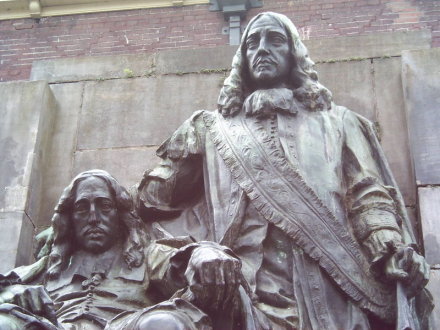
That ominous mob got its spectacle this date in 1672, lynching the Dutch Republic’s longtime de facto head of state, Johan de Witt along with his brother Cornelis/Cornelius.
A statue of Johan (standing) and Cornelis de Witt in their native Dordrecht.
The mercantile powerhouse that was the 17th century Dutch Republic was the stage for a long-running conflict between the Orange monarchists (hence the soccer uniforms) and the Republican merchant class.
With the sudden death of the young William II, Prince of Orange in 1650, leaving the (non-hereditary) executive office of stadtholder vacant, the Republicans became ascendant.
And the outstanding figure of the First Stadtholderless Period was Johan de Witt, scion of a Dordrecht merchant family powerful enough that William II had imprisoned de Witt’s own father during a power struggle.
While all these guys were landing themselves in their respective canons, Johan de Witt was trying to keep the age Golden.
Having only relatively recently broken free of Spain, the small country was an up-and-comer on the horns of a serious security dilemma: its leading commercial position put it into maritime competition with England, while its continental location made it vulnerable to the enormous army of the neighboring continental hegemon, France. Ultimately, even with its trade wealth, it did not have the resources to keep up with both of western Europe’s leading powers.
For a generation, de Witt’s statecraft kept the men of the Low Countries out of that predicament, while his brother Cornelis chipped in with a couple of timely naval victories. (Actually authored by Michiel de Ruyter, but Cornelis rode shotgun.)
In 1654, Johan brought the First Anglo-Dutch War to a close, making with Oliver Cromwell a secret pact he was only too happy to enforce never to allow William II’s son, the eventual William III, to be named stadtholder. Reason being: William III was the grandson of the Stuart king Cromwell beheaded, Charles I, and thus a potential claimant to the English throne. Both Protestant Republics had a distinct interest in keeping this monarchist well away from power. (Both would be sorely disappointed.)
A decade and a Stuart Restoration later, de Witt maintained (mostly) Dutch dominance of the seas in the Second Anglo-Dutch War, then held off France (with the help of a timely alliance with the recent adversary, England) in the War of Devolution.
In each case, he kept at least one of England or France on the sideline, or in his own camp.
But the Third Anglo-Dutch War was the charm — as it was also the Franco-Dutch War, and therefore 1672 was Rampjaar: disaster year. While the Dutch were aces on the waves, a massive French invasion easily overwhelmed them on terra firma.
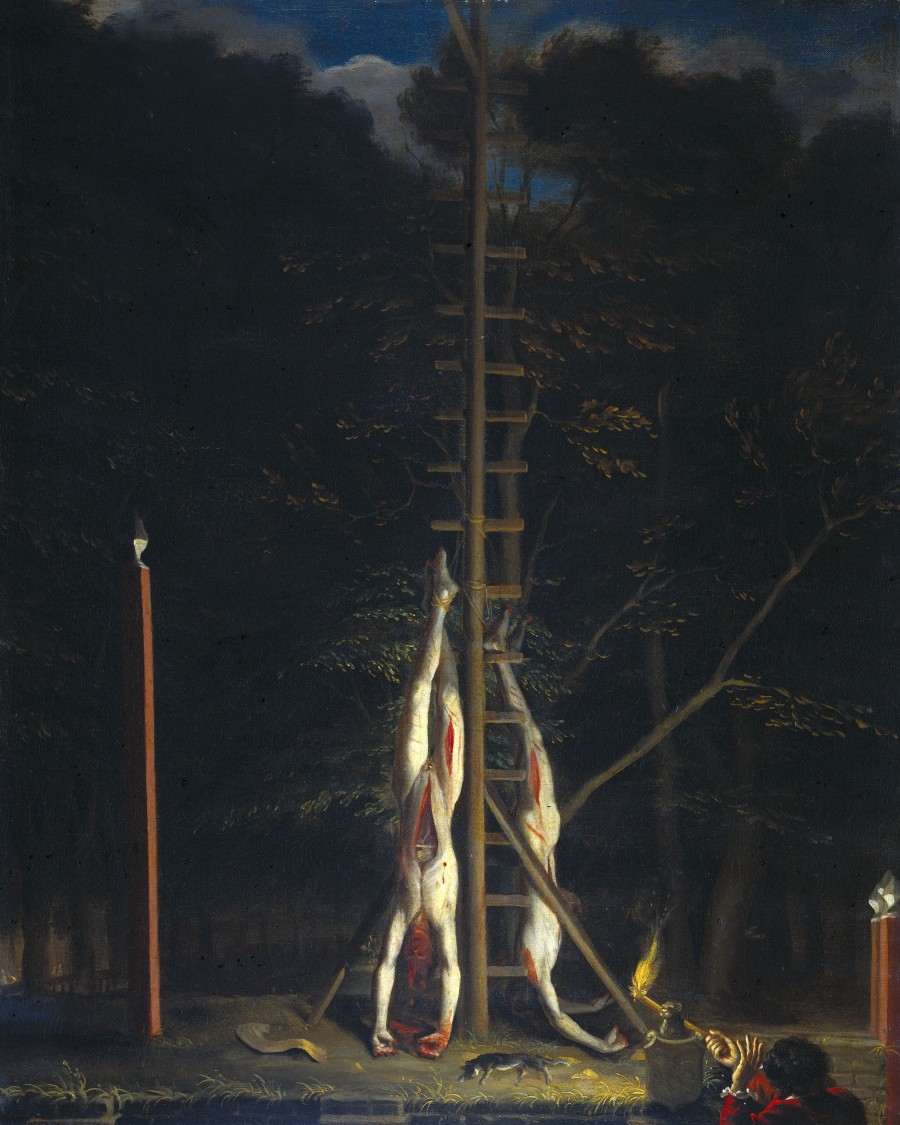
Detail view (click for the full image) of a grisly painting of the mutilated de Witt brothers strung up at The Hague. It’s attributed to Jan de Baen, who in better times took Johan de Witt’s portrait.
De Witt’s never-beloved mercantile oligarchy speedily collapsed with the military reverses, and the now all-grown-up William III was there to pick up the pieces to popular acclaim. Arrested for treason, Cornelis sustained torture without confessing, but when Johan visited him in prison — and William III incriminatingly withdrew the cavalry protecting the brothers — the mob quenched its fury with the de Witts’ blood.
every one of the miscreants, emboldened by his [Johan’s] fall, wanted to fire his gun at him, or strike him with blows of the sledge-hammer, or stab him with a knife or swords, every one wanted to draw a drop of blood from the fallen hero, and tear off a shred from his garments.
And after having mangled, and torn, and completely stripped the two brothers, the mob dragged their naked and bloody bodies to an extemporised gibbet, where amateur executioners hung them up by the feet.
Then came the most dastardly scoundrels of all, who not having dared to strike the living flesh, cut the dead in pieces, and then went about the town selling small slices of the bodies of John and Cornelius at ten sous a piece.
-Dumas
The word “ungrateful” comes to mind.
De Witt stood altogether on a lower plane than Cromwell. We regard him rather as a man of rare and singular talent, than as one of the chosen great ones of the earth, which Cromwell was. He stands far above the common run of men; and he was head and shoulders above nearly all the notable men of his time. He would have been greater if the movement of his limbs had been less burdened with the Dutch governing apparatus … He is not one whom the world can ever greatly admire or love.
(Here’s another, and here’s a 17th century volume de Witt himself coauthored.)
The rise of William III came with the decline of that Dutch Golden Age: the country fended off the immediate military threat, but it increasingly slipped behind its larger neighbors. Costly as was the Franco-Dutch War, it is a step on the path towards the present-day Europe, and this gives us enough excuse to notice that the Eurovision lead-in tune is actually from a Te Deum composed to mark its end.
But William’s own ascent to this wealthy sovereignty was just the beginning for him. Sixteen years later, the House of Orange’s champion vindicated Cromwell’s trepidation about him and gained a far more satisfactory position from which to do battle with his Gallic rival Louis XIV by stunningly overthrowing the Stuart dynasty and becoming King of England in the Glorious Revolution.**
* The Dutch remained the sole western contact of closed Japan until 1854, which is why Japan’s eventual period of scientific advancement became known as ‘Dutch Learning’.
** Albion did not forget the de Witts, either: according to this 1785 cant dictionary, the term “dewitted” had a 17th-18th century run in English to denote — well, exactly what happened to Cornelis and Johan.
Dutch-born and of Scottish descent, Stedman was a soldier who volunteered to serve in the West Indies and found himself in Suriname fighting those “revolted negroes” — Maroons fled from slavery who had established independent communities and episodically (most of the 1770s were one such episode) fought the white colonies.
Maroon settlements in Suriname still pesist to this day.
Though that was Stedman’s business on the Caribbean coast of South America, the culprits whose deaths he witnessed today were not among the “revolted”, but more prosaic criminal fare. Prosaic, that is, until Neptune’s insouciantly comedic discourse in the midst of the most appalling torture.
Stedman sets the scene for us with the more everyday depravities prevailing in the colonial capital, Paramaribo
If, as I have just mentioned, cruelties were become less common in the rivers by the rebels, barbarities still continued in a shocking degree in the metropolis; where my ears were deafened with the clang of the whip, and the shrieks of the negroes. Among the most eminent of these tyrants was a Miss Sp—n,who lived next door to Mr. de Graav, and who I saw with horror from my window give orders that a young black woman should be flogged principally across the breasts, at which she seemed to enjoy peculiar satisfaction. To dissipate the impression this scene had left on my mind, I got into a whiskey, and rode out; when the first thing I saw was a negro girl fall naked from a garret window on a heap of broken bottles: this was indeed an accident, but she was so mangled, though not dead, that she exhibited a spectacle nearly as wretched as the other.—Cursing my unlucky fate, I turned the horses, and drove to the beach, as the only place to avoid every scene of cruelty and misery; but here I had the mortification to see two Philadelphia sailors (while they were fighting on the forecastle of their vessel) both fall over the ship’s bow into the stream, where they sunk, and were no more seen. On board another American brig, I discovered a little tar defending himself from the cross-trees with a hatchet, against a serjeant and four armed men, for a considerable time; till they threatening to shoot him out of the rigging, he at last surrendered, and being brought ashore, was dragged to Fort Zelandia, in company with two others, by a file of musketeers, where, for having been drunk on duty, they received a fire-cant each, at the captain’s request; that is, they were bastinadoed or beaten on the shoulders by two corporals with bamboo canes, till their backs were black, and swelled like a cushion. However arbitrary this mode of correction, the captain endeavoured to explain the necessity of it; the private American sailors being of a turbulent spirit indeed when drunk, although when sober they may be fairly classed among the best seamen in the world.
But the narrator is just getting warmed up, and after a good night’s sleep …
Early the next morning, while musing on all the different dangers and chastisements to which the lower class of people are exposed, I heard a crowd pass under my window. Curiosity made me start up, dress in a hurry, and follow them: when I discovered three negroes in chains, surrounded by a guard, going to be executed in the savannah. Their undaunted look, however averse I may be to the sight of cruelties, so attracted my attention, as to determine me to see the result, which was thus:— The sentence being read in Low Dutch (which they did not understand) one was condemned to be flogged below the gallows, and his accomplice to have his head struck off with an axe, for having shot a slave who had come to steal plantains on the estate of his mistress. The truth however was, that this had been done by that lady’s absolute command; but the murder being discovered, she, in the hopes of saving her character, besides the expence of paying the penalties, gave up her valuable slave, and permitted the unhappy man to be thus sacrificed. He laid his head upon the block with great indifference, stretching out his neck; when, with one blow of the axe, it was severed from his body.
The third negro, whose name was Neptune, was no slave, but his own master, and a carpenter by trade; he was young and handsome, but having killed the overseer of the estate Altona, in the Para Creek, in consequence of some dispute, he justly forfeited his life. The particulars, however, are worth relating: This man having stolen a sheep, to entertain a favourite young woman, the overseer, who burnt with jealousy, had determined to see him hanged; to prevent which, the negro shot him dead among the sugar canes; for these offences of course he was sentenced to be broken alive upon the rack, without the benefit of the coup de grace or mercy-stroke. Informed of the dreadful sentence, he composedly laid himself down on his back on a strong cross, on which, with arms and legs expanded, he was fastened by ropes: the executioner, also a black man, having now with a hatchet chopped off his left hand, next took up a heavy iron bar, with which, by repeated blows, he broke his bones to shivers, till the marrow, blood, and splinters flew about the field; but the prisoner never uttered a groan nor a sigh. The ropes being next unlashed, I imagined him dead, and felt happy; till the magistrates stirring to depart, he writhed himself from the cross, when he fell on the grass, and damned them all, as a set of barbarous rascals; at the same time removing his right hand by the help of his” teeth, he rested his head on part of the timber, and asked the by-standers for a pipe of tobacco, which was infamously answered by kicking and spitting on him; till I, with some American seamen, thought proper to prevent it. He then begged that his head might be chopped off; but to no purpose. At last, seeing no end to his misery, he declared, “that though he had deserved death, he had “not expected to die so many deaths: however, (said he) you christians have missed your aim at last, and I now care not, were I to remain thus one month longer.” After which he sung two extempore songs (with a clear voice) the subjects of which were, to bid adieu to his living friends, and to acquaint his deceased relations that in a very little time he should be with them, to enjoy their company for ever in a better place. This done, he calmly entered into conversation with some gentlemen concerning his trial; relating every particular with uncommon tranquillity—”But,” said he abruptly, “by the sun it must be eight o’clock; and by any longer discourse I should be sorry to be the cause of your losing your breakfast.” Then, casting his eyes on a Jew, whose name was De Vries, “A-propos, sir,” said he, “won’t you please to pay me the ten shillings you owe me ?” — “For what to do ?” — “To buy meat and drink, to be sure—don’t you perceive I am to be kept alive?” Which speech, on seeing the Jew stare like a fool, this mangled wretch accompanied with a loud and hearty laugh. Next, observing the soldier that stood sentinel over him biting occasionally on a piece of dry bread, he asked him ” how it came to pass, that he, a white man, should have no meat to eat along with it ?” — ” Because I am not so rich,” answered the soldier. — “Then I will make you a present, sir,” said the negro; “first, pick my hand that was chopped off clean to the bones, next begin to devour my body, till you are glutted; when you will have both bread and meat, as best becomes you;” which piece of humour was followed by a second laugh; and thus he continued, until I left him, which was about three hours after the dreadful execution.
Wonderful it is indeed, that human nature should be able to endure so much torture, which assuredly could only be supported by a mixture of rage, contempt, pride, and the glory of braving his tormentors, from whom he was so soon to escape. [ here a footnote is marked in the original text, whose content is: “At Demerary, so late as October, 1789, thirty-two wretches were executed in three days, sixteen of whom suffered in the manner just described, with no less fortitude, and without uttering one single complaint.” -ed. ]
Though I never recal to my remembrance, without the most painful sensation, this horrid scene, which must revolt the feelings of all who have one spark of humanity, I cannot forbear exhibiting to the public the dreadful spectacle in the annexed drawing.
Detail view of William Blake‘s illustration of Neptune’s breaking on the rack. (Click for full image.)
If the reader, however, should be offended with this shocking exhibition, and my dwelling so long on this unpleasant subject, let it be some relief to his reflection, to consider this punishment not inflicted as a wanton and unprovoked act of cruelty, but as the extreme severity of the Surinam laws, on a desperate wretch, suffering as an example to others for complicated crimes; while at the same time it cannot but give me, and I hope many others, some consolation to reflect that the above barbarous mode of punishment was hitherto never put in practice in the British colonies.
I must now relate an incident, which, as it had a momentary effect on my imagination, might have had a lasting one on some who had not investigated the real cause of it, and which it gave me no small satisfaction to discover. About three in the afternoon, walking towards the place of execution, with my thoughts full of the affecting scene, and the image of the sufferer fresh in my mind, the first object I saw was his head at some distance, placed on a stake, nodding to me backwards and forwards, as if he had really been alive. I instantly stopped short, and seeing no person in the savannah, nor a breath of wind sufficient to move a leaf or a feather, I acknowledge that I was rivetted to the ground, where I stood without having the resolution of advancing one step for some time; till reflecting that I must be weak indeed not to approach this dead skull, and find out the wonderful phenomenon, if possible, I boldly walked up, and instantly discovered the natural cause, by the return of a vulture to the gallows, who perched upon it, as if he meant to dispute with me for this feast of carrion ; which bird, having already picked out one of the eyes, had fled at my first approach, and striking the skull with his talons, as he took his sudden flight, occasioned the motion already described. I shall now only add, that this poor wretch, after living near six hours, had been knocked on the head by the commiserating sentinel, the marks of whose musket were perfectly visible by a large open fracture in the skull.
Stedman’s work details a number of other atrocities against Suriname’s African (primarily slave) population, many of them powerfully illustrated by William Blake with near pornographic effect. These sorts of things were of ancient vintage in the realm.
The Narrative itself became both an important anti-slavery text, and an invaluable historical reference. (Where I have clipped the text, Stedman is about to segue into a discourse on the local vulture population, just the sort of detail that present-day researchers might have a hard time sourcing for 18th century Suriname.)
But even though contemporary abolitionists made use of the Narrative, Stedman’s 18th century publisher actually played down the author’s tone on the subject. A version much more overtly critical of slavery and the savage corporal punishments that upheld it has recently been published from the original manuscripts. (An abridged version of that original is also available.)
* Stedman’s narrative mingles chronological journal-style entries with general observations about his environs. The text is slightly ambiguous as to the date, but the chapter in question begins by situating the action on Aug. 12, digresses into a description of the regional landscape, then returns to the narrative where this blog entry picks it up. It’s not completely explicit that the metropolitan atrocities he witnesses also occur on the 12th, but the text invites that inference — with the execution taking place the next morning after.
The next date explicitly named is Aug. 24, the birthday of the Prince of Orange, so if Neptune did not die on Aug. 13, it was within only a very few days after.
This is the feast date, in both the Orthodox and Catholic traditions, of the Woman with Seven Sons — each of whom is supposed to have been put to death for refusing to break the Mosaic law by eating pork.
Although they are Jewish martyrs more than a century before Christ, they are revered most especially by the Christian faith that elbowed Judaism aside. Their story comes from 2 Maccabees, a “deuterocanonical” text that is part of the Old Testament but not part of the Hebrew Bible — for reasons having to do with the contingent process of formulating the canon.* (Short explanation | Long explanation)
Whether sent from the Lord or not, this story features the righteous resistance of the faithful family against Antiochus IV Epiphanes, ruler of the Seleucid Empire, which was one of the successor Hellenistic states to Alexander the Great’s conquests.
In 2 Maccabees (and also in 1 Maccabees, which covers the same period, though not this specific martyrdom), Antiochus IV is making an unwelcome pro-heathen intervention in a Jewish civil war on the side of the hellenizers as against the hidebound traditionalists. This comes to attempting “to compel the Jews to depart from the laws of their fathers, and not to live after the laws of God: And to pollute also the temple in Jerusalem, and to call it the temple of Jupiter Olympius.” (2 Maccabees 6:1-2; this chapter features a Whitman’s sampler of other faithful traditionalists slaughtered for various forms of adherence to the Law.)
Same deal with the dietary laws, whose countermanding edict Antiochus (being a wicked heathen king) is pleased to enforce by the most ghastly tortures.
Das Martyrium der sieben Makkabaer, by Antonio Ciseri, in an aptly classical setting.
1: It came to pass also, that seven brethren with their mother were taken, and compelled by the king against the law to taste swine’s flesh, and were tormented with scourges and whips.
2: But one of them that spake first said thus, What wouldest thou ask or learn of us? we are ready to die, rather than to transgress the laws of our fathers.
3: Then the king, being in a rage, commanded pans and caldrons to be made hot:
4: Which forthwith being heated, he commanded to cut out the tongue of him that spake first, and to cut off the utmost parts of his body, the rest of his brethren and his mother looking on.
5: Now when he was thus maimed in all his members, he commanded him being yet alive to be brought to the fire, and to be fried in the pan: and as the vapour of the pan was for a good space dispersed, they exhorted one another with the mother to die manfully, saying thus,
6: The Lord God looketh upon us, and in truth hath comfort in us, as Moses in his song, which witnessed to their faces, declared, saying, And he shall be comforted in his servants.
7: So when the first was dead after this number, they brought the second to make him a mocking stock: and when they had pulled off the skin of his head with the hair, they asked him, Wilt thou eat, before thou be punished throughout every member of thy body?
8: But he answered in his own language, and said, No. Wherefore he also received the next torment in order, as the former did.
9: And when he was at the last gasp, he said, Thou like a fury takest us out of this present life, but the King of the world shall raise us up, who have died for his laws, unto everlasting life.
10: After him was the third made a mocking stock: and when he was required, he put out his tongue, and that right soon, holding forth his hands manfully.
11: And said courageously, These I had from heaven; and for his laws I despise them; and from him I hope to receive them again.
12: Insomuch that the king, and they that were with him, marvelled at the young man’s courage, for that he nothing regarded the pains.
13: Now when this man was dead also, they tormented and mangled the fourth in like manner.
14: So when he was ready to die he said thus, It is good, being put to death by men, to look for hope from God to be raised up again by him: as for thee, thou shalt have no resurrection to life.
15: Afterward they brought the fifth also, and mangled him.
16: Then looked he unto the king, and said, Thou hast power over men, thou art corruptible, thou doest what thou wilt; yet think not that our nation is forsaken of God;
17: But abide a while, and behold his great power, how he will torment thee and thy seed.
18: After him also they brought the sixth, who being ready to die said, Be not deceived without cause: for we suffer these things for ourselves, having sinned against our God: therefore marvellous things are done unto us.
19: But think not thou, that takest in hand to strive against God, that thou shalt escape unpunished.
20: But the mother was marvellous above all, and worthy of honourable memory: for when she saw her seven sons slain within the space of one day, she bare it with a good courage, because of the hope that she had in the Lord.
21: Yea, she exhorted every one of them in her own language, filled with courageous spirits; and stirring up her womanish thoughts with a manly stomach, she said unto them,
22: I cannot tell how ye came into my womb: for I neither gave you breath nor life, neither was it I that formed the members of every one of you;
23: But doubtless the Creator of the world, who formed the generation of man, and found out the beginning of all things, will also of his own mercy give you breath and life again, as ye now regard not your own selves for his laws’ sake.
24: Now Antiochus, thinking himself despised, and suspecting it to be a reproachful speech, whilst the youngest was yet alive, did not only exhort him by words, but also assured him with oaths, that he would make him both a rich and a happy man, if he would turn from the laws of his fathers; and that also he would take him for his friend, and trust him with affairs.
25: But when the young man would in no case hearken unto him, the king called his mother, and exhorted her that she would counsel the young man to save his life.
26: And when he had exhorted her with many words, she promised him that she would counsel her son.
27: But she bowing herself toward him, laughing the cruel tyrant to scorn, spake in her country language on this manner; O my son, have pity upon me that bare thee nine months in my womb, and gave thee such three years, and nourished thee, and brought thee up unto this age, and endured the troubles of education.
28: I beseech thee, my son, look upon the heaven and the earth, and all that is therein, and consider that God made them of things that were not; and so was mankind made likewise.
29: Fear not this tormentor, but, being worthy of thy brethren, take thy death that I may receive thee again in mercy with thy brethren.
30: Whiles she was yet speaking these words, the young man said, Whom wait ye for? I will not obey the king’s commandment: but I will obey the commandment of the law that was given unto our fathers by Moses.
31: And thou, that hast been the author of all mischief against the Hebrews, shalt not escape the hands of God.
32: For we suffer because of our sins.
33: And though the living Lord be angry with us a little while for our chastening and correction, yet shall he be at one again with his servants.
34: But thou, O godless man, and of all other most wicked, be not lifted up without a cause, nor puffed up with uncertain hopes, lifting up thy hand against the servants of God:
35: For thou hast not yet escaped the judgment of Almighty God, who seeth all things.
36: For our brethren, who now have suffered a short pain, are dead under God’s covenant of everlasting life: but thou, through the judgment of God, shalt receive just punishment for thy pride.
37: But I, as my brethren, offer up my body and life for the laws of our fathers, beseeching God that he would speedily be merciful unto our nation; and that thou by torments and plagues mayest confess, that he alone is God;
38: And that in me and my brethren the wrath of the Almighty, which is justly brought upon our nation, may cease.
39: Than the king’ being in a rage, handed him worse than all the rest, and took it grievously that he was mocked.
40: So this man died undefiled, and put his whole trust in the Lord.
41: Last of all after the sons the mother died.
42: Let this be enough now to have spoken concerning the idolatrous feasts, and the extreme tortures.
The upshot of the Maccabees texts is the revolt of Judas Maccabeus against the Seleucids, the episode that gives us Hanukkah, when that “temple of Jupiter Olympius” was rededicated back to YHWH.
And though not specifically because of the Holy Maccabees, the start of that revolt is the very next thing to occur in the text,** at the start of chapter 8:
1: Then Judas Maccabeus, and they that were with him, went privily into the towns, and called their kinsfolks together, and took unto them all such as continued in the Jews’ religion, and assembled about six thousand men.
2: And they called upon the Lord, that he would look upon the people that was trodden down of all; and also pity the temple profaned of ungodly men.
3: And that he would have compassion upon the city, sore defaced, and ready to be made even with the ground; and hear the blood that cried unto him,
4: And remember the wicked slaughter of harmless infants, and the blasphemies committed against his name; and that he would shew his hatred against the wicked.
And then, of course, it’s the good guys’ turn to start killing.
* It is worth noting that deuterocanonical books aren’t part of the Old Testament for most Protestants; Martin Luther declared himself “so great an enemy to the second book of the Maccabees, and to Esther, that I wish they had not come to us at all, for they have too many heathen unnaturalities.”
** The book’s chronology is scarcely rigorous, but if the episode is considered historical, it would have occurred in 167 B.C.E. (the year the Maccabean revolt began) or the few years before, reaching back to Antiochus’s anti-Mosaic injunctions c. 175 B.C.E.


 Lewis suffered just days after a fellow priest and fellow victim of Titus Oates’ “Popish Plot” concoctions,

 Kemble had been discreetly performing the offices of his faith — still illicit, but less liable to get you killed at this late date — for over five decades since ordination.