1525: Count Ludwig von Helfenstein

At the end of the fifteenth and beginning of the sixteenth centuries, conditions for peasants in what is now southern and central Germany were in decline. The cost of goods continued to increase while the ruling aristocracy, who owned the land rented by peasants to grow crops, declined to reduce rents or raise wages

In addition, the territorial sovereigns attempted to increase their income to accommodate the increase in prices by levying additional taxes and tithes on, and increase other obligations owed by, the peasants and serfs under their control.

Simultaneously, changes in the economic market due to increased international trade and industry affected the structure of society, putting into conflict the interests of the aristocracy and the growing merchant class, and giving rise to burghers and industrial workers. Growing awareness of the Reformation and changes in commerce and the social structure also put ecclesiastical society and its lifestyle into conflict with secular interests.

In 1524, a petition known as the Twelve Articles of the Black Forest was presented to the Holy Roman Emperor.

The majority of the Twelve Articles asked for relief from economic hardships, such as the cattle tithes and death tax, and for the preservation of “common” land for use by the peasants. The Emperor ignored the petition, which then became the definitive set of grievances of the lower class. The movement quickly splintered into three factions: Catholics who resisted any challenge to the Church’s supremacy; burghers and princes seeking autonomy from the Church through reforms proposed by Luther; and the lower classes.

Violence soon errupted, as these factions took up arms to preserve, or better, their way of life in an uprising known as the Peasant’s War (1524-1525).

Not surprisingly, sources differ on why the conflict came to a head when it did: the Catholic church blamed the revolting Lutherans; the peasants blamed the aristocracy; and the aristocrats blamed the church. Regardless of the reason, Count von Helfenstein was not in a favorable position.

Count Ludwig von Helfenstein fought against the peasants during this conflict. Occupying the town of Weinsberg on the orders of the Archduke, von Helfenstein freely slew peasants either when discovered in small bands or when they sought admission to the town.

On April 16, in revenge for these killings, an attack led by Florian Geyer and Jacklein Rohrbach (German link) and under the command of George Metzler captured the town and von Helfenstein.

Many aristocrats and knights were killed outright during the fight. Von Helfenstein, however, was forced by vengeful peasants to run (while his wife and child watched) a double gantlet of men with spears drawn.


Helfenstein is led to his messy fate, while his kneeling wife entreats in vain, in this 1844 painting by Gustav Metz. (More, in German.)

Like most peasant revolts, however, it got its licks in and then got crushed. The princes, connected to the Empire, were able to amass greater control over other nobility, while feudalism’s decline was accelerated in favor of commercialism and trade.

(See The Peasants War in Germany, 1525-152, by Ernest Belfort Bax for a florid description of Helfenstein’s end.)

On this day..

1554: Thomas Wyatt the Younger, with the Queen’s life in his hands

On this date in 1554, rebel leader Thomas Wyatt the Younger tied on his own blindfold and laid his head on the block, having declared that not “any other now in your durance [i.e., the Tower] was privy to my rising”.

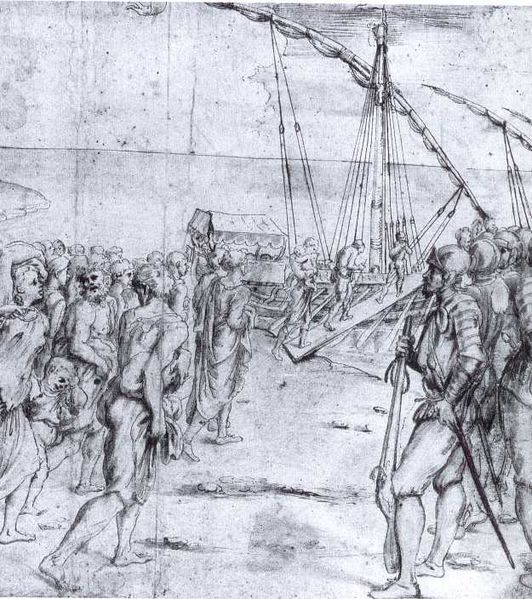
That remark exculpated the Princess Elizabeth, who just days before had been ominously rowed to the Tower on suspicion of having known of or involved herself in Wyatt‘s abortive revolt.

And Wyatt had had to do more than talk the talk to keep the future Queen Elizabeth I out of the executioner’s way.

Sore afraid that Wyatt’s rebellion had been engineered with the connivance of her Protestant half-sister, the Catholic Queen Mary Tudor had had Wyatt tortured to implicate her.

Wyatt held firm to Elizabeth’s innocence.

Had he not, the princess might have followed her mother to the scaffold, instead of becoming one of the realm’s most illustrious monarchs* — a fraught situation aptly portrayed at the outset of the 1998 Cate Blanchett flick Elizabeth.

It wasn’t only religion that made the political situation in 1550s England so perilous.

Mary Tudor’s marriage to Philip of Spain had roused fears of Spanish political domination. This, much more than theology, triggered the plot that took Thomas Wyatt’s head off his shoulders.

Against this specter of Iberian influence, Wyatt and some fellow-nobles attempted to raise coordinated insurrections in early 1554. Most fizzled or were busted by authorities before they could get going. Wyatt’s alone, in quarrelsome Kent, ignited: he marched 4,000 men on the city of London and for a moment seemed to have a real prospect of capturing it before the crown rallied the city.

A paroxysm of vengeful executions in February 1554 claimed nearly 100 participants in the rebellion, their mutilated bodies demonstratively hung up around town. (It also claimed Lady Jane Grey, the lately defeated rival contender for Mary’s throne, whom the latter now realized was too dangerous to be left alive.)

It could have been uglier, though.

Despite her “Bloody Mary” reputation, the Queen went fairly easy on this dangerous challenge to her authority, making some high-profile examples but paroling most of the rank-and-file traitors in a hearts-and-minds clemency campaign.

The namesake rebel, however, was never going to be in that bunch. He was kept on a bit in the Tower while Mary’s goons “laboured to make Sir Thomas Wyatt confess concerning the Lady Elizabeth … but unsuccessfully, though torture had been applied.”

“Much suspected by me, nothing proved can be, Quoth Elizabeth prisoner”

Having kept his head under torture, Wyatt lost it on this date — and readied Elizabeth’s to wear the crown.


If you find the Elizabethan age worth celebrating, spare an extra thought this date for Thomas Wyatt the Younger’s eponymous old man.**

This Henrician poet is supposed to have been Anne Boleyn‘s last lover before Henry VIII.

In Henry’s snakepit, youthful frolics could come back to bite you; Wyatt the elder was actually imprisoned for adultery with the queen, only ducking the fatal charge thanks to some pull with Thomas Cromwell.

Wyatt pere wrote a melancholy poem about this depressing turn of his fortunes, but considering his times, you’d have to say he was born under a good sign.

A few years later, he was again on the hook for treason, and (Cromwell having been beheaded in the interim) saved by the fortuitous influence of Queen Catherine Howard, who was herself not long before a fall and a chop. (After that, Lady Wyatt, famous for her gallantries, was supposed to be in the running to become King Henry’s sixth wife even though she was still married to Thomas.)

The elder Wyatt managed to die naturally before trying his luck with a third treason charge.

* Many a slip ‘twixt a cup and a lip, but that turn of ill fate for Elizabeth could have set Mary, Queen of Scots on her way to becoming one of England’s most illustrious monarchs, instead of going to the scaffold.

** The illustrious family ties go the other direction, too. Thomas Wyatt the Younger was the grandfather of Francis Wyatt, the first English royal governor of the New World territory named for Queen Elizabeth: Virginia.

On this day..

1520: Gaspar Quesada, Magellan’s expedition mutineer

On this date* in 1520, on his famous voyage of circumnavigation, explorer Ferdinand Magellan ordered the immediate execution of a mutinous captain.

Not to be trifled with.

Having alit just days before at the natural harbor of Puerto San Julien on the Brazilian Argentine coast (Magellan named it) with plans to winter there, the overweening Portuguese explorer faced an uprising of grumpy Spanish officers.

Gaspar Quesada, captain of the Concepcion, along with Luis de Mendoza of the Victoria and recently displaced San Antonio skipper Juan de Cartagena, seized some of the expedition’s ships during the night of April 1-2.

Since you know Magellan’s name five centuries later, you already know he quashed it.

As the sovereign of this fragile floating world, Magellan had little choice but to treat a challenge to his authority mercilessly.**

Though accounts are inconsistent, it seems Mendoza was boldly slain by one of Magellan’s men meeting him under color of “negotiation”.


Mendoza’s assassination. From this site.

Mendoza was then posthumously beheaded and quartered along with Gaspar Quesada. Juan de Cartagena was either executed as well, or else caught a “break”: some sources relate that, instead of executing Cartagena, Magellan had him marooned.

the twentieth of June [1578], wee harboured ourselues againe in a very good harborough, called by Magellan Port S. Julian, where we found a gibbet standing upon the maine, which we supposed to be the place where Magellan did execution upon some of his disobedient and rebellious company.

From a member of the Francis Drake expedition. Just 12 days later and at the very same place, Drake visited a similar penalty for a similar offense upon one of his own crew.

* “‘The authorities’ are divertingly divergent on the precise date of these events,” says O.H.K. Spate in The Spanish Lake, referring specifically to the dates of the mutiny. “Denucé puts them on Easter Sunday and Monday, 1–2 April; Merriman on Easter Sunday and Monday, 8–9 April; Nowell on Palm Sunday and the next day, with the trial verdict on 7 April. By the Julian calendar, in use until 1582, the dates would be 1–2 April; by the Gregorian, ten days later. Pigafetta and Maximilian, who slur over the whole affair, give no dates at all. It is not of vast moment.” Clearly, O.H.K. Spate never had to write an almanac blog.

Anyway, there’s some primary sourcing on this affair here.

** Though Magellan made an example of the leaders, he pragmatically spared about 40 others after keeping them in chains and working the pumps for three months. After all, the man still needed to crew his ships.

On this day..

1199: Pierre Basile, marksman

(Thanks to Jonathan Shipley of A Writer’s Desk for the guest post. -ed.)

If you kill a king, expect swift retribution.

Expect avengers.

Expect to not live long after you deal the final fatal blow to a royal personage.

A boy, Pierre Basile, was executed on this date in 1199 for shooting King Richard the Lionhearted* with an arrow expelled from his crossbow.

The wound wasn’t fatal to Richard I; the gangrene was. (French page) Although the king pardoned the boy for the shot before dying, Richard’s right hand man, French Provencal warrior Mercadier, would hear none of it. After the king’s death, Mercadier stormed Chateau de Chalus-Chabrol, defended weakly by Basile, then flayed him alive before hanging him.

Little is known of the boy defender. Also known as Bertran de Gurdun and John Sabroz (the various names suggest we’ll never know his real name), Basile was one of only two knights defending the castle against the king’s siege.

This castle protected the southern approach to Limoges and was betwixt routes from Paris and Spain and the Mediterranean Sea and the Atlantic Ocean. The English army openly mocked its defenses as the siege continued. The ramparts were cobbled together with makeshift armor. A shield was constructed out of a frying pan.

Knowing the castle would fall sooner than later, the English were lax in their siege, though eager for the riches inside. (Supposedly within the castle walls was a treasure trove of Roman gold.)

Richard I, as feudal overlord, claimed it for himself and no boy knights were going to get in his way. The king had been in the area suppressing a revolt by Viscount Aimar V of Limoges. The viscount’s forces had been decimated by the king’s army. The riches for the win lay in the castle and Basile stood atop it.

It was early evening, March 25, 1199, when Richard walked around the castle perimeter without his chainmail on. Arrows had been shot from the ramparts by Basile but were paid little attention. The king applauded when one arrow was aimed at him. The next arrow fired struck the king in the left shoulder near the neck.


Richard the Lionhearted, mortally wounded.

The king returned to the privacy of his tent to pull it out. He couldn’t. The surgeon Hoveden, Mercadier’s personal physician, was summoned. He removed the arrow, but not swiftly, or cleanly. Gangrene quickly set in. The king asked for the crossbowman. The boy, Basile, appeared before the stricken king, expecting to be executed on the spot. The boy spoke first, saying he had tried to kill Richard because the king had killed the boy’s father and two brothers.

“Live on,” the king replied, “and by my bounty behold the light of day.”

He ordered the boy set free and, further, sent him away with 100 shillings. Deliriously jubilant at the king’s decision, the boy quickly returned to the castle.

On April 6, in the arms of his mother, Richard I died. His remains were buried at the foot of the tower from which Basile shot the arrow.

And with the king died his chivalry towards Basile.

Mercadier, who had entered the king’s service in 1184 and fought in battles in Berry and Brittany, Flanders and Normandy, brought the castle’s defenders to a swift and punishing death.

Hanging the defenders, he took the boy and flayed him first — that is, he removed the boy’s skin while he was still alive. Then Pierre Basile was hung, and his body consigned in an unmarked grave.

* Last seen in these parts slaughtering Muslims on Crusade.

On this day..

Jesus of Nazareth, King of the Jews

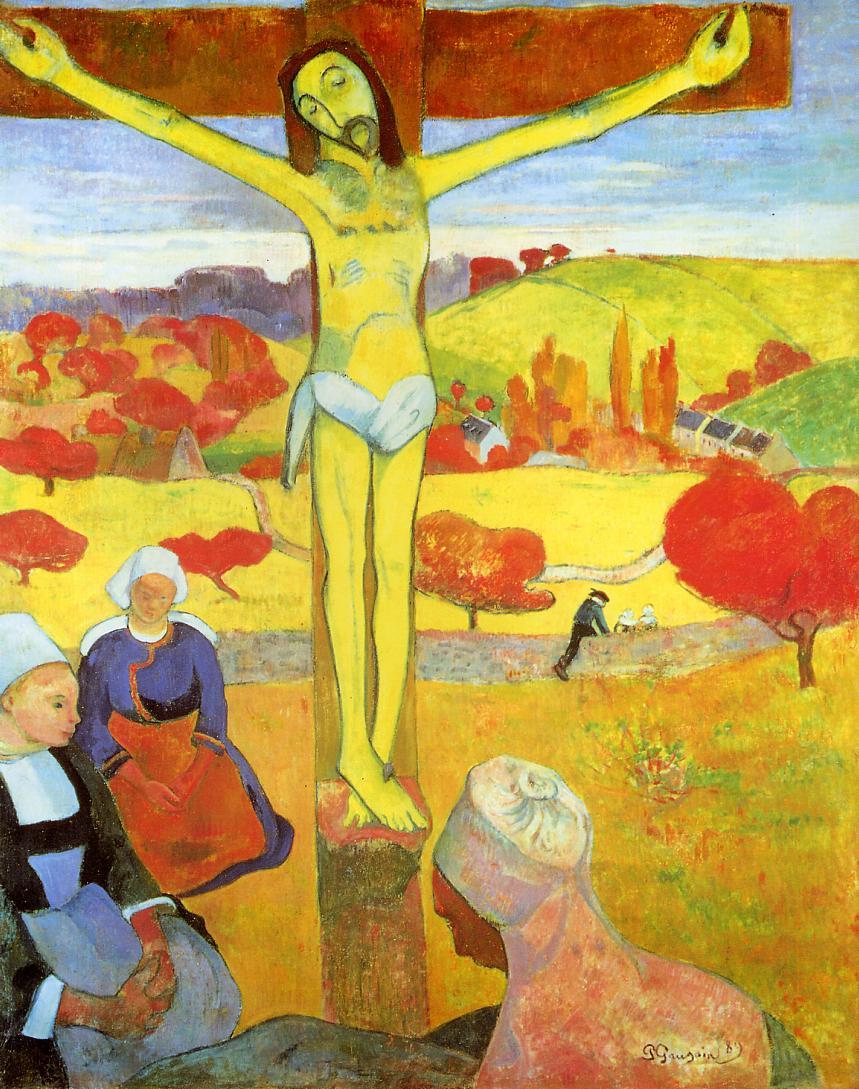
Images of the Crucifixion


(Thanks to Jeffrey Fisher [jeffreyfisher at me.com] for the guest post.)

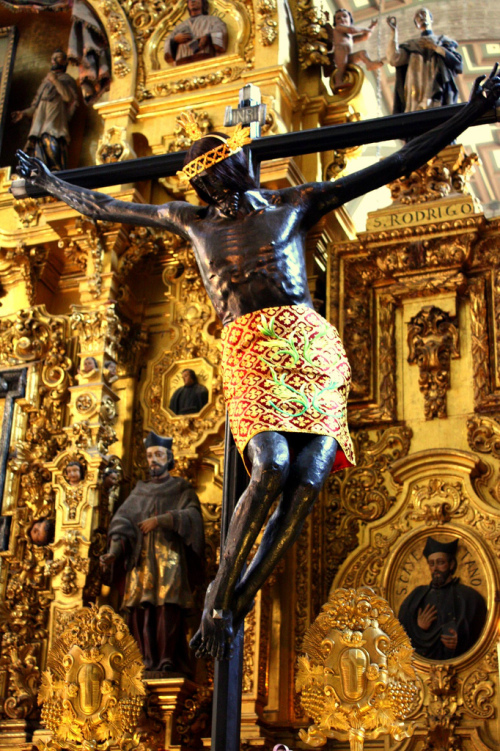
On Good Friday every year,* Christians around the world commemorate the death by crucifixion of Jesus of Nazareth, rabbi, prophet, Son of God, Son of Man, messiah, and all-around trouble-maker.

The truth is that very little is known of Jesus’ life and teachings from verifiable accounts, but this has not stopped generation after generation of Christians from telling his story, beginning with Jesus’ semi-official biographers, the evangelists of the New Testament. Almost everything we know about the life and teachings of the physical human being Jesus are in those writings, which do not portray him always in compatible ways, and which are almost entirely unconfirmed by any external source. The Roman historian Tacitus mentions (with disdain if not disgust) Jesus’ cult following, as does the Jewish historian and philosopher Josephus, but neither gives us anything to work with as historians (or, for that matter, as theologians). For the record, Suetonius and Pliny also talk about Christians, but these piecemeal sources tell us much more about Roman perceptions of Christians than about Christ and his teachings, or even necessarily Christian beliefs and practices.

What, then, can we reasonably say about Jesus?

It is almost impossible to find universal agreement around anything more than a few basics, including most importantly Jesus’ crucifixion. The Gospels narrate it; Paul the Apostle (who never met Jesus in the flesh, as it were) hangs his theology on it, together with the equally important resurrection; and no contemporary sources (Christian or otherwise) dispute it.

But it’s when we ask why Jesus was crucified that things start to get interesting.

What did he do? The two men he is traditionally said to have been crucified with are commonly understood to be “robbers,” but that they were common criminals is highly unlikely. Crucifixion is a horrible death designed to make a very public statement about the crucified, the sort of thing you use on gladiator-slave rebels like Spartacus, not on pickpockets and roustabouts. The Greek term used for these two men (lestai) is consistent with the description of the released Barabbas as one who had participated in rebellious activities, whose “criminality” was related to his revolutionary business. Moreover, the name “Barabbas” means literally “son of the father,” a purely symbolic and surely entirely fictional name, and that the people choose to have him released indicates their affinity for him as a thorn in the side of the Romans. He is thus contrasted with Jesus, the other son of the father, the peaceful (apocalyptic) revolutionary.

So Jesus would have been crucified as a political criminal, a rebel. This would make sense of accounts of his having been identified by the Romans as “Iesus Nazarenus Rex Iudaeorum”: “Jesus of Nazareth, King of the Jews.” Anyone claiming to be king (and “son of God” was a Jewish way of talking about the king of Israel recorded clearly in Psalm 2), would, if taken seriously, be understood as challenging Roman authority.

Insofar as Jesus seems to have been deliberately poking the Romans’ local running dogs, the Sadducees and the Temple priests, his seizure and termination were surely inevitable. If his teaching is as opposed to violence and unconcerned with “politics” as it seems to have been, it’s hard to believe the Romans would have noticed him without some prodding, this coming not from the “crowd,” but from the leadership (who in Mark and Matthew incite the crowd). Indeed, the priests and scribes look for ways to arrest him when the crowds are not around, because they fear a riot.

If we take the Gospel of Mark at all seriously, Jesus was preaching a new kingdom of God, an apocalyptic redemption of the people of the earth by God’s direct intervention (and with Jesus as the sacrificial pesach lamb). If we take the Gospel of Luke seriously, Jesus spoke in a classic prophetic mode, calling people — Jew and Gentile both — to care for the oppressed of the earth, the poor and the hungry and the helpless. Both Jesuses called for people to be better to each other, to love each other, and indeed to love each other when love was, according to common sense, the foolish thing.

Why would this get you executed?

Well, in itself, it wouldn’t. But the Gospel of Mark tells us of Jesus speaking with a man who realizes that all the animal sacrifices in the world don’t amount to a hill of beans (in that crazy world). When love counts more than sacrifice, we are undermining the Temple. When we go into the Temple, start knocking things over, and say it’s become about robbing the poor and not about loving God and one’s neighbor, we are undermining the Temple. And to undermine the Temple’s authority is also to undermine Rome’s authority, and Rome’s cash flow.

Jesus, like the Essenes he may or may not have associated with, was a purist.

The Temple was full of collaborators and exploiters, the kind seen before in the history of Israel (and berated by prophets like Isaiah and Amos), the kind hated also by the Dead Sea community of apocalyptic purists awaiting a final showdown between God and evil (i.e., the Roman Empire and their local potentates, the Temple authorities).

Jesus, like other Jewish prophets before him, thought that Judaism was about something. That it was somehow about justice and not just about following rules or waiting around for things to get better: that it was about our making the world a better place, and not just making our own lives better.

Start talking that way and get people on your side, and you’re fairly likely to get killed, even twenty centuries later.

* Though the actual date (even the year) of the execution marked by the movable feast of Good Friday is fundamentally unknowable, there are some present-day astronomer types who’d like to sell you April 3, 33 A.D.

On this day..

1585: Frederick Werner, the executioner’s brother-in-law

Being ‘broken on the wheel’ was an agonising and prolonged way in which to die …

The felon was secured, spread-eagled, face upwards, on a large cartwheel mounted horizontally on an upright which passed through the hub, the wheel sometimes being slightly canted in order to give the spectators a better view of the brutal proceedings …

Death was meted out by the executioner wielding a heavy iron bar, three feet long by two inches square, or using a long-handled hammer. Slowly and methodically he would shatter the victim’s limbs; the upper and forearms, the thighs and the lower legs … On being removed from the wheel the corpse would resemble a rag doll, the various short sections of the shattered limbs being completely disconnected from each other …

In some states in Germany the regulation number of blows was forty. Franz Schmidt, executioner of Nuremberg in the sixteenth century, wrote in his diary that on 11 February 1585 he ‘dispatched Frederick Werner of Nuremberg, alias Heffner Friedla, a murderer who committed three murders and twelve robberies. He was drawn to execution in a tumbrel [a cart], twice nipped with red-hot tongs and afterwards broken on the wheel.’

This multiple murderer was in fact Schmidt’s brother-in-law and, probably in view of their relationship, the judges decreed that only thirty-one blows need be struck. One wonders whether, after that number, there was anything worthwhile left to aim at.

On this day..

1661: Thomas Venner and the Fifth Monarchy Men

On this date in 1661, the restored English monarchy made an end to the interregnum’s religious crazies.

A few other images of Thomas Venner are available here.

“It is difficult in these days to follow with patience, or even with complete seriousness, all the ramifications of Fifth Monarchy speculation,” writes historian Louise Fargo Brown, whose gratis tome The Political Activities of the Baptists and Fifth Monarchy Men in England proceeds to do just that.

This blog wants for both patience and seriousness, so we’ll sum up that Venner et al were the holy rollers of the day, the true whack-jobs in the millenarian hustle of Cromwellian England.

Venner himself was born in New England, and there’s a zippy bio of him in The New England Historical and Genealogical Register. The North American colonies and Parliamentarian Britain helped to incubate political/religious heterodoxy for one another, and Venner was not the only budding religious zealot in the distant marches to emigrate to London after Charles I lost his head.

There the cooper became an outspoken apostle of the Fifth Monarchists, a part of Cromwell’s coalition made for disappointment with the mundane machinations of statecraft. Relieved in time of any a share in General Ironsides’ burden of helming the state in choppy waters, the men of the Fifth Monarchy were at liberty, to retire with their slide rules and philosopher’s stones to calculate the (imminent) date of the apocalypse foretold by Daniel and pursue the maxim not yet born that, starting with a mistake, a remorseless logician can end up in Bedlam.

All well and good to mock from posterity, and from a country where Left Behind is a bestseller no less. To be fair to the Monarchy Men, one could as well say that the egalitarian political language of these “arrant Radicals and levellers” just happened to be scriptural.* They would hardly be the last to foretell a golden age made ready by the slaying of a king, not by a long shot.

At any rate, our Bostonian tradesman became such an outspoken prophet of the return of “King Jesus” that Cromwell was obliged to clap him in irons.

Venner didn’t take the hint well, nor other more salutary warnings, and Venner instigated a riot of his few dozen followers at the start of January 1661 that took London unawares and did some damage before it was put down.

Diarist Samuel Pepys records of the riots that

[a] thing that never was heard of, that so few men should dare and do so much mischief. Their word was, “The King Jesus, and the heads upon the gates.” Few of them would receive any quarter, but such as were taken by force and kept alive; expecting Jesus to come here and reign in the world presently, and will not believe yet but their work will be carried on though they do die.

Thomas Venner and his compatriot Roger Hodgkins died that traitor’s death this day, along with William Oxman and Giles Pritchard, the latter two having their sentences commuted to simple hanging and posthumous beheading. The remaining survivors of his band climbed the scaffold two days later.

* e.g., “Then shall the Oppressor cease and no more complaining be heard in the streets. Taxes should be no more. And Trade and industry should abound. … The poor should have bread, and the Army no more in Arrears. Prison doors should be open and Debtors satisfied without Arrests … then peace and safety, plenty and prosperity, should overflow the land.” (Cited by Brown)

Part of the Themed Set: Resistance and Rebellion in the Restoration.

On this day..

1676: Joshua Tefft, drawn and quartered in Rhode Island

On this date in 1676, Puritan colonist Joshua Tefft (or Tifft, or Tift) became perhaps the only person ever to suffer the traitor’s death of hanging and quartering in what is now the United States.

The 30-ish Rhode Island farmer got sucked into King Philip’s War and was captured by colonists apparently fighting for the Narragansett Indians during a the Great Swamp Fight.

Lacking a first-person account from Mr. Tefft, we are left to descry (or project) his purpose. Tefft himself claimed that he had been enslaved by the Indians, but he made this claim in the context of trying to avoid a grisly execution; opposing witnesses said he’d been much more enthusiastic in the fight, raising an evident horror of civilized man gone native.

Without English clothes and with a weather-beaten face, he looked like an Indian to the English. Tefft was a troubling example of what happened to a man when the Puritan’s god and culture were stripped away and Native savagery was allowed to take over. (Source)

He was one man caught up in a war, so of course he could have been many things. But Tefft invites speculation on racial self-identification on this still-tenuous New World frontier.

Living immediately adjacent to the Narragansett, Tefft was probably on good terms with the natives, something that at least some Anglos had keenly worked after for fifty-plus years. Some sources report (or charge) that he had taken an Indian wife,* and the Narragansett redoubt attacked in the Great Swamp Fight was a fortified encampment full of non-combatant types, hundreds of whom were eventually slaughtered.

And Rhode Island had a long-running border dispute with its Puritan fellow-colonists that intersected their historical differences on religious toleration. (Tefft is also decried as irreligious, though whether that’s literally true or just an extra heaping of opprobrium is anyone’s guess.) Why, after all, should a man not cohabit among the friendly peoples of his wife, and assist them when attacked — for the Narragansett were not at war until they were attacked — by a bunch of Connecticut and Plymouth colony prigs who’d want to shanghai him into their army?

One colonist able to sympathize with the Indians’ situation wrote of them that “perhaps if Englishmen, and good Christians too, had been in their case and under like temptations, possibly they might have done as they did.” Who knows but that some were, and they did.

Our Scouts brought in Prisoner one Tift, a Renegadoe English man, who having received a deserved punishment from our General, deserted our Army, and fled to the Enemy, where had good entertainment, and was again sent out by them with some of their forces; he was shot in the knee by our scouts, and then taken before he could discharge his musket, which was taken from him and found deep charged, and laden with Slugs: He was brought to our army, and tryed by a counsel of war, where he pretended that he was taken prisoner by the Indians, and by them compelled to bear Arms in their Service; but this being proved to be false, he was condemned to be hanged and Quartered, which was accordingly done. (Source)

But while some Indian tribes allied with some whites, European identification ultimately proved much too strong to admit any possibility of not banding together against the “savages.” When vengeful Narragansett warriors raided Providence the following spring and torched the house of Rhode Island founder Roger Williams, Massachusetts in sympathy lifted its 39-year-old exile on the man they’d have hung as a heretic in days gone by.

By then, it had long been over for Joshua Tefft, whose trial preceded execution by only two days. Joshua’s son Peter and other descendants of the Tefft family, however, would be fruitful and multiply.

By the time these New World settlements became the United States a century later, drawing and quartering was still on the books in England. But the New York legislature expressed (pdf) the sense of that realm’s North American offspring that this sentence even for treason was “marked by circumstances of Savage Cruelty, unnecessary for the Purpose of public Justice, and manifestly repugnant to that Spirit of Humanity, which should ever distinguish a free, a civilized, and Christian People.”

* Joshua Tefft’s previous wife, Sara, had died from childbirth a few years before. For Sara, also notable as the owner of what was once thought to be the oldest marked headstone in New England, it was her second husband … the first, Thomas Flounders, was hanged for murder.

Part of the Themed Set: Resistance and Rebellion in the Restoration.

On this day..

Feast Day of St. Stephen

The day after Christmas — or the second day of the twelve days of Christmas, in a more traditional coinage — is the feast of St. Stephen.*

St. Stephen is well-known as the “protomartyr”, the first Christian to die for his faith. (Jesus doesn’t count.) There’s a St. Stephen’s Gate in Jerusalem so named for its supposed proximity to the site of the protomartyrdom.

We get the Stephen story from the New Testament Acts of the Apostles, as given in this from the Tyndale-derived King James Version (Acts 6:8 – 8:3)

And Stephen, full of faith and power, did great wonders and miracles among the people. Then there arose certain of the synagogue, which is called the synagogue of the Libertines, and Cyrenians, and Alexandrians, and of them of Cilicia and of Asia, disputing with Stephen. And they were not able to resist the wisdom and the spirit by which he spake.

Then they suborned men, which said, We have heard him speak blasphemous words against Moses, and against God. And they stirred up the people, and the elders, and the scribes, and came upon him, and caught him, and brought him to the council, and set up false witnesses, which said, This man ceaseth not to speak blasphemous words against this holy place, and the law: For we have heard him say, that this Jesus of Nazareth shall destroy this place, and shall change the customs which Moses delivered us. And all that sat in the council, looking stedfastly on him, saw his face as it had been the face of an angel.

Then said the high priest, Are these things so? … [elided; Stephen preaches on at great length before he comes to the point]

Howbeit the most High dwelleth not in temples made with hands; as saith the prophet, Heaven is my throne, and earth is my footstool: what house will ye build me? saith the Lord: or what is the place of my rest? Hath not my hand made all these things?

Ye stiffnecked and uncircumcised in heart and ears, ye do always resist the Holy Ghost: as your fathers did, so do ye. Which of the prophets have not your fathers persecuted? and they have slain them which shewed before of the coming of the Just One; of whom ye have been now the betrayers and murderers: Who have received the law by the disposition of angels, and have not kept it.

When they heard these things, they were cut to the heart, and they gnashed on him with their teeth.

But he, being full of the Holy Ghost, looked up stedfastly into heaven, and saw the glory of God, and Jesus standing on the right hand of God, and said, Behold, I see the heavens opened, and the Son of man standing on the right hand of God.

Then they cried out with a loud voice, and stopped their ears, and ran upon him with one accord, and cast him out of the city, and stoned him: and the witnesses laid down their clothes at a young man’s feet, whose name was Saul.

And they stoned Stephen, calling upon God, and saying, Lord Jesus, receive my spirit. And he kneeled down, and cried with a loud voice, Lord, lay not this sin to their charge. And when he had said this, he fell asleep.

And Saul was consenting unto his death. And at that time there was a great persecution against the church which was at Jerusalem; and they were all scattered abroad throughout the regions of Judaea and Samaria, except the apostles. And devout men carried Stephen to his burial, and made great lamentation over him.

As for Saul, he made havock of the church, entering into every house, and haling men and women committed them to prison.

The persecuting “Saul” at the end of this text is, of course, Saul of Tarsus, the future St. Paul.

Here’s a set of Catholic devotionals for the day, and here’s a more secular vibe on the day’s various quirky Anglo traditions.

As for that song …

Good King Wencesla(u)s, a tenth-century Bohemian ruler, is himself a saint — the patron saint of the Czechs, as a matter of fact.

Wenceslas was murdered in a palace coup, supposedly leading his servant Podevin to avenge that death, for which said Podevin was in turn executed. The lyrics of the song “Good King Wenceslas” celebrate the king and his loyal page undertaking together the charitable works they were famous for.

“Mark my footsteps, my good page
Tread thou in them boldly
Thou shalt find the winter’s rage
Freeze thy blood less coldly.”

In his master’s steps he trod
Where the snow lay dinted
Heat was in the very sod
Which the Saint had printed
Therefore, Christian men, be sure
Wealth or rank possessing
Ye who now will bless the poor
Shall yourselves find blessing.

* At least, it’s the Feast of St. Stephen in the Latin rite. The occasion is observed on Dec. 27 in the Orthodox tradition.

On this day..

1609: Vicente Turixi, King of the Moriscos

La Expulsión de los Moriscos, by Vincenzo Carducci (Vicente Carducho).

Having taken the trouble over the preceding century to eliminate (or force underground) its substantial Muslim population by forcibly converting it to Christianity, Spain in the early 1600s bethought itself to complete the operation upon its recently minted fellow-Christians by ejecting these Moriscos from Spain altogether.

When the edict for this radical act of expulsion first came down in the heavily Morisco area of Valencia, some of its victims reportedly embraced the prospect of deportation to a land where their dress, language, and religion were no longer forbidden.

Others were less sanguine.

Armed resistance broke out in two wilderness fastnesses, the mountainous Vall de Laguar (Spanish link) and — as narrated by Henry Charles Lea in his freely available The Moriscos of Spain; their conversion and expulsion

the Muela de Cortes (Spanish link), an almost inexpugnable spot, being a deep valley surrounded by precipitous heights, of which the passes were easily defensible. The Moriscoes of that region … were in a state of excitement and were readily persuaded to rise by an outlaw named Pablillo Ubcar. They elected as king Vicente Turixi, who sent a proclamation through the sierra for all to join him under pain of treason. From their strongholds they made raids on the surrounding country, gathering cattle and provisions, burning villages, and desecrating churches.

[Ethnic cleansing coordinator Don Agustin] Mexia, absorbed in the work of embarkation and fearing to interrupt it, for awhile paid no attention to these movements … who could readily be reduced when the time came.

His provisions were justified … those of the Muela de Cortes … lost heart when they heard of the defeat of those of Aguar, and were disappointed as to the appearance of the Moor Alfatami on his green horse, whom tradition reported to be concealed under the mountain since the days of King Jayme … It was agreed that they [the rebels, surrendering] should be safe in person and property, provided they would go to embark within three days.

The rapacious soldiery, who had promised themselves abundant plunder, in their disappointment threw off all discipline; they sacked the village of Royaya, outraged the women and seized numbers of children as slaves. Only three thousand Moriscoes were brought to the port of embarkation, the rest having scattered and taken to the mountains to escape the fury of the soldiers.

These, estimated at two thousand in number, for several years gave infinite trouble, killing all the Christians they met and committing constant depredations. At one time the Governor of Jativa induced many of them to come down, but finding that they were to be enslaved they fled back to the mountains.

A reward was offered for King Turixi, dead or alive; he was tracked to a cave, captured, and brought to the city, when he was sentenced to have hands and ears cut off, to be drawn, torn with pincers, hanged and quartered; but at the execution, December 18th, the cutting of hands and ears was omitted. He had been confessed twice and reconciled twice, and died as a good Christian, making a most edifying end, for we are told that he had been a liberal almsgiver and devoted to the Virgin and the religious Orders.

The miserable remnants were hunted down gradually, the viceroy paying twenty ducats a head for them as galley-slaves.

The armed resistance in Valencia — where Moriscos were most numerous, and the expulsion was first decreed — was actually much less than had been feared, which gave the Spanish authorities all the encouragement they would need to enforce it elsewhere, too.

“Seeing that the whole body of our nation is tainted and corrupt, he applies to it the cautery that burns rather than the salve that soothes; and thus, by prudence, sagacity, care and the fear he inspires, he has borne on his mighty shoulders the weight of this great policy and carried it into effect, all our schemes and plots, importunities and wiles, being ineffectual to blind his Argus eyes, ever on the watch lest one of us should remain behind in concealment, and like a hidden root come in course of time to sprout and bear poisonous fruit in Spain, now cleansed, and relieved of the fear in which our vast numbers kept it.”

-Cervantes, Don Quixote

On this day..