1693: Five at Tyburn

A True Account of the Behaviour, Confession, and Last Dying Speeches Of the Criminals that were Executed at Tyburn, On Wednesday the 8th, of March, 1693.

On the Lord’s-Day, in the Forenoon the Ordinary preacht on the 16th. Verse of the 24th. Chapter of the Acts of the Apostles, viz. And herein, I exercise my self, to keep always a Conscience void of offence toward God and Men. From which Words, The Doctrinal Observation was, that it is the Duty and Priviledge of every True Christian, to get aud retain the Integrity of Conscience. For the Explicating of this Four General Heads were inquired into, and Stated.

First, What is Conscience? It is a Mans Judgment of his Souls Estate and Actions, as these are subjected to the Judgment of God in his Revealed Will. The Lord hath placed Conscience in all Men to approve of what is Right with Complacency, and to disallow what is Evil with Grief, Shame, and Abhorrence. It is a Spy and Register in the Bosom of Ungodly Men, that they cannot Sin, in quiet. Conscience makes a Judgment and Determination. How we have observed the Rule of God’s Sacred Law, or swered from it, accordingly, it Acquits and Comforts; or, Condems and Terrifies.

Secondly, What is essentially necessary to constitute your Conscience Morally Good and Comfortable. First, It must be cleansed and sanctified by Renewing Grace, that it may be conformable in all Things to the Law of God. Secondly, Because its exactest Obedience is defective, therefore it must be spingled with the Propiatory Merits of Christ’s Bloodshed. Thirdly, From the Virtue of Christ’s death, there must be exprest, the lively Fruits of an Holy Conversation, with a constant Reliance on Christ’s Intercession to preserve the Integrity of Conscience, under the Violence of all Temptation to Sin, and to support its Comfort, under the deepest Tryals of Affliction.

Thirdly, What Influence doth the Practical believe of the Judgment Day.

What doth the Exercise which preserves a Good Conscience include? It signifies, to be train’d up, under the Discipline of Christianity, so as to be confirm’d in an Holy Conversation against all Contempt and Opposition. So dare be openly Good and Strict in the Practice of all Christian Virtues, when the present Age is most degenerate. It is to make True Religiion our Recreation, and to promote its Aymiableness, in the Uniformity of our Obedience. Righteousness toward Men, Severe[d] from Piety toward God, is veiled Ath[e]ism; and Holy Exercises toward Him, with the neglect of Relative Duties toward men is demure and glittering Hypocrisie. Therefore the Charitable Testimony of others, cannot comfort the Conscience, under its presumptive Groundles Hopes, concerning its Renewed State. This is Infallibly known to God, altho’ Conscience may make a false Report, by Self-flattery, and the Sinners deep Security. Therefore, let us Summon our Hearts, to a strict Account, what preparative Dispositions are formed in us, which may present us before Christ’s Tribunal, with Approbation. But such, who carry their unpardoned Guilt and unrenewed Nature, to the Judgment Seat of Christ, shall have Convulsive pangs of desperation in their Conscience, and shall be rejected by Christ, with the Greatest Abhorrency. After several Rules and Directions, how to get and preserve a Good Conscience, The Conclusion was thus directed to the Condemned Criminals. How may St. Paul‘s Example in the Text, reflect a sad Aspect on your Consciences. These you have defiled, by prostituting them to the Infamous Lusts of your Fleshly Minds. Have you not striven to rase out the Dictates and Sentiments of common Equity? when your Convictions have been troublesome, you have flattered Conscience, with Carnal Reasonings. How have you deafed it to Divine Instructions. By Wordly Diversions, and have drowned the Cries thereof in sensual Pleasures, and thereby, brought the sly Artifices of Sining, unto a destructive Maturity. You have sinned in despight of all Admonitions, and the Examples of Publick Justice. Notwithstanding, when your Consciences shall be arm’d with God’s Commission, they will be active to Condemn you, though cast at present, into a Lethargy of Stupidity. You cannot deny, that you have been great Sinners, yet, there is pardoning Mercy to be obained, by that Satisfaction Christ’s death hath made to God’s offended Justice. This applied by Faith unfeigned, purifies the Heart in Obedience to all Divine Commands. This Renewed Frame, by sprinkling the Merits of Christ’s Bloodshed on the Conscience, turns his Tribunal of Strict Justice, into a Throne of Grace and Mercy. So shall we (at last) be presented to God the Father, not only void of Offence, but in a perfect State of Holiness to all Eternity.

I proceed to give an Account of the Behaviour and Confessions of the Condemned Criminals.

I. Mr. Best, Condemned for High-Treason, in Clipping, Filing, and Diminishing the Current Coyn of England. He is Aged 50 Years. Was Educated at School in Hertfordshire. His Father sent him to in Cambridge, where, he continued his Studies, till he took the Degree of Bachelor in Physick. Afterwards, he practised in that Science, and might have lived comfortably upon it. But by Degrees, he neglected to follow his Profession; and was drawn into Bad Company, of which he now Repents. He denied not, that he had been a great Sinner. I enquired into the Particulars of his Evil Conversation, it being a necessary Duty, to unburthen the Conscience of a Load of Sin, by a free discovery, of it, that so, Serenity of Mind, may be obtained. Besides, there is great difference betwixt Person lying on a sick Bed whose Sins are more secreet, and who may recover to a longer Space of Repentance. Such, are not so strictly obliged, to confess their particular Enormities. But for those, who by Notorious Crimes have given Publick Scandal to the Christian Religion, and brought themselves under the Sentence of Death; such ought to make Publick Acknowledgment of their Excesses in Sinning, that their Repentance may be as Exemplary, as their Conversation hath been Vicious upon this, Mr. Best, was better convinced of his Duty. And freely confest, that he had been Guilty of most Sins, Murther only excepted. Saying withal, that he doubted not the Truth of his Repentance, and that God was reconciled to him, in Christ. I replied, that the Heart of Man is very deceitful in Judging its Spiritual State Godward, especially when Persons have contracted a Custom in Sinning, and thereby hardned their Hearts, to persist therein. To this he replied, that Naturally Man’s Heart is inclined to Self-flattery, but he hoped, the Spirit of God had so sanctified this distress, that his Heart was thoroughly broken for and from the Love of all Sin, chiefly, as an offence against God, who might have justly cut him off, by an untimely death, for his younger Excesses in Sinning. But, said he, I would not be Reclamed, by a more gentle Rod; therefore God now compells me, by greater Severity, to turn to him, and Blessed is the Man, whom the Reproachful stroke of Death, makes (tho’ late) a Partaker of God’s Holiness. I replied, that I was glad, he was convinced of his sinful State, and in some Preparation, to apply the Promises of Salvation. But, it is safest, to be poor in Spirit, and thereby, to Magnifie the All-sufficiency of God’s Grace. He replied, that he endeavoured to be Self abas’d in as much, as the Omniscient, Heart-searching God, would not be Mockt, and could not be deceived with semblant Flourishes in Soul-Concernments.

II. James Steward, Condemned for Breaking the House of Elizabeth Thorne. He is Aged 24 Years, or thereabout. His Father placed him forth, to the Employment of a Chyrugeon. He said, that his Father was of the Roman Religion, and bred him up, in it, so that he knew not well how to quit it. I replied, that we are not obliged to live and d[i]e, in the Religion of our Parents, not grounded on the Purity of God’s Word. And endeavoured to convince him of the Hazard and Danger, in Adhearing to False Principles in Religion, in as much, as these have Influence on an Immortal Conversation. He replied, that he had so much Knowledge, as not to believe the gross Errors of the Romish Church. He also said, that be could not have wanted this Severe. Yet, Just Dealing of God with him in as much, that now he is thoroughly awakend from his Security, and Hopes, that God will turn this distress, into a means of his Conversion; and then, he shall not be troubled for his Reproachful Death. I Stated to him, the Nature and Effects of True Saving Faith and Godly Sorrow for Sin: To which he was attentive and seemed to comply with my Advice, that he might be prepared for Death. He said, that if he had followed his Wives Good Counsel to have been content with an Honest Employment, he had not fallen into this Shameful and Untimely End.

III. Elizabeth Wann, Condemned for Robbing Frances Coguer of a Gold-Chain, Value 8 l. being stopt, the Neck-Lace was found in her Mouth. She is Aged 16 Years. Had Good Education, but was Disobedient to her Mother. Whereupon she left her Family, and entered her self a Servant in London with a Mistress, who employ’d her, most what in Needle-work; but she soon left that Service. Then she grew idle and kept bad Company. She confest, that not Poverty, but only her wicked Heart, inclined her to commit the Crime she did not observe the Sabboth days of later time, and when she did pray, (which was seldom) she performed that Holy Part of Worship, very carelesly. She denied not that she had been a Great Sinner, but being Reprieved, as with Child she promised, that she would not absent her self from the Publick Worship of God, but would endeavour, to beg of Him, firrm Resolutions of Amendment.

IV. David Shammel, Condemn’d for Felony. He is Aged 33 Years. He said, that he was bred up, to Husbandry, and continued that Employment for some length of time, but leaving it, and betaking himself to an Idle Life, he became Poor, and so adventur’d to commit this Felony. He was willing to make an Acknowledgment of his Evil Life. and in particular accused himself of Sabboth-breaking, neglecting to pray that God would keep him, from the wicked incliantions of his own Heart, and the Mischiefs of bad Company. He wept, yet complained of the Hardness of his Heart. Saying, he prayed earnestly, that God would make it thoroughly Contrite, that upon the Change of it, and being made Holy, he might be in a fit Frame to die.

V. John Noble, Condemn’d for Felony and Burglary in Breaking the House of William Cook together with others, not yet taken. He is Aged 53 Years. He said, that he had used the Employment of a Seaman for 38 Years. That he had been Master of a Ship, some time since, but of late, he serves King William in the Fleet. That he had escaped many Perils at Sea. That in great Distresses, he made several Vows to God, that is he would preserve him, his Life should be Reformed. But he forgot the sparing Mercies of the Lord, and return to his former Evil Course of Life, which is now, a greater Trouble to his Mind. He said, that God was Righteous in bringing him to Shame and Punishment: But he prays, that this may work upon his Heart, to make him thorouhgly sensible of all his Sins, that the Lord may Pardon them and in Mercy, save his Soul, when he shall undergo the Pains of Death. I hope he was Penitent.

VI. Philip Mackqueere, Condemned for Robbing John Lacey Esq; in the High-way. He is Aged 28 Years. Was born in Ireland of Protestant Parents. They educated him with Religious Instruction, but he now grieves, that it made not that Impression on him, which they expected. For, he was not obedient to them, as he ought. Upon that, he left them to Travel into Spain and Portugal, after that, into the West-Indies when he returned into England.

He entr’d into Sea-service, under King Charles the II. He said, that he was entertain’d in a large Ship of War last Summer, and was Engaged in a Sea-Fight: But he left that Employment, and thereupon, joyning with bad Company, fell into many Excesses in Sinning. He said, it Repents him, that he did not take Warning by former escaping the Sentence of Death. But since his last Confinement, he hath endeavour’d to get his Heart made sensible of all his sins, which now lie as an heavy Burden on him. He was attantive to the Exhortations given him, to prepare for Death. He promised that he would endeavour to the utmost, by God’s Assistance, to improve his Time, for the getting his Heart into a more penitent Frame, that he may make his Peace with God, and be fit for his Appearance at Christ’s Judgment Seat

On Wednesday the 8th. of March these Five Prisoners were convey’d to Tyburn, viz.
Josiah Best (who was drawne in a Sledge) Phillip Mackguire, James Steward, David Shammell, and John Noble. Mr. Best Confest that he had been Educated at the University of Cambridge, and there took the Degree of Batchelour in Physick; though now he had unworthily declined his profession; which was a great trouble to him, he desires the Ordinary to come to him in the Sledge, which he did, where he told him that he had great hopes of Salvation through the Merits of Christ, and that he was very willing to Dye, though he had sometimes some doubts and jealousies upon him as to his Eternal welfare: Yet now he was Composed, and so did continue to the last, in an humble Frame, after a Devot manner; Joyning in Prayer, and Pray’d to Almighty God in a very sensible manner with Contrition; acknowledgeing that God was Jnst and Righteouss.

David Shammell, was very Ignorant as to to the concerns of his Soul, but was willing to hearken to Instructions; desiring all he Spectators to take warning by his untimely end, and particularly to beware of Whoredom, evil Company, and breach of the Sabbath.

James Steward, and Phillip Mackguire, Declared that they Dyed in the Roman Catholick Religion, (tho’) when they were in Newgate, they always came to the Chappel. Steward at last spake to this effect; Gentlemen, I am but a young Man, and by my sins, I have brought my Body to be Exposed before you, but I hope God will have Mercy upon my soul: I desire that all young Persons would take Example by me, that they may not be Disobedient to their Parents; I run from mine, and would not be ruled by them, they Indulged me and gave me Money, which spoiled me, I had good Education, and might have lived honestly, but Pride and Lastness hath brought me to this shameful End, and now God is just; I spake this that all Parents may take heed, and breed their Children well; and in the fear of God, and that all men may be warned by my fatal End.

Mackguire said but little, only desired all Men to take timely Warning by him; acknowledging that God had justly brought him to such severe Punishment.

John Noble, behaved himself a little unseemly, being very unsensible, of his latter End; would not be perswaded to hear good Counsel, he seemed to be disturbed in his Brain.

This is all the Account I can give of this Sessions.

Samuel Smith, Ordinary.
Dated the 8th. March, 1693.

Advirtisement

There is lately Published a Book Entituled, Conversation in Heaven: Being Devotions consisting of Meditations and Prayers on several considerable Subjects in Practical Divinity; Written for the raising the Decay’d Spirit of Piety; very proper to be Read in the time of Lent: By Lawrence Smith, LL. D. Fellow of St. John’s College in Oxford. Price Two Shillings.

Printed for Tho. Speed, at the Three Crowns near the Royal Exchange in Cornhill.


Whereas a Picture was lost some time since being the Representation of Flushing, one of the Provinces, or a Town in Holland, with a Sea incompassing it; a Packet-boat under Sail, a large Ship under Sail: and a little above the Ship it was torn about eight Inches, and but corsely swen up. At the Bottom, near the Frame, there is a yellow Streak, whereon was inscribed Ulisingen: It had a gilt Frame, and fit for a large Chimney-Piece Whoever gives Notice of it to Edward Paige, Surgeon, in Goat-Court upon Ludgate-Hill, shall be rewarded, and if bought their Money returned, and gratified for their Trouble.

LONDON, Printed for L. Curtis, at Sir Edmundbury-Godfrey’s-Head, near Fleet-Bridge, 1693.

Part of the Themed Set: The Ordinary of Newgate.

On this day..

1785: Horea and Closca, Transylvanian rebels

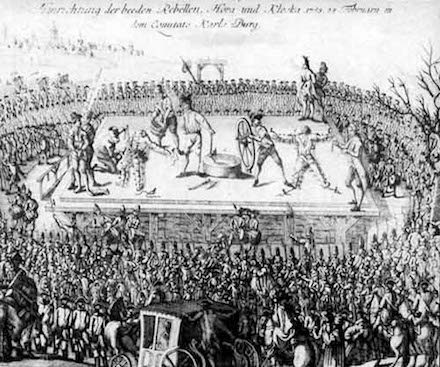
On this date in 1785, two of the three leaders of Transylvania’s great peasant uprising were broken on the wheel in the city of Alba Iulia — the third having cheated the executioner by hanging himself in his cell.


Left to right: Vasile Ursu Nicola, known as Horea; Ion Oarga (Closca); and, the suicide, Marcu Giurgiu (Crisan).

The Revolt of Horea, Closca and Crisan (English Wikipedia entry | the far more detailed Romanian) featured the usual grievances of feudal serfs, who in this case were Orthodox Christians governed by a Hungarian Catholic nobility. The heavier exactions of the region’s magnates in this period had led to several peasant delegations petitioning for relief from the Habsburg crown, among whose rosters appear this day’s eventual executees, Horea and Closca.

Those grievances were transmuted into rebellion, paradoxically as it might seem, by the 1780 death of Maria Theresa and the consequent ascent to sole rulership of Emperor Joseph II. Remembered as one of history’s great progressive “enlightened despots,” Joseph would surely have thought himself a friend to the peasantry with measures like rolling back serfdom and a broadened mandate for education.*

But the careless injuries his modernizing edicts visited on a precarious dominion of his polyglot empire would help beat ploughshares into swords in the regions of present-day Romania.

Imperial demands for fresh (rationalized, as the empire saw it) cash taxation had excited the countryside’s nobility and peasantry alike, since little specie flowed through their traditional agrarian arrangements, and an attempted census had met widespread resistance as a likely harbinger of the revenue man; but, these rebels from the soil still mostly hated their traditional local overlords and in due course would direct their blades and torches accordingly. Demands they presented to a besieged city on November 11 of 1784 underscore their perspective:

  1. The nobility should be abolished; each noblemen, if he could get a job in the imperial administration, should live on that income.
  2. The noble landlords should leave once for all their nobiliary estates.
  3. The noblemen should pay taxes like any common taxpayer.
  4. The noblemen’s estates should be divided among the common people

Source

The most immediate spark to set all this tinder ablaze would be the apparent prospect of widespread military recruitment — a desideratum for the peasantry, as it offered the prospect of social mobility and an escape from the magnate’s lash — which was then apparently withdrawn or blocked, a cruel trick to put the servile class in mind of its many abuses. In early November, beginning in Zarand, thousands of peasants Romanian, Saxon, and Hungarian alike rose in arms and began putting manors and churches to the sack.

“Letters from Transylvania continue to talk of excesses committed by rebels there,” one bulletin reported.

Not content to kill the feudal lords, they set fire to the habitations of their vassals if these refuse to embrace the party of the insurgents. At Kerespaya they broke into the coffers of the royal treasury and took away all the money. The evangelical pastor of that place, after having seen the throats of his wife and children cut, was taken to the church and decapitated at the foot of the altar. Some Franciscans met the same fate, those who had taken refuge in the bell towers were strangled and thrown into the streets. But they respect the officials of the emperor, as long as they are not nobles … Major Schultz asked one of them the motives for their cruel conduct, he answered: “Do not believe, Sir, that we have joined this party without reason; we were forced into it by the most pressing necessity. Here are authentic copies of several royal orders given out for our benefit that have not been carried out. All our remonstrances in this matter have been useless, and we have been sent away without receiving justice. It is thus only to break the yoke of the most insufferable slavery that we have resolved to vindicate ourselves. We know well that our conduct will be disapproved of, but we pride ourselves at the same time that it will serve to force examination of the conduct of those who have so cruelly deceived us. At any event, we prefer death to a miserable life, and will die content so that our example might guarantee the rights of humanity to our descendants and give the state contented subjects.”

Nuove di diverse corti e paesi, Dec. 27, 1784 (quoted by Franco Venturi)

The tragic aspirations of this rebellion — which lasted only two months, but had managed to assume a proto-national character** — were amply fulfilled once it was crushed and its three principal leaders betrayed to the government. The two who faced the horrors of the breaking-wheel, and Crisan as well, had their corpses quartered and their limbs distributed to the major thoroughfares by way of intimidation. Dozens of others of less eternal fame were also put to death during this period, to add to the innumerable killings in the course of suppressing the rebels.†


Above: detail view (click for the full image) of an 18th century print illustrating the execution. Below: another take on the scene.

But there was, too, that examination they desired forced upon the emperor, who promulgated a decree abolishing serfdom in 1785, eliminated noble control over marriages, and expanded the peasantry’s grazing rights. These reforms were at best only partially successful (the true end of serfdom still lay decades in the future) but they betokened on parchment just as the rebels had done in fire and blood the crisis striking at the ancien regime — for, alongside condemnations of the peasantry, there were during those revolutionary years also vindications of them, written in the language of the Enlightenment:

The Walachian uprising is an important lesson for sovereigns. It confirms the observation that the human spirit is mature for a general ferment, that it yearns for laws that respect equality, justice, and the order corresponding to its nature. How could it have been that under the most beneficent and mild government in the world, that of Joseph II, such an event could occur? It is because the principles of liberty, justice, and equality are woven into our hearts; they are a part of our natural destiny.

Wilhelm Ludwig Wekhrlin

* Joseph also abolished the death penalty in 1787. (He died in 1790, and the abolition with him.)

** And even more so in hindsight; see, for instance, this 1937 tributary obelisk.

† “I will leave you to judge the excesses they committed. Among others twenty-seven peasants were arrested, whose heads were cut off by nobles in one day without any kind of procedure.” One reported decree — we hope never effected in reality — threatened to impale a random citizen of any town that gave sanctuary to the “villainous low people.” (Both nuggets from Venturi, op. cit.)

On this day..

1755: Henri Mongeot, Lescombat assassin

On this date in 1755, Henri Mongeot was broken on the wheel for assassinating the husband of his adulterous lover, Marie.

Louis Alexandre Lescombat was a Paris architect; the betrayal of his flighty wife Marie Catherine Taperet was all the talk of Paris after her lover Mongeot slew the husband whilst out on a walk in December of 1754 — then summoned the watch to present a bogus self-defense claim.

This tactic has been known to work when the killer enjoys sufficient impunity; perhaps a respectable bourgeois like Lescombat could have done it to Mongeot — but when the horny 23-year-old busts up the family home with one blade and then the other, it’s La Mort de Lescombat, a tragedy.

For the widow, one good betrayal would deserve another: Mongeot faithfully avoided implicating her in the murder but when he discovered on the very eve of his death that she was already making time with a new fellow, he summoned the judge and revenged himself by exposing her incitement to the crime. His evidence would doom her to follow him many months later, after the sentence was suspended long enough for the widow Lescombat to deliver a son.

Joining Mongeot on the scaffold this date was a 15-year-old heir to the family executioner business apparently conducting just his second such sentence — Charles-Henri Sanson, the famed bourreau destined in time to cut off the head of the king and queen. Mongeot makes a passing appearance in the 19th century Memoirs of the Sansons; in it, Charles-Henri’s grandson remarks from the family notes that “Mdme. Lescombat … was confronted with him [i.e., her doomed lover] at the foot of the scaffold. She was remarkably handsome, and she tried the effect of her charms on her judges, but without avail.”

On this day..

1594: Jean Châtel, lipstabber

On this date in 1594, Catholic militant Jean Châtel was dismembered for the near-assassination of King Henri IV.

Just two days before his public butchery, the 19-year-old clothier’s son (English Wikipedia entry | French) had milled about in a crowd awaiting the Huguenot* king’s return from Picardy. As Henri entered the Hotel de Bouchage and bent over to accept the obeisance of two courtiers, Châtel sprang out of the crowd and daggered him. The blade cut Henri’s lip — a glancing blow just a few degrees distant from a history-altering one.

Châtel would cite Jesuitical inspiration, and when his instructors’ quarters were searched they yielded seditious exhortations against Protestant princes. One Guignard, who had authored the most inflammatory tracts (e.g., regretting that Henri had not been slain at the St. Bartholomew’s Day massacre), was put to death on January 7; the rest of the order was expelled from Paris — as was Châtel’s family, whose home was razed and replaced with a monument against religious fanaticism.


The pyramid memorial was replaced by a succession of fountains, of which the most recent is the present-day Fontaine Cuvier.

It was of course far too much to hope that this scolding plinth could bring down the dangerous sectarian temperatures raised by a half-century of civil war. In his time Henri IV evaded numerous — some 20 or more — attempts on his life, before a different Catholic enragee, one Francois Ravaillac, successfully murdered him in 1610.

* The threat of pedantry in the comments section obliges us to allow that Henri nominally converted to Catholicism in order to take the throne and end the Wars of Religion — the occasion on which he was purported to murmur that (staunchly Catholic) Paris is worth a Mass.

On this day..

831: St. Euthymius of Sardis, iconophile

This is the martyrdom date in 831 for the iconodule saint Euthymius of Sardis.

Euthymius was just a child when Byzantium’s century-long internal conflict over image-veneration wrote St. Stephen the Younger into the pages of this here blog way back in 764.

By the time Euthymius attained the bishopric of Sardis in the 780s, the Empress Irene was putting an end to her predecessors’ anti-icon campaigns, and Euthymius took part in the Second Council of Nicaea that made the new policy official.

Posterity has a difficulty measuring by way of scanty and partisan sources the true state of sentiments surrounding icons during this period but it’s a sure thing that for an empire besieged both west and east, religious questions connected inextricably to geopolitical ones. Irene’s shift towards embracing what iconoclasts saw as graven images spanned about a quarter-century which also coincided with humiliating reverses for Constantinople. Irene’s son was thrashed by the Bulgars to whom her treasury was then obliged to submit tribute; then Irene had that very son deposed and blinded. Irene was toppled in her turn by her finance minister but Emperor Nikephoros too was trounced in battle and his skull wound up as the Bulgar Khan’s ceremonial goblet.

Small wonder that when Leo the Armenian took power in 814 he reflected that

all the emperors, who took up images and venerated them, met their death either in revolt or in war; but those who did not venerate images all died a natural death, remained in power until they died, and were then laid to rest with all honors in the imperial mausoleum in the Church of the Holy Apostles.

For a prelate like Euthymius, this meant a return to the opposition benches. He’s reported to have been arrested and exiled twice in the ensuing years before finally being scourged to death in 824 at the behest of Leo’s successor; however, scholarship has better associated this event with the more vigorous anti-icon persecutions of Theophilus after 829. In 831, Arab forces devastated Cappadocia and also captured Panormos in Byzantine Sicily. In light of these reverses Theophilos discovered that an anti-iconoclast manifesto predicting the emperor’s imminent death had been circulated — so again the link between prestige abroad, sedition within, and those damned icons. Theophilus attributed the pamphlet to a pro-icon bishop named Methodius, who was a friend of Euthymius, and had both men arrested.

Imprisoned on the island of St. Andrew, near Constantinople in the Sea of Marmara, the two men were questioned about their associates by the postal logothete — probably Arsaber, the brother of [anti-icon future patriarch] John the Grammarian — who was accompanied by the chartulary of the inkpot Theoctistus. Euthymius seems to have mocked Theoctistus and would name only one of his visitors: Theoctista, the mother-in-law of both the logothete and the emperor!* Theophilus had both Euthymius and Methodius beaten soundly. While Methodius, who was just over 40, could endure it, the 77-year-old Euthymius died from his injuries on December 26 and became an iconophile martyr. The empress Theodora was reportedly so upset at Euthymius’s death that she told Theophilus that God would desert him for what he had done. (Source)

The History of Byzantium podcast covers this period in episode 103.

* Theoctista was an actual iconophile. Her house in Constantinople later became the Monastery of Gastria — and post-1453, a mosque.

On this day..

1678: Edward Colman, Popish Plot victim

On this date in 1678, Catholic courtier Edward Col(e)man was hanged, drawn and quartered at Tyburn — the second victim of Titus Oates’s “Popish Plot” concotion.

Colman was a Catholic convert whose zeal for the old faith led him into a variety of treacherous intrigues with the French court — although Colman’s eager and fruitless offices more annoyed than profited his allies.

His behavior was sufficiently indiscreet that fabulist Titus Oates had Colman queued up by name* as a Catholic plotter in the first round of 1678 Catholic terrorism allegations that would roil the realm for the next three years.

That indiscretion was very real, however, and extended to a careless presumption of his own safety. He seems to have been tipped to his danger by the judge who first took Oates’s evidence, a friend named Sir Edmund Godfrey, but he failed to use this advance intelligence to destroy his own correspondence. Godfrey in his own turn went on to a starring role in the Popish Plot debacle when he turned up murdered in October of 1678, a crime whose immediate attribution to the Catholic conspiracy that Oates had unfolded for him sent England clear round the bend.**

Colman’s case had already begun and half-fizzled by that point but with the apparent assassination of the judge a cry for his own blood now shook Parliament — “Colman’s letters!” alluding to that correspondence he surely wished he had burned: its volumes unfolded intelligence leaks, offers to exert French influence in the government even so far as dissolving Parliament, and applications for King Louis’s gold.

There are some incriminating examples in the trial transcript that, Lord Chief Justice William Scroggs charged, show “That your Design was to bring in Popery into England, and to promote the interest of the French King in this place, for which you hoped to have a Pension.” While Oates was a legendary perjurer and his fables destined to take the lives of 20-odd innocent souls in the months to come, the fact was that Colman really was caught out. His scheming ought not have merited such spectacular punishment under less extraordinary circumstances, but the things Colman really did do made it easy for Oates to position him as a paymaster in the fictitious regicidal conspiracy. “Mr. Colman, your own papers are enough to condemn you,” Scroggs said when his prisoner asserted innocence.

Nor could he protect himself with position. (Men even higher than Colman would succumb to the panic in time.) As detestably elevated as Colman looked to the average commoner, he was not himself a lord and was already (pre-Oates) regarded by King Charles II and many members of the court as a loose cannon. Everything pointed to sacrificing him … and they did. But as events would prove, the popular rage was not quenched on Colman’s bones alone.

The always-recommended BBC In Our Time podcast covers the Popish Plot in its May 12, 2016 episode.

* By name — not by face: Oates would be embarrassed at Colman’s eventual trial by the prisoner pointing out that Oates, who now claimed to have been personally paid out by Colman for various seditious errands, had utterly failed to recognize his “conspirator” when Oates appeared before the Privy Council to lay his charges in September.

** Godfrey’s murder has never been satisfactorily explained. There’s a good chance that it was a wholly unrelated affair with amazing bad timing; the revenge of the truculent Earl of Pembroke, whom Godfrey had prosecuted for murder a few months previous, is one leading possibility.

On this day..

1738: False Tsarevich Alexei

From the memoirs of Cristof Hermann von Mannstein, a Prussian officer who served in Russia from 1727 to 1744. As Manstein has this report by second hand, he has no precise dates.

Execution of the false Czarewitz.

In the month of November, there was a terrible execution in the Ukrain[e]. The son of a peasant in that country had given himself out for the Czarewitz, son of Peter I deceased, in the year 1718.

He had come into a village on the frontiers, where he had declared himself as such to three soldiers, who were on guard near the pyramidal beacons fixed along the limits. These had done homage to him, as also the inhabitants of the village. The priest had caused the bells to be rung, and said a mass in his favor.

At length the people of the village assembled, and perhaps the matter would have gone farther, if it had not been for a Sotnick, or Cossack captain, who, hearing of it, acquainted general Romanzow, then in the neighbourhood.

This pretended Prince and his adherents, who were not very numerous, were easily seized, and conveyed to Petersburgh, where they had their trial in the secret chancery; after which they were sent back to the Ukrain[e]. There the major-general Schipow had an order to see them executed.

The self-made Prince was impaled; the priest and the three soldiers were put to different kinds of deaths.

The Empress forgave the peasants, but the village was razed to the ground, and the inhabitants were removed to other places.

On this day..

1591: Brian O’Rourke, Irish lord

On this date in 1591, Brian na MĂşrtha Ă“ Ruairc — Brian O’Rourke to the English who killed him — was drawn and quartered as a rebel at Tyburn.

O’Rourke was a chieftain in a disappearing world, the Gaelic Ireland that the English had been engaged in reducing ever since King Henry VIII realized that he was King of Ireland back in 1542.

O’Rourke’s patrimony in this Tudor conquest was the kingdom of West Breifne, with a lineage going right back to its 12th century founder. As far as the Tudors were concerned he was just one more truculent local lord to subdue — even if the very “proudest man this day living on the earth.” (per Nicholas Maltby)

O’Rourke’s pride put him into opposition against the English satrap and even led him to succor sailors taking refuge from the shattered Spanish Armada in 1588. But the scope of his autonomy was narrowed and narrowed as expanding English occupation crept upon his environs.

In the end it was his brother-Celts in Scotland who finished him: when O’Rourke turned up there in 1591 seeking license to recruit sword-arms from King James VI (James was not yet James I of England at this point), Queen Elizabeth successfully prevailed upon her Scottish counterpart to arrest and extradite the man — an incident that triggered a riot in Glasgow.

Tried on the highly dubious grounds of treason against England committed in Ireland — plus a lese-majeste incident of having the queen’s image dragged in the mud tossed into the indictment for good measure* — O’Rourke scornfully refused to plead, or to defend himself unless Elizabeth herself would deign to sit in judgment — sovereign to sovereign. The court required only O’Rourke’s body, not his assent, to proceed.

O’Rourke had a sharp enough tongue when minded to deploy it, however. On the scaffold, he witheringly abused the notoriously avaricious bishop Miler Magrath who had been sent to minister to him. Then …

Upon Wednesdaie the 3 of November, Bren O’Royrke was drawne to Tyborne, and there hanged, his members and bowels burned in the fire, his heart taken out, and holden up by the hangman, naming it to be the archtraytors heart, and then did he cast the same into the fire, then was the head stricken off, and his bodie quartered

-John Stowe, The Annales of England (1605) (via)

O’Rourke’s son Brian oge O’Rourke inherited his position, and his struggle, until younger brother Tadgh O’Rourke deposed him with English support. Tadgh died young in 1605 — and with him, West Breifne expired too.

* Enjoy an itemized list of the naughty O’Rourke’s many offenses against English sensibilities from page 144 of this public domain volume.

On this day..

1783: Jacques Francois Paschal, rapist monk

For this date’s post, we are indebted to Rictor Norton, who maintains the invaluable Homosexuality in Eighteenth-Century Enland site. Norton wrote a book about England’s proto-gay “molly house” culture, and his site includes a nigh-comprehensive index of 18th century reportage touching same-sex activity.

Norton quotes these reports — luridly horrible, if slightly contradictory — here.


Wednesday 29 October 1783

A correspondent from Paris, who was present at the late execution of the Friar convicted of an unnatural crime, has favoured us with the following particulars: the monk who murdered a young boy that would not submit to his infernal solicitations, was tried at two o’clock in the afternoon, and sentenced to be broke alive on the cross, and then burnt to ashes at four the same day. He was allowed some time in a house to prepare himself for the awful moment, but did not remain there half an hour. He was then taken to the Grève, the place of execution, tied to the cross of St Andrew, and broke with amazing celerity. He had eight bones broken, and was thrown alive into the fire. It is usual for criminals on these occasions to receive the coup de grace, that is, the criminal being tied down on the cross, which is fixed upon a scaffold, the executioner sets a halter round the said criminal’s neck, and passing the ends of the rope through two holes made on purpose in a board of the scaffold, one of Jack Ketch’s* men, who attends underneath, joins the aforesaid ends in a kind of press, and takes care to strangle the malefactor at the very instant he receives the first stroke. The Friar in question was denied this extraordinary favour, though he begged it with many dreadful cries. Monsieur Jack Ketch made his appearance in his own coach, dressed in scarlet laced with gold, with three of his men behind. (Caledonian Mercury)

Thursday 30 October 1783

On Friday, the 10th inst. a friar was executed at Paris for an unnatural crime, and afterwards attempting to murder a young boy of 14, a commissionaire, a kind of porter to waits at the corner of the streets to run of errands. the sentences on criminals are published in France by the Courts of Justice in which they are passed; the present runs in the following manner: Jacques François Paschal, is condemned to the amende honorable, before the principal door of L’Eglise de Paris, where he shall be conducted by the executioner of haute justice, in a tumbril, in his shirt, his feet and head naked, holding in his hand a burning torch of yellow wax of two pounds weight, having a rope about his neck and a label before and behind, on which shall be written these words: Debauche contre nature & assassin: “The crime against nature, and murder”; and there, on his knees shall declare in a loud and intelligible voice that wickedly, rashly, and ill-advisedly, he had delivered himself up to an excess the most criminal towards a young commissionaire, aged fourteen, and had enticed him into his chamber, on the 3d of the present month of October, where, irritated by his resistence [sic], he had attempted to murder him, by giving him a great number of stabs with a knife on the head, reins, and in the back; of which he repents, and demands pardon of God, the King, and Justice: He shall then be taken in the same tumbril to the Place de Greve, to have his arms, legs, thighs, and reins, broken on a scaffold erected for that purpose in the said Place de Greve, and shall afterwards be cast into a burning fire, there to be consumed to ashes, and his ashes scattered in the wind, &c. The boy, though desperately wounded, we hear is not dead.

from Thursday 30 October to Thursday 6 November 1783

A Gentleman who arrived in Town a few Days ago from Paris, was present at the Execution of the Monk on the 10th Inst. for Murder, and an Attempt to commit a detestable Crime, says, the Particulars on the Subject, as stated in some of the English News-papers, are erreoneous; but the following may be depended on as a Fact. — The Monk, who belonged to the Convent of Montmartre, having formed a Design of gratifying his unnatural Passion on a Savoyard Boy, Commisionaire, or Messenger frequenting the Boulevards, Corner of Rue Poissoniere, enticed him to the Convent, and pretending to confess him, took him into his Cell, where, under the Mask of Religion, the Monster in Iniquity attempted to satisfy his brutal Desires, which the Boy resisting, he gagged, and bound him with Cords, to prevent his crying out, or making any Noise, and then stabbed him in several Parts of the Body, locked the Door and fled. Being missed in the Evening at Vespers, the Superior sent to his Cell, the Door of which remaining fastened, notwithstanding being repeatedly knocked at, was ordered to be broke open, when a most shocking Scene presented itself to View, the poor Boy weltering in his Blood, and near expiring. Every possible Assistance was immediately given, but in vain; for he survived no longer than just to be able to relate the dreadful Story, and to discover who was the nefarious Perpetrator of so inhuman a Deed; in pursuit of whom the Police instantly dispatched the Marrechausse, and he was apprehended the next Morning in the Forest of St. Germain, disguised as a Peasant. Being conveyed to the Prison of the Grand Chatelet at Paris, he was privately tried according to the Custom of that Country, though on this particular Occasion his Sentence was not announced so soon as is usual; for it was not till after the Expiration of twenty Days allotted for the Arrival of the Chief Executioners from the provincial Cities, summoned to give their personal Attendance at this Execution extraordinary, that his Sentence was read to him, that within forty-eight Hours he was to be broke on the Wheel, and his Body, whilst yet alive, burnt; at which he seemed very little affected. About one o’Clock on the Day mentioned, under strong Guard, and escorted by a very numerous Procession of Capuchin Friars, bareheaded, with lighted Torches in their Hands, chanting a Requiem for his departing soul, he was brought on Foot to the Church of Notre Dame, where, bare-footed, and stripped to his Shirt, with Labels behind and before, denoting, in Capital Letters, his Crimes, he made his final Confession, and asked Pardon from God, his King, and Country. He was, then, in the same Order, conducted to the Grève, the Place of Execution, where a large Scaffold, with the Apparatus of Death, was erected. At the same Time arrived the Executioner of the Capital, stiled Monsieur de Paris, who alighted from a most elegant Cabriolet, beautifully ornamented with his Arms and Crest on the Pannels, and two Servants in rich Liveries behind. He was a tall, handsome Man, between thirty and forty Years of Age, dressed in Scarlet and Gold, with the Insignia of his Order embroidered over the right Shoulder, a Sword by his Side, and from Head to Foot fashionably and well equipped. After bowing three Times to the Spectators, who were amazingly numerous, he ascended the Scaffold, whereon the Criminal had, in the Interim been placed, and accompanied by a large Body of provincial Executioners, and other Officers of Justice, his Confessor now took leave, and he being fastened to the Cross, Monsieur de Paris, by Means of an Iron Bar, which he used with both Hands, very expeditiously executed Part of the first of the Sentence; and then ordered the Body to be trussed on a Wheel, they were together thrown into a large Fire, kindled at a little Distance from the Scaffold. The poor Wretch mounted the Steps with seeming Composure; but from the Moment he received the first Blow, he continued to utter the most piercing Shrieks, till the Fire put a Period to his Life and Misery. (Derby Mercury)

* The reference here is to the notorious English hangman whose name became the metonym for an executioner. The high executioner of Paris by this point would have been Charles-Henri Sanson, the man who would eventually guillotine Louis XVI. (Sanson was 44 years old at this date, contrary to the estimate in the the excerpt quoted above.)

On this day..

1554: A false coiner and a masked dummy

From the diary of Felix Platter, a Swiss youth studying in Montpellier, France. It is not completely evident from context (“afterwards …”) whether the masked dummy was “executed” on the same occasion as the coiner, or whether that effigy was punished on a different day.

On the next day [after a September 28 execution] a false coiner was hanged in the same place. The gibbet was not vety high and had only one arm.

Afterwards a masked dummy was brought on a hurdle, and was laid on the cross and its limbs broken, as I have described. This dummy represented a Greek who had studied at Montpellier and had been accounted one of the keenest blades of the town. He had married Gillette d’Andrieu, a girl of doubtful reputation, who had neither beauty nor fortune. She had a very long nose, and her lover could scarcely manage to kiss her on the lips, especially since he too had a nose of respectable size.

The Greek was insulted by a canon, Pierre Saint-Ravy, who taunted him, at the moment when he was about to relieve himself, of having had intercourse with his wife. The husband at once stabbed the canon and fled; he could therefore be executed only in effigy. His wife continued to live in Montpellier, and was often in Rondelet’s house she was a relative of his.*

She often came there to dance, and one day I danced with her, all booted and spurred, on my return from Vendargues. As I turned, my spurs entangled themselves in her dress, and I fell full length on the floor. Some tablets I had in a breast pocket were broken into pieces, and I was so stunned that I had to be helped up.

* Guillaume Rondelet was one of Platter’s instructors, a professor of medicine. He had been friends with Rabelais and has the distinction of appearing in Gargantua and Pantagruel under the name Rondibilis.

Part of the Daily Double: Felix Platter’s Diary.

On this day..