1982: Charles Brooks, Jr., the first by lethal injection

Besides being Pearl Harbor Day and Noam Chomsky Day, December 7 is a black-letter anniversary for capital punishment as the date in 1982 when the United States first executed a prisoner by means of lethal injection.

Charles Brooks, Jr. — who had by the time of his death converted to Islam and started going by Shareef Ahmad Abdul-Rahim — suffered the punishment in Texas for abducting and murdering a car lot mechanic. With an accomplice,* he had feigned interest in a test drive in order to steal the car, stuffing the mechanic in the trunk and then shooting him dead in a hotel room.

The “modern” U.S. death penalty era had just dawned with 1976’s Gregg v. Georgia decision affirming new procedures meant to reduce systemic arbitrariness — and the machinery was reawakening after a decade’s abeyance.

In the wake of the circus atmosphere surrounding the January 1977 firing squad execution of Gary Gilmore, the laboratories of democracy started casting about for killing technologies that were a little bit less … appalling.

“We had discussed what happened to Gary Gilmore,” former Oklahoma chief medical examiner Jay Chapman later recalled. “At that time we put animals to death more humanely than we did human beings — so the idea of using medical drugs seemed a much better alternative.”

This was not actually a new idea: proposals for a medicalized execution process had been floated as far back as the 1880s, when New York instead opted for a more Frankenstein vibe by inventing the electric chair. And the Third Reich ran a wholesale euthanasia program based on lethal injections.

But 1977 was the year that lethal injection was officially adopted as the lynchpin method for regular judicial executions. It happened in Oklahoma, and Chapman’s three-drug protocol — sodium thiopental (an anaesthetic), followed by pancuronium bromide (to stop breathing) and potassium chloride (to stop the heart) — became the standard execution procedure swiftly taken up by numerous other U.S. states in the ensuing years. As years have gone by, Chapman’s procedure has come under fire and supply bottlenecks have led various states to experiment with different drug cocktails; all the same, nearly 90% of modern U.S. executions have run through the needle.*

Texas was one early adopter, rolling in the gurney to displace its half-century-old electric chair. Its debut with Charlie Brooks was also Texas’s debut on the modern execution scene, and both novelties have had a lot of staying power since: every one of Texas’s many executions in the years since — 557 executions over 36 years as of this writing — has employed lethal injection.

* For up-to-date figures, check the Death Penalty Information Center’s executions database.

On this day..

1787: John Bly and Charles Rose, Shaysites

On this date in 1787, the only two men to hang for the infant American republic’s seminal post-independence rebellion went to the gallows at Lenox, Massachusetts.

The newborn United States emerged from the American Revolution (1776-1783) in a parlous financial condition. Forever short of gold and credit, it had paid George Washington’s Continental Army in worthless scrip* and promises of goodwill. Instead, many a Cincinnatus returned from Yorktown to discover his debtor farm dunned by creditors and taxmen, as desperate as he for hard currency.

Come 1786, protests against unpayable taxes verged into an outright rural insurrection in western Massachusetts. Known for one of its principals, Daniel Shays — who like so many of his fellows was a Continental Army veteran turned penniless farmer — this rebellion continued for several months and took earnest aim at the hated Massachusetts merchant elites. Some 4,000 “Shaysites” would eventually admit to** taking the field as rebel guerrillas. They mounted an attack on a federal armory, and seized weapons where they could for their own use.

A few books about Shays’s Rebellion

It was this last act which occasions our men’s hangings.

The new American authorities, who had not so many years ago been beckoning this same populace to take up their muskets in revolution, exercised in this moment a brittle authority and they would calculate that the proper balance of due regard for their power without unnecessary resentment entailed only a circumscribed approach.

Instead of charging Shaysites wholesale, most were waved away with a free pardon. And instead of charging treason, the Bay State made its demonstration cases with regular criminal offenses — for burglary when our men John Bly and Charles Rose followed some Shaysite militiaman’s order to confiscate guns and powder from nearby houses. In 1787, that was still a potential hanging offense.

Of course, everyone understood well enough the real offense. On the eve of their executions, someone got the condemned men to sign onto a “Last Words & Dying Speeches” broadsheet with a lesson addressed “To the good People of Massachusetts, more especially to Daniel Shays, and other Officers of the Militia, and the Select men of Towns who have been instrumental in raising the Opposition to the Government of this Commonwealth:”

Our fate is a loud and solemn lesson to you who have excited the people to rise against the Government … Advert to those things — live peaceably with all men — be not too jealous of your Rulers — remember that Government is absolutely necessary to restrain the corrupt passions of men — obey your Honest Governors — be not allured by designing men — pay your honest debts and your reasonable taxes — use your utmost endeavours to give peace to your divided, distracted country …

There was another legacy: the outbreak of Shays’s Rebellion — and the federal government’s impotence to respond to it (it was haltingly suppressed by state militia, with the insurgents at points escaping into New York for breathing room) — helped catalyze the Constitutional Convention from May to September of 1787, and informed its creation of a stronger federal state and of the system of checks upon democratic action that a rebellious populace might wish to undertake.

There’s a podcast episode about Shays’s Rebellion here.

* So widely shunned was the depreciated paper Continental currency issued during the Revolution that the phrase “not worth a Continental” entered the parlance of the times; it was these notes that had been given to revolutionary soldiers by way of aspirational salary like so many stock options from a foundering Silicon Valley startup. In 1791, these Continentals were bought out by the new federal government at one cent on the dollar.

** This census arrives via applications for the free amnesty eventually offered to the Shaysite rank and file.

On this day..

1705: Edward Flood and Hugh Caffery

On this date in 1705, Edward Flood and Hugh Caffery hanged at Dublin’s St. Stephen’s Green for robbing one “Mr. Casey.”

Both men were impugned by a witness who subsequently recanted — at which point the victim’s mother-in-law, Elizabeth Price, stepped in to denounce them instead. In their dying statements (republished in James Kelly’s Gallows Speeches: From Eighteenth-Century Ireland) both men insist upon their innocence of the robbery.

It’s unclear to this reader all these centuries later whether we are meant by these doomed “robbers” to understand something unstated between the lines about Elizabeth Price’s animosity towards them, or whether we simply have a case of unreliable witness testimony and tunnel vision. (Obviously we also can’t know whether Flood’s and Caffery’s protestations are reliable.) Judge for yourself, gentle reader:


THE LAST SPEECHES AND DYING WORDS OF

EDWARD FLOOD AND HUGH CAFFERY

Who was Executed at St. Stephen’s-Green, On Friday the 5th of December, 1707 for Robbing of Mr. Casey, at Cabbra?

Good Christians,

Now that I am brought to so scandalous an End, and within a few Minuts of my last Breathing; I here declare before God and the World, that I was not Guilty of this Fact for which I am now to Dye for; neither was I privy thereto, nor to any other Robbery all my Life-time.

One of the same Company that I belong’d to being Confined in the Castle Guard, and transmitted to New-Gate for stealing Cloaths, was in a starving Condition; and that Mr. Casey, who was Robbed, hearing there was some of the Regiment in New Gate, and being Robb’d by some of the same Regiment, as they suppos’d, came to New Gate, to see if he cou’d hear any thing of this Robbery among them.

Then this Man who belong’d to the same Company that I was in, by name Bryan Mac Couly, being in a starving Condition, and Casey making him Drink, and Bribed him, Swore against Four of the same Company; for which we were Apprehended.

In a considerable time after, his Conscience prick’d him; and sent for the Reverend Mr. Jones, who examin’d Mac Couley, who Declared he Wrong’d us Four … That Elizabeth Price, Mother-in-law to the said Casey, hearing that Bryan Mac Couly had made the second Examination, came to him, and said; If he would not Swear against us, she would swear against Caffery and I; so she desired him to Swear, and that he shou’d have for his Reward two Guineas, but he wou’d not.

Then Mrs. Price Swore against Caffery and I, and said she knew us Both well enough … [and] Mrs. Price pitch’d upon one of Man of the Battallion, and said, that was one of the Men, and would have had him confined only he had good proof to the contrary; and made out where he was that Night.

Likewise I declare once more before God and the World, I know nothing of this Robbery that I am to Die for; altho’ I deserved Death before now, but I thank my God not for Robbing or Stealing, but for keeping Company with Women, and I was much given to that Crime, and do trust that God of his great Mercy will forgive me …

Edward Flood

Christians,

Since it has pleased Almight God, that I should Dye this most unfortunate Death; these few minutes that I have to live, shall be to satisfy the World of what was laid to my Charge. And now that I am to dye, I hope all Good Christians do believe that I have a tender regard for my poor soul, (which I hope God will be Merciful to,) and not think that I will dissemble with the World so as to deprive my self of Eternal happiness.

Dear Christians, these being my last Words, I do declare I never was Guilty of this Crime that I now suffer for, nor was I ever Guilty of so hainous a Crime as Stealing or Robbing; but all other small Vices I have been Guilty of, (and hope my Heavenly Father will pardon the same) Cursing, Swearing, and Women was the only Vice I was Guilty of; And that I do heartily forgive the Persons that hath occasion’d this my untimely End. And do further declare, that I never before knew any that was privy to the fact I suffer for; not did I see Mrs Price for 3 Years to my knowledge, ’till she came to New Gate.

I lived with one Ignatius Taffe, at the sign of the Black Swan in Smite-Field; during which service, I have been often in her House, yet never did her any wrong. I Confess I deserv’d Death long ago for the matter of keeping Company with Lewd Women, and I was as much given to that, which is all that troubles my Conscience.

I never wrong’d any living Soul, except I did my Master when I was sent to Buy small Conveniences for the House, then some small thing or other I often kept for my own use: Which is all I shall answer at the Tribunal. And pray God that all Christians may eschew those Vices of Lewd Women, Cursing and Swearing; God will one time or other revenged on ’em that Practice ’em. I desire the prayers of all that sees my untimely End. So fare well.

Hugh Caffery

These are the true Copies of the Dying Persons as delivered by ’em.
Printed by E. Waters in School-House Lane.

On this day..

1856: Six Tennessee slaves, election panic casualties

On this date in 1856, the white citixens of Dover, Tennessee hanged at least six black slaves in the midst of a regional panic.

They could well sense, as could all Americans, the hollowing authority of slavery in the 1850s with the Civil War looming ahead in 1861. Conflict over the issue had split the country sectionally over the disposition of the huge territory annexed in the Mexican-American War; the matter came to literal blows on the western frontier in the “Bleeding Kansas” bush war.

On the cultural plane, these are the years that germinated the definitive anti-slavery novel Uncle Tom’s Cabin (1852); on the legal plane, they produced the the notorious pro-slavery Dred Scott Supreme Court case (1857).

And on the political plane, the slavery issue tore apart the old Whig Party — and so the 1856 presidential election for the first time featured the new anti-slavery Republican Party as the chief opposition. The very first Republican presidential nominee, John Fremont, carried 11 states on November 4, 1856: not enough to capture the White House, but enough to put the Slave Power in fear for its human chattel and catalyze, in the weeks surrounding the vote, paranoid reactions in various southerly locales to the effect that Fremont-inspired blacks would be coming to dispossess all the masters.

Now it only takes a glance at Twitter to evidence the capacity of a presidential ballot to dominate the public mind, so there can hardly be doubt that seditious rumors of liberty fell from black lips which had never been so close to tasting emancipation. “Wait till Fremont is elected, and den I guess as how, missess, you will have to dew de pots yourself,” a Memphis kitchen-slave supposedly told her mistress on the eve of the election. (New York Herald, December 11, 1856) The masters too would have spoken of the same topic, but with trepidation; nobody knew but what the future could hold, and words overheard would have worked their way to and fro across the color line to shape hope, terror, anticipation. The newspapers from the last weeks of 1856 have reports of rumored insurrections and white vigilance committees in Missouri, in Texas, in Arkansas, in Louisiana.

As is usual in slave rising panics no firm evidence exists that black plots consisted in this moment of anything more substantial than whispered hopes. Whites in scattered localities saw Nat Turner everywhere — and nowhere was this more the case than in western Tennessee. There, slaves around the Cumberland River were believed to be organizing a Christmas Day rising* to cut their masters’ throats, run amok, and rendezvous with an imagined army of Fremont liberators. One correspondent described for northern papers how

the credulity of these poor people is such that, in the belief of the whites who excite them, they imagine that Col. Fremont, with a large army is awaiting at the mouth of the river Cumberland … Certain slaves are so greatly imbued with this fable, that I have seen them smile while they are being whipped, and have heard them say that ‘Fremont and his men can bear the blows they receive.’ (via the Barre (Mass.) Gazette, Dec. 19, 1956)

Against such hope — more blows. A truly horrifying and widely republished editorial in the Clarksville (Tenn.) Jeffersonian that Dec. 3 proposed an overwhelming bloodletting to crush this prospective jacquerie.

It is useless to shut our eyes and deny the facts, or sneer at the developments which have been made. Every hour multiplies the proof and corroborates previous discoveries. It is no Titus Oates affair, but a solemn, fearful and startling reality, and must be dealt with accordingly.

The crimes contemplated should be atoned for precisely as though those crimes had been attmpted and consummated. Fearful and terrible examples should be made, and if need be, the fagot and the flame should be brought into requisition to show these deluded maniacs the fierceness and the vigor, the swiftness and completeness of the white man’s vengeance. Let a terrible example be made in every neighborhood where the crime can be established, and if necessary let every tree in the country bend with negro meat. Temporizing in such cases as this is utter madness. We must strike terror, and make a lasting impression, for only in such a course can we find the guaranties of future security …

The path of future safety must be wet with the blood of those who have meditated these awful crimes. Misplaced clemency, and we believe that any clemency would be misplaced, may at no distant day bring upon this people, the horrors and the inexpressible crimes which marked the enfranchisement of St. Domingo. While retributive justice, sternly and unbendingly enforced, will certainly remove the cause of the evils we now suffer and prove our sure protection against their repetition in all time to come.

So far as this writer can establish it is not certain how many people overall in Tennessee and throughout the Slave Power met the guns and nooses of white vigilantes, but some of the best-established are a sextet hanged at Dover on December 4, 1856. This town on the Cumberland was roiled by rumors that slaves from nearby communities intended to march, armed, on Dover itself, an idea that seems not much less fanciful than that of deliverance by Fremont; it became thereby an epicenter of the suppression, and favors us from a sea of unreliable timelines and misstated figures with a concrete eyewitness description.

Tuesday morning [sic — the writer means Thursday, Dec. 4, having narrated Wednesday, Dec. 3 immediately prior], I went to Dover, and arrived there about 2 o’clock. The people had hung four negroes at 11 o’clock that morning, and two more then in town to be hung. I got to the place of execution in time to see the last one go off. Of the six that were hung, three had been preachers. They were all proved to be ring-leaders. I learned that the men at the forge were at work whipping the truth out of their negroes, so I rode out there that night, and was up with them all night. I never had such feelings in my life. I saw a list of negroes that had been whipped, and was told what they all had stated, and then I heard the balance examined — some taking five and six hundred lashes before they would tell the tale … One of the negroes at the forge died from whipping that night, several hours after the operation.

We are at work here to-day. We have one negro in chains, and will hang him I think, certain; if the committee will not the community are determined to do it. I think we will have quite an exciting time here before we get through. I have no doubt but that it is a universal thing all over the Southern States, and that every negro fifteen years old, either knows of it or is into it … (Louisville Daily Courier, Dec. 29, 1856)

Two key academic sources on this affair are:

  • Harvey Wish, “The Slave Insurrection Panic of 1856,” The Journal of Southern History, May, 1939
  • Charles Dew, “Black Ironworkers and the Slave Insurrection Panic of 1856,” The Journal of Southern History, August 1975

* Shades of Jamaica.

On this day..

2009: Bobby Wayne Woods

Bobby Wayne Woods was executed by lethal injection in Texas on this date in 2009.

A proud bearer of the classic middle name, Woods in 1997 broke into his ex-girlfriend’s home and kidnapped her two children, both of whom he did to what he thought was death. (11-year-old daughter Sarah Patterson, whom Woods also raped, did die; nine-year-old son Cody Patterson survived a savage beating, barely.)*

What distinguished Woods from a run-of-the-mill capital murder was his disputed competency — a product of what Australia’s Sydney Morning Herald aptly termed a “legal grey area.” A landmark 2002 U.S. Supreme Court case, Atkins v. Virginia, bars the execution of mentally disabled prisoners … but punts the definition of this protected class to the very states that are trying to execute them. Ah, federalism.

Woods was a barely-literate middle school dropout with I.Q. test scores ranging from 68 to 80; the commonplace threshold for mental disability is about I.Q. 70. He definitely did the crime, but was he entitled to protection under Atkins?

The case stuck in the judicial craw, scratching a scheduled 2008 execution and resulting in appeals that resolved only half an hour before Woods received the needle. The whole thing was essentially stalemated by dueling experts on retainer who made the arguments you’d expect them to make for their sides. And since the legal standard is whatever Texas feels like enforcing, that means the guy is not disabled.

* The victims’ mother, Schwana Patterson, was convicted of felony child neglect for failing to intervene in the abduction, out of fear of the assailant; she served eight years in prison for this.

On this day..

2005: Kenneth Boyd, the 1,000th modern execution in the U.S.

On this date in 2005, Kenneth Lee Boyd died to lethal injection in Florida. His was the 1,000th execution conducted in the so-called “modern” death penalty era in the United States.

“I’d hate to be remembered as that,” Boyd said of his prospective milestone distinction. “I don’t like the idea of being picked as a number.”
He’d not needed a number to fight in Vietnam thirty-odd years before: he volunteered, and worked heavy equipment under fire, which his attorneys would later argue made him a PTSD victim.

The victims of the PTSD victim were his estranged wife Julie Curry Boyd and Julie’s father Thomas Dillard Curry, both of whom he gunned down with a .357 magnum in the presence of his and Julie’s three children back in 1988. Then he called 911 with the report, “I’ve shot my wife and her father — come on and get me.” In his voluntary confession upon surrender to the responding officers, he invoked the ghost of his youth’s imperial war.

It was just like I was in Vietnam. I pulled the gun out and started shooting. I think I shot Dillard one time and he fell. Then I walked past him and into the kitchen and living room area. The whole time I was pointing and shooting. Then I saw another silhouette that I believe was Julie come out of the bedroom. I shot again, probably several times. Then I reloaded my gun. I dropped the empty shell casings onto the floor. As I reloaded, I heard someone groan, Julie I guess. I turned and aimed, shooting again. My only thoughts were to shoot my way out of the house. I kept pointing and shooting at anything that moved.

The press comments from people linked by kinship to this horror make heartbreaking reading. This excerpt is from the New York Times report:

As to the provision of justice, Marie Curry, who lost her husband and her daughter when Mr. Boyd shot them 17 years ago, said she was at a loss to provide any answers. “I really don’t know,” she said.

Mrs. Curry raised Mr. Boyd’s three sons, Christopher, Jamie, and Daniel, after their father was sent to prison for their mother’s murder. “It’s just a sad day. The bible says to forgive anyone that asks you, and I did,” she said, “But I can’t ever forget.”

On this day..

1958: Istvan Angyal, Hungarian revolutionary

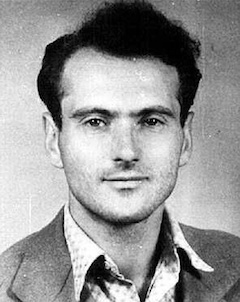
On this date in 1958, Angyal Istvan was hanged for the failed 1956 Hungarian revolution.

A working-class Jew who survived Auschwitz as a boy — his mother and sister were not so fortunate — Angyal was a convinced leftist who became disaffected with the Hungarian regime not because of its Communism but because of its failure to realize the democratic and egalitarian aspirations of that ideology.

A fixture on the youthful intellectual ferment in Budapest in the early 1950s, he was one of the leaders of street protests against Soviet domination during the doomed Hungarian Revolution of 1956, even conferring personally with Prime Minister Imre Nagy during its last days. In a gesture that not all of his comrades would have supprted, he set out the hammer and sickle along with the Hungarian national flag on November 7, the very eve of the revolution’s defeat, arguing to Soviet troops that they were fighting against true communism.

He’s commemorated today at an Angyal István Park in Budapest; it’s evidently “a modern social place with free Internet” and a nifty paper plane art installation.

On this day..

1885: Robert Goodale, messily

(Thanks to Richard Clark of Capital Punishment U.K. for the guest post, a reprint of an article originally published on that site with some explanatory links added by Executed Today. CapitalPunishmentUK.org features a trove of research and feature articles on the death penalty in England and elsewhere. -ed.)

45-year-old Robert Goodale was a market gardener who had been married to a lady called Bethsheba for 22 years. He owned a piece of land at Walsoken Marsh, near Wisbech, where he grew fruit and vegetables. On the property was a house that was used only for storage and not lived in, together with a well. The Goodales lived in Wisbech with their two sons, aged 18 and 21. All of them would walk to Walsoken in the mornings and work on the land.

On the 15th of September 1885 Bethsheba did not arrive at the market garden and a search was made for her. Her body was discovered the following day in the well. Examination of the body revealed that she had been struck three times on the head, most probably with a bill-hook, and then thrown down the well, where she drowned.

Goodale was arrested by Sgt. Roughton on suspicion of murder and later charged with the crime. He came to trial at the Norfolk Assizes at Norwich before Mr. Justice Stephen on Friday the 13th of November 1885.

Evidence was presented of the Goodales’ unhappy marriage and of threats of violence made against Bethsheba by her husband. A witness testified that he had heard a quarrel in the Goodales’ house on the afternoon of the murder. Dr. Stevenson the Home Office analyst said he had found traces of mammalian blood on the prisoner’s hat and jacket.

The defence led by Mr. Horace Browne contended that the case against Goodale was very weak. He conceded that husband and wife were not on good terms but insisted that Goodale’s conduct was not consistent with that of a murderer. He rebutted the blood stain evidence and suggested that it had come from the prisoner having a nose bleed. At this time it was not possible to determine the group to which the blood belonged and therefore it could not be certain that it was the victim’s blood, or even that it was human rather than animal blood.

The trial resumed on the Saturday and after the closing speeches and the summing up it took the jury just 20 minutes to reach their verdict of guilty of the wilful murder of his wife. Goodale was sentenced to death and removed to the Condemned Cell in Norwich Castle to await execution on Monday the 30th of November.

He was visited by his two sons and his sister on the Friday. Later that day he asked to see the governor of Norwich Castle, Mr. Dent. He and the Chief Warder went to Goodale’s cell where he told them that the crime had taken place due to extreme provocation. He claimed that his wife had told him that she liked other men. Mr. Dent took Goodale’s statement down in writing and sent it to the Home Secretary. The Rev. Mr. Wheeler and a former Sheriff of Norwich went to London and made representations for a reprieve at the Home Office. On Sunday the 29th of November the governor received a letter saying that the Home Secretary had not found cause to grant a reprieve.

James Berry had arrived at the prison and tested the drop on the Monday morning in the presence of the governor and under-sheriff. The gallows there had been constructed some three and a half years earlier for the execution of William Abigail on the 22nd of May 1882. The trap doors were set level with the floor over an 11′ 5″ deep brick lined pit in the middle of a small yard. This yard was approximately 48 feet long by 15 feet wide near the Castle wall, opposite Opie Street. The gallows consisted of a black painted wooden beam supported by two stout uprights set over the black painted trap doors.

Goodale stood 5′ 11″ tall and was a heavy man at 15 stone (210 lbs.) with a weak neck. Berry considered that a drop of 5′ 9″ should be given. He used a “government rope” that had been used for the hanging of John Williams at Hereford a week earlier.

At 7.55 a.m. on the Monday morning the bell of St. Peter’s church began to toll and the officials proceeded to the condemned cell. A procession then formed consisting of the governor, the Rev. Mr. Wheeler, the surgeon, Mr. Robinson and the under-sheriff, Mr. Hales. Mr. Charles Mackie of the Norfolk Chronicle represented the press. They went down a passage that connected the cell to the gallows yard where Berry met them and pinioned Goodale, after which they continued into the prison yard.

Here Berry strapped Goodale’s legs and applied the white hood and the noose. Goodale several times exclaimed “Oh God, receive my soul.” As the church clock struck for the eighth time Berry released the trap doors and Goodale disappeared into the pit, but the rope sprung back up to the horror of the witnesses.

As they looked down into the pit they could see the body and the head lying separately at the bottom.

The law required that an inquest be held after an execution and this was presided over by Mr. E. S. Bignold, the Coroner. Mr. Dent gave evidence that the machinery of the gallows was in good working order and that Goodale was decapitated by the force of the drop. Mr. Dent did not think that a drop of 5′ 9″ was excessive and in fact thought it was insufficient for a man of ordinary build. He also stated that James Berry was perfectly sober.

Berry himself testified and at the end of this the Coroner absolved him of any blame for what had happened. The jury returned a verdict that Goodale “came to his death by hanging, according to the judgement of the law.” They further said “that they did not consider that anyone was to blame for what had occurred.”

This is the only occasion of a complete decapitation occurring at a hanging in England, Scotland and Wales, although Berry had several partial ones.

Assuming that Goodale actually weighed 15 stones (in some reports it is given as 16 stones) and that Berry had correctly set the drop at 5′ 9½” or 5′ 10″ then the energy developed would have been around 1218 foot lbs. This is around 100 foot lbs. more than would have been given after 1939 for a man of normal build with a normal neck. The “Goodale Mess” as it came to be known, led to a lot of unfavourable comment in the press.

Just one day after the most damning newspaper editorials had appeared, the head of the Prison Commission, Sir Edward Du Cane, wrote to the Home Secretary on the 2nd of December. In his letter he suggested the setting up of a Committee on Capital Punishment (which became the Aberdare Committee).

Footnote:

The Norwich Chronicle published an interview with Goodale’s spiritual advisor, the Rev. Mr. Wheeler, a Baptist minister. He felt that maybe Goodale might not have been convicted of murder if he had said earlier what he said in his confession on the Friday evening. When Bethsheba fell into the well, he fetched a ladder to go down and look for her but that he could not get down the well since the opening was just 18 inches wide and he could not physically fit through it.

Had he spoken up earlier, Mr. Wheeler said, the police would have found the ladder still in the well and the dirt of the well on Goodale’s clothes. It might have led to a verdict of manslaughter.

When Goodale finally came forward with this tale, it was too late.

On this day..

1937: Vincenzo Baccala

Italian Communist Vincenzo Baccala was executed on this date in 1937 … but not by the fascists.

The blackshirted turn of his country in the 1920s had driven Vincenzo into emigre exile, pursued by an in absentia prison sentence for “subversive propaganda tending to insurrection and incitement of class hatred.” He went first in Paris and then in 1931 to the USSR.

Although present in the fortress of Communism at the Party’s direction, and eventually an outright Soviet citizen, Baccala came into trouble after criticizing Stalin in 1933 and had to leave his family in Odessa as he struggled to find work. Come the height of the purges in the later 1930s, he was predictably denounced.

Baccala’s wife Pia Piccioni swallowed a bitter draught of her own; unable to see her husband or find support amid Stalin’s purges, she returned to her native country, finding little comfort either in Mussolini‘s Italy (for obvious reasons) or in postwar Italy (where red comrades shied from traducing the USSR). She wrote a book about her own and Baccala’s experiences, Compagno Silenzio: Una vedova italiana del gulag racconta.

On this day..

1857: Two surviving members of the Aiken Party

On this date in 1857, the Utah Territory finished the extrajudicial executions it had botched three days before.

As we have detailed, Utah’s Mormon authorities had during these months of near-war against federal authorities taken prisoner a party of Californians crossing their territory — the Aiken (or Aikin) Party.

On November 25, four members of that party were murdered by the Mormon guards escorting them out of the territory — killings that were quite extrajudicial, but also quite deliberately orchestrated by the state.

Except, they had only killed two of the four.

Although outnumbered by their attackers and miles from the nearest settlement, somehow two men — perhaps John Aiken and John “Colonel” Eichard or Achard, although we cannot be certain of their identities — survived the bludgeons and staggered, wounded, back to the town of Nephi whose residents could not but take them in: an awkward situation since they still had to be done to death and could not very well be gunned down right there in the town.

We excerpt at length here from J.H. Beadle’s explanatory appendix in the autobiography of frontiersman and confessed Brigham Young hit man Wild Bill Hickman. Beadle was a vituperative anti-Mormon propagandist and his prose runs to the purple, but the core facts of the case are historically well-supported; see David Bigler, “The Aiken Party Executions and the Utah War, 1857-1858,” The Western Historical Quarterly, Winter 2007.

Two died without a struggle. But John Aikin bounded to his feet, but slightly wounded, and sprang into the brush. A shot from the pistol of John Kink laid him senseless. “Colonel” also reached the brush, receiving a shot in the shoulder from Port Rockwell, and believing the whole party had been attacked by banditti, he made his way back to Nephi. “With almost superhuman strength he held out during the twenty-five miles, and the first bright rays of a Utah sun showed the man, who twenty-four hours before had left them handsome and vigorous in the pride of manhood, now ghastly pale and drenched with his own blood, staggering feebly along the streets of Nephi. He reached Bishop Foote’s, and his story elicited a well-feigned horror.

Meanwhile the murderers had gathered up the other three and thrown them into the river, supposing all to be dead. But John Aikin revived and crawled out on the same side, and hiding in the brush, heard these terrible words:

“Are the damned Gentiles all dead, Port?”

“All but one — the son of a b– ran.”

Supposing himself to be meant, Aikin lay still till the Danites left, then, without hat, coat, or boots, on a November night, the ground covered with snow, he set out for Nephi. Who can imagine the feelings of the man? Unlike “Colonel” he knew too well who the murderers were, and believed himself the only survivor. To return to Nephi offered but slight hope, but it was the only hope, and incredible as it may appear he reached it next day. He sank helpless at the door of the first house he reached, but the words he heard infused new life into him. The woman, afterwards a witness, said to him, “Why, another of you ones got away from the robbers, and is at Brother Foote’s.” “Thank God; it is my brother,” he said, and started on. The citizens tell with wonder that he ran the whole distance, his hair clotted with blood, reeling like a drunken man all the way. It was not his brother, but “Colonel.” The meeting of the two at Foote’s was too affecting for language to describe. They fell upon each other’s necks, clasped their blood-spattered arms around each other, and with mingled tears and sobs kissed and embraced as only men can who together have passed through death …

[But] the murderers had returned, and a new plan was concocted. “Colonel” had saved his pistol and Aikin his watch, a gold one, worth at least $250. When ready to leave they asked the bill, and were informed it was $30. They promised to send it from the city, and were told that “would not do.” Aikin then said, “Here is my watch and my partner’s pistol — take your choice.” Foote took the pistol. When he handed it to him, Aikin said, “There, take my best friend. But God knows it will do us no good.” Then to his partner, with tears streaming from his eyes, “Prepare for death. Colonel, we will never get out of this valley alive.”

According to the main witness, a woman of Nephi, all regarded them as doomed. They had got four miles on the road, when their driver, a Mormon named [Absalom] Woolf,* stopped the wagon near an old cabin; informed them he must water his horses; unhitched them, and moved away. Two men then stepped from the cabin, and fired with double-barreled guns; Aiken and “Colonel” were both shot through the head, and fell dead from the wagon. Their bodies were then loaded with stone and put in one of those “bottomless springs” — so called — common in that part of Utah.

I passed the place in 1869, and heard from a native the whispered rumors about “some bad men that were sunk in that spring.” The scenery would seem to shut out all idea of crime, and irresistibly awaken thoughts of heaven. The soft air of Utah is around; above the blue sky smiles as if it were impossible there could be such things as sin or crime; and the neat village of Nephi brightens the plain, as innocently fair as if it had not witnessed a crime as black and dastardly as ever disgraced the annals of the civilized world.

* Grandfather of jockey George Woolf, who rode Seabiscuit to a famous victory over Triple Crown winner War Admiral in 1938.

On this day..