On this date in 1934, in the coda to Hitler’s Night of the Long Knives purge of the Nazi party, the emerging dictator had his longtime ally shot.
Bavarian World War I veteran Ernst Röhm (Roehm) had been a National Socialist brawler of the earliest vintage: after the armistice, he was among the Freikorps paramilitaries to topple the short-lived Munich Soviet. He joined the NSDAP’s predecessor, the German Workers’ Party, before Hitler himself, and he stood trial with the future Fuhrer after helping Hitler attempt the Beer Hall Putsch. They were so tight, Hitler politely ignored Röhm’s open homosexuality.
But most importantly, Röhm was the energetic organizer of the Sturmabteilung, or SA — the party’s private army ready at arms for street battles with Communists, roughing up Jews, Praetorian Guard duty for party brass, and various and sundry other unpleasantries.
An SA brownshirt tosses a book on the pyre at a May 10, 1933 book burning.
Röhm grew the SA like a weed. At well over 4 million men by the time of Hitler’s Chancellorship, it greatly outnumbered the army itself.
This gave Röhm personal designs on absorbing the army into his paramilitary instead of the other way around, and it gave Röhm the literal boots on the ground to manifest his own commitment to the “Socialist” bits of the “National Socialist” project. His noises about the “second revolution” to come after the Nazis had already obtained state power were most unwelcome.
“One often hears voices in the bourgeois camp to the effect that the SA have lost any reason for existence, but I will tell these gentlemen that the old bureaucratic spirit must yet be changed in a gentle or, if need be, an ungentle manner.”
Well, those gentlemen weren’t about to wait around to be changed in an ungentle manner. Hitler was induced to sacrifice the man who raised him to power in favor of those who could keep him there, personally arrested his old friend and aide-de-camp as the June 30 purge got underway.
A sucker for nostalgia, Hitler didn’t have Röhm killed outright — the fate of many others in those terrible hours — but instead shipped him to Stadelheim Prison in Munich.* After due consideration, though, the treacherous chancellor did what he was always going to do.
Hitler ordered a revolver to be left in his cell, but Röhm refused to use it: “If I am to be killed, let Adolf do it himself.” According to an eyewitness at the 1957 Munich trial of those involved, he was shot by two S.S. officers who emptied their revolvers into him at point blank range. “Röhm wanted to say something but the S.S. officer told him to shut up. Then Röhm stood at attention — he was stripped to the waist — with his face full of contempt.”
A nice twist of the Long Knife by its wielders: they justified the purge on the grounds of an imminent coup attempt by the dead SA boss,** branding the murders of Röhm and his comrades … the Röhm-putsch.
In the dark hours this date in 1934, a bargain with the devil was sealed in blood.
Months before, even mere hours before, it was still possible for longstanding adherents of the National Socialist Workers’ Party to demand the “Socialist” part of the program.
The SA and the SS will not tolerate the German revolution going to sleep and being betrayed at the half-way stage by non-combatants. … It is in fact high time the national revolution stopped and became the National Socialist one. Whether [the bourgeoisie] like it or not, we will continue our struggle — if they understand at last what it is about — with them; if they are unwilling — without them; and if necessary — against them.
Populist, not Bolshevik. (In fact, stridently anti-communist.) Nevertheless, a distinct menace by the have-nots against the haves.*
Especially so because they were the words not of some impotent scribbler but of Ernst Roehm, commander of the the Nazis’ paramilitary brownshirts. And threatening, too, for Adolf Hitler for this same reason: his ascension the previous year to the Chancellorship had entailed terms with a German elite who needed but mistrusted the man’s mass party. Something was going to have to give.
The Communist exile Leon Trotsky’s 1933 analysis of the infant Nazi Germany’s dynamics proved prescient.
The banner of National Socialism was raised by upstarts from the lower and middle commanding ranks of the old army. Decorated with medals for distinguished service, commissioned and noncommissioned officers could not believe that their heroism and sufferings for the Fatherland had not only come to naught, but also gave them no special claims to gratitude. Hence their hatred of the revolution and the proletariat. At the same time, they did not want to reconcile themselves to being sent by the bankers, industrialists, and ministers back to the modest posts of bookkeepers, engineers, postal clerks, and schoolteachers. Hence their “socialism.”
…
German fascism, like Italian fascism, raised itself to power on the backs of the petty bourgeoisie, which it turned into a battering ram against the organizations of the working class and the institutions of democracy. But fascism in power is least of all the rule of the petty bourgeoisie. On the contrary, it is the most ruthless dictatorship of monopoly capital. … The “socialist” revolution pictured by the petty-bourgeois masses as a necessary supplement to the national revolution is officially liquidated and condemned.
The Night of the Long Knives this date took those blades to the “socialists”, to the men like Roehm whose dreams of redistribution were reckless enough to picture his working-class militia supplanting the German army proper.
As its price of power, the Nazi leadership purged these dangerous elements.
At 2 a.m. this date, Hitler flew to Munich to personally arrest Roehm on the pretext of averting an imminent coup by Roehm’s SA.** Elsewhere in the Reich, coordinated arrests and summary executions destroyed the Nazi party’s “left”, and throughout this date, and continuing into the next, did not scruple to sweep up whatever other conservative elements Hitler considered unreliable.
It was a dangerous but ultimately decisive move. Albert Speer saw Hitler on July 1, and remembered him ebullient at the triumph.
Hitler was extremely excited and, as I believe to this day, inwardly convinced that he had come through a great danger. … Evidently he believed that his personal action had averted a disaster at the last minute: “I alone was able to solve this problem. No one else!”
The final death toll is uncertain. Hitler copped to 77 in a speech to the Reichstag two weeks later which chillingly claimed that “in this hour I was responsible for the fate of the German people, and thereby I became the supreme judge”; it is likely that the true number is much higher. But its effect went far beyond those immediately killed: it tamed the SA’s independence, and permanently subordinated it to the military; and, it brought Adolf Hitler the dictatorial power that would make the succeeding years so fruitful for this blog.
Roehm himself died on July 2, initially spared for his many good offices for the Nazi cause before Hitler realized he could not leave him alive.
The armed forces, apparently the day’s big winner, would pay a price of their own for the arrangement.
“In making common cause with” the murderous purge, observed William Shirer in The Rise and Fall of the Third Reich, “the generals were putting themselves in a position in which they could never oppose future acts of Nazi terrorism.” As the quid for the quo, soldiers were soon required to swear “unconditional obedience” to Adolf Hitler, and this oath would give countless Wehrmacht officers sufficient reason or excuse to eschew resistance to their leader until much too late.
Barely a month after the Night of the Long Knives, the ancient German President Hindenburg died in office. Hitler, who now commanded the clear allegiance of his nation’s elites and had savagely mastered his own party besides, succeeded the powers of Hindenburg’s vacant office along with those of his own Chancellorship and became the German Fuehrer.
* When the Nazis were knee high to the Weimar Republic, their party program sought such radical stuff as abolition of rentier income, generous old-age pensions, and nationalizing trusts.
** The historicity of any actual coup plot is generally dismissed, although the event is still known in German by the expedient sobriquet the Nazi leadership gave it, Roehm-putsch.
This date marks the centennial of perhaps the most famous execution in the history of Reunion Island: the June 20, 1911 guillotining of Sitarane and Fontaine.
Sitarane (French link) — his actual name was Simicoudza Simicourba — hailed from Portuguese Mozambique, supposedly from a long line of sorcerors.
A contract job brought him to Reunion, but he soon abandoned it for the black [magic] economy. A fellow purported necromancer named Pierre-Elie Calendrin pulled Sitarane and run-of-the-mill hoodlum Emmanuel Fontaine into a prolific little crime ring that terrorized Reunion around 1907 to 1909, amassing about a dozen murders.
And what murders!
Most of the sources on this circle are French, and they narrate weird occult criminality: reading tarot and sacrificing a black cock before a proposed adventure, drinking the blood of their victims to gain their strength.
Still, this was practical magic: Calendrin, Sitarane and Fontaine killed people so that they could rob them.
So it was with their dark arts, too: the sacrificed chickens were drugged and tossed to watchdogs; a mysterious powder blown through keyholes narcotized targets before the gang burst in to do its dirty work. It’s Sherlock Holmes in the Indian Ocean.
The three were finally surprised in the midst of one of their mercantile and monstrous sorties, and tried in 1910.
Although all three received death sentences, Calendrin — who as the trio’s leader would figure to have been the most culpable among them — had his execution mysteriously commuted to penal transportation to Guyana instead. Maybe he foretold the lottery numbers for a judge, or just cooked him a mean chicken dinner.
Sitarane died wailing a Comorian death-chant. Fontaine, more panicky, resisted the executioners and got his neck in a twist, resulting in a bad strike from the blade that lodged in his jaw.
But bad luck on the appellate circuit would mean a bit of immortality that the spared Calendrin could never obtain: today’s doomed — most particularly Sitarane — live on yet as popular saints with a special appeal to the underworld.
Sitarane’s jaunty red grave in Saint-Pierre attracts a lively flow of cult offerings from supplicants hoping to avail the powers of its resident thaumaturge … and of gawkers who do not fear to tempt the evil eye by photographing same. Allegedly, it’s the place to pray for fortune in the sort of nefarious scheme Sitarane used to get up to: folk contemplating a robbery or homicide are among those particularly likely to invoke their criminal forebear, as are those who fear such plots against them.
Image: Par Thierry Caro (Travail personnel) [GFDL (www.gnu.org/copyleft/fdl.html) ou CC-BY-SA-3.0-2.5-2.0-1.0 (www.creativecommons.org/licenses/by-sa/3.0)], via Wikimedia Commons
The toxic hallucinogen Datura, a “witches’ weed” of long standing deployed over the centuries in all manner of potions and poultices, is knownlocally as Herbe à Sitarane.
On this date in 1965, Israel’s greatest spy suffered an ignominious public hanging in Martyrs Square, Damascus.
The signage swaddling the body denounces his crimes.
Eliahu Ben Saul Cohen — you can call him Eli(e) — was an Egyptian Jew who got recruited by Israeli intelligence to put his Arabic credentials to use in the cloak and dagger game.
You could say he’d found his calling.
After a spell establishing his cover story credentials in Argentina, he “returned” to Syria posing as a prodigal returning emigrant. There, he became the Zionist Richard Sorge.
Brazenly infiltrating the ascendant Ba’ath party and Syrian elite circles as wealthy businessman “Kamel Amin Thaabet”, Cohen piped years of high-quality intelligence to Israel from the very pinnacle of its enemy’s power structure.
(As described in this account, Eli’s own brother, another Mossad agent, was at one point charged with deciphering the spy’s communiques — thereby accidentally catching up with the family business.)
The trusted Eli Cohen in a snapshot with Syrian officials in the Golan Heights, overlooking Israel.
Cohen’s information on Syrian positions in the Golan has been credited with helping Israel win the Six-Day War in 1967.
But he wasn’t around to see it.
By that time, Syrian and Soviet intelligence had finally traced the damaging radio transmissions to “Kamel’s” apartment. He was purportedly — the matter is disputed, and smacks of hagiography — so influential and well-trusted at that point that he was on the verge of being named Deputy Minister of Defense.
Instead, he had a future in the martyr business.
A few books about Eli Cohen
After Cohen’s January 1965 arrest, events moved with implacable dispatch, and neither spy swaps nor diplomatic arm-twisting would avail an agent so embarrassingly, damagingly accomplished. Thousands turned out to cheer the spy’s public hanging, or gawk at the body as it remained hanging throughout the morning. Thousands more watched the live telecast of the execution.
(Six Syrians drew prison sentences for their parts in Cohen’s spy ring.)
Israel is still on about getting his body back from the Syrians. Whether or not that ever happens, the man lives on as a hero for his side. His story is the subject of the 1987 TV movie The Impossible Spy.
It was on this date that notoriously corrupt Chinese minister of state Heshen or Ho-Shen was forced to commit suicide in lieu of execution.
The able child of a Manchu military officer, Heshen came of age in the long reign of the emperor Qianlong.
That Heshen rose above his modest station with this monarch’s favor was the source of no small resentment. Rumors circulated that the attractive young former bodyguard reminded the emperor of a lost, beloved concubine — with all that implies.
“Elegant in looks, sprucely handsome in a dandified way that suggested a lack of virtue,” a Korean diplomat described Heshen.
Whatever there might have been to the homosexuality angle, Heshen exploited the imperial protection to gorge himself on the state’s revenues; he’s reported to have filled the bureaucracy with clients who saw to it that Heshen got a yuan out of every tael that passed through state business in the last quarter of the 18th century. He even dynastically married his own son to one of Qianlong’s daughters.
It was the peak of the Qing dynasty’s glory, and the dawn of its imperial stagnation. Heshen — resplendent, omnipotent, and sunk in vice* — remains to this day its persona par excellence.
As long as the emperor lived, Heshen had a virtual free hand.
But as soon as the emperor died — on February 7, 1799, at the age of 87 — the successor** Jiaqing destroyed him.
Citing Heshen’s inability to suppress the nettlesome White Lotus and Miao rebellions, Jiaqing arrested and tortured the former retainer into copping to all manner of offenses both mortal and venial.
My thoughts dwell ever on the Confucian precept: ‘For three years after a parent’s death none of his former surroundings should be changed.’ …
But as regards Ho Shen, his crimes are too grave to admit of possible pardon … Ho Shen is a deep-dyed traitor, lost to all moral sense, who has betrayed his Sovereign and jeopardised the State. As self-constituted dictator he has usurped supreme authority.
Seeing the man’s abrupt change of fortunes, Heshen’s people in the bureaucracy fell over each other to denounce him.
He was condemned to the horrific expiation of “slow slicing”; however, given “the undesirability of executing the chief Minister of State like a common felon in the public square,” Jiaqing “allowed him the privilege of committing suicide, as a mark of high favour and out of regard to the dignity of the nation.”
A principal accomplice was made to witness Heshen ceremonially hanging himself; then the accomplice was reprieved of his own death sentence and sent into exile.
The new sovereign found his nation’s dignity sufficiently upheld by the doomed man’s melancholy inventory of loot destined (of course) for the re-appropriation of the Qing … and sufficiently outraged that, upon discovering weeks after the some artifact Heshen had failed to enumerate,
Had these facts come to Our knowledge before the 18th day of the 1st Moon [i.e., February 22], we should assuredly have decreed Ho Shen’s decapitation, even if We had spared him the lingering death and dismemberment.
However, he has already been permitted to commit suicide, and thus luckily escaped the extreme penalty of public execution. We do not, therefore, insist on his corpse being hacked to pieces.
Jiaqing had better to worry about his own now-declining state, which was about to be hacked to pieces by encroaching European powers.
Having made an example of Heshen and a handful of his most visible allies, he was still saddled with the endemic structural corruption Heshen had fostered in the institutions of Qing governance.
“Historians have tended to see Jiaqing’s failure of nerve in purging the bureaucracy of all tainted officials as something of an original sin whose commission predetermined the dynasty’s steady decline,” writes William T. Rowe of this turning point. “But given the need for at least some continuity in routine administration, it is not at all clear that he could have acted otherwise.”
And so Jiaqing struggled in vain to maintain China’s fading prestige; his reign would witness economic erosion and a burgeoning opium trade that eventually led it to war with the British and humiliating western domination.
Since a sclerotic bureaucracy at once crushing in its expanse, helpless in its effect, and riven with self-dealers, is a timeless theme (especially in China), Heshen persists as a lively emblem of corruption.
Heshen’s luxurious mansion — which was also among Jiaqing’s indictments — still stands; today, it’s a museum.
* It bears remembering that it is principally by the testimony of Heshen’s enemies that we know him.
** Technically, Jiaqing had been ruling since Qianlong symbolically “abdicated” in 1796; in reality, Qianlong continued to run the realm until his death.
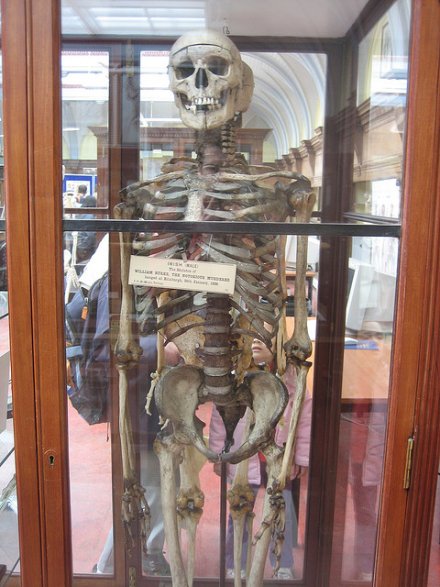
Wanted: corpses. Apply to Doctor Robert Knox, MD, FRSCEd, Professor of Medical Studies, Barclay’s Medical College, Surgeon’s Square, Edinburgh. Reference William Burke, hanged Jan. 28, 1829.
Robert Knox was a noted physician in his prime, in the early 1800s.
A surgeon, anatomist, and zoologist, Knox studied anatomy in London, then headed off to Africa in the army. Field surgery was a brutal business, and the poor anatomical knowledge at the time made it even more terrifying for those involved.
In 1821, Knox moved to France to work in the shadow of his heroes, Georges Cuvier and Étienne Geoffroy Saint-Hilaire; a year later, he was back in Edinburgh, making himself a career academic.
When his old professor came calling in 1826 with an opportunity to teach at Surgeon’s Square in Edinburgh, Knox jumped at the chance. As a partner to Barclay and curator of the school’s museum, Knox was well aware of the significant problem that faced the school: corpses were hard to come by.
And since the Royal College of Surgeons at Edinburgh certified the school as a prep course for entrance to University, coming up with bodies became a very important task.
If there’s one way to ruin your career, it’s to be caught paying a few pounds for fresh murder victims.
So it was for Knox, who gave out 7 pounds, 10 shillings for the body of an itinerant lodger who died in William Burke’s building in 1827.
This transaction led Burke to realize that such lodgers weren’t paying as much alive as dead. As a collector of bodies, Knox also had a strict no-questions-asked policy, and Burke and his partner William Hare exploited that to its fullest extent.
Almost a score of suspicious bodies later (and after the price had inflated to 10 pounds per), the pair was found out, given away as suspects by the lame and mentally disabled “Daft Jamie” Wilson, then caught when the late Marjory Campbell Docherty was found by a fellow tenant under one of Burke’s lodge’s beds.
Hare copped to a string of murders* and played stool pigeon in exchange for a lighter sentence.
Burke went to the gallows to “vehement cheering from every quarter, mingled with groans and hisses.” (London Times, Feb. 2, 1829)
“When the cheers had subsided, the wretched man was assailed with every epithet of contempt and abhorrence,” the Times continued. “Not a single indication of pity was observable among the vast crowd: on the contrary, every countenance wore the lviely aspect of a gala-day.”
William Burke’s hanging.
As a corpse himself, Burke made one final contribution to science’s insatiable desire for bodies: his cadaver went straight from the gallows to the practiced hands of one Dr Alexander Monro, who performed a complete lecture while dissecting the murderer’s corpse.
Knox, for his part, paid not with his neck but with his reputation.
Though never charged with a crime, the doctor was run out of the the lecturing business, first by subtle and not-so-subtle actions by the University, and eventually by the passage of the Anatomy Act of 1832.
He was also unable to obtain any surgical post after the incident and spent his later years writing academic books and papers, none of which have lasted like the doggerel that shadowed his steps.
Burke’s the butcher, Hare’s the thief,
Knox, the boy who buys the beef.
A few books about Burke and Hare
Anatomy of Anatomy
Robert Knox was operating under the Murder Act of 1751, which expressly forbade the burial of an executed murderer while permitting the malefactor’s dissection.
The Act had the dual effect of allowing the state to gibbet executed criminals (both hanging in chains and dissection were considered an added ignominy, beyond the punishment of the gallows), and of supplying the budding medical community with an immediate source of fresh bodies.
As courses in anatomy became more commonplace, though, the need for cadavers increased dramatically, and the business of selling bodies for science was born.
Typically, these sales manifested themselves in body-snatching — wherein “resurrectionists” illicitly exhumed a freshly buried corpse and conveyed it to some physician’s ready scalpel.
This grim trade in turn spawned a variety of security measures. The favored dead were defended by fences, watchtowers, and human lookouts. But nothing could eliminate the industry.
In particular, those with little money or no immediate relatives were unlikely to be buried in these gated graves; that left their remains ripe for the remaindering. As well, the increase in demand made so-called anatomy murder a possibility. Burke and Hare may have been notorious for the offense,** but they did not invent it.
In that case, two nurses (Jean Waldie and Helen Torrence) on death watch bartered a decent price of two shillings to sell the body of an ill child to a local surgical college. His death was delayed, and the nurses smothered him, possibly through simple carelessness.
Shortly after the Murder Act, simple economics made pikers of Torrence and Waldie. In the 17th century, England executed hundreds of prisoners a year, each a potential dissection. As Dr D.R. Johnson writes in his Introductory Anatomy:
The dissections performed on hanged felons were public: indeed part of the punishment was the delivery from hangman to surgeons at the gallows following public execution, and later public exhibition of the open body itself. …
Agents representing surgeons would bargain with condemned prisoners not under sentence of dissection (remember this only happened for murder: hanging was in vogue for stealing a sheep or even a loaf): occasionally prisoners struck a bargain to pay expenses, to provide for a family or to buy the customary decent apparel for the hanging.
Supply was unreliable, however: riots at public hangings became common, partly because of the paltry nature of hanging events, partly from superstition. The body was often reclaimed by relatives and the unpopular anatomists stoned, defeated and out of pocket. Competition was often so fierce that a rival anatomy school carried off the body.
Dissection was unpopular and other medical uses were to be found for a recently hung body – the cure of scofula, goitre, wens, ulcers, bleeding tumours, cancers and withered limbs for example. To prevent riots and disorder the Sheriff of London took all bodies of hanged men, except those sentenced to dissection, into his own custody and handed them to the relatives for burial.
Human Trafficking
Hanoverian Britain sure did keep the gallows busy. But the pace of hangings had abated by the 19th century just as demand boomed. The math didn’t add up.
Anatomy schools (officially) dissected some 592 corpses in 1825; at the time of the Burke and Hare murders, only about 50 executions were carried out annually, and each college was guaranteed just one a year.
That meant a shortfall of close to 550 bodies. With limited supply and significant demand, surgical colleges and anatomical lecturers were willing to pay top dollar for new cadavers … and the anatomical murder business really got legs.
And while the execution of Burke was met with applause from the community, in London, another group was already hard at work both body snatching and murdering its way into the classroom.
The London Burkers were caught in 1831 and convicted of murdering a 14-year-old whose cadaver they sold to St Bartholemew’s Hospital for 9 guineas.† The killers, Thomas Williams and John Bishop, had offed several others prior to the lad in question, making about the same price on each body.‡ In the grand, Burkean tradition of anatomical murderers, these miscreants were also dissected after their execution.§
Williams and Bishop were just two of a group of resurrectionists known collectively as the London Burkers, who claimed to have stolen upwards of 1,000 bodies from nearby cemeteries. That made the Burkers the largest known exploiters of the anatomical trade.
Over the decades after the Murder Act, though, resurrectionists were walking a dangerous line in their communities.
Reverence for the dead sparked community outrage when graves were found empty or disturbed, and it was often the anatomists themselves who felt the wrath of crowds.§§ In Glasgow in 1803, surgeons were threatened by an unruly mob and were forced to seek police protection; in 1813, an empty grave caused a similar furor. Punishments moved from fines to jail time as the surging demand made body-snatching an ever more lucrative trade.
A few books about body-snatching
By the time of the Burkers, anatomists were generally presumed to be body thieves in some capacity, a hostile sentiment graphically underscored during the Aberdeen riots of 1831. When a dog unearthed what looked like a human bone behind the Aberdeen surgical college, a mob coalesced and stormed the lecture hall.
The lecturer (“Dr Moir” — little else is known about the man) fled in terror as the hall was burned to the ground. Soldiers and police clashed with the crowd, which was thought to be over 10,000 strong. Hours later, the riot subsided, but Aberdeen was no longer a friendly place for a prospective medical talent.
And where Burke and Hare were still not quite sufficient to convince the House of Lords to take up a measure providing anatomists with alternatives for corpse acquisition, the Burkers and the Aberdeen riots apparently were.
The underground economy of resurrectionists was supplanted by the Anatomy Act of 1832, which allowed individuals to donate themselves or their unwilled kin to science for a pittance of compensation.
Anatomy murder is, of course, still the subject of horror movies. Like this one, or for the more classically inclined, this 1945 Boris Karloff/Bela Lugosi vehicle adapted from a Robert Louis Stevenson story inspired by Burke and Hare:
* The murders included at least one husband/wife pair, a mother and, later, her (adult) daughter, and a grandmother and her young grandson. They are also known as the West Port Murders.
** Burke entered the English language as a verb meaning … well, pretty much exactly what Burke got up to.
Dr. Murray, in the new English Dictionary, gives the following definition of the verb to ‘burke.’ ‘To murder in the same manner or for the same purpose as Burke did: to kill secretly by suffocation or strangulation, or for the purpose of selling the victim’s body for dissection,’ and the familiar lines are quoted from the Ingoldsby Legends: —
But when beat on his knees, that confounded De Guise
Just whipped out the “fogle” that caused all the breeze,
Pulled it tight round his neck until backwards it jerked him,
And the rest of the rascals jumped on him and burked him.
† 9 pounds, 9 shillings; by the time of the transactions, the guinea was no longer technically in use, but the term had stuck at the 21-shilling mark.
‡ Over the course of their 6 active months, the pair went from asking 8 guineas to asking 12 guineas; apparently 9 was the negotiated price with St Bartholemew’s.
§ The Burkers are the subject of the song “The Resurrectionist” by the Pet Shop Boys. (Lyrics)
§§ Edinburgh also had trouble as far back as 1742, when several surgeons’ homes were attacked by locals; a local beadle suspected of the crimes also had his home, dubbed resurrectionist hall, burned during the mob incident.
Four hundred years ago today, on Jan. 7 1611, three servants of the legendary “Countess of Blood” Elizabeth Bathory (Báthory Erzsébet, in the Hungarian) were tried, convicted, and immediately put to death for the noblewoman’s stupendous career of homicide.
This date’s entry is occasioned by the deaths of three subalterns — manservant Janos Ujvary, beheaded; and female attendants Ilona Jo and Dorottya Szentes, fingers ripped off and burned — but the headline attraction is their employer, who was never tried or condemned.
Bathory was rarefied Hungarian nobility, the niece of the King of Poland, which is also the biography of countless aristocrats you’ve never heard of.
The world remembers Elizabeth Bathory because she exploited her rank to butcher hundreds of peasant girls, allegedly to bathe in their rejuvenating blood.
On one occasion, a lady’s-maid saw something wrong in [Elizabeth Bathory’s] head-dress, and as a recompence for observing it, received such a severe box on the ears that the blood gushed from her nose, and spirted on to her mistress’s face. When the blood drops were washed off her face, her skin appeared much more beautiful — whiter and more transparent on the spots where the blood had been.
Elizabeth formed the resolution to bathe her face and her whole body in human blood so as to enhance her beauty.
These scrub-ups are what the Countess of Blood is best remembered for, but however striking the visual, it’s an atrocity that actually doesn’t turn up in the trial records.
But she could hardly complain of the embroidery, having given her interlocutors so much material.
Elizabeth Bathory is supposed to be responsible for over six hundred deaths, starting while her husband was away on campaign, and then carrying on into a wholesale operation after he died. When she and her servants were finally busted at Csejte Castle the end of 1610, their captors found a dead girl, a dying girl, and several others imprisoned and awaiting that fate.
Elizabeth Bathory, a sexually charged 1893 painting by Hungarian impressionist Istvan Csok depicting one of the countess’s victims being drenched in icy water for death by exposure.
So although the confessions the servants made this date to seal their own fates were undoubtedly torture-adduced, the documentary record turns out to be amazingly strong for such a fantastical spree. Hungarian King Matthias II convened a tribunal that examined 200 to 300 witnesses.
One can postulate that the woman ran afoul of a patriarchal culture affronted by her exercise of power or that she became a parable for the “unnatural” lust of a middle-aged woman … but so far as we are left to understand, Erzsebet Bathory really did lure young girls to her castle, and then inflict (pdf) a Nazi doctors’ litany of sadism on them … like jabbing them with needles to drain out their blood. She even kept a log of the victims in her own hand.
So, locals disappearing into the creepy castle, never to be seen again, or possibly to turn up pallid and dead. (Disposing of all those corpses became a logistical problem for the creepy castle.) No surprise to find it associated with the vampire legend.*
And no surprise that the tale became magnified, twisted, and reconfigured by popular culture.
In 1817, as accounts of the testimonies about the alleged murders and sadistic tortures were published for the first time, national and international headlines sensationalized the already misconceived story. From that on [sic], the literary countess took on a life of her own: the Grimm brothers wrote a short story about her, the romantic German writer, Johann Ludwig Tieck (1774 – 1853), cast her as a Gothic femme fatale, Swanhilda, in his short story Wake Not the Dead. It is alleged that Sheridan le Fanu shaped his female vampire Carmilla on Elizabeth Bathory. If we can believe some etymological explanation the compound English word blood-bath is of mid-nineteenth century origin possibly connected to the bloody countess’ rising popularity in England.
-László Kürti, “The Symbolic Construction of the Monstrous — The Elizabeth Bathory Story,” Croatian Journal Of Ethnology and Folklore Research, Jan. 2009
A few books about Erzsebet Bathory
To say nothing of the death porn (link not safe for work).
The noblewoman never faced an executioner herself, owing to her rank; she was shut up in the castle.
Kenneth Allen McDuff grew from the small-time bully of tiny Rosebud, Texas, to a feared and reviled killer finally apprehended with the help of the America’s Most Wanted television series. By the time of his execution on November 17, 1998, he stood as a symbol of how the best-intentioned prison reforms could bring the most hideous results.*
In 1966, on parole for a string of burglaries, McDuff was first sentenced to death for the brutal murder of three teenagers he kidnapped and killed. The female member of the trio was sexually abused and raped for hours before McDuff used a broomstick to snap her neck “just like you’d kill a possum,” in the words of Falls County Sheriff Brady Pamplin, one of the first generation of Central Texas lawmen to deal with McDuff.
He remained on death row until 1972, when the U.S. Supreme Court in Furman vs. Georgia struck down all death penalty statutes in the United States. McDuff’s sentence was commuted to life imprisonment, which left the possibility of parole.
A rape and attempted murder for which McDuff was never prosecuted resulted in a daughter who at the age of 21 visited McDuff in prison. Her visits ceased after McDuff described his fantasy of taking her to Las Vegas and pimping her out to earn himself a fortune.
A prisoner’s fifteen-page handwritten lawsuit, Ruiz vs. Estelle, exposed conditions in Texas prisons which proved unconstitutionally inhumane, including the use of inmates as guards. (McDuff ascended to the position of boss over fellow convicts following his exit from death row into the general prison population; his perks included a “gal-boy” who traded the usual personal services for McDuff’s protection from white supremacist former gang associates whom he had offended.) Ruling in the Ruiz case, Federal Judge William Wayne Justice placed the Texas prison system under the control of a Special Master and ordered that traditional prison overcrowding must cease.
The Texas parole board was ordered to release 150 prisoners a day, to reduce the prison population to the 50,000 for which there was adequate capacity. Despite a 1982 conviction for attempted bribery of a parole board member, McDuff made parole in early October of 1989. Waco’s U.S. Marshall Parnell McNamara could only ask, “Have they gone crazy?”
Kenneth Allen McDuff was a rarity on Texas’s death row: He was a son of the middle class among the poorest of the poor. On parole, his family furnished him with motor vehicles as needed, and a credit card so that he would not have to carry cash in his chancy, drug-ridden haunts along the Interstate 35 corridor of Central Texas.
Even a new arrest in July 1990, after he chased and threatened some black teenagers and then spewed racist invective at his parole revocation hearing, did not suffice to return him to prison. Six women, three of them drug-addicted prostitutes, have been verified as murder victims of Kenneth McDuff between his parole date in 1989 and his arrest as a fugitive in Kansas City on May 4, 1992; there may well be others whose identities will never be known.
McDuff was tried for the abductions and murders of Melissa Northrup, a convenience store clerk, and Colleen Reed, an accountant. He was convicted and sentenced to death in both cases.
Parole requirements for violent Texas criminals were stiffened substantially as a direct result of McDuff’s career, by the regulations of the parole board and by the Texas Legislature. (The statutes are known as the McDuff Laws.) McDuff by all accounts became the most hated man in the Texas prison system; once returned to death row, he was held in administrative segregation for his own protection from his latest arrival in 1993 until his execution.
Progressive Democrat Ann Richards was Governor of Texas at the time of McDuff’s last trial. A recovering alcoholic, she created an unprecedented emphasis on drug and alcohol treatment for Texas prisoners, the overwhelming majority of whose crimes involved substance abuse of one kind or another. No one appreciated the irony more than she: a governor dedicated to rehabilitation of prisoners was forced to kick off the biggest prison building spree in Texas history, to comply with the federal court’s orders on prison overcrowding while trying to ensure that Texas would never again see the likes of Kenneth Allen McDuff.
It took six years for law enforcement officers to persuade McDuff that his continued refusal to reveal where he had hidden the bodies of several of his victims offered him no sort of advantage. Some remains were located by means of hand-drawn maps, but maps did not suffice in every case. A few days before his execution, an unusual excursion party set out from the Ellis I prison outside Huntsville: a caravan of unmarked cars with dark-tinted glass carried McDuff, locked to a back seat and disguised with a baseball cap, on a “clandestine high security move.” Never allowed out of the car, McDuff directed investigators to the shallow grave of Colleen Reed, whom he kidnapped from an Austin car wash on December 29, 1991. Shortly thereafter, McDuff’s nephew received a reduction in his sentence for drug dealing.
McDuff never expressed remorse for any of his crimes. A lifetime of cheap beer and needle drug abuse was catching up to his liver when he climbed on the Walls Unit gurney on November 17, 1998. His last words: “I am ready to be released. Release me.”
* See Gary Cartwright’s “Free to Kill” Texas Monthly, Aug. 1992, Vol. 20, Issue 8, p. 90.
Ten years ago today, former Chinese politburo member Cheng Kejie was executed for gobbling up an impressive $5 million in bribes.
The onetime chairman of the Guangxi Zhuang Autonomous Region was (and, as best I can determine, remains) the highest-ranking official judicially executed since the Communists took power in China in 1949. He’d spent the best part of the 1990s soaking up kickbacks from his powerful post, much of it secreted in out-of-country accounts.
The execution was part of a massive campaign against official corruption which has long bedeviled China’s economic surge. Cheng’s own former boss around this time warned that “graft could destroy China”.
Cheng’s execution was announced after the fact, at the same time that China belatedly publicized the arrest of former Vice-Minister of Public Security Li Jizhou in a billion-dollar smuggling scandal. Li somehow managed to duck execution for similarly show-stopping corruption allegations (including scandalous details supplied by his mistress*), a fact which raised eyebrows in the People’s Republic about improper influence.** He “deserves to die ten thousand times over,” opined the Beijing Youth Daily.
Here in 2010, China (whose wholesale execution pace is quietly on the decline) has moved — not without opposition — to drop the death penalty for a number of non-violent economic crimes. That rollback apparently would not apply to bribery, however.
On this date in 1772, straw effigies of the (in)famous French libertine Marquis de Sade and his servant Latour were executed in Marseilles for sodomy.
“It is always by way of pain one arrives at pleasure.”
The aristocrat christened Donatien Alphonse François (even the name would become taboo for later use among his family) was at this point just 32 years old, but already cultivating the reputation that would make his name a byword for violent sex. He had in 1768 got the boot from Paris in view of the many courtesans who complained of his mistreatment.
Five more would do so for the incident that triggered his “execution”: de Sade took his baroque pleasure from these “very young girls” obtained by his manservant Latour (who also took part in the bisexual debauch). The whole scene was spiced with liberal dosage of the poison/aphrodisiac* spanish fly.
“Cruelty, very far from being a vice, is the first sentiment Nature injects in us all.”
One of these working girls seriously overindulged on the the love potion and spent the next week puking up “a black and fetid substance.” The authorities got interested, and de Sade and Latour bolted to Italy.**
Back in Marseilles, proceedings against the fugitives saw them sentenced for (non-fatal) poisoning and sodomy
for the said Sade to be decapitated … and the said Latour to be hanged by the neck and strangled … then the body of the said Sade and that of the said Latour to be burned and their ashes strewn to the wind.
This was duly carried out against straw effigies of de Sade and Latour on September 12, 1772.
“Lust is to the other passions what the nervous fluid is to life; it supports them all, lends strength to them all: ambition, cruelty, avarice, revenge, are all founded on lust.”
Although the Marquis eventually got this sentence overturned, it did in a sense mark an end to his life as it had been. Later in 1772, he’d be arrested in Italy; though he escaped and went back on the orgy circuit, most of the four-plus decades left to his life would be spent imprisoned or on the run — an ironic situation for the man Guillaume Apollinaire would celebrate as “the freest spirit that has yet existed.”
(Astonishingly, de Sade also avoided execution during the French Revolution: he was supposed to have been in the last batch guillotined before Robespierre fell; either through bureaucratic bungling or efficacious bribery, he avoided the tumbril.† De Sade also cheated death when a man whose daughter the marquis had outraged attempted to shoot him point-blank … only to have the gun misfire.)
“My manner of thinking, so you say, cannot be approved. Do you suppose I care? A poor fool indeed is he who adopts a manner of thinking for others!”
From this latter half of the infamous satyr’s life — when he often had time on his hands not available to dispose in more corporal pursuits — date the pornographic/philosophic writings that would stake de Sade’s disputed reputation for posterity.
** With another lover, his sister-in-law Anne … who was also a Benedictine canoness.
† It was on some firsthand authority, then, that de Sade took a dim view of capital punishment: “‘Til the infallibility of human judgements shall have been proved to me, I shall demand the abolition of the penalty of death.” This and other pithy de Sade quotes in this entry are from here.

 Bavarian World War I veteran Ernst Röhm (Roehm) had been a National Socialist brawler of the earliest vintage: after the armistice, he was among the Freikorps paramilitaries to topple the short-lived Munich Soviet. He joined the NSDAP’s predecessor, the German Workers’ Party, before Hitler himself, and he stood trial with the future Fuhrer after helping Hitler attempt the Beer Hall Putsch. They were so tight, Hitler politely ignored Röhm’s open homosexuality.


 The able child of a
  Almost a score of suspicious bodies later (and after the price had inflated to 10 pounds per), the pair was found out, given away as suspects by the lame and mentally disabled “Daft Jamie” Wilson, then caught when the late Marjory Campbell Docherty was found by a fellow tenant under one of Burke’s lodge’s beds.


 In 1966, on parole for a string of burglaries, McDuff was first sentenced to death for the brutal murder of three teenagers he kidnapped and killed. The female member of the trio was sexually abused and raped for hours before McDuff used a broomstick to snap her neck “just like you’d kill a possum,” in the words of Falls County Sheriff Brady Pamplin, one of the first generation of Central Texas lawmen to deal with McDuff.
 The onetime chairman of the
  The aristocrat christened