On this date in 1938 — so the Soviet government finally announced in 1989, after decades of opacity — the Hungarian Communist leader Bela Kun was secretly shot by firing squad in the gulag.
The pudgy and pugnacious* onetime journalist whose capture by the Russians during World War I enabled him to get in on the ground floor with the Bolshevik Revolution became the de facto leader of the short-lived Hungarian Soviet Republic. For a few months in 1919, it was the world’s second Soviet state after Russia itself.
Bela Kun’s moment in the sun was particularly notorious for his advocacy late in the Soviet Republic’s brief life of a Red Terror against internal opposition. Several hundred people were killed over the last few weeks of the state’s existence, until a Romanian invasion toppled the reds and sent Bela Kun fleeing back to the Soviets. There, he’s supposed to have brought his gift for wholesale murder to surrendered White prisoners in the Crimea.
Still, Hungary was an insurrectionary success next to most everywhere else, and Bela Kun was detailed to Germany to revive the flagging fortunes of a revolution that the Bolsheviks thought would be critical to sustaining their own. Modeling on Lenin’s own coup d’etat in 1917, Kun pushed the Germans to go all-in on an aggressive 1921 “March Action” offensive to capture state power — which backfired catastrophically, essentially marking the end of the post-World War I revolutionary window. Vladimir Ilyich gave his Magyar counterpart a dressing-down for that gambit at that summer’s Comintern summit.
He’d become associated in this time with Zinoviev, an Old Bolshevik whose comradeship would blow an ill wind come the killing time of the 1930s. Kun himself was long past his sell-by date at this stage, knocking around Moscow feuding with other Hungarian exiles.
Stalin eventually had him arrested for “Trotskyism”, and he disappeared into the Gulag never to be seen again.
Like many purge victims, Bela Kun was rehabilitated under Khrushchev, which also made him fitting source material for statuary congenial to the post-World War II Hungary, situated (however unhappily) within Moscow’s sphere. Some of the detritus of this age can be found at Budapest’s Mememto Park outdoor fairgrounds of discarded Communist kitsch.
Bela Kun, marshaling the Magyar masses. The streetlamp behind him (a literary symbol of hanging) alludes to his martyrdom. Wider views of the entire monument: 1 | 2
On this date in 1953, English serial killer John Christie was hanged by Albert Pierrepoint for the murders of six women.
The sex-killer is most infamous, though, for a different death: that of Timothy Evans, a neighbor and fellow client of Pierrepoint whom Christie had stitched up three years before for strangling Evans’s wife and child.
Back then, the respectable Christie was the star witness against Evans. Evans tried in vain to blame Christie (“this perfectly innocent man,” Evans’s prosecutors scoffed) for the murders.
Nobody knew then that Christie had strangled an Austrian prostitute during sex back in 1943, nor that he had done a gassing-strangulation-rape job the following year.
Both their bodies were both buried in the garden at 10 Rillington Place: the first inhabitants of what would be the British Isles’ most notorious corpse hotel.
Strangulation sex killings would become the definitive Christie m.o. after Evans hanged. He got himself a no-fault divorce by throttling his wife in bed late in 1952, then raped and strangled at least three other women whom he had invited back to his pad. The remains of each were secreted in the apartment’s nooks and crannies.
This is Richard Attenborough as Christie doing his thing to Evans’s wife (he’d later confess to that crime) in the 1971 flick 10 Rillington Place.
Christie seemingly could’ve gotten away with it all, if it weren’t for his penny-wise and pound-foolish decision to move out of the charnel house early in 1953 and let someone else stumble upon the remains. (Christie had quit his job the previous December, and hocked his strangled wife’s stuff to make ends meet for a while. He was homeless when the subsequent manhunt tracked him down.) There was even a human femur being used to prop a fence.
Having quite a lot of damning evidence, and Christie’s confession besides, his lawyer went for a hail-Mary insanity defense, but Christie didn’t even bother with an appeal when that didn’t take.
But there was the small matter of that other gentleman hanged back in the day for a strangulation murder, all the while unsuccessfully accusing his then-respectable neighbor Christie.
An inquiry launched by the government very conveniently concluded that (Christie’s confession notwithstanding) Evans was indeed guilty of killing his wife. Two stranglers in the same place at the same time, and the one had just happened to try to blame the other one when he was accused.
For obvious reasons, this whitewash was greeted skeptically and — though the two-killers theory does still have its defenders — officially reversed when Evans was posthumously exonerated in 1966.
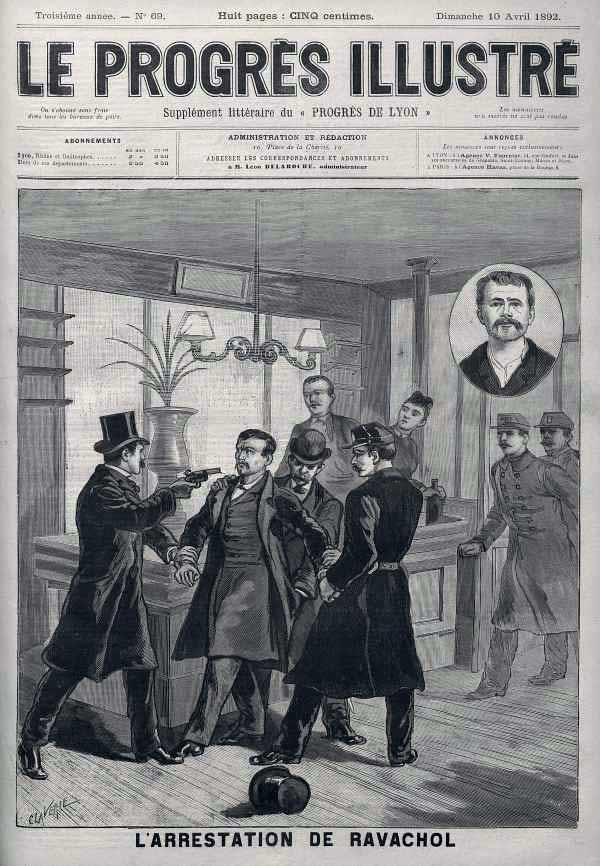
On this date in 1892, French anarchist François Claudius Koenigstein — better known as Ravachol — was guillotined at Montbrison for a series of bomb attacks on right-wing judges.
He took the name “Ravachol”, his mother’s, after his Dutch father ditched his mom, leaving the family in poverty.
Young Ravachol supported himself as best he could in proletarian labor and crime, as he attempted to observe* at his trial.
There are many people who will feel sorry for the victims, but who’ll tell you they can’t do anything about it. Let everyone scrape by as he can! What can he who lacks the necessities when he’s working do when he loses his job? He has only to let himself die of hunger. Then they’ll throw a few pious words on his corpse. This is what I wanted to leave to others. I preferred to make of myself a trafficker in contraband, a counterfeiter, a murderer and assassin. I could have begged, but it’s degrading and cowardly and even punished by your laws, which make poverty a crime. If all those in need, instead of waiting took, wherever and by whatever means, the self-satisfied would understand perhaps a bit more quickly that it’s dangerous to want to consecrate the existing social state, where worry is permanent and life threatened at every moment.
Personal want segued into political conviction for Ravachol, whose crimes were justified by the principle of reprise individuelle.
And the political led him to reprisals of a less individual nature, when French state violence against radicals caused him to dynamite several magistrates’ homes.
He was caught in a restaurant,** brought to trial, and let off with penal servitude for life. Then another jury, intimidated by public outcry, reversed the decision and sent him to the guillotine.
Anarchism, that revolutionary specter stalking fin-de-siecle Europe, burnt its fuse at both ends, but Ravachol’s falling head‡ left a legacy for his fellow-travelers. The next year, Auguste Vaillant tossed a bomb into the French Chamber of Deputies to avenge Ravachol. (Vaillant was himself guillotined, and himself avenged by Emile Henry and Sante Geronimo Caserio.)
Ravachol was also honored in a song, La Ravachole — set to the jauntily menacing tune of La Carmagnole, it cheers, “Long live the sound of the explosion!”
* This incendiary speech was cut off by the court.
** The table where the terrorist was nabbed got its own inscription: “Here ate Ravachol the day of his arrest.”
We had lost confidence in our culture. Everything had to be demolished. We would begin again after the ‘tabula rasa’. At the Cabaret Voltaire we began by shocking common sense, public opinion, education, institutions, museums, good taste, in short, the whole prevailing order.
‡ Ravachol was guillotined midway through a parting exclamation, “Vive la Re-“. Initial newspaper reports implausibly rendered this as the patriotic classic “Vive la Republique!” rather than a much more in-character word like, oh, “Revolution”.
Weeks of controversy ensued over some witnesses’ claims that the head post-severing had actually completed the word “-publique”, a notion of a piece with the idea that the severed head survives decapitation by a few seconds. Scienticians countered that obviously excited witnesses were maybe hearing air escaping from the headless trunk and filling in the rest of the scene in their heads.
It was this date in 1983 that the last hanging (so far) in Swaziland took place — that of 48-year-old Phillipa Mdluli, for ritually killing the daughter of one of her restaurant’s employees.
The True Crime Library’s archive of worldwide hangings reports that
after the girl, Thuli Mabaso, was slaughtered, her body parts were removed and served up in Mdluli’s restaurant, where the bodies of small girls were considered by the customers to be a great delicacy.
It may be no coincidence that this last hanging occurred during the run-up to parliamentary elections later that year, and while executive power in this absolute monarchy had devolved to a fractious regency following the death of the previous king.
When the heir to Swazi throne came of age as Mswati III in 1986, he became known both for clemency and for centralizing power in his own person. Between those two phenomena, there’s not much room for politicians to productively demagogue the issue. And with a population barely north of one million, there are only so many cannibal restauranteurs.
Despite the death penalty’s long abeyance in the small kingdom, Swaziland has been obstinate about not repealing the statute; in 2008, it voted against a UN death penalty moratorium resolution despite the fact that it functionally had a quarter-century moratorium of its own at that point.
But Swaziland does still have prisoners on death row. In an apparent show of empty juridical saber-rattling, Swaziland made a very public international search in the late 1990s for a new “hangperson” (“Women are welcome … I therefore advise them to try their luck”).
A buzz filled the air as people stood on their toes and filled every window in an attempt to get a glimpse of the great Jonathan Wild as he was paraded through the London streets on Monday, May 24, 1725. Despite the festive atmosphere surrounding the procession, Wild appeared to be unmoved by the shouts of the crowd, his attention focused instead on the Bible held open in his hands. After traveling about a third of the way to his destination, the procession stopped at the Griffin Tavern, so that Wild could drink a glass of wine.
Not long after leaving the Griffin Tavern, a rock thrown from a window hit Wild in the head, and blood began to pour down his face. The crowd roared with approval and people started to hurl insults at him, along with more stones and dirt. The cart stopped twice more before reaching its final destination: first at the White Lion, where Wild drank another glass of wine, and once again at the Oxford Arms, home of the bare-knuckle boxing champion James Figg, where Wild drank a tankard of beer and even more wine. His next and final stop was Tyburn Hill, where he was scheduled to be executed.
Convicts often stopped for drinks at various taverns during their march from Newgate Prison to Tyburn to be executed, so the fact that Wild stopped at three along the way to his execution was not unusual. What was unusual, however, was the fact that he was able to hold down his liquor, given that the previous night at two in the morning he had tried to kill himself in his jail cell by drinking a large dose of laudanum, a concoction of opium dissolved in alcohol. Wild was already in a half-stupefied state before his slow journey to the gallows and his wine drinking had even begun.
Wild’s dramatic execution marked a precipitous fall for a man who was perhaps the most influential person in England’s criminal justice system, even though he never held an official government position. As the self proclaimed “Thief-Taker General of Great Britain and Ireland,” Wild was instrumental in capturing and bringing to justice scores of petty thieves that plagued the London streets. He consulted the government on the passage of laws intended to encourage the capture of criminals. He also oversaw a vast criminal empire, the likes of which has never been duplicated.
Wild ran an Office for the Recovery of Lost and Stolen Property where people could apply to him for help in recovering their possessions for a fee that fell below what it would cost them to replace the objects. Wild would then use his connections in the criminal underworld to recover the goods and return them to the owner. His business proved to be extremely popular.
In addition to recovering lost and stolen property, Wild was particularly adept at catching and prosecuting criminals, a public service that enhanced his general reputation and gained the approval of the authorities. In the absence of a true police force, the government relied on rewards to encourage people to police the streets themselves. Anyone who could capture a thief and convict him or her with evidence received a reward of £40, far more than what most people in England could earn in a year. Wild benefited from this policy by collecting a fee every time he was able to prosecute a criminal. His office, then, essentially served as the de facto “Scotland Yard” of the day.
Wild’s knack for catching criminals brought him great renown. He often appeared at trials to give evidence against the criminals he helped to capture. He got to know the bailiffs of the prisons and could be seen socializing in the local taverns with Justices of the Peace. He entertained government officials in his house.
In point of fact, the man supposedly responsible for clearing the streets of criminals was also the head of a vast criminal empire and a well-oiled criminal machine. Wild’s Lost Property Office turned out to be a clearinghouse for stolen goods that members of his own organized gang had themselves acquired. The thieves he apprehended, supposedly for the good of the community, were fall guys; they either belonged to rival gangs, or were members of his own gang who tried to double-cross him, quit his business, or had ceased to be more valuable than the £40 reward given by the government for capturing and convicting a criminal. Wild sent many of these criminals to the gallows by appearing in court to give evidence — real or otherwise — against them. The unofficial head of crime prevention was in actuality the foremost perpetrator of crime and organizer of criminals in London and throughout Great Britain.
Wild’s downfall began when he helped prosecute the thief and burglar Jack Sheppard, whose daring and dramatic escapes from the notorious Newgate Prison turned him into a folk hero. Public opinion soured on the “Thief-Taker General” and his involvement with Sheppard’s execution … and when details of Wild’s criminal operation emerged after his arrest for receiving stolen goods, the public was furious.
When Wild finally reached the gallows at Tyburn, the noise from the crowd was so loud that the Ordinary of Newgate found it almost impossible to say his prayers with Wild and the three other criminals scheduled to die. The hangman, Richard Arnet, who years before had been a guest at Wild’s wedding, tried to give Wild as much time as he needed before preparing him for execution. The crowd, however, grew restless and threatened to tear Arnet to pieces if he did not proceed in carrying out his duties immediately. Reluctantly, Arnet placed a noose around Wild’s neck.
A great shout went up from the crowd as the cart drove away leaving the convicts dangling from the ropes tied around their necks. After the drop, Wild desperately grabbed onto Robert Harpham, who was being executed for coining, in an attempt to lift himself up and slacken the rope connected to his neck. Arnet intervened and separated the two, and after a few minutes, the life of Jonathan Wild came to an end at the age of about 42.
Almost as soon as Wild’s body was cut down, a rumor began to circulate that it was being carried off to the Surgeon’s Hall for dissection. The bodies of executed criminals were often used for such a medical purpose, but the practice usually led to a struggle between the surgeons, who were trying to take the body of the criminal away, and the disapproving crowd. In this case, Jonathan’s wife, Mary Wild, had arranged to circulate the rumor that he had been turned over to the surgeons as a ruse, so that his body could be properly buried without interference. Her plan didn’t work. Three or four days after it was buried Wild’s body was dug up from the St. Pancras churchyard by the surgeons.
Today, Jonathan Wild’s skeleton can be seen on display at the Hunterian Museum at the Royal College of Surgeons in Lincoln’s Inn Fields.
The skeleton of Jonathan Wild at the Hunterian Museum at the Royal College of Surgeons in Lincoln’s Inn Fields.
In the year 1894 Mr. Smith, a carpenter, of Philadelphia, had patented a new saw-set. Wishing to make some money out of his invention, Mr. Smith was attracted by the sign:
B. F. PERRY
PATENTS BOUGHT AND SOLD
which he saw stretched across the window of a two-storied house, 1,316 Callowhill Street. He entered the house and made the acquaintance of Mr. Perry, a tall, dark, bony man, to whom he explained the merits of his invention. Perry listened with interest, and asked for a model. In the meantime he suggested that Smith should do some carpenter’s work for him in the house. Smith agreed, and on August 22, while at work there saw a man enter the house and go up with Perry to a room on the second story.
A few days later Smith called at Callowhill Street to ask Perry about the sale of the patent. He waited half an hour in the shop below, called out to Perry who, he thought, might be in the rooms above, received no answer and went away. Next day, September 4, Smith returned, found the place just as he had left it the day before; called Perry again, but again got no answer. Surprised, he went upstairs, and in the back room of the second story the morning sunshine, streaming through the window, showed him the dead body of a man, his face charred beyond recognition, lying with his feet to the window and his head to the door. There was evidence of some sort of explosion: a broken bottle that had contained an inflammable substance, a broken pipe filled with tobacco, and a burnt match lay by the side of the body.
The general appearance of the dead man answered to that of B. F. Perry. A medical examination of the body showed that death had been sudden, that there had been paralysis of the involuntary muscles, and that the stomach, besides showing symptoms of alcoholic irritation, emitted a strong odour of chloroform. An inquest was held, and a verdict returned that B. F. Perry had died of congestion of the lungs caused by the inhalation of flame or chloroform. After lying in the mortuary for eleven days the body was buried.
In the meantime the Philadelphia branch of the Fidelity Mutual Life Association had received a letter from one Jephtha D. Howe, an attorney at St. Louis, stating that the deceased B. F. Perry was Benjamin F. Pitezel of that city, who had been insured in their office for a sum of ten thousand dollars. The insurance had been effected in Chicago in the November of 1893. Mr. Howe proposed to come to Philadelphia with some members of the Pitezel family to identify the remains. Referring to their Chicago branch, the insurance company found that the only person who would seem to have known Pitezel when in that city, was a certain H. H. Holmes, living at Wilmette, Illinois. They got into communication with Mr. Holmes, and forwarded to him a cutting from a newspaper, which stated erroneously that the death of B. F. Perry had taken place in Chicago.
On September 18 they received a letter from Mr. Holmes, in which he offered what assistance he could toward the identification of B. F. Perry as B. F. Pitezel. He gave the name of a dentist in Chicago who would be able to recognise teeth which he had made for Pitezel, and himself furnished a description of the man, especially of a malformation of the knee and a warty growth on the back of the neck by which he could be further identified. Mr. Holmes offered, if his expenses were paid, to come to Chicago to view the body. Two days later he wrote again saying that he had seen by other papers that Perry’s death had taken place in Philadelphia and not in Chicago, and that as he had to be in Baltimore in a day or two, he would run over to Philadelphia and visit the office of the Fidelity Life Association.
On September 20 the assiduous Mr. Holmes called at the office of the Association in Philadelphia, inquired anxiously about the nature and cause of Perry’s death, gave again a description of him and, on learning that Mr. Howe, the attorney from St. Louis, was about to come to Philadelphia to represent the widow, Mrs. Pitezel, and complete the identification, said that he would return to give the company any further help he could in the matter. The following day Mr. Jephtha D. Howe, attorney of St. Louis, arrived in Philadelphia, accompanied by Alice Pitezel, a daughter of the deceased. Howe explained that Pitezel had taken the name of Perry owing to financial difficulties. The company said that they accepted the fact that Perry and Pitezel were one and the same man, but were not convinced that the body was Pitezel’s body. The visit of Holmes was mentioned. Howe said that he did not know Mr. Holmes, but would be willing to meet him. At this moment Holmes arrived at the office. He was introduced to Howe as a stranger, and recognised as a friend by Alice Pitezel, a shy, awkward girl of fourteen or fifteen years of age. It was then arranged that all the parties should meet again next day to identify, if possible, the body, which had been disinterred for that purpose.
The unpleasant duty of identifying the rapidly decomposing remains was greatly curtailed by the readiness of Mr. Holmes. When the party met on the 22nd at the Potter’s Field, where the body had been disinterred and laid out, the doctor present was unable to find the distinctive marks which would show Perry and Pitezel to have been the same man. Holmes at once stepped into the breach, took off his coat, rolled up his sleeves, put on the rubber gloves, and taking a surgeon’s knife from his pocket, cut off the wart at the back of the neck, showed the injury to the leg, and revealed also a bruised thumb-nail which had been another distinctive mark of Pitezel. The body was then covered up all but the teeth; the girl Alice was brought in, and she said that the teeth appeared to be like those of her father. The insurance company declared themselves satisfied, and handed to Mr. Howe a cheque for 9,175 dollars, and to Mr. Holmes ten dollars for his expenses. Smith, the carpenter, had been present at the proceedings at the Potter’s Field. For a moment he thought he detected a likeness in Mr. Holmes to the man who had visited Perry at Callowhill Street on August 22 and gone upstairs with him, but he did not feel sure enough of the fact to make any mention of it.
In the prison at St. Louis there languished in the year 1894 one Marion Hedgspeth, serving a sentence of twenty years’ imprisonment for an audacious train robbery. On the night of November 30, 1891, the “‘Friscow express from St. Louis had been boarded by four ruffians, the express car blown open with dynamite, and 10,000 dollars carried off. Hedgspeth and another man were tried for the robbery, and sentenced to twenty years’ imprisonment. On October 9, 1894, Hegspeth{sic} made a statement to the Governor of the St. Louis prison, which he said he wished to be communicated to the Fidelity Mutual Life Association. In the previous July Hedgspeth said that he had met in the prison a man of the name of H. M. Howard, who was charged with fraud, but had been released on bail later in the month. While in prison Howard told Hedgspeth that he had devised a scheme for swindling an insurance company of 10,000 dollars, and promised Hedgspeth that, if he would recommend him a lawyer suitable for such an enterprise, he should have 500 dollars as his share of the proceeds. Hedgspeth recommended Jephtha D. Howe. The latter entered with enthusiasm into the scheme, and told Hedgspeth that he thought Mr. Howard “one of the smoothest and slickest” men he had ever known. A corpse was to be found answering to Pitezel’s description, and to be so treated as to appear to have been the victim of an accidental explosion, while Pitezel himself would disappear to Germany. From Howe Hedgspeth learnt that the swindle had been carried out successfully, but he had never received from Howard the 500 dollars promised him. Consequently, he had but little compunction in divulging the plot to the authorities.
It was realised at once that H. M. Howard and H. H. Holmes were the same person, and that Jephtha D. Howe and Mr. Holmes were not the strangers to each other that they had affected to be when they met in Philadelphia. Though somewhat doubtful of the truth of Hedgspeth’s statement, the insurance company decided to set Pinkerton’s detectives on the track of Mr. H. H. Holmes. After more than a month’s search he was traced to his father’s house at Gilmanton, N. H., and arrested in Boston on November 17.
Inquiry showed that, early in 1894, Holmes and Pitezel had acquired some real property at Fort Worth in Texas and commenced building operations, but had soon after left Texas under a cloud, arising from the theft of a horse and other dubious transactions.
Holmes had obtained the property at Fort Worth from a Miss Minnie Williams, and transferred it to Pitezel. Pitezel was a drunken “crook,” of mean intelligence, a mesmeric subject entirely under the influence of Holmes, who claimed to have considerable hypnotic powers. Pitezel had a wife living at St. Louis and five children, three girls–Dessie, Alice, and Nellie–a boy, Howard, and a baby in arms. At the time of Holmes’ arrest Mrs. Pitezel, with her eldest daughter, Dessie, and her little baby, was living at a house rented by Holmes at Burlington, Vermont. She also was arrested on a charge of complicity in the insurance fraud and brought to Boston.
Two days after his arrest Holmes, who dreaded being sent back to Texas on a charge of horse-stealing, for which in that State the punishment is apt to be rough and ready, made a statement to the police, in which he acknowledged the fraud practised by him and Pitezel on the insurance company. The body substituted for Pitezel had been obtained, said Holmes, from a doctor in New York, packed in a trunk and sent to Philadelphia, but he declined for the present to give the doctor’s name. Pitezel, he said, had gone with three of his children–Alice, Nellie and Howard–to South America. This fact, however, Holmes had not communicated to Mrs. Pitezel. When she arrived at Boston, the poor woman was in great distress of mind. Questioned by the officers, she attempted to deny any complicity in the fraud, but her real anxiety was to get news of her husband and her three children. Alice she had not seen since the girl had gone to Philadelphia to identify the supposed remains of her father. Shortly after this Holmes had come to Mrs. Pitezel at St. Louis, and taken away Nellie and Howard to join Alice, who, he said, was in the care of a widow lady at Ovington, Kentucky. Since then Mrs. Pitezel had seen nothing of the children or her husband. At Holmes’ direction she had gone to Detroit, Toronto, Ogdensberg and, lastly, to Burlington in the hope of meeting either Pitezel or the children, but in vain. She believed that her husband had deserted her; her only desire was to recover her children.
On November 20 Holmes and Mrs. Pitezel were transferred from Boston to Philadelphia, and there, along with Benjamin Pitezel and Jephtha D. Howe, were charged with defrauding the Fidelity Life Association of 10,000 dollars. Soon after his arrival in Philadelphia Holmes, who was never averse to talking, was asked by an inspector of the insurance company who it was that had helped him to double up the body sent from New York and pack it into the trunk. He replied that he had done it alone, having learned the trick when studying medicine in Michigan. The inspector recollected that the body when removed from Callowhill Street had been straight and rigid. He asked Holmes what trick he had learnt in the course of his medical studies by which it was possible to re-stiffen a body once the rigor mortis had been broken. To this Holmes made no reply. But he realised his mistake, and a few weeks later volunteered a second statement. He now said that Pitezel, in a fit of depression, aggravated by his drinking habits, had committed suicide on the third story of the house in Callowhill Street. There Holmes had found his body,carried it down on to the floor below, and arranged it in the manner agreed upon for deceiving the insurance company. Pitezel, he said, had taken his life by lying on the floor and allowing chloroform to run slowly into his mouth through a rubber tube placed on a chair. The three children, Holmes now stated, had gone to England with a friend of his, Miss Minnie Williams.
Miss Minnie Williams was the lady, from whom Holmes was said to have acquired the property in Texas which he and Pitezel had set about developing. There was quite a tragedy, according to Holmes, connected with the life of Miss Williams. She had come to Holmes in 1893, as secretary, at a drug store which he was then keeping in Chicago. Their relations had become more intimate, and later in the year Miss Williams wrote to her sister, Nannie, saying that she was going to be married, and inviting her to the wedding. Nannie arrived, but unfortunately a violent quarrel broke out between the two sisters, and Holmes came home to find that Minnie in her rage had killed her sister. He had helped her out of the trouble by dropping Nannie’s body into the Chicago lake. After such a distressing occurrence Miss Williams was only too glad of the opportunity of leaving America with the Pitezel children. In the meantime Holmes, under the name of Bond, and Pitezel, under that of Lyman, had proceeded to deal with Miss Williams’ property in Texas.
For women Holmes would always appear to have possessed some power of attraction, a power of which he availed himself generously. Holmes, whose real name was Herman W. Mudgett, was thirty-four years of age at the time of his arrest. As a boy he had spent his life farming in Vermont, after which he had taken up medicine and acquired some kind of medical degree. In the course of his training Holmes and a fellow student, finding a body that bore a striking resemblance to the latter; obtained 1,000 dollars from an insurance company by a fraud similar to that in which Holmes had engaged subsequently with Pitezel. After spending some time on the staff of a lunatic asylum in Pennsylvania, Holmes set up as a druggist in Chicago. His affairs in this city prospered, and he was enabled to erect, at the corner of Wallace and Sixty-Third Streets, the four-storied building known later as “Holmes Castle.” It was a singular structure. The lower part consisted of a shop and offices. Holmes occupied the second floor, and had a laboratory on the third. In his office was a vault, air proof and sound proof. In the bathroom a trap-door, covered by a rug, opened on to a secret staircase leading down to the cellar, and a similar staircase connected the cellar with the laboratory. In the cellar was a large grate. To this building Miss Minnie Williams had invited her sister to come for her wedding with Holmes, and it was in this building, according to Holmes, that the tragedy of Nannie’s untimely death occurred.
“Holmes Castle”
In hoping to become Holmes’ wife, Miss Minnie Williams was not to enjoy an exclusive privilege. At the time of his arrest Holmes had three wives, each ignorant of the others’ existence. He had married the first in 1878, under the name of Mudgett, and was visiting her at Burlington, Vermont, when the Pinkerton detectives first got on his track. The second he had married at Chicago, under the name of Howard, and the third at Denver as recently as January, 1894, under the name of Holmes. The third Mrs. Holmes had been with him when he came to Philadelphia to identify Pitezel’s body. The appearance of Holmes was commonplace, but he was a man of plausible and ingratiating address, apparent candour, and able in case of necessity to “let loose,” as he phrased it, “the fount of emotion.”
The year 1895 opened to find the much enduring Holmes still a prisoner in Philadelphia. The authorities seemed in no haste to indict him for fraud; their interest was concentrated rather in endeavouring to find the whereabouts of Miss Williams and her children, and of one Edward Hatch, whom Holmes had described as helping him in arranging for their departure. The “great humiliation” of being a prisoner was very distressing to Holmes.
“I only know the sky has lost its blue,
The days are weary and the night is drear.”
These struck him as two beautiful lines very appropriate to his situation. He made a New Year’s resolve to give up meat during his close confinement. The visits of his third wife brought him some comfort. He was “agreeably surprised” to find that, as an unconvicted prisoner, he could order in his own meals and receive newspapers and periodicals. But he was hurt at an unfriendly suggestion on the part of the authorities that Pitezel had not died by his own hand, and that Edward Hatch was but a figment of his rich imagination. He would like to have been released on bail, but in the same unfriendly spirit was informed that, if he were, he would be detained on a charge of murder. And so the months dragged on. Holmes, studious, patient, injured, the authorities puzzled, suspicions, baffled — still no news of Miss Williams or the three children. It was not until June 3 that Holmes was put on his trial for fraud, and the following day pleaded guilty. Sentence was postponed.
The same day Holmes was sent for to the office of the District Attorney, who thus addressed him: “It is strongly suspected, Holmes, that you have not only murdered Pitezel, but that you have killed the children. The best way to remove this suspicion is to produce the children at once. Now, where are they?” Unfriendly as was this approach, Holmes met it calmly, reiterated his previous statement that the children had gone with Miss Williams to England, and gave her address in London, 80 Veder or Vadar Street, where, he said, Miss Williams had opened a massage establishment. He offered to draw up and insert a cipher advertisement in the New York Herald, by means of which, he said, Miss Williams and he had agreed to communicate, and almost tearfully he added, “Why should I kill innocent children?”
Asked to give the name of any person who had seen Miss Williams and the children in the course of their journeyings in America, he resented the disbelief implied in such a question, and strong was his manly indignation when one of the gentlemen present expressed his opinion that the story was a lie from beginning to end. This rude estimate of Holmes’ veracity was, however, in some degree confirmed when a cipher advertisement published in the New York Herald according to Holmes’ directions, produced no reply from Miss Williams, and inquiry showed that no such street as Veder or Vadar Street was to be found in London.
In spite of these disappointments, Holmes’ quiet confidence in his own good faith continued unshaken. When the hapless Mrs. Pitezel was released, he wrote her a long letter. “Knowing me as you do,” he said, “can you imagine me killing little and innocent children, especially without any motive?” But even Mrs. Pitezel was not wholly reassured. She recollected how Holmes had taken her just before his arrest to a house he had rented at Burlington, Vermont, how he had written asking her to carry a package of nitro-glycerine from the bottom to the top of the house, and how one day she had found him busily removing the boards in the cellar.
The District Attorney and the Insurance Company were not in agreement as to the fate of the Pitezel children. The former still inclined to the hope and belief that they were in England with Miss Williams, but the insurance company took a more sinister view. No trace of them existed except a tin box found among Holmes’ effects, containing letters they had written to their mother and grandparents from Cincinnati, Indianapolis, and Detroit, which had been given to Holmes to dispatch but had never reached their destination. The box contained letters from Mrs. Pitezel to her children, which Holmes had presumably intercepted.
It was decided to make a final attempt to resolve all doubts by sending an experienced detective over the route taken by the children in America. He was to make exhaustive inquiries in each city with a view to tracing the visits of Holmes or the three children. For this purpose a detective of the name of Geyer was chosen. The record of his search is a remarkable story of patient and persistent investigation.
Alice Pitezel had not seen her mother since she had gone with Holmes to identify her father’s remains in Philadelphia. From there Holmes had taken her to Indianapolis. In the meantime he had visited Mrs. Pitezel at St. Louis, and taken away with him the girl, Nellie, and the boy, Howard, alleging as his reason for doing so that they and Alice were to join their father, whose temporary effacement was necessary to carry out successfully the fraud on the insurance company, to which Mrs. Pitezel had been from the first an unwilling party. Holmes, Nellie and Howard had joined Alice at Indianapolis, and from there all four were believed to have gone to Cincinnati. It was here, accordingly, on June 27, 1895, that Geyer commenced his search.
After calling at a number of hotels, Geyer found that on Friday, September 28, 1894, a man, giving the name of Alexander E. Cook, and three children had stayed at a hotel called the Atlantic House. Geyer recollected that Holmes, when later on he had sent Mrs. Pitezel to the house in Burlington, had described her as Mrs. A. E. Cook and, though not positive, the hotel clerk thought that he recognised in the photographs of Holmes and he three children, which Geyer showed him, the four visitors to the hotel.
They had left the Atlantic House the next day, and on that same day, the 29th, Geyer found that Mr. A. E. Cook and three children had registered at the Bristol Hotel, where they had stayed until Sunday the 30th.
Knowing Holmes’ habit of renting houses, Geyer did not confine his enquiries to the hotels. He visited a number of estate agents and learnt that a man and a boy, identified as Holmes and Howard Pitezel, had occupied a house No. 305 Poplar Street. The man had given the name of A. C. Hayes. He had taken the house on Friday the 28th, and on the 29th had driven up to it with the boy in a furniture wagon. A curious neighbour, interested in the advent of a newcomer, saw the wagon arrive, and was somewhat astonished to observe that the only furniture taken into the house was a large iron cylinder stove. She was still further surprised when, on the following day, Mr. Hayes told her that he was not going after all to occupy the house, and made her a present of the cylinder stove.
From Cincinnati Geyer went to Indianapolis. Here inquiry showed that on September 30 three children had been brought by a man identified as Holmes to the Hotel English, and registered in the name of Canning. This was the maiden name of Mrs. Pitezel. The children had stayed at the hotel one night. After that Geyer seemed to lose track of them until he was reminded of a hotel then closed, called the Circle House. With some difficulty he got a sight of the books of the hotel, and found that the three Canning children had arrived there on October 1 and stayed until the 10th. From the former proprietor of the hotel he learnt that Holmes had described himself as the children’s uncle, and had said that Howard was a bad boy, whom he was trying to place in some institution. The children seldom went out; they would sit in their room drawing or writing, often they were found crying; they seemed homesick and unhappy.
There are letters of the children written from Indianapolis to their mothers, letters found in Holmes’ possession, which had never reached her. In these letters they ask their mother why she does not write to them. She had written, but her letters were in Holmes’ possession. Alice writes that she is reading “Uncle Tom’s Cabin.” She has read so much that her eyes hurt; they have bought a crystal pen for five cents which gives them some amusement; they had been to the Zoo in Cincinnati the Sunday before: “I expect this Sunday will pass away slower than I don’t know–Howard is two (sic) dirty to be seen out on the street to-day.” Sometimes they go and watch a man who paints “genuine oil paintings” in a shoe store, which are given away with every dollar purchase of shoes–“he can paint a picture in one and a half minutes, ain’t that quick!” Howard was getting a little troublesome. “I don’t like to tell you,” writes Alice, “but you ask me, so I will have to. Howard won’t mind me at all. He wanted a book and I got `Life of General Sheridan,’ and it is awful nice, but now he don’t read it at all hardly.” Poor Howard! One morning, says Alice, Mr. Holmes told him to stay in and wait for him, as he was coming to take him out, but Howard was disobedient, and when Mr. Holmes arrived he had gone out. Better for Howard had he never returned! “We have written two or three letters to you,” Alice tells her mother, “and I guess you will begin to get them now. She will not get them. Mr. Holmes is so very particular that the insurance company shall get no clue to the whereabouts of any member of the Pitezel family.
Geyer knew that from Indianapolis Holmes had gone to Detroit. He ascertained that two girls, “Etta and Nellie Canning,” had registered on October 12 at the New Western Hotel in that city, and from there had moved on the 15th to a boarding-house in Congress Street. From Detroit Alice had written to her grandparents. It was cold and wet, she wrote; she and Etta had colds and chapped hands: “We have to stay in all the time. All that Nell and I can do is to draw, and I get so tired sitting that I could get up and fly almost. I wish I could see you all. I am getting so homesick that I don’t know what to do. I suppose Wharton (their baby brother) walks by this time, don’t he? I would like to have him here, he would pass away the time a good deal.” As a fact little Wharton, his mother and sister Dessie, were at this very moment in Detroit, within ten minutes’ walk of the hotel at which Holmes had registered “Etta and Nellie Canning.”
On October 14 there had arrived in that city a weary, anxious-looking woman, with a girl and a little baby. They took a room at Geis’s Hotel, registering as Mrs. Adams and daughter. Mrs. Adams seemed in great distress of mind, and never left her room.
The housekeeper, being shown their photographs, identified the woman and the girl as Mrs. Pitezel and her eldest daughter Dessie. As the same time there had been staying at another hotel in Detroit a Mr. and Mrs. Holmes, whose photographs showed them to be the Mr. Holmes in question and his third wife. These three parties–the two children, Mrs. Pitezel and her baby, and the third Mrs. Holmes–were all ignorant of each other’s presence in Detroit; and under the secret guidance of Mr. Holmes the three parties (still unaware of their proximity to each other, left Detroit for Canada, arriving in Toronto on or about October 18, and registering at three separate hotels. The only one who had not to all appearances reached Toronto was the boy Howard.
In Toronto “Alice and Nellie Canning” stayed at the Albion Hotel.
They arrived there on October 19, and left on the 25th. During their stay a man, identified as Holmes, had called every morning for the two children, and taken them out; but they had come back alone, usually in time for supper. On the 25th he had called and taken them out, but they had not returned to supper. After that date Geyer could find no trace of them. Bearing in mind Holmes’ custom of renting houses, he compiled a list of all the house agents in Toronto, and laboriously applied to each one for information. The process was a slow one, and the result seemed likely to be disappointing.
To aid his search Geyer decided to call in the assistance of the Press. The newspapers readily published long accounts of the case and portraits of Holmes and the children. At last, after eight days of patient and untiring investigation, after following up more than one false clue, Geyer received a report that there was a house–No. 16 St. Vincent Street–which had been rented in the previous October by a man answering to the description of Holmes. The information came from an old Scottish gentleman living next door. Geyer hastened to see him. The old gentleman said that the man who had occupied No. 16 in October had told him that he had taken the house for his widowed sister, and he recognised the photograph of Alice Pitezel as one of the two girls accompanying him. The only furniture the man had taken into the house was a bed, a mattress and a trunk. During his stay at No. 16 this man had called on his neighbour about four o’clock one afternoon and borrowed a spade, saying that he wanted to dig a place in the cellar where his widowed sister could keep potatoes; he had returned the spade the following morning. The lady to whom the house belonged recognised Holmes’ portrait as that of the man to whom she had let No. 16.
At last Geyer seemed to be on the right track. He hurried back to St. Vincent Street, borrowed from the old gentleman at No. 18 the very spade which he had lent to Holmes in the previous October, and got the permission of the present occupier of No. 16 to make a search. In the centre of the kitchen Geyer found a trap-door leading down into a small cellar. In one corner of the cellar he saw that the earth had been recently dug up. With the help of the spade the loose earth was removed, and at a depth of some three feet, in a state of advanced decomposition, lay the remains of what appeared to be two children. A little toy wooden egg with a snake inside it, belonging to the Pitezel children, had been found by the tenant who had taken the house after Holmes; a later tenant had found stuffed into the chimney, but not burnt, some clothing that answered the description of that worn by Alice and Etta Pitezel; and by the teeth and hair of the two corpses Mrs. Pitezel was able to identify them as those of her two daughters. The very day that Alice and Etta had met their deaths at St. Vincent Street, their mother had been staying near them at a hotel in the same city, and later on the same day Holmes had persuaded her to leave Toronto for Ogdensburg. He said that they were being watched by detectives, and so it would be impossible for her husband to come to see her there.
But the problem was not yet wholly solved. What had become of Howard? So far Geyer’s search had shown that Holmes had rented three houses, one in Cincinnati, one in Detroit, and one in Toronto. Howard had been with his sisters at the hotels in Indianapolis, and in Detroit the house agents had said that, when Holmes had rented a house there, he had been accompanied by a boy. Yet an exhaustive search of that house had revealed no trace of him. Geyer returned to Detroit and again questioned the house agents; on being pressed their recollection of the boy who had accompanied Holmes seemed very vague and uncertain. This served only to justify a conclusion at which Geyer had already arrived, that Howard had never reached Detroit, but had disappeared in Indianapolis. Alice’s letters, written from there, had described how Holmes had wanted to take Howard out one day and how the boy had refused to stay in and wait for him. In the same way Holmes had called for the two girls at the Albion Hotel in Toronto on October 25 and taken them out with him, after which they had never been seen alive except by the old gentleman at No. 18 St. Vincent Street.
If Geyer could discover that Holmes had not departed in Indianapolis from his usual custom of renting houses, he might be on the high way to solving the mystery of Howard’s fate. Accordingly he returned to Indianapolis.
In the meantime, Holmes, in his prison at Philadelphia, learnt of the discovery at Toronto. “On the morning of the 16th of July,” he writes in his journal, “my newspaper was delivered to me about 8.30 a.m., and I had hardly opened it before I saw in large headlines the announcement of the finding of the children in Toronto. For the moment it seemed so impossible that I was inclined to think it was one of the frequent newspaper excitements that had attended the earlier part of the case, but, in attempting to gain some accurate comprehension of what was stated in the article, I became convinced that at least certain bodies had been found there, and upon comparing the date when the house was hired I knew it to be the same as when the children had been in Toronto; and thus being forced to realise the awfulness of what had probably happened, I gave up trying to read the article, and saw instead the two little faces as they had looked when I hurriedly left them–felt the innocent child’s kiss so timidly given, and heard again their earnest words of farewell, and realised that I had received another burden to carry to my grave with me, equal, if not worse, than the horrors of Nannie Williams’ death.”
Questioned by the district attorney, Holmes met this fresh evidence by evoking once again the mythical Edward Hatch and suggesting that Miss Minnie Williams, in a “hellish wish for vengeance” because of Holmes’ fancied desertion, and in order to make it appear probable that he, and not she, had murdered her sister, had prompted Hatch to commit the horrid deed. Holmes asked to be allowed to go to Toronto that he might collect any evidence which he could find there in his favour. The district attorney refused his request; he had determined to try Holmes in Philadelphia. “What more could, be said?” writes Holmes. Indeed, under the circumstances, and in the unaccountable absence of Edward Hatch and Minnie Williams, there was little more to be said.
Detective Geyer reopened his search in Indianapolis by obtaining a list of advertisements of houses to let in the city in 1894. Nine hundred of these were followed up in vain. He then turned his attention to the small towns lying around Indianapolis with no happier result. Geyer wrote in something of despair to his superiors: “By Monday we will have searched every outlying town except Irvington. After Irvington, I scarcely know where we shall go.” Thither he went on August 27, exactly two months from the day on which his quest had begun. As he entered the town he noticed the advertisement of an estate agent. He called at the office and found a “pleasant-faced old gentleman,” who greeted him amiably. Once again Geyer opened his now soiled and ragged packet of photographs, and asked the gentleman if in October, 1894, he had let a house to a man who said that he wanted one for a widowed sister. He showed him the portrait of Holmes.
The old man put on his glasses and looked at the photograph for some time. Yes, he said, he did remember that he had given the keys of a cottage in October, 1894, to a man of Holmes’ appearance, and he recollected the man the more distinctly for the uncivil abruptness with which he had asked for the keys; “I felt,” he said, “he should have had more respect for my grey hairs.”
From the old gentleman’s office Geyer hastened to the cottage, and made at once for the cellar. There he could find no sign of recent disturbance. But beneath the floor of a piazza adjoining the house he found the remains of a trunk, answering to the description of that which the Pitezel children had had with them, and in an outhouse he discovered the inevitable stove, Holmes’ one indispensable piece of furniture. It was stained with blood on the top. A neighbour had seen Holmes in the same October drive up to the house in the furniture wagon accompanied by a boy, and later in the day Holmes had asked him to come over to the cottage and help him to put up a stove. The neighbour asked him why he did not use gas; Holmes replied that he did not think gas was healthy for children. While the two men were putting up the stove, the little boy stood by and watched them. After further search there were discovered in the cellar chimney some bones, teeth, a pelvis and the baked remains of a stomach, liver and spleen.
Medical examination showed them to be the remains of a child between seven and ten years of age. A spinning top, a scarf-pin, a pair of shoes and some articles of clothing that had belonged to the little Pitezels, had been found in the house at different times, and were handed over to Geyer.
His search was ended. On September 1 he returned to Philadelphia.
Holmes was put on his trial on October 28, 1895, before the Court of Oyer and Terminer in Philadelphia, charged with the murder of Benjamin Pitezel. In the course of the trial the district attorney offered to put in evidence showing that Holmes had also murdered the three children of Pitezel, contending that such evidence was admissible on the ground that the murders of the children and their father were parts of the same transaction. The judge refused to admit the evidence, though expressing a doubt as to its inadmissibility. The defence did not dispute the identity of the body found in Callowhill Street, but contended that Pitezel had committed suicide. The medical evidence negatived such a theory. The position of the body, its condition when discovered, were entirely inconsistent with self-destruction, and the absence of irritation in the stomach showed that the chloroform found there must have been poured into it after death. In all probability, Holmes had chloroformed Pitezel when he was drunk or asleep. He had taken the chloroform to Callowhill Street as a proposed ingredient in a solution for cleaning clothes, which he and Pitezel were to patent. It was no doubt with the help of the same drug that he had done to death the little children, and failing the nitro-glycerine, with that drug he had intended to put Mrs. Pitezel and her two remaining children out of the way at the house in Burlington; for after his trial there was found there, hidden away in the cellar, a bottle containing eight or ten ounces of chloroform.
Though assisted by counsel, Holmes took an active part in his defence. He betrayed no feeling at the sight of Mrs. Pitezel, the greater part of whose family he had destroyed, but the appearance of his third wife as a witness he made an opportunity for “letting loose the fount of emotion,” taking care to inform his counsel beforehand that he intended to perform this touching feat. He was convicted and sentenced to death on November 2.
Previous to the trial of Holmes the police had made an exhaustive investigation of the mysterious building in Chicago known as “Holmes’ Castle.” The result was sufficiently sinister. In the stove in the cellar charred human bones were found, and in the middle of the room stood a large dissecting table stained with blood. On digging up the cellar floor some human ribs, sections of vertebrae and teeth were discovered buried in quicklime, and in other parts of the “castle” the police found more charred bones, some metal buttons, a trunk, and a piece of a watch chain.
The trunk and piece of watch chain were identified as having belonged to Miss Minnie Williams.
Inquiry showed that Miss Williams had entered Holmes’ employment as a typist in 1893, and had lived with him at the castle. In the latter part of the year she had invited her sister, Nannie, to be present at her wedding with Holmes. Nannie had come to Chicago for that purpose, and since then the two sisters had never been seen alive. In February in the following year Pitezel, under the name of Lyman, had deposited at Fort Worth, Texas, a deed according to which a man named Bond had transferred to him property in that city which had belonged to Miss Williams, and shortly after, Holmes, under the name of Pratt, joined him at Fort Worth, whereupon the two commenced building on Miss Williams’ land.
Other mysterious cases besides those of the Williams sisters revealed the Bluebeard-like character of this latterday castle of Mr. Holmes. In 1887 a man of the name of Connor entered Holmes’ employment. He brought with him to the castle a handsome, intelligent wife and a little girl of eight or nine years of age.
After a short time Connor quarrelled with his wife and went away, leaving Mrs. Connor and the little girl with Holmes. After 1892 Mrs. Connor and her daughter had disappeared, but in August, 1895, the police found in the castle some clothes identified as theirs, and the janitor, Quinlan, admitted having seen the dead body of Mrs. Connor in the castle. Holmes, questioned in his prison in Philadelphia, said that Mrs. Connor had died under an operation, but that he did not know what had become of the little girl.
In the year of Mrs. Connor’s disappearance, a typist named Emily Cigrand, who had been employed in a hospital in which Benjamin Pitezel had been a patient, was recommended by the latter to Holmes. She entered his employment, and she and Holmes soon became intimate, passing as “Mr. and Mrs. Gordon.” Emily Cigrand had been in the habit of writing regularly to her parents in Indiana, but after December 6, 1892, they had never heard from her again, nor could any further trace of her be found.
A man who worked for Holmes as a handy man at the castle stated to the police that in 1892 Holmes had given him a skeleton of a man to mount, and in January, 1893, showed him in the laboratory another male skeleton with some flesh still on it, which also he asked him to mount. As there was a set of surgical instruments in the laboratory and also a tank filled with a fluid preparation for removing flesh, the handy man thought that Holmes was engaged in some kind of surgical work.
About a month before his execution, when Holmes’ appeals from his sentence had failed and death appeared imminent, he sold to the newspapers for 7,500 dollars a confession in which he claimed to have committed twenty-seven murders in the course of his career. The day after it appeared he declared the whole confession to be a “fake.” He was tired, he said, of being accused by the newspapers of having committed every mysterious murder that had occurred during the last ten years. When it was pointed out to him that the account given in his confession of the murder of the Pitezel children was clearly untrue, he replied, “Of course, it is not true, but the newspapers wanted a sensation and they have got it.” The confession was certainly sensational enough to satisfy the most exacting of penny-a-liners, and a lasting tribute to Holmes’ undoubted power of extravagant romancing.
According to his story, some of his twenty-seven victims had met their death by poison, some by more violent methods, some had died a lingering death in the air-tight and sound-proof vault of the castle. Most of these he mentioned by name, but some of these were proved afterwards to be alive. Holmes had actually perpetrated, in all probability, about ten murders. But, given further time and opportunity, there is no reason why this peripatetic assassin should not have attained to the considerable figure with which he credited himself in his bogus confession.
Holmes was executed in Philadelphia on May 7, 1896. He seemed to meet his fate with indifference.
The motive of Holmes in murdering Pitezel and three of his children and in planning to murder his wife and remaining children, originated in all probability in a quarrel that occurred between Pitezel and himself in the July of 1894. Pitezel had tired apparently of Holmes and his doings, and wanted to break off the connection. But he must have known enough of Holmes’ past to make him a dangerous enemy. It was Pitezel who had introduced to Holmes Emily Cigrand, the typist, who had disappeared so mysteriously in the castle; Pitezel had been his partner in the fraudulent appropriation of Miss Minnie Williams’ property in Texas; it is more than likely, therefore, that Pitezel knew something of the fate of Miss Williams and her sister. By reviving, with Pitezel’s help, his old plan for defrauding insurance companies, Holmes saw the opportunity of making 10,000 dollars, which he needed sorely, and at the same time removing his inconvenient and now lukewarm associate. Having killed Pitezel and received the insurance money, Holmes appropriated to his own use the greater part of the 10,000 dollars, giving Mrs. Pitezel in return for her share of the plunder a bogus bill for 5,000 dollars. Having robbed Mrs. Pitezel of both her husband and her money, to this thoroughgoing criminal there seemed only one satisfactory way of escaping detection, and that was to exterminate her and the whole of her family.
Had Holmes not confided his scheme of the insurance fraud to Hedgspeth in St. Louis prison and then broken faith with him, there is no reason why the fraud should ever have been discovered. The subsequent murders had been so cunningly contrived that, had the Insurance Company not put the Pinkerton detectives on his track, Holmes would in all probability have ended by successfully disposing of Mrs. Pitezel, Dessie, and the baby at the house in Burlington, Vermont, and the entire Pitezel family would have disappeared as completely as his other victims.
Holmes admitted afterwards that his one mistake had been his confiding to Hedgspeth his plans for defrauding an insurance company–a mistake, the unfortunate results of which might have been avoided, if he had kept faith with the train robber and given him the 500 dollars which he had promised.
The case of Holmes illustrates the practical as well as the purely ethical value of “honour among thieves,” and shows how a comparatively insignificant misdeed may ruin a great and comprehensive plan of crime. To dare to attempt the extermination of a family of seven persons, and to succeed so nearly in effecting it, could be the work of no tyro, no beginner like J. B. Troppmann. It was the act of one who having already succeeded in putting out of the way a number of other persons undetected, might well and justifiably believe that he was born for greater and more compendious achievements in robbery and murder than any who had gone before him. One can almost subscribe to America’s claim that Holmes is the “greatest criminal” of a century boasting no mean record in such persons.
In the remarkable character of his achievements as an assassin we are apt to lose sight of Holmes’ singular skill and daring as a liar and a bigamist. As an instance of the former may be cited his audacious explanation to his family, when they heard of his having married a second time. He said that he had met with a serious accident to his head, and that when he left the hospital, found that he had entirely lost his memory; that, while in this state of oblivion, he had married again and then, when his memory returned, realised to his horror his unfortunate position. Plausibility would seem to have been one of Holmes’ most useful gifts; men and women alike — particularly the latter — he seems to have deceived with ease. His appearance was commonplace, in no way suggesting the conventional criminal, his manner courteous, ingratiating and seemingly candid, and like so many scoundrels, he could play consummately the man of sentiment.
The weak spot in Holmes’ armour as an enemy of society was a dangerous tendency to loquacity, the defect no doubt of his qualities of plausible and insinuating address and ever ready mendacity.
On this date in 1901, a two-bit outlaw from a vanishing frontier made his reservations for hell.
Tom Ketchum — who had become known as “Black Jack” when misidentified with another hombre he resembled — was the last man to hang in America for attempting to rob a train. Given the way the authorities in Clayton, N.M., conducted the job, that’s probably for the best.
He was finally caught attempting a dangerous one-man train robbery, when a conductor (taking part in his third stickup, and tired of being on the wrong end of the gunbarrel) got the drop on Ketchum and winged him with a shotgun. Too weakened by his injury to escape, Ketchum surrendered himself to the law, and his wounded arm to the surgeons.
The un-amputated remainder belonged to Clayton, N.M. — New Mexico Territory, that is, which was not yet a state at this time, but was keen on making an example to stanch the tide of train robberies.
(Formally, the charge that hung Ketchum was “felonious assault upon a railway train”; he was the only person executed for this offense before the Supreme Court decided that a hanging crime needed more victims than just an iron horse. This jurisprudential advance might not have done Black Jack very much good anyway, since neighboring Arizona had also put in an extradition request for murder.)
When the body dropped through the trap the half-inch rope severed the head as cleanly as if a knife had cut it. The body pitched forward with blood spurting from the headless trunk. The head remained in the black sack and flew down into the pit.
SOME MEN GROANED.
Some men groaned and others turned away, unable to endure the sight. For a few seconds the body was allowed to lie there half-doubled up on its right side, with the blood issuing in an intermittent stream from the severed neck as the heart kept on with its mechanical beating. Then with cries of consternation the officers rushed down from the scaffold and lifted the body from the ground. It was only then apparent exactly what happened.
The drop of the body was seven feet and the noose was made so it slipped easily. Ketchum was a heavy man, and the weight of the body, with the easy-running noose, caused the rope to cut the head cleanly off. Dr. Slack pronounced life extinct a little over five minutes from the time the body dropped through the trap. It is stated too much of a drop was given for so heavy a man.
The newspaper account above cites much more forgettable scaffold-talk from Ketchum, but we can’t help but find charm (and obviously, black humor) in his alleged last words,
I’ll be in hell before you start breakfast, boys! Let her rip!
Fictional? If so, they’re more like what Ketchum’s last words ought to be. Although let St. Peter‘s ledger reflect that Ketchum was a decent enough chap to post a letter to President McKinley on the morning of his own execution copping to several robberies for which other people were imprisoned.
Initially buried — naturally — at Clayton’s Boot Hill, this infernal denizen’s grave can now be found (and more than a century on, tourists and admirers do find it) at Clayton Memorial Cemetery.
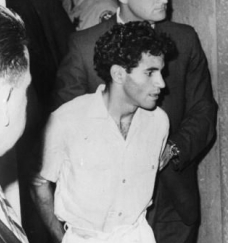
The aggrieved Palestinian was not marked by fate to suffer that last extremity of the law, however; instead, his sentence was commuted to life imprisonment when all existing death penalty statutes were invalidated in 1972.*
As a result, Sirhan Sirhan remains alive as of this writing, serving that sentence in the Golden State’s Pleasant Valley State Prison. He’ll be next up for parole in 2011.
(In a parole appeal back in 1982 — he’s been on a bit of a losing streak — the convicted assassin had the chutzpah to complain that “if Robert Kennedy were alive today, I believe he would not countenance singling me out for this kind of treatment.”)
Although the guy was seen in a crowded room pulling the trigger (onlookers tackled him) and he subsequently confessed to the deed, there has long been a conspiratorial counternarrative suggesting that other shooters were there, too. It’s pretty hard to say that the guy who emptied his chamber in front of dozens of witnesses wasn’t involved, but there are versions of this where he’s a Manchurian Candidate-style hypnotized patsy.
Politics: much more interesting in the 1960s.
Precisely because that is so, this particular man’s crime attracts retrospective interest for what followed: the charismatic Democratic frontrunner from Camelot cut down; the sinister Richard Nixon arising in his place to bomb Cambodia, burgle Watergate, and create the Environmental Protection Agency. Sirhan Sirhan “assassinated modern U.S. history.”
Sirhan Sirhan himself has contributed to the trippy theorizing about his case by being all over the map on it. At one point, he attempted to plead guilty and draw the death penalty; the trial judge forced him to go through with a defense. Subsequently, as noted, he’s whinged for an early release. He’s claimed to have had no memory of the attack, which certainly isn’t what he said after he got arrested.
Ultimately, the most self-evident explanation has always been the first one that he offered: “I did it for my country.”
Kennedy was a strong advocate of that policy, and his death happened to coincide with the anniversary of war.
Maybe that’s just what they want you to think. But it has to be allowed that the cause in question has claimed more lives than just RFK’s.
* People v. Anderson, decided by the California Supreme Court. Later that same year, the U.S. Supreme Court would issue Furman v. Georgia, which would have had the same effect for Sirhan Sirhan.
On this date in 1925, German serial killer Fritz Haarmann dropped his head in a basket in Hanover.
One of the most iconic and most terrifying among Weimar Germany’s ample crop of mass murderers, Haarmann is thought to have slain dozens of boys and young men from 1918 to 1924. (He was charged with 27 murders and convicted in 24 of them; Haarmann himself suggested the true number might be north of 50.)
Such gaudy statistics require teamwork.
This predatory pedophile partnered with one Hans Grans, a younger lover-slash-confederate; together they would lure fresh “game” (Haarmann’s word) for a meal and more.
Everyone dined well — Haarmann especially. Notorious as one of the most prolific “vampire” killers (the press also favored him with this moniker its its search for some epithet equal to the offenses; “werewolf” and “butcher” were also current), Haarmann liked to gnaw through his victims’ throats.
A chilling ditty paid tribute to the unsubstantiated rumor that Haarmann would even butcher the human flesh and sell it as “pork” on the black market. (He was known to trade in black-market meat.)
Just you wait ’til it’s your time,
Haarmann will come after you,
With his chopper, oh so fine,
He’ll make mincemeat out of you.
In the 1931 Fritz Lang classic M, for which Haarmann is one of several influences on the fictional serial killer at the center of the action, this rhyme appears with the name “Haarmann” replaced by “black man”.
Much deeper delves into the mind of this particular madman are to be had here, here and here.
And here:
That accomplice of his, Hans Grans, drew a death sentence too, but Haarmann somehow exculpated him successfully. Not only did Grans get out of prison, the once-notorious homosexual killer lived out the Nazi regime in Hanover un-tortured.
Unprincipled, octogenarian Scottish noble Simon Fraser,* Lord Lovat was on this date in 1747 the last to lose his head on Tower Hill.
The Clan Fraser patriarch was an expert double-dealer from his youth in Restoration England — when he recruited a small regiment in nominal service to William and Mary but allegedly plotting to desert to the Stuarts at the opportune moment.
That moment never came … and the Stuarts’ fruitless quest for it in the decades to come would eventually claim the Lord Lovat.
But first up: a long life of opportunistic, frequently reprehensible political maneuvering.
He kidnapped, raped, and forcibly married a woman from a rival clan in order to gain claim on a contested succession (Lovat had to flee the country, a death sentence in absentia at his heels)
He expediently converted to Catholicism to get in with the exiled Stuarts and their continental allies
He forged incriminating documents in an unsuccessful bid to undermine rival nobles
He played both sides of the Hanover-Stuart intrigue, ingratiating himself with both Jacobites and London during the 1715 rising. He did this so adeptly that George I served as Lovat’s son’s godfather
When the Jacobites decided to double down on doomed risings in 1745,** this wily knave finally managed to commit himself to the wrong team at the wrong time. Hey, everyone should be allowed one fatal mistake every 80 years or so. (Read all about those years in this public-domain biography.)
Though Lovat was so infirm he had to be borne on a litter, his military acumen would have been worth the rebels’ while had they possessed the muscle to get into a fair fight.
But they didn’t, and Lord Lovat was captured in the undignified circumstance of being stashed in a tree, and at length fitted for a no less undignified trial.
He could neither walk nor ride, as he was almost helpless; he was deaf, purblind, eighty years of age, ignorant of English law, and it was therefore not a matter of surprise that the high-born tribes, who thronged to his trial, were disappointed in the brilliancy of his parts, and in the readiness of his wit. “I see little of parts in him,” observes Walpole, “nor attributed much to that cunning for which he is so famous; it might catch wild Highlanders.” … It appeared, indeed, doubtful in what form death would seize him first, and whether disease and age might not cheat the scaffold of its victim.
Oh, well.
Only the good die young.
By his public life, he has left an indelible stain upon the honour of the Highland character, upon his party, upon his country.
* Not to be confused with the Canadian explorer for whom British Columbia’s Simon Fraser University is named.
** The 1745 rebellion spawned a popular patriotic song that became the national anthem: “God Save the King/Queen”.
One of the tune’s impolitic verses you won’t hear performed at glitzy official ceremonies (or much of anywhere at all) is this nationalist blast at the Jacobite party:
Lord grant that Marshal Wade
Shall by thy mighty aid
Victory bring
May he sedition hush,
And like a torrent rush
Rebellious Scots to crush
God save the King.
All of which, one supposes, gives Simon Fraser claim to a spot in the fine print of the credits for the song, and for that matter, for the Sex Pistols’ riposte.

 The pudgy and pugnacious* onetime journalist whose capture by the Russians during World War I enabled him to get in on the ground floor with the Bolshevik Revolution became the de facto leader of the short-lived Hungarian Soviet Republic. For a few months in 1919, it was the world’s second Soviet state after Russia itself.


 Wild’s dramatic execution marked a precipitous fall for a man who was perhaps the most influential person in England’s criminal justice system, even though he never held an official government position. As the self proclaimed “Thief-Taker General of Great Britain and Ireland,” Wild was instrumental in capturing and bringing to justice scores of petty thieves that plagued the London streets. He consulted the government on the passage of laws intended to encourage the capture of criminals. He also oversaw a vast criminal empire, the likes of which has never been duplicated.


 The aggrieved Palestinian was not marked by fate to suffer that last extremity of the law, however; instead, his sentence was commuted to life imprisonment when all existing death penalty statutes were invalidated in 1972.*
 One of the most iconic and most terrifying among Weimar Germany’s ample crop of mass murderers,
  The Clan Fraser patriarch was an expert double-dealer from his youth in Restoration England — when he recruited a small regiment in nominal service to