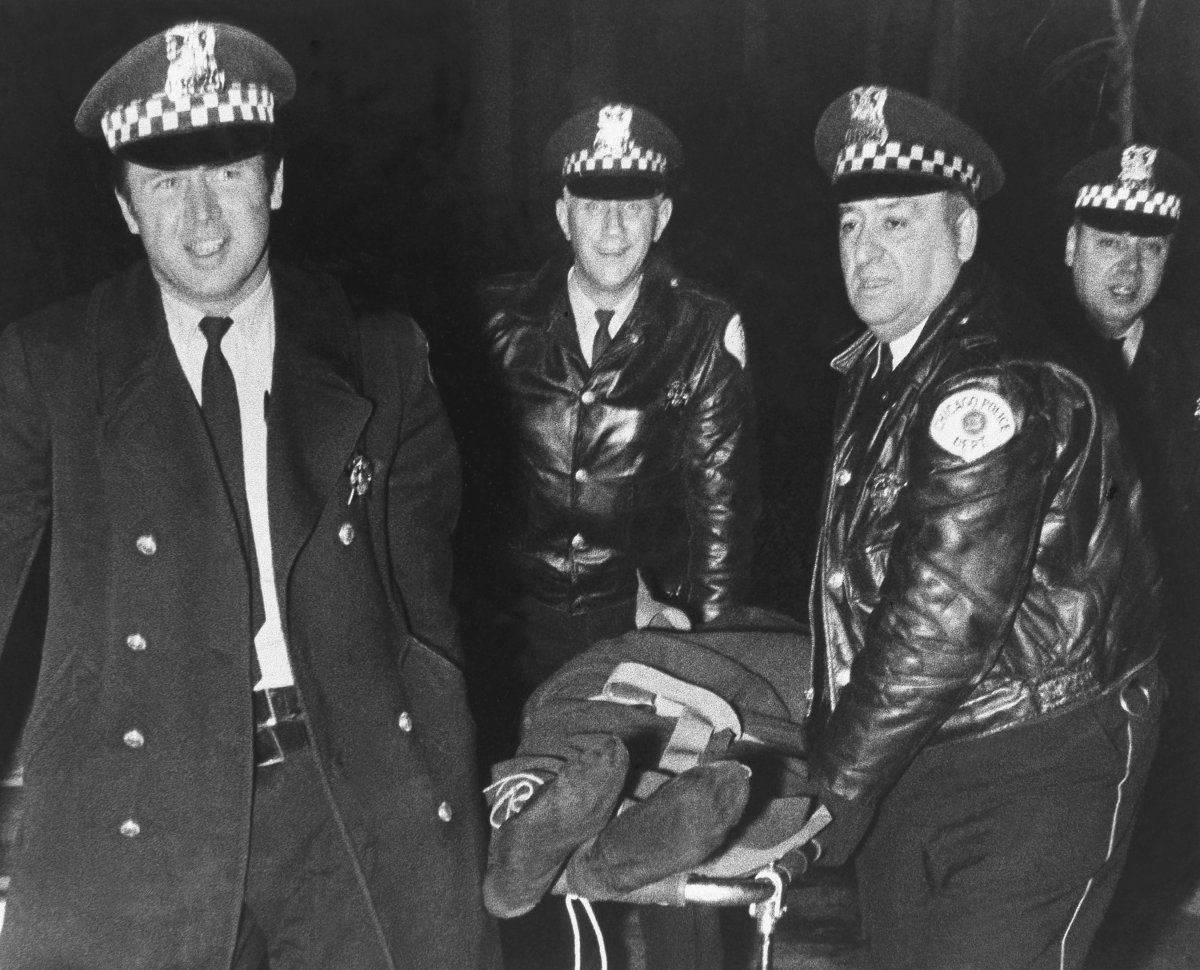
On this date in 1701, the Prussian commander of Vienna Castle was beheaded and then quartered for abetting the escape of Hungarian national hero Ferenc (Francis) Rakoczi.
Gottfried Lehmann was the name of this remarkable Pomeranian dragoon, who as Rakoczki’s jailer became convinced that his charge would inevitably be executed.
His conviction on this point was merited: Rakoczi’s maternal grandfather, Petar Zrinski, had been executed for rebelling against the Austrian empire, and his father, also named Ferenc Rakoczi, had been fortunate to avoid the same fate. After Ferenc pere died young, his widow remarried to yet another anti-Habsburg rebel, one who had aided the Turks at the 1683 Battle of Vienna. Thus, our Ferenc Rakoczi — who is also the Ferenc Rakoczi — labored under close imperial supervision through his childhood and into adulthood. No surprise, his flirtation with aiding the French as a fifth columnist during 1700-1701 outset of the multifaceted War of Spanish Succession led speedily to Rakoczki’s arrest as a for disloyalty.
The prospective doomed was blessed with an intrepid wife, Charlotte Amalia, who went to work charming the King of Prussia — whose intercession to Lehmann on Rakoczi’s behalf was impactful since the commandant was Pomeranian and considered Prussia a primary loyalty — and likewise directly charming Lehmann himself. Only the faithless officer’s shade can ever account which proved decisive in the end: the wife’s charisma, the sovereign’s authority, or the prisoner’s own persuasiveness in his daily interactions with the commandant. For any or all of these reasons, Lehmann eventually agreed to facilitate Rakoczi’s escape.
To this end, he supplied Rakoczi with an officer’s uniform and his quarters to change into it, then looked the other way as Rakoczi bluffed his way out the gates where a coach spirited him away. Within a week the fugitive had reached the safety of Polish soil … but far behind him, Gottfried Lehmann was in irons and under torture. He would lose his head on Christmas eve, his body chopped into quarters for his treason — but gain the eternal gratitude of the Hungarian nation.*
Events would prove the Habsburg emperors correct to fear this youth — only 25 years old at the time of his Lehmann-aided flight.
Eighteen months later, Rakoczi stood at the head of a war of national liberation that would run for eight years. Rakoczi’s War of Independence did not secure its titular objective, but it stood long afterwards as a signal of Hungarians’ patriotic aspirations.
* He also gained a lifetime annuity for his widow and son from Rakoczi’s purse.
And not onely these men troubled the Church at home, but also some which proceeded from these did the like abroad, namely Robert Browne a Cambridge man, a young student in Divinity, of whom the new sectaries were called Browniste, and Richard Harison a pety schoolmaster. for these two presuming but of their owne spirit to judge of matters of Religion, by bookes set forth at this time in Zeland and dispersed all over England condemned the Church of England as no Church, and intangled many in the snares of their new schisme, notwithstanding that their bookes were suppressed by the Queenes authority and soundly confuted by learned men, and that two of the Sectaryes, one after another, were excuted at Saint Edmunds Bury.
On the other side some Papists bookes against the Queene and Princes excommunicate drew some which had the Popes power in great reverence for their obedience, and amongst others they so distracted one Somervill, a gentilman, that in haste he undertooke a journey privily to the Queenes Court, and breathing nothing but blood against the Protestants, he furiously set upon one or two by the way with his sword drawne. Being apprehended, hee professed that hee would have killed the Queene with his owne hands. Whereupon he, and by his appeachment Edward Ardern his wives father, a man of very ancient gentility in the County of Warwicke, Ardern’s wife, their daughter Somervill, and Hall a Priest, as accessaries, were arrraigned and condemned. After three daies Somervill was found strangled in prison; Arderne, being condemned, was the next day after hanged and quartered; the woman and the Priest were spared. This woefull end of this gentleman, who was drawne in by the cunning of the Priest and cast by his own testimony, was commonly imputed to Leicesters malice. For certaine it is that hee had incurred Leicesters heavie displeasure, and not without cause, against whom hee had rashly opposed himselfe in all hee could, had reproached him as an adulterer, and detracted him as a new upstart.
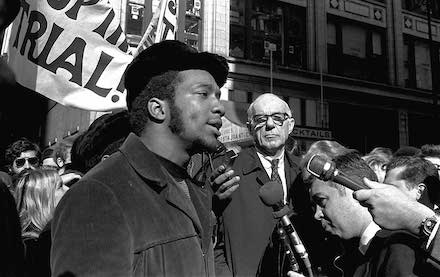
This charismatic — nearly every bio uses this word — 21-year-old star of the Illinois Black Panther Party had in his brief life shown himself a visionary exponent of radicalism; he would end as one of the signal martyrs to his movement’s violent suppression.
Well did he know it.
“If you’re asked to make a commitment at the age of 20 and you say, I don’t want to make a commitment only because of the simple reason that I’m too young to die, I want to live a little bit longer. What you did is, you’re dead already,” Hampton once mused. “You have to understand that people have to pay the price for peace. If you dare to struggle, you dare to win. If you dare not struggle then damnit, you don’t deserve to win … And I think that struggle’s going to come. Why don’t you live for the people? Why don’t you struggle for the people? Why don’t you die for the people?”
Emerging late in 1966 out of Oakland, Calif., the Black Panthers were a revolutionary and pointedly armed movement that fused black power demands with critique of the entire edifice — war, imperialism, capitalism and the rest of it. Although the organization was dissolved in 1982, the Panthers’ actions and legacy are still quite controversial and their mere specter remains a potent bogeyman for much of contemporary white America.
One thing is for sure: in their moment, they scared the shit out of the powers that be. Within months of its founding, the Federal Bureau of Investigation turned upon the Panthers its COINTELPRO program of domestic surveillance, suppression, and assassination. One particularly notorious FBI memo drew a bead on “Black Nationalist-Hate Groups” with an avowed intention to “prevent the rise of a ‘messiah’ who could unify, and electrify, the militant black nationalist movement” — and to “pinpoint potential troublemakers and neutralize them”.
Fred Hampton isn’t mentioned by name in this chilling missive from early 1968; he was just then beginning to emerge onto the FBI’s index of rabble-rousers. (Literally, the feds had a list called the “Rabble Rouser Index”.) He was fresh out of high school in 1966, and subsequently a wildly successful NAACP chapter leader, but gravitated to the new Illinois Panthers organ by 1968 where he quickly became its most outstanding organizer and spokesman, the prospective future face of a stirring cross-racial, class-conscious justice movement that Hampton perceived with a wisdom well beyond his years. Under his leadership the BPP spun out health care programs, legal aid programs, and free breakfast programs; he forged the original Rainbow Coalition* that brought rival street gangs and activist groups from different racial communities into a shared political ambition.
“We’re going to fight racism not with racism, but we’re going to fight with solidarity,” Hampton said. “We’re not going to fight capitalism with black capitalism, but we’re going to fight it with socialism.”
Just as energetically did the FBI work — and succeed, in the end — to break up such alliances, using informers and agents provocateur and false flags to encourage schisms and discredit leaders. Chicago’s police department was a ready collaborator in these operations; its relationship was the Panthers was hostile and often violent. Just three weeks before Hampton’s murder, two Chicago cops and a 19-year-old Black Panther were killed in a shootout. (Hampton was in California at the time.)
We don’t have the full documentary paper trail with deliberations and countersigned orders, but the known facts (and the smug grins of the cops) admit no reasonable dispute this side of performative naivete that Hampton was assassinated by a state death squad — “executed”, if you like, to fit an admittedly expansive read of this here site‘s mandate.
A compromised Hampton bodyguard named William O’Neal gave his FBI handler — who also happened to be running the Chicago COINTELPRO operation targeting the Panthers — a detailed floor plan of Hampton’s apartment, which the FBI shared with the Chicago police for a raid putatively hunting illegal weaponry. On the night of December 3, O’Neal slipped Hampton a barbituate to dull his reactions for what was to come; surviving comrades would describe Hampton being roused amid the early-morning fusillade only with difficulty, responding barely and in “slow motion” even as Chicago police stormed front and rear entrances and poured nearly 100 rounds into the place. Another Hampton aide named Mark Clark, sitting watch, was blasted dead in the initial barrage, convulsively discharging his shotgun once into the ceiling as he fell. It was the only shot fired that night by any of the Black Panthers.
By the account of Hampton’s eight-months pregnant partner Deborah Johnson, corroborated by other Panthers in the apartment, Fred Hampton was injured by the volley, but alive — and cold-bloodedly finished off with a coup de grace.
First thing that I remember after Fred and I had went to sleep was being awakened by somebody shaking Fred while we were laying in the bed. Saying, “Chairman, Chairman, wake up, the pigs are vamping, the pigs are vamping!” And, um, this person who was in the room with me, kept shouting out “we have a pregnant sister in here, stop shooting”. Eventually the shooting stopped and they said we could come out. I remember crossing over Fred, and telling myself over and over, “be real careful, don’t stumble, they’ll try to shoot you, just be real calm, watch how you walk, keep your hands up, don’t reach for anything, don’t even try to close your robe”. I’m walking out of the bedroom, there are two lines of policemen that I have to walk through on my right and my left. I remember focusing on their badge numbers and their faces. Saying them over and over on my head, so I wouldn’t forget. Um, as I walked through these two lines of policemen, one of them grabbed my robe and opened it and said, “Well, what do you know, we have a broad here.” Another policeman grabbed me by the hair and pretty much just shoved me — I had more hair then — pretty much just shoved me into the kitchen area. It was very cold that night. I guess that it snowed. And, ah, the back door was open. Some people were on the floor in the kitchen area. I think it was Harold Bell was standing next to me in the kitchen area. They, ah, it was a police, ah, plainclothes policeman there, and I asked him for a pin, so I could pin my robe, because it was just open. And he said, “Ask the other guy.” And, ah, then somebody came back and handcuffed me, and Harold Bell behind the back. I heard a voice come from the area, I guess from the dining room area, which was, the kitchen was off from that area. And someone said, “He’s barely alive, he’ll barely make it.” The shooting, I heard some shooting start again. Not much. Just a little shooting, and, um, and someone said, “He’s good and dead now.” I’m standing at the, um, kitchen wall, and I’m trying to remember details of these policemen’s face, say it over and over in my head, and, and badge numbers, so, you gotta remember, gotta remember. And then when I felt like I was just going to really just pass out, I started saying the ten-point program over and over in my head. Um, at one point I turned around, the shooting had continued again, and I saw the police drag Verlina Brewer and throw her into the refrigerator. And it looked like blood was all over her. And she fell to the floor and they picked her up and threw her again. I saw Ronald Satchel bleeding. I kept trying to focus on the ten-point program platform, because I, again, I wanted to take myself out of that place. And I knew I just couldn’t break down there. Because I didn’t know if I would be killed, or what would happen.
Incidentally, Hampton’s killing was also a key catalyst for the terroristic turn of the Weather Underground — whose decisive “war council” meeting occurred later that same month of December 1969, with Hampton’s blood heavy in the air (and his picture prominently displayed on the wall) as an emblem of the futility of pacific resistance within the belly of the beast. “It was the murder of Fred Hampton more than any other factor that compelled us to feel we had to take up armed sturggle,” said David Gilbert, who’s now serving a prison sentence for a deadly bank robbery. “We wanted to create some pressure, to overextend the police so they couldn’t concentrate all their forces on the Panthers. We wanted to create a political cost for what they were doing. And we also felt that to build a movement among whites that was a revolutionary movement, a radical movement … it had to respond when our government in our name was destroying the most promising, exciting, and charismatic leadership to come out of the Black movement in a long time.” (Source) It was a paradoxical inspiration, since Hampton himself had criticized the emerging Weathermen after their “Days of Rage” riot in Chicago as “anarchistic, opportunistic, individualistic,” and even “Custeristic” — as in Indian Wars cavalryman George Armstrong Custer, famous for his defeat — “in that its leaders take the people into situations where they can be massacred. And they call that revolution.”
* The name and concept of the Rainbow Coalition were later revived by Jesse Jackson in his left-wing presidential challenges in 1984 and 1988, but there is not a continuous institutional thread from Hampton’s coalition to Jackson’s. Jackson did, however, deliver a eulogy at Hampton’s funeral on December 6, 1969.
These Christian denizens of Muslim Spain embraced their own martyrdoms by purposefully denouncing Islam before a Qadi. In Flora’s case, she qualified as an apostate by virtue of her Muslim father.
While in Cordoban prison being entreated by Islamic scholars to reconsider their path, they were admonished to militancy by another inmate, St. Eulogius, himself a future martyr in a like cause. Citing the example of courageous Biblical heroes like Esther, Elogius’s Exhortation to Martyrdom calls on the virgins not to shrink in the face of of their impending tribulations, even if they were to be threatened with rape.
Unfortunately we don’t have the voice of Flora and Maria, even at second-hand. Their actions certainly announce that they like Eulogius were not ecumenical where Islam was concerned. As Charles Tieszen notes in Christian Identity amid Islam in Medieval Spain Eulogius’s language in his confrontational epistle is determinedly martial, with much about arming oneself for battle with the enemy while calling Muhammad
“forerunner of the … possessed man, servant of Satan, full of lies and son of death and perpetual ruin.” Eulogius goes further, coupling his criticism of Islam and its Prophet with a condemnation of the wider Cordovan Christian community (nostra ecclesia), which in his opinion, approved of Islam by its silence. Accordingly, Flora and Maria must not recant upon their previous insults of Muhammad when they faced the qadi again. If they did, their recantations were to be equated with telling outright lies.
Likewise, any retreat by Flora and Maria was to be equated with Christians who remained silent when it came to passing judgment on Islam. In the end, Flora and Maria could do nothing but uphold their public decrials of Muhammad, for if they “… den[ied] having cursed their prophet, [they] will be cursed; and if [they] have not rejected what the Lord rejects, [they] will be guilty of double sin … And surely whomever we do not curse, on the contrary we bless, and whoever we do not reject, we admit in our fellowship as if we were befriending him.” Threats like these, as we have noted, were commonplace in martyrologies, especially texts that exhorted Christians to stay the course towards martyrdom. In the context of Muslim Cordova, it is difficult not to read the threats as a means for equating recanters with the enemy.
…
Eulogius lamented those Christians that so willingly accepted the presence of Muslims, their leadership, and their customs:
But we wretches, delighting in [Muslims’] crimes, rightfully condemn ourselves by the prophecies of the psalmist who says: “but they mingled with the gentiles and learned their works, they served their idols, and a scandal took place among them.” Oh, what agony, that we consider it a pleasure to be submitted to gentiles and we do not oppose carrying our yoke with the unfaithful. And thus, in our daily business, we participate in their sacrileges and desire their company more than, according to the example of Lot the patriarch, fleeing the territory of Sodom in order to save ourselves in the mountains.
The mid-9th century was an apogee of such militancy with a number of martyrs into the bargain … but the Christian community of Cordoba nevertheless remained submitted to the gentiles (pleasurably or otherwise) until 1236.
If a ready translation of the prelate’s text into English exists online I have not located it; flex your classical learning and peruse Documentum martyriale in Latin here or (adjacent a Danish translation) here.
(Thanks to Elizabethan Catholic martyr Edward Osbaldeston for the guest post on the 16 November, 1594 York execution of Elizabethan Catholic martyr Edward Osbaldeston. We offer here the letter from his own hand recounting the circumstances of his capture, as published subsequently by Richard Challoner. -ed.)
I was apprehended at Towlerton by Mr. Thomas Clark, the apostate priest, upon St. Hierome’s day [September 30], at night; a thing much more to my comfort, than at any other time; for that I had such a special patron to commend myself to, and such a stout champion under Christ; and, besides, it pleased God, much to my comfort, to let this sign of his love fall unto me that day above all others; for that it was God’s great goodness to call me to the honour of priesthood; and that, upon St. Hierome’s day, I said my first mass, and consecrated the blessed body and blood of my Saviour Jesus Christ, and received him with great reverence and devotion, and ever since have honoured St. Hierome [Jerome]. And the morning before I came forth, I made my prayer to blessed St. Hierome; and, in his merits, I offered myself a sacrifice to God, and recommended myself to him, to direct me to his will and pleasure, and that I might walk aright in my vocation, and follow St. Hierome, as long as God should see it expedient for his church, and most for his honour and glory: and if it pleased him still to preserve me, as he had done before, I never would refuse to labour, or murmur at any pain or travail; and if it should please his majesty to suffer me to fall into the prosecutors’ hands, that then it would please his infinite goodness to protect me to the end; which I have no doubt but he will, after so many and so great goodnesses and gifts, as he hath bestowed on me over all my life, which are without number and inexplicable: wherefore my hope and trust is much helped, that now be will be most sure unto me, since this is the weightiest matter that I ever was about in my life: and so considering this, and infinite others, such like, I find great comfort, and fully trust in God’s goodness, and distrust only in myself; but in him that comforteth me, I can do all things. And this actual oblation of myself that morning, and this that ensueth, maketh me very comfortable, and bringeth me into many good and heavenly cogitations, feeling his strength so much as I have done in lesser matters, and further off from him than this is: therefore I nothing doubt, by his grace, but he will grant me to finish that which was for him, and by him, begun; which I pray God I may worthily do when his good will and pleasure is, and not before: and that I may not wish or desire any thing in this life but what may best please him and honour him, and our blessed lady his mother, and all the court of heaven, the most, and edify the people, and strengthen them in the way to Jesus, the king of bliss.
The manner [of my apprehension] was thus: Abraham Sayre and I came to the Inn a little before Mr. Clark, and we all came before night. I knew him not fully; for I thought he had been in the south; but at supper I looked earnestly at him, and I thought it was he, and yet I still persuaded myself that he knew me not, and if he should know me, he would do me no harm: which fell out otherwise; God forgive him for it. For when we were going to bed, he went and called the curate and constable, and apprehended us, and watched us that night, and came with us to York, and stood by when I was examined before the council, but said nothing then, that I feared; and he was present afterwards when I was called again; and since I have been nothing said unto; what will follow, God knoweth: but I will not be partial to myself, but prepare me for death, and what else may befal unto me. Now I pray you, for God’s sake, what you hear or learn let me know; and what is the best course for me to take in all points; and how mybrethren have behaved themselves in this case, that have gone before me; and, for myself, I yield me wholly to obedience to you in that blessed society and number in the castle: and desire, in all points, to live in discipline and order, and as the common live; and what I have, or shall have, it shall be in common. — And therefore I pray you direct me in all things, both for my apparel and diet, and every thing; and as my brethren have gone before me, so would I follow in the humblest sort.
A century ago today, an Armistice Day parade turned the Pacific Northwest logging town of Centralia, Washington into a battlefield. By the time night fell on the Centralia Massacre* four American Legionnaires had been shot dead … and then the cover of darkness was used to revenge them with the lynching that evening of Wobbly labor agitator Wesley Everest.
Before Amazon and Starbucks and Microsoft and even before Boeing, the economic engine of early Washington state consisted of cutting down its mighty ancient trees.
The spruce and fir trees were torn from the verdant Northwest by rough men working dangerous jobs in brutally exploitive conditions. “Loggers dealt with adulterated food, fleas and other vermin in their overcrowded housing, straw for bedding, the smell of disgusting wet socks drying near the bunkhouse’s one heater, latrines located directly next to the dining hall so that they could smell feces when they sat down to eat, etc.,” writes labor historian Erik Loomis. “They were paid next to nothing for their work and frequently ripped off by a collusion of timber operators and employment agencies.”
Small wonder that this part of the world yielded ready soil for radical labor organizers. The syndicalist labor union Industrial Workers of the World (IWW, familiarly nicknamed “Wobblies”) made notable inroads there.
Section of the map of the Northern Pacific rail network (rail lines in red), circa 1900.
In the town of Centralia, inland and convenient to the continent-straddling Northern Pacific Railway which whisked away the produce of her logging camps, Wobblies’ presence dated back at least as far as 1914.
They’d been the locus of violence previous to the events in this post: in 1918, a Red Cross parade addled on wartime jingoism turned into the sack of the IWW’s union hall. Vowing that they’d not suffer invasion again the Wobblies armed themselves, and they were on guard for the large parade Centralia had scheduled for the first anniversary of the Great War’s end — suspiciously routed to pass right in front of the new IWW hall.
Every history of the Centralia Massacre says at this point that the facts are in dispute as to who started what on that day, but it can be fairly said that a deliberate provocation deliberately provoked and before you knew it war veterans of the then-newformed American Legion were storming the Wobblies, under gunfire.
Ere the hive of radicalism was overrun, three Legionnaires had been shot dead.
Meanwhile, fleeing via an adjacent alley as he reloaded his .44 pistol went one of the hall’s armed defenders, Wesley Everest. The enraged mob pursued him, and as the IWW’s (obviously partisan) official site observes, this fact likely saved other Wobblies in the hall from summary execution. Instead they were bundled into jail where they’d soon be joined by Mr. Everest.
Running pell-mell down the alley the mob gave a shout of exaltation as Everest slowed his pace and turned to face them. They stopped cold, however, as a number of quick shots rang out and bullets whistled and zipped around them. Everest turned in his tracks and was off again like a flash, reloading his pistol as he ran. The mob again resumed the pursuit. The logger ran through an open gateway, paused to turn and again fire at his pursuers; then he ran between two frame dwellings to the open street. When the mob again caught the trail they were evidently under the impression that the logger’s ammunition was exhausted. At all events they took up the chase with redoubled energy. Some men in the mob had rifles and now and then a pot-shot would be taken at the fleeing figure. The marksmanship of both sides seems to have been poor for no one appears to have been injured.
DALE HUBBARD
This kind of running fight was kept up until Everest reached the river. Having kept off his pursuers thus far the boy started boldly for the comparative security of the opposite shore, splashing the water violently as he waded out into the stream. The mob was getting closer all the time. Suddenly Everest seemed to change his mind and began to retrace his steps to the shore. Here he stood dripping wet in the tangled grasses to await the arrival of the mob bent on his destruction. Everest had lost his hat and his wet hair stuck to his forehead. His gun was now so hot he could hardly hold it and the last of his ammunition was in the magazine. Eye witnesses declare his face still wore a quizzical, half bantering smile when the mob overtook him. With the pistol held loosely in his rough hand Everest stood at bay, ready to make a last stand for his life. Seeing him thus, and no doubt thinking his last bullet had been expended, the mob made a rush for its quarry.
“Stand back!” he shouted. “If there are ‘bulls’ in the crowd, I’ll submit to arrest; otherwise lay off of me.”
No attention was paid to his words. Everest shot from the hip four times, — then his gun stalled. A group of soldiers started to run in his direction. Everest was tugging at the gun with both hands. Raising it suddenly he took careful aim and fired. All the soldiers but one wavered and stopped. Everest fired twice, both bullets taking effect. Two more shots were fired almost point blank before the logger dropped his assailant at his feet. Then he tossed away the empty gun and the mob surged upon him.
The legionaire who had been shot was Dale Hubbard, a nephew of F.B. Hubbard, the lumber baron. He was a strong, brave and misguided young man — worthy of a nobler death.
“LET’S FINISH THE JOB!”
Everest attempted a fight with his fists but was overpowered and severely beaten. A number of men clamoured for immediate lynching, but saner council prevailed for the time and he was dragged through the streets towards the city jail. When the mob was half a block from this place the “hot heads” made another attempt to cheat the state executioner. A wave of fury seemed here to sweep the crowd. Men fought with one another for a chance to strike, kick or spit in the face of their victim. It was an orgy of hatred and blood-lust. Everest’s arms were pinioned, blows, kicks and curses rained upon him from every side. One business man clawed strips of bleeding flesh from his face. A woman slapped his battered cheek with a well groomed hand. A soldier tried to lunge a hunting rifle at the helpless logger; the crowd was too thick. He bumped them aside with the butt of the gun to get room. Then he crashed the muzzle with full force into Everest’s mouth. Teeth were broken and blood flowed profusely.
A rope appeared from somewhere. “Let’s finish the job!” cried a voice. The rope was placed about the neck of the logger. “You haven’t got guts enough to lynch a man in the daytime,” was all he said.
At this juncture a woman brushed through the crowd and took the rope from Everest’s neck. Looking into the distorted faces of the mob she cried indignantly, “You are curs and cowards to treat a man like that!”
There may be human beings in Centralia after all.
Wesley Everest was taken to the city jail and thrown without ceremony upon the cement floor of the “bull pen.” In the surrounding cells were his comrades who had been arrested in the union hall. Here he lay in a wet heap, twitching with agony. A tiny bright stream of blood gathered at his side and trailed slowly along the floor. Only an occasional quivering moan escaped his torn lips as the hours slowly passed by.
Dead in the fray outside the union hall were three World War I soldiers: Arthur McElfresh, Ben Cassagranda, and Warren Grimm, the last of whom had the distinction of participating in the unsuccessful American invasion of Bolshevik Russia — plus Dale Hubbard, the man shot dead while attempting to apprehend Everest. All four were Legionnaires who have been honored as martyrs by that organ ever since.**
The IWW, conversely, says the same for Everest, for once night fell he was hauled from his cell and lynched to Mellen Street Bridge: “Hangman’s Bridge” as it was later known — although the present-day bridge dates only to 1958, replacing Everest’s gallows.
And even though anyone involved is long dead by now the affair has remained a charged topic for the hundred years from that day to this; a local newspaper marked the centennial by noting that memorial events by the respective factions’ descendants brought “confrontation even now, even about how to memorialize the dead and imprisoned.” (Although Everest was the only Wobbly lynched, a number of his comrades tossed into prison for years on trumped-up charges, prey to the Red Scare run amok in those years; even the union’s lawyer was prosecuted, albeit unsuccessfully. It goes without saying that nobody ever answered for the lynching.)
There has been for many decades a memorial in Centralia’s George Washington Park commemorating the dead Legionnaires; more recently, Centralia’s cityscape was also enhanced by a rival mural celebrating Everest.
“The Resurrection of Wesley Everest” by activist muralist Mike Alewitz (1997). (cc) image by Richard Colt.
* Also sometimes called the “Centralia Tragedy”. It’s not to be confused with the U.S. Civil War’s Centralia Massacre — which occurred in 1864 in a town of the same name in the bloody border state of Missouri. North America has numerous settlements called Centralia including several with no massacre at all, yet.
** Four Legionnaires plus Wesley Everest make five victims for Armistice Day. There’s a sixth man whose death can be attributed to the affair: a sheriff’s deputy who was mistakenly shot dead a couple of days later when he was unable to give the countersign to a paranoid posse.
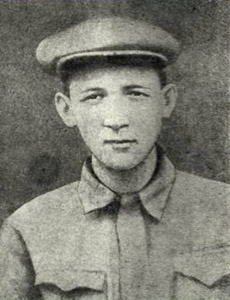
Sixteen-year-old partisan Alexander Chekalin earned his martyrs’ crown as a Hero of the Soviet Union when he was executed by the occupying Third Reich on this date in 1941.
The city of Tula, a transport hub 200 kilometers south of Moscow, was a key target for the German drive on the Soviet capital in those pivotal months; the Wehrmacht’s eventual inability to take it from determined defenders was crucial to thrwarting the attack on Moscow by protecting her from the southern tong of the intended pincer maneuver.*
Chekalin didn’t live long enough to see any of this come to fruition but in his moment he did what any one man could do: ambushes, mining, and other harassment of the occupation army in the Tula oblast (region) with his comrade irregulars. Our principal was found out by the Germans recuperating from illness in a town called Likhvin — see him defending his house of refuge against hopeless odds in the commemorative USSR stamp below — and then suffered the usual tortures and interrogations before he was publicly strung up on November 6. He hung there for 20 days before the Red Army took the town back and buried him with honors
In 1944, the tiny town of Likhvin was renamed in his honor: to this day, it’s still called Chekalin.
* Tula was recognized as a Hero City of the USSR for the importance of its defence.
Boyarina Feodosia Morozova starved to death in the early hours past midnight on the night of November 1-2, 1675.
This wealthy “Old Believer” noblewoman (English Wikipedia entry | Russian) is one of art history’s most famous religious dissidents thanks to Vasily Surikov‘s iconic painting of her being hauled away by the authorities, defiantly making the outlawed two-fingered sign of the cross.
But her writ of privilege had long since run out, for she had been arrested and tortured back in 1671 together with her sister Evdokia Urusova and a fellow-travelling friend, Boyarina Maria Danilova. (This is the event captured by Surikov’s painting.) Perhaps her position saved her from outright execution — which all-grown-up Tsar Alexei reportedly contemplated — but not from being done to death by the state.
After all three women were arrested and so dramatically dragged away, they were locked up in the cellars of a small-town monastery where their guards were eventually ordered to permit them to waste away by deprivation.
Her movement did not carry its contest for religious primacy and was violently persecuted for many years thereafter, but Old Believers still exist to this day — thought to number about one to two million worldwide. As of the 20th century, Old Believers are longer anathema to mainline Orthodoxy, and a fearless martyr such as Boyarina Morozova cannot but inspire respect no matter how many fingers you use to make the blessing. She’s still well-known in Russia and is the subject of a 2006 choral opera.
On this date in 1929, the Punjabi Muslim youth Ilm Deen was hanged for murdering a blasphemous publisher.
The Rangila Rasul is a pamphlet-length send-up satirizing the “widely experienced”, chortle chortle, Prophet Muhammad for his many wives; Muslim fury at its publication brought the Raj to legislate against “outraging the religious feelings of any class” — a law that’s still on the books in India.
However, there was no such law at the time of the naughty screed’s publication, and as a result the Hindu publisher, Mahashe Rajpal of Lahore, was acquitted of any charge in 1929.
‘Twas a temporary exoneration, for Ilm Deen (or Ilm-ud-din, or Ilmuddin), a 20-year-old carpenter, delivered his verdict extrajudicially by daggering Rajpal in the chest in a Lahore bazaar on April 6, 1929.
The assassin’s speedy trip to the Raj’s gallows thereafter only cinched his place as a sectarian, and later (for Pakistan) national, martyr; the poet Allama Iqbal exclaimed at the young man’s funeral that “this uneducated young man has surpassed us, the educated ones!” To this day, Ilm Deen’s solemn tomb is a place of pilgrimage and veneration.




 “Shura” (

 The
The 
_-_Ant%C3%B3nio_de_Oliveira_(%3F),_Museu_de_Arte_Sacra_da_S%C3%A9_de_%C3%89vora.png)