1645: William Laud, given to the devil

On this date in 1645, Archbishop William Laud was beheaded on Tower Hill for treason.


Portrait of William Laud by Anthony Van Dyck. For this image’s subsequent life in popular circulation (and its contribution to its subject’s beheading) see Mercurius Politicus.

This diminutive “martinet” made himself odious to the rising Puritan party through his rigorous (some would say narrow-minded) enforcement of so-called “High Church” dogma and decor. It was a time when believers were prepared to rend the fabric of the church over a literal fabric, the surplice worn by the clergy — among other innumerable points of doctrinal rectitude.

Laud’s run as Archbishop of Canterbury also happened to coincide with Charles I‘s 11-year personal rule, sans parliament. The overweening divine’s influence on secular as well as religious policy would do his sovereign no favors in the public mind.

Roughly enforcing an unpopular minority position, Laud got the woodblock blogosphere in a tizzy with heavy-handed stunts like having dissenters’ ears cut off.

That’s the sort of thing that’ll give a guy an image problem. The king’s fool, Archibald Armstrong, is supposed to have tweaked our high and mighty subject (and warned the king against his influence*) with the punny aphorism,

Give great praise to the Lord, and little laud to the devil.

Funny because it’s true.

So when Charles ran out of money and finally had to call parliament in 1640, that august representative of the nation had some business with Laud. Ironically — since the prelate was always sensitive about his height — it would involve shortening him.

Laud was impeached as early as December 1640 and soon tossed in the Tower, where his neck awaited the unfolding radicalization of the pent-up Puritans and the onset of armed hostilities in their contest with the obdurate king. (While his hands blessed the allies who preceded him to the block.)


Wenceslas Hollar’s etching of William Laud’s trial.

For more about Laud’s life and work, check out the detailed Britannica entry or this Google books freebie.

* If a warning, it apparently was not heard. This 19th-century publication of Armstrong’s jests cites a 1637 royal order to the effect that

the King’s Fool, for certain scandalous words of a high nature, spoken by him against the Lord Arch-Bishop of Canterbury his Grace … shall have his coat pulled over his head, and be discharged of the King’s service, and banished the Court.

On this day..

1794: Maurice Joseph Louis Gigost d’Elbee, Vendean general

On this date in 1794, one of the great royalist generals of the Vendee revolt was shot by the French Revolution’s Republican forces at Nourmoutier.

The 1793 counterrevolutionary uprising in the Vendee had roused retired cavalryman Maurice Joseph Louis Gigost d’Elbee (English Wikipedia link | French), and he became the second commander of the Royal and Catholic Army upon the death of Jacques Cathelineau.

Unfortunately for d’Elbee, even with English support, the balance of force rather tipped in favor of Paris, and the Revolutionary government was obviously not shy about sealing its victories in blood.

D’Elbee suffered a grievous wound at the Battle of Cholet in October 1793, and for a couple of months was spirited one step ahead of the advancing Republicans.

As Charles MacFarlane writes in The French Revolution, Vol. 3, he ran out of room to run at the island of Noirmoutier.

D’Elbee was lying in bed between life and death; his wife might have escaped, but would not leave him: they were both taken. As Turreau’s soldiers entered their chamber the wounded royalist exclaimed, “Yes, here I am! Here is d’Elbee, your greatest enemy! If I had been strong enough to fight or stand upon my feet, you would not have taken me in my bed!” They kept him for five days, treating him with execrable barbarity, and then carried him in an arm-chair to the place appointed for fusilading the prisoners, and there shot him. His wife was fusiladed the next day, and her brother and brother-in-law perished in the same manner.


Mort du General d’Elbee, by Julien Le Blant, depicts the general shot with three other royalist officers. Not pictured: Hundreds of other Vendean prisoners massacred in the aftermath of the Battle of Savenay.

On this day..

1943: Jerzy Iwanow (Georgios Ivanof)

On this date in 1943, Polish-born Greek resistance hero Jerzy Iwanow-Szajnowicz was shot (or shot attempting to escape the Kaisariani execution ground, which amounts to pretty much the same thing) for a dramatic career fighting the occupation of Greece.

Iwanow (Polish) — or Georgios Ivanof — was the son of a Russian officer, but his parents divorced in his childhood, and mom married a Greek.

Jerzy was on his way to a cosmopolitan upbringing, mastering half a dozen languages and apparently just as many sports.

His athletic and linguistic prowess would both come in handy for derring-do missions (more Polish) in the Greek waters that saw him sink a German submarine and a destroyer with magnetic bombs. He even escaped the first two times he was captured.

Third time was a charm for the Nazis.

Sounds like celluloid material. As a matter of fact, a 1972 Polish film valorized Iwanow as Agent Nr. 1.

You can see the full movie on Veoh, if you’re prepared to install their viewing software.

On this day..

1645: John Hotham the Elder

On this date in 1645 — one day after the same fate befell his son — Sir John Hotham was beheaded by the English Parliamentarians for attempting to betray Hull to the Cavaliers in the English Civil War.

Part of the Daily Double: John Hothams.

On this day..

1645: John Hotham the Younger

On this date in 1645, John Hotham the Younger — former M.P., and (too) briefly an adherent of Parliament in the English Civil War, was beheaded as a traitor.

Part of the Daily Double: John Hothams.

On this day..

104 B.C.E.: Jugurtha

(Thanks to Daily Kos diarist “emperorhadrian” for licensing this guest post, originally published on that site June 24, 2007. -ed.)

The Jugurthine War was a key war in the final century of the Roman Republic.

Like the Americans in Iraq, Rome assumed that their war against Jugurtha, King of Numidia (a nation in north Africa), would be a cakewalk. They believed that Numidia was a nation of savages with a bizarre religion. They assumed that their own “shock and awe” attacks by the superior legions would decapitate and destroy the “evil doer” Jugurtha. They believed that in order to liberate the Numidians of their primitive ways, they had to impose the civilized will of the Roman state on this backward nation. Rome never expected that the Numidians would wage an insurgent war against their Roman occupiers. This war ended up dragging on for almost a decade. And in the end, it showed the depravity of the ruling party (the ultra-conservative republican Optimate party), which was sending the Roman Republic on its way to tyranny, empire and ruin.

In 148 BC, the King of Numidia, Masinissa, died. The Roman proconsul, Publius Cornelius Scipio Aemilianus, had been given authority by Masinissa to divide Masinissa’s estate. He divided it between Masinissa’s three sons, Micipsa, Gulussa, and Mastarnable. Soon after, Gulussa and Mastarnable died, leaving Micipsa as the sole King of Numidia. Around the year 134 BC, Micipsa sent Jugurtha (who was Masinissa’s grandson, but the son of another Numidian) to Spain with Scipio Aemilianius. Scipio was fighting the Celtiberians, who lived in a part of what is now Spain. Jugurtha was able to raise an army to help Scipio. Because of the valor of Jugurtha and his army at the Siege of Numantia, Scipio was able to win his war against the Celtiberians.

While fighting for Rome, Jugurtha worked alongside his future enemy, Gaius Marius. Jugurtha not only learned the superior Roman style of fighting, but he also learned of Rome’s weakness for money and thus bribery. Jugurtha described Rome as “urbem venalem et mature perituram, si emptorem invenerit” (“a city for sale and doomed to quick destruction, if it should ever find a buyer”). When Jugurtha returned to Numidia, Micipsa adopted Jugurtha, and decided to include Jugurtha in his will.

After the fall of Numantia, Jugurtha returned home with a letter from Scipio addressed to his uncle; in it, the commander praised Jugurtha’s exploits and congratulated Micipsa for having “a kinsman worthy of yourself, and of his grandfather Masinissa” (Sallust Iug. 9). On this recommendation the king formally adopted Jugurtha and made him co-heir with his own children

In 118, Micipsa died. He left his kingdom to Jugurtha and his two natural sons, Hiempsal and Adherbal. Shortly after Micipsa’s death, Jugurtha had Hiempsal killed. Adherbal fled to Rome. The Roman Senate sent a commission to Numidia to make peace. Jugurtha bribed the Romans on the commission, and thus the commission gave the better regions of the kingdom to Jugurtha.

In 113 BC, Jugurtha took his army and cornered Adherbal in his capital city of Citra. According to Sallust, Adherbal had the support of the people, but Jugurtha had the support of the best soldiers. A Roman Commission was sent to Numidia to forge a new peace. Jugurtha then bribed the Romans on this commission. The Romans thus allowed Jugurtha to storm Citra, and slaughter Adherbal and his supporters. Because Jugurtha slaughtered a number of Italian business people (including Roman Equites, or “Knights“), the Roman senate declared war on Jugurtha.

The Roman Senate sent an army under the command of the consul Lucius Calpurnius Bestia to fight Jugurtha. Bestia decisively defeated Jugurtha. But Jugurtha bribed Bestia, and thus was given unusually favorable terms. The Roman Senate viewed the favorable terms with suspicion, so it summoned Jugurtha to Rome. When Jugurtha arrived in Rome, he bribed two Tribunes, who thus prevented him from testifying. While in Rome, Jugurtha attempted to have his cousin and rival Massiva assassinated. Because of this, he was expelled from the city and returned to Numidia.

In 110 BC, the Roman Senate sent the praetor Aulus Postumus Albinus (who was the cousin of a consul for that year) to defeat Jugurtha. Because Jugurtha bribed key Romans involved in Albinus’ army (who then betrayed Albinus), Albinus was defeated.

The Roman Senate then sent the consul Quintus Caecilius Metellus to fight Jugurtha. At the Battle of the Muthul, a young Roman officer named Gaius Marius helped to reorganize Metellus’ legions, which then defeated Jugurtha. But Jugurtha was defeated because he forced his army to retreat before it could suffer heavy losses. The Romans did suffer their own heavy losses. Jugurtha disbanded his army, and had his soliders mount an insurgency to fight the Roman occupiers.

Marius returned to Rome. Dissatisfied with the slow pace of the war under Metellus, the Roman Military Assembly (one of the two Roman legislative assemblies, similar to the US Senate) appointed Marius consul (the Military Assembly, not the senate, appointed consuls). The Roman consuls had similar powers as the US President. The consulship was the highest constitutional office, and the consuls had imperium powers, which allowed them to command armies and conduct wars. The senate didn’t want Marius to be consul, because at this time it was dominated by an ultra-conservative republican party of aristocratic elites known as the Optimates. Marius belonged to the party that opposed the Optimates, the Populares. Partly because the senate didn’t like Marius, and partly because of the increasing difficulty Rome was having in recruiting armies, Marius was forced to raise his own army.

The capture of Jugurtha, from this French history of the Jugurthine War.

Marius took his army to Numidia to fight Jugurtha. But while Marius had been raising his army, Jugurtha allied with his father-in-law, Bocchus, the King of Mauretania. Marius defeated Jugurtha and Bocchus in several key battles. But much like with the American occupation in Iraq, Jugurtha’s strategy of insurgency warfare against the occupiers rendered all conventional victories irrelevant. Marius was playing a game of whack-a-mole. No matter how many times the Numidians were defeated, Jugurtha’s insurgents would regroup and keep fighting. It became clear that because of this, Rome could not defeat Jugurtha.

Marius sent his young Quaestor, Lucius Cornelius Sulla, to Bocchus. Sulla bribed Bocchus, and told him that Bocchus would be given a part of Numidia if he would betray Jugurtha. Bocchus then decided to give Jugurtha to Sulla. Sulla took Jugurtha to Rome, where Jugurtha was strangled in the Tullianum in Rome after marching in Marius’ January 1, 104 B.C. Triumph.


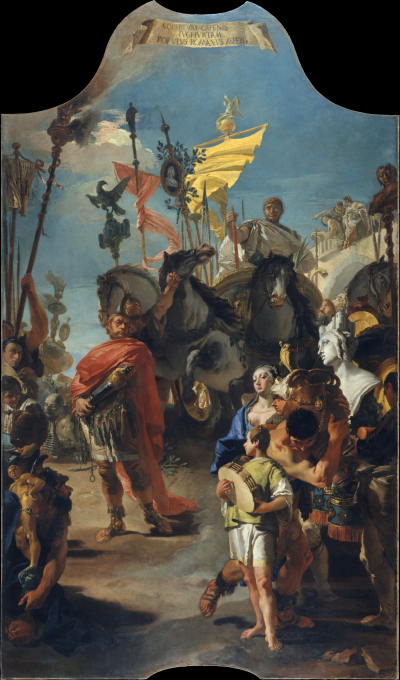
The Triumph of Marius (1729) by Giovanni Battista Tiepolo. The inscription in Latin reads “The Roman people behold Jugurtha laden with chains”.

The Jugurthine War was over. But in the process, several problems were exposed that would cause Rome serious pain in the future. Republicans in this country love to tell us that money in politics is harmless free speech. But as we saw in the Roman Republic during the Jugurthine War, money can be very corrupting. Rome almost lost the war because of money in politics, and the susceptibility of public officials to bribery.

In addition, this war saw the rise of two Romans who would play a key role in the events that directly preceded the fall of the Roman Republic. The first Roman made famous through this war was Gaius Marius. Gaius Marius would later hold the Roman Consulship an unconstitutional 7 times in 21 years (constitutionally, a Roman had to wait 10 years before being reelected consul).

The second Roman made famous through this war was Lucius Cornelius Sulla. Sulla and Marius would fight an unconstitutional civil war with each other several years after this war had ended. Sulla would illegally march his troops on Rome, and unconstitutionally legalize the mass killing of Marius’ supporters. Marius’ supporters in the senate would unconstitutionally prevent Sulla from fighting a war during one of Sulla’s consulships. Sulla would eventually seize absolute power for himself. Sulla would be the first Roman to be Dictator in almost 150 years. He would also be the first Roman in history to hold the dictatorship without the traditional six month term limit.

As dictator, Sulla would illegally change the Roman constitution to make himself and his party (the ultra-conservative republican Optimates) even more powerful. And most importantly, Sulla would set the example (of civil war on Romans, and then the seizing of absolute power) that the future tyrant Gaius Julius Caesar would follow.

In the end, the actions taken by key players in the war against Jugurtha would be repeated in the final destruction of the Roman Republic. The future triumvir Pompey would unconstitutionally hold multiple consulships in a short period of time. Crassus, another future triumvir, would illegally bribe politicians to get his way. And the future tyrant Julius Caesar would bribe, unconstitutionally hold the consulship, and become dictator for life (as Sulla had done). It was Caesar’s actions in this regard, as well as the similar actions of his adopted son and heir, Gaius Octavius (later Gaius Julius Caesar Octavianus, the Emperor Augustus) that would once and for all destroy the Roman Republic, and create the Roman Empire.

1. When when, and whenever death closes our eyelids,
2. Moving naked over Acheron
3. Upon the one raft, victor and conquered together,
4. Marius and Jugurtha together,
5. one tangle of shadows.

6. Caesar plots against India,
7. Tigris and Euphrates shall, from now on, flow at his bidding,
8. Tibet shall be full of Roman policemen,
9. And the Parthians shall get used to our statuary
10. and acquire a Roman religion;

11. One raft on the veiled flood of Acheron,
12. Marius and Jagurtha together.
13. Nor at my funeral either will there be any long trail,
14. bearing ancestral lares and images;
15. No trumpets filled with my emptiness,
16. Nor shall it be on an Atalic bed;
17. The perfumed cloths shall be absent.
18. A small plebeian procession.
19. Enough, enough and in plenty
20. There will be three books at my obsequies
21. Which I take, my not unworthy gift, to Persephone.

From Homage to Sextus Propertius, Canto VI by Ezra Pound

On this day..

1683: Merzifonlu Kara Mustafa Pasha, for the Battle of Vienna

On this date in 1683, the commander who just months before had brought the Turkish army to the gates of Vienna was executed in Belgrade for losing one of the pivotal battles in European history.

The Battle of Vienna saw the Ottoman Empire’s high tide and its last great bid to capture control of the strategic Danube city.

Despite an army of well over 100,000 that had besieged a frightened garrison numbering fewer than 20,000 soldiers and civilians, Kara Mustafa Pasha had been unable to reduce the city, and then decisively beaten after the timely arrival of a 70,000-strong relief force under the command of the Polish monarch Jan Sobieski. Here’s a great Italian map of the battle, with Mustafa himself hanging out in the lower corner; apparently, you can buy the original.

For both contemporaries and posterity, the “miraculous” defeat of an overwhelming Turkish threat by a coalition of Christian forces — a sort of earthbound equivalent to the previous century’s Battle of Lepanto — has appeared as a signal clash-of-civilizations event. In the right audience, a knowing 1683 reference is a sort of dominionist gang handshake.

So, anyway: big win.

If the blame for the defeat — Sobieski’s intervention apart — lay at Kara Mustafa’s door, it was due less to his decision to march straight for Vienna than to a number of technical miscalculations on his part, such as failing to bring heavy artillery to the siege but relying instead on light guns … inadequate to breach Vienna’s strongly fortified walls …

Merzifonlu Kara Mustafa Pasha had long been a close adviser of the Sultan, but any doubts Mehmed IV might have harboured about him were given substance during his absence on campaign as plotters fabricated reports of disorder in the empire. On hearing of the defeat at Vienna, one of the plotters … announced, in the words of Silahdar Findiklih Mehmed Agha, that ‘our enemy is finished with; the time is ripe for revenge’ …

Mehmed succumbed to the pressure from Kara Mustafa’s detractors, and the Grand Vezir was executed in Belgrade on Christmas Day 1683 while engaged in planning a new advance for the following spring … a skull in Vienna’s city museum is commonly believed to be his.

The Austrian victory at Vienna cost the Turks more than Mustafa’s service, which was quite a lot in itself. (Twelve different viziers held the post in the two decades after Kara Mustafa Pasha was strangled.)

The empire’s longstanding (and to Christendom, terrifying) expansionist posture towards Europe was at an end; in the future, the Musulman would have to ward off the Christian.

Ensuing Holy League victories wrested central Europe away from Constantinople, inaugurating a long Ottoman stagnation that would culminate in the empire’s destruction after World War I.

The Hapsburgs — though likewise marked for calamity in the War to End All Wars — for their part won hegemony in central Europe … and, it is said, the literal coffee beans captured as war booty with which to brew the famous Viennese cafe scene.

On this day..

1953: Lavrenty Beria, Stalin henchman

On this date in 1953, Stalin’s feared minister Lavrenty Beria was shot — finally on the receiving end of the cruelty he had administered to countless Soviet citizens.

Lavrenty Pavlovich was, like Stalin, a Georgian peasant, albeit one generation younger.

He won his way into Stalin’s confidence from the 1920’s, and in 1938 replaced Nikolai Yezhov as head of the KGB predecessor NKVD. Yezhov did much of the bloody work of the Great Purge, and was himself in turn purged. The cunning Beria must have taken note.

Though his initial project was to clean up the excesses of the Yezhovshchina — releasing thousands of innocent convicts, making the gulag camps less homicidal and more effective and keeping prisoners alive long enough to get some work out of them, that sort of thing — it wasn’t long before Beria cast a terrifying shadow of his own. (Beria was Yezhov’s deputy, so it’s not like he walked into the job without the requisite qualifications for mass murder.) He wrote the memo proposing the execution of Polish officers that led to the Katyn massacre.

To the more everyday repressive operations of the Soviet secret police, Beria added his notorious (perhaps propagandistically exaggerated?) personal peccadilloes: nothing to trouble the boss, just a little penchant for seducing, or raping, and at his pleasure murdering, comely young lasses.

Soviet author Sergei Dovlatov sketched his character in this imagined vignette (translated by Executed Today friend Sonechka from the Russian original here):

As is well known, winsome high school girls were delivered to Lavrenty Beria’s house. Then his chauffeur presented a bouquet of flowers to the next victim. And rendered her home. This was an established ceremony. Suddenly, one of the damsels became unruly. She began to struggle and scratch. In short, held her ground and did not succumb to the charms of the Internal Affairs minister. Beria told her:

-You can leave.

The young woman descended the stairs. The chauffeur, not expecting such a turn of events, handed her over the prepared bouquet. The girl, somewhat more composed now, addressed the minister who was standing on the balcony:

-You see, Lavrenty Pavlovich! Your chauffeur is more courteous than you are. He gave me a bouquet of flowers.

Beria sneered and dully uttered:

-You are mistaken. It is not a bouquet. It is a funeral wreath.

More consequential for his fate was his position among the handful of Stalin’s closest associates, in which capacity he maintained himself for a remarkably extended period of time. This made him one of the people with a shot at succeeding Stalin, which in turn put him in the middle of the furious political infighting Uncle Joe was pleased to subject his subordinates to.

And the natural enmity between sovereign and heir — the one whose interest is the other’s death — may have even led Beria to poison Stalin in March 1953 when he was on the verge of a falling-out himself. Foreign Minister Vyacheslav Molotov (he of the pact, and the cocktail) remembered in his memoir Beria boasting after Stalin’s sudden and mysterious death,

“I did him in! I saved all of you!”

Briefly the official #2 man in the post-Stalin state, he would again preside over a political liberalization that belied his monstrous personal reputation.

But this pallbearer of Stalin soon followed his former master to the grave. Outmaneuvered by rivals Nikita Khrushchev, Georgy Malenkov, and Molotov, Beria was purged as a traitor in the summer of 1953 and secretly executed Dec. 23, 1953 with six confederates after a summary trial before the Supreme Court. (One of the expedients laid at his feet in that affair was a set of executions he had ordered in a 1941 purge).

According to a chapter by Michael Ross and Anne E. Wilson in Memory, Brain and Belief, after Beria’s fall, subscribers to the Great Soviet Encyclopedia

were instructed to destroy the article on Beria and were provided additional information on the Bering Strait to fill the gap in the pages.

Beria’s heirs actually applied to the post-Soviet government for a reversal of the conviction under laws granting victims of politically motivated prosecutions right of redress. The Russian judiciary turned them down.

On this day..

1624: Marco Antonio de Dominis, posthumously

On this date in 1624, the recently-deceased body of unscrupulous Croatian prelate Marco Antonio de Dominis was burned at Rome’s Campo dei Fiori, along with all his manuscripts.

Hypothesizing

As a precocious young man Dominis taught mathematics, rhetoric and philosophy; in 1611, he produced a scientific treatise on the formation of rainbows through light refraction, De radiis visus et lucis. A century later, Isaac Newton would write* in Opticks that

it is now agreed upon, that this Bow is made by Refraction of the Sun’s Light in drops of falling rain. This was understood by some of the Antients, and of late more fully discover’d and explain’d by the famous ANTONIUS DE DOMINIS Archbishop of Spalato.**

More opportune was his advocacy of a moon-induced tide, which idea his contemporary Galileo erroneously scorned.†

Though he makes a “great men of Croatian science” list, the scientific dabblings are not what the man was chiefly known for.

Apostatizing

A caricature of Dominis made an appearance, around the time of the man’s bodily demise, in Thomas Middleton’s play A Game at Chess, as the “fat bishop” who switches sides from black to white and back.

And that’s the man’s legacy, in a nutshell.

Elevated to Bishop of Senj, and then Spalato, he got the Inquisition after him and raised dust for England and the Anglican church in 1616.

They called you great-bellied-Doctour, made fat under Antichrist; and some there were also that sayd, that before you ranne away from the Pope, you got your owne Neece with child, and that feare to be punished for it, made you trudge away with your great load of flesh in such hast.

John Floyd

In Albion the absconded archbishop settled into a fine tenured appointment on the king’s dole to denounce the papists like only a convert can do. As A Game at Chess would indicate, he also earned fame for his avarice and gluttony, and who knows how many other deadly sins.

The rep for opportunism grew when Dominis defected back to Holy Mother Church upon the election of an old intimate as Pope Gregory XV. His well-worn welcome in England as anti-papal vituperator had, too, become complicated by the progress of the proposed Spanish Match to wed Prince Charles to Europe’s leading Catholic monarchy — an ultimately abortive project, but nearing the acme of its fortunes at the time Dominis returned to Italy.

(The Spanish Match is the protracted political and diplomatic dance whose progress A Game at Chess allegorically tells. Dominis arranged his return to the Catholic fold through the Spanish ambassador in England, making the former a fit character for the playwright to project the double-dealing and skullduggery of the rivals’ negotiations.)

Theosophizing

Unfortunately for our unprincipled Renaissance man, Gregory himself yielded up the ghost almost immediately and left the Church in the hands of the aggressive Urban VIII. (Urban is the guy who forced Dominis’s old tidal rival Galileo to retract heliocentrism.)

Dominis — who seems to have been an ecumenical guy, maybe just a fancy way of saying he could accommodate any doctrine amenable to his ambition‡ — was evidently still trafficking with the unorthodox even after he returned, recanted, and renounced. (Renunciation in English | Latin).§

One contemporary reportedly said of Dominis

he was a malecontent knave when he fled from us, a railing knave while he lived with you, and a motley parti-coloured knave now he is come back.

The Inquisition imprisoned Dominis, and his death in Castel Sant’Angelo was not sufficient to end heresy proceedings against such as he left behind.

[H]is body was put into a well-pitched coffin, and that into another greater than it … until such time as the cause of the said Archbishop, still depending, should be determined by the Sacred Congregation; that according to their sentence, whatever justice did require, might be done upon him.

The sentence being framed and ready to be put in execution, the said body was … taken the twentieth of this present month of December, forth from the convent where it was left, and carried to the church of Minerva, and there laid upon a table in an eminent place, together with his picture and a little sack of books which he had printed; and where it stood all the night.

The next morning … the most illustrious and most reverend lods cardinals, supreme inquisitors, with many others … proceeded unto a definitive sentence, which was, to declare him unworthy of the favour of the Holy See apostolic, to deprive him of all his honour, benefit, or dignity, confiscate his goods, and give him over to the secular powers, as de facto they then gave him over, that he and his picture, together with the books he had written, should be burned …

INSCRIPTIO

MARCUS ANTONIUS DE DOMINIS,

LATE ARCHBISHOP OF SPALATRO,

Most impiously bent his style against the Church of God, which had extraordinarily well deserved of him; having wounded her and stabbed her through, he so left her without cure, and wretchedly betook himself to the English altars, that thence the swine might the more securely gruntle against the Pope and Catholics. Returning home again, but no convert, his apostatic spirit he forsook not. He died (and the voice of a penitent man would he had not uttered) impenitent. (Source)

* Dominis is still today sometimes credited as the first to explain both primary and secondary rainbows, in preference to Descartes, who nailed them 20 years later. According to The Rainbow Bridge: Rainbows in Art, Myth, and Science, that gave far too much credit to Dominis for either originality or accuracy, and may have been written intentionally to undercut Descartes. (R.E. Ockenden made the same claim about Newton’s exaggeration in “Marco Antonio de Dominis and His Explanation of the Rainbow” in the not-exactly-current Dec. 1936 Isis).

Maybe Newton explicator and Executed Today guest blogger Thomas Levenson of the Inverse Square blog could refract some light on this.

** Spalato, i.e., Split, the scenic Dalmatian city where the great Roman Emperor Diocletian famously retired to tend his cabbages.

† “Lately,” Galileo sniffed, “a certain prelate has published a little tract wherein he says that the Moon, wandering through the sky, attracts and draws up toward itself a heap of water which goes along following it.” As cited in Understanding the Heavens: Thirty Centuries of Astronomical Ideas from Ancient Thinking to Modern Cosmology.

There’s an interesting treatment of Galileo’s stubborn adherence to a wrong idea about the tides in a history-of-ideas context in “Galileo’s Claim to Fame: The Proof That the Earth Moves from the Evidence of the Tides,” by W. R. J. Shea in The British Journal for the History of Science, Vol. 5, No. 2 (Dec., 1970)

‡ Though he’s frequently read as a mere trimmer, it’s possible to give Dominis a much more sympathetic take. King James VI and I and the Reunion of Christendom argues that

it is difficult to explain his movements on this basis alone. Both in his journey to England and in his journey to Rome he took great risks, and in both cases gave up a reasonably secure position for one much less certain. Hacket, in the late seventeenth century, saw him not only as a place-seeker but as a man obsessed with an idea: “He lived and died with General Councils in his Pate, with Wind-Mills of Union to concord Rome and England, England and Rome, Germany with them both, and all other Sister-Churches with the rest, without asking leave of the Tridentine Council.” … [he] died for an ecumenical ideal which is only now, perhaps, beginning to be understood and appreciated … [and his] move [back to Rome] was the desperate attempt of a lonely, egotistical, and gifted man to find personal and spiritual fulfillment and, at the same time, to help to restore unity and coherence to a Europe being torn apart by religious conflict and war.

§ The Catholic Encyclopedia has Dominis re-relapsing when his pension expired along with Pope Gregory.

On this day..

1818: Abdullah ibn Saud, last ruler of the first Saudi state

On this date in 1818, the last ruler of the first state established by the Al Saud who rule the modern state of Saudi Arabia lost his head to the Ottoman Sultan.

The Ottoman state and its (largely independent) vassal Egypt begged to dispute the Wahhabi tribe’s authority in the Arabian peninsula (and its proclivity for raiding Ottoman caravans) and made war on the House of Saud throughout the 1810’s.

The Battle of ad-Dir’iyah in 1818 settled the matter, with our day’s principal Abdullah I surrendering to the Egyptian general Ibrahim Pasha.

We pick up the action from the third-hand, well-after-the-fact reports of the London Times. This, printed on Jan. 16 1819 under the “German Papers” heading:

FROM THE TURKISH FRONTIERS, DEC. 16.

The last victory over the Wechabites puts an end to the war at once. Ibrahim Pacha, who commanded the Turkish army, sends the captive Abdallah to Constantinople, but he first had his head shaved, and all his teeth pulled out.

On Feb. 6, the Times channeled the Dutch and Flanders mail:

Intelligence from Constantinople, dated the 24th December, states, that the Chief of the Wechabites, Abdallah, and his Iman, were brought prisoners into that capital on the 16th of the same month. After being led, in chains, through the principal streets, they were taken to prison and put to the torture. On the following morning, they were brought before the Sultan and beheaded. Their naked bodies were exposed during three days, and then delivered to the populace.

In addition to Abdullah himself, this affair finished off the city of Diriyah as a Saudi capital.

But of course, the Saud and their state were just getting started.

On this day..