1669: Susanna One-Ear

On this date in 1669, a slave of the Dutch East India Company named Susanna was sewn into a rock-weighted sack and tossed into Table Bay as punishment for infanticide in the Cape Colony (present-day South Africa).

The spare narration of the company’s journal describes Susanna’s speedy progress from the (not further explained) strangulation of her “half-caste” infant girl — reported on December 11, tried on December 12, and executed on December 13.

December 11th. — In the evening meeting the Fiscal [Cornelis de Cretzer] reported that a female slave of the Company, named Susanna of Bengal, lying stiff and stinking of the small-pox in the slave house, had not hesitated to strangle her infant, a half-caste girl; he likewise submitted the sworn declaration of the surgeon, which mentioned that the poor innocent child had died in consequence. The Council having considered this serious affair at once, ordered that the murderous pig should be placed in confinement in order to be punished according to her deserts.

December 12th. — This evening the Council decreed that the female slave, above mentioned, should be tied up in a bag and thrown into the sea. The minister [Adrianus de Voogd] and sick comforter [Joannes à Bolte(n)] were accordingly sent to her, to admonish her to repentence [sic] of what she had done, so that she might in a Christian manner prepare herself for death to-morrow afternoon.

December 13th. — About 11 o’clock the sentence was read here on the square in presence of the murderess and the public, and afterwards carried out on the roadstead in the presence of all the slaves. For the maintenance of justice it was executed with death [by drowning?].

Unsurprisingly we know little else about Susanna … but we do know something.

A documentation project on the first decades of the Cape Colony features a series called “Uprooted Lives”, by Mansell Upham focusing on the lives of slaves and aboriginals affected by the settlement has a fantastic article (pdf) on “Susanna van Bengale” or “Susanna Een Oor” (Susanna One-Ear). It’s a highly recommended read, not only illuminating the judicial perspectives on infanticide that would have informed her judges, but tracing other, fleeting glimpses of Susanna supplied by the documentary record and illuminating the context of her case in view of two other important trials of mothers that preceded it.

It’s worth the click to read it here.

On this day..

2011: Amina bint Abdul Halim bin Salem Nasser

Per the BBC’s report of a Saudi Interior Ministry statement, a woman named Amina bint Abdul Halim bin Salem Nasser was beheaded for sorcery in the northern province of Jawf on this date in 2011.

The London-based newspaper, al-Hayat, quoted a member of the religious police as saying that she was in her 60s and had tricked people into giving her money, claiming that she could cure their illnesses.

Our correspondent said she was arrested in April 2009.

But the human rights group Amnesty International, which has campaigned for Saudis previously sentenced to death on sorcery charges, said it had never heard of her case until now, he adds.

Amnesty says that Saudi Arabia does not actually define sorcery as a capital offence. However, some of its conservative clerics have urged the strongest possible punishments against fortune-tellers and faith healers as a threat to Islam.

On this day..

1452: Antonio Rizzo, cannonaded

From Charles Stanton in Medieval Maritime Warfare:


In the months preceding the final fall of Constantinople in 1453, the great Ottoman sultan Mehmed (II), the Conqueror, caused to be constructed in less than twenty weeks on the European bank of the Bosporus just north of the city a colossal castle which he called Bas-kesen, meaning ‘Decapitator’ or ‘Throat-cutter’. Later called Rumeli Hisar (‘Castle of the Roman Lands’), it stood opposite the Anadolu Hisar (‘Castle of Anatolia’), built in 1394 by his great-grandfather Bayezit I at the narrowest part of the strait (less than 1km across). It consisted of three main towers and fourteen smaller ones connected by inner and outer curtain walls, covering an area of 31,250 sq. m (almost 7.75 acres). The fortress still stands to this day, glowering down upon passing maritime traffic much as it did when it was completed on 31 August 1452.


The view from the still-standing fortress shows its commanding view over the narrow strait. (cc) image from Olga Petrovska.

The main tower in the middle was 22m (72ft) high and 23.3m (76ft 5 in) in diameter, with 6.5m (21ft 4in) thick walls. Named the Halil Pasha after the sultan’s vizier who built it, it stood closest to the shoreline. On it, Mehmed had positioned what were described as ‘bronze tubes capable of discharging balls weighing over six hundred pounds’. He then gave the citadel’s commander, one Firuz Aga, the following explicit instructions:

Do not allow ships sailing from the Hellespont [Dardanelles] to the Black Sea or from the Black Sea to the Hellespont, no matter under whose flag they may be sailing — Genoese, Venetian, Constantinopolitan, Kaffatinian, Trapezundian, Amisinian, Sinopean, or even under my own flag, and no matter what class they are — triremes, biremes, barques, or skiffs — to sail through without first lowering their sails and paying the customs duties; only after they have done so will you permit them to proceed on their way. Use the cannon to sink the ship that does not comply and submit.

Early the following November two Venetian ships destined for the Dardanelles ignored the injunction and passed through the Bosporus without stopping as ordered. Luckily, they survived the consequent cannonade. A third, carrying grain for Constantinople a short time later, was not so fortunate. The earlier experience had evidently served to provide Firuz Aga’s gunners with the proper range. A single stone from one of the cannon ‘shattered the ship’. The crew of thirty, including the captain, a certain Antonio Rizzo, were subsequently captured and taken to the sultan in Didymoteichos (in Thrace, about 37km or 23 miles south of Adrianople — modern Edirne). ‘He gave orders to behead them all except the captain whose life was to be taken by a stake through the anus,’ recorded a fifteenth-century chronicler known only as ‘Doukas’, who claimed he himself saw Rizzo’s rotting corpse only ‘a few days later’. The impact on maritime warfare was just as dramatic. The advent of a true ship-killing weapon spelled the end of one age and the beginning of another.

In his watershed study Gunpowder and Galleys, early modern military historian John Francis Guilmartin concluded that the one technological innovation most responsible for ushering in a new age of warfare was ‘the use of effective heavy cannon’. It was, therefore, fitting that Mehmed II employed perhaps the largest cannon ever built up to that point to vanquish the first great naval power of the passing medieval period. In his campaign to conquer Constantinople, the Ottoman sultan engaged a Hungarian engineer named Orban to produce a sort of supergun which could smash the several-feet thick Theodosian Walls that had protected the capital of the Eastern Roman Empire for a millennium. ‘In three months’ time a terrifying and extraordinary monster was forged,’ testified Doukas. Mehmed’s Greek biographer, Michael Kritovoulos, provided precise dimensions: the barrel was cast in bronze some 20cm (8in) thick; it measured about 8m (26ft 8in) long, with a bore at the muzzle of 76m (30in) in diameter. In a test, the cannon discharged a 544kg (1,200-pound) stone ball which burrowed itself almost 2m (6ft) into the ground over 1.6km (1m) away. Doukas said that thirty wagons pulled by sixty oxen and 200 men were required to haul it from Adrianople to Constantinople where it was positioned to batter the walls south of the Blachernae Palace.

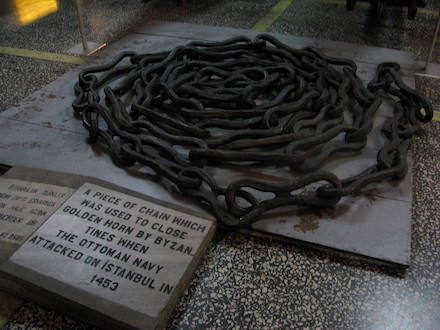
Not content with this ostentatious display of military power, Mehmed then brought to bear the full force of his powerful new fleet. The Byzantines had barred the entrance to the Golden Horn with a giant iron chain suspended on wooden pontoons between two fortified towers, one on each side. (This chain currently resides in the Turkish Naval Museum of Istanbul.)


(cc) image from Henri Bergius.

A squadron of ten Greek warships was stationed outside it, while another sixteen from Genoa, Venice and other western maritime cities guarded it from inside. Previous Ottoman assaults on this defensive cordon had failed, so the sultan circumvented it by building a road of greased wooden logs across Galata Hill behind the Genoese colony of Pera on the side of the Golden Horn opposite the city. He then, on 22 April, had seventy to eighty ‘biremes on wheeled cradles’ hauled over said byway and into the harbour behind the chain. The manoeuvre demoralized the defenders and enabled Mehmed’s naval forces to attack the city’s sea walls from the Golden Horn at the same time that his army assaulted the land walls. Inevitably, Constantinople fell on 29 May 1453. Vanquished were the last vestiges of Byzantine imperial power and its maritime thalassocracy remained only as a distant memory.

On this day..

1805: Gabriel Aguilar and Manuel Ubalde, abortive Peruvian rebels

On this date in 1805, Cusco‘s Plaza Mayor hosted the hangings of two colonial Peruvian creoles who had aspired to revive the Incan resistance to Spain.

The devastating Tupac Amaru rebellion lay just 25 years in the background here, but these men were not themselves indigenes. They were, however, New World-born, and thus heirs to a resentment at colonial control from half a world’s distance that would within the coming generation separate Peru from Spain.

“Denizens of the lower strata of creole society,” as D.A. Brading writes, the lawyer Jose Manuel Ubalde and the mining entrepreneur Gabriel Aguilar — close friends from a previous association in Lina —

inhabited a world in which Catholic piety, patriotic fervour and personal ambition were fuelled by visions and dreams. For Aguilar obtained Ubalde’s support for proclaiming him Inca emperor of Peru by informing him of a childhood vision in which he had been assured of a great role in his country’s history. Both men agreed that Spanish rule was oppressive and that St Thomas Aquinas had recognised the right to rebel against tyranny. When they conferred with like-minded priests, one cleric cited the prediction of Raynal,* the 1771 representation of the Mexico City Council,** and the example of the ‘Americans of Boston’. But the current of religious emotion that underlay these arguments surfaced when another cleric fell into an ecstasy in Aguilar’s presence, and claimed later to have seen the pretender crowned in the cathedral of Cuzco.

Unfortunately, the path to such a coronation ran through the actions of sympathetic military men — and one of the officers that these conspirators reached out to shopped the plotters before they could set anything in motion.

After their arrest, Ubalde was reminded of the traditional doctrine that, since the Catholic king was God’s image on earth, any challenge to his authority was an attack on God. By way of reply, he insisted on the right of rebellion against tyranny and argued that natural law did not prescribe loyalty to any particular dynasty. After all, the Papacy had just recognised Napoleon as emperor of the French, despite the claims of the Bourbon dynasty to that throne. He went to his execution convinced that Aguilar had been chosen by providence as a creole Maccabee, called to liberate Peru from Spanish rule.

* French Enlightenment figure Guillaume Thomas Francois Raynal anticipated a rebellion that would destroy colonial slave empires from below: “Your slaves stand in no need either of your generosity or your counsels, in order to break the sacrilegious yoke of their oppression … they will rush on with more impetuosity than torrents; they will leave behind them, in all parts, indelible traces of their just resentment. Spaniards, Portuguese, English, French, Dutch, all their tyrants will become the victims of fire and sword.”

** Mexico submitted a notable May 2, 1771 petition to King Carlos III calling for most of the imperial positions in the New World to be staffed by people from the New World rather than home country cronies — and warning that to do otherwise was to invite “not only the loss of this America, but the ruin of the State.” (Source)

On this day..

1903: Phil Davis, Walter Carter and Clint Thomas, multiracial lynching

From the Dec. 1, 1903 Augusta (Ga.) Chronicle:

On this day..

1499: Edward, Earl of Warwick, the last Plantagenet claimant

On this date in 1499, the Plantagenet prince Edward, Earl of Warwick lost his head — and his once-mighty house lost its last direct male successor to its claim upon kingship.

A lagging casualty of the Wars of the Roses, little Ted was only three when he lost his old man to a treason charge and a butt of malmsey. The same blade dangled close to Edward’s neck throughout his few years, for he became a potential royal claimant after his young cousins, the Princes in the Tower, were killed off in 1483.

Warwick was all of eight years old at that moment. When he was 10, he was shut up in the Tower of London by Henry VII, never really to leave it again.* “Being kept in the Tower from his tender age, that is to say from his first year of the king [i.e., of Henry VII’s reign] to this fifteenth year, out of all company of men and sight of beasts, in so much that he could not discern a goose from a capon,” in the words of chronicler Edward Hall. Some historians have taken that to mean that Edward was was mentally disabled, but under the circumstances, who wouldn’t be?*

It was cold and eminently practical mistreatment, for this boy however innocent in his own person was the potential champion of the Yorkists. In 1487, an abortive rebellion arose in Warwick’s name, with a 10-year-old kid named Lambert Simnel presented as a faux-Edward. Henry crushed the rebellion and was obliged to make his proofs to the populace by parading the real Edward around London which was at least a rare excursion outside the Tower walls for the tween hostage.**

Pretenders tossed the boy prisoner hither and yon on the currents of fortune. The next one to have a go at Henry, a Low Countries twerp named Perkin Warbeck who claimed to be one of the lost Princes in the Tower, mounted landings in the mid-1490s, vainly hoping to spark a general revolt. After he was finally captured in 1497, he wound up in the Tower with poor Warwick. Warbeck persuaded the desperate youth upon a desperate course — or was it by the intentional policy of that scheming king to dispose of a threat and thereby cinch that famously ill-fated Spanish marriage so productive of clientele for our grim annals? A century-plus later, Francis Bacon described in History of the Reign of King Henry VII the popular suspicion that had attached to this convenient tying up of loose ends:

it was ordained, that this winding-ivy of a Plantagenet should kill the true tree itself. For Perkin, after he had been a while in the Tower, began to insinuate himself into the favour and kindness of his keepers, servants to the lieutenant of the Tower Sir John Digby, being four in number; Strangeways, Blewet, Astwood, and Long Roger. These varlets, with mountains of promises, he sought to corrupt, to obtain his escape; but knowing well, that his own fortunes were made so contemptible, as he could feed no man’s hopes, and by hopes he must work, for rewards he had none, he had contrived with himself a vast and tragical plot; which was, to draw into his company Edward Plantagenet earl of Warwick, then prisoner in the Tower; whom the weary life of a long imprisonment, and the often and renewing fears of being put to death, had softened to take any impression of counsel for his liberty. This young Prince he thought these servants would look upon, though not upon himself: and therefore, after that by some message by one or two of them, he had tasted of the earl’s consent; it was agreed that these four should murder their master the lieutenant secretly in the night, and make their best of such money and portable goods of his, as they should find ready at hand, and get the keys of the Tower, and presently let forth Perkin and the earl. But this conspiracy was revealed in time, before it could be executed. And in this again the opinion of the King’s great wisdom did surcharge him with a sinister fame, that Perkin was but his bait, to entrap the earl of Warwick.

… Howsoever it were, hereupon Perkin, that had offended against grace now the third time, was at the last proceeded with, and by commissioners of oyer and terminer arraigned at Westminster, upon divers treasons committed and perpetrated after his coming on land within this kingdom, for so the judges advised, for that he was a foreigner, and condemned, and a few days after executed at Tyburn; where he did again openly read his confession, and take it upon his death to be true. This was the end of this little cockatrice of a King, that was able to destroy those that did not espy him first. It was one of the longest plays of that kind that hath been in memory, and might perhaps have had another end, if he had not met with a King both wise, stout, and fortunate.

And immediately after was arraigned before the Earl of Oxford, then for the time high steward of England, the poor Prince, the Earl of Warwick; not for the attempt to escape simply, for that was not acted; and besides, the imprisonment not being for treason, the escape by law could not be treason, but for conspiring with Perkin to raise sedition, and to destroy the King: and the earl confessing the indictment, had judgment, and was shortly after beheaded on Tower-hill.

This was also the end, not only of this noble and commiserable person Edward the earl of Warwick, eldest son to the duke of Clarence: but likewise of the line male of the Plantagenets, which had flourished in great royalty and renown, from the time of the famous King of England, King Henry the second. Howbeit it was a race often dipped in their own blood. It hath remained since only transplanted into other names, as well of the imperial line, as of other noble houses. But it was neither guilt of crime, nor treason of state, that could quench the envy that was upon the King for this execution: so that he thought good to export it out of the land, and to lay it upon his new ally, Ferdinando King of Spain. For these two Kings understanding one another at half a word, so it was that there were letters shewed out of Spain, whereby in the passages concerning the treaty of marriage, Ferdinando had written to the King in plain terms, that he saw no assurance of his succession, as long as the earl of Warwick lived; and that he was loth to send his daughter to troubles and dangers. But hereby, as the King did in some part remove the envy from himself; so he did not observe, that he did withal bring a kind of malediction and infausting upon the marriage, as an ill prognostic: which in event so far proved true, as both Prince Arthur enjoyed a very small time after the marriage, and the lady Catharine herself, a sad and a religious woman, long after, when King Henry the eighth his resolution of a divorce from her was first made known to her, used some words, that she had not offended, but it was a judgment of God, for that her former marriage was made in blood; meaning that of the earl of Warwick.

* The situation reminds of little Tsar Ivan VI in the 18th century, although that Russian prince was held from an even younger age, under even more oppressive conditions.

** Being only a figurehead, the pretend Warwick ironically enjoyed great mercy compared to the real one. Simnel was installed in Henry’s kitchens instead and lived out a comfortable life in the royal household.

On this day..

1620: Michal Piekarski, warhammer wielder

Calvinist nobleman Michal Piekarski was spectacularly executed in Warsaw on this date in 1620 for attempting the life of the Polish-Lithuanian king.

The lengthy reign of Sigismund III Vasa marks Poland’s downward slide out of her golden age, although how much of this trendline is personally attributable to Sigismund embarks scholarly debates well beyond this writer’s ken.

Sigismund III Vasa held both the Polish-Lithuanian and the Swedish thrones in a personal union but he lost the latter realm to rebellion; he meddled unsuccessfully in Russia’s Time of Troubles interregnum; and he faced a rebellion of nobility in 1606-1608 that, although it failed to overthrow him, permanently curtailed the power Polish monarchy.

That conflict with the aristocracy overlapped with a sectarian schism common throughout Europe in the train of the Protestant Reformation — for Sigismund was very Catholic and his nobility divided.

It’s the latter fissure that’s thought to have supplied the proximate motivation for our date’s principal. Piekarski (English Wikipedia entry | Polish), a petty noble, had long been noted as a moody, melancholic man too unstable even to be entrusted with the management of his own estates — the consequence of a childhood head injury.

He was also a staunch Calvinist, but broad-minded enough to find virtue in his opponents’ tactics. In 1610, Catholic ultra Francois Ravaillac had assassinated France’s Henri IV, and it’s thought that Ravaillac’s boldness put the bee into Piekarski’s bonnet.

A decade later, the Pole stung with cinematic flair: he jumped Sigismund in a narrow corridor while the latter was en route to Mass and dealt 1d8 bludgeoning damage by thumping the king in the back with a warhammer; after a second attempted blow only grazed the sovereign’s cheek, the royal entourage subdued Piekarski and started looking up chiropractors.


It’s only a model: replica of the would-be assassin’s instrument on display in Warsaw.

Torture failed to elucidate a coherent motivation from a muddled mind. Reports had him only babbling nonsense, so attribution of the attack to religious grievance remains no more than partially satisfying; there were rumors of other more determined instigators to steer Piekarski’s mind towards regicide for their own ends. (Although he didn’t get the king, he did confer upon the Polish tongue the idiom “plesc jak Piekarski na mekach” — “to mumble like Piekarski under torture”.)

In the end, for Ravaillac’s crime, he took Ravaillac’s suffering: the Sejm condemned him to an elaborate public execution which comprised having his flesh torn by red-hot pincers as he was carted around Warsaw, until reaching a place called Piekielko (“Devil’s Den”) where the hand he had dared to raise against the king was struck off, and then what was left of his ruined flesh was torn into quarters with the aid of four straining horses.

On this day..

1789: Ann Davis, the first woman hanged at Sydney Cove

The first woman hanged in colonial Australia was Ann(e) Davis, on this date in 1789.

Convicted in London “for feloniously stealing, on the 27th day of April, eight pair of silk stockings, value 8s. the property of James Atkinson,” Davis was one of 101 female convicts transported to Sydney Cove with the First Fleet aboard the Lady Penrhyn.* Davis would have been in the crowd of onlookers the year before when the fledgling colony conducted its very first execution.

This spectacle did not un-sticky Davis’s fingers, for she was sentenced in Sydney Cove for again plundering wardrobes to the tune of

four linen shirts of the value of twenty nine shillings and six pence; one cheque shirt of the value of four pence; one linen waistcoat of the value of two shillings; two cambrick handkerchiefs of the value of three shillings; one silk waistcoat of the value of two shillings; one dimety waistcoat of the value of eighteen pence of the goods and chattels of the said Robert Sidaway; and one linen bed gown of the value of two shillings; one linen apron of the value of eighteen pence; two linen caps of the value of sixpence; one piece of a cap of the value of one penny; one muslin handkerchief of the value of six pence; and one pair of linen pockets of the value of one penny of the goods and chattels of Mary Marshall in the same dwelling house.

Davis attempted to plead her belly, failing to impress a jury of matrons impaneled to scrutinize her for pregnancy.

Seaman Jacob Nagle piteously recorded her end:

Some time after this, one of the wimen [Ann Davis] stole some wet clothes and was condemned and hung. She strove to bring a free man in guilty that belonged to our ship that was on duty on shore, it being proved by a number of witnesses that he was innocent and new nothing of it. Otherwise, she might have been saved, as the Governor left it to Captain Hunter, but he would not for give her, and when brought to gallos, leading her by two wimen, she was so much intocsicated in liquor that she could not stand without holding her up. It was dreadful to see heir going to aternity out of this world in such a senceless, shocking manne.

As noted by Australia’s Dark Heart the experience of dispatching this creature might have been especially traumatizing to the colony’s unwilling executioner James Freeman — for he was found roaring drunk a few days later and punished with 100 lashes.

* After discharging its human cargo, the Lady Penrhyn proceeded upon further circulating in the Pacific and the Far East; in 1788, she sighted and named the Cook Islands atoll of Penrhyn.

On this day..

1894: Santiago Salvador, William Tell bomber

Spanish terrorist Santiago Salvador died to the garrot on this date in 1894.

A central-casting figure from the heyday of anarchist bomb attacks on bourgeois society, Salvador highlighted the November 7, 1893 premier of opera season at Barcelona’s Gran Teatre del Liceu by chucking a couple of Orsini bombs from the balcony during the second act of William Tell.*

“My wish was to destroy bourgeois society,” he would explain. “I did not set out to kill certain people. I was indifferent to killing one or the other. My desire was to sow terror.” A more specific provocation (cited by Salvador at his trial) was the execution one month before of another anarchist, Paulino Pallas.

Salvador successfully escaped the scene amid the confusion and the hunt for him licensed a year of martial law with a plethora of offices ransacked and subversives sweated.

The man died with the requisite cry of Viva la Anarchia! upon his lips; however, anarchist violence in his parts did greatly abate in the ensuing couple of years, with the main theater of the propaganda-of-the-deed tendency now shifting to France.

* France’s Le Petit Journal had an explosive illustration of the event on the cover of its 26 November issue.

On this day..

1663: Volkmar Limprecht

Volkmar Limprecht, a pedagogue and city councilor of Erfurt in Thuringia, was beheaded on this date in 1663. Almost all the links in this post are in German.

“A Mephistophelian mixture of reckless egoistic ambition and restless energy, worldly agility, and unfettered frivolity,” our man Limprecht was a pedagogue turned demagogue who won election to the city council and briefly rode his acumen to control of the city and the absurd prospect of asserting leadership of the Electorate of Mainz.

The Elector, Johann Philipp von Schoenborn, dispatched an army to Erfurt to put it in its place, leading the city’s other grandees to overthrow Limprecht for self-preservation and have him condemned a traitor. He was beheaded the day after his sentence, and his head mounted on a spike as a gesture of submission to the Elector.

Google Books has digitized a public domain blackletter summary of the man’s fall here.

On this day..