1549: Thomas Seymour, more wit than judgment

Having been elevated to the shadow of the throne by one sibling, Thomas Seymour on this date in 1549 was seen to the block by another sibling.

The brother of Henry VIII’s favorite queen, Jane Seymour, our Thomas was when that burly king kicked the bucket beautifully positioned for a share of power, being named to the regency council that would govern for his nephew, nine-year-old heir Edward VI.

What dreams may come!

But Thomas Seymour would find like many a Tudor courtier before and after him, that around the throne it thunders.

His vaunting ambitions were blocked by the oldest ogre of all, big brother: Edward Seymour, Duke of Somerset, who surpassed our Thomas in ability and seniority alike, was the man who rose to the top of the regency and as Lord Protector exercised sovereignty in the child-king’s name. “As the Duke was elder in Years, so was he more staid in Behaviour,” one history has it, observing that Thomas Seymour “was fierce in Courage, courtly in Fashion, in Personage stately, in Voice magnificent, but somewhat empty of Matter.”

Courageous, empty Thomas — whom we shall call Sudeley for the sake of his barony* and our clarity — took a more generous estimate of his own talents and the boys soon festered a sibling rivalry of uncommon consequence. Our man connived to attract the favor of young Edward, inveigling and cajoling him to exercise his kingly prerogatives to lever Somerset out and Sudeley in. This campaign found little traction among fellow regents and finally came to the desperate strait of Sudeley skulking on the grounds of Hampton Court Palace one night in January 1549 in a possible adventure to kidnap the king. Instead, it landed him in the Tower with treason charges pending after he gave away the game by shooting one of the king’s barking dogs. It would afterwards emerge that he had conspired with a corrupted official of the mint to coin him a sum sufficient to furnish the rebellious army he had allegedly already begun recruiting.

King Edward wasn’t the only underage royal to labor under Sudeley’s excessive attentions.

This chancer had married the former queen, Catherine Parr, and in early 1548 they had the young princess ElizabethAnne Boleyn‘s daughter, the future queen, who was here all of 14 years old** — living with them at Chelsea. Pushing 40, the cocksure Sudeley got far too friendly with Elizabeth, repeatedly entering her chambers early in the morning despite the reprimands of Elizabeth’s governess and playing a lot of slap and tickle. It’s ambiguous just how far this frolic went and what Elizabeth thought about it but despite Catherine Parr’s occasional participation in such romps(!) Sudeley did eventually cross his wife’s boundary for good, giving, and game. As that governess explained,

the Admiral [Sudeley] had loved the Princess but too well, and had so done for a long while … [until] the Queen [Catherine Parr], suspecting too often access of the Admiral to the lady Elizabeth’s Grace, came suddenly upon them, when they were all alone (he having her in his arms). Whereupon the Queen fell out both with the Lord Admiral and with her Grace also … And this was not long before they parted asunder their families [households].

By the time Sudeley fell, he had resumed his suit of Elizabeth, Catherine Parr having died late in 1548 from childbirth — or, as was rumored, poison. It wasn’t merely that Sudeley was on the perv; he had married Catherine Parr secretly, against the will of the council, and that he now intended the princess should succeed the queen in his bed augured a seditious intent. The regents found out about it and swiped left, and their cockblock might have been the spur for Sudeley’s desperate attempt to grab the king’s own person; certainly his efforts to wed the princess featured among the many charges laid by the bill of attainder that claimed Sudeley’s head.

Her stalker’s attentions also put Elizabeth under close questioning and had she not the sangfroid to deny resolutely any part in the man’s schemes her history, and ours, might have gone very differently. It’s not the last time that Elizabeth proved her mettle under interrogation.

As for Thomas Seymour himself, a delicate proceedings unfolded in the winter of 1549 with the Lord Protector and the King ultimately both assenting to a fatal prosecution of their kinsman, and perhaps also to a convenient magnification of his faults. For example, it was said that he went scheming literally all the way to the block, having prepared secret revengeful letters for posthumous delivery intended to set the princesses Mary and Elizabeth against his brother; this detail would lead Hugh Latimer to preach about the Lord Admiral — “a covetous man … an ambitious man … a seditious man, a contemner of common prayer”:

As touching the kind of his death, whether he be saved or no, I refer that to God only. What God can do, I can tell. I will not deny, but that he may in the twinkling of an eye save a man, and turn his heart. What he did, I cannot tell. And when a man hath two strokes with an axe, who can tell but that between two strokes he doth repent? It is very hard to judge. Well, I will not go so nigh to work; but this I will say, if they ask me what I think of his death, that he died very dangerously, irksomely, horribly.

Edward Seymour himself set his own hand to his brother’s death warrant in concert with the rest of the regency council. In a fine case study for parents who might wish to impress quarreling children with their interest in finding common purpose, Edward met the same fate inside of three years.

As for the savvy young Elizabeth, this early brush with reckless sexuality, political intrigue, and the perpetual proximity of the headsman’s axe, was perhaps an instructive event that would help to see her to her own glory. Her would-be lover had admirable qualities but she perceived well enough how they weighed as compared to his incontinence, and she quipped the definitive epitaph upon receiving news of his destruction: “This day died a man of much wit and very little judgement.”

* Sudeley Castle still stands today, and is open to tourists.

** Also crashing at the maison Sudeley in 1548: Lady Jane Grey. One of Sudeley’s numerous vain machinations was to orchestrate a Jane Grey-Edward VI marriage.

On this day..

1830: Robert Emond

(Thanks to Meaghan Good of the Charley Project for the guest post. -ed.)

On this day in 1830, at Libberton’s Wynd in Edinburgh, Scotland, Robert Emond or Edmond was hanged for the brutal murders of his sister-in-law, Catherine Franks, a fifty-year-old widow, and her teenage daughter, Magdalene. They had lived in a village called Abbey, near Haddington.

The story of the killings is told in Martin Baggoley’s book, Scottish Murders. It’s a sad but familiar tale of family trouble and domestic violence.

The victims had been discovered by concerned neighbors on the afternoon of October 28, 1829. Neither of them had been seen for days, and Catherine’s pig was squealing continually from hunger in its sty.

Two men went to the Franks cottage to investigate and found Catherine’s body lying in the pigsty. Her throat had been slashed and, as the Newgate Calendar records, her rings, earrings and watch were missing. The neighbors’ first thought was for Magdalene, and they rushed inside the cottage through the open back door and found her in the bedroom. The girl had been beaten to death; there were eight distinct injuries to her head and her skull had been fractured several times.

The doctor who examined the bodies determined Catherine and Magdalene had probably been killed on either Sunday night, October 25, or early Monday morning. The house had been ransacked, drawers had been pulled out of and their contents dumped on the floor, and the floor was covered with blood, including distinct bloody footprints.

The police didn’t have to look far for a suspect: a neighbor told them Catherine had recently accused her brother-in-law of stealing from both her and his wife, the latter also named Magdalene. Robert had then obliquely threatened her, saying, “If you won’t keep away from here and your sister, who are you are making as cross-grained as yourself, I won’t answer for the consequences.”

Although Robert Emond was of “respectable” parentage, had a good education and had been honorably discharged from the Army, he had a reputation for violence even as a youth and the neighbor kids called him “the fiend.”

The Emonds had been married for less than three years by the time Catherine and Magdalene Franks were murdered, but already the relationship was breaking on the rock of Robert’s violent temper and dissatisfaction with his life.

Unusually for that time, Magdalene Emond owned her own successful business and was of independent means, but Robert had had several financial failures and resented his wife’s success. He also resented Catherine because he felt she was continually criticizing him to everybody and making his marital problems worse.

A broadside about the crimes and Emond’s execution noted,

He seems to have brought himself to think that he was utterly despised by Mrs. Franks and his wife, and on being opposed by them in any of his foolish speculations in trade, although for his own ultimate good, was considered by him as resulting from that deep-rooted [antipathy], as he thought, they treated him with.

Guy B. H. Logan, in his 1928 book Dramas of the Dock: True Stories of Crime, described Robert as “a morose, sullen man, given to brooding over real or fancied wrongs, which, in his warped mind, became intolerable injuries,” and suggested he might have been mentally unbalanced, pointing out that there was a history of mental illness in his family.

When police went to Emond’s home in North Berwick, neighbors there told them Robert and his wife had had a violent, screaming argument after she refused to lend him money, and he’d beaten her and tried to throw her down the garden well. During their quarrel, the witnesses said, Magdalene had screamed that she knew Robert had taken money from her and her sister.

When questioned, Robert’s wife admitted the argument had taken place. Magdalene said they’d slept in separate rooms since their fight, and she kept her bedroom door locked from the inside at night.

Catherine Franks’s younger daughter, who was also named Catherine, lived with her aunt and uncle to maximize the reader’s confusion: we’ve got Catherine and Magdalene as victims, survived by Magdalene and Catherine in the killer’s household. The latter Catherine reported that she’d tried to go into Robert’s room at eight o’clock on Monday morning to give him a cup of tea, but found the door shut from the inside.

Magdalene became worried that her husband had “done himself some mischief” and summoned two men, who got a ladder and looked in the bedroom window. Robert wasn’t there and the bed had not been slept in. When he returned several hours later, he was dishelved and agitated.

The little girl would later testify at the trial, “He was wild-like, and trembling a lot. His eyes were fixed and staring.” He wouldn’t say where he’d been. His boots and stockings were wet and little Catherine saw him cleaning them later.

Suspicious, police searched the house and found Robert’s vest and pants, which were damp and bloodstained. They also found a shirt which had a bloody handprint on the fabric in spite of someone’s attempt to clean it. They also confiscated his boots.

Under arrest on two counts of murder, Robert Emond steadfastly maintained his innocence. He wrote the following letter to his wife while in custody:

My dear wife,

I am now confined in Calton Jail charged with the murder of your sister and daughter, of which I declare to you I am perfectly innocent, though I have done as much as deserves the gallows.

My dear Magdalene, I am sorry and even wish to take my own life when I think upon what I have done to you. I can’t rest night or day. I can’t rest night or day. I confess that I am a great sinner and nothing hurts me more than to think that I am suspicion of the crime of murder. I assure you that I am perfectly innocent of the crime laid to my charge and I hope God Almighty who sees into all things will be my advocate on the day of the trial.

I am aware the people are inveterate against me, because the proof, in their opinion, is so much against me. I again, my dearest Magdalene, declare I am innocent, although at this time my mind is so much affected that I hardly know what I say.

I have been examined before the Sheriff of Edinburgh several times but I think they can’t prove nothing against me. The public are aware I understand of the iron heels of my shoes corresponding with some marks at Mrs. Frank’s [sic] house and with a bloody shirt found in my house, which you can prove was occasioned by the bleeding of my knows, or you know better by the blood that flowed from your head the Sunday preceding that most horrid murder. I understand that the authorities in Edinburgh are anxious to discover my old coat, but I hope they never shall.

My dearest wife, my name has been branded in Edinburgh by illiterate stationers and I suppose that even in North Berwick is held in as much dread as the notorious murderers Burke and Hare. I must allow suspicions are against me that is nothing. I again implore you to banish from your mind the idea [that I am] a murderer of your sister and niece.

My love to all your friends, for friends I have none. Would that God take me to himself.

Robert Emond

Robert was tried in February. The prosecution argued that he’d killed Catherine Franks to get revenge, and Magdalene Franks because she was a witness, and then tore the house apart and stole Catherine’s jewelry to make it look like a robbery.

Some local witnesses who saw Robert on October 26 testified, reporting that he had “blood about his mouth, both above and below,” and that he complained that Catherine Franks was ruining his marriage and said, “This is a terrible business. I am so confused I don’t know what I am doing.” He told a friend that “the devil had been very busy with him.”

Robert pleaded not guilty and claimed the blood on his clothes came from a nosebleed, the injuries his wife sustained when he beat her, or a chicken he’d killed. The coat he mentioned in his letter never did turn up, but one witness testified that he’d seen Robert wearing it shortly after the murders and it had a “wet, reddish stain” on the sleeve.

But there wasn’t a lot he could say about the bloody footprints at the crime scene: a local cobbler testified and said he’d compared the prints to Robert Emond’s boots and “it was a most unusual design and they matched the heels of Emond’s boots perfectly.”

The jury deliberated an hour before convicting him, and after his conviction he finally confessed. In spite of several attempts at suicide while in jail, Robert lived to be hanged five weeks later. On the scaffold he admitted his crime and said he deserved to die. His body was dissected at the University of Edinburgh, as per the custom.

* Line breaks have been added to this letter for readability.

On this day..

1841: The Jewboy’s Gang

On this date in 1841, Australian bushranger Edward “Teddy the Jewboy” Davis was hanged in Sydney along with five others of his gang. The reader may guess the chief’s distinguishing demographic characteristic, and some lists mark him the only Jewish bushranger.

He’d been transported from England in 1833 at the age of about 16, for a trifling theft. “Obsessed by the idea that he had been wronged when he was transported and governed by an indomitable desire for freedom,” Davis began repeatedly escaping from his penal assignments only to be repeatedly captured.

Indefatigable as Monty Python’s Swamp Castle King, he just kept trying until he got it right.

By 1839 the young Hebrew had formed a seven-strong outlaw gang plundering New South Wales’s future wine country, the Hunter Valley. Their captain seems to have brought along from the old country the romantic conception of a cavalier-thief, as this charming account of one of their raids suggests, wherein the victim “says he was treated in the most gentlemanly manner by them, and that he never spent a happier night in his life.” The stylish marauders, we find, dressed themselves “rather gaudy, as they wore broad-rimmed Manilla hats, turned up in front with abundance of broad pink ribbons, satin neck-cloths, splendid brooches, [and] all of them had rings and watches.”

They kept by a sage policy of Davis’s to eschew deadly violence for fear of bringing down the authorities’ wrath, but they didn’t quite keep to it well enough. One of their number, John Shea, slew a man in December 1840, and a posse hunted them down the very next day, and interviewed in jail, “Davies said that he would always oppose the shedding of blood, for he knew if they once committed a murder they would not reign a week; whilst saying so he looked at the other four men,* and said, you now see we have not reigned a day.”

Edward Davis, 26, Robert Chitty, 37, James Everett, 25, John Marshall, 27, Richard Glanville, 31, and the 27-year-old Shea were hanged behind Sydney Gaol on the 16th of the following March.

The notoriety which the crimes of these men has attained drew together a large concourse of spectators to witness their execution. The entrance to the Gaol, in George-street, was besieged for admission long before the arrival, at nine o’clock, of a strong military guard from the barracks, and so great was the pressure of the crowd, that it required the unremitting exertions of Captain Innes to preserve order. At ten minutes past nine, the culprits were strongly pinioned, and conducted from the cells to the area in front of the drop, where they knelt down. Chitty, Everett, Marshall, and Glanville, were attended by the Rev. William Cowper and the Rev. John Elder. The Rev. Mr. Murphy, Catholic Priest, accompanied Shea; and Davis (being of the Jewish persuasion), was attended by Mr. Isaacs, Minister of the Jewish congregation in New South Wales. All the culprits (if we except Everett), deeply lamented their having committed the crimes for which they were about to die, and acknowledged the justice of their sentences. Everett ascended the scaffold hurriedly, and in an evident state of excitement. He was followed by Chitty, Marshall, and Glanville, all three of whom, on reaching the scaffold sung the first verse of the Morning Hymn, to be found in many editions of the book of Common Prayer, commencing “Awake my soul, and with the sun.”

This act of devotion, we have since heard was entirely spontaneous, not having been suggested, or even expected by either of the reverend gentlemen, who attended to administer the consolations of religion according to the rites of the Protestant Church. The ropes were speedily adjusted, and the white caps drawn over the faces of the wretched criminals; in the short interval which elapsed before the withdrawal of the fatal bolt, Marshall and Glanville were engaged in loud and apparently fervent prayer, and we observed the culprit Davis (who was attired in a suit of mourning), thank the Jewish Minister for the attention paid him in his last moments. The struggles of all the men were of short duration; the immense crowd dispersed peaceably. It will be remembered that these men were apprehended, chiefly through the active exertions of Mr. Day, Police Magistrate, Maitland.

* A fifth accomplice was captured a short time afterwards and joined his mates on the gallows.

On this day..

1766: Nicholas Sheehy, Whiteboys priest

On this date in 1766, Irish priest Nicholas Sheehy was hanged, drawn, and quartered in Clonmel — a victim to the years-long campaign of enclosures by Ireland’s landlords, whom English agriculturist Arthur Young reported as “harpies who squeezed out the very vitals of the people and by process, extortion, and sequestration dragged from them the little which the landlord had left them.”

Sheehy was a sympathizer of the peasant “Whiteboys” resistance movement, so named for the snowy frocks these secret guerrillas donned when out on midnight raids to strike back against the owners where tenants’ livelihoods were at stake. Where landlords enclosed public grounds, Whiteboys knocked down the fences; where they displaced peasant farmer with commercial livestock, Whiteboys hamstrung the cattle.

“It could not be expected,” wrote Margaret Anne Cusack, “that the Irish priest would see the people exposed to all this misery — and what to them was far more painful, to all this temptation to commit deadly sin — without making some effort in their behalf.”

Father Sheehy, parish priest of Clogheen, was one of these, and a villain in the eyes of Protestant elites for his denunciations of enclosure and his comforts to its more muscular foes.

He had interfered in the vain hope of protecting his unfortunate parishioners from injustice; and, in return, he was himself made the victim of injustice. He was accused of encouraging a French invasion — a fear which was always present to the minds of the rulers, as they could not but know that the Irish had every reason to seek for foreign aid to free them from domestic wrongs. He was accused of encouraging the Whiteboys, because, while he denounced their crimes, he accused those who had driven them to these crimes as the real culprits. He was accused of treason, and a reward of £300 was offered for his apprehension. Conscious of his innocence, he gave himself up at once to justice, though he might easily have fled the country. He was tried in Dublin and acquitted. But his persecutors were not satisfied.

A charge of murder was got up against him; and although the body of the man [John Bridge, a former Whiteboy turned informer -ed.] could never be found, although it was sworn that he had left the country, although an alibi was proved for the priest, he was condemned and executed. A gentleman of property and position came forward at the trial to prove that Father Sheehy had slept in his house the very night on which he was accused of having committed the murder; but the moment he appeared in court, a clergyman who sat on the bench had him taken into custody, on pretence of having killed a corporal and a sergeant in a riot. The pretence answered the purpose …

At the place of execution, Father Sheehy most solemnly declared, on the word of a dying man, that he was not guilty either of murder or of treason; that he never had any intercourse, either directly or indirectly, with the French; and that he had never known of any such intercourse being practised by others.

Father Sheehy’s head wound up on a pike (it was said that the birds in reverence would not peck at it), and his name in the rich firmament of Irish martyr-patriots. He’s been occasionally proposed for canonization.

On this day..

1663: Alexander Kennedy, forger of false bonds and writts

On this date in 1663, Alexander Kennedy was hanged at the Cross of Edinburgh for forging false bonds and writs, whose particulars we discover in The Records of the Proceedings of the Justiciary Court, Edinburgh, 1661-1678.


Edinbr. 24 feb. 1663. Deput Cuningham pt.

Alexander Kennedy, sometimetime Porter in the Castle of Edr., now prisoner, dilated and accused for the crime following, viz. for that notwithstanding of the common, municipall Laws and constant practise of this kingdome, the forgers, Counterfeiters and Devisers up and Users of false Bonds, obligations and other Writts, are to be punished be tinsell of their lives and moveable estate and especially by the 22d Act, 23 Parl. Ja. 6, it is statute and ordained, that whosoever makes any false writ or is accessory to the making thereof shall be punished with the pains due to the Committers of falsehood, which by the constant practise of this kingdome is the pain of Tinsell of Life and moveable estate, and that it shall not be but that after Tryall of the Writt quarrelled it be found false the passing from or Declaration of the Party that he will not use the same shall no ways free him from the punishment due to the committers of falsehood as at more length is contained in the said Acts whereupon it is subsumed that the Pannell has forged, feinzied, counterfeited and made up the six Bonds, Obligations, and Contracts under written, four of the which Bonds are alledged granted by the decast John Renton of Lamberton, therein designed Constable of the Castle of Edinbr., to the deceast Dame Agnes Renton, Countess of Levin, all dated 17 Octor. 1648, by each of which four Bonds, the said umq John Renton granted him to have borrowed (here follows the contents of the Bonds as they are made payable to the Lady and her Daughter, then follows the tenor of a Contract made up by the Pannell betwixt himself and Lamberton, be which he is obliged to pay 3000£ to the Pannell upon his delivery of him of the forsaid six Bonds by the Lady Leven’s warrand, and Alexr. upon receipt of the forsaid sum is obliged to deliver tye Bonds and the Lady’s warrand, and subsumes that the Pannell is the forger of all these Writts, or airt and part, and that the Lo: of Session has found so by a Decreet of Improbation, dated 22 July last, and finds that the Pannell is an infamous and perjured person, and has remmitted him to be criminally tryed, and ordained the King’s Advocate to process him, which being found by an Assize, he ought to be punished with the Tinsell of Life and moveables, to the terror and example of others.

Mr. And. Birnie, Pror. for the Pannell, alledges the Dittay is not relevant, because it does not condescend wherein the Pannell is forger of the Writts lybelled, whether in the Subscription of the principall party, granter, or Subscriptions of the Witnesses, or date, or some other substantiall head. 2d. Nonrelevat accessory or user because by the Act of Parliat. the User of a false Writte unless he byde by it is not liable to the punishment of falsehood. Neither is Accession relevant unless the way of his accession be condescended upon, frae which Condescendance a Defence may result. 3d. The Lybell non relevat in so far as it concludes Tinsell of Life and Goods, because the Act of Parliamt. lybelled on does not express the Punishment, but referrs to prior Acts, and it is clear both from K. Jas. the 5th and Q. Mary‘s Acts that the Punishment is restricted to Imprisonment, Banishment, etc. which is placed in Arbitrio Judicis.

My Lo: Advocate to all this oppones the Dittay as it is lybelled, and the Act of Parlt. whereupon it is founded bearing the punishment of falsehood to be inflicted on such as are forgers and users of false Writts, or art and part thereof, and both the Act of Parliament and custom of the Justice Court has determined the pain to be loss of Life and Moveables.

Duplys Birnie to the last part of the Advocate’s Alledgiance, that it is to be understood only as to falsifying Writts that can proceed only from authority, and oppones the Act of Parliament.

The Justice Depute ordains the Dittay, notwithstanding of the Answer, to pass to the Tryall of an Assize. The Assize being sworn, the King’s Advocate produces the Lo: of Session’s Decreet of Improbation per modum probationis, and thereupon the Assize finds the Pannell guilty as art and part, accessory and user of the false Writts mentioned in the Dittay, conform to the Decreet of Session. Vide sentence 12th instant.

I repeat here my Observe which I made on Birnie’s sentence day of 1662. [I’m unsure what this alludes to -ed.]

Edinbr 12 March 1663. Deput Cuningham.

Alexr. Kennedy convict ut supra of falsehood, sentenced to be hanged at the Cross of Edinburgh.

On this day..

1817: John Cashman, Spa Fields rioter

On this date in 1817, a sailor named Cashman was hanged for the Spa Fields riots.

In the aftermath of the Napoleonic Wars, Britain’s economy had all but ceased to function for her lowest orders, burdened by spiraling food prices and cratering wages. An ample stock of radical agitators put the powdered wig set in mind of so many Robespierres, and here and there they were sacrificed on the scaffold.

Three years on, in the wake of a different protest against these unresolved crisis that was crushed with the same violence, Shelley would put the spirit of swelling desperation into verse in his “Masque of Anarchy”

Men of England, heirs of Glory,
Heroes of unwritten story,
Nurslings of one mighty Mother,
Hopes of her, and one another;

Rise like Lions after slumber
In unvanquishable number,
Shake your chains to earth like dew
Which in sleep had fallen on you —
Ye are many — they are few.

What is Freedom? — ye can tell
That which slavery is, too well —
For its very name has grown
To an echo of your own.

‘Tis to work and have such pay
As just keeps life from day to day
In your limbs, as in a cell
For the tyrants’ use to dwell,

So that ye for them are made
Loom, and plough, and sword, and spade,
With or without your own will bent
To their defence and nourishment.

‘Tis to see your children weak
With their mothers pine and peak,
When the winter winds are bleak,–
They are dying whilst I speak.

‘Tis to hunger for such diet
As the rich man in his riot
Casts to the fat dogs that lie
Surfeiting beneath his eye;

‘Tis to let the Ghost of Gold
Take from Toil a thousandfold
More than e’er its substance could
In the tyrannies of old.

In November of 1816, activists convened a 10,000-strong meeting/rally at Spa Fields, Islington, demanding political reforms including universal male suffrage, the secret ballot, and annual general elections. After a petition to this same effect had been repeatedly rebuffed by the corpulent Prince Regent, a follow-up meeting on December 2 doubled the crowd, and doubled its anger. Balked of even so much as a hearing for their petition, the crowd rioted — incited in one instance by a demagogue thundering,

A man who receives one million a year public money gives only 5,000l. to the poor. They have neglected the starving people, robbed them of every thing, and given them a penny. Is this to be endured? Four millions are in distress; our brothers in Ireland are in a worse state, the climax of misery is complete, it can go no further. The Ministers have not granted our rights. Shall we take them? (Yes, yes, from the mob.) Will you demand them? (Yes, yes.) If I jump down, will you follow me? (Yes, yes, was again vociferated. It shall go no further.) (London Times, Dec. 3, 1816)

In a trice the crowd sacked the nearby establishment of a gunsmith called Beckwith for armaments, and a gentleman in the shop was shot in the fracas which is a painful place to be shot. He survived, but it’s for this attack that our principal will find his way to the gallows: the riot itself was restrained after some hours.

The tumult made witnesses uncertain to the detriment of the law but although four comrades were acquitted beside him, John Cashman was condemned thanks to a firm identification by the gunsmith’s apprentice. Cashman denied it in words calculated to stir the ire that had launched Spa Fields.

My Lord, —

I hope you will excuse a poor friendless sailor for occupying your time. Had I died fighting the battles of my country, I should have gloried in it, but I confess that it grieves me to think of suffering like a robber, when I can call God to witness that I have passed days together without even a morsel of bread, rather than violate the laws.

I have served my King for many years; and often fought for my country. I have received nine wounds in the service, and never before have been charged with any offence. I have been at sea all my life, and my father was killed on board the Diana frigate. I came to London, my Lord, to endeavour to recover my pay and prize money, but being unsuccessful, I was reduced to the greatest distress; and being poor and pennyless, I have not been able to bring forward witnesses to prove my innocence, nor even to acquaint my brave officers, for I am sure they would all have come forward in my behalf.

The Gentlemen who have sworn against me must have mistook me for some other person (there being many sailors in the mob): but I freely forgive them, and I hope God will also forgive them, for I solemnly declare that I committed no act of violence whatever. (Morning Chronicle, January 31, 1817)

Cashman’s spirits were less exalted come execution day, when the man was hauled in a cart to a gallows situated opposite the gunsmith’s outraged shop — in the presence of a vast and testy mob. Authorities feared a rescue attempt or an attack upon the execution team, a replay of the Porteous riot that had many years before lay Edinburgh in flames on the occasion of a provocative public hanging. If ever there was a man they hoped would do the submissive penitential act, it was this bluff sailor. Instead, Cashman bantered with onlookers, cheeky and fearless, stirring the pot.

The Rev. Mr. Cotton and Mr. Devereux now ascended the platform, and endeavored to bring the wretched man to a sense of his awful situation. Their benevolent exertions, however, were fruitless, he appeared callous to all religious exhortations, and pushing them aside, exclaimed, “Don’t bother me — it’s no use — I want no mercy but from God!”

The executioner then came forward, and put the rope round his neck. This operation excited new tumults, and fresh exclamations of disapprobation burst from the crowd. On the night cap being put over his face, he said, “For God’s sake let me see to the last; I want no cap.” In this he was indulged, and the cap was withdrawn. He now turned towards Mr. Beckwith’s house in an angry manner, and shaking his head, said, “I’ll be with you there” — meaning that he would haunt the house after his death. Again turning to the people, he cried “I am the last of seven of them that fought for my King and country: I could not get my own, and that has brought me here.” The executioner having quitted the platform, the unfortunate wretch addressed the crowd nearest him, and exclaimed: “Now you —— [bastards?] give me three cheers when I trip.” — “Hurra you ——.” And then, calling to the executioner, he cried out, “come, Jack, you ——, let go the jib-boom.” The few remaining seconds of his existence he employed in similar addresses, and was cheering at the instant the fatal board fell beneath his feet. The cap was then drawn over his face, and he died almost without a struggle. A dead silence instantly prevailed, which continued for a few moments.

The Sheriffs during the execution took their station in the window of a home opposite Mr. Beckwith’s shop.

After the lapse of about ten minutes the populace renewed the expressions of disgust and indignation towards every person who had taken a part in the dreadful exhibition. Cries of “Murder! Murder!” were distinctly heard from the innumeraboe mouths, followed by crimes of “Shame! Shame!” “Where are the conspirators? Why not hang them?” &c. Groans and hisses accompanied these allusions. (New York (USA) National Advocate, April 25, 1817, reprinting the Commercial Advertiser

In the end, the potential violent recrudescence did not come to pass and the angry onlookers dispersed to carry their foul tempers and unsatisfied grievances back to the workingmen’s haunts. Parliament paid the Spa Fields petitioners one last rude tribute by enacting just days later a Seditious Meetings Act barring any unauthorized assemblies “for the purpose … of deliberating upon any grievance, in church or state.”

On this day..

222: Elagabalus

March 11, 222 marked the downfall of the Roman emperor Elagabalus (or Heliogabalus, in the Greek rendering).*

Notorious to posterity for lapping the field in outrageous sensuality, he was the 14-year-old cousin of the deposed brute Caracalla and stepped into the purple because his crafty grandma won the civil war that ensued Caracalla’s assassination.

By family heredity he was by that time already the high priest of the Syrian sun-god Elagabalus,** in the city of Emesa (present-day Homs, Syria). History has flattered the youth with the name of his novel god, although in life the former was simply Marcus Aurelius Antoninus. By any name, his eastern affectations would smell as foul to the Romans.

We’re forever constrained by the partiality of our few sources when it comes to antiquity and the possibility cannot be dismissed that the bizarre and alien portrait remaining us is mostly the outlandish caricature of his foes. However, such sources as we have unanimously characterize Elagabalus as — per Gibbon’s summary — “corrupted by his youth, his country, and his fortune” and it is this that has made his name a western metonym for for the sybaritic Oriental despot. (“I quote in elegiacs all the crimes of Heliogabalus,” patters the Modern Major-General of Gilbert & Sullivan canon.)

But in this they are not faithless to their sources. The ancient chroniclers practically compete for outlandish anecdotes of hedonism (the very dubious Historia Augusta) …

He would have perfumes from India burned without any coals in order that the fumes might fill his apartments. Even while a commoner he never made a journey with fewer than sixty wagons, though his grandmother Varia used to protest that he would squander all his substance; but after he became emperor he would take with him, it is said, as many as six hundred, asserting that the king of the Persians travelled with ten thousand camels and Nero with five hundred carriages. The reason for all these vehicles was the vast number of his procurers and bawds, harlots, catamites and lusty partners in depravity. In the public baths he always bathed with the women, and he even treated them himself with a depilatory ointment, which he applied also to his own beard, and shameful though it be to say it, in the same place where the women were treated and at the same hour. He shaved his minions’ groins, using the razor with his own hand — with which he would then shave his beard. He would strew gold and silver dust about a portico and then lament that he could not strew the dust of amber also; and he did this often when he proceeded on foot to his horse or his carriage, as they do today with golden sand.

… and tyranny (Cassius Dio)

Silius Messalla and Pomponius Bassus were condemned to death by the senate, on the charge of being displeased at what the emperor was doing. For he did not hesitate to write this charge against them even to the senate, calling them investigators of his life and censors of what went on in the palace. “The proofs of their plots I have not sent you,” he wrote, “because it would be useless to read them, as the men are already dead.”


Detail view (click for the full image) of The Roses of Heliogabalus, by Sir Lawrence Alma-Tadema (1888). The work alludes to one of the boy-emperor’s crimes of decadence recounted in the Historia Augusta: “In a banqueting-room with a reversible ceiling he once overwhelmed his parasites with violets and other flowers, so that some were actually smothered to death, being unable to crawl out to the top.”

Most scandalous to Romans, or at least most expedient for his foes’ vituperations, were the adolescent’s outrageous transgressions of masculinity — again, we must underscore, “alleged”. They’re clearly deployed by his enemies to magnify Elagabalus’s cultural easternness, and we might suspect them to also hint at the emasculating power of the teenager’s mother and grandmother who were the true chiefs of state (and who were outrageously admitted to the Senate). Yet if we are to believe the half of what we read of Elagabalus then this effeminate priest-king constitutes one of history’s most notable transgender or genderfluid figures.

Let’s hear at some length from the tittering Cassius Dio, calling the emperor “Sardanapalus” to exoticize him by connection to Assyria.†

When trying someone in court he really had more or less the appearance of a man, but everywhere else he showed affectations in his actions and in the quality of his voice. For instance, he used to dance, not only in the orchestra, but also, in a way, even while walking, performing sacrifices, receiving salutations, or delivering a speech. And finally, — to go back now to the story which I began, — he was bestowed in marriage and was termed wife, mistress, and queen. He worked with wool, sometimes wore a hair-net, and painted his eyes, daubing them with white lead and alkanet. Once, indeed, he shaved his chin and held a festival to mark the event; but after that he had the hairs plucked out, so as to look more like a woman. And he often reclined while receiving the salutations of the senators. The husband of this “woman” was Hierocles, a Carian slave, once the favourite of Gordius, from whom he had learned to drive a chariot. It was in this connexion that he won the emperor’s favour by a most remarkable chance. It seems that in a certain race Hierocles fell out of his chariot just opposite the seat of Sardanapalus, losing his helmet in his fall, and being still beardless and adorned with a crown of yellow hair, he attracted the attention of the emperor and was immediately rushed to the palace; and there by his nocturnal feats he captivated Sardanapalus more than ever and became exceedingly powerful. Indeed, he even had greater influence than the emperor himself, and it was thought a small thing that his mother, while still a slave, should be brought to Rome by soldiers and be numbered among the wives of ex-consuls. Certain other men, too, were frequently honoured by the emperor and became powerful, some because they had joined in his uprising and others because they committed adultery with him. For he wished to have the reputation of committing adultery, so that in this respect, too, he might imitate the most lewd women; and he would often allow himself to be caught in the very act, in consequence of which he used to be violently upbraided by his “husband” and beaten, so that he had black eyes. His affection for this “husband” was no light inclination, but an ardent and firmly fixed passion, so much so that he not only did not become vexed at any such harsh treatment, but on the contrary loved him the more for it and wished to make him Caesar in very fact; and he even threatened his grandmother when she opposed him in this matter, and he became at odds with the soldiers largely on this man’s account. This was one of the things that was destined to lead to his destruction.

Aurelius Zoticus, a native of Smyrna, whom they also called “Cook,” after his father’s trade, incurred the emperor’s thorough love and thorough hatred, and for the latter reason his life was saved. This Aurelius not only had a body that was beautiful all over, seeing that he was an athlete, but in particular he greatly surpassed all others in the size of his private parts. This fact was reported to the emperor by those who were on the look-out for such things, and the man was suddenly whisked away from the games and brought to Rome, accompanied by an immense escort, larger than Abgarus had had in the reign of Severus or Tiridates in that of Nero. He was appointed cubicularius before he had even been seen by the emperor, was honoured by the name of the latter’s grandfather, Avitus, was adorned with garlands as at a festival, and entered the palace lighted by the glare of many torches. Sardanapalus, on seeing him, sprang up with rhythmic movements, and then, when Aurelius addressed him with the usual salutation, “My Lord Emperor, Hail!” he bent his neck so as to assume a ravishing feminine pose, and turning his eyes upon him with a melting gaze, answered without any hesitation: “Call me not Lord, for I am a Lady.” Then Sardanapalus immediately joined him in the bath, and finding him when stripped to be equal to his reputation, burned with even greater lust, reclined on his breast, and took dinner, like some loved mistress, in his bosom. But Hierocles fearing that Zoticus would captivate the emperor more completely than he himself could, and that he might therefore suffer some terrible fate at his hands, as often happens in the case of rival lovers, caused the cup-bearers, who were well disposed toward him, to administer a drug that abated the other’s manly prowess. And so Zoticus, after a whole night of embarrassment, being unable to secure an erection, was deprived of all the honours that he had received, and was driven out of the palace, out of Rome, and later out of the rest of Italy; and this saved his life.

He carried his lewdness to such a point that he asked the physicians to contrive a woman’s vagina in his body by means of an incision, promising them large sums for doing so.

Some books about Elagabalus

The essential problem for Elagabalus was that regardless the precise reality of the behavior his sure cultural distance from Roman manners was also a cultural distance from Roman soldiers — the men whose power to arbitrate succession had placed him in the purple to begin with. The reader may hypothesize the direction of causality but Elagabalus’s historical reputation proves that he failed to bridge that distance.

The fickle Praetorian Guard soon harbored an accelerating preference for Elagabalus’s cousin and heir Severus Alexander, a moderate and respectable Roman youth. Elagabalus triggered his own downfall, and summary deaths meted out to his associates and hangers-on like the hated charioteer/lover Hierocles, with an ill-considered attempt to disinherit this emerging rival. For this narrative we turn to Herodian, a contemporary of events who has disdain for the emperor’s weird god and his “dancing and prancing” but is not nearly so colorful on the subject of his purported sexual depravity. (For Herodian, Elagabalus’s “mockery of human marriage” consists in taking and discarding several different wives, including a Vestal Virgin.)

the emperor undertook to strip Alexander of the honor of caesar, and the youth was no longer to be seen at public addresses or in public processions.

[11 or 12 March 222] But the soldiers called for Alexander and were angry because he had been removed from his imperial post. Heliogabalus circulated a rumor that Alexander was dying, to see how the praetorians would react to the news. When they did not see the youth, the praetorians were deeply grieved and enraged by the report; they refused to send the regular contingent of guards to the emperor and remained in the camp, demanding to see Alexander in the temple there.

Thoroughly frightened, Heliogabalus placed Alexander in the imperial litter, which was richly decorated with gold and precious gems, and set out with him for the praetorian camp. The guards opened the gates and, receiving them inside, brought the two youths to the temple in the camp.

They welcomed Alexander with enthusiastic cheers, but ignored the emperor. Fuming at this treatment, although he spent the night in the camp, Heliogabalus unleashed the fury of his wrath against the praetorians. He ordered the arrest and punishment of the guards who had cheered Alexander openly and enthusiastically, pretending that these were responsible for the revolt and uproar.

The praetorians were enraged by this order; since they had other reasons, also, for hating Heliogabalus, they wished now to rid themselves of so disgraceful an emperor, and believed, too, that they should rescue the praetorians under arrest. Considering the occasion ideal and the provocation just, they killed Heliogabalus and his mother [Julia] Soaemias (for she was in the camp as Augusta and as his mother), together with all his attendants who were seized in the camp and who seemed to be his associates and companions in evil.

They gave the bodies of Heliogabalus and Soaemias to those who wanted to drag them about and abuse them; when the bodies had been dragged throughout the city, the mutilated corpses were thrown into the public sewer which flows into the Tiber.

More detail on reprisals — not exactly dated — comes from Cassius Dio:

His mother, who embraced him and clung tightly to him, perished with him; their heads were cut off and their bodies, after being stripped naked, were first dragged all over the city, and then the mother’s body was cast aside somewhere or other, while his was thrown into the river.

With him perished, among others, Hierocles and the prefects; also Aurelius Eubulus, who was an Emesene by birth and had gone so far in lewdness and debauchery that his surrender had been demanded even by the populace before this. He had been in charge of the fiscus, and there was nothing that he did not confiscate. So now he was torn to pieces by the populace and the soldiers; and Fulvius, the city prefect, perished at the same time with him.

The History of Rome podcast covers Elagabalus in episode 104.

* As pertains the mandate of this here site Elagabalus’s death is far more a murder than an execution, while the actual and threatened executions surrounding this murder are not necessarily dated, and verge towards lynchings. But between them we have a patina of somewhat orchestrated state violence with a somewhat dependable calendar peg that will suffice for a worthy cheat.

** The deity Elagabalus was among several pagan forerunners of the later sun god Sol Invictus, whose cult in turn became eventually conflated with another strange Asian religion, Christianity. There is a reading (distinctly a minority one) of Elagabalus as Rome’s Akhenaten, an unsuccessful proto-monotheist traduced by the incumbent priests who defeated his before-his-time religious revolution.

† Cassius Dio was a senatorial historian which both positioned him to know the scandalous things he reported and problematically incentivized him to concoct scandalous things to report. In particular we should note that Elagabalus’s successor Severus Alexander was personally and politically tight with Cassius Dio and, the historian boasts, “honoured me in various ways, especially by appointing me to be consul for the second time, as his colleague, and taking upon himself personally the responsibility of meeting the expenditures of my office.” In reading Cassius Dio we read the party line of the post-Elagabalus regime.

On this day..

1882: Dead Shot, Dandy Jim and Skippy, mutinous Apache scouts

On this date in 1882,* the U.S. Army hanged three White Mountain Apache scouts as mutineers.

This small tragedy in the long-running Apache Wars of the American Southwest had its seeds in the 1870s, when the Army forced onto the San Carlos reservation several bands of Apache peoples, including the Chiricahua, Yavapai, and the Western Apache nations of Tonto, White Mountain, and Cibecue.

The concentration proved potent, unexpectedly so since the tribes in question were not all on friendly terms with one another.

Noch-ay-del-klinne (many other transliterations are possible), an influential White Mountain medicine man of 36 summers or so — and a man who had been to Washington DC with a peace delegation and laid his own eyes on the encroaching industrial civilization — began cultivating something very like a ghost dance for the San Carlos Indians.

Though the ghost dance is most closely associated with the Lakota Sioux, several years and several hundred kilometers’ distance from the Apache of Arizona, the movement actually originated among the much nearer Nevada Paiute. Incarnations of ghost dancing throughout the American West gave a millenial expression to indigenes’ shared trauma of defeat, displacement, and death.

Noch-ay-del-klinne’s rituals were called Na’Ilde’, meaning raising from the dead,** and his prophesy that lost comrades would rise from their graves and the white man would vanish from Apache lands when the corn was ripe, spoke to that trauma for the denizens of the San Carlos reservation — and alarmed the U.S. Army troops stationed at nearby Fort Apache. Especially troubling was the “fraternizing that went on between tribes and elements of tribes which had always held for each other the most deadly aversion,” in the words of the later memoir of Thomas Cruse, who commanded the army’s company of native Apache scouts. He had granted leave for some of his scouts to attend these dances and didn’t like what he saw when they returned.

After the medicine dances began around the post I noticed a change. Generally they [the scouts] are very ready to communicate anything they know or may have seen, but after these dances they became very uncommunicative and would not tell anything that was going on among the other Indians or among themselves … when they came back they were not only exhausted and unfit for duty, but they showed surliness and insubordination. They grumbled constantly and made vague remarks about the country being theirs, not ours. Dozens of small incidents showed that something, or someone, was giving them new thoughts.

Cruse gave a grim — and as events soon proved, sound — assessment of his men’s unreliability: “he entirely distrusted his scouts in event of the rising of the White Mountains and believed all or nearly all would go with the enemy.” But the affirmative reply to Cruse’s plea to discharge the unit was delayed due to telegraph problems by the time that unit set out with Col. Eugene Asa Carr on an August 1881 mission to arrest Noch-ay-del-klinne.†

This incursion, which will set in motion dozens of untimely deaths, was entirely aggressive, justified by no act of overt hostility by the Apache. Although Cruse was writing many years after the fact, his complaints about his subalterns’ “surliness” and “new thoughts” have the ring of the boss’s know-your-placeism, as directed in this same period at social insubordination elsewhere in the American experiment — at organized labor, for example; or at Black men and women.

The army found the medicine man and took him into custody on August 30. That evening, as the troop bivouaced down for the night, Apaches began gathering ominously beyond their fringes. They were visibly armed, and unhappy about the unprovoked seizure of Noch-ay-del-klinne; according to an oral history relayed by Tom Friday, the orphaned son of one of the men destined for the gallows in this post, “All Cibecue Indian people know that the soldiers were coming. They were ready for them. They were ready to fight. They sent word to all Indians, ‘Come, clean your guns; get ready.’ … The Indians were very angry: they had done no wrong and could not understand why the soldiers would come.”‡

Whether upon an arranged signal or merely the alert of the sort of random confrontation this situation invited, those Apaches started firing at the army camp — and as Cruse had anticipated, his scouts in the breach adhered to their people, not the flag.

The Battle of Cibecue Creek could easily have wiped out the expedition, for as one of their number named William Carter later wrote, there were at the outset of “more than 100 Indians besides the scouts in camp, and less than forty dismounted men engaged in a hand-to-hand conflict.”

In averting catastrophe, Carr was one of four U.S. soldiers to earn the Medal of Honor for gallantry in the battle, repulsing the hostiles from the camp and scrambling his surprised men to hold off any further attacks until night dispelled the combatants. He also had Noch-ay-del-klinne summarily shot during the fight. Carter again:

Before leaving the field Colonel Carr sent Lieutenant Carter to examine the body of the Medicine Man and determine if life was extinct. Strange to say, notwithstanding his wounds [he’d been shot in the head -ed.], he was still alive. The recovery of this Indian, if left in the hands of his friends, would have given him a commanding influence over these superstitious people, which would have resulted in endless war. Colonel Carr then repeated the order for his death, specifying that no more shots should be fired. Guide Burns was directed to carry out the order with the understanding that a knife was to be used. Burns, fearing failure, took an ax and crushed the forehead of the deluded fanatic, and from this time forward every person murdered by these Apaches was treated in a similar manner.

Carr’s bloodied expedition proceeded that night upon a forced march for the safety of Fort Apache, reaching it the following afternoon — although “many of the Indians had preceded the command, and all night they were haranguing in the vicinity. They covered the roads and trails, and killed a number of citizens.” The fort came under a brief siege in the ensuing days, and hostilities in the resulting regional uprising dragged on for two years, concluding with the outcome customary for the Apache Wars.

Four of the absconded scouts were arrested in the months ahead and tried at court-martial. (Other captured Apache who were not enlisted in the army were not prosecuted for the firefight.) A Private Mucheco was sentenced to hard labor at Alcatraz. The other three, sergeants jauntily known to the whites as Dead Shot, Dandy Jim, and Skippy,

On the appointed day, per a detailed report in the New York Herald (March 4, 1882),

Wagons of all descriptions loaded with men anxious to see the execution of the Indian scouts, Dead Shot, Dandy Jim and Skippy, came pouring into this place from Wilcox, Thomas, Safford and all points from very early this morning. The time not being known at which the event would take place, there was a state of suspense until the moment arrived for the execution. The gallows was erected in front of the guard house and was fourteen feet high, with a platform six feet four inches from the ground and a distance of seven feet four inches from the floor to the gallows pole. The whole measured twelve feet in length by eight feet wide. The rope used was three-quarters of an inch thick and the drop was four feet six inches.

Dandy Jim, from this forum thread.

[On the scaffold] Dead Shot said he had nothing to say. What was being done was correct. He would probably meet his people. He had suffered much in this world and now he was through and would see his people. Since he first saw white men he had been well treated. He had plenty to eat and plenty of clothes, but this day paid for all he got from the white men. He also said Dandy Jim was a nephew and Eskiticha, or “Skippy,” a cousin of his. He had seen a good many of his people die and did not know where they went, but he was going to follow. He thought there was no use in dressing an Indian up as he was and then hanging him. When he came into San Carlos, if he had done anything wrong, he would not have given himself up, yet he gave up his rifle and the twenty rounds of ammunition that were furnished him at Camp Apache.

Dandy Jim said he had to be hanged, as such were the orders. He could not talk much. It was no use to beg for his life, as people would only laugh at him for his trouble. Eskiticha said: — “The sun is going down, and God is looking after me.” He did not think they were doing right, as he had never done anything to warrant being hanged.

The chaplain, Rev. A.D. Mitchell, then repeated a short prayer, which was interpreted by Merijilda, when all retired from the scaffold, except the hangman, a military prisoner. The black caps were then placed over the heads of the men, and at one o’clock the drop fell. Death was instantaneous in the case of Dead Shot and Eskiticha; Dandy Jim quivered once or twice. After being allowed to hang about twenty minutes they were cut down and pronounced dead by the doctors.

* The same date as an unrelated Mississippi double hanging, previously covered in these pages.

** According to John R. Welch, Chip Colwell-Chanthaphonh and Mark Altaha in “Retracing the Battle of Cibecue: Western Apache, Documentary, and Archaeological Interpretations,” Kiva, Winter 2005. Noch-ay-del-klinne had some exposure to Christian doctrine, which seems present in his own movement’s interest in resurrection.

† Also in the scouting party for this mission was famed frontiersman and eventual Executed Today client Tom Horn.

‡ Thomas Friday’s full account of this affair — which is a second-hand version, since Friday himself was a small child at this time — comes courtesy of William B. Kessel in “The Battle of Cibecue and Its Aftermath: A White Mountain Apache’s Account,” Ethnohistory, Spring 1974.

On this day..

1423: William Taylor, Lollard

On this date in 1423 the Lollard theologian William Taylor was burned at Smithfield.

We have only fleeting glimpses of this excommunicate priest but the Oxford master made a scintillating entrance to the historical record by preaching a Wycliffite sermon for Advent of 1406 — which stirred a hornet’s nest and saw him excommunicated by the Lollard-quashing Archbishop Thomas Arundel. This denunciation of clerical privilege survived to our digital age as a single, damaged manuscript, and was published in 1993.

Certainly we great cause to weep if we behold the nobility, glory and cleanness of the church in Christ’s time and his apostles … for in that time the people fervently loved God and his law, and were diligent in the keeping thereof, and dreaded the hideous sins of usury, simony, whoredom, forswearing, manslaughter, and the unmeasurable filthiness of lechery …

So wonderful is our church in comparison to the time here before … shiningly arrayed and delicately fed with poor men’s goods, it lifts its voice in gladness — and great weeping. And so the voice of him that makes mirth and the voice of the weeping of the people being melded together. But the voice of the weepers, taking heed to their own wretchedness bodily and ghostly, desiring for to be relieved from bodily discomfort and to be lightened in soul by the word of God, bewail their own discomfort and others’ both. But that voice is so thin and so low that it may not be heard among the voice of those that make joy, the which, not reckoning the health of their own soul neither of others entrusted to their care, say in effect in the words of Zachary, “Blessed be God we are made rich!” and live as delicately and recklessly as though they despaired of the life to come.

We have scant evidence of him in the succeeding generation, but references in his 1420s legal difficulties to his ongoing excommunication make plain that Taylor did not reconcile: instead, he seems to have retreated to the fringes of the high church’s writ, preaching in his native Worcestershire and availing the protection of sympathetic elites during Lollardy’s apex years.

Taylor was finally run to ground in 1420 when he was forced to do penance to resolve his excommunication, and then once again made to abjure his heresies in 1421 — an occasion that might easily have been construed as his second offense and resulted in his execution.

His submissions entirely lacked sincerity, however, and each time returned to his subversive doctrines. His last arrest in February 1423 saw him “brachio seculari traditus fuerat, ac igni combustus in Smythfeld, secundo die Martii, A.D. MCCCCXXII,* et regis Henrici sexti primo,” as described in Fasciculi Zizaniorum (see “Sententia lata contra Willelmum taylor Wycclevistam” on p. 412) on a host of charges that confirm his unreconstructed Lollardy: for denouncing clerical alms; for calling on the devout to pray to God alone, sans intercessors; for insisting that “in no way does Christ wish priests of the church to rule” in the sense of any secular authority. (Translation per Lollards and Reformers: Images and Literacy in Late Medieval Religion.)

* 1423 by present reckoning, or 1422/23 as one often sees it rendered: England at the time marked the New Year on March 25.

On this day..

1525: Cuauhtémoc, the last Aztec emperor

Although the primary accounts — those by conquistadors Hernán Cortés and Bernal Díaz del Castillo, and historian Francisco Lopez de Gomara* — did not explicitly record the date, February 28 is the traditionally recognized anniversary of the execution of the last Aztec emperor, Cuauhtémoc.

A monument to Cuauhtemoc in Mexico City. (Author’s photo; public domain)

Cuauhtemoc (English Wikipedia entry | Spanish) was enthroned early in 1521, in a Tenochtitlan already in the train of devastation brought by the Spanish, which had over the preceding months laid low the Emperor Moctezuma II (by violence) and his brother Cuitlahuac (by smallpox, a disease that halved the city’s population within a year).

He was about 23 or 24 years old, a nobleman who must have distinguished himself in war — “a handsome man, both as regards his countenance and his figure,” in Bernal Diaz’s estimation; “a valiant man and a good warrior” by Gomara’s account.

And it would fall to him to bear his proud kingdom’s ruin.

Having previously been welcomed to Tenochtitlan as guests, Cortes and the Spanish had fought their way out and now returned as besiegers, joined by most of the Aztecs’ resentful former subject kingdoms. They soon had Tenochtitlan in a stranglehold, undaunted by the frightening sacrifice of captured prisoners.

all in a moment the large drum of Huitzilopochtli again resounded from the summit of the temple, accompanied by all the hellish music of shell trumpets, horns, and other instruments. The sound was truly dismal and terrifying, but still more agonizing was all this to us when we looked up and beheld how the Mexicans were mercilessly sacrificing to their idols our unfortunate companions, who had been captured in Cortes’ flight across the opening.

We could plainly see the platform, with the chapel in which those cursed idols stood; how the Mexicans had adorned the heads of the Spaniards with feathers, and compelled their victims to dance round the god Huitzilopochtli; we saw how they stretched them out at full length on a large stone, ripped open their breasts with flint knives, tore out the palpitating heart, and offered it to their idols. Alas! we were forced to be spectators of all this, and how they then seized hold of the dead bodies by the legs and threw them headlong down the steps of the temple, at the bottom of which other executioners stood ready to receive them, who severed the arms, legs, and heads from the bodies, drew the skin off the faces, which were tanned with the beards still adhering to them, and produced as spectacles of mockery and derision at their feasts ; the legs, arms, and other parts of the body being cut up and devoured!

In this way the Mexicans served all the Spaniards they took prisoners; and the entrails alone were thrown to the tigers, lions, otters, and serpents, which were kept in cages. These abominable barbarities we were forced to witness with our own eyes from our very camp; and the reader may easily imagine our feelings, how excessively agonizing! the more so as we were so near our unfortunate companions without being able to assist them. Every one of us thanked God from the bottom of his soul for His great mercy in having rescued us from such a horrible death!

Bernal Diaz

Wracked by famine after Cortes successfully cut off its food and water, Tenochtitlan succumbed that August. (The conquistadors found they could barely endure the stench of countless rotting bodies as they took control of the famished city.) When captured, Cuauhtemoc implored Cortes through tears (again according to Bernal Diaz),

I have done what I was bound to do in the defence of my metropolis, and of my subjects. My resources have now become entirely exhausted. I have succumbed to superior power, and stand a prisoner before you. Now draw the dagger which hangs at your belt, and plunge it into my bosom.

There would be no bosom-daggering. Cortes had a much worse fate in mind.

He saluted Cuauhtemoc for his intrepidity in defense, vowing to maintain the latter as the ruler of Mexico … Cortes’s ruler, to ratify the dictates of the conquerors, beginning with commanding his remaining loyalists to surrender. Cuauhtemoc obeyed, with what posterity can only guess must have been fathomless shame and sorrow.

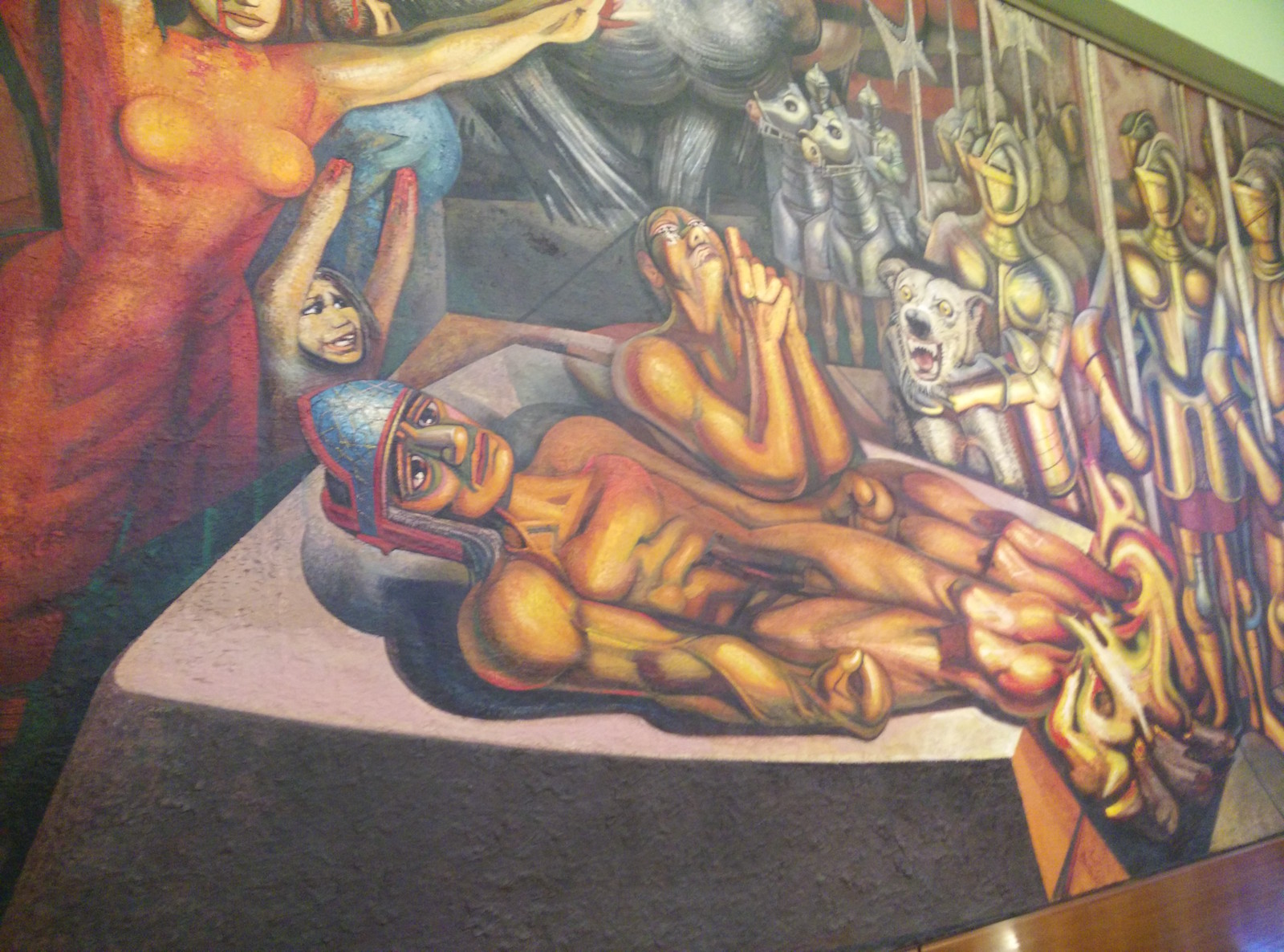
Upon humiliation, Cortes heaped physical torture when the invaders’ ransack of their captured city turned up far less lesser quantities of material loot than they had anticipated — torture which Cuauhtemoc and a cousin-king of a loyal Aztec ally both endured heroically without augmenting the Spanish bottom line. Bernal Diaz once again:

The next thing which Cortes did was to collect all the gold, silver, and jewels that had been found in Mexico, of which, however, there was very little; for Quauhtemoctzin, it was said, had ordered all the treasures to be thrown into the lake four days previous to his capture. A great quantity had likewise been purloined by the Tlascallans, Tezcucans, Huexotzincans, Cholullans, and other auxiliary troops which had assisted us in the siege, besides what had fallen into the hands of the troops on board the brigantines.

The crown officials were positive that Quauhtemoctzin had concealed the greater part, and asserted that Cortes was very pleased that the monarch refused to say a word where it was hidden; for he would then be able to get the whole treasure into his own possession.

The officers then proposed that Quauhtemoctzin and the king of Tlacupa, his most intimate friend and cousin, should be put to the torture, in order to extort from them a confession as to what had become of the treasures: but Cortes could not make up his mind to insult so great a monarch as Quauhtemoctzin, whose territory more than trebled that of Spain, and that for mere lust after gold. Moreover, the monarch’s household assured us they had given up all the gold they possessed to the officers of the crown, which, it was well known, amounted to 380,000 pesos, the whole of which had been melted into bars; and one thing is certain, that the emperor’s and Cortes’ fifths were deducted from that sum; but the conquistadores were not at all satisfied, and considered this sum much below the real amount, and several expressed their suspicion to Alderete, the royal treasurer, that Cortes’ only reason for not wishing to put the monarch to the torture was, that he might secretly take possession of all his riches. Cortes, not willing that such a suspicion should any longer he upon him, or that he should afterwards be called to an account on this score, at last consented that both should be put to the torture.


Detail view (click for the full image) of David Alfaro Siquieros‘s monumental 1950-51 mural, The Torment of Cuauhtemoc.

Boiling hot oil was then applied to their feet; upon which they confessed that, four days prior to Quauhtemoctzin’s capture, all the gold, with the cannon, crossbows, and muskets, which we had lost in the night of sorrows, when we retreated from Mexico, besides those which had been taken in Cortes’ last defeat on the causeway, had been thrown into the lake. A number of good swimmers were then sent to dive for the treasure in the spot they pointed out, but nothing was found. Yet there was some truth in the statement; for I was myself present when Quauhtemoctzin led us to a large and deep reservoir of water, built of stone, which lay near his palace. From this reservoir we fished up a sun of gold similar to the one sent us by Motecusuma, besides many jewels and other trinkets, though all of little value. The king of Tlacupa also informed us that he had hidden all manner of valuable things in some large houses, about twelve miles from Tlacupa, and he would accompany us there to point out the spot where he had buried them.

Alvarado was then despatched thither with six soldiers, among which number I also was; but when we arrived at the spot, this king assured us he had merely invented all this in the hopes that we would have killed him in a moment of anger at our disappointment.

(Diaz later added that “the suspicion was become pretty general that he [Cortes] had concealed the greater part of Quauhtemoctzin’s treasure,” and indeed some disgruntled companions — unsatisfied with the share they had been allotted for so magnificent a conquest — would come to lodge this charge against Cortes formally with Emperor Charles V.)

Cortes eventually brought both these hostages/puppet kings/torture victims along with him on a 1524-1525 expedition to Honduras, perhaps to deprive them of any opportunity to rebel in his absence.

On the evening of February 27, Cortes received a report or a rumor that the Indian kings had rebellion on their mind just the same. The timetable from this report to execution is uncertain from the records, but if it was not within 24 hours it cannot have been much longer. Diaz, a hostile-to-Cortes witness here whose narrative indicates his dismay at proceedings, describes it thus:

I have now to relate a circumstance of a very different nature, which occasioned much grief to us all. Quauhtemoctzin and other Mexican chiefs who accompanied our army had, it would appear, spoken among themselves, or secretly determined to put the whole of us to death, then march back to Mexico, and assemble the whole armed power of the country against the few remaining Spaniards, and raise an insurrection throughout the whole of New Spain. This circumstance was discovered to Cortes by two distinguished Mexican chiefs, one of whom was named Tapia, and the other Juan Velasquez. This latter personage had been Quauhtemoctzin’s captain-general during our war with Mexico, and his testimony was borne out by the investigation which Cortes made into the matter, and by the confession of several of the caziques themselves who were implicated in the conspiracy. These men fearlessly declared, that seeing how carelessly and dispiritedly we roamed about; that numbers of the men were ill from want of food; that four of our musicians, with the buffoon and five soldiers, had died of hunger; and that three other men had turned back, more willing to run the risk of reaching Mexico again than of moving forward, the thought struck them that they could not do better than fall suddenly upon us while we were crossing some river or marsh, particularly as they were upwards of 3000 in number, all armed with lances, and several of them with swords. Quauhtemoctzin did not hesitate to acknowledge that these men had spoken the truth, but added that the conspiracy did not emanate with him, and that he himself had never for a moment contemplated carrying it into effect, but had merely spoken about it with the other caziques. All the cazique of Tlacupa confessed was, his having declared to Quauhtemoctzin that it was better to die at once than daily to have death before their eyes on these fatiguing marches, and see their countrymen and relations perish with hunger.

These were sufficient proofs for Cortes, and without any further ceremony he sentenced Quauhtemoctzin and his cousin the king of Tlacupa to the gallows. Before, however, this sentence was executed, the Franciscan monks, with the assistance of Dona Marina, strove to comfort these unfortunate men, and commended their souls to God. When they were being led to the place of execution, Quauhtemoctzin turned to Cortes, and said: “Oh Malinche! I have for a long time perceived, from your false words, that you had destined me for such a death, because I did not lay violent hands on myself when you entered my city of Mexico! Why are you thus going to put me unjustly to death? God will one time ask this of you!”

The king of Tlacupa said, he could only rejoice in a death which he would be permitted to suffer with his monarch Quauhtemoctzin.

Previous to their being hung, both these unhappy caziques confessed to father Juan, who understood the Mexican language, and they begged of him to commend their souls to God. For Indians they were good Christians, and they died in the true faith, and fully believed in our holy religion.

The death of these two monarchs grieved me excessively, for I had known them in all their glory, and on our march they honoured me with their friendship, and showed me many little attentions; for instance, they would often order their servants to go in quest of fodder for my horse; besides which, they were innocent of the guilt imputed to them, and it was the opinion of all who accompanied this expedition that they were put to death unjustly.

But I will leave this miserable subject, and return to our march, on which we henceforth observed the utmost vigilance, for we greatly feared the Mexicans might rise up in arms against us, after they had thus beheld their monarch ignominiously hung by the neck from a tree. But hunger, fatigue, and sickness weighed heavier upon their minds than the misfortune of Quauhtemoctzin.


Detail view (click for the full image) of the “rebel” kings hanged from a tree.

Gomara and, of course, Cortes characterize the accusations against the Indian kings as true and the proceedings against them lawful. From the footnotes in this same Bernal Diaz volume, we have this from the later Jesuit historian and ethnographer Juan de Torquemada, who was fluent in Nahuatl:

I find it differently represented in a history written in the Mexican language, and which I believe to be perfectly correct. While Cortes (the Mexican author says) was quartered in a certain township, the Mexican chiefs one evening began to discourse among themselves about the recent hardships they had suffered, and Cohuanacotzin said to Quauhtemoctzin, to Tetlepanquetzaltzin, and to other distinguished Mexicans, ‘Thus you see, gentlemen, from kings we are become slaves, and we suffer ourselves to be led about by Cortes and this handful of Christians. If we were other people than we are, and would break through the promise we have made these Spaniards, we could play them a pretty trick here, and revenge ourselves upon them for all they have done to us, and the ill-treatment my cousin Quauhtemoctzin has suffered at their hands.’ To this the Mexican monarch replied, ‘I beg of you Cohuanacotzin to drop this subject, lest some one should overhear us, and imagine we were in earnest.’ It appears (continues Torquemada) that they were indeed overheard, for the whole of this discourse was reported to Cortes by a low-minded Mexican of the lower classes.

By law, Mexican flags fly at half-staff in his honor on February 28.

* These texts are cited throughout the post, but for ease of reference … Bernal Diaz: Memoirs of the Conquistador Bernal Diaz del Castillo, vol. 1, vol. 2 | Gomara: The Pleasant Historie of the Conquest of the West India; now called New Spaine | Cortes: History of New Spain, which is a Spanish text as I could not locate an English translation. However, even the Anglophone is liable to appreciate (from p. 225) the illustrations of Indian material culture observed by the Spaniards.

On this day..