1437: Walter Stewart, Earl of Atholl

On this date in 1437, the Earl of Atholl finally reached the end of a three-day carnival of public tortures and lost bowels, heart, and head for assassinating the King of Scotland.

When Atholl’s grandson Robert exploited the family’s familiar proximity to the king to admit a team of assassins on the night of Feb. 20-21 1437, it ended a strange run for James I.* James had been melodramatically kidnapped by pirates at age 12 and sold to the English — who held the Scottish king** for ransom for 18 years.

By the time James returned to native soil in 1424, he had had quite enough of being some other lord’s shuttlecock and irritated Scotch magnates — who had formerly enjoyed the run of the place and therefore dragged their feet when it came to repatriating their hostage king — by his overweening grabs at land, money, and power. One prime example that would come back to haunt him in the events of this post was the 1425 destruction of the Albany Stewarts, which netted the crown the forfeiture of three earldoms. Clients of the Albany Stewarts, like Sir Robert Graham, delivered a fair fraction of the 28 stab wounds that shuffled King James off this mortal coil.

But even James’s allies had to look sharp when it came to any demesnes not nailed down.

Our principal for today’s post, Walter Stewart by name, was one of these. James’s uncle and supporter, and the son of King Robert II, Stewart/Atholl had pushed for the magnates to ransom James.

Putatively seen as the king’s ally, Atholl’s complicity in regicide made him a byword for treachery to outraged Scottish chroniclers; the apparent grab for the throne led his captors to put a “corone of papir … upon his hed, the which was all abowte depaynetid with jubettes, and for the more dispite and shame to hym was writyne with thes wordes, TRAITOUR, TRAITOUR, TRAITOUR,” according to The Dethe and False Murdure of James Stewarde, Kyng of Scotys.

In a 1992 article on events† historian Michael Brown noted that what Atholl had added to his holdings through his nephew the king was the earldom of Strathearn, and it was but tentatively held: granted for Walter Stewart’s lifetime only, it would revert to the king with the septaugenarian’s death, leaving his heirs no better off than Walter’s own efforts had made them circa 30 years before.

Brown depicts the aging lord as a savvy operator who “would increasingly have despaired of keeping the earldom of Strathearn in his family … [as] a consequence of James’s general opportunism when it came to increasing the revenues of the crown.” A couple of specific adverse interventions that trimmed Atholl’s estates might have presaged — in the earl’s mind, at least — a potential royal move against his position, a move that Atholl would be best advised to check preemptively or never at all. Who could say in February of 1437 whether the Stewarts would by March or April still be royal confidantes in any position to have “left the Kynges chamburs doore opyne; and … brussed and blundird the lokes of hem, yn such wise that no man myght shute hem”?

If we’re not sure of exactly why they did it, we do know very clearly that the plot failed as a coup attempt. Both the queen and the six-year-old heir James II survived that evil night, and James’s violent deposition met not support, but horror. Within weeks the conspirators were hunted to ground. Atholl, for his part, protested his innocence of the regicide all the way to the end, a protest that neither contemporaries nor historians have much credited.

And his death declar’d that there is nothing more popular than justice, for they who were wont to detract from him whilst he was alive, now he as dead had most flagrant desires after him, insomuch that the Nobles, as soon as they heard he was murder’d, came in of their own accord from their respective countries and before a tryal was appointed they voluntarily sent out into all parts to apprehend the murderers and bring them to justice.

Very many of them were taken. The principal of them was put to new and exquisite kinds of death. The rest were hang’d. The chief heads in perpetrating the wickedness were reckon’d to be Walter Earl of Athole, Robert his nephew by his son, and their kinsman Robert Graham.

The punishment of Walter (because he was the chief author and instigator of the whole plot) was divided into three days suffering. In the 1st he was put on a cart wherein a stork-like swipe [crane] or engine was erected, and by ropes let through pullies was hoisted up on high and then, the ropes being suddainly loos’d, he was let down again almost to the ground with grievous pains by reason of the luxation [stretching] of the joints of his body. Then he was set on a pillory that all might see him, and a red-hot iron crown set on his head with this inscription, that he should be called King of all Traitors. They say the cause of this punishment was that Walter had been sometimes told by some female witches (as Athole was always noted to have such) that he should be crown’d king in a mighty concourse of people. For by this means that prophecy was either fulfill’d or eluded, as indeed such kind of predictions do commonly meet with no other events. The day after, he was bound upon a hurdle and drawn at an horse-tail thro’ the greatest street in Edinburgh. The 3rd day he was laid along upon a plank in a conspicuous place and his bowels were cut out whilst he was alive, cast into the fire, and burnt before his face. Afterwards his heart was pulled out and cast into the same fire. Then his head was cut off and expos’d to the view of all, being set upon a poll in the highest place of the city. His body was divided into four quarters and sent to be hang’d up in the most noted places of the best cities of the kingdom.

After him, his nephew was brought forth to suffer, but because of his age they would not put him to so much pain; and besides, he was not the author, but only an accomplice in another man’s wicked design, as having obey’d his grandfather therein, so that he was only hang’d and quarter’d.

But Robert Graham, who did the deed with his own hand, was carried in a cart thro’ the city, and his right hand was nail’d to a gallows which was set up in the cart, and then came executioners which did continually run red-hot iron spikes into his thighs, shoulders, and those parts of his body which were most remote from the vitals, and then he was quarter’d, as the former. After this manner was the death of James vindicated.

‘Tis true, ’twas a cruel one, but ’twas reveng’d by punishments so cruel that they seem’d to exceed the very bounds of humanity. For such extreme kinds of punishment do not so much restrain the minds of the vulgar by the severity as they do make them wild to do or suffer any thing; neither do they so much deter wicked men from committing offences by their acerbity as they lessen their terror by often beholding them, especially if the spirits of the criminals be so hardened that they flinch not at their punishment. For among the unskilful vulgar a stubborn confidence is sometimes prais’d for a firm and stable constancy.

Rerum Scoticarum Historia (1582)

* James’s successors handed down the throne, father James to son James, right down into the Stuart dynasty that came to rule England as well. This makes our James I an ancestor of such scaffold worthies as Mary Queen of Scots and Charles I.

** James was kidnapped in March 1406. His father Robert III died in April of the same year.

† “‘That Old Serpent and Ancient of Evil Days’: Walter, Earl of Atholl and the Death of James I,” The Scottish Historical Review, Vol. 71, No. 191/192, Parts 1 & 2 (Apr. – Oct., 1992).

On this day..

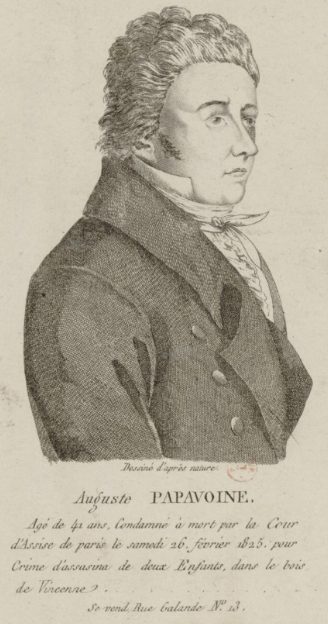
1825: Louis August Papavoine, An Execution in Paris

(Thanks to Dr. Robert Macnish, a young Scottish surgeon, writer, and polymath whose wide-roaming intellect earned him the nickname of “the Modern Pythagorean.” While resident in Paris, Macnish witnessed the public beheading of a French murderer on March 24, 1825 … an experience he rendered into the essay below. The crime which occasioned this spectacle was notorious in his brief day; Victor Hugo refers to Papavoine by name as “the horrible madman who killed the children with a knife to the head!” in The Last Day of a Condemned Man. -ed.)

AN EXECUTION IN PARIS.

In the month of March 1825, Louis Auguste Papavoine lost his head. He was guillotined at the Place de Greve for the murder of two children in the Bois de Vincennes. The man was mad, beyond all doubt, and in Great Britain would have been sentenced to perpetual confinement as a lunatic; but the French criminal court refused to admit the plea of insanity, and he was given over to the executioner: the Cour de Cassation having rejected his appeal from the decision of that which tried him.

To my shame be it spoken, I wished to see an execution by the guillotine. There was a sort of sanguinary spell attached to this instrument, which irresistibly impelled me to witness one of its horrid triumphs. When I thought of it, the overwhelming tragedy of the Revolution was brought before my eyes — that Revolution which plunged Europe in seas of blood, and stamped an indelible impression upon the whole fabric of modern society. There was something appalling in the very name of this terrific engine. M. Guillotine, its inventor, was also one of its victims — he perished by his own contrivance. [this popular legend is untrue -ed.] Let no man hereafter invent an instrument of punishment. Perillus contrived the brazen bull, and was among the first to perish by it. Earl Morton, who brought the “Maiden” to Scotland, underwent a like fate; and Deacon Brodie was hanged upon his own drop.

The day on which Papavoine suffered was beautifully fair; and, profiting by this circumstance, the idle population of the French capital flocked in myriads to witness his exit. It was calculated that there were not fewer than eighty thousand spectators. The Place de Greve was literally paved with human beings. A person might have walked upon their heads without difficulty; and so closely were they wedged together, that had any object larger than an apple been thrown among them, it could not have found its way to the ground. Men, women, and children, were clumped into one dense aggregate of living matter; and as the huge multitude moved itself to and fro, it was as the incipient stirring of an earthquake, or as the lazy floundering of the sea, when its waves, exhausted by a recent storm, tumble their huge sides about, like the indolent leviathan which floats upon their surface. There was no spot of the Place unoccupied save immediately around the scaffold, where a portion was squared off, and kept clear by a strong body of mounted gendarmerie, who kept back with their horses the living wall, which was every moment threatening to break asunder by the pressure behind, and intrude its animated materials into the proscribed area. Nor was the Place de Greve the only spot so crowded. The quays along the Seine were equally peopled, and even the opposite banks of that broad stream were filled with multitudes. Notre Dame shone with spectators, who had mounted its beetling towers to catch a dim prospect of the sacrifice; and every window and height, which afforded the most distant view, were similarly occupied.

In Paris, as in London, it is customary to let out those windows where a good view can be obtained; and on any occasion of particular interest — as the present happened to be — considerable sums are asked, and given. Sometimes half a Napoleon is demanded for a single place; and the sum varies from that to half a franc, according to the eligibility of the situation. Many of the windows are so near to the guillotine, that a very favourable prospect of the painful spectacle can be obtained; and these, of course, are crowded with persons who can afford to pay well for the gratification of their curiosity — if there be, indeed, any gratification in witnessing the instantaneous and sanguinary death of a fellow creature. Yet the view, even from the best windows, is not equal to that from within the open area. But into this space, it is no easy matter to get a footing; the few who are admitted being military men, and such of their friends as they choose to bring along with them. Indeed, at this time, there were few or no officers of any rank within the opening. It was mostly occupied by the gendarmes, who were there upon duty; and by a few dozens of common soldiers, whom curiosity or idleness had brought together. This, however, was the spot to which my wishes led me; and under the guidance of a young French officer of hussars, I was led into the area, and placed in front of the guillotine, not ten feet from its dreadful presence. But dreadful as it is from association, and from its destructive rapidity, this machine is by no means so appalling to look at as the gallows. The same feeling of horror does not attach to it; nor is the mind filled with the same blank dismay, or the same overpowering disgust, which are universally felt on beholding the gibbet, with its looped rope, its horrid beam, and its deceitful platform, which, slipping from beneath the feet of its victim, leaves him dangling and gasping in the winds of heaven. Somehow the same strong idea of disgrace is not connected with the axe as with the gibbet; but this may be from the thought that the noble and the good have shed their blood in torrents beneath its edge, thus giving it a sort of factitious interest, and deadening even with the most criminal the ignominy of its punishment. Nor is it coupled with such inveterate disgust, and such decided outrage to the feelings of humanity. Prolonged physical suffering is at all times revolting; and to see a human being struggling with a violent death — writhing in agony, and perishing like a dog — is the most detestable sight in existence. The guillotine distracts the fancy with no such sickening imagery. Whatever agony is sustained, is the more noble and enduring agony of the spirit, previous to the fatal hour. There is no struggle here with the grim tyrant — no painful encounter between life and death — no tortures like those which wrung Laocoön and his miserable offspring. From perfect life, the individual is transported to as perfect annihilation. He does not enter eternity by slow, unwilling steps: the spirit does not quit its fleshly mansion painfully and tardily, but leaves it with a sudden bound, and plunges at once into a new existence, there to be saved or lost, as its fate chances to be decreed in the Book of Life.

At the period of my admission, it was two o’clock — one hour exactly from the time of execution; and I had, therefore, abundant leisure to contemplate the engine of death, and to witness the behaviour of the vast multitude around it. Things were as quiet as could well be expected in so great an assemblage. There was plenty of talking, but much less disturbance than would have occurred in England upon any similar occasion. In truth, the only quarter which manifested tumult, was in the immediate neighbourhood of the area, which threatened every moment to be broken in, not so much by the fault of those directly in front of it, as by the immense pressure of those in the back-ground. Every now and then its square proportions were destroyed by a portion of the crowd which bulged inwards in a solid mass; and almost at the same moment, this violation of the straight line was repaired by the gendarmes, who kept riding along the square, and pressing back the intruding body into its proper place. The recklessness and fierce temper of the French soldiery were manifest, and formed a strong contrast to the good-humoured forbearance of our own troops. No ceremony was used towards intruders. Whoever came, or was forced into the square by his rearward companions, was thrust back with wanton violence. Where the pressure of the horses was resisted, the gendarmes made use of the flat sides of their sabres, and belaboured the crowd without mercy. The whole scene presented a strange picture of the fearful and the ludicrous. While it was distressing to witness the terrified crowd recoiling before the soldiers, it was amusing to witness the dexterity with which the latter treated the refractory — sometimes pushing them back with their steeds, sometimes beating them with their swords, and sometimes dexterously pitching off their hats into the assemblage. When any unfortunate fellow lost his chapeau in this manner, or received a salutary blow from the weapon of a gendarme, a loud shout of laughter was set up among the spectators. In fact, the whole, except thosewithin reach of punishment, were in excellent humour, and seemed to have come together more to enjoy a farce than witness the horrors of a public execution. Things continued in this state till the hour of three, which, pealing from the clock of the Hotel de Ville, announced the approach of the criminal. Scarcely had the fatal sounds swung upon the air, than the whole host was hushed into silence. They knew that the destined time was at hand, and that Papavoine was on his way to the scaffold; — and every man held his breath with deep interest, and felt, in spite of himself, a solemn awe fall over his spirit. But this dreadful silence did not continue long — for far off, in the direction of the bridge over which the criminal must pass, there was seen a heaving among the assemblage, which moved as if borne on the bosom of a vast wave; and murmurs like the half-suppressed voice of a remote volcano, were heard to proceed from this moving multitude. It was now evident that the procession approached; and every eye was turned towards that direction, and every ear wrought to its keenest pitch to catch the strange sounds which denoted its coming. Each moment the noise became louder, and the motion of the crowd more general. At last the trampling of horses was heard, and a troop of gendarmes, forcing a path through the recoiling people, were seen to approach. Behind them came a cart drawn by two horses; and in this cart sat Papavoine and an old Catholic priest. To the rear of this a second body of gendarmes brought up the procession. The criminal was a small, thin man, of about five feet six. He was dressed in a shabby blue surtout, and brown trowsers, and wore a fur cap upon his head. His arms were pinioned behind him, not by the elbows as with us, but by the wrists. He had no neckcloth on, nor shirt; and the collar of his surtout was drawn some way over his shoulders, so as to leave the neck quite bare and ready for the axe. Though pale and death-like, and seemingly impressed with the marks of sorrow and bad health, he exhibited no signs of terror or dismay. His demeanour was quiet and composed; and to the exhortations of his spiritual adviser he appeared to pay deep attention.

Now, here a scene took place which baffles description. No sooner had the wretch entered the area appropriated for his fate, than a shout of deafening execration arose from the hitherto silent multitude. No preparatory murmurs of hatred and revenge preceded this ebullition of feeling. It sprung up simultaneously, and as if those from whom it proceeded were animated with one soul, and felt one pervading vengeance thrilling through their hearts. “Wretch!” “Villain!” “Miscreant!” “Assassin!” arose in a wild swell from the crowd; and above the deeper voices of the men were heard the shrill imprecations of females, denouncing, with even more bitter wrath, the murderer. Had it been for almost any other crime, the women would have felt towards him more kindly than his own sex; but that for which he was to suffer was one of all others the most heinous to a maternal heart — and the natural fountains of woman’s tears were no longer free to flow in their wonted channel.

But Papavoine did not seem to hear the imprecations which were poured like vials of wrath upon his head — nor did he even appear sensible of the presence of those who so bitterly reviled him in his last moments. The cart stopped at the foot of the scaffold, and descending firmly, he conversed for one moment with the old priest, previous to mounting the fatal steps. I was at this time only a few yards from him, and marked him most distinctly. His look was perfectly calm and composed, and, had he died in a better cause, it would have been impossible not to admire his steady heroism. He said a single word in the ear of the priest who kissed him on the cheek, and left him, apparently much affected. Papavoine now ascended the guillotine rapidly and firmly, and committed himself to the hands of the executioner and his assistant satellite. At this part of the scene the loud execrations of the people had melted into breathless awe. Not a whisper was heard, nor even a movement among the vast and silent assemblage. The whole spectacle was dreadful — the very stillness of the crowd had something appalling in it; and the systematic dispatch with which the executioners proceeded among such universal silence, was sickening to the last degree. While gazing upon the victim, my respiration was almost totally suspended — my heart beat violently, and a feeling of intense anxiety and suffocation pervaded my frame.

The process was incredibly short. In a few seconds Papavoine was bound to a board which stood upright, and reached to the middle of his breast. The board moved on a pivot, and as soon as the malefactor was buckled to it, it was depressed, and shoved with its burden towards the groove of the guillotine, at the top of which hung the axe, ready to descend, on the pulling out of a small peg which kept it in its situation. A moveable piece of wood being now drawn down upon the root of the neck, to prevent all attempt at motion, and everything being ready, the executioner pulled a cord, and with the impetuosity of lightning, down came the axe upon its victim. Papavoine was annihilated in a moment. I saw his head slip from the body and tumble into a basket ready to receive it, while the blood spouted forth in little cataracts from the severed trunk, and dyed the scaffold with a purple tide. From the time when he appeared upon the guillotine till the head was severed, only twenty-five seconds elapsed — such is the appalling, yet humane rapidity of a French execution.

I looked attentively to observe if there was any motion in the trunk — any convulsive start at the instant of decapitation, but there was none. It lay from the first perfectly motionless, nor exhibited the slightest shudder — the least quivering — or the faintest indication that, the moment before, it was part of a sentient being, instinct with all the energies of life. This I did not expect. I conceived that a strong muscular spasm would have convulsed it at the fatal instant: and such, I am told, was the case with Brochetti, an Italian, executed some time before, and whose trunk sprung violently from its situation, and shook with universal tremor.

The momentary silence which pervaded the crowd previous to the axe’s descent was now broken, and an instantaneous movement ensued among its before tranquil numbers. The windows were deserted by their occupants; the doors poured their population into the streets; and the house-tops and black Gothic towers of Notre Dame were rid of the crowds which sat perched like eagles upon their lofty summits. But long ere this assembly had melted away, the guillotine had disappeared from the Place de Greve. Two minutes were allowed to elapse, that the head and body of the criminal might part with their blood.

They were then thrown into a long basket, and sent in the cart — which brought them alive — to the Ecole de Medecine for dissection. And the scaffold, after being cleansed of the gore, by having several buckets of water dashed over it, was taken to pieces, and deposited in the Hotel de Ville, till its sanguinary services were again required. The execution, together with the process of cleansing and dismantling the guillotine, did not occupy above seven minutes.

Next morning, the same curiosity which led me to witness this revolting sight took me to the Ecole de Medecine, to witness the remains of Papavoine. There were a number of scientific men present — among others, the celebrated Doctor Gall, who was employed in investigating the developements of the head, and pointing them out to several of his pupils. [A topic of great interest to Macnish, who also wrote a book about phrenology. -ed.] There was no portion whatever of the neck remaining attached to the trunk. It, as well as the head, had been severed from the body. The axe had struck at its very root, and even grazed the collar bone where it is fixed to the sternum. This is not in general the case, the neck being in most instances pretty accurately cut through the middle — one half of it adhering to the head, the other to the trunk.

I am not sure that I had done right in making such a scene as the above the subject of an article. There is something in the minute details of an execution, at which the mind shudders; and it is probable the reader may think that my impressions of the spectacle just related, should have been confined to my own bosom instead of being made public.

(For writerly firsthand accounts of the guillotine in action in the 19th century, compare to Tolstoy or Turgenev. -ed.)

On this day..

1823: John Newton, wife-beater

From the Hampshire Telegraph and Sussex Chronicle, March 31, 1823.

SHOCKING MURDER — At Shrewsbury Assizes, on Saturday, John Newton, a Farmer, living at Severn-Hall, near Bridgenorth, was tried for the Wilful Murder of his wife, Sarah Newton, by violently beating and striking her, by throwing her down on a sledge, and by kicking her, (she being five months gone with child), in consequence of which she languished three hours and then expired.

The provocation on her part was — having misapplied the trifling sum of three shillings.

Her children stood by at the time (the eldest not more than eight years of age) and exclaimed — “O dear! do not dad!”

The evidence clearly proved the initial act of the prisoner.

Mr. Justice Best, in passing sentence, spoke to the following effect: —

John Newton, you have been convicted, upon the clearest and most satisfactory evidence, of the dreadful crime of murder — a crime upon which Heaven has imposed a sentence. It was recorded in Holy Writ, that, “Whosoever shed a man’s blood, by man his blood should be shed.” You have deprived of life one whom it was your duty to protect and cherish: and for what cause? Why, because your wife had misapplied the trifling sum of three shillings.

Your humane and kind-hearted creditor had endeavoured to prevent you exercising your brutal chastisement upon your wife, and he told you he would rather lose this trifling sum than you should punish your wife. You promised him that you would not beat her. Notwithstanding this promise, notwithstanding she was in a state that not even a monster would have laid violent hands upon her, the dreadful threat you had uttered four hours before was put into execution.

You beat her to the ground; you kicked her on a part of her body which might almost in all cases have caused death, but especially in the state she was in. You acted as a most inhuman father, destroying that life which owed its origin to you; and you killed your wife at a time when it might be thought that the most savage, the most ferocious of mankind would be disarmed.

When she was lying in an alarming state from the bruises she had received at your hands, you refused to send for medical advice, and when she was lying on the floor you abused her in addition to your cruel conduct.

After thirty years’ experience in Courts of Justice, I confess I have never witnessed such savage conduct as yours. I hope to God you will obtain that mercy you were not disposed to show here. May you apply to him with a contrite and repentant heart, who is the distributor of all mercy, during the very short time you have to live; for no mercy can you obtain on this side the grave. You will have the assistance of a clergyman, who is better qualified than I am to teach you true repentance: and may God of his infinite mercy, so dispose your heart that it may be better fitted for another world.

There now remains for me only the painful duty of passing the sentence of the law — which is, that you be taken hence to the place whence you came, and thence to the place of execution, on Monday next, where you shall be hanged by the neck until you are dead, and your body shall then be given to the surgeons for dissection, and may God have mercy on your soul!

The prisoner, who is a robust-looking man of forty, showed little emotion during the trial, or when the verdict was given: but while the Judge was addressing him he seemed bewildered — looking wildly about him — moved, as if involuntarily, up and down as sick and once or twice attempted to turn away. He once put his handkerchief to his face, but did not want to shed tears.

On this day..

1768: James Gibson and Benjamin Payne, impressing James Boswell

(Thanks to James Boswell for the guest post. The Dr. Johnson biographer was a ravenous gallows-haunt whom we have encountered repeatedly in these pages; even in his guise as a barrister, Boswell personally lost a client to the hangman. No fool when it came to content repurposing, Boswell in 1768 wrote the Publick Advertiser about the March 23, 1768 double hanging of John Gibson and Benjamin Payne; then, in 1783, he recycled the entirety of this bygone letter to extend his musings on the spectacle of public executions, for the occasion of Tyburn’s abolition. We reprint here the 1783 article, a comment within a comment, within the very comment that is this dreary site. -ed.)

LONDON MAGAZINE,
FOR MAY, 1783.
THE HYPOCHONDRIACK. No. LXVIII.
Mitiores Poena nobis semper placuere. Justinian., 
'We have always preferred mild punishments.'

THE question, Whether society has a right to punish individuals, especially to the extent of death, which is well denominated in Latin “ultimum supplicium — the last or utmost punishment,” has been treated with great attention and ingenuity by a number of casuists in law and in morals. And of late it has been discussed with elegant ability by the Marquis di Marco, an Italian nobleman of Mantua, whose performance well becomes that celebrated city, while it shews that in modern times the descendants of those whom we are taught from our early years to admire, are yet worthy of admiration. So that we may quote from Addison‘s beautiful letter from Italy,

And still I seem to tread on classick ground.

It is indeed a question which resolves into the powerful and irresistible plea of necessity; since we are sure society could not exist without such a right. But the exercise of it, no doubt, admits of much modification, in which the wisdom and humanity of legislators has a wide field. Another Italian nobleman has done himself great honour by his admirable work “Delle de litte e delle pene,” which Voltaire has illuminated with some additional rays; and I can with pleasure mention, to the credit of our own nation, Mr. Eden‘s Principles of Penal Law.

These cursory remarks are only meant to serve the purpose of introducing into the collection of my Hypochondriack Essays, another of my former writings, which is, I think, well suited to my present title.

April 25, 1768.

To the Printer of the Publick Advertiser

Sir,

THAT the people of England possess that quality called good-nature, will not be denied by any man whose mind is not fretted by some real ills, or clouded by some fanciful ones. But it must also be acknowledged that the people of England are, of all nations in the world, the most desirous of feeing spectacles of cruelty. Bull-baiting, cock-fighting, and even throwing at cocks, were for many and many a year the delight of the English; and it is not long since assemblies of good-natured people were deliberately held to see their fellow-creatures beat, bruise, and sometimes actually kill each other.

Though the desire of seeing spectacles of cruelty has peculiarly prevailed in England, it has more or less been the passion of mankind in all ages and countries. Hence the various satires against it by poets; hence the various attempts to account for it by philosophers. Lucretius, who was both a poet and a philosopher, refers it to self-love, as we may see from that celebrated passage,

Suave mari magno turbantibus aequora ventis.

He thinks that men love to behold scenes of distress, that they may hug themselves in security, and relish more their own safety and ease, by comparing themselves with those who are suffering. Though I, as well as every rational and virtuous man, must think that Lucretius is in general a very false and a very hurtful writer; yet I must candidly own that he is often ingenious and just in his observations. In the present case he certainly has a great deal of merit; though I would be for compounding his system with that of the Abbe du Bos, who accounts for our desire of seeing spectacles of cruelty from the universal wish that we all have to be moved; that is, to have our souls agitated; for to be sure there is nothing so irksome to a man of lively sensations, as to have his faculties thrown into a kind of torpor, so that in Shakespeare’s words,

They cream and mantle like a standing pool

This will more fully account for what I am endeavouring to explains and will make human nature appear not so grossly selfish as Lucretius paints it.

Of all publick spectacles, that of a capital execution draws the greatest number of spectators. And I must confess that I myself am never absent from any of them. Nor can I accuse myself of being more hard-hearted than other people. On the contrary, I am persuaded that nobody feels more sincerely for the distresses of his fellow-creatures than I do, yor would do more to relieve them. When I first attended executions, I was shocked to the greatest degree. I was in a manner convulsed with pity and terror, and for several days, but especially nights after, I was in a very dismal situation. Still, however, I persisted in attending them, and by degrees my sensibility abated; so that I can now see one with great composure, and my mind is not afterwards haunted with frightful thoughts: though for a while a certain degree of gloom remains upon it. I can account for this curiosity in a philosophical manner, when I consider that death is the most aweful object before every man, who ever directs his thoughts seriously towards futurity; and that it is very natural that we should be anxious to see people in that situation which affects us so much. It is true indeed that none of us, who go to see an execution have any idea that we are to be executed, and few of us need be under any apprehension whatever of meeting with that fate. But dying publickly at Tyburn, and dying privately in one’s bed, are only different modes of the fame thing. They are both death; they are both that wonderous, that alarming scene of quitting all that we have ever seen, heard, or known, and at once passing into a state of being totally unknown, to us, and in which we cannot tell what may be our situation. Therefore it is that I feel an irresistible impulse to be present at every execution, as I there behold, the various effects of the near approach of death, according to the various tempers of the unhappy sufferers, and by studying them I learn to quiet and fortify my own mind.

I shall never forget the last execution I saw at Tyburn, when Mr. Gibson, the attorney, for forgery, and Benjamin Payne, for an highway robbery, were executed. Poor Payne was a thin young lad of twenty, in a mean dress, and a red night-cap, with nothing to discriminate him from the many miserable beings who are penitent and half dead with fear. But Mr. Gibson was indeed an extraordinary man. He came from Newgate in a coach, with some friends attending him. I met the mournful procession in Oxford-road; and I declare that if I had not been told it, I should not have known which was Mr. Gibson. He was drawn backwards, and looked as calm and easy as ever I saw a man in my life. He was dressed in a full suit of black, wore his own hair round and in a natural curl, and a hat. When he came to the place of execution he was allowed to remain a little in the coach. A signal was then given him that it was time to approach the fatal tree. He took leave of his friends, stepped out of the coach, and walked firmly to the cart. He was helped up upon it, as he was pinioned and had not the free use of his arms. When he was upon the cart, he gave his hat to the executioner, who immediately took off Mr. Gibson’s cravat, unloosed his shirt neck, and fixed the rope. Mr. Gibson never once altered his countenance. He refreshed his mouth by sucking a sweet orange. He shewed no stupid insensibility; nor did he affect to brave it out like those hardened wretches who boast that they die hard. He appeared to all the spectators a man of sense and reflexion, of a mind naturally sedate and placid. He submitted with a manly and decent resolution to what he knew to be the just punishment of the law. Mr. Moore, the Ordinary of Newgate, discharged his duty with much earnestness, and a fervour for which I and all around me esteemed and loved him. Mr. Moore seems worthy of his office, which, when justly considered, is a very important one, if administering divine comfort to multitudes of miserable beings, be important. Poor Payne seemed to rely on that mercy which I trust has not been refused him — Mr. Gibson seemed truely devout; and, in short, from first to last, his behaviour was the most perfect that I ever saw, or indeed could conceive of one in his unhappy circumstances. — I wish, Sir, I may not have detained you too long with a letter on subjects of a serious but I will not fay of a gloomy cast, because from my manner of viewing them I do say that they become matters of curious speculation, and are relieved of their dreary ideas. I am, Sir,

Your constant reader,
MORTALIS.

After an interval of fifteen years, I have little to add to this occasional essay. But I cannot but mention in justification of myself, from a charge of cruelty in having gone so much formerly to see executions, that the curiosity which impels people to be present at such affecting scenes, is certainly a proof of sensibility not of callousness. For it is observed, that the greatest proportion of the spectators is composed of women; and I do not apprehend that my readers will impute a barbarous severity to the fair sex, though it is common for lovers to represent them as metaphorically cruel. But in the one case they are cruel to others to be kind to themselves, by avoiding what is disagreeable to them. Whereas in the other case the pleasure must be from the sufferings of others independent of any such reference. That there, however, is such a pleasure I am afraid is true; and in support of my opinion, I bring no less authority than Edmund Burke, who maintains it in his Treatise on the Sublime and Beautiful. Yet let it not be supposed that this pleasure arising from agitation, prevents the finest feelings and effects of compassion; I am sure it does not.

As the great Justinian nobly expressed himself, I should wish that as mild punishments as are consistent with terrour were always inflicted. It is indeed astonishing how men have been found willing and able to execute some of the horrible sentences which have been put in execution upon some criminals. One shudders to think of them; and I shall not wound the minds of my readers by reciting particulars. They who wish to be shocked, or to gratify a monstrous curiosity, may read the tortures of Ravaillac or Damiens. A mode of death which strikes terrour into spectators, without excruciating the unfortunate objects of legal vengeance, seems to be the most eligible. I, therefore, think that the faces of those who are hanged should not be covered, as in Britain, but exposed, as is the custom upon the continent, that the distortions may be seen, which covered or uncovered must take place. I also think that the punishment of throwing criminals from the Tarpeian rock in ancient Rome was a very judicious one. But the best I have ever discovered is one practised in Modern Rome, which is called Macellare — to butcher.” The criminal is placed upon a scaffold, and the executioner knocks him on the head with a great iron hammer, then cuts his throat with a large knife, and lastly, hews him in pieces with an ax; in short, treats him exactly like an ox in the shambles. The spectators are struck with prodigious terrour; yet the poor wretch who is stunned into insensibility by the blow, does not actually suffer much.

But, indeed, death, simple death, when slowly and solemnly inflicted, will be fully sufficient to answer the purposes of publick punishment, as is very well demonstrated by Dr. Mandeville, in An Essay upon the Increase of Robberies, in which he has written with a very different spirit from that which prompted his very shrewd, lively, and entertaining, but dangerous Fable of the Bees.

On this day..

1824: David Howe, bitter debtor

On this date in 1824, David D. Howe (or “How”) was publicly executed at the upstate New York town of Angelica. Up to five or six thousand souls — several times the population of Angelica — were said to have turned out on a fair springtime morning for the hanging.

Howe’s fate could be read as a cautionary of life before the bankruptcy code. Financially ruined by an unsuccessful investment in a turnpike, Howe attempted to recover himself by farming only to sink ever deeper into debt. Creditors soon came to drag him cruelly under the water line, and in the summer of 1823 they repossessed much of what he owned — including “all my crops, my horses, cattle, and even my farming utensils,” which of course cratered the farming venture into the bargain.

“Had I had time to have turned my property, I would have been able to pay my honest debts,” Howe complained (somewhat optimistically, given his track record) from his dungeon a few days before he hanged.

And the worst of these oppressors in his mind was the victim, Othello Church — who seized “possession of much more than he was bound for, (in my opinion, and which he acknowledged to several persons before his death.)” From Howe’s desperate standpoint, Church “had taken advantage of my troubles, and taken property from me wrongfully, and several other persons seemed combined with him to work my destruction.” The two traded high words often and in public; Howe’s obvious motive would in time help to cinch the circumstantial case against him because he was sought so immediately after the man’s murder that his horse was discovered still damp from its evil ride, and the muzzle of his rifle not yet cooled from the assassination.

Still, Howe could justify the fancy of escaping detection: after all, motive had not been enough to convict him when he was arrested — correctly so, he would admit in gallows’ shadow — for vengefully torching the barn of another vulturous creditor.

And so on December 29, 1823, having observed that “the state of the snow [was such] that I might not be tracked,” Howe — after a couple of alibi-making calls at public houses — secreted his rifle under his coat and made the six-mile ride to the farm of his nemesis. Whatever the injustice of his provocation, it is obvious in his narration that he acted with sure deliberation:

I hitched my beast near Mr. Spear’s shop — took out my knife and rubbed the flint that it might not miss fire. — I took the mitten from off my right hand and put it in my pocket, and was careful not to drop any thing whereby I might be detected. I then stepped to his kitchen door, which opened near the head of his bed, and stood 5 or 6 minutes on his door stone. All creation seemed locked in slumber, and one dread silence reigned through all the works of God.

Now my bold heart even trembled at the thought of an act so desperate, and every vibration of my soul seemed shrinking beneath the horrors of the scene.

I rapped at his door, and shuddered and the very noise I made, and was on the point of retiring, when his wife, I think, awoke him, and he exclaimed, “Who is there?” I endeavored to alter my voice, and answered, “I have a letter for you;” he then said, “walk in;” I answered, “have the goodness to open the door and take it.” He arose, and as he opened the door, as soon as I saw the appearance of his white shirt, I shot at venture; I took no sight, and had the gun by my side, and I think the muzzle was not more than three or four feet from him. I then heard him exclaim, “Oh! my God, my God!!” I heard no more of him. I then returned to my beast; and every step was marked with care, lest I should fall or loose something, as it was slippery. The shocking cries and shrieks of the family broke the midnight silence, and rent the air with horror, which I heard considerable distance. I then rode with great speed home. I dismounted and loaded my gun in haste, and set into the window whence I had taken it; then put out my beast, went to bed, and went to sleep.

The quotes above all come from The Trial of David D. How for the murder of Othello Church at Angelica, which is freely available here; it contains the evidence given against How(e) at trial as well as the confession he dictated to Rev. Joseph Badger.

Badger, a traveling evangelist, would preach the sermon at Howe’s hanging; Badger left an ample journal of his 18-day ministry to the doomed Howe, and parts of that journal can be read in Badger’s memoir. (Unfortunately I have not been able to access the complete original which the memoir references.)

Howe seems by Badger’s account to have hurled himself sincerely, and almost voraciously, into the pious repentance expected of a condemned man. One might well imagine the grateful heart with which Howe, so lately picked into penury by stone-hearted foes, greeted the clergymen and neighbors who now took such an interest in his salvation.

March the 18th. He sent for me at daybreak. I found he had a restless night, and was in great distress. I made him several visits ; his family came to take their leave of him forever. At 3 o’clock P. M., the Rev. Mr. Boach, a Methodist minister, preached a short discourse in the dungeon from John 3:16. Five clergymen were present, and the scene was solemn. Mr. How took the lead in singing two hymns, and carried his part through in a graceful manner. In singing the first, he stood up and leaned partly on the stove; held his little girl by one hand, who sat in the lap of her mother, and with the other he took the hand of his affectionate brother, who stood by his side. At the close of the meeting, his wife gave him her hand for the last time. He embraced her with fondness, and when he pressed his little girl to his bosom (about four years of age) he wept aloud. He requested that several Christian friends should spend the night with him in prayer; thus his last night on earth was spent in imploring God for grace and mercy.

March the 19th. I entered the prison at break of day, found him much resigned. He observed, as I entered, that his last night on earth was gone, which he had spent in prayer. At 7 o’clock I visited him again with a company of ladies who had never seen him. Mrs. Richards, of Dansville, took him by the hand, both fell upon their knees, and she prayed for him in the most fervent manner. He then prayed for himself, for his family, for the family of Mrs. Church, who were afflicted by him, for his executioner, and all the world. As we came out, a gentleman remarked that he had never heard a man pray like him.

At 9 I entered his apartment for the last time, accompanied by his heloved daughter and a young man who was soon to become her husband. We entered with serious hearts; he received them very pleasantly, and made remarks to me on the fine weather, and the lady who had prayed with him. He asked of me the privilege of walking into the yard with the young man. They spent a short time together. He then asked me to wait on Harriet to the door. He placed her by the side of the young man, and delivered her to his charge, saying that she had long been deprived of the counsels of a mother, and would be in a few moments separated from her father forever. “I now commit her to you as a friend, protector,
and lover.”

On this day..

1563: Jean de Poltrot, assassin of the Duke of Guise

On this date in 1563, Jean de Poltrot de Méré was ripped apart in the streets of Paris for assassinating the Duke of Guise.

The opening act of the civil war between Catholics and Huguenots that would devour France in the late 16th century was but a year old at this moment, and Guise was the very man who had set off the powderkeg with a notorious massacre of Huguenots the previous March that had sent agitated confessional armies into the fields.

During the ensuing months, Guise stood at the fore of Catholic forces, opposite the Huguenot commander Conde.

Come early 1563, Guise was besieging the Huguenot-held city of Orleans when Poltrot (English Wikipedia page | French) contrived to ambush him on a nearby road. Poltrot shot Guise with a pistol* and fled; he’d be arrested a day later.

In the Wars of Religion, each previous atrocity justified the revenge that followed it; Guise’s death — and Poltrot’s confession under torture** that it was the Huguenot Admiral Coligny who directed his hand — would help to set the scene for the St. Bartholomew’s Day Massacre visited by Catholics on the Huguenots nine years later. (In fairness we ought also to add that this was not Guise’s first brush with Protestant assassins.) And heavily Catholic Paris was even before the Guise murder violently agitated against Huguenots. During the fighting in 1562,

Reputed Huguenots were struck down in the streets. Sometimes mock trials were held; the attackers grilled the captives on their religious beliefs and, when not satisfied with the answers, killed them on the spot. Officials who tried to intervene were themselves in danger, and edicts against violence were bitterly protested. As one anonymous memoirist described it, “The people wanted nothing less than permission to kill and exterminate the Huguenots without any form of trial; but the consequences were too dangerous.” He implied that permission might have been given, had it been possible to contain the violence.†

All this rage, when focused on the assassin of the Catholic party’s champion, was enough to tear a man limb from limb.

Poltrot’s sentence was to be publicly ripped apart by horses straining his limbs to the four points of the compass. It didn’t quite work: sinew and muscle is too dense and tough to shred by main force, even for a horse; it was only by dint of the the executioner’s helpful hacking that the beasts could dismember their prey.


Here’s a similar take in color.

Quartering by horses is a punishment so preposterously horrific that it could only belong to an age of intentional spectacle.

Indeed, Florike Egmond and Peter Mason argue‡ that until the 16th century such a theatrical execution “was a purely fictional punishment in Europe, which ever since Roman times emerged occasionally in literature, legend and folk-tales as an outrageous form of retribution for (high) treason and related offences” — such as Livy’s mythic rendering of the end given faithless ex-ally Mettius Fufetius, the supposed treatment of St. Hippolytus, and foggy distant Frankish legends

Although the concept might have existed in imaginations for centuries before, equine execution was at best a vanishingly rare event in reality; certainly when Poltrot was butchered, nobody present had ever before beheld such a sight. For Egmond and Mason, this was an innovation of his judges who “jumped the gap between fiction and historical records” in pursuit of ever “more expressive forms of punishment in order to emphasize the outrageousness of the offense.”

It was an outrage whose time had come, however, for quartering by horses was employed several times more for regicidal offenses in the ensuing decades — including for the Catholic militant who assassinated the Huguenot King Henri IV.

* This event would appear to dislodge the 1570 murder of Scotland’s Regent Moray from its popular acclamation as history’s earliest firearm assassination. As Guise lingered for six days and finally succumbed to effects of his doctor’s own bloodletting, perhaps the view is that Poltrot’s pistol only earned half-credit.

** Poltrot would later retract the claim, when not under torture.

† Barbara Diefendorf, “Prologue to a Massacre: Popular Unrest in Paris, 1557-1572,” The American Historical Review, Dec. 1985.

‡ “Domestic and Exotic Cruelties: Extravagance and Punishment,” The Irish Review, Autumn 1999

§ The chronicler Matthew Paris records a thirteenth century would-be regicide condemned “to be torn limb from limb by horses, at Coventry, a terrible example, and lamentable sight to all who dared to plot such crimes. In the first place, he was dragged asunder, then beheaded, and his body divided into three parts; each part was then dragged through one of the principal cities of England, and was afterwards hung on a gibbet used for robbers.”

On this day..

1784: Anne Castledine, infanticide

(Thanks to Meaghan Good of the Charley Project for the guest post. -ed.)

On this day in 1784, 28-year-old Anne Castledine was executed at Retford, Nottinghamshire for the murder of her newborn baby.

The unmarried Castledine had been obviously pregnant, “being much alter’d in the size and shape of her belly”, then suddenly she was not pregnant but there was no baby to show for it. Suspicious neighbors alerted the authorities.

Although she maintained her innocence, the circumstances were very much against her. Just two years previously, Castledine had been charged with murdering another newborn under identical circumstances. No medical evidence was offered at the trial and she was acquitted in spite of her confession — perhaps indicative of the discomfort European courts had about delivering infanticides to the executioner. But this second time, the judge ordered Castledine to a midwife’s examination.

Castledine then admitted to having strangled her baby after birth. She had sewed its body into her mattress and slept on it for several days before her arrest.

Castledine was hanged alongside Robert Rushton, who had murdered his daughter. As was the case with most murderers executed in England during this period, Anne Castledine’s corpse was dissected after her hanging. Elizabeth T. Hutton noted in her book, Dissecting the Criminal Corpse: Staging Post-Execution Punishment in Early Modern England:

Yet it was Anne’s body that aroused intense medico-legal interest in the Midlands. The General Evening Post recorded that both bodies were ‘taken to county hall in order to be publicly exposed and dissected’. Further source material uncovers however how gender dictated the precise medico-legal steps. Robert’s body was muscular and therefore valuable. He was opened up to be anatomically checked and later dissected in Nottingham town. Anne’s corpse was initially opened up with a ‘crucial incision’, the cross-like cut on her torso, to establish her medical death. Then it was ‘exposed on boards and tressels [sic] in front of County Hall for two days’ so that ordinary people could walk around it and see that a child killer was ‘truly dead’ … [T]he table was mobile, it could be levered up and down to take in and out of County Hall each night, and had to be erected twice on two separate days to satisfy the large crowds filing past over a forty-eight hour period. Meantime there was considerable local discussion about where to dissect such a ‘good body’. She was a fertile young woman and corpses like it attracted a lot of medical competition. In the end a decision was taken by a judge in consultation with the local medical fraternity to send her body to ‘a surgeon in Derby’.

That Derby surgeon, according to lore from the The Date-Book of Remarkable & Memorable Events Connected with Nottingham and Its Neighbourhood, 1750-1879, from Authentic Records, had a novelistic last encounter in the course of his autopsy.

The remains of the young woman were given to Mr. Fox, a surgeon, of Derby. While they lay in a barn near his residence, a strange gentleman came on horseback to view them. He took up the heart, kissed it, squeezed a drop of blood from it upon his handkerchief, and rode away. This gentleman was doubtless the seducer, who had come many miles to take a last look at the once beautiful object of his cruelty and lust.

On this day..

1718: Stepan Glebov, lover of the tsarina

On this date in 1718,* the vengeful tsar Peter the Great staged a horrible execution on Moscow’s Red Square.

Stepan Glebov was the collateral damage of Peter’s ferocious conflict with his ill-favored crown prince Tsarevich Alexei — the whelp who had only recently been repatriated to his glowering father after fleeing Russia altogether, to cap a lifetime of letting dad down. Alexei was back in Peter’s clutches, and a few months from the events in this post would be shockingly knouted to death at Peter’s orders.

This Freudian clash also mapped sharply onto Russia’s political schisms (and many of the links in this post are to Russian pages). Alexei was the son of Peter’s first wife, Eudoxia [or Evdokia] Feodorovna Lopukhina, a princess whom the teenage Peter had been required to wed as part of the political logrolling involved in overcoming the 1680s regency of his sister Sofia.

Peter had achieved that victory, definitively, and once it was secured it didn’t take him long to tire of both Eudoxia and of the stagnant boyar class she represented. Peter was all about westernizing the motherland; what better way to start than by immuring his Russian bride in a monastery** and grabbing a German merchant’s daughter for a mistress?


Out. (Painting by Evgeny Alexandrovich Demakov, from this Russian-language page)

The blows were borne together by Eudoxia, by her devout son Alexei, and by that part of traditional and Orthodox Russia horrified by Peter’s innovations. Resentments ran along the familiar channels, here to an immoderate fantasy of deliverance come Peter’s death and there to dangerous plans to immanentize same.

When exposed by to Peter’s hostile gaze little distance would there seem between these varietals.

When Alexei returned to face Peter’s investigation, the old man turned his harsh scrutiny on the ex, knowing her to be a locus of opposition. She was found living outside the monastery in secular garb, having taken an officer named Stepan Glebov as her lover. Their correspondence was ransacked by persecutors determined to discover indicia of treasonable scheming therein. Dozens of associates and monastery monks and nuns would be caught up in the affair, damned for anything from failing to prevent the former queen’s dalliance to plotting against the life of Tsar Peter. Most were stripped of rank and sent to exile with various forms of corporal punishment — whipping, severed nostrils, tongues sliced out — but several would be tortured to death or executed on the breaking-wheel including Dositheus, Bishop of Rostov, a confidante of Eudoxia who had allegedly prophesied Alexei’s triumph over his father, and Alexander Kikin, a mentor of Alexei’s who had helped to arrange his escape from Russia.

But upon Glebov, miserable man, Peter would give free rein to his amazing talent for cruelty: the lover to be impaled alive on a stake artfully inserted to miss all vital organs so as to maximize his suffering; some accounts even give it out that the naked Glebov was bundled in furs for the freezing winter’s execution, that he might endure his pains the longer.

Glebov survived impalement for over 14 hours, only dying after 7 a.m. on the morning of March 16. Folklore (it’s probably just that) has it that, importuned on that stake by the tsar to admit to the treasonable conspiracy, Glebov justifiably retorted that he had refused such a confession under unspeakable torment in Peter’s dungeons, so why would he break now? “Depart, and let me die in peace so that you may live without peace.”

Eudoxia’s brother Avram was also put to death in December 1718. She herself was shut up in Shlisselburg fortress for the balance of Peter’s life, but she would survive to see her grandson (Alexei’s son) take the throne in 1727 as Peter II.

* Julian date: it was March 26 on the Gregorian calendar.

** Suzdal‘s Pokrovsky Monastery.

On this day..

1824: John Smith

(Thanks to Meaghan Good of the Charley Project for the guest post. -ed.)

On this date in 1824, John Smith, 25, was publicly hanged before an angry crowd at Lincoln Castle for the murder of his fiancee, 24-year-old Sarah Arrowsmith.

John and Sarah had been seeing each other for a long time. Sarah had a three-year-old son by him, and was heavily pregnant with another child. She was under the impression that the wedding banns had been published and they would marry soon, but matrimony was the furthest thing from John’s mind.

On December 4, 1823, he bought a pound of white arsenic from the chemist for nine pence, saying he was going to use it for washing sheep. Instead, Smith mixed the arsenic with some flour and gave it to Sarah. She, in turn, baked some cakes with the poisoned flour and served them to her friends for tea.

Neil R. Storey records what happened in his book A Grim Almanac of Lincolnshire:

In less than a quarter of an hour, Sarah, her sister-in-law Eliza Smith, her friend and neighbour Mrs. Dobbs, and three children—two of them her younger sisters, and one of them Smith’s illegitimate child with Sarah—all suffered intense burning in their throats and excruciating pains in their stomachs. Several medical men were sent for and, immediately on arrival, the surgeons, Mr. Tyson West and Mr. Pell, set about administering antidotes and emetics. They rapidly had to admit that Sarah Arrowsmith was in a hopeless condition and sent for magistrates to take her deposition from her death bed. Sarah told them who had given her the flour and soon two constables were sent to the cottage where Smith lived in Little Steeping; they arrested him.

Although Smith presented two character witnesses at his trial who described him as a good farmhand and a sober, even-tempered and hard-working man, the evidence against him was strong and public sentiment equally so. The London Morning Chronicle reported on Dec. 27, 1823, that as Sarah Arrowsmith lay painfully expiring so heavy was the crush of gawkers that her bedroom’s only supporting cross-joint “snapped in the middle, and had not every person except the sufferer, who was in bed, made a hasty retreat, the floor would have fallen in.”

She succumbed the next day (to the poison, not to a fall) and “a great concourse of persons was assembled from all parts of the country round” to lay her to rest — “and the only feelings displayed upon the solemn occasion, were those of indignation against the unhappy wretch who was the author of the untimely death of the poor woman and her child.”

Smith could surely tell that his goose was cooked, and even as his life hung in the balance there was “an extraordinary apathy about him.” (Storey) Prior to his death he admitted his guilt.

It is believed that the other poisoning victims survived.

On this day..

1601: Henry Cuffe, mingled interest

When Francis Osborne mused “mingle not your interest with a great one’s,” in Advice to a Son, the counsel was suggested by surveying the life of Henry Cuffe, a retainer of the disgraced Earl of Essex who, “tho’ of excellent Parts,” hanged at Tyburn on this date in 1601 on account of his late master’s rebellion. (With him hanged Essex’s stewart, Gilly Merrick.)

A child of the gentry, Cuffe’s academic brilliance landed him a (still-extant) professorship at Oxford. The vain Lord Essex, who prided himself a patron of scholarship, hired him into his retinue in the mid-1590s. Cuffe would prove to be a loyal companion. Too loyal.

He accompanied Essex on the latter’s great foreign adventures, the triumphant raid on Cadiz and the disastrous expedition to Ireland, and was entrusted as the earl’s messenger to Queen Elizabeth when the latter project began to founder. Essex was one of the great men of state and it was through him that Cuffe came in sight of those zeniths of power only dreamt by Oxford dons. But he could only scale them if Essex kept his own footing, too.

Six years or so into their association, Cuffe was all-in on restoring his patron’s favor (and with it, his own) once Essex returned from the Ireland debacle to find himself on the outs. The treason trial against Cuffe would slate him as one of the chief spirits agitating the earl, imprisoned then in Essex House, to break out with his foolhardy rebellion or coup in February 1601.

“Ere long you shall see a change: my lord is like to come in favour again, and be restored to his greatness,” recalled one Essex rebel of Cuffe’s recruitment pitch to him. Once their seizure of power got underway, “We having the face of the state, all will follow and take with us.” It was alleged that Cuffe inveigled Essex against more cautious counselors, arguing that the lord’s charisma was sure to carry the day could he but secure some personal face time with the queen — and that Cuffe stood in line to become the next Speaker of the Parliament, should the wager pay off.

It didn’t. Treason doth never prosper …

Cuffe’s best argument in defense was that he, bookish lad, had never left Essex House at all on the fatal day when other conspirators attempted to march through London, and what treason was that?

“I must confess, as a servant that longed for the honour of his master, I have often wished to see his recalling to the court, and restored to her majesty’s former favour” Cuffe allowed — “but beyond the limits of these desires, my thoughts never carried me, nor aspired to other greatness than to see him again in place of a servant and worthy subject, as before he had been.”

The volume of accusations otherwise from within Essex’s inner circle overwhelmed this defense — most especially so the accusation of the very lord with whom Cuffe had so carelessly mingled his own fortunes. For, four days before Essex lost his own head, that doomed magnate had summoned his prosecutors to the Tower and bid them bring Cuffe to his chamber.

This request being granted him, and Cuffe brought before him, he [Essex] there directly and vehemently charged him; and among other speeches used these words:

Henry Cuffe, call to God for mercy, and to the queen, and deserve it by declaring truth. For I, that must now prepare for another world, have resolved to deal clearly with God and the world: and must needs say this to you; You have been one of the chiefest instigators of me to all these my disloyal courses into which I have fallen.

This is a very fine parting kick in the teeth for a devoted lickspittle. Maybe Osborne’s advice should have been to mingle not your interest with an asshole’s.

On this day..