1918: Fanya Kaplan, Lenin’s would-be assassin

On this date in 1918, a 28-year-old Jewish revolutionary was shot in Moscow for attempting to murder Vladimir Lenin.

Fanya (“Fanny”) Kaplan had actually drawn a life sentence for trying the same trick on a tsarist official 12 years before, so you couldn’t say she was a reactionary element.

No, she was a member of the peasant-based Socialist Revolutionary Party, the SRs — the Bolsheviks’ onetime coalition partners who had splintered into left and right factions, the latter being shut out of power when the Constituent Assembly was closed.

A peasant herself, Kaplan was incensed at the Bolshevik power grab and shot Lenin twice at close range as he left a factory on August 30.

Taken immediately, Kaplan clammed up in interrogation.

My name is Fanya Kaplan. Today I shot at Lenin. I did it on my own. I will not say whom I obtained my revolver. I will give no details. I had resolved to kill Lenin long ago. I consider him a traitor to the Revolution. I was exiled to Akatoi for participating in an assassination attempt against a Tsarist official in Kiev. I spent eleven years at hard labour. After the Revolution I was freed. I favoured the Constituent Assembly and am still for it.

Realizing there was no information to be had from her, the Cheka had her executed four days after her crime — an affair organized by Yakov Sverdlov, the same guy who had recently disposed of the tsar.

On the same day Kaplan took her shots at Lenin, Bolshevik Moisei Uritsky was (successfully) assassinated. The two murders helped justify the Red Terror officially initiated on September 2 — which saw thousands of politically-motivated arrests and executions as the Bolsheviks consolidated their hold on power.


YouTube hosts a great many dreadful student dramatizations of historical events, but this one of Fanya Kaplan by Georgia Tech students is remarkably watchable.

On this day..

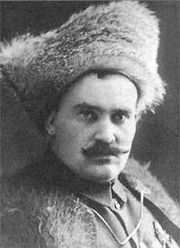
1946: Grigory Semenov, anti-Bolshevik

At 11 p.m. this date in 1946, White general turned Japanese collaborator Grigory Semenov (or Semyonov) was hanged for a generation’s worth of anti-Soviet depredations in the Far East.

The tsarist officer Semenov joined the Russian Civil War as a notoriously vicious White commander with the grandiosely retro title of Ataman of the Baikal Cossacks.

According to G. Patrick March, Semenov’s “penchant for killing, torturing, and looting” extended to executing a captured socialist by tossing the man into his locomotive’s fuel chamber.

Although also a rival in the suicidally fractious White political jostle, Semenov was the designated successor of Aleksandr Kolchak when the latter was shot in 1920, but by that time there wasn’t much left to succeed.

Knocking around the interwar era in gloryless exile, Semenov was an easy recruit for the Japanese war machine, which was in the market by the late 1930’s for locals with command experience and a grudge against Moscow and put him on retainer in Manchuria. Like the Soviet-Japanese front in general after Khalkin Gol, nothing much came of that enterprise; the Ataman’s last great hurrah was but a footnote for Japan, and his death would be a footnote in the annals of postwar victors’ justice.

Having picked a loser two wars in a row, Semenov was captured during the short-lived Soviet invasion of Manchuria at the tail end of the war and packed off for the inevitable. Five co-defendants, including Semenov’s son Mikhail, suffered death as well — although they were simply shot, while Semenov was ignominiously hanged. (According to White Terror: Cossack Warlords of the Trans-Siberian, the hanging was either botched or engineered to be an ugly strangulation job.)

On this day..

1906: Zinaida Konoplyannikov, assassin

On this date in 1906, less than three weeks after she had assassinated tsarist general Georgiy Alexandrovich Min (Russian biography), revolutionary Zinaida Vasilevna Konoplyannikov was hanged at Schlisselburg fortress near St. Petersburg.

Konoplyannikov is mostly noted in Russian sources online (for instance, here and here).

The daughter of a soldier and a peasant, she was educated — hardly a given for a low-born girl in the late 19th century — and taught in the Baltics and St. Petersburg around the turn of the century. By her profession, the plight of her similarly unprivileged students helped radicalize her.

She had a couple arrests for the usual subversive stuff (distributing illicit propaganda and the like) during Russia’s brief flowering towards liberalism in the 20th century’s early years. Those years would be bloodily reversed as tsarism reasserted itself after the revolutionary moment of 1905.

Konoplyannikov avenged herself on one of the great villains (from her standpoint) of that reversal, G.A. Min — commander of the Semenyovsky Life Guards regiment which bloodily bombarded Moscow’s Red Presnia working-class district to crush the last bastion of revolutionary sentiment in December 1905 at the cost of more than 1,000 lives.

Konoplyannikov gunned him down at a Peterhof train station the following August; in a closed military courtroom (giving her no opportunity to use the trial as an oratorical platform), the assassin was condemned to hang in less than an hour.

She was reported to have died calm, sure in the approaching victory of her cause:

the history of the Russian nation is a record of blood … the autocratic and bureaucratic structures are maintained only by violence … You cannot build anything upon the place of the old without first destroying the old. If it is impossible to catch ideas with bayonets, it is also impossible to resist bayonets with ideas only …

No repressions, no arrests, no prisons, no exiles, no shootings, no punitive expeditions, no pogroms, will stop the rising national movement.

I die with one thought: forgive me, forgive me, my people! I have so little to give you — only this, my life. I die full of faith in what will come … when the throne will crumble, and over the Russian plain, a broad, bright sun of freedom arise.

According to Abraham Ascher, Min’s assassination so spooked Tsar Nicholas II that for a time he refused to leave his room … a evocative and emblematic summary of the Romanov dynasty’s ultimately fatal dilemma.

On this day..

1944: Bronislav Kaminski, Waffen SS collaborator

On this date in 1944, the Gestapo eliminated more-trouble-than-he-was-worth Russian SS man Bronislav Kaminski.

The St. Petersburg-born Kaminski was Soviet by citizenship, but not Russian by nationality. Half-German and half-Polish, he’d done time twice for his questionable loyalties during the paranoid 1920’s and 30’s.

Turns out the commissars were on to something … or maybe, to paraphrase the old saying, that a Nazi is a Communist who’s been to the gulag.

Either way, when the front swept past Belarus where Kaminski was serving his post-release internal exile, the engineer jumped on an opportunity to join a classmate with the Russian National Liberation Army (RONA, or ROA). Kaminski soon rose to command the anti-partisan “army,” and earned an Iron Cross and the rank of Major General when it was incorporated into the Waffen-SS.

Unfortunately for Kaminski — and more so for anyone who happened to be in his unit’s vicinity — the 29th Waffen Grenadier Division was much better at roughing up partisans and their presumed civilian sympathizers than conducting disciplined military operations.

Little more than a roving band of armed thugs,* it was completely ineffective in the Siege of Warsaw earlier in August 1944, spending its time raping and looting instead.

That, evidently, was enough for Himmler, who had Kaminski eliminated** in punishment for his own looting (the booty was supposed to belong to the Reich), and the alleged rape-murder of German women along with all the expendables in Warsaw.

The exact trigger for this execution (for the juridical machinery always veils acts of discretion and intentionality; certainly, this is evident in a state like Nazi Germany) has never been completely clear; it may have been that between Kaminski and turncoat Red Army general Andrei Vlasov, the shrinking Reich had room enough for only one Russian commander.

Devil knows what he was commanding, anyway.

When, post-Kaminski, Vlasov assigned the remains of the RONA to Ukrainian collaborator Sergei Bunyachenko, the latter fumed, “So that’s what you’re giving me, bandits, robbers and thieves! You’ll let me have what you can no longer use!” … and soon bailed on his “patrons” by switching sides in the war yet again.

* It had some operations with the notorious Dirlewanger Battallion.

** The official announcement was that Kaminski had been killed in a partisan ambush; crazy conspiracy theorists refused to buy it.

On this day..

1952: Night of the Murdered Poets

As night fell this evening in Moscow, 13 prominent Soviet Jews were shot in Lubyanka Prison on trumped-up charges of treason and espionage.

“The Night of the Murdered Poets”, as it’s come to be remembered, wasn’t so much about the poetry; “only” five of the victims fit that description.

But as Joshua Rubenstein put it, “only the martyred Yiddish writers are mentioned at August 12 commemorations; the other defendants who lost their lives, as well as the sole survivor Lina Shtern, are rarely if ever remembered, perhaps because their careers as loyal Soviet citizens do not fit comfortably into an easy category for Westerners to honor … Stalin repaid their loyalty by destroying them.”

Falling victim to Stalin was such a particularly tragic fate because they were, in the main, good Communists:* good enough to have been part of the Jewish Anti-Fascist Committee, a World War II organ dedicated to rallying support for the Soviet Union against Nazi Germany.

Such national particularism — any port in a storm! — was all well and good when Moscow had the Wehrmacht at its gates and a short supply of friends, but it increasingly ran dangerously afoul Soviet officialdom as the 1940’s progressed. It was a bastion of sectarian identity rather than socialist universalism; its celebration of the Jewish soldier and of Jewish wartime travails cut against the narrative of Soviet sacrifice and heroism; its overseas links to the United States (where it toured in wartime) and the new state of Israel made it suspect, or at least vulnerable.

Thin excuse for mass execution, to be sure, but in a structure of generalized antisemitism run by a trigger-happy dictator …

In 1948-49, fifteen JAC members were arrested. One would die in prison; the aforementioned Lina Stern, a scientist, would receive a term of exile and return to Moscow when this purge’s victims were rehabilitated after Stalin’s death.

The thirteen others were tortured and condemned by a rigged (but secret, since many of the accused wouldn’t cop to public self-denunciations) trial

Years before his arrest, Markish would write words to make a eulogy for many a disillusioned Soviet citizen … and literally so in his case, since the verse was cited at his trial as evidence of his “pessimism”:

Now, when my vision turns in on itself,
My shocked eyes open, all their members see
My heart has fallen like a mirror on
A stone and shatters, ringing, into splinters.

Piece by piece I’ll try to gather them
To make them whole with stabbed and bleeding fingers.
And yet, however skillfully they’re glued,
My crippled, broken image will be seen.

* Naturally, being a good Communist did not keep one safe from Uncle Joe.

On this day..

1864: Romuald Traugutt and the January Uprising leaders

On this date in 1864, the leadership of Poland-Lithuania’s abortive January Uprising against the Russian tsar was hanged before 30,000 at Warsaw Citadel.


Romuald Traugutt depicted (somewhat ironically) on the 20-zloty note of Soviet bloc Poland.

Romuald Traugutt (English Wikipedia link | Polish) had been a decorated Lieutenant Colonel in the Tsarist army, and a heretofore apolitical man — but he resigned shortly after the outbreak of the doomed national uprising to take up sides against Russia.

This installment of the venerable Russians vs. Poles series was characteristically nasty.

In 1863 – Polonia by Jan Matejko, an allegory for the Polish nation is manacled by the Russians.

And it ended the way these affairs have ended these last 400 years or so: Russian victory.

The fallout was severe.

In addition to this day’s batch — Traugutt along with (all Polish Wikipedia links) Rafal Krajewski, Jozef Toczyski, Roman Zulinski and Jan Jezioranski — a further 391 were put to death after the war; tens of thousands were deported to Siberia or otherwise scattered in the vast Romanov empire; a war indemnity tax was imposed; and over three thousand estates in Poland and Lithuania were confiscated.

Traugutt has gained some latter-day support in the Catholic Church for beatification.

On this day..

1826: The Decembrists

On this date* in 1826, five leaders of the Decembrist revolt were hanged at St. Petersburg’s Peter and Paul fortress for their abortive eponymous uprising eight months before.

The most renowned and romantic of Russia’s hapless liberals, the Decembrists were a secret clique of idealistic young officers, many of whom had cut their teeth chasing Napoleon’s grande armee out of Russia in 1812.

In Russia’s complex interaction with the West — its ideas, its political institutions, its ways of life — these were the westernizers, who saw constitutionalism as the way of the future.

Upon the mysteriously sudden death of Tsar Alexander I, an irregular succession to the second-oldest surviving brother, Nicholas I, gave our day’s doomed and gallant youth cause to occupy St. Petersburg’s Senatskaya Square to uphold the rights of the first brother — and more to the point, to uphold the constitution to the extent of constraining the monarchy.
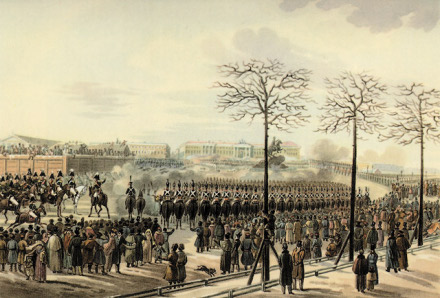

Decembrists at Senate Square, as depicted by Karl Kolman.

Uh … Now What?

This badly organized affair failed in its aim to attract the mass of soldiery and, constitutionalists as its organizers were, did not even aim at mobilizing the general populace.

After the initial heady rush of marching into the square in the name of liberty, the Decembrists were left in a standoff against a much larger force of loyalists. When the latter started shooting, that was that.

Those that survived faced trial, with five — Peter Kakhovsky, Kondraty Ryleyev, Sergei Muravyov-Apostol, Mikhail Bestuzhev-Ryumin and Pavel Pestel — initially sentenced to drawing and quartering.

“Mere” hanging was deemed sufficient for the purpose. That would be about the maximum embrace of liberalism by the Russian autocracy, whose lesson from the uprising was to crack down against any hint of forward-thinking politics — ultimately an unsuccessful strategy for the Romanov dynasty.

St. Petersburg’s Senate Square — renamed Decembrist Square by the Soviet government — where the action happened. The iconic equestrian statue of Peter the Great, commissioned by Catherine the Great and unveiled in 1782, witnessed it all; the statue acquired its enduring moniker, “The Bronze Horseman”, from a poem of the same title penned in 1833 by Alexander Pushkin, a friend of several Decembrists.

One of the greatest works of Russian literature, Pushkin’s “Bronze Horseman” weaves an ambiguous Decembrist-tinged critique of cruel imperial power and overreach into a complex narrative of St. Petersburg whose upshot is still up for lively literary debate. “The Bronze Horseman’s crag rose up before the poet on an empty square,” wrote one historian, “washed with the blood of those who rebelled on December 14, 1825”

Appalling there
He sat, begirt with mist and air.
What thoughts engrave His brow! what hidden
Power and authority He claims!
What fire in yonder charger flames!
Proud charger, whither art thou ridden,
Where leapest thou? and where, on whom,
Wilt plant thy hoof?

“They don’t even know how to hang you …”

When the hangings were carried out, Kakhovsky, Muravyov-Apostol and Ryleyev all had their ropes break; while some in the crowd anticipated the old prerogative of mercy for any prisoner who survives an execution, they just got re-hung instead. “Unhappy country,” quipped Ryleyev as the fresh nooses were fixed up, “where they don’t even know how to hang you.”**

Other Decembrists not condemned to the unreliable craftmanship of the Russian gallows were shipped to Siberia, where they invigorated the cultural life of the Lake Baikal city of Irkutsk — many of them famously followed by their “Decembrists’ wives,” an iconic type that continues to denote heroically sacrificial loyalty since the women had to renounce their own right to return to European Russia.

These, at least, had a place to call their own, however distant. But the class of Russian elites to which they belonged would be thrust into a trackless wilderness by their failure (in the Decembrist rising and otherwise) to carve out some distinct place for themselves. Russia’s long reckoning with modernity still had many years to run.


A worn postcard of a 19th century Russian painting depicting (perhaps) a political prisoner in the Peter and Paul Fortress.

* July 25 was the date on the Gregorian calendar; per the Julian calendar still in use in Russia at the time, the date was July 13.

** Ryleyev was quite the saucy one, having fought a “mysterious” duel with Pushkin in 1823, and instigated (and served as second at) a famous St. Petersburg jilted-love duel in 1825 that cost the lives of both antagonists.

A poet himself and a romantic to the point of fanaticism, Ryleyev wrote odes extolling executed national heroes like Artemy Volynsky and Severyn Nalyvaiko, seemingly alluding (as in this excerpt from the latter work) to his anticipation of joining them.

I know full well the dire fate
Which must upon the patriot wait
Who first dare rise against the foe
And at the tyrant aim the blow.
This is my destined fate

On this day..

1947: The avatar of Doctor Wonder

On this date in 1947, according to the modern mystical sect of Daheshism, the eponymous founder Dahesh was shot as a spy at the Iran-Azerbaijan frontier — only to reappear perfectly alive in his native Lebanon.

Not that Dr. Wonder.

This Dr. Wonder:

Now, every theology looks like mummery to an outsider practically by definition, and far be it from Executed Today to impugn anyone’s spiritual truth. But: you might want to strap yourself in for Dahesh.

Born Salim Moussa Achi, “le docteur Dahesh” — “a Franco-Arabic amalgam that translates as ‘Dr. Wonder'” — made his unusual name in Beirut in the 1930’s and 1940’s “for his mesmeric gaze, the sway he held over some highly placed Lebanese (especially women), and his propensity for performing Houdini-like ‘wonders’ — including transmuting strips of paper into banknotes, appearing and disappearing at will, removing his head before retiring, and summoning spirits.”

Expelled from Lebanon, he is supposed to have walked across Syria and Turkey to Azerbaijan,* been caught without papers in that dangerous neighborhood, and shortly thereafter executed as a suspected spy.

Next thing you know, he’s back in Beirut, ready to fulfill his destiny of dying in New York in 1984 as a collector of forgettable 19th century art. And also performing “thousands” of miracles revealing him to be the reincarnation of Jesus Christ, which we know for a fact because he never claimed to be Jesus.

Something like that. Finer points elided.

Daheshism today evidently claims a few thousand followers — including the wealthy Zahid family — and no centralized church-like entity. Its most prominent public billboard is New York’s Dahesh Museum, which houses the late Doc Wonder’s collection of the official French Academy art overthrown by impressionism.

And the miracle on this date in 1947?

Sure, you (o ye of little faith!) might think that he slipped back into Beirut and seized on the shooting of some poor undocumented schmo who happened to resemble him.

But actually, the trick was to swap places with one of your six celestial avatars, a race of real good sports about suffering martyrdom since that’s also what the “crucified” Jesus did.**


* The sourcing is mixed on whether “Azerbaijan” here should be considered the Azerbaijan Soviet Socialist Republic then a constituent of the USSR, or its neighboring Iranian region, also called Azerbaijan.

** In this, Daheshism echoes very longstanding mystical approaches to spirit/body dualism; some early Gnostic Christians seem to have believed that Christ was not flesh in the literal human sense, and therefore his apparent death was otherwise. The Koran also supports the notion that Christ did not die bodily.

On this day..

1881: The assassins of Tsar Alexander II

On this date* in 1881, five members of the Russian terrorist organization Narodnaya Volya were publicly hanged in St. Petersburg, where they had slain the tsar Alexander II a few weeks before.

“The People’s Will” etched in blood its place in the dangerous late 19th century ferment of Russian revolutionaries. In time they would read as the politically immature forerunners of the Bolsheviks, whose turn into terrorism was a political dead end.

But as of this date, they were at the top of their arc.

Every St. Petersburg tourist sees the place Alexander II died: the spot received a picturesque church that is now one of the city’s principal attractions.

On March 13, 1881, Narodnaya Volya assassinated the former tsar with a suicide bombing on the streets of St. Petersburg. With the death of the monarch who had emancipated the serfs, and was on the very day of his murder tinkering with plans to introduce an Assembly, liberalism arguably lost its weak purchase on Russia’s future.

The Nihilists** — who immediately sent an open letter to the new tsar demanding amnesty and a representative political body† — did not prevail in any direct sense.

Their dramatic gesture failed to ignite a social revolution or topple the autocracy, and they would find in Alexander III an implacable foe.

But while this spelled the end for the old man’s five assassins,‡ and even the end of Narodnaya Volya as an effective organization as the 1880’s unfolded, Alexander III’s efficacious repression was a Pyrrhic victory for the Romanov dynasty.

By depending on police operations rather than political reforms, Alexander III bequeathed his doomed successor a hopelessly backward political structure … and a considerably more dangerous revolutionary foe.


Refusal of Confession (Before Execution), by Ilya Repin, 1879-1885. (Via)

Alexander II’s death in the context of the times and its effect for Russia’s fate receive diverting treatment in a BBC In Our Times broadcast

* April 15 was the date on the Gregorian calendar; per the Julian calendar still in use in Russia at the time, the date was April 3.

** A quick summary of the strains of Russian revolutionary thought of the time here.

† Despite their dramatic tyrannicide, the Nihilists’ letter was angled for the consumption of mainstream post-Enlightenment Europeans. Karl Marx noted its “cunning moderation,” and its call for freedom and civil rights commonplace in more developed countries drew considerable support in the west. The Nihilists even took care to underscore their reasonableness a couple months later by condemning the senseless assassination of American President James Garfield. (See Inside Terrorist Organizations.)

Andrei Zhelyabov, Sophia Perovskaya, Nikolai Kibalchich, Nikolai Rysakov and — though he had backed out of the plot — Timofei Mikhailov, whose noose broke twice in the attempt to hang him. A sixth condemned assassin, Gesya Gelfman, escaped hanging due to pregnancy … but she and her child both died shortly after the birth.

Perovskaya gets adulatory treatment in this 1910 New York Times retrospective (pdf) on Russian political violence and repression.

On this day..

1009: St. Bruno of Querfurt

We have the rare privilege this date* to salute 1,000 years since the martyrdom of St. Bruno of Querfurt.

St. Bruno — also Brun or Boniface — had his head chopped off, and 18 companions were allegedly simultaneously hung or hacked to pieces, by a chieftain who did not appreciate the bishop’s efforts to Christianize the Baltics. The wherefores, and even the wheres (different sources locate it in Prussia, Rus’, or Lithuania) of this missionary’s end are permanently obscure to us.

But this relatively forgotten saint has something to tell us about the fluid area of contact between the Latin and Greek Christian spheres in the decades before their schism.

Lithuanian Institute of History scholar Darius Baronas argues** that although Bruno’s missions were conducted independently under papal authorization, he received support from the courts of both the Polish king Boleslaw the Brave and the Grand Prince of Kievan Rus’ Vladimir the Great.†

Both rulers hoped to extend their influence among the still-pagan lands of Europe, a secular incarnation of the rivalry between eastern and western rites.

So why is he so little-known to posterity? Baronas observes that St. Bruno

is a supreme example of a missionary saint and his activities ranged almost from the Baltic to the Black Sea. Yet despite his activities, let alone his glorious death, he did not receive much praise from his contemporaries and still less from later generations. His subsequent cult was rather circumscribed and was largely forgotten.

Precisely because of his ambiguous place between these two competing powers, and because his mission did not conform precisely with either’s policies of statecraft, neither Boleslaw nor Vladimir promoted a cult of Bruno: each realm was uncertain which side Bruno was on, and which side would profit most from his inroads among the pagans.

* February 14, 1009 is also cited as a date for St. Bruno’s martyrdom — for instance, by the Catholic Encyclopedia; the source of this may be the chronicle of Thietmar of Merseburg. In the absence of a determinative reason to prefer that earlier date, and allowing that 1,000-year-old executions are prone to shaky dating, I’m placing it on March 9 based on the Annals of Quedlinburg.


This text, reading “St. Bruno, an archbishop and monk, who was called Boniface, was beheaded by Pagans during the 11th year of this conversion at the Rus and Lithuanian border, and along with 18 of his followers, entered heaven on March 9th,” also happens to be the earliest surviving written reference to Lithuania.

** Darius Baronas, ‘The year 1009: St. Bruno of Querfurt between Poland and Rus”, Journal of Medieval History (2008), 34:1:1-22

† Vladimir the Great is himself a saint, too — in the Catholic tradition as well as the Orthodox.

Part of the Themed Set: The Church confronts its competition.

On this day..