1939: Stanislav Kosior, Vlas Chubar and Pavel Postyshev

On this date in 1939, a couple of “New Bolsheviks” recently flying high after helping purge the Old Bolsheviks had their own reversals of fate culminate with a bullet to the head.

Stanislav Kosior* (or Kossior), a Pole who ran the Ukrainian Communist Party for much of the 1930’s, and Vlas Chubar, a Ukrainian politburo member who had once served as Prime Minister, were shot this day along with Pavel Postyshev,** once Stalin’s personal representative to the Ukraine.

Left to right: Kosior, Chubar, and Postyshev — the first and last on post-rehabilitation Soviet stamps.

Though these obviously died because of parochial party politics under the terrifying reign of Stalin — and all were accordingly rehabilitated after Stalin’s death — posterity has another bone to pick with them: the Ukrainian famine known as the Holodomor.

Their portfolios included carrying out the forced collectivization to which the famine is generally attributed. Participation was strongly encouraged.

“Join the collective farm or else off to the Solovets Islands.”

Chubar

It was a grim time: starving peasnts dared not touch collectivized foodstuffs slated for use elsewhere on pain of execution themselves.† (Kosior won the Order of Lenin for his achievements in agriculture.) These Soviet VIPs themselves faced very similar pressure to implement Moscow policy and party line with exactitude … and very similar consequences for any perceived failure. (Kosior, too steely to succumb to torture, finally broke when his captors raped his teenage daughter in front of him.)

State organs adapted to the fall of these powerful men with Orwellian aplomb. “Radio Kosior” was renamed “Radio Kiev” overnight with its namesake’s arrest. Secret police chief Lavrenty Beria personally expropriated Chubar’s dacha. And

there is an account of a case in the Ukraine in which fifty students were charged with forming an organization to assassinate Kossior, who had been named as one of the senior intended victims in the great Moscow Trials. A year’s work on this case, which was a structure of great intricacy, had been performed by the interrogators. In 1938, however, it became known that Kossior himself had been arrested as a Trotskyite. Everyone thought that the students would be released. But a new interrogation immediately started, and they were beaten up for having lied to the NKVD. After a few days, the stool pigeons in the cells let them know what they were supposed to confess this time. It was to change their deposition, putting the name of Kaganovich for that of Kossior. The NKVD could not face the trouble of constructing a completely new fabrication. Finally everything was in order, and the students were sent off to labor camps.

A Ukrainian court recently named Kosior, Chubar and Postyshev among eight individuals personally responsible for the Holodomor.

* When Kosior was assigned to Moscow in 1938, he was replaced in the Ukraine by a good friend: future Soviet Premier Nikita Khrushchev. (According to Nikita’s son.) To judge by the ferocity and extent of the purges Khrushchev oversaw, he took to heart the lesson from his predecessors’ fall.

** But on the plus side, Russians’ and eastern Slavs’ (continuing) tradition of putting up New Year’s trees in at least partly attributable (Russian link) to a Postyshev epistle to Pravda in 1935 calling for same. (The New Year’s yolka was a religious/tsarist tradition that had been discontinued after the Russian Revolution, but like many such cultural artifacts proved amenable — with Postyshev’s nudging — to secular/Communist reappropriation.)

† The nature of the Holodomor is the subject of furious present-day wrangling: can the mass starvation accurately be classed as a “genocide”? Especially given that such a finding could expose Russia and/or Russians to legal liability, there’s something of a difference of opinion on the matter between Kiev and Moscow.

On this day..

1880: Ippolit Mlodetsky, Loris-Melikov’s would-be assassin

If you were a person of any privilege or official authority in late 19th century Russia, chances are that Narodnaya Volya was planning to take a shot at you.

If you were General Loris-Melikov, a Ukrainian Jew did that to you two days before this date in 1880.*

And if you were that errant assassin, Ippolit Mlodetsky, this was your execution date.

Even though Melikov rated as something of a liberal on the Russian autocracy spectrum, he had no qualms about ordering legal proceedings barely this side of summary.

Gen. Melikoff, on Wednesday evening, ordered a court-martial to assemble on Thursday morning. The trial of the prisoner was opened at 11 o’clock in the morning. The prisoner was insolent in his language and demeanor, and refused to stand up or take any part in the proceedings. He said he had nothing to add … that he did not want to be troubled any more, and wanted the matter finished. … at 1 o’clock … judgment was pronounced against him. The judgment on the prisoner sentenced him to be hanged, and his execution was appointed for 10 o’clock this (Friday) morning on the Simeonofsky Plain, near the Tsarskoe-selo Railway terminus.

And so he was.

Mlodetsky’s public hanging was witnessed by novelist Fyodor Dostoyevsky in the very square where Dostoyevsky himself had faced mock-execution for revolutionary activity 30 years before.

Dostoyevsky was, even then, pulling together his magnum opus, The Brothers Karamazov.

The very day Mlodetsky tried to kill Melikov found Fyodor Mikhailovich chatting with fellow reactionary journalist Aleksey Suvorin about the plague of terrorism and its accompanying social malaise.

On the day of the attempt by Mlodetsky on Loris Melikov I was with F. M. Dostoyevsky.

… Neither he nor I knew anything about the assassination. But our conversation presently turned to political crimes in general, and a [recent] explosion in the Winter Palace in particular. In the course of talking about this, Dostoyevsky commented on the odd attitude of the public to these crimes. Society seemed to sympathize with them, or, it might be truer to say, was not too clear about how to look upon them … (Quoted here.)

Dostoyevsky in this conversation revealed that for the planned sequel to The Brothers Karamazov — never to be realized in the event —

he was going to write a novel with Alyosha Karamazov as the hero. He planned to bring him out of the monastery and make a revolutionary of him. He would commit a political crime. He would be executed.

(Much more about this sequel in this paper.)

Melikov’s brush with death did not dissuade him from continuing to push for constitutional reforms as the antidote to terrorism, including introduction of a parliament. Tsar Alexander II was on the point of implementing that proposal … when he himself was assassinated by Narodnaya Volya, precipitating a political backlash.

That murder of Alexander II helped put the kibosh on the Karamazov sequel, which would thereafter have become politically problematic.

Nor was that the only artistic casualty of the Russian terrorists.

A discomfiting thematic similarity in Mlodetsky’s execution with that of the protagonist resulted in the cancellation of a just-opened opera: The Merchant Kalashnikov. (It would be a few more decades before that connection could appear ironic.)

* The assassination attempt occurred on February 20, with the execution on February 22, according to the Julian calendar still in use in Russia at that time. By the then-12-days-later Gregorian calendar, the dates were March 3 and March 5, respectively.

On this day..

1994: Andrei Chikatilo, the Butcher of Rostov

On this date in 1994, Ukrainian serial killer Andrei Romanovich Chikatilo was shot dead in a soundproof room in Novocherkassk, Russia, for a stupendous serial murder spree in the 1980s USSR.

The quintessential case study in anonymous middle-aged melancholy turned larger-than-life horror, the sexually dysfunctional Chikatilo raped, murdered and mutilated dozens in a homicidal career beginning at the unusually late age of 42.

After that initial foray into rape-murder in 1978, three years passed before the factory clerk (molestation allegations had drummed him out of teaching in the interval) began his harvest of 50-plus victims: children and teenagers of both sexes, and young adult women.

In addition to the staggering body count, the murders of the “Rostov Ripper” were marked by orgiastic savagery: breasts severed, eyes gouged out, genitalia mutilated and even eaten, and bodies lacerated with scores of stab wounds.

Like many monsters, he was also, as much as his more well-adjusted fellows, a creature of his own time and place.

Chikatilo was a socially maladjusted child in part due to his father’s capture by the Germans during World War II, subjecting the family to the postwar ostracism that awaited returning POWs. (Some sources also say Chikatilo saw his mother raped by German soldiers.)

The part of his life for which he’s most famous, meanwhile, drew out into a years-long bloodbath even though he was a suspect from the very first murder — a crime for which another man was wrongfully executed. Sclerotic bureaucracy and investigative cock-ups hobbled the police effort throughout, a sort of criminological emblem of the Soviet Union’s twilight. Authorities were loathe to involve the public by admitting the presence of a serial killer, a type officially associated with bourgeois society.

Chikatilo was arrested once in 1984 carrying a Bundy-esque murder kit, but authorities couldn’t make anything stick (Chikatilo’s Communist Party membership helped); another officer stopped him leaving the forest where bodies turned up, but didn’t search the satchel which contained his most recent victim’s severed breasts. Chikatilo was investigated early on, but ruled out as a suspect because of a blood type mismatch between his blood and crime-scene semen — apparently the result of a rare biological anomaly that (combined with authorities’ outsized confidence in forensic detection) bought him years of killing and involved thousands more suspects before investigators finally circled back to Andrei Romanovich.

Even at his last arrest, investigators who knew they had their man nearly let him slip away because they couldn’t charge him within 10 days — finally cajoling a confession and the killer’s cooperation at nearly the last possible hour.

According to Cannibal Killers, the Chikatilo task force solved 1,062 unrelated crimes, including 95 murders, while puzzling out the Rostov Ripper.

There’s much more about Chikatilo’s career at trutv.com; the 1995 film about the Chikatilo murders, Citizen X, indulges some dramatic license, but it’s pretty watchable for a TV movie.

On this day..

1940: Isaak Babel

On this date in 1940, Isaak Babel, “the greatest prose writer of Russian Jewry,” was shot in Moscow.

The Odessa-born 45-year-old had managed the difficult trick of maintaining a high-profile writing career in the 1930s Soviet Union without abandoning his artistic integrity. (This meant he published a lot less in that decade, which fact was held against him in his trial: “deliberate sabotage and a refusal to write.”)

A pre-revolutionary friendship with Maxim Gorky and an early affinity for the Bolsheviks had helped see him through such transgressions against Communist ideology as describing Red atrocities during the Russian Civil War, and writing a play about the underbelly of Soviet society.

Babel remains beloved today for that very reason; his Odessa Tales collection of short stories about Jewish gangsters still charms Russians and foreigners alike.

But Gorky died in 1936, and without that elder statesman’s protection, Babel’s insufficiently lockstep scribbling laid him increasingly liable to public denunciation for, e.g., “aestheticism.”

And as sickle follows hammer, miscalibrated revolutionary ardor in Stalin’s Russia led in 1939 to that dread knock on the door, that stay in Lubyanka Prison, that inevitable “confession” of Trotskyism, and that bullet to the head after a perfunctory trial.

Babel’s work is recent enough that it’s mostly not freely available in English. A couple in English and several in Russian are linked here; literary criticisms with plentiful excerpts of Babel’s work are available here, here, and here, among many other places.

Babel was officially rehabilitated during the Khrushchev era.

On this day..

1953: Lavrenty Beria, Stalin henchman

On this date in 1953, Stalin’s feared minister Lavrenty Beria was shot — finally on the receiving end of the cruelty he had administered to countless Soviet citizens.

Lavrenty Pavlovich was, like Stalin, a Georgian peasant, albeit one generation younger.

He won his way into Stalin’s confidence from the 1920’s, and in 1938 replaced Nikolai Yezhov as head of the KGB predecessor NKVD. Yezhov did much of the bloody work of the Great Purge, and was himself in turn purged. The cunning Beria must have taken note.

Though his initial project was to clean up the excesses of the Yezhovshchina — releasing thousands of innocent convicts, making the gulag camps less homicidal and more effective and keeping prisoners alive long enough to get some work out of them, that sort of thing — it wasn’t long before Beria cast a terrifying shadow of his own. (Beria was Yezhov’s deputy, so it’s not like he walked into the job without the requisite qualifications for mass murder.) He wrote the memo proposing the execution of Polish officers that led to the Katyn massacre.

To the more everyday repressive operations of the Soviet secret police, Beria added his notorious (perhaps propagandistically exaggerated?) personal peccadilloes: nothing to trouble the boss, just a little penchant for seducing, or raping, and at his pleasure murdering, comely young lasses.

Soviet author Sergei Dovlatov sketched his character in this imagined vignette (translated by Executed Today friend Sonechka from the Russian original here):

As is well known, winsome high school girls were delivered to Lavrenty Beria’s house. Then his chauffeur presented a bouquet of flowers to the next victim. And rendered her home. This was an established ceremony. Suddenly, one of the damsels became unruly. She began to struggle and scratch. In short, held her ground and did not succumb to the charms of the Internal Affairs minister. Beria told her:

-You can leave.

The young woman descended the stairs. The chauffeur, not expecting such a turn of events, handed her over the prepared bouquet. The girl, somewhat more composed now, addressed the minister who was standing on the balcony:

-You see, Lavrenty Pavlovich! Your chauffeur is more courteous than you are. He gave me a bouquet of flowers.

Beria sneered and dully uttered:

-You are mistaken. It is not a bouquet. It is a funeral wreath.

More consequential for his fate was his position among the handful of Stalin’s closest associates, in which capacity he maintained himself for a remarkably extended period of time. This made him one of the people with a shot at succeeding Stalin, which in turn put him in the middle of the furious political infighting Uncle Joe was pleased to subject his subordinates to.

And the natural enmity between sovereign and heir — the one whose interest is the other’s death — may have even led Beria to poison Stalin in March 1953 when he was on the verge of a falling-out himself. Foreign Minister Vyacheslav Molotov (he of the pact, and the cocktail) remembered in his memoir Beria boasting after Stalin’s sudden and mysterious death,

“I did him in! I saved all of you!”

Briefly the official #2 man in the post-Stalin state, he would again preside over a political liberalization that belied his monstrous personal reputation.

But this pallbearer of Stalin soon followed his former master to the grave. Outmaneuvered by rivals Nikita Khrushchev, Georgy Malenkov, and Molotov, Beria was purged as a traitor in the summer of 1953 and secretly executed Dec. 23, 1953 with six confederates after a summary trial before the Supreme Court. (One of the expedients laid at his feet in that affair was a set of executions he had ordered in a 1941 purge).

According to a chapter by Michael Ross and Anne E. Wilson in Memory, Brain and Belief, after Beria’s fall, subscribers to the Great Soviet Encyclopedia

were instructed to destroy the article on Beria and were provided additional information on the Bering Strait to fill the gap in the pages.

Beria’s heirs actually applied to the post-Soviet government for a reversal of the conviction under laws granting victims of politically motivated prosecutions right of redress. The Russian judiciary turned them down.

On this day..

1941: Masha Bruskina, Kiril Trus, and Volodia Shcherbatsevich, partisans

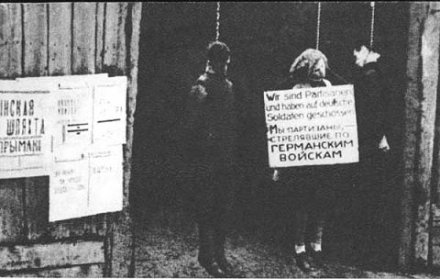
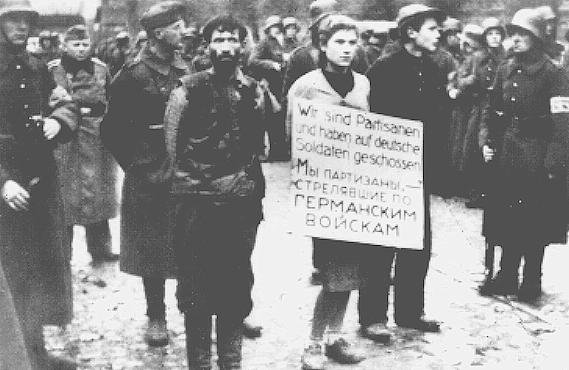
On this date in 1941, the German occupiers of Minsk conducted an infamous public hanging of partisans — perhaps the first such salutary public execution of resistance members of the war.

Jewish* 17-year-old Maria (Masha) Bruskina was the central figure of the grim tableau, and wore the placard announcing “We are partisans and have shot at German soldiers.” Evidently, she also attracted the most attention** from the onlookers to whom the scene was addressed.

Before noon, I saw the armed German and Lithuanian soldiers appear on the street. From over the bridge they escorted three people with their arms tied behind their backs. In the middle there was a girl with a sign-board on her chest. They were led up to the yeast factory gate. I noticed how calmly these people walked. The girl did not look around … The first one led to the gallows was the girl.

She was hanged with bewhiskered World War I vet Kiril Trus and the 16-year-old Volodia Shcherbatsevich. The men were members of a partisan cell organizing anti-fascist resistance; Masha Bruskina was a nurse who had been caught aiding the partisans by providing civilian clothes and papers for wounded Red Army soldiers under her care to smuggle them back to the resistance.

The scene of their deaths was captured in a series of powerful photographs taken by one of the Lithuanian Wehrmacht collaborators.

(More images here and here.)

* Phototextualities: Intersections of Photography and Narrative claims that Bruskina lightened her hair and changed her name to prevent her Jewishness affecting her resistance work; even though she was a Minsk native, her initial identification didn’t happen until 1968. The men who suffered with her were named almost immediately after the war.

** Despite the eye-catching place of the girl, she was officially unidentified for decades even after the name Masha Bruskina surfaced. In “A Historical Injustice: The Case of Masha Bruskina,” (Holocaust Genocide Studies 1997, 11:3) Nechama Tec and Daniel Weiss argued that Soviet authorities, and later Belarusian ones, found her Jewishness problematic and resisted identifying her because of it — while an ethnically Russian female partisan like Zoya Kosmodemyanskaya could be more conveniently accepted as a heroine. Maybe, but bureaucratic inertia and simple precedence (since Zoya Kosmodemyanskaya was known immediately while Masha Bruskina was not) are also plausible contributing factors.

A plaque unveiled at the Minsk yeast factory in 2009 finally called her Maria Bruskina.

On this day..

1946: The Nuremberg Trial War Criminals

Victor’s justice was never better served than this date in 1946, when the brass of Third Reich hung for crimes against humanity during the late World War II.

[audio:http://www.stelzriede.com/ms/mus/nuremexe.mp3]

(From this page of original period audio files.)

The landmark legal proceeding* is covered well enough in many other sources for this humble venue to break new ground.

Apart from trailblazing international law, the trial was notable for the gut-punching film of German atrocities; this relatively novel piece of evidence is available for perusal thanks to the magic of the Internet. Caution: Strong stuff. An hour’s worth of Nazi atrocities.The climactic hangings in the predawn hours this day in Nuremberg were conducted by an American hangman who used the American standard drop rather than the British table calibrated for efficacious neck-snapping. As a result, at least some hangings were botched strangulation jobs, a circumstance which has occasionally attracted charges of intentional barbarism.

Media eyewitness Kingsbury Smith’s taut report of the night’s executions (well worth the full read) described just such an ugly end for propagandist Julius Streicher.

At that instant the trap opened with a loud bang. He went down kicking. When the rope snapped taut with the body swinging wildly, groans could be heard from within the concealed interior of the scaffold. Finally, the hangman, who had descended from the gallows platform, lifted the black canvas curtain and went inside. Something happened that put a stop to the groans and brought the rope to a standstill. After it was over I was not in the mood to ask what he did, but I assume that he grabbed the swinging body of and pulled down on it. We were all of the opinion that Streicher had strangled.

There were in all 12 condemned to death at Nuremberg; all hanged this day except Martin Bormann (condemned in absentia; it was only years later that his death during the Nazi regime’s 1945 Gotterdammerung was established) and Hermann Goering (who cheated the executioner with a cyanide capsule two hours before hanging). The ten to die this day were:

* Its resultant Nuremberg Principles comprise a lofty articulation of principles whose actual application, as Noam Chomsky has observed, would have meant that “every post-war American president would have been hanged.”

On this day..

1764: Lt. Vasily Mirovich, for attempting to topple Catherine the Great

On this date* in 1764, one of history’s greatest monarchs cemented her still-uncertain hold on power by beheading a rebellious lieutenant.

Ivan VI: Born under a bad tsar.

Succession in the Russian Empire had been disputatious ever since Peter the Great went and killed off his last male son, eventually putting far-flung branches of the family into a contest for power.

To skip over much regal jockeying, Peter’s vicious niece Anna, who reigned in the 1730s, had installed her infant nephew Ivan VI as successor just before her own death.

The little Tsar of All the Russias was displaced before his second birthday by Peter the Great’s daughter Elizabeth, who clapped the former emperor in a dungeon in Schlusselburg fortress to grow up ignorant and alone, isolated from the parties who might scheme to bid for power in his name. Two Caesars are too many.

Into this dangerous scene stepped Sophia Augusta Frederica, better known to posterity by the name she took upon her politically savvy conversion to Orthodoxy: Catherine.

This Catherine immigrated to wed Elizabeth’s simpleminded heir, then overthrew him a few months into his reign.

Catherine had ultimate power, but she wasn’t yet “Catherine the Great”: as a foreigner with the late Romanov’s blood on her hands (if only indirectly), it was nowhere written that she would rule Russia for 34 brilliant years. And with the throne came its rival claimants … like Ivan, now an adult and potentially more “legitimate” than this imported German princess.

Ivan was held in Man in the Iron Mask-like secrecy, known only as “Nameless Prisoner Number One”; his warders had strict orders to murder him on the spot were any attempt made to liberate him.

Two years into Catherine’s reign, Lt. Vasily Mirovich, “a tormented young officer … with dreams of restoring his family’s fortunes,” attempted just that. As commanded, the guards put an end to Ivan’s troubles.

Those guards got cash rewards and promotions for their diligence. Mirovich got death. (Other soldiers whom he had rallied to his cause were condemned to run the gauntlet; I have been unable to ascertain if any were killed by this punishment.)

Mirovich was executed in St. Petersburg. When his head was held up to the crowd, it had a terrifying impact, the death penalty not actually having been exercised in Russia for 22 years.** Mirovich himself faced his execution calmly, convincing some of the bystanders that he was expecting to be pardoned at the last minute. His remains were left on public display until the evening, when they were burnt along with the gallows.

And so the first two years of the reign of Catherine II, who set so much store by reason and enlightened principles, had included two assassinations and an execution.

The woman of letters, the correspondent of philosophers, the Semiramis of the North … like the age’s other great enlightened despot, Frederick the Great, Catherine had to rule. She had not the luxury to dispense with statecraft’s cruel necessities.

Her admirers would have to be content with making her excuses. Fortunately, admirers always are.

“These are family matters with which I do not meddle,” wrote Voltaire. “Besides, it is not a bad thing to have a fault to repair; this engages her to make great efforts in order to force the public to esteem and admiration”

* September 26 (pdf) was the date on the Gregorian calendar then prevalent in Europe; it was September 15 by the older Julian calendar still used in Russia at the time.

** Not carrying out the death penalty had been a signature policy of Ivan’s usurper Elizabeth. The elimination of capital punishment in “backwards” Russia for an entire generation during the Age of Absolutism surely urges caution against any assumption that death penalty repeal is a one-way street.

On this day..

1918: The 26 Baku Commissars

On this date in 1918, 26 Bolsheviks and Left SRs were shot in what is now Turkmenistan, their bid to establish Soviet power in Baku defeated — temporarily.


The Execution of the Twenty-Six Baku Commissars, by Isaak Brodsky (1925)

The 26 Baku Commissars were the men of the Baku Commune, a short-lived Communist government in 1918 led by the “Caucasian Lenin,” Stepan Shahumyan. (He was a good buddy of the Russian Lenin, Vladimir Ilyich Ulyanov.)

In a cauldron of ethnic violence and against the military interventions of Turkey and Britain, these worthies were tasked with extending Soviet writ to the stupendous Azerbaijani oil fields* — the predominant source of tsarist Russia’s oil, and destined to be the engine of Soviet industry as well.

The Baku Soviet was expelled by the British, who inherited the bloody fight against an advancing Ottoman army.

Shahumyan and his fellow commissars, meanwhile, fled by ship across the Caspian Sea to Krasnovodsk (now Turkmenbashi, Turkmenistan), where they fell into the hands of a the anti-Soviet factions — backed, once again, by the British — of a brand new locale’s incarnation of civil war.

The commissars’ “presence in Krasnovodsk was a matter of great concern to the [anti-Bolshevik] Ashkhabad Committee, the members of which were seriously alarmed that opposition elements in Transcaspia might take advantage of the presence of the Commissars to stage a revolt against the government.” Said concern was relieved by the expedient of escorting the Baku Soviet to the desert and shooting them en masse.

The Red Army recaptured Baku in 1920, this time for good, and Shahumyan and friends were raised to the firmament of Communist martyrology, and not only in the Azerbaijan Soviet Socialist Republic. Streets and schools throughout the USSR bore their names.

As with many Soviet icons, the commissars had a rough come-down after the Iron Curtain fell. Their monument in Baku stood untended for many years, its eternal flame extinguished … until it was finally (and somewhat controversially) torn down earlier this year.


The Baku Commissars’ monument and its dead eternal flame, prior to its early 2009 demolition. Image (c) denn22 and used with permission.

* The Nobel family, which established the Nobel Prize, had a significant presence in the Baku petrol industry.

On this day..

1941: Olga Kameneva, Christian Rakovsky, Maria Spiridonova and many others by the NKVD

On this date in 1941, as Nazi armies surged into the USSR, the Soviet NKVD summarily executed a reported 157 prisoners held in the soon-to-be-Nazi-occupied city of Oryol (Orel).


Kameneva (top), Rakovsky (middle) and Spiridonova.

Most prominent among them were:

  • Olga Kameneva, a pol in the 1920’s, she was the sister of recently-murdered Communist heretic/Stalin gadfly Leon Trotsky, and she was the widow of executed Old Bolshevik Lev Kamenev.
  • Christian Rakovsky, internationalist Bulgarian revolutionary turned Soviet diplomat. Rakovsky, Dmitry Pletnyov and Sergei Bessonov had been the only three to avoid execution at the Trial of the 21, one of Stalin’s red-letter purges. But all three were shot together this day.
  • Prominent Left SR Maria Spiridonova, a revolutionary who had taken four decades of beatings from tsarist and Bolshevik alike, and who Emma Goldman saluted as “one of the most sincere, well-poised, and convincing” opponents of the Soviet regime.

Many other political transgressors less memorable than these went along with them, leftover targets of opportunity from a generation’s internecine purges and counterpurges.

Why bother to spend the resources evacuating an enemy of the people? By this time, Operation Barbarossa was nearly three months old, and mass prisoner executions ahead of the advancing Germans were a practiced art. One difference this day: this hecatomb was not in the western Soviet Republics, but in Russia proper.

In the autumn of 1941, the Left SRs Spiridonov, Izmailovich, and Mayorov, the Maximalist Nestroyev, and the SR Timofeyev were among the 157 prisoners shot in the Medvedevsky woods. (A Century of Violence in Soviet Russia

As many of them might have been denounced as “fascist” in their time for not hewing the correct revolutionary line, one doubts they would have enjoyed any more comfortable treatment at the hands of the Wehrmacht, which overran Oryol on Oct. 3.

On this day..