1918: Tsar Nicholas II and his family

In the small hours after midnight on the night of July 16-17 90 years ago, the former Tsar Nicholas II, his wife, children, and four family retainers, were shot in a Yekaterinburg basement by their Bolshevik jailers.

Doting family man, vacillating dictator, as weak and rich as Croesus … the doomed Emperor and Autocrat of All the Russias was a man small of stature. His reign emerged under a bad star when 1,300 Muscovites were trampled to death in the crush for his coronation largesse; 18 years later, Nicholas‘s support for Serbia against Austria-Hungary was instrumental in pitching Europe into World War I, a blunder for which he reaped a whirlwind long in the making.

When an anti-Bolshevik force approached Yekaterinburg (or Ekaterinburg), where the deposed royals had been stashed in a commandeered private residence,* Yakov Sverdlov (for whom the city was subsequently renamed) ordered the prisoners shot — not only the tsar, but his beloved wife, their hemophiliac heir, and those four daughters who had to be bayoneted because the state jewels secreted in their corsets shielded them from the gunfire.

The executioners (here’s the account of their leader; here’s another guard’s version) did their best to destroy and conceal the remains, helping fuel subsequent rumors that one of the children had survived and escaped.

Those rumors are only now, with post-Soviet investigation and DNA forensics, being debunked, and not yet to the satisfaction of all comers. This very week, Moscow affirmed (though the Orthodox church has not accepted) that the last of Nicholas’s family had been accounted for:

Modern nostalgia for this unimpressive sovereign is making a minor comeback, with Nicholas absurdly contending in a current poll for the title of “greatest Russian” … supported not only by the miseries of the state that succeeded his, but by the family’s decent and accessible private life.

Even a monarchist — especially a monarchist! — shouldn’t reason that the greatest monarch is the one who drove the bus over the cliff. But much is forgiven a martyr. Indeed, like Charles I of England, the last Romanov monarch has been posthumously saddled with divine sanction; he and all the family are certified “passion bearers”. (Update: And possible future relics!)

A handful of the many books about the Romanovs and their fall

* The Ipatiev House where the tsar was held (and shot) no longer stands. On its spot is a church consecrated five years ago yesterday to the Romanov canonization.

Update: The Romanovs were officially rehabilitated by the Russian Supreme Court on October 1, 2008.

On this day..

1946: Eleven from the Stutthof concentration camp

On this date in 1946, officials of Soviet-occupied Poland publicly hanged eleven convicted war criminals of the Stutthof concentration camp.

Set up immediately upon Germany’s September 1, 1939 invasion of Poland and not liberated until after official German capitulation in 1945, Stutthoff handled over 100,000 prisoners during its long service.

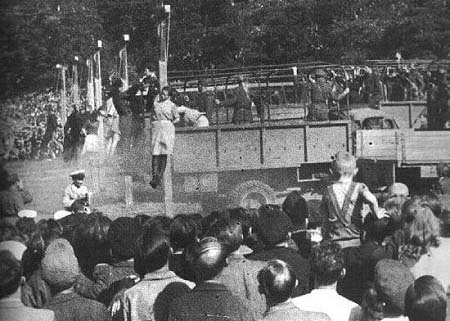
This day’s condemned — camp commandant Johann Pauls, five male kapos, and five female guards — were the product of the first of four Stutthof trials held in 1946-1947. At a hill in Gdansk known as Biskupia Gorka (Bishop Hill), upon a specially-erected row of four T-shaped double gallows centered around a pi-shaped triple gallows, and before a crowd of thousands, the doomed eleven were noosed on the back of military trucks which then drove away to leave them strangling to death with a “short drop” hanging.

The following gut-twisting images are among a number to be found here.

Above: on one end of the gallows row, the truck has just pulled away from Jenny Wanda Barkmann — a modish Hamburg lass in her mid-20’s known to Stutthof prisoners as “the Beautiful Specter” for her cruelty. Down the row, one can see that some of the prisoners are already swinging, while others have not yet been dropped.

Upon hearing her sentence, Jenny Barkmann retorted, “Life is indeed a pleasure, and pleasures are usually short.” (More about Barkmann, including trial photos, here.) In this closer view of her, just as in the first photo, she is still alive and struggling. Next to her, Ewa Paradies, another guard, is prepared for the same fate.

The central triple gallows. Commandant Johann Pauls hangs in the middle with Gerda Steinhoff — one of the senior female guards — in the foreground. The line of five male kapos recedes behind them into the enormous crowd of onlookers.

There’s more about Stutthof’s history at the Holocaust Research Project, and at the current memorial facility’s home page.

On this day..

1953: Dmytro Bilinchuk, Company 67 of the Ukrainian Insurgent Army

On this date in 1953, a guerrilla with the nom de guerre “Khmara” was shot in Kiev’s Lukianivka Prison for his involvement in a still-controversial resistance movement.

Dmytro Bilinchuk on the forest moon of Endor. UPA regs supposedly strictly prohibited photography; being rebels by nature, they snapped enough to fill up this page.

History is lived forward but understood backward. Therein lies the ambiguity of the Ukrainian Insurgent Army (UPA), a nationalist organization that operated in Galicia and environs after the Nazi invasion and persisted several years afterwards.

At its height, the UPA is said to have had up to 100,000 members, famously operating out of subterranean forest bunkers. This day’s victim was the captain of one of its companies; there is very little about him available online in English — principally his death date — but Ukrainian sites add the folklorish but poignant detail of his supposed adoption of an orphaned bear cub.

But about his organization, the name alone is sufficient to invite the most acrimonious debate:* were these partisans Nazi collaborators? Ukrainian patriots? Both?

Ukrainian nationalists, under the leadership of a man who had abandoned socialism for a fascist national ideology (everyone was doing it), entered the World War II era having conspicuously failed to grasp independence in a period when nationhood was being handed out like candy to small European states.

The specific kettle for Ukraine’s stewing ethnic aspirations was Galicia, the northeastern shoulder of the Carpathian mountains presently in western Ukraine. Galicia had been at the heart of both Polish and Ukrainian national movements, and they fought for it after World War I — a war won by Warsaw. (Meanwhile, Bolshevik victory in the Russian Civil War forestalled national ambtions further east.)

Brewed with the movement’s right-wing ideology, Ukrainian nationalism developed an anti-Polish, anti-Russian, anti-Communist programme, and it gazed around 1930’s Europe wondering if it couldn’t find an aggressive great power with a similar outlook that might take Ukraine under its wing.

Fast forward to the eve of World War II: by the terms of the Molotov-Ribbentrop Pact, Hitler and Stalin carved up the Ukrainians’ rival and thrust Galicia into Soviet hands, incidentally exposing its inhabitants to the pleasures of life under Stalin.

For Ukrainian nationalists, the altered situation of the Poland partition — followed shortly by Hitler’s initially successful invasion of Russia — offered an apparent opportunity to realize the dream of statehood under the patronage of a somewhat congenial Nazi government.

Though there’s a great deal of contention this author is not remotely qualified to referee about precisely which organs collaborated with or resisted the Nazis in precisely which ways, it seems fair summation to say that Ukraine’s nationalist movement was happy to treat with Berlin. Berlin being more reserved about a Slavic nationalist movement in its conquered territory, the UPA’s proposed institutional alliance with the Wehrmacht never quite came to pass as such, but that left many nationalists as freelance collaborators instead.** The hypothetical Ukrainian state in a Nazi-dominated Europe was not going to come about by sabotaging the Germans.

Instead, the UPA got busy laying the groundwork for an ethnically homogeneous Ukrainian homeland by fighting a reciprocal dirty war of ethnic cleansing against Poles in Galicia (most notoriously and emblematically, at Volhynia) — eventually developing into inter-partisan civil warfare against both Polish and Communist units (who had their own differences) with the odd brush with the Wehrmacht mixed in, and giving way to full concentration upon Soviet authorities as Red Army drove out the Germans.

The fact of having engaged German troops is a loudly bandied point in the UPA’s modern defense — the elevator pitch is that they “fought the Nazis and the Communists,” though it sure looks like they fought the one a lot harder than the other, and fought both less eagerly than they fought the Poles. There may be no cause to call UPA fighters other than sincere patriots of a nation whose aspirations were no less worthy than any other, who under beastly circumstances and for motives they believed noble committed sins no uglier than many other nationalists: even so, the thing separating that militia and its movement from, say, the Croatian Ustashi looks like opportunity rather than principle. Most perceived at the strategic plane a clear choice between Nazi victory with Ukrainian independence and Nazi defeat without, and most consciously preferred the former. No doubt the UPA would retort that its only other option was worse.

While Ukraine had a predictable exodus of anti-communist types as World War II drew to a close,† thousands of UPA guerrillas stuck around to keep up their fight (already underway) against the Soviets — including Dmytro Bilinchuk, whose biography can be enjoyed by readers of Ukrainian here.

It took a decade or more for Russia to extirpate this movement by hunting down its Bilinchuks. Buried in obscurity for the remainder of the Cold War, however, the martyrs of the OUN and UPA have pried open their tombs since Ukraine separated from the USSR in 1991 and become a contentious symbol in present-day Ukraine.

The OUN successor Congress of Ukrainian Nationalists has been part of Ukraine’s governing alliance since the Orange Revolution, and has pressed to treat its dead forebears as national heroes — renaming streets and attempting to rehabilitate UPA veterans into a class with those of the Red Army, a problematic enterprise since the two groups spent years killing one another. Old warriors may never reconcile, but the self-conscious reconstruction of the Ukrainian partisan movement in the service of shaping modern Ukrainians’ identity is a going concern:

Proving Faulkner’s old aphorism that the past isn’t dead and isn’t even past, this latter-day party and others of the Orange coalition remain electorally rooted in the UPA’s old western Ukraine stomping grounds, and tend to lean towards western Europe in outlook; eastern Ukraine remains more heavily Russian-oriented, and more inclined to the Russians’ distasteful view of the OUN and UPA.

* See, for instance, this Axis History thread, or the UPA’s Wikipedia discussion page.

** Late in the war, Germany would eventually form its own Galician SS Division. UPA proponents take pains to separate this German-officered formation from UPA guerrillas.

† Ironically, Ukrainians who bolted west — including the Galician SS division, which undertook a forced march to surrender in Italy rather than to the Soviets — profited greatly from having been “occupied” by Poland before the war, and from bloodily moving the border during the war. A refugee screening report (cited in Poland’s Holocaust — a source hostile to the UPA, as the title suggests) commented that Ukrainian detainees

are really having the best of both worlds. They do not qualify as Soviet citizens because their place of birth and/or habitual domicile on 1.9.39 were in Poland, and they therefore by our definition escape all punishment by the Russians for their having assisted the enemy; and they are not presumably eligible now for punishment by the Polish authorities because that part of the country from which they came is no longer part of Poland.

On this day..

1953: Julius and Ethel Rosenberg, “the first victims of American fascism”

On this date in 1953, Julius and Ethel Rosenberg were put to death in Sing Sing’s electric chair as Soviet spies.

Divisive since it was handed down — or more precisely, since a famous article in London’s Guardian challenged the verdict and helped elevate it into a latter-day Dreyfus case — the Rosenbergs‘ sentence has inspired so much acrimony over several generations that merely to observe the date is to invite a debate capable of eminently more heat than light.

Where to begin with a case so towering in the recent cultural milieu?

A textbook might say that Julius and Ethel were convicted of passing atomic secrets to the Russians, that they maintained their innocence and their defenders carried that flame years after their deaths, and that intelligence files opened after the Cold War — notably the Venona project — apparently confirmed that Julius was a spy after all, though Ethel seems to have been little more than an approving bystander and Julius, come to think of it, never had anything so worthwhile as atomic secrets to share with Moscow. This information (which does have its own skeptics, albeit a small minority) undermines the maximal “absolute innocence” position that this day’s victims always asserted, but it’s a curious leap to take it as vindicating the legal outcome.

“My husband and I must be vindicated by history; we are the first victims of American fascism.”

Half a century on, juridical guilt or innocence seems distinctly secondary in the lasting importance of the Rosenberg trial, the two-year battle to save them, and their potent symbolic afterlives.

The Rosenbergs are the only stateside judicial executions for espionage since the Civil War.* That is a remarkable distinction, after all; so, how comes it that it is held by — to state the case against them in its strongest imaginable terms — two enthusiastic but bush-league players, and not by the likes of Aldrich Ames? How was it that a judge with a largely center-liberal career on the bench would read them a sentence of death hysterically accusing these Lower East Siders of causing the Korean War?

[Y]our conduct in putting into the hands of the Russians the A-bomb years before our best scientists predicted Russia would perfect the bomb has already caused, in my opinion, the Communist aggression in Korea, with the resultant casualties exceeding 50,000 and who knows but that millions more of innocent people may pay the price of your treason.

I feel that I must pass such sentence upon the principals in this diabolical conspiracy to destroy a God-fearing nation, which will demonstrate with finality that this nation’s security must remain inviolate; that traffic in military secrets, whether promoted by slavish devotion to a foreign ideology or by a desire for monetary gains must cease.

It is here in the age of McCarthyism, in the shadow of the USSR’s balance-altering A-bomb test in 1949, that the Rosenbergs stand in sharpest relief — not because of “guilt” or “innocence”, but as the ne plus ultra of that era’s range of social discipline.

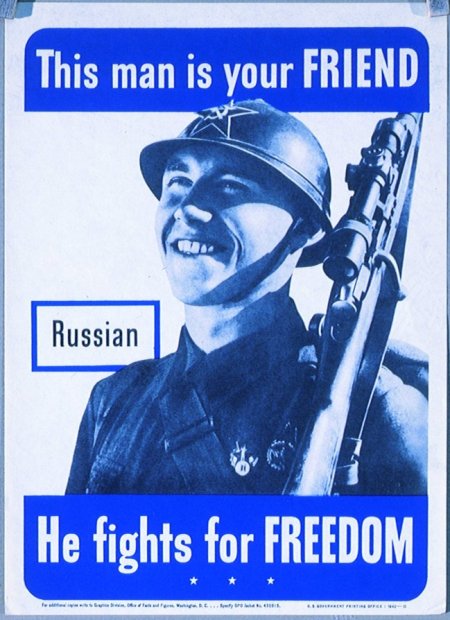
A few years before, the United States and the Soviet Union had made common cause against Hitler in World War II, the United States pumping war materiel to Russians bearing the brunt of the fighting.

No longer operative.

The Communist Party USA enjoyed membership rolls pushing six figures; other socialist parties and movements had found niches in American life in the interwar years.

As the Great War gave way to the Cold War, the great powers remained nominal allies (that’s the reason the Rosenbergs weren’t tried for treason), but shifted rapidly into conflict. The American polity organized to expel the red menace by rendering it foreign and criminal — ideological rigging for the forty years’ imperial contest ahead. Loyalty oaths, blacklists, the House Un-American Activities Committee … in the whole of the self-conscious construction of communism as “contagion”, the power and willingness of the state to kill Julius and Ethel Rosenberg formed the tip of the spear, and an ugly contrast to that same state’s solicitous handling of Nazi scientists then developing the vehicles to deliver atomic technology to Moscow in mushroom cloud form.

Though different in many particulars, the thrust will be familiar to any sentient denizen of post-9/11 America: the extreme penalty enforces a wall between the suspect and abject (but tolerated) loyal liberal and the enemy left. Depend upon Ann Coulter for the most brutal articulation:

We need to execute people like John Walker [the American-born soldier captured fighting for the Taliban in 2001] in order to physically intimidate liberals, by making them realize that they can be killed, too. Otherwise, they will turn out to be outright traitors.

Like most symbols, the Rosenbergs came by their exaltation by accident; at the strictly personal level, their deaths are nearly operatic performances of human stubbornness and bureaucratic inertia. Investigators rolling up a spy ring** were looking for confessions and names to keep the indictments coming.

Julius refused to provide either, so his wife was arrested for leverage against him on the reasoning that he would confess to protect her. The gambit failed: both prisoner and hostage remained obstinate. The government’s bluff had been called, and it ruthlessly executed its threat.

Had the two really been responsible for starting a war, execution would hardly begin to cover the bill — yet to the very foot of the chair, the condemned, and Julius especially for the sake of his wife, were pressed with offers of mercy for confessing and “naming names”.

Abjure or expire: show trial logic.

[audio:Julius_and_Ethel_Rosenberg.mp3]

An Execution in the Family

Given names to name, the personal mystery of their silence — the ultimate heroism or folly or tragedy or transcendence — only deepens the resonance of their fate both for contemporaries and posterity, the poignance of their orphaned children’s subsequent path, the contrast with Ethel’s brother David Greenglass who has since admitted to perjuring testimony against Ethel in order to shield his own wife. (Greenglass says the Rosenbergs died from the “stupidity” of not copping a deal of their own.)

Even before Julius and Ethel went to the chair this date,† they had become the emblem of a paranoid age. In the days following, Sartre savaged the United States for trying “to stop scientific progress by a human sacrifice”:

Your country is sick with fear. You’re afraid of everything: the Russians, the Chinese, the Europeans. You’re afraid of each other. You’re afraid of the shadow of your own bomb.

Decades later, the shadows haven’t faded altogether. In playwright Tony Kushner’s imagination, the spirit of Ethel stalks her real-life prosecutor, closeted McCarthy henchman Roy Cohn, as he succumbs to AIDS in the 1980’s.‡

Rosenberg resources — and vitriol — are in plentiful supply online and off. A good starting point on the case is this page at the University of Missouri – Kansas City. Be sure to check the tale of a last-ditch legal maneuver that almost succeeded.

* There is one partial exception in the unusual case of six German saboteurs electrocuted in Washington, D.C., during World War II on a charge sheet that included espionage. The hearing was held by a military commission and only one of the six was an American citizen, so it was far from the regular judicial process — if one can call it that — the Rosenbergs faced.

** Originating in the investigation of Klaus Fuchs, the man who actually did what Julius and Ethel Rosenberg were accused of doing — passing atomic secrets to Moscow — although with debatable ultimate effect for the Soviets’ research. Fuchs served nine-plus years in a British prison and was released to East Germany; more than a few were galled at the difference between his sentence and the Rosenbergs’.

Stateside, George Koval was another spy far more valuable to Moscow in the nuclear race than were the Rosenbergs. Koval got away clean and died in Moscow in 2006.

† Julius first, then Ethel. Her execution was botched; repeated shocks were required to kill her.

‡ Cohn’s posthumous autobiography did acknowledge illegally rigging the Rosenberg trial, as his Kushner character does.

On this day..

1958: Imre Nagy, former Prime Minister of Hungary

Fifty years ago today, the onetime Hungarian Prime Minister and three others associated with the country’s shattered 1956 revolution were hanged in Budapest for treason by the Soviet-backed Hungarian government.

A moderate Communist, Imre Nagy assumed leadership of Hungary from 1953 to 1955, a period of ideological thawing after the death of Joseph Stalin.

Nagy charted a “new course” towards Austrian-style neutrality or Yugoslavian-style “national Communism” not yoked to Moscow, opposed domestically by his predecessor and rival Matyas Rakosi, who eventually ousted the reform-minded minister.

But Nagy’s anti-Soviet credentials saw him elevated back to the office by popular acclamation during the 1956 Hungarian Revolution — an interval of the nation’s history still deeply cherished in Hungary today. Here’s a recollection by newsreel montage to the strains of Beethoven’s salute to the national martyrs of another time and place.

Nagy held the office for only ten days before Soviet intervention crushed the revolution. He issued this radio appeal to the world (in Hungarian, followed by the English version at about 0:34) on November 4, 1956:

[audio:Imre_Nagy_broadcast.mp3]

It was an appeal against all geopolitical realities; Hungary was the Soviet Union’s sphere, and western counter-intervention could have precipitated World War III. Verbal outrage abounded, of course:

But Khrushchev gibed that the United States had “supported” the revolution “in the nature of the support that the rope gives to a hanged man.”

For all that, the abortive revolution has won the benediction of history: still venerated in Hungary, and arguably a turning point in the postwar world when the Soviet Union set itself unmistakably and, eventually, fatally against the legitimate aspirations of its subjects.

Nagy’s statue in Budapest’s Martyrs’ Square. Creative Commons photo by Martin Ujlaki.

Less the leader of this stirring movement than carried along by it, Nagy nevertheless embraced the revolution fully.

His government hardly had the opportunity to implement any sort of programme, but it gestured towards multiparty parliamentary democracy. Nagy attempted to withdraw Hungary from the Warsaw Pact. And to the fame of his memory, he refused Soviet blandishments after his capture to recant and accede publicly to the new Hungarian government.

For these principles, Nagy, his defense minister Pal Maleter, and revolutionary officials Miklos Gimes and Jozsef Szilagyi underwent a weeklong trial June 9 to 15, culminating in execution on this date — all strictly hush-hush, and not announced until the bodies were cold.

Though secret, the trial was tape-recorded in its entirety. This past week, to coincide with the anniversary of the affair, the full 52 hours of audio were publicly aired for the first time — over the same June 9-15 span, and at the location of the original trial. The recordings are held by the Open Society Archives, which maintains a wealth of information on the 1956 revolution (such as, topically, this ‘death circular’ issued by anti-Soviet Hungarians). Formerly held under lock and key, the audio files are not yet published for public distribution at this point, but one would expect that it’s only a matter of time.

Nagy and his companions were officially rehabilitated and, on this date in 1989, reburied with honors; tens of thousands turned out to pay respects that had been officially prohibited for 33 years. In this chaotic period as Soviet domination of eastern Europe crumbled, their fellow-traveler Bela Kiraly (who gives a fascinating account from the inside of the Revolution in this 1996 interview) returned from exile for the reinternment ceremony and found that he was technically still under the sentence of death he had received in absentia at Nagy’s trial.

On this day..

1937: Mikhail Tukhachevsky and seven other Soviet commanders purged

Early this date in 1937,* Soviet Marshal Mikhail Tukhachevsky was executed by a gunshot to the head for allegedly plotting a coup d’etat against Stalin.

One of the most infamous trials** of the Soviet Union’s Great Purge, which would strip the Red Army of much of its officer corps on the eve of its existential test against the Wehrmacht, the Case of the Trotskyist Anti-Soviet Military Organization has always offered fodder for debating the whys and wherefores.

The bare facts are that nine extremely high-ranking members of the military brass were suddenly arrested and within a few weeks (except the one who committed suicide first) shot on the staggering charge of counterrevolutionary conspiracy. Foremost among the victims was Marshal of the Soviet Union Mikhail Tukhachevsky, notable in the annals of military history for pioneering (along with several other Soviet officers, notably Triandafillov) the military doctrine of “deep battle” or “deep operations”.

Deep Battle

Reflecting on the grinding, indecisive struggles of attrition that characterized World War I and the Russian Civil War (both conflicts Tukhachevsky served in), he sought a theory of offensive warfare for modern armies fighting in large and complex engagements — the operational art. In an early (1923) formulation, Tukhachevsky noted

the impossibility in the presence of modern wide fronts to destroy an enemy army by a single blow compels us to achieve this by a series of successive operations … A series of annihilating operations, introduced successively and combined by continuous pursuit, can replace the annihilating engagement, which in former armies was a better type of combat. (Cited here.)

Deep operations would require sophisticated application of technology to strike an opposing army’s entire support structure behind its lines in coordinated operations, rather than the unproductive World War I tactic of throwing waves of cannon fodder across No Man’s Land in the hope of achieving a breakthrough by sheer mass alone. It ripened into official Red Army doctrine in the 1930’s, decreeing

[s]imultaneous assault on enemy defenses by aviation and artillery to the depths of the defense, penetration of the tactical zone of the defense by attacking units with widespread use of tank forces and violent development of tactical success into operational success with the aim of the complete encirclement and destruction of the enemy. The main role is performed by the infantry, and the mutual support of all types of forces are organized in its interests. (Cited here.)

What Happened?

The mystery has always been exactly why Stalin should shoot Tukhachevsky, even if any question beginning “why should Stalin shoot …” nearly answers itself.

Explanations particular to Tukhachevsky range from rivalries within the army (early blocs of officers appointed by Trotsky and Stalin formed professional rivalries; Trotsky had given Tukhachevsky his first Soviet command) to purely personal enmity between the two men. Many have speculated that a genuine “plot” of some sort — whether a coup or assassination, or more mundane political scheming — was indeed afoot against the Soviet dictator. Tukhachevsky’s (officially sanctioned) links with a German military then developing its own similar operational concepts have told against him in some readings.

Author Robert Conquest put about the theory that Heinrich Himmler’s intelligence operatives had contrived to pass the Soviets forged documents pointing to Tukhachevsky’s German collaboration, the better to weaken the Bolshevik defenses. Conversely — and in his diary, Goebbels attributed this riff on the Dolchstosslegende to Hitler himself — a contrarian take has long defended at least this particular purge as a judicious one by Uncle Joe, insuring that wartime Russia would not be hamstrung by “defeatist” elements or other players who might develop both the means and motive for ending the war on German terms.

Inquiries along these lines, of course, expand beyond the particular case into the larger questions of why Stalin purged the army as a whole, and what ultimate effect that purge had on the Soviets’ military readiness in 1941.

Legacy

With Tukhachevsky’s fall, accompanied by other military reformers, the “deep operations” school acquired sufficient taint to abjure the company of the judicious officer. Nevertheless, Tukhachevsky’s influence would play its part in the Great War: his onetime associate Georgy Zhukov, who may have only accidentally avoided being purged himself, deployed Tukhachevskian mobile tactics to crush Japan’s Siberian aspirations at the Battle of Khalkhin-Gol in 1939; duly elevated for this victory to the precarious post of Marshal of the Soviet Union, Zhukov was a crucial commander in the defeat of Nazi Germany.

Tukhachevsky, along with all those shot this day, was rehabilitated during the Khrushchev era.

Sorry about shooting you in the head. Here’s a commemorative stamp.

* The condemned received their death sentence at 23:35 on June 11, the sentence to be carried out “immediately” — it seems likely but not completely certain that it had become the 12th by the time the executions actually took place, and different sources report different different dates of death. According to the contemporaneous New York Times report, Soviet authorities announced that the executions had taken place on the 12th. (As an interesting side note, the Times that day also blurbed exiled Stalin rival Leon Trotsky reading in the tea leaves of Tukhachevsky’s death “the beginning of the end for the Stalinist dictatorship.”)

** Not, however, a show trial — Tukhachevsky et al were tried in secret.

On this day..

1987: Valery Martynov, betrayed by Aldrich Ames and Robert Hanssen

On this date in 1987, a once-promising American intelligence asset was executed with a single gunshot to the head in Moscow — his treachery exposed by two of the most infamous Soviet moles in U.S. intelligence history.

A Lieutenant Colonel in the KGB posted to the Soviets’ official Washington, D.C. offices in 1980, Martynov had turned in 1982 and begun funneling intelligence to the CIA and FBI under the cryptonym “Gentile”. Truth be told, he was a mediocre source, but he was a younger officer with the chance to grow into a more important asset in the years ahead.

Fate had sized him up as an extra in someone else’s story instead.

In 1985, “the year of the spy” to those in the know for the volume of important cloak-and-dagger work, the Soviets landed two highly-placed moles in the American intelligence world — Aldrich Ames of the CIA and Robert Hanssen of the FBI.

Both those notorious turncoats shopped Martynov (among others); duly informed, Russian spymaster Victor Cherkashin conned Martynov into returning to Moscow where he could be arrested.

Here’s a 2001 New York Times account on how it went down:

[Soviet counterintelligence officer Vitaliy] Yurchenko, unhappy with his lot as a defector [after coming over to the Americans in August 1985], suddenly redefected back to the Soviet Union in early November [1985, still]. Mr. Cherkashin has said in a previous interview that Mr. Yurchenko’s redefection presented an opportunity to lure Valeriy Martynov, a K.G.B. officer in the Washington station working for the F.B.I., back to the Soviet Union: The K.G.B. arranged for Mr. Martynov to serve as a member of an honor guard escorting Mr. Yurchenko back to Moscow.

When they arrived back in the Soviet Union, it was Mr. Martynov who was arrested; Mr. Yurchenko was given a job at the K.G.B. again.

No honor among thieves.

Martynov left a widow, Natalia, and two children. But he is remembered and written about exclusively in the context of the men who sold him out, who taken separately or together rate among recent history’s most catastrophic intelligence failures. (Or triumphs, depending on your point of view.)

Martynov’s ultimate tragedy, of course — one he shares with his more infamous American betrayers in this shadowland chess match — is that not by all the information he provided, and neither by his life nor his death, was the Cold War protracted or abbreviated by one single hour.

Books about the Ames and Hanssen cases

On this day..

1887: Alexander Ilyich Ulyanov, Lenin’s brother

On this date in 1887, a young revolutionary went to the gallows with four other comrades for an attempt on the life of Tsar Alexander III.

Alexander (or Aleksandr) Ilyich Ulyanov was among 15 members of Narodnaya Volya, the terroristic revolutionary organization, nabbed (in an “amateurish” scheme) trying to blow up the monarch on the anniversary of his father’s assassination. The five of these who refused to plead for mercy paid for their principles with their necks.

The young man had kept his political affiliations rigorously secret from his close-knit bourgeois family. Little could he have suspected that the boy he shared a room with —

— would render his own passion a footnote in perhaps the 20th century’s epochal event.

Seventeen-year-old Vladimir Ilyich Ulyanov, years yet from the moniker “Lenin” by which history knows him, was supposedly fired by this event with a vow for vengeance and the politically mature resolve that “we will go another way!” — that is, another way than terrorism. Here’s the manful young Bolshevik* consoling his grief-stricken mother with revolutionary ardor:

But Lenin’s radicalization seems in fact to have not even begun as of this date, when he was consumed with studying for his exams (in a month’s time, he would graduate with a gold medal from a school headed by the father of Lenin’s future opponent during the Russian Revolution).

Though Lenin’s eventual political persona would comprehensively reject his brother’s tactics, the impression Alexander left upon him must have been profound. According to Tony Cliff in Building the Party: Lenin, 1893-1914, Vladimir Ilyich grappled with Narodism, Marxism and their proper relationship throughout his political development during his university years, and at least at certain moments Narodism appeared compelling to him.

According to Cliff, Lenin’s wife considered this passage from his What Is To Be Done? somewhat autobiographical:

Many of them [Russian Social Democrats] had begun their revolutionary thinking as adherents of Narodnaya Volya. Nearly all had in their early youth enthusiastically worshipped the terrorist heroes. It required a struggle to abandon the captivating impressions of those heroic traditions, and the struggle was accompanied by the breaking off of personal relations with people who were determined to remain loyal to the Narodnay Volya and for whom the young Social Democrats had profound respect.

Lenin mastered that struggle. In the end, he indeed went another way.

* Except there was no such thing yet, but never mind.

On this day..

1682: Avvakum Petrov, Old Believer

[audio:Old_Believer_chant.mp3]
(An Old Believer chant, via the Orthodox Church in America)

On this date in 1682, the Orthodox “Old Believer” priest Avvakum was burned at the stake in Pustozyorsk — part of Russia’s brutal crackdown on religious dissenters.

Old Believers rejected — with varying degrees of obstinacy, ranging at its most dramatic to communal self-immolation — liturgical reforms (and a concomitant expansion of central authority) forced by Patriarch Nikon. The conflict between the institutional church and Old Believers resulted in Orthodoxy’s great 17th-century schism, and persecution of the recalcitrants that waxed and waned for generations.

Avvakum, a protopope of one of the principal Moscow cathedrals, was at the forefront of the resistance as the schism opened, refusing to be reconciled with Nikon.

His tart autobiographical account — of miracles, devilry, preaching and persecution — captures an arresting, if obviously partisan, view of the situation.

Later they took the priest Lazar and cut his entire tongue from his throat. Just a bit of blood there was, and then it stopped. And he again spoke even without a tongue. Next they put his right hand on the block and chopped it off at the wrist, and lying there on the ground, of itself the severed hand composed its fingers according to tradition, and it lay that way a long time before the people. Poor thing, it confessed even in death the unchanging sign of the Savior.*

Wonderful are the works of the Lord and inexpressible are the designs of the Most High! He suffers punishment, but he has mercy and heals again. But why go on and on ? God’s an old hand at miracles, he brings us from nonexistence to life. And surely he will resurrect all human flesh on the last day in the twinkling of an eye. But who can comprehend this? For God is this: he creates the new and renews the old. Glory be to him in all things!

The “Life of the Archpriest Avvakum” is reprinted in Russian, English and Belgian here, and a slightly different English translation is extensively annotated here.

Old Believers (not excluding those in North America, though this trove of resources is not to be missed by anyone with an interest in Russian Orthodoxy, regardless of locale) still persist, unreconciled to the Orthodox establishment. This respectful photography project documents modern Old Believer life:

* One of the liturgical changes at issue was making the sign of the cross with two fingers (the old way) or three (the new way) — a particularly emblematic symbol of the conflict (notice Avvakum’s two-fingered blessing in the icon above). The dispute had a notable artistic use in Boyarina Morozova, a Vasily Surikov painting of an Old Believer defiantly holding up two fingers as she is hauled to exile.

On this day..

1938: Seventeen former Bolshevik officials from the Trial of the 21

(Thanks to Dmitri Minaev of De Rebus Antiquis Et Novis for the guest post. Be sure to read his corollary piece on cameos by some of this day’s victims in Bulgakov’s Master and Margarita.)

On 15 March 1938, 17 former executives of the Communist Party were executed at the “special object” Kommunarka near Moscow.

As head of the NKVD, Yagoda had arranged show trials before. This time, the shoe was on the other foot.

The names of some of them are found in any history book’ others were totally unknown even in 1930s. Alexey Rykov and Nikolay Bukharin were the topmost (well, almost) leaders of the USSR. Nikolai Krestinsky was a member of the Central Committee Secretariat and the Soviet ambassador to Germany. Christian Rakovsky was a diplomat, the head of the government of the Ukrainian SSR. Genrikh Yagoda was the minister of internal affairs, head of NKVD (the late name of Cheka). P. Kryuchkov was an officer of OGPU (an NKVD department) and the secretary of Maxim Gorky, the “official writer” of the communist USSR.

The others were ex-finance minister of the USSR Grigory Grinko, the general secretary of the Communist Party of Uzbekistan Vladimir Ivanov, ex-prime-minister of the Uzbek SSR Faizullo Hojayev, ex-minister of foreign trade of the USSR Arkady Rozengoltz, ex-minister of agriculture Mikhail Chernov, Isaac Zelensky, S. Bessonov, Akmal Ikramov, Vasily Sharangovich, Prokopy Zubarev, Pavel Bulanov, Veniamin Maksimov-Dikovsky and the doctors Lev Levin, Ignaty Kazakov and Dmitri Pletnyov (one of the founders of the Soviet cardiology).

There were 21 of them under trial, but three (Pletnyov, Rakovsky and Bessonov) were sentenced to imprisonment* and the date of execution of Yagoda remains unknown. The others all died this day.

Railroaded

“The trial of the 21” was officially known as “the case of the anti-Soviet right-Trotskyite block”. They were accused of “treason, espionage, sabotage, terror, undermining Soviet military power and provoking foreign countries to attack the USSR”. The other accusations were: a conspiracy to restore capitalism and to separate the Soviet republics and the Far East from the USSR; ties with foreign intelligence (including that of Nazi Germany, via Trotsky or directly); preparation of military aggression against the USSR; organizing peasants’ revolts in the USSR; the murders of Kirov, Menzhinsky, Kuibyshev, Maxim Gorky and his son Maxim Peshkov; and attempts to assassinate Lenin, Stalin and N. Yezhov (note this name).

After having his memory jogged, Krestinsky remembered that he really was part of the right-Trotskyite conspiracy.

Only the three doctors were provided with a legal defense. The others “voluntarily” refused.

All of them confessed to committing most of the various supposed crimes, although several had unavailing caveats. Krestinsky denied the charges, but it took only one day to convince him of his “failing” memory. “I fully and completely admit that I am guilty of all the gravest charges brought against me personally, and I admit my complete responsibility for the treason and treachery I have committed,” he said on the next day. Bukharin denied some of the charges brought against him. The doctors insisted that they killed Menzhinsky because of fear of Yagoda. Yagoda himself confirmed that he participated in the murder of Gorky’s son Peshkov, but said that motives were personal and not anti-Soviet.

According to the documents found in the archives, Bukharin, Rykov and Krestinsky were sentenced to death on 2 March, on the first day of the process. It could be an error, but on the other hand, it could indicate that the sentence was determined before the trial.

Neverending Story

The first draft of this article started like this: “This story began in …”

Then I stopped and scratched my head. The date when this story really began is not very clear. Some would argue that it began in 1922 when Stalin became the general secretary of VKP(b), others might say that it started in 1918, when the Bolsheviks dissolved the Constituent Assembly, and so on. What is clear is that 1937, when many of those twenty one were arrested, was not the beginning.

Then I decided to begin the other way round: “This story ended in…”

And once again I stopped. This trial had too many interesting corollaries and, of course, the story did not end in 1938. So, in the end the article became a mess of jumps in time to and fro. We are nearly as far removed today from Stalin’s purges as the purges were from the age of Russian serfdom — and those trials throw a shadow across the entire span of time.

Terror

Here’s a small extract from the series of events that preceded and followed the trial. In 1936 Bukharin and Rykov zealously supported the prosecutions of Zinoviev and Kamenev, two other old faithful Bolsheviks, accused by Stalin in opposing the policy of the party. The campaign ended with their trial and execution. Bukharin wrote letters to Stalin:

“I have always sincerely supported the line of the party and Stalin … These are the glorious milestones: industrialization, collectivization, elimination of kulaks, two great five-year plans, concern for the working man, new technologies and stakhanovism, wealthy life, the new constitution.”

“It’s great that the rascals [Zinoviev and Kamenev] were shot. The air became cleaner.”

Bukharin kept busy awaiting trial by writing Philosophical Arabesques … and three other books.

In 1925-1926, when Stalin organized the first campaign against Zinoviev and Kamenev, Bukharin and Rykov also applauded him. “I hand the broom to comrade Stalin,” said Rykov, “to wipe our enemies away.” Yet earlier, Bukharin and Rykov together with these “enemies” Zinoviev and Kamenev helped Stalin to repel the attempts of Trotsky to become the leader of the Soviet state after the death of Lenin.

Bukharin was not an idiot. He understood that he was not any different from Zinoviev. He was the first candidate to replace Stalin if something happened to Stalin — which made him automatically suspect in the eyes of the boss.

Moreover, he was a Bolshevik and he knew the habits of Bolsheviks very well. Caricaturist Boris Yefimov recalled that on 1 December 1934, when Bukharin learned of the assassination of Kirov, he told the other people who were in the room: “Kirov was killed in Leningrad. Now Koba will shoot us all.” (Koba was Stalin’s nom de guerre) But, being a professional revolutionary and conspirator, he knew only one strategy for survival: hypocrisy.

In this 1927 photo at Lenin’s mausoleum, two of today’s victims — Rykov (on the far left) and Bukharin (by his side) — share the platform with Joseph Stalin (far right). Between them is Kalinin, the rare old Bolshevik who managed to survive the 1930’s. (Source)

This strategy did not guarantee success with Stalin. The proof for this may be found in what happened during and after the trial.

Ostracism

Let’s have a look at the newspapers of 1938.

From the resolution of the meeting of the workers of the institute of physiology of the Ukrainian Academy of Sciences and the institute of experimental biology and pathology of the Ukrainian ministry of health care.

With the deepest resentment and indignation we hold up to shame the traitors of their motherland, the mercenaries of the fascist secret services, mean Trotskyite-Bukharin’s scoundrels. The history of humanity hardly knows other examples of similar crimes.

We proclaim that the fascist mercenaries will never succeed in dismembering the great Soviet Union and in handing the flourishing socialist Ukraine to the capitalists. We add our voices to the voice of the many million Soviet people demanding to exterminate all the mean traitors, spies and murderers.

From the resolution of the third conference on physiology of the Academy of Sciences of the USSR.

The traitors Bukharin, Rykov, Yagoda and others did not disdain any means in their vile job. These traitors never eschewed any mostrous crime.

The doctors Pletnyov, Kazakov, Vinogradov and Levin in this repellent union consciously used the trust of their patients to kill them. History never saw such crimes. Death to these murderers! Destroy all the gang of the “right-trotskyite” block!

From the article “We demand merciless retaliation against the vile traitors of our great Motherland”.

Having sold themselves to the fascists, plotting with the diplomats and the general staffs of some aggressive imperialist states, a despicable handful of human degenerates, servants of the fascist cannibals, led by a Gestapo agent, gangster Trotsky, sold our socialist motherland and its treasures to the most evil enemies of the human progress.

We demand from our Soviet court merciless retaliation against the vile traitors! We demand the extermination of the despicable degenerates!

The last article was signed by many outstanding scientists: the chairman of the Academy of sciences Komarov, professor Valeskalns, academics Keller, Bach, Vavilov, Gorbunov and others. N. Vavilov died in prison in 1943. N. Gorbunov was sentenced to death and executed in 1938. I am not certain about the others, but about 70% of the members of the Central Committee of the Communist party who supported Stalin’s proposal to arrest Bukharin and Rykov were later arrested themselves, and many of them died or were killed.

Here’s another quotation from a newspaper:

While accepting responsibility for the endless chain of dreadful bloody crimes which history never saw before, Bukharin attempts to give an abstract, ideological, sissy nature to his concrete criminal guilt. He fails to do so, the court and the prosecutor easily discern these attempts, but this trick is very typical for Bukharin’s nature of the right-Trotskyite political prostitute.

The pretensions of the garrulous, hypocritically vile murderer Bukharin to look as an “ideologist” lost in theoretical blunders are hopeless. He will not succeed in separating himself from the gang of his accomplices. He will not succeed in averting full responsibility for the chain of monstrous crimes. He will not wash his academic hands. These hands are stained with blood. These are the hands of a murderer.

I ask myself, “If you must die, what are you dying for?” With startling vividness a black void immediately rises before my eyes. “There is nothing to die for, if one wants to die unrepentant. If, on the contrary, one repents, everything fine and good that shines in the Soviet Union acquires in one’s mind a new dimension.” In the end it was this thought that completely disarmed me. I went down on my knees before the Party.
Bukharin

This article was written by a gifted poet, journalist Mikhail Koltsov on 7 March 1938. He was shot by NKVD on 2 February 1940, less than two years later.

By the way, N. Yezhov (the “assassination” target of Bukharin’s party), who replaced Yagoda as the head of NKVD, was also arrested and executed in 1940 as a spy and conspirator.

Krestinsky, Ikramov, Hojayev and Zelensky were acquitted in 1963.

On 4 February 1988 the Supreme Court of the USSR ruled that confession cannot be interpreted as a proof of guilt and acquitted ten out of twenty one victims. (I could not find information on the cases of Grinko, Bessonov, Sharangovich, Zubarev and Pletnyov.) The sentence against Yagoda, to whose ruthless secret police history has been less generous, was left in force.

* Pletnyov, Rakovsky and Bessonov, the three to avoid death sentences at the Trial of the 21, were later summarily executed together with 154 other political prisoners when the Nazi armies approached the city Oryol in September 1941.

On this day..