1953: Emil August Fieldorf, Polish anti-Communist

On this date in 1953, Polish Home Army General Emil August Fieldorf was hanged at Warsaw’s Mokotow Prison by the Polish Communist government as a “fascist-Hitlerite criminal.”

The officer suffered a hard fate for the geopolitical jostling of great powers in its neighborhood. He had escaped German detention to become a Brigadier General and the second-in-command of the Polish Home Army, the occupied country’s resistance movement answerable to its government in exile.

Polish-Russian animosity is an ancient and fragrant vintage, just the sort of intoxicant to lend an especial bloodthirstiness to the ample brutality of politicking under Stalin’s sway.

As the Red Army threw back the Wehrmacht, the rivalry between the government in exile, (organically descended from the less-than-liberal prewar Polish government) and Poland’s Communist soon-to-be occupiers escalated.

Diplomatically, the government in exile engaged a (losing) joust with Stalin over the postwar Polish state’s borders and political structure; on the ground, Polish and Russian forces nominally united against Hitler maneuvered against one another — and at least one researcher has characterized their enmity as an outright dirty war.

Fieldorf had been detained by the NKVD at the war’s end, but he passed under an assumed name and therefore survived an internment in the Soviet Union. Shortly after his return, a sham offer of “amnesty” to Home Army survivors induced him to reveal himself under his true identity. He was convicted in a show trial of authorizing the killing of Soviet partisans. The post-Communist Polish government posthumously pardoned him.

It would be safe to say that “forgive and forget” is not a governing principle in the current memory of Soviet-Polish relations. Fieldorf’s fate is one more bill on the indictment, and in his case, quite literally so: spurred by the general’s daughter, Poland has doggedly pursued the extradition of Fieldorf’s prosecutor, Helena Wolinska Brus, now an octogenarian pensioner in Britain.

The years-long legal duel between these two women has ballooned into a sort of proxy fight over the still-sensitive definition of heroism and victimhood in the Poland of Hitler and Stalin.

The Jewish* Brus, who narrowly escaped the Nazis to join a leftist partisan unit, is contemptuous of the charge. To some, she is shamelessly exploiting her Jewishness to escape her own culpability. To others — aided not a little by the general’s daughter’s own remarks — the charge springs from a Polish polity whose own insistence upon victimhood (of Communism) has authorized historical forgetfulness over its complicity in genocide.

Someday soon — in a year or two, or five or ten; in England or Poland or some other spot — Helena Wolinska Brus will follow the man she hanged into the clay that awaits all us wretches. So will the general’s daughter, only a few years the junior of her foe. The bitter specter of wrongs that can never be righted is sure to long outlive their passing.

* Jewish partisans form a distinct population whose membership will make all-too-predictable appearances in these pages. Communist units were generally happy to have them, while Catholic Poles fighting for the anti-Semitic ancien regime were generally not — although in some instances, all-Jewish partisan bands organized outside these two forces.

On this day..

1939: Georgy Nikolayevich Kosenko (aka Kislov), NKVD spy

(Thanks to Dmitri Minaev of De Rebus Antiquis Et Novis for the guest post.)

One thing about the first years of Soviet history that always puzzled me is how the Bolsheviks managed to create a wide and reliable network of foreign intelligence and counter-intelligence so fast. Below is a history of life and death of a typical spy from the early Soviet years.

Georgy Nikolayevich Kosenko was born on 12 May 1901 in Stavropol. He was a smart schoolboy. Foreign languages, especially French, were among his favorite subjects. He graduated from school when the Russian Civil War began and his parents became active Bolsheviks.

Stavropol was a region of fierce struggle between the Whites and the Reds. On the one hand, the anti-Bolshevik Volunteer Army had good support in Southern Russia, but on the other hand, the factory workers who concentrated in the cities tended to support the Bolsheviks.

Georgy’s father participated in the revolt in Stavropol and in 1918 he was executed by the Whites. Georgy’s sister was a Bolshevik since 1914 and actively worked for the revolutionary underground. Soon after the death of their father she too was caught and hanged. I don’t know what was her crime, but most probably it was sabotage.

So, choosing sides in the civil war was not difficult for young Georgy. In 1920 he became a secret agent of Cheka in Stavropol; in 1921 he joined the RCP(b) (Russian Communist Party, bolsheviks) and became a private in the OGPU military detachment. From 1924 he was a full-fledged officer of OGPU (the new name of Cheka) and continued his work in Stavropol and other cities: Novorossiysk, Vladikavkaz, Rostov, Sverdlovsk and Moscow.

A Lethal Career

In 1933 the Foreign department of OGPU noticed the young officer with good command of French and offered him a post in Soviet foreign intelligence. On 30 April 1933 he was appointed the deputy of the chief agent of OGPU in Kharbin in Manchuria, then occupied by the Japanese. According to the usual practice of the OGPU, he received false documents and became Georgy Nikolayevich Kislov. He became the secretary of the Soviet embassy in Kharbin. In June 1935 he was promoted to the chief agent and, automatically, to the vice-consul of the USSR.

Anti-communist forces were still active in Siberia in the 1930s and the main task of Soviet agents in Kharbin was identifying organized groups of Whites. There was a large colony of Russian emigrants in Manchuria and many of them eagerly helped the anti-Soviet fighters. By the end of 1935 Kosenko-Kislov and his colleagues had identified about 180 members of this movement. The gathered information helped to intercept three armed groups on the border of the USSR. Another important target of Soviet counter-intelligence was Japanese spies. Kosenko identified about 300 of them. He also helped to prevent an operation of Japanese saboteurs who planned to destroy a railroad tunnel.

In the end of 1935 Kosenko fell ill and was evacuated to Moscow. Having spent some months in a hospital he got better and in May was sent to Paris.

The French Connection

France played a crucial role in international politics and the main goal of Soviet intelligence was to learn more about the position of the French government toward Germany and USSR. The network led by Kosenko received information from government sources, from the president’s office and from the French army and intelligence. They also gathered important information on new models of tanks, aeroplanes and handguns.

Another target of Soviet intelligence was the so called Russian All-Military Union (ROVS, Rossiyskiy Obshche-Voinskiy Soyuz). This organization united the soldiers and officers of the Russian army who were forced to leave Russia in 1920 but who still hoped to return. The organization was then headed by General Yevgeny Miller. NKVD thought that if they could make Miller disappear, the leadership would go to General Skoblin, who was an agent of Soviet intelligence. Miller was kidnapped to the USSR in an operation assisted by Alexander Orlov — remember that name — the head of Soviet intelligence in Spain and by Georgy Kosenko.

Kosenko was awarded the order of the Red Banner — but the most important operation of his life was still to come.

Another anti-Soviet organization also located in Paris was the international secretariat of the Fourth International, founded by Leo Trotsky. The secretariat was managed by Leo Sedov, Trotsky’s son. An agent of Soviet intelligence, Mark Zborovsky, became Sedov’s personal secretary and transferred to NKVD the letters of Trotsky and Sedov. In August 1936 Sedov left Paris and left all his papers to Zborovsky. Zborovsky got access to the list of Trotsky’s correspondents in many countries and immediately sent it to NKVD. He also informed Soviet intelligence that Trotsky sent a large part of his personal archive to the Institute of Historical Research in Paris. Stalin ordered the archive captured. A special NKVD group headed by Yakov Serebryansky was sent to Paris and Kosenko organized the operation. On 6-7 November 1936 Kosenko received the archive — about 80 kilograms of documents, articles and letters — and sent it to Moscow with the diplomatic mail.

In February 1937 Kosenko received a report from Mark Zborovsky that Sedov had asked Zborovsky to organize Stalin’s assassination. When Kosenko sent this information to Moscow, Stalin was infuriated and ordered Trotsky and his top aides killed. Among other operations to this end, Moscow sent Trotsky’s eventual murderer Ramon Mercader from Spain to France. Kosenko had to help him to enter the circle of Trotsky’s close friends.

Although this intrigue turned out to be a success, it would claim Kosenko’s life before Trotsky’s.

Purged

In July 1938, Kosenko’s Spanish opposite number and sometime collaborator Alexander Orlov fled to the USA, guaranteeing his own safety (and that of the mother he left in the USSR) by threatening to reveal Soviet intelligence secrets if pursued. Orlov sent a letter to Trotsky warning him that a Soviet agent named Mark had penetrated his son’s circle, and that the NKVD was preparing the assassination of Trotsky at the hands of either Mark or an unknown Spaniard. (Trotsky thought the tip was a provocation, and fatefully ignored it.)

Stalin went mad. He ordered the new head of NKVD Lavrentiy Beria to punish all spies involved in the debacle. Kosenko was one of them. In November 1938 Kosenko received an order to return to Moscow and on 27 December he was put to the same jail where General Miller was still imprisoned. Kosenko was accused of participation in a counter-revolutionary organization and on 20 February he was sentenced to death. That same night of 20-21 February 1939 he was shot and his body was buried in an tomb without any name or date.

So, this story does not answer the question I asked in the beginning, but rather dismisses it by proving that the Soviet intelligence network was wide but far from reliable and that eventually these spies either eagerly got rid of each other or simply fled as far as they could.

On this day..

1775: Yemelyan Pugachev

On this date in 1775, the Russian Empress Catherine the Great had Cossack rebel Yemelyan Pugachev chopped to pieces in Moscow for sustaining a major insurrection whose effects would haunt Russia for decades to come.

Pugachev’s Rebellion was the most spectacular specimen in populous family tree of 18th century peasant uprisings.

Most such disturbances were local and fundamentally unthreatening. Pugachev’s was neither.

The Cossack commander raised a revolt in the Urals in 1773, styling himself the long-lost tsar Catherine had overthrown a decade before.

Catherine was slow to see the import, but this hinterlands pretender set up a state-like bureaucracy and began issuing ukases as tsar — and one can readily discern from their content why he attracted a following:

We bestow on all those who formerly were peasants and in subjugation to the landowners, along with Our monarchic and paternal compassion … tenure of the land and the forests and the hay meadows and the fisheries and the salt lakes, without purchase and without obrok, and we liberate all the aforementioned from the villainous nobles and from the bribe takers in the city–the officials who imposed taxes and other burdens on the peasants and the whole people … [T]hose who formerly were nobles living on estates are enemies to Our power and disrupters of the empire and oppressors of the peasantry, and they should be caught, executed and hanged, they should be treated just as they, who have no Christianity, dealt with you peasants.

The insurrection speedily metastasized, and by the time a force sufficient to quash it was deployed, it had stretched itself from the Urals to the Volga.

Alexander Pushkin used the story of Pugachev’s rebellion for The Captain’s Daughter (text in English | Russian), which has been adapted to film several times — most recently in 2000.

Catherine the Great, for her part, was deeply shaken by the affair, and the “enlightened despot”, while maintaining traffic with the era’s liberal intellectual ferment, decisively turned against any reform to serfdom. Catherine’s choice, reinforced by her successors, to uphold their security with nothing but repression maintained Russian serfdom until 1861 on a staggering scale — an anchor dragging down the economy just as industrializing western Europe opened a development gap whose effects persist to this day.

On this day..

1849: Not Fyodor Dostoyevsky

“Brother, I am not dejected or crestfallen. Life, life is everywhere, life is in us ourselves, not outside. Near me will be people, and to be a person among persons and stay him forever, to not be cast down or despondent no matter what the misfortunes are – therein lies life, therein lies its purpose. I realized that. This idea entered my flesh and blood. Yes! It’s true! The head that created and got accustomed to the higher demands of the spirit, that head is cut off from my shoulders. What’s left are the memories and images created and not reified by me. They will ulcerate me, indeed! What I have left is my heart and the same flesh and blood, which can love, suffer, pity, and remember, and this is life, after all …” (quote — in Russian; the translation is mine)

The square — now named Pionerskaya Ploschad’ — where Dostoyevsky faced a mock execution. Image used with permission.

This slightly rambling epistle is authored by a titan of the world literature, a schizophrenic, a gambler, a true believer, a sufferer, a humanitarian, an epileptic, a Russian, a philosopher, a St. Petersburger, the Writer. Let us forgive him a certain incongruity of thought, since that letter was his first salute to a newly acquired chance to live.

On this date in 1849, Dostoevsky, along with some 20 other condemned, was brought out to St. Petersburg’s Semyonovsky platz. They were meant to be shot for affiliation with the Petrashevsky circle, a group of idealistic young intellectuals, apologists of Fourier and fervent advocates of socialism. Just like the generation of aristocrats (alas, some of them will be featured on this macabre blog) before them and generations of intelligentsia (whose destiny is equally unenviable) after them, Petrashevtsy gathered at Petersburg’s flats, read articles and concerned themselves with the fate of the permanently-rising-from-the-knees Motherland.

The formal charges brought upon Dostoevsky were quite bizarre: he listened to a story that criticized the army; had in his possession an illegal printing press; read an open letter to the circle from Belinsky to Gogol which excoriated the church and government; and participated in a regicide plot. The latter accusation Fyodor Mikhailovich vehemently denied, for indeed he was not a bloodthirsty revolutionary, but a proponent of the peaceful Christ’s teaching (this affliction with Christian philosophy was incidentally somewhat of a mauvais ton among the predominantly atheistic circle).

It always seemed to me that Dostoevsky’s participation in the Petrashevky circle was a tribute to the epoch’s fad. It was the imperfections of human nature, not the peculiarities of a hypothetical social structure, that concerned him greatly. The world’s wrongdoings result from something rotten in a man’s soul, and once those internal blemishes are erased, the external harmony emerges. “Beauty will save the world”, a cliché instilled in every Russian by a literature teacher in 10th grade, a phrase attributed to Christ-like kniaz’ Myshkin, and one of Dostoevsky’s most important statements: inner beauty is vital, the rest is a consequence.

The military court condemned Dostoevsky to death. The general-auditor amended this decision and recommended a lighter punishment: “… deprive of all fortune and send to hard labor in fortresses for eight years”. The final resolution of Nicholas I reduced the sentence to four years, “and then [relegate] to [the rank of] private … declare clemency only at the moment when everything is ready for execution”.

“Life is a gift, life is happiness, every minute could be a century of happiness …” continued Dostoevsky his letter. In three days, he received a prisoner’s dress, a fur coat, and valenki. He was put in shackles and dispatched to Siberia …

Novels and Short Stories by Dostoyevsky

On this day..

1635: Ivan Sulyma

On this date in 1635, Cossack commander Ivan Sulyma was put to death in Warsaw for razing the Kodak Fortress on the Dnieper River.

Sulyma‘s death, a footnote historically, unfolded in the rising action of Zaporozhian Cossacks‘ conflict with the Polish-Lithuanian empire then at the peak of its power.

Those famed corsairs of the steppes made their way in the world by plunder. The European powers at play around the Black Sea domains of the Zaporozhian host — Poland, Russia and the Ottoman Empire — each struggled to exploit Cossack raiders for their own ends of statecraft.

The Zaporozhian Cossacks, as portrayed by Ilya Repin

It was perhaps the misfortune of Poland to claim suzerainty during this unruly horde’s upswinging arc. The Poles endeavored to gather the Cossacks into the formal apparatus of the state, “registering” an elite corps of Cossacks inducted into the armed forces while reducing the remainder to peasantry.

The registry’s size and privileges became a permanent bone of contention, driving a cycle of uprisings through the 1620’s and 30’s that sapped Cossacks’ loyalty to the Polish crown.

Sulyma was a partisan of the militant unregistered Cossacks, fresh from war against the Ottomans. He returned to find that Poland had thrown up a fortress controlling the Dnieper, with an eye both to checking Cossack provocations against the now-peacable Turks, and to controlling internal Cossack disturbances.

Sulyma sacked the fortress, slaughtering its 200 inhabitants, but the disturbance was quickly put down and loyal registered Cossacks handed over the rebel. By the late 1630’s, Poland had imposed a peace of arms on the region … but hardly a secure one. As historian Orest Subtelny notes:

[E]ach successive uprising reflected the growing strength and military sophistication of the rebels. Their numbers grew, their tactics improved, and Cossack identification with the plight of the peasantry and the defense of Orthodoxy deepened. The decade-long Golden Peace merely masked a problem that was waiting to explode again.

It exploded in 1648. Where Sulyma had failed, Bohdan Khmelnytsky would succeed — breaking the Cossack lands permanently free of Poland.

Remembered to the modern state of Ukraine as a father of the country, Khmelnytsky’s immediate achievement was to rearrange the balance of power in Eastern Europe. Poland, ravaged by invading Swedes just as the Cossacks slipped away, fell into permanent decline — leaving a vacuum filled by Russia, which soon pulled the Cossacks into its orbit.

On this day..

1937: Teido Kunizaki

On this date in 1937, Japanese intellectual Teido Kunizaki was shot as a “spy of the Japanese army” in Moscow.

The reader is not deceived to infer from the date and place the dread hand of Stalin’s NKVD at the height of the Soviet purges. The fate of the Soviet Union’s tiny community of Japanese emigres, one of the hidden chambers in a house of horrors, only became fully understood after the Soviet Union collapsed.

The leader of the Japanese section of the German Communist Party in Weimar Germany, Kunizaki’s opposition to Japanese intervention in China and involvement in a publication as subversively titled as Revolutionary Asians had made him unwelcome in Germany shortly before Hitler took power.

But arriving in Russia in September 1932 with his German wife, he stepped into a struggle for power within the Japanese Communist Party’s Russian organs.

According to Tetsuro Kato, the professorial Kunizaki was among those denounced by another seminal Japanese communist, Kenzo Yamamoto — a working-class activist who distrusted intellectuals.

Kunizaki’s execution this day was only one of many wrought on the Japanese party by the Soviet secret police in the dangerous exchange of accusations and denunciations. On this date, Yamamoto himself was already in prison; early in 1939, he would swallow the same draught as Kunizaki — denounced, as it emerged after the Cold War, by yet another of Japan’s revered old Marxists.

In the 1920s and 1930s, there were about 100 Japanese who dreamed of living in “the paradise of the working class” and went to the USSR. These people were mainly communists, who were oppressed by the imperial police in Japan. There were also ordinary workers, intellectuals and artists who were not communist … Almost all Japanese living in the USSR [in the 1930’s] faced the same destiny. The exact number of victims is not yet known, but I now estimate there to have been about 80 Japanese [shot by the NKVD].

On this day..

1952: Rudolf Slansky and 10 “conspirators”

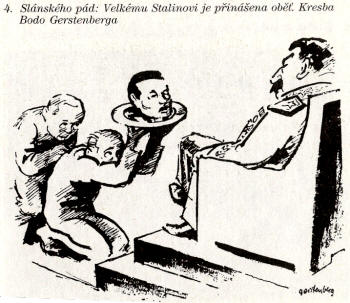
On this date in 1952, eleven high-ranking Czechoslovakian politicians were hanged at Prague’s Pankrac Prison two weeks after a show trial purging unreliable elements from the Communist party.

One of the most infamous show trials in Czechoslovakia saw 14 high-ranking Communists — eleven of them Jews — railroaded for a “Trotskyite-Titoist-Zionist activities in the service of American imperialism”. Three received life sentences. The other eleven went to the gallows.

While the roots of the persecution, especially the undertones of anti-Semitism, sink into the id of the Stalinist Eastern bloc, the most evident proximate cause was the USSR’s assertion of control over its satellite states at a time when Josip Tito was successfully charting a course of independent communism. Purges in Poland, Bulgaria and Hungary had taken place in the years before.

The Soviet agents rounding up suspects for Stalin did not trifle with small game. Rudolf Slansky was General Secretary of the Communist Party and therefore the second-most powerful man in the country; by the time he was tried, after a year in prison under torture, he was publicly denouncing himself.

Otto Sling, whose name became synonymous with forbidden heterodoxy, did likewise — “I was a treacherous enemy within the Communist Party … I am justly an object of contempt and deserve the maximum and the hardest punishment.”

And Vladimir Clementis, the Slovak Minister of Foreign Affairs, was erased from a photo taken with the Czechoslovakian President, a circumstance Milan Kundera reflected upon in The Book of Laughter and Forgetting:

In February 1948, the Communist leader Klement Gottwald stepped out on the balcony of a Baroque palace to harangue hundreds of thousands of citizens massed in Old Town Square … Gottwald was flanked by his comrades, with Clementis standing close to him.

The propaganda section made hundreds of thousands of copies of the photograph taken on the balcony where Gottwald, in a fur hat and surrounded by his comrades, spoke to the people. On that balcony the history of Communist Bohemia began. Every child knew that photograph, from seeing it on posters and in schoolbooks and museums.

Four years later, Clementis was charged with treason and hanged. The propaganda section immediately made him vanish from history and, of course, from all photographs. Ever since, Gottwald has been alone on the balcony. Where Clementis stood, there is only the bare palace wall.

The hanged were rehabilitated in 1963.

Artur London, who received a life sentence and was released after rehabilitation, wrote about his experiences in The Confession, subsequently a 1970 Costa-Gavras film. The wife and son of Deputy Minister of Foreign Trade (and Auschwitz survivor) Rudolf Margolius have also both written memoirs covering the trial.

The younger Margolius in particular, who has staunchly defended his father as an essentially apolitical man and not a Communist apparatchik, has been in the thick of present-day disputes in Czechoslovakia’s successor states over whom is due sympathy and recognition for bygone political crimes.

On this day..

1941: Zoya Kosmodemyanskaya

On this date in 1941, Soviet partisan Zoya Kosmodemyanskaya was hanged by the Wehrmacht for sabotaging buildings behind German lines near Moscow.

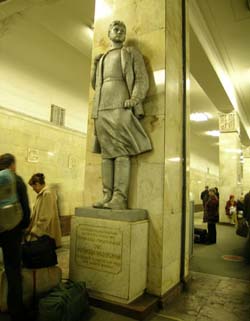
A statue of Zoya Kosmodemyanskaya stands vigil over Moscow’s World War II-era Partizanskaya metro station. Image used with permission.

One of the most famous Soviet war heroines and the first woman decorated as Hero of the Soviet Union during World War II, the 18-year-old had quit school to volunteer for a partisan unit only a few weeks before her hanging as Russia mobilized against Hitler’s race towards Moscow.

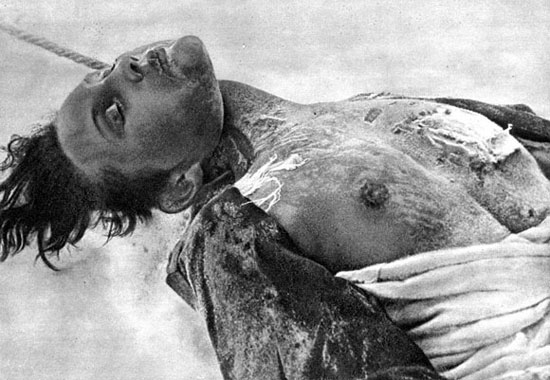
Known simply as “Tanya”, the nom de guerre which was the only information she volunteered during two days of torture, the power of the press offered her apotheosis into a propaganda coup for the Kremlin, and a symbol of courage that would long outlive Stalin. Before the public execution, the Nazis paused to photograph the scene; Kosmodemyanskaya availed the lull to harangue the Germans — “you can’t hang all 190 million of us!” — and call on the Russian villagers present to resist occupation.

Her bayoneted, mutilated body hung on the gibbet until the Red Army recaptured the village; witnesses related the tale of her dying heroism to a newsman.

It was only after the story of “Tanya” hit the press in January 1942 that her identity was established … and then promulgated widely. Anonymous and obscure in death, Zoya Kosmodemyanskaya would inspire millions and become the heroic emblem of other women partisans.


Soviet propaganda poster unabashedly modeled on the already-iconic image of Zoya Kosmodemyanskaya’s abused corpse.

Zoya, a 1944 Soviet film, was scored by Dmitri Shostakovich.

Part of the Themed Set: Women Against Fascism.

On this day..

1944: Richard Sorge and Hotsumi Ozaki

On the day of the USSR’s October Revolution holiday in 1944, Stalin’s greatest spies were hanged in Japan.

Renowned among espionage aficionados for supposedly forewarning Moscow of the exact date of Germany’s planned surprise attack in 1941, Richard Sorge‘s work in the pregnant years leading up to World War II produced multiple intelligence coups and could lay claim to the uncommon distinction of having materially affected the course of the war.

His signal achievement was establishing, as a foreigner in a highly xenophobic Japan, a spy ring that for years penetrated the highest levels of the Japanese government and the German embassy, giving Moscow an inside look at Axis planning.

Working under the cover of journalism in the German expat community — he had grown up in a mixed German-Russian household in Berlin and won the Iron Cross for his service in the Kaiser’s army in World War I before embracing communism — Sorge struck Hitler from half a world away. His access to the German embassy was untrammeled — indeed, he had an affair with the ambassador’s wife. His lead Japanese collaborator Hotsumi Ozaki was a major public intellectual similarly privy to sensitive information through his contacts.

The two, along with several other Japanese and foreign collaborators, produced a steady diet of top-shelf intelligence, including the (ignored) forecast of Operation Barbarossa. But the ring’s most important coup — arguably a decisive one in the history of the war as a whole — was to inform Moscow in September 1941 that Japan did not intend to attack the Russian Far East. Relieved of the nightmare prospect of a two-front war, Stalin transfered desperately needed Siberian divisions to help throw back the German advance on Moscow.

Japan by 1941 was a dangerous place to operate, however, and the nerve-rattling work — and the alcoholism to which it contributed — were taking its toll on the master spy just as the authorities were closing in. Sorge and his ring were arrested in October 1941.

Sorge’s decisive communique regarding Japanese intentions in the East had not yet borne its fruit. The war had nearly four years yet to run, and Sorge would languish in prison for most of them — long enough to leave fellow detainees with recollections of the captured operative jubilant at Red Army victories. Soviet tanks were at Germany’s doorstep by the time the two went to the gallows, one after the other, with the few minutes’ notice still customary for Japanese hangings to this day.

The spies in history who can say from their graves, the infomation I supplied to my masters, for better or worse, altered the history of our planet, can be counted on the fingers of one hand. Richard Sorge was in that group.

Spy novelist Frederick Forsythe

Sorge’s personal role in the crucible of world-shaping politics have proven a compelling topic for biographers. Among the notable works:

The Soviet government did not officially acknowledge Sorge until 1964, but the case had immediate and widespread interest in Japan. Ozaki inspired an early Kurosawa film, No Regrets for Our Youth:

The espionage ring’s operations were also the subject of a recent multilingual Japanese epic, Spy Sorge:

Part of the Themed Set: Spies.

On this day..

1925: Sidney Reilly

On this date in 1925, legendary British spy — and subsequent James Bond inspiration — Sidney Reilly was shot in a forest outside Moscow for his efforts to overthrow the Soviet government.

Fact blends insensibly into fiction in Reilly‘s biography; much of what is known or believed about him is conjectural or colored by his posthumous valorization, such the 1967 book Reilly: Ace of Spies written by [the son of] his onetime cloak-and-dagger collaborator Robin Bruce Lockhart — who was himself a close friend of Bond author Ian Fleming.

However, even at the word of less sensational biographers — such as Andrew Cook — Reilly lived a life almost too extraordinary for belief.

A Jewish child of tsarist Russia born in what is now the Ukraine, Reilly claimed to have escaped Odessa by faking his death and hopping a ship bound for Brazil. Like much of Reilly’s life, the story is unverifiable, but by hook or by crook — and possibly by way of a murder in France — he arrived in London in 1895, hitched himself to a wealthy woman a few months after the suspicious death of her husband (discarding the inconvenient surname Rosenblum in the process), and became entangled with British intelligence.

In the first decade of the 20th century, he apparently spied promiscuously on England’s imperial rivals Germany and Russia, though the particulars are disputed. He arrived in Port Arthur, Russia, shortly before the outbreak of the Russo-Japanese War and may have provided the Japanese fleet intelligence enabling it to navigate the mined harbor — in addition to a copious side business in war profiteering. He may also have had a hand in capturing British oil concessions in Persia and reconnoitering behind German lines during World War I.

Like his fictional heir 007, he gambled often and left a string of lovers and mistresses in his wake. His true allegiances, and the extent to which his exploits were inflated or outright fabricated, are debated to this day.

The adventures that brought both death and fame were his machinations to overthrow the Bolshevik government in the fraught early months after Lenin took power. A planned coup d’etat in September 1918 came to grief and Reilly fled Russia steps ahead of the authorities, who subsequently condemned him to death in absentia.

Notwithstanding the sentence, which had been ruthlessly visited on his less-fortunate conspirators, Reilly was lured back to the USSR in 1925 by the Soviet counterintelligence project Operation Trust. Intending to meet anti-Bolshevik agitators, he was instead arrested at the border and tortured at the infamous Lubyanka Prison, where he kept notes on cigarette papers about enemy interrogation techniques for the eventuality of an escape or release that never came.

Part of the Themed Set: Spies.

On this day..