1936: Rainey Bethea, America’s last public hanging

On this date in 1936, thousands thronged Owensboro, Kentucky, for a glimpse of what would prove to be the last public hanging in the United States.

The U.S. followed the trend of its onetime mother country, England, in moving the formerly iconic public hanging increasingly behind closed doors, but its federalist structure made that change uneven. In Kentucky itself at this time, the law displayed sedimentary layers of death penalty history.

Caught up for killing a 70-year-old woman — done in the midst of a drunken burglary, he had left a telltale ring at the scene; fingerprint analysis also helped establish his guilt — Rainey Bethea was on the hook for murder, robbery and rape. The former two indictments would have subjected him to (private) electrocution at the state penitentiary. The latter charge still carried the punishment of public hanging in the local county seat.

Bethea was charged only with rape.

While the explicit sentencing disparity between the crimes bears the clear marks of racism and patriarchy that made purported black-on-white sexual crimes such live fodder for lynch law, and the four-and-a-half-minute jury deliberation doesn’t have the look of solemnity, Bethea’s actual guilt seems fairly well-established.

But the case attracted a nationwide media swarm not for any exceptional quality of the crime or the anachronistic nature of the punishment, but for the involvement of a female sheriff. The “matronly” (virtually all descriptions of her gravitate to this adjective) Florence Thompson had inherited the top law enforcement post upon the death of her husband … and that meant she had inherited the responsibility of hanging Rainey Bethea, which would make her the first American woman to supervise an execution.

Would she or wouldn’t she? The press descended on Owensboro to cover the edifying spectacle of a plump mother stringing up a rapist, or else maneuvering her way out of the job. Thompson played cagey until the very last moment, when the ringers she had secretly hired appeared on the scaffold while she watched from a nearby vehicle.

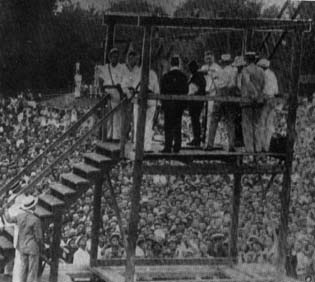
In this photo, Bethea — almost totally obscured between his escorts — has just begun ascending the gallows.

The man who threw the trap showed up drunk and performed appallingly, but press reports subsequently focused on the beastly behavior of the “jeering” crowd rushing the gallows to tear souvenirs from the corpse. (For instance, Time and the New York Times.)

But according to Perry T. Ryan’s 1992 review of the case — including interviews with surviving witnesses — little to nothing of the kind occurred. Ryan claims Bethea faced about the most dignified hanging mob imaginable.
Maybe hyped-up atrocities in the hinterlands were part of what distant editors demanded after H.L. Mencken at the Scopes trial. Certainly, the local Messenger-Inquirer painted a sharply different picture from more prominent outlets in this August 16 editorial (titled “Panderers Galore”) whose themes could have stepped fresh from a modern cable TV gabfest:

Ambitious and irresponsible reporters and photographers who swarmed into Owensboro for the Bethea hanging dipped their ready hands into the cloaca of evil designs and plastered over the name of this fair city the dirty results of their pandering.

Those who saw the dawn kindling in the east and ushering in the last sunrise of the despicable creature about to die, did not expect all of the watchers to be in reverent mood, but a calm, quiet demeanor characterized their behavior, as a group, throughout their long wait, surprisingly moderate for an occasion on which the law was exacting the supreme penalty.

Considering the size of the throng that witnessed the hanging Friday morning and that it was composed largely of people, who journeyed to Owensboro from distant places, the wonder is that there was no demonstration, no emotional outburst. There was not the semblance of ‘mob impulse’ or ‘eagerness for the kill.’ For the sensation seeking star scribes of quacks of American journalism, it was entirely too tame an affair. This is the reason that some of them reported it as they wanted it to be — not as it was.

They heard a very few people on the outskirts of the crowd call out at different times: ‘Hurry up,’ ‘Get it over’ or ‘hang him.’ To give screaming bulletins to the yellow press and to ruthless radio commentators, they magnified and colored it into a scene of ‘great disorder’ though there was never a general outcry of any kind.

When a priest held up his hand from the scaffold for silence, as Bethea was about to go to his death, there was no ‘blood thirst’ mob ‘shouting and yelling.’ Present were several thousand, who came from near and far to see a man legally hanged for the most heinous crime ever committed in Daviess county, and several thousand more, who turned out to see how the rest would act. When that hand went up in a gesture for silence, the buzz of the multitude’s conversations died down till the fall of the proverbial pin could have been heard.

The smart scribes and sob sisters looked on. All they saw was a black man standing on a scaffold with a rope around his neck and a mass of people peering up at him. That was too tame, they would call it a ‘jeering’ throng. All they heard was the click of the trap door. That would not do. There would have to be ‘cheering.’ So they said there was. Then they heard cameramen from cities where nothing is cared about the horrible crime Bethea committed. They were bawling at officials to ‘move out of the way,’ to ‘give us a break.’ They had to have their souvenirs to show the half civilized readers of their yellow sheets. The boys and girls who had to tell the story needed more color to regale them with atrocious accounts of how the people behaved. They found a few individuals who had gone in the bizarre which inspired thundering headlines about ‘gayety’ and ‘carnival’ spirit.

In administering the last sacrament, the Rev. H. J. Lammers, of Louisville, made an opening in the hood. When the doctors pronounced Bethea dead, one of the attendants at the scaffold took a tag off the hood. Another then took a fragment and others, who were at arms length from the dead man, followed suit. The blunder of tearing off that tag gave the high powered thrill-writers their big opening. They pictured the crowd as tearing Bethea’s clothes from his body. The crowd was never in disorder and Bethea’s clothes were never torn.

The ‘souvenir hunting mob’ did not even pick up the sox [sic] and shoes the doomed man left at the foot of the gallows. It did not so much as touch the basket in which Agnew and Wheatley, colored undertakers, placed the body, clothes and all, or molest it or them in the slightest as they bore it away.

The scavenger writers who came to depict a ‘jolly holiday’ and ‘gala occasion’ had both, but they never saw a more orderly throng at a baseball game.

The public hanging of Bethea was not a disgrace to Kentucky. But, a disgrace to Illinois, Missouri, Tennessee, and some other states, was the spectacle made of it in their scandal monger press. Owensboro should not be surprised at the scurrilous attack upon it by lurid writers and glib tongued talkers in northern and eastern states for they delight to distort any news from Kentucky into weird barbaric tales. We have learned how best to protect our women from rapists-murderers, white or colored. The only way, it seems, that we will ever be able to protect them from the cruelties of a sordid section of the press, will be by softening the state’s anti-rape law, which makes public hanging mandatory. So many as favor that will please tell the legislature.

Vendors of news occupy an important place in the nation, and their purpose should always be to maintain unquestioned exactness of facts. Where the subject matter is susceptible to coloring there should be no sacrifice of truth. To pervert the high honor of the profession for the paltry reward of more readers is a dangerous venture and one that should be curbed.

Owensboro’s citizenry, than which no finer representatives of high-bred Americans can be found anywhere, regrets that it was necessary to invoke the Mosaic law, but a sobered regret and a more solemn memory is that the hanging was eagerly seized upon and transformed into a picturization of the exhibition of low passions loosed.

We are proud of our city, and justly so, for no people are of finer fiber. The putrid pens of those who wore the garb of the news profession painted in lurid colors purported happenings, and it is sad but true that such distorted reports are accepted while the plain statement of facts is discarded as an attempted apology.

Thousands of those who witnessed the Bethea hanging came from outside the county. They belonged to good families in their communities, temporarily bereft of their better judgment and bent on viewing a scene which ordinarily would be extremely repugnant to them. And the out-of-town reporters found in the visitors elements to embody in their sordid stories.

A thoughtless word here and there, expressed without cognizance of its probability of misuse, and the staid citizen away from home becomes to the wild-eyed correspondent a Kentuckian gunning for human game. There should be available means of calling to account the writer who for a few filthy shekels diverts his sense of justice into the recording of things that never were.

As the editorial intimates, regardless of what actually happened in Owensboro, the circus atmosphere quickly brought the matter of public hangings into question. In 1938, the Kentucky legislature moved all executions behind prison walls … and Bethea secured an indefinite claim to the status of last person publicly executed in the United States.

Part of the Themed Set: At the End of the Rope.

On this day..

1862: Nueces Massacre

On this date in 1862, German immigrants fleeing Confederate conscription were caught near Texas’ Nueces River and slain to a man.

The nomenclature of the “Nueces Massacre” is controversial since this party of Union loyalists making a leisurely pace* for Mexico got its shots off as it was gunned down in a gully by Texas Partisan Rangers in the predawn hours.

But the incident becomes a clear candidate for these pages with the summary execution of the surviving captured and wounded men later this day. Here’s the account of an obviously upset member of the Confederate party:

[S]ome of the more humane of us did what we could to ease the sufferings of the wounded Germans. They had fought a good fight, and bore themselves so pluckily I felt sorry I had taken my part against them. We bound up their wounds, and gave them water, and laid them as comfortably as we could in the shade. Poor creatures, how grateful they were!

He then pauses for breakfast and helps gather up the scattered German horses; we rejoin the narration after 4 o’clock in the afternoon.

I hurried over to where we had left the German wounded to see how they were getting on, and was surprised to find them gone. Asking what had become of them, I was told they had been moved to a better shade a short distance away. With this answer I was quite satisfied, and never dreamed the brutes with whom I served would be guilty of foul play, especially after the gallant fight the enemy had made.

Just then one of our wounded called for water, and I brought him some from the cool spring. As I was giving it to him, the sound of firing was heard a little way off. I thought at first they were burying some of the dead with the honors of war; but it didn’t sound like that either. Then, possibly it might be an attack on the camp; so I seized my rifle and ran in the direction of the firing. Presently I met a man coming from it who, when he saw me running, said, “You needn’t be in a hurry, it’s all done; they shot the poor devils, and finished them off.”

“It can’t possibly be they have murdered the prisoners in cold blood!” I said, not believing that even Luck [a villainous — to the diarist’s mind — lieutenant] would be guilty of such an atrocious crime. “Oh, yes; they’re all dead, sure enough — and a good job too!” Feeling sick at heart, though I hardly even then credited his report, I ran on, and found it only too true.

It seems they were asked if they wouldn’t like to be moved a little way off into better shade. The poor creatures willingly agreed, thanking their murderers for their kindness. They were carried away, but it was to the shade and shadow of death, for a party of cowardly wretches went over and shot them in cold blood.

More summary justice followed in the weeks ahead against members of the party who had escaped** and others, and Confederate Haengerbande would plague Texas Germans of insufficient southern enthusiasm for the remainder of the war.

Fred Shon Powers offers this detailed account of the affair; there’s another here.

This day’s victims are honored by the Treue der Union obelisk, the only Union monument in Confederate territory, a prominent distinction that (as with all things in the Civil War) invites political football. This conservative article throws cold water on the “Germans-as-antislavery-Unionists” trope, and academic papers from a 1990’s conference gathered in this volume treat Nueces among other topics of “disloyalty” in the Confederacy.


The photo is taken by Steve & Marion Daughtry In Comfort, Texas. Image used with permission.

* An escapee recounted decades later by way of explanation for the party’s fatal inattention to either haste or defense, “Having read a proclamation from the Confederate government announcing that all persons not friendly to it might leave the country, we believed we had a right to do so in large or small bodies, as best suited our convenience, to the border and there cross over into Mexico.”

** About half the group had separated from the main body just before the Confederates engaged them. From this number come the “escapees,” many of them later killed in the hills or while crossing into Mexico. Those who stayed put all died this day.

On this day..

1777: A British spy, by Israel Putnam

On this date in 1777, a general of the American Revolution laconically asserted his prerogatives with the hanging of a British spy.

A former ranger in the British service, Israel Putnam — he may or may not be the “don’t fire until you see the whites of their eyes” guy — was camped at Peekskill, New York, when he caught one Edmund Palmer stalking the camp.

It was early in the American Revolution, and American spies were being hanged by the British … but the commanders of Albion evidently entertained some notion that the shoe would not go on the other foot. When Palmer was condemned to death for spying, the British General Sir Henry Clinton hurried a missive to his opposite number under flag of truce claiming Palmer as a British lieutenant.

Old Put firmly believed “the speedy execution of spies is agreeable to the laws of nature and nations and absolutely necessary to the preservation of the army.” (According to the unimpeachable sourcing that is the “about” page of an intel e-learning university named for him.)

And Putnam’s reply to Clinton, a terse little masterpiece answering Cicero‘s dictum that “Brevity is a great praise of eloquence,” was one for the ages.

Headquarters, 7th August, 1777.

Sir — Edmund Palmer, an officer in the enemy’s service, was taken as a spy lurking within our lines; he has been tried as a spy, condemned as a spy, and shall be executed as a spy, and the flag is ordered to depart immediately.

Yours, &c.,

Israel Putnam

P.S. He has accordingly been executed.

(Some versions give the slightly zippier postscript as “afternoon — he is hanged.”)

Read all about this spry American Cincinnatus in Old Put, a now-public-domain book published for America’s centennial celebration; or at this enthusiastic fan page. Also of some now-current relevance: tangential background on the jurisdictional wrangling around military commissions at this period, here.

On this day..

1890: William Kemmler, only in America

On this date in 1890 the iconic symbol of the American death penalty made its grisly debut upon the person of William Kemmler at New York’s Auburn Prison.

The long New World tradition of hanging condemned prisoners came under fire as a barbarism in the late 19th century, leading reformers to look for killing procedures less likely to result in a horrendously protracted strangulation or a midair decapitation. As Empire State Governor David Hill put it,

The present mode of executing criminals by hanging has come down to us from the dark ages, and it may well be questioned whether the science of the present day cannot provide a means for taking the life of such as are condemned to die in a less barbarous manner.

On this stage, Executed Today presents a rogues’ gallery of homo Americanus, the salesmen and swindlers who would help the U.S.A. ride the lightning.

The Dentist

A true renaissance man, Buffalo dentist Dr. Alfred Southwick, applied his active mind to the need to better kill a fellow, and soon hit upon an inspiration — that is to say, a town drunk hit upon an electrical generator and died instantaneously, and the observant Southwick said “eureka!”

Without the subsequent industry of this neglected gentleman, who added to his repertoire scientifically-minded electrical butchery of animals alongside political gladhandings to bring a flutter to a busybody’s heart, the Chair’s entire oeuvre of machismo-sadism might have missed the country altogether. Just imagine living in a world where New York had pioneered its other leading reform alternative: lethal injection.

(This, incidentally, is why the chair is a chair, and not a bed or a stake or a St. Andrew’s Cross: because the guy who thought of it spent all day administering his own tender mercies to seated penitents.)

The Plutocrats

As Southwick nagged his senator and shocked stray cats into the great hereafter, the gears of commerce strove relentlessly ever-onward. The business of America was ever business, and never more so than the Gilded Age.

And the business of killing people was about to become the biggest business there was.

The age of electricity was buzzing into incandescence, and two rival standards were at currents amped over eventual dominance of this stupendous industry. Thomas Edison’s earlier Direct Current (DC) standard was being challenged by Nikolai Tesla’s Alternating Current (AC), backed by the financial muscle of George Westinghouse.

Cheaper and more efficient, AC tilted the playing field against Edison. Seeing his days numbered, the Wizard of Menlo Park fought back the way any dinosaur industry would: dirty.

AC, Edison said, was too dangerous for consumer use — a lurking killer. “Is this what your wife should be cooking with?” And he started taking up traveling road shows zapping large animals with AC to demonstrate the rival product’s deadliness. (This press coined the term “electrocution” from these spectacles.)

This clip of the electric demise of a circus elephant — don’t hit “play” if you’re not up for animal cruelty — is from some years later (Edison kept tilting at windmills and megafauna carcasses as his DC empire disappeared), but it’ll give a sense of the horrifying spectacle.

(Topsy, it should be noted, was being put down as a danger and not strictly for kicks.)

Elephants? Horses? Dogs?

How about a human?

With the New York legislature’s embrace of Southwick’s seated voltage people-eater, Edison turned his PR gears on the state, demanding they adopt his competitor’s “deadlier” current for the contraption. And they did, reflecting a widespread belief inculcated by Edison’s experiments — as this New York Times article on an Edison crony’s public livestock-killing show in the days leading up to the advent of the electrocution law indicates:

The experiments proved the alternating current to be the most deadly force known to science, and that less than half the pressure used in this city for electric lighting by this system is sufficient to cause instant death.

After Jan. 1 the alternating current will undoubtedly drive the hangmen out of business in this State.

Too bad for Edison that the business he was really trying to kill was made of sturdier stuff.

The Alcoholic Vegetable Merchant

As the 1880’s wane, we come at last to our subject — in several senses of the term — an illiterate nobody of German stock who chanced to kill his common-law wife with just the right timing to join in a new kind of experiment.

William Kemmler mounted a “cruel and unusual punishment” appeal against his sentence funded by Westinghouse himself: no dice. Perhaps appreciating the odd foothold on history he was about to attain, he showed little worry as he entered the execution room and sat himself — “undoubtedly the coolest man in the room,” a journalist present reported.

The End of the Beginning

That reporter’s description for the New York Herald graphically captures humanity’s first horrible encounter with this “humanitarian” machine, beginning with the prisoner’s parting remarks.*

Doubtless he knew that his words will go down in history and he had his lesson well learned. He addressed his audience [in] a commonplace way and without hesitation.

“Well, gentleman, I wish everyone good luck in this world, and I think I am going to a good place, and the papers have been sa[yi]ng a lot of stuff that isn’t so. That’s all I have to say.”

And so with a parting shot at what he was good enough to refer to not long ago as “those d—d reporters,” William Kemmler took his leave of earth. The quiet demeanor of the man as he entered had made a strong impression on those in the room. His self-possession after his oratorical effort simply amazed them. He got up out of his chair as though he were anxious to try the experiment, not as though he courted death, but as though he was thoroughly prepared for it. …

There was no delay. Kemmler constantly encouraged the workers at the straps with “Take your time; don’t be in a hurry; do it well; be sure everything is all right.” He did not speak with any nervous apprehension.

Warden Durston leaned over, drawing the buckle of the straps about the arm. “It won’t hurt you, Bill,” he said, “I’ll be with you all the time.”

A minute later Kemmler said, “There’s plenty of time.” He said it as calmly as the conductor of a streetcar might have encouraged a passenger not to hurry.

Kemmler was pinioned so close that he could hardly have moved a muscle except those of his mouth.

The Warden took a last look at the straps. “This is all right,” he said.

“All right,” said Dr. Spitzka, and then bent over and said, “God bless you, Kemmler.”

“Thank you,” said the little man, quietly.

“Ready?” Said the Warden.

“Ready,” answered the doctors.

“Goodbye,” said the Warden to Kemmler. There was no response.

GAVE THE SIGNAL.

The Warden stepped to the door leading into the next room. It was then forty-three and one-half minutes past six o’clock by the prison clock. “Everything is ready,” said the Warden to some one hidden from view in the next room.

The answer came like a flash in the sudden convulsion that went over the frame of the chair. If it seemed rigid before under the influence of the straps, [it] was doubly so now has it strained against them.

The seconds ticked off. Dr. McDonald, who was holding the stopwatch, said “Stop.”

Two voices near him echoed, “Stop.”

The Warden stepped to the door of the next room and repeated the word “Stop.”

As the syllable [passed] his lips the forehead of the man in the chair [grew] dark [in] color, while his nose, or so much of it as was exposed, appeared a dark red.

There was very little apparent relaxation of the body, however. [A] fly lighted on the nose and walked about unconcernedly. The witnesses drew nearer to the chair.

“He’s dead,” said Spitzka, authoritatively.

“Oh, yes, he’s dead,” said McDonald.

“You’ll notice,” said Spitzka, “the post-mortem appearance of the nose immediately. There is that remarkable change that cannot be mistaken for anything else, that remarkable appearance of the nose.”

The other doctors nodded [assent]. They looked at the body critically for a minute and then Spitzka said, [“]oh, undo that now. The body can be taken to the hospital.”

“Well, I can’t let you gentlemen out of here until I have your certificates,” said the Warden.

FOUND SIGNS OF LIFE.

It was while this businesslike conversation was going on that Dr. Balch made a discovery.

“McDonald,” he cried, “McDonald, look at that rupture,” he pointed at the abrasion of the skin on Kemmler’s right thumb. In the contraction of the muscles the figurehead[?] scraped against it and removed the skin, and from that little [wound] blood was flowing-[an] almost certain indication of life.

A low cry of horror went through the assemblage.

“[Turn] on the current,” excitedly cried Dr. Spitzka. “This man is not dead.”

The crowd fell back from the chair, as though they were in danger. The Warden sprang into the closed door and pounded on it with his hand.

“Start the current!” he cried. As he spoke of fluid began to drop from Kemmler’s mouth and to run down his beard; a groaning sound came from his lips, repeated and growing louder each time.

It seemed [an] age before the card was again turned on. In fact it was just seventy-three seconds from the end of the first contact when the first sound was heard to issue from Kemmler’s lips, and it was not more than a half [minute] before the card was again turned on.

RECOVERING CONSCIOUSNESS.

But every second to that time the horrible sound from those groaning lips was becoming more distinct, [a straining] of the chest against the leather harness stronger and more evident.

The man was coming to life. The spectators grew faint and sick. [Men] who had stood over dead and dying [men] and had cut [men] to pieces without an emotion [grew] pale and turned their heads away.

One witness was forced to lie down while one of the doctors fanned him.

But [the end] came at last. There was another convulsion of the body, and … it became rigid with the rigidity of iron.

“That man wasn’t dead,” cried Spitzka excitedly. As he spoke the body twitched again. The electrician had given the current gain new alternation and now 2,000 volts [were] playing in short, successive shocks down Kemmler spine. The sound ceased with the first convulsion, but the fluid continued to trip from the mouth and down the beard, making the body a sickening spectacle.

“Keep it on now until he’s killed,” said one of the doctors. …

“Keep it on! Keep it on!” Cried Warden Durston through the door.

Silence reigned for a moment. A bell without began to [toll] solemnly. …

BURNED BY THE CURRENT.

Then from the chair came a sizzling sound, as of [meat] cooking on hand. Following it immediately a billow of smoke came from the body and filled the air of the room with the odor of burning hair.

There was a cry from all the members of the little group, and Warden Durston cried through the door leading to the next room to [turn] the current off.

(Also of interest: the New York Times‘ (non-eyewitness) report on the affair.)

More shocking — so to speak — papers ran the next day’s headline “Kemmler Westinghoused,” the verb “to Westinghouse” being another shameless Edisonian bid to stamp his marketing project onto the Queen’s English. This fine, rounded, archaic neologism the right sports anchor could resuscitate as a fresh synonym for thrashing, horsewhipping, poleaxing, or else (in greater justice) for moderation and decency as the only principal in the sordid affair that rejected death-dealing by electricity.

(Officially, Edison also opposed the death penalty. Like Dr. Guillotin, he was doing his part for humanity in the meantime … just with a little skin in the game. Did we mention the business of America is business?)

Westinghouse, for his own part, thought the Kemmler debacle would nip the electric chair in the bud, and he was scarcely the only one.

Official reviews for the “art of killing by electricity” were, ahem, mixed.

“They could have done better with an axe.”**
-George Westinghouse

“Strong men fainted and fell like logs on the floor.”
-New York Herald

“Revolting … a disgrace to civilization.”
-New York Times

“We live in a higher civilization from this day on.”
-Alfred Southwick

Books (remarkably numerous!) about the creation of the electric chair

It should, in fairness, be noted that the U.S. was not the only country (pdf) to mull an electrocution chair in the 19th century … but it was (and for a long time remained) the only one to actually use one.

* The Herald excerpt, along with several other articles from the same paper about the Kemmler execution, is here, but the text has obviously been generated from a scan with uneven results. As I do not have access to the originals, [bracketed] remarks in the excerpt indicate this author’s own interpretations or interpolations of seemingly mistaken transcriptions.

** Some sources make it “would have done better with an axe.”

On this day..

1917: Frank Little of the IWW lynched

On this date in 1917, Wobbly labor organizer Frank Little was abducted from his hotel and hanged from a railroad trestle in Butte, Montana.

An executive board member of the radical Industrial Workers of the World, the half-Cherokee Little had only rolled into Montana’s copper mining hub two weeks before. A roving agitator who had organized workers all around the west, he would be a signal martyr to America’s nascent Red Scare.

It was a fraught moment nationwide, and worldwide. After winning re-election on the slogan “He kept us out of war,” Woodrow Wilson upon his inauguration immediately (try to act surprised) got the United States into World War I. Just as it had in Europe, the question of war put American labor to the test: would it transfer opposition to war into resistance, or would it line up patriotically with its state?

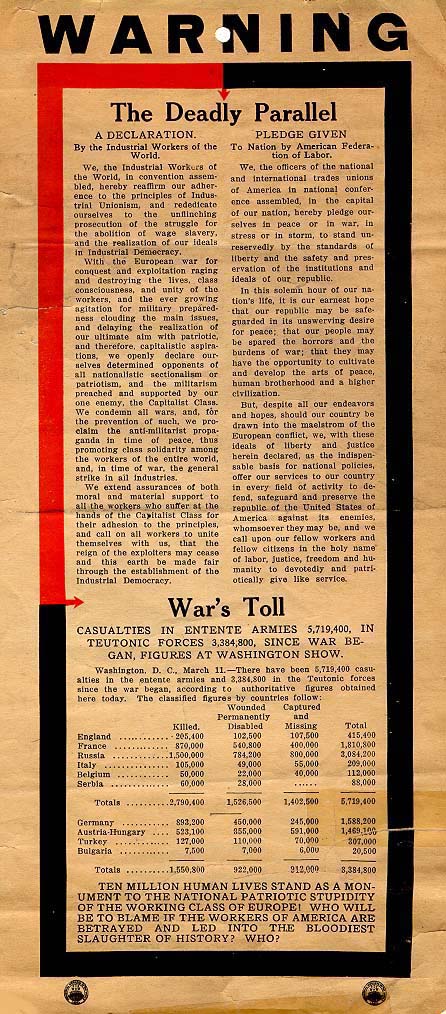
This outstanding IWW poster (via the University of Arizona’s web exhibit on the labor deportations that had expelled Frank Little from Arizona just days before he arrived in Butte) pits the militant Wobbly position against the nationalist American Federation of Labor.*

And Little was one of the most stridently anti-war in his movement.

Either we’re for their capitalist slaughter fest or against it. I’m ready to face a firing squad** rather than compromise. (Source)

Anaconda Copper could nowise welcome this character’s arrival, where he would organize already-striking miners and mix in militant anti-war rhetoric with incendiary potential in the cocktail of immigrant workers being asked (in many cases) to wage war on their homelands.

The local labor conflict, an exceptionally brutal instance of a pattern across the country and especially in western mining country, was probably savage enough on its own to make Little a marked man. Whether his anti-war activity or his union activity motivated his death is not sure, but the dilemma was probably a false one for his killers just as it was for Little himself: they were two heads of the coin. As American troops poured into Europe, and particularly as the Bolshevik Revolution later in 1917 spurred a worldwide Communist scare (and a separate American military expedition), both public and private power violently pursued left-wing elements.

Caption: Copper Trust to the Press: “It’s all right, pal; just tell them he was a traitor.” (Source.)

The film An Injury To One (review) deftly weaves those themes and others together into the tale of a crime which is also the tale of a time and place:

This note was found pinned to Little’s body. “3-7-77”, a Montana vigilante calling card, indicates the dimensions of a grave.

Officially (again, act surprised), it’s an unsolved crime. Even though the New York Times report the day after the hanging quoted a labor official claiming “certain” knowledge of five of the six men in the posse, and a prosecutor vowing, “it is a cold-blooded murder and every effort will be used to apprehend the men who did it,” nobody ever went on trial for lynching Little.

Company goons, likely aided by the infamous union-busting Pinkerton detective agency, are the presumed culprits. And it is the nature of lynchings to make extrajudicial the rough justice sought by a certain constituency, as expressed by Montana’s Helena Independent:

Good work! Let them continue to hang every I.W.W. in the state. The time has come. It is beyond the comprehension of the average citizen why the war department has not ordered certain leaders arrested and shot. The people will not stand for much more.

A massive funeral turnout brought federal troops to quash labor unrest in Butte … and in the years to come, the IWW would be hunted from pillar to post.

Pro-Wobbly sites give adoring biographical treatment and fairly extensive resource lists on Little here and here.

Little is buried in Butte. His grave marker reads:

Slain By Capitalist Interests For Organizing And Inspiring His Fellow Men.

* The AFL, now the AFL-CIO, remains the dominant institution in American labor today.

** Little undoubtedly had in mind the precedent of his fellow-martyr Joe Hill, executed judicially two years before in Utah.

On this day..

1794: Not Thomas Paine

An avidity to punish is always dangerous to liberty. It leads men to stretch, to misinterpret, and to misapply even the best of laws. He that would make his own liberty secure must guard even his enemy from oppression; for if he violates this duty he establishes a precedent that will reach to himself. -Thomas Paine

On this date in 1794, revolutionary firebrand Thomas Paine got a date with the guillotine when the public prosecutor Antoine-Quentin Fouquier-Tinville put his name on the list for the next batch of heads.

Paine — “Mad Tom” to foes of his fire-eating opposition to despotic church and crown — is best-known for his part in the American Revolution; his pamphlet “Common Sense” made an incendiary and influential case for revolution.

More so than any other high-profile compatriot in the cause of American independence, Paine took to heart the age’s revolutionary spirit, the fine principles of solidarity, the zeal to put life and fortune at liberty’s service.

Not content to retire to the estate granted him for his services to the fledgling United States of America — Paine coined that name, by the way — the hellraiser sailed for the Old World to help overthrow the sclerotic Bourbon despotism whose geopolitically-minded aid* had had such material effect for American liberty.

Paine served in France’s National Convention, one of the highest-profile and least-impeachable members of that body as well as one of only two foreigners. These distinctions offered him some safety in the Revolution’s internecine tempests — some, but not quite enough. He drew the ire of the Montagnards by opposing the execution of Louis XVI.

The terrible gears of mass fratricide which apparently doomed Paine as the Terror unfolded turned out to be his refuge, and that of three fortunate fellows with him. Had he gone to the scaffold as a single high-profile traitor, there would have been no mistake about it; now, at the height of the Terror, jailers marked dozens for death by the fallible expedient of chalking their cell doors. If the guillotine made mass execution feasible, the bureaucratic apparatus to manage it was still catching up.

Here’s the version of a Paine’s preservation that he himself later related — albeit second-hand, since he was suffering this day “a violent fever which had nearly terminated my existence” and “was not in a condition to be removed, or to know of what was passing, or of what had passed, for more than a month. It makes a blank in my remembrance of life. The first thing I was informed of was the fall of Robespierre.”

[T]he manner in which I escaped that fate is curious, and has all the appearance of accident.

The room in which I was lodged was on the ground floor, and one of a long range of rooms under a gallery, and the door of it opened outward and flat against the wall; so that when it was open the inside of the door appeared outward, and the contrary when it was shut. I had three comrades, fellow-prisoners with me, Joseph Vanhuile, of Bruges, since president of the municipality of that town, Michael Robins, and Bastini, of Louvain.

When persons by scores and hundreds were to be taken out of prison for the guillotine, it was always done in the night, and those who performed that office had a private mark or signal by which they, knew what rooms to go to, and what number to take. We, as I have said, were four, and the door of our room was marked unobserved by us with that number in chalk; but it happened, if happening is a proper word, that the mark was put on when the door was open and flat against the wall, and thereby came on the inside when we shut it at night, and the destroying angel passed by it. A few days after this Robespierre fell, and the American ambassador arrived and reclaimed me and invited me to his house.

During the whole of my imprisonment, prior to the fall of Robespierre, there was no time when I could think my life worth twenty-four hours, and my mind was made up to meet its fate.

Presumably this would have been a short reprieve, had not Jacobin rule (and rulers) promptly expired.

We noticed two days ago the U.S. mission’s willingness to exert itself for Lafayette’s wife, who surely had not done better service for the American Revolution than had Paine himself.

Paine waited in vain for American intervention, and was incandescent with rage at George Washington and his envoy Gouverneur Morris for abandoning him (Morris was replaced by the more Paine-friendly James Monroe a few weeks later). In a wide-ranging 1796 denunciation of Washington’s conduct and American political tilt towards Britain and away from France, Paine accused his country** of giving the Jacobins the green light to cut off a gadfly’s head.

Could I have known to what degree of corruption and perfidy the administrative part of the Government of America had descended, I could have been at no loss to have understood the reservedness of Mr. Washington toward me, during my imprisonment in the Luxembourg. There are cases in which silence is a loud language.

Soon after I was put into arrestation and imprisonment in the Luxembourg, the Americans who were then in Paris went in a body to the bar of the Convention to reclaim me. They were answered … that I was born in England, and … their reclamation of me was only the act of individuals, without any authority from the American Government.

A few days after this, all communication from persons imprisoned to any person without the prison was cut off by an order of the police. I neither saw, nor heard from, anybody for six months; and the only hope that remained to me was that a new Minister would arrive from America to supersede Morris …

One hundred and sixty-nine were taken out of the Luxembourg one night, in the month of July, and one hundred and sixty of them guillotined. A list of two hundred more, according to the report in the prison, was preparing a few days before Robespierre fell. In this last list I have good reason to believe I was included. A memorandum in the hand-writing of Robespierre was afterwards produced in the Convention, by the committee to whom the papers of Robespierre were referred, in these words:

Demander que Thomas Payne soit de decrete d’accusation pour les interets de l’Amerique, autant que de la France.

I had then been imprisoned seven months, and the silence of the Executive part of the Government of America (Mr. Washington) upon the case, and upon everything respecting me, was explanation enough to Robespierre that he might proceed to extremities.

This venomous open letter and the deistic tract The Age of Reason he was banging out during the Revolution, combined with the frightening turn of the French Revolution itself, helped send Paine’s public regard into decline. “Atheist,” they tutted, and he’s been the most untouchable Founding Father ever since.

Next year is the bicentennial of his death in obscurity and pauperhood; his homelessness, so to say, in the annals of political thought and national pantheons testifies in some ways to the defeat his principles suffered in his very lifetime. The American Revolution turned conservative; France’s fell to despotism; England’s was strangled in its crib.

Even so, he fired the imaginations of many troublemakers still to come. A man of no wealth or position who etched in fire the spirit of his times, Paine saw further and spoke plainer than most of his contemporaries. If a prophet is not welcome in his own country, it scarcely diminishes the power of the prophecy.

And/or, enjoy this free biography at Google Books.

* Given by the French crown in opposition to France’s great rival Britain, of course.

** Paine certainly considered himself American, though he wouldn’t have made that inconsistent with being French, too. The matter of his citizenship between England (where his pamphlets had him attainted in absentia on a capital charge), France and the United States was a contested one at a time when the very notion was being reforged in the heat of revolution; at any rate, as diplomatic pretext for failing to ask for his life, citizenship makes a feeble excuse.

Republican radicals in England didn’t mind claiming him as their own, developing this alternate lyric sheet to the national anthem:

[audio:God_Save_the_Queen.mp3]

God save great Thomas Paine
His ‘Rights of Man’ explain
To every soul.
He makes the blind to see
What dupes and slaves they be,
And points out liberty,
From pole to pole.

Thousands cry ‘Church and King’
That well deserve to swing,
All must allow:
Birmingham blush for shame,
Manchester do the same,
Infamous is your name,
Patriots vow.

Part of the Themed Set: Thermidor.

On this day..

1989: Horace Franklin Dunkins, Jr., “just hope that he was not conscious”

Minutes after midnight this date in 1989, Alabama’s executioners electrocuted a developmentally disabled murderer. Nine minutes later, after rewiring the chair, they finally managed to kill him.

Alabama’s fifth execution of the “modern” era initially made the headlines as the nation’s first execution of a mentally impaired prisoner after the Supreme Court’s controversial Penry v. Lynaugh decision (since overturned) green-lighted the death penalty for developmentally disabled defendants.

Horace Franklin Dunkins, Jr. and an accomplice had raped a mother of four, tied her to a tree, and stabbed her to death, an unquestionably horrific crime. A black man with a white victim deep in Dixie … well, his IQ in the high sixties wasn’t going to help him do anything but waive his right to remain silent. The jury at his trial didn’t hear about his borderline mental retardation — Penry would require that juries get that information in the future — and at least one juror later said that little tidbit would have made the difference in Dunkins’s case.

At any rate, the buzz in this morning’s papers wasn’t about the circumstances of Dunkins’s entry into the criminal justice system, but his clumsy exit from it into the great hereafter.

According to the account of a Dr. John Vanlandingham:*

I saw Dunkins in the electric chair and I heard the generator start…. After a short period of time the other doctor … and I were called into the execution chamber. I could see that Dunkins was breathing…. I checked his peripheral pulse, in his wrist, and it was normal. I listened to his heart and his heartbeat was strong with little irregularity…. I told an official that Dunkins was not dead. Dr. – and I returned to the witness room…. I again heard the generator begin.

“I believe we’ve got the jacks on wrong,” the prison guard captain called out. It was flatly not enough current to kill, although it apparently did the killer the favor of knocking him out.

From 12:08 to 12:17, Dunkins sat motionless and seemingly unconscious while the execution team went all MacGyver on Yellow Mama. Once they’d fit Tab A into Slot B into Lethal Electrode C, they were finally able to try again. The doctors pronounced death 19 minutes after the switch had first been thrown.

”I regret very very much what happened,” the Alabama Prison Commissioner, Morris Thigpen, said at a news conference after the execution. ”It was human error. I just hope that he was not conscious and did not suffer.” (The New York Times)

* Dr. Vanlandingham was participating in the execution despite an injunction by the American Medical Association, which considers it a violation of the Hippocratic Oath. Physicians’ involvement (or not) in executions is a thorny ethical issue of its own; Vanlandingham, however, is not the only doctor to break the taboo.

Part of the Themed Set: Embarrassed Executioners.

On this day..

1882: Thomas Egan: 3 tries, 2 ropes, 1 innocent man

On this date in 1882, Thomas Egan was hanged in Sioux Falls in the Dakota Territories (present-day South Dakota) for strangling his wife, Mary.

It took three tries to get the hanging right … and it still turned out they got it wrong: years later, Egan’s stepdaughter copped to the crime on her deathbed.

Egan was the first man hanged (.doc) by state officers in the Dakota Territory; earlier, Jack McCall had been executed there by the feds.

Let’s start with the twice-botched hanging, whose can’t-look-away horror can hardly be improved from its original coverage by The Chicago Tribune (picked up elsewhere as well — such as The Alexandria Post of Douglas County, Minnesota):

A HORRIBLE AFFAIR.

The Execution of Thomas Egan, the Wife Murderer, at Sioux Falls, Dak — The Drop Fails Three Times Before the Culprit is Deprived of Life, Owing to Rotten Ropes.

On Thursday, July 13, occurred at Sioux Falls the first judicial hanging ever done in the territory of Dakota. Nearly two years ago Thomas Egan, who suffered the death penalty, most foully and cruelly murdered his wife, with whom he had lived for nearly a quarter of a century. From evidence produced at the trial it would appear that they had frequent quarrels which at length culminated on this fatal morning in her death. He deliberately sent the children away, and while she was washing dishes at the table came behind her, and after throwing a rope around her neck and strangling her, pounded the life out of her with a club. The body was then thrown through a trap door into the cellar, where it was found three days after, horribly mutilated. The skull was fractured and the head was covered with frightful gashes made by the club. It appeared also as if she were not dead when thrown down, as she was discovered partly reclining against the call [sic] of the cellar, which added to the horribleness of the crime. Eagen [sic] was arrested and tried, and although there was every effort made by his attorneys to save him; he was convicted and sentenced to be hanged at Sioux Falls by Judge Kidder of the Fourth judicial district of the territory.

On Thursday, 13th, after eating a hearty breakfast, hearing the sentence read, and some religious exercises by a Catholic priest, Eagan [sic] was taken to the gallows. All eyes were intently fixed on the prisoner. His face was somewhat pale, but his lips were firm and he seemed to exhibit no sign of fear. He was a straight, heavy-set man, weighing 180 lbs., with a retreating forehead, heavy projecting eyebrows and an ugly looking eye. His general appearance was far from prepossessing. He was dressed in a plain black suit, with clean white shirt, collar and tie, and low shoes. He walked straight up to the platform to the scaffold, taking his place on the fatal trap, turned around and faced the crowd below. The sheriff now asked him if he had any thing to day [sic], but his lips still were kept sealed to his secret, and he shook his head and answered in a low voice, “No.” His legs were now tied, he himself assisting the officer by placing his feet close together. The black cap was put on his head, but not a limb quivered. The noose was adjusted and the fatal moment had come. While the priests were chanting their solemn service, and while the attending officers and crowd were holding their breath in silence, the sheriff touched the trigger which alone kept Thomas Egan from his death. There was a crash as the door flew back against the boards and body, deprived of its footing, shot through the door, and now, horror or horrors!

The rope snaps like a piece of thread, the body drops to the earth with a dull thud, partly on its back, and rebounding rolls over on its face. The crowd are paralyzed with astonishment and fear. An unearthly gurgling sound now breaks forth from the prisoner. His neck is not broken, but the cord is wound tightly about it and he is strangling. A half a dozen men now rush forward, one seizes him by the arm, another by the leg, another by the waist, another by the head. It is seventy-five feet from the ground, where he has fallen, back to the jail-door, and around to the platform of the scaffold he is hurriedly conveyed through the crowd, the broken rope in the meanwhile dangling from his neck, while his horrible groaning strikes terror to the bystanders. Once more on the scaffold, another rope is adjusted and the sickening details once more gone through with, the trap falls again and the half dead man drops once more; but worse. The rope was not fully adjusted before the excited sheriff again touched the trigger and down the body goes a second time but not with sufficient force to accomplish the desired result.

His neck is still unbroken, and the slow process of suffocation is all this time going on. The attendants seize him by the arms and again pull him on the scaffold while the death struggle continues. The first rope is flopping from his neck and he still has life enough, so one says who was on the scaffold, to brace his feet for the third and last fall. If at this juncture some one had mercifully stepped up and put a bullet through his head, it would have been an act which would have certainly been appreciated by the crowd. The rope is finally fixed, the door drops once again, the man shoots down, and there is a snap which is heard all around the yard and outside. There is a shrugging of the shoulders, a twitching of the legs a convulsive shudder and all is still. The body swings slowly around. There is no motion of leg or arm or muscle, and in eight and one half minutes the doctors pronounced him dead, and shortly after the body was taken down. Yes, he is dead at last, and the sightseers heave a genuine sigh of relief. The corpse is now cut down and the pinioned arms and legs released. The dirt was brushed from the clothing and body laid in a coffin, where it was afterwards viewed by the crowd, both outside and inside the jail. The effects of the strangulation were fearfully evidence about the neck. The first cord had embedded itself, but the action of the heart had forced the blood under it and the flesh was swollen, purpled and discolored. There was a sightless stare to the eyes and blood was flowing out of the corners of his mouth. After all those desiring had seen the corpse it was boxed up, and early in the afternoon it was taken to the Catholic burying-ground where it was buried, and with it the club and cord with which he killed his wife.

Nobody in a position to help Egan knew he hadn’t “most foully and cruelly murdered his wife” or that “the horribleness of the crime” stained some other’s soul, of course … but one wonders how the writer thinks he did know it. The obscure considerations of jurymen might well be the most virtuous structural safeguard of the Republic, but as a dependable compass of fact, one might as well scry the entrails of a sacred ox.

It has always seemed misfortunate to the Headsman that journalists prone to the most tedious wheedling over the use of the qualifier “allegedly” to uphold the principle of innocent before proven guilty consider the epistemological certitude of a juridical conviction sufficient to abandon full stop the (admittedly inelegant) qualifier and speak of Revealed Truth. The New York Times would hardly think to make apology for flatly calling Egan — who did keep his peace about the verdict — “the wife murderer”:


… any more than the San Antonio Express-News would regret the assertive headline “Father who killed 3 is executed” mounted atop an article reporting the executed man’s continued insistence upon his innocence. Any good scribe frets more readily about column-inches and legal ass-covering than bickering and arguing over who killed who. But shame if not stylistics merits less awe before the particular sausage-making of the judiciary when such modern cases too turn out to have been cock-ups from start to finish.

In 1993, South Dakota Governor Walter Miller apologized (.pdf) for Egan’s execution. A descendant of Egan’s has written a book about the case, Drop Him Till He Dies: The Twisted Tragedy of Immigrant Homesteader Thomas Egan.

Part of the Themed Set: Embarrassed Executioners.

On this day..

1726: William Fly, unrepentant pirate

On this date in 1726, an obscure boatswain who had mutinied for the liberty of piracy succumbed but did not submit on the gallows in Boston.

Fly overthrew (figuratively and literally — they both ended up in the drink) a tyrannous captain and first mate on a British slave ship in May, reconstituting it Fame’s Revenge, and in a northward journey from North Carolina to New England captured a few less-than-lucrative ships in a month and change.

A minor character in the annals of seaborne pillage. So why should historian Marcus Rediker devote the opening chapter to his Villains of All Nations: Atlantic Pirates in the Golden Age (review) to this man?

[T]he early-eighteenth-century pirate ship was a world turned upside down, made so by the articles of agreement that established the rules and customs of the pirates’ alternative social order. Pirates “distributed justice,” elected their officers, divided their loot equally, and established a different discipline. They limited the authority of the captain, resisted many of the practices of capitalist merchant shipping industry, and maintained a multicultural, multiracial, and multinational social order. They demonstrated quite clearly — and subversively — that ships did not have to be run in the brutal and oppressive ways of the merchant service and the Royal Navy.

Rediker’s sympathetic but unromantic work treats the radical, doomed sphere of resistance pirates offered to the enormous cruelty of the developing Atlantic economy: grinding exploitation of white sailors in the service of the black slave trade under the iron hand of the empire (British, in this case, but hardly exclusive to Old Blighty.)

It bears the trace of Hakim Bey‘s treatment of Temporary Autonomous Zones:

Fleeing from hideous “benefits” of Imperialism such as slavery, serfdom, racism and intolerance, from the tortures of impressment and the living death of the plantations, the Buccaneers adopted Indian ways, intermarried with Caribs, accepted blacks and Spaniards as equals, rejected all nationality, elected their captains democratically, and reverted to the “state of Nature.” Having declared themselves “at war with all the world,” they sailed forth to plunder under mutual contracts called “Articles” which were so egalitarian that every member received a full share and the Captain usually only 1 1/4 or 1 1/2 shares. Flogging and punishments were forbidden — quarrels were settled by vote or by the code duello.

Certainly many men (and women) turned to piracy for many different reasons. Rediker’s work on the systematic brutality in the guts of the imperial economy and the pressures of resistance and coercion they spawned finds an outstanding individual exponent in this day’s victim.

Fly walked indifferently to the gallows; to the astonishment of the spectators, he upbraided the hangman’s poor knot and remade with his own hands the instrument for his own neck — one last use of his seaman’s proficiency with ropes.

On Fly’s turn upon that fatal stage, he would not read from the classics — not cower before his executioners, not salute the majesty of the crown that hung him, not enjoin the mob to straighten up and sail right, and certainly not be cowed on the cusp of the eternal by officious colonial holy roller Cotton Mather’s vain personal bid to convert the corsair:

When the time came for last words on that awful occasion, Mather wanted Fly and his fellow pirates to act as preachers — that is, he wanted them to provide examples and warnings to those who were assembled to watch the execution. They all complied. Samuel Cole, Henry Greenville, and George Condick [three of Fly’s crew], perhaps hoping for a last-minute pardon, stood penitently before the crowd and warned all to obey their parents and superiors and not to curse, drink, whore, or profane the Lord’s day. These three pirates acknowledged the justice of the proceedings against them, and they thanked the ministers for their assistance. Fly, however, did not ask for forgiveness, did not praise the authorities, and did not affirm the values of Christianity, as he was supposed to do, but he did issue a warning. Addressing the port-city crowd thick with ship captains and sailors, he proclaimed his final, fondest wish: that “all Masters of Vessels might take Warning by the Fate of the Captain (meaning Captain Green) that he had murder’d, and to pay Sailors their Wages when due, and to treat them better; saying, that their Barbarity to them made so many turn Pyrates.” Fly thus used his last breath to protest the conditions of work at sea, what he called “Bad Usage.” He would be launched into eternity with the brash threat of mutiny on his lips.

“Bad Usage.” Rediker later defines it as “the violent disciplinary regime of the eighteenth-century deep-sea sailing ship, the ordinary and pervasive violence of labor discipline as practiced by the ship captain as he moved the commodities that were the lifeblood of the capitalist world economy.”

The resistance to a pattern of savage floggings, cheated wages, and the whole spectrum of rough and arbitrary authority on a shipboard dictatorship might be spontaneous and individual in the instant … but it was thick with the stuff of solidarity, and the fraternity of outlawry could make people equal across the boundaries of national rivalry and institutional racism — “Villains of all Nations,” as the title goes.

And the obdurate, like Fly, could every now and then move the pastors who were sent to thunder hellfire at them rather than the other way around.

As it happened, the “stupid” and “impenitent” pirate [Mather uses these words to describe Fly elsewhere] was able to convince the self-righteous minister of at least one primary cause of piracy. During his execution sermon, Mather made it a point to address the ship captains in the crowd, telling them in no uncertain terms that they must hereafter avoid being “too like the Devil in their Barbarous Usage of the Men that are under them and lay them under Tempations to do Desperate Things.”

After the hanging, William Fly’s body was gibbeted as a warning on Nixes Mate, a barely-there speck of an island at the mouth of Boston Harbor. For Rediker, this date marks the end of the Golden Age of Piracy.

Although the full book is worth the buy, a paper Rediker wrote on the subject prior the book’s publication is available free online.

Part of the Themed Set: Embarrassed Executioners.

On this day..

1999: Allen Lee “Tiny” Davis, the end of the road for Old Sparky

On this date in 1999, America’s obesity epidemic met Florida’s death penalty politics in the ugly electrocution of Allen Lee “Tiny” Davis.

The reader will discern that Tiny earned his nickname ironically. Reportedly 159 kg (350 pounds) at his death, he’d put his ample heft to work bludgeoning a pregnant mother of two beyond recognition with a revolver handle back in 1982 … and then shooting to death the now-motherless two.

As his appeals meandered through the courts, Davis got fatter — and got high blood pressure, arthritis, hypertension and a wheelchair. Meanwhile, the death penalty was meandering its own way across the weird political chessboard of the Sunshine State.

For the American death penalty nowadays, it’s Texas and then everyone else … but time was that Florida was the capital of capital punishment.

It conducted the first “modern” involuntary execution in 1979. It had carried out three executions before anyone else had more than one. And when the the drip-drip-drip pace of one or two execution nationwide per year in the early 1980’s finally burst into a torrent, Florida led the way with eight of the 21 executions in 1984.

Not until late in 1986 did Texas overtake Florida in the body count sweepstakes.

All that time, Florida was happily using its vintage electric chair, Old Sparky (one of several electric chairs with that moniker), built in 1923 of 100% oak wood and prison labor. And the more the chair’s quasi-medieval ickiness drove other states to lethal injection, the more Floridians cherished electrocution.

Law-and-order Tampa mayor Bob Martinez won the governorship in 1986 on the promise that “Florida’s electric bill will go up.” There was a high-profile botch in 1990, and another in 1997 — flames shooting from the inmates’ heads. What was the state’s Attorney General going to do about it? “People who wish to commit murder, they’d better not do it in the state of Florida because we may have a problem with the electric chair.” Under pressure to move to lethal injection — the chair’s unsightly malfunctions were spawning legal and public relations nightmares that were gumming up the gears — the legislature voted nearly unanimously to keep Old Sparky.

And then along came a giant.

After three-quarters of a century and 266 jobs, Old Sparky was “falling apart” … and that was going to be a problem for a man of Davis’ carriage.

The killer’s lawyers argued that Davis was so fat he couldn’t conduct electricity efficiently and would be slowly cooked to death. According to Slate, Florida authorities were nervous that he’d break the chair during his electrocution and send a disconnected live cable scything into someone else in the room.

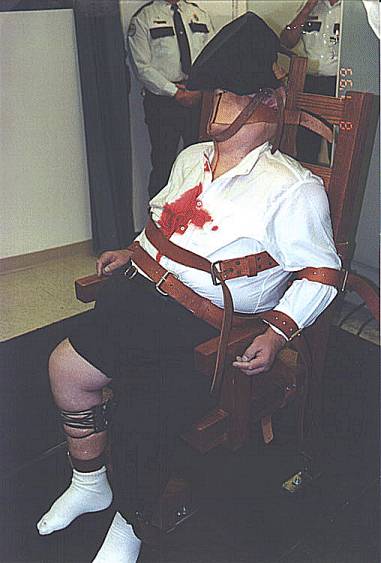
It was time for the unthinkable: Florida retired Old Sparky and built a new chair … and supersized it. (Image, from the Florida Department of Corrections)

And it worked, in that it killed Tiny. But what a mess — especially when an ensuing Florida Supreme Court opinion once again upheld the constitutionality of electrocution, and a dissenting judge attached the photos on this page to his opinions. Naturally, they became a grisly Internet sensation.

Old Sparky’s custom-built successor would only manage this single execution before Florida finally got on the lethal injection bandgurney.

Or at least, it’s only managed one so far. Old electric chairs don’t die, they just fade away … and in Florida, Tiny Davis’s chair remains available for condemned prisoners who choose it. Since this date in 1999, none have.

On this day..